Technical
Discussions
Havana, Cuba August 1960
CD12/DT/1 (Eng.) 12 July 1960
ORIGINAL: ENGLISH
TECHNICAL, ADMINISTRATIVE, LEGAL, AND FINANCIAL ASPECTS OF GARBAGE AND REFUSE EISPOSAL
by
William A. Xanten* Sanitary Engineer, Superintendent Division of Sanitation, Washington, D. C. Abraham Michaels*
Streets and Chief,
Sanitary Engineer, Deputy Commisioner of Bureau of Sanitation, Philadelphia, Pa.
CONTENTS
Page
I INTRODUCTION 1
II THE PROBLEM 2
III TECHNICAL CONSIDERATIONS 4
1. Climate and Physical Characteristics 4 2. Retail Markets - Public and Private 6 3. Refuse Storage and Frequency of Collection 6
4. Special Economic Factors 7
IV ADMINISTRATIVE, FINANCIAL AND LEGAL SITUATION 10 1. Relationship of Water and Sewer Service
to Refuse 13
2. Administration, Organization, and Operation
of Services 14
V EVALUATION OF PRESENT PRACTICES 17
VI RECOMIENDATIONS 18
VII ACKNWLEDGEMENTS 22
CD12/DT/1 (Eng.)
INTRODUCTION
In the consideration of garbage and refuse disposal practices of any area, it is necessary to emphasize the profound relationship of water supply and sewage and excreta disposal facilities to the general pattern of good public hygiene. This is immediately apparent in any discussion of the over-all environmental sanitation Droblems associated with garbage and refuse in the Middle and South American countries and frequent reference will be made in this paper to the inter-relationships of these three environmental factors.
It is also necessary to emphasize that in speaking of garbage and refuse disposal, there must be included not only matters of final disposal but also practices involved in the fields of refuse storage, collection, and street cleaning, with all the incidental services included among which are: mobile water supply, public markets, dead animals, promiscuous dumping, etc.
Because of differences in administrative, legal and fiscal situations encountered from country to country in the field of refuse and street
CD:L2/DT/1 (Eng.) Page 2
with an attempt to concentrate on subjects having universal application in the operational and technical field, and, of even mare importance, to strive for general acceptance and implementation of uniform policies and procedures that will surely tend to place these vital health activities on a higher plane, professionally, financially, and administratively.
THE PROBLEM
The environmental sanitation of any community depends primarily upon three major functions of Sanitary Engineering, namely, water supply and distribution, sewage disposal, and the prompt removal and disposal of the daily accumulations of solid wastes, including garbage and other mis-cellaneous refuse. While a priority can be easily established with respect to the relative importance of each of these functions (and it is incontro-vertible that without water there can hardly be any life itself), all of them are essential to proper environmental sanitation. Recognizing that there can hardly be any cleanliness without water, it is certain that its availability does not of itself guarantee clean living. Nor does the col-lection and proper disposal of human excreta complete the cycle for healthful and hygienic environment. Under modern conditions of urban development, only where all three activities are dealt with in a satisfactory manner can one say that the community has fully met its fundamental environmental sanitary obligations.
In a recent PAHO report (April, 1960)* the following quotation is of especial significance:
CD12/DT/1 (Eng.) Page 3
"In many countries and other areas of the Americas the major causes of death are those related to environmental factors. In seven countries the leading cause of death was the group entitled "gastritis, enteritis, etc.," which includes the diarrheal diseases for which the etiologic agents are either not known or not stated. Diarrheal diseases are important causes of death in infancy and early childhood. ***-******
********H**H * In the countries of Middle America the rates are very high as well as in several countries of South America. In two countries the death rates exceeded 1,000 per 100,000 population, which means that more than 1 out of each 100 children under 5 years of age die each year from diarrheal disease. These high rates are over 60 times the comparable death rate for the United States."
In large cities, particularly, the daily production of solid wastes invariably represents a bulk handling problem of great magnitude. Length of haul for collection vehicles is therefore a matter of prime economic
importance. As cities expand in population and area, available dumping sites are usually difficult to establish within reasonable distance from the
central core, and in fact are generally located at or outside the perimeter of the more densely populated areas. Such conditions invariably Justify
careful engineering studies to determine the economic advisability of establishing plants at strategic locations within the city for the purpose of reducing materially (particularly in the case of combustibles) the quantities to be disposed of finally by landfilling. Such plants should, of course, be capable of dealing with combustible yard refuse, street
CD12/DT/1 (Eng.) Page 4
In planning future sewage systems, and to the extent that present systems can absorb the load, the introduction of putrescible wastes
(i.e. garbage) into sewers after grinding should be considered as an ideal sanitary method for the handling of this type of solid waste. A partial utilization of this method to deal with special conditions at markets, res-taurants, etc. is obviously of great benefit to on-site sanitation at such places. An additional noteworthy on-site disposal method of dealing with the problem of combustible wastes particularly is the utilization under proper regulatory controls of commercial and industrial incinerators.
In the final analysis, the best and most efficient and sanitary systems of refuse collection and disposal and street cleaning require a reasonable amount of cooperation and an acceptance of basic responsibilities on the part of the citizens of the local community. It has been said that a city
is only as clean as its people wish it to be. Improper storage practices, promiscuous dumping, littering of public and private space, and general
indifference to matters related to cleanliness and good personal hygiene, are all factors which considerably influence the ability of a community to solve the problem.
TECHNICAL CONSIDERATIONS 1. Climate and Physical Characteristics
It is well-known, of course, that special conditions related to climate and topography exist in many large cities of Central and South America. The vital relationship of such conditions to environmental sanitation and their
CD12/DT/1 (Eng.) Page 5
In cities lying near the equator particularly, it is, of course, worth noting that temperature conditions create fly and insect breeding
problems of unusual proportions, and that the efficiency and extent of the refuse collection and disposal services rendered are of vital significance in any eradication program.
It was somewhat surprizing to find, by comparison with conditions in more temperate climates, the absence of any serious rat harborage problems, and in fact a relatively small population of rodents generally. Landfill infestations were reported to be of minor consequence, which might be ac-counted for to some extent by the scavenging activities of flocks of buzzards which were invariably present in large numbers on all refuse dumps.
The influence of the "rainy season" in these areas cannot be overlooked. During such periods usually 4 5 months duration, from June to October -heavy downpours tend to scour out previously contaminated rivers, streams, and small water courses; much debris is washed down from mountain sides and
subsequently cleaned up, and the refuse itself reportedly becomes moisture-laden at times to the point of being quite a different material to handle
for both collection and disposal.
Extremely rugged topography in many cities also heavily influenced and complicated the extension of fundamental and essential sanitary services of water, sewage and refuse collection, particularly in the face of the tendency of so many families to insist upon a questionable privilege of erecting their own shelters (apparently in most cases without regard to building codes) and literally clinging to the sides of hopelessly
CD12/DT/1 (Eng.) Page 6
in considerations unrelated to topographical conditions, and much concern was indicated regarding the need for some long-range approach based on socialogical and economic programs, as well as by the imposition of dis-ciplines, governmentally enforced. In densely populated urban areas in particular it is not seen how the latter approach can be avoided in the interest of the general public health of the community.
2. Retail Markets - Public and Private
In most cities food markets were a continuing problem for the cleansing agency due to the large quantities of putrescible wastes generated. While some progress in some cases had been made by the installation of new
markets, unfortunately the on-site provisions made for dealing with this special problem of refuse were generally inadequate. In addition to the permanent markets, there existed a number of roving open-stand push-cart type groups utilizing sidewalk and curb areas to sell their wares, and moving from day to day to different locations. In Slo Paulo, for instance, it -was reported the street cleaning agency had to give special service to over 300 different locations weekly.
3. Refuse Storage and Frequency of Collection
CD12/DT/1 (Eng.) Page 7
Any reduction of service frequencies to householders would, of course, in these climates, require rigid enforcement of regulations relating to covered storage containers. The inaccessibility of some areas to trucks, further complicates the problem. This, to a degree, is overcome by the use of mule-drawn vehicles. Special efforts were being made to deal with
this problem in most cities, although, the lack of public cooperation, and the rather general neglect of police enforcement of minor ordinances re-lated to litter, etc. was immediately apparent, and serve to place severe requirements on the public cleaning services for manpower and equipment to keep abreast of the load. Difficult access to long-haul dumping areas over rough roads as well as a dearth of skilled mechanics and part pro-curement problems, all serve to make this a problem of special significance. Efforts to improve facilities for equipment maintenance were generally in evidence, and in some cases the operating fleet was being given quite com-petent attention despite the severe service requirements.
4.
Special Economic FactorsIt is a fundamental fact that local conditions in this sphere play a most important role in determining the methods and techniques utilized in providing the services of refuse collection and disposal and street cleaning.
CD12/DT/1 (Eng.) Page 8
housekeeper, who put aside such items for the periodic visits of the buyers (in most cases push-cart operators), and this was followed generally by further salvaging of the balances of such items not so conserved at the household, by the collectors of refuse and the persons permitted to salvage on landfills. This practically standard practice so influenced the quality and quantity of refuse to be collected and disposed of that it would be more accurate to define the general problem as one more nearly connected with the disposal of organic wastes only
(i.e., garbage).
Exceptions to the above practices were found in some areas, where markets for such salvageable items were scarce, and in a number of cases it was noted that efforts to salvage on landfills constituted such an
interference with operations that the practice was prohibited. On the basis of observations, and applying such data as was available the unit weight of refuse being handled varied from approx. 600 to 900 lbs./cu.yd.
and the B.T.U. value from about 2500 to 4000 B.T.U./lb. In general, these values were found to be more affected by salvage in Central America than
in South America and Cuba, where in some instances commercial wastes particularly were more combustible, lighter in weight, and on the higher
side in B.T.U. content.
A physical analysis, by weight, of the refuse of Havana, Cuba, was reported as follows:
THE REFUSE OF HAVANA (ANALYSIS)
(Cardboard 4.10%)
Paper (Craft
4.35%)
17.00%(Newspapers 8.00%)
CD12/DT/1 (Eng.) Page 9
(Containers, 25-300 cm3 150,000 units-0.90%)
Glass (Containers, 300 cm3 or over 80,000 units-l.30%)
(Containers and other useless glass -0.80%) Leather: . . . .. ...
Bones: . . . . . . . .
Combustible (wood, sawdust, etc.e). ..
(Cast . . . . Iron (Wrought . . . .
(With steel o . . ...
(With tin a . ... *
* * * * . . * * . * * . .
* * . * * * . * . * . . * a
· 0.5%)
0.o6%)
. . o . .. .. * 01%)*3.8%)
White rags . . . .. . ..* . * .. . .. * * .
Colored rags. . . . ... .
Organic material (vegetable and animal) . . . .... Metals (cooper, zinc, etc.) . . ... * .* .. * * . . ·. ...
Rubble (bricks, etc.) o . ·e· . o * *. *. .e .. e * *
Miscellaneous (films, plastics, etc.) . .... .O * .. . e
Humidity. . . .. . . .. .. . . . .
9
0
0
0
0
Composting
Almost without exception was considered of great economic importance as a means of conservation and potential source of revenue, and it was apparent that in many instances the subject was so controversial, and so preoccupied the minds of public health and other officials, that it represented a distinct interference to final solutions involving other methods of disposal. Many responsible public officials expressed more than a passing interest in this method, and in fact, several compost plants were being planned or placed under
contract.
In the larger cities particularly, where critical landfill site con-ditions were the rule, and where haul to such fills were inordinately long, obviously prompt solutions will be required. Such solutions should be based upon careful engineering studies of the over-all long-range problem, without 3.00%
1.00%
1.50%
8.00%
5.00%
CD12/DT/1 (Eng.) Page 10
being influenced by pre-conceived notions that "industrialization" is a panacea that can be applied uniformly to all situations. Nothing could be further from the truth; and this should be obvious based upon existing practices and experience not only in Latin America, but in other countries as well. This preoccupation with a questionable disposal method has resulted in numerous delays in the execution of good refuse disposal programs.
ADMINISTRATIVE, FINANCIAL AND LEGAL SITUATION
Recognizing the importance of political, legal and fiscal policies on a public service of this type, attempts were made to obtain information which described these policies and the relation of the intergovernmental structure
(city, state, nation)to these policies. The study revealed noticeable
uniformity in a number of these policies. In all but one city, for example, the lowest political entity, the city, is legally responsible for refuse col-lection, street cleaning, and refuse disposal. The exception is Havana, Cuba, where the National Ministry of Health is responsible for the performance of
these functions for the entire country. It was indicated, however, that the Health Ministry is considering the advisability of giving operational
respon-sibility to the cities.
In the matter of regulation promulgation, there is also a noticeable uniformity since this is generally the responsibility of a state or federal health agency. However, responsibility for enforcing regulations is usually vested in either the health, police, or cleansing agency, or a combination of these.
CD12/DT/1 (Eng.) Page 11
few cities which enjoy considerable autonomy, legal and fiscal problems were found to be considerably less complicated. The municipality could budget and regulate as it saw fit. In one case, the cleansing department
was empowered to enforce regulations.
The methods of obtaining funds for the solid waste sanitation operation do vary. Some cities apply a service charge or tax for this service. Others use general tax revenues. In all but two relatively autonomous cities there is an interchange of funds between the city and state or Federal government. Generally the federal or state government contributes a considerable amount
to the municipal government and is responsible for approval of the municipal budget. This relationship enables the higher government to exercise
consider-able control over municipal operations. However, regardless of the source or budgetary control, in all instances most of the funds used for refuse collec-tion come from the Municipal General Fund.
To some extent legal and fiscal information was obtained in the related sanitation fields, water and sewage. It is very interesting to note that in both of these fields there is a decided trend towards federal, state, or authority type operations with service charges being used to pay for either the operation or the total cost including capital investment financing.
There is some peculiar manipulation of funds, such as a small quantity of Public Health funds being used in one city to help clean up promiscuous dumping, but these pecularities are not significant.
CD12/DT/l (Eng.) Page 12
In general, legal, political, and fiscal responsibility was rather clearly defined in all cities surveyed (except Rio de Janeiro which was undergoing a major governmental change at the time of the survey), but,
except for Venezuela, it was unfortunately apparent that a "second class" status was accorded the solid waste sanitation functions.
Although in virtually all instances the individuals responsible for operation of the refuse and street cleaning functions were extremely com-petent, they lacked adequate, trained, professional assistance, thereby tremendously hampering their operations. To further hinder this function, it was found that many important decisions concerning refuse were made by legislative and administrative personnel without consulting with the chief of the refuse service. One outstanding example of this poor approach occurred quite recently in a major city. The legislative body passed a municipal ordinance designating that all future refuse disposal plants were to be "industrialization" or "composting" plants. This decision had been reached without any of the legislators bothering to examine the cur-rently used methods or seeing advice from the chief of the operation. The chief, who was impressive as being quite expert in the field of solid
waste sanitation, was firmly convinced that "industrialization" or "compost-ing" is a method of disposal ill-suited for the needs of his city. A
CD12/DT/1 (Eng.) Page 13
of the sanitation experts. Again, their experts are opposed to this
plant. Although experimentation of this type may be desirable and healthy, it should be conducted under the direction and control of the agency res-ponsible for the refuse function.
1, Relationship of Water and Sewer Service to Refuse
Due to explosive growth in urban population and area expansion a number of cities visited were in the business of furnishing water to
suburban sections by truck haul to tanks located around the perimeter of the City. Again, in the case of Sto Paulo some 500 tanks were being so serviced.
In many instances the maintenance of storm water drainage and the control of weed growth along unimproved roadways was a function of some magnitude for street cleaning forces.
Although generally solid waste sanitation was found relegated to a position of secondary importance, it was gratifying to find that water treat-ment and distribution and sewage collection and disposal were in the forefront among the important public services. Most of the cities visited have extensive water and sewer programs nQw under way. And, in most instances, responsibility for administering these programs rests with either a state or federal agency, or an authority. A strong tendency was in evidence to pay for part or all of the water and/or sewer service from direct use or service charges. And we also learned that many of the programs were recently inaugurated.
CD12/DT/l (Eng.) Page 14
by the Division de Malariologia, Direcci6n de Salud P6blica, Ministerio de Sanidad y Asistencia Social to determine the effect of proper refuse collection and disposal on fly breeding and, consequently, on health. These studies have been prepared in report form and substantiate the importance of a proper refuse service on public health. The studies strongly emphasize the fact that proper refuse collection and disposal should be recognized as a service seriously affecting the health of the community and tends to justify the belief that it should be treated with the respect accorded water and sewage. 2. Administration, Organization, and Operation of Services
Attempts were made to obtain statistical data from all of the cities
visited and this information is appended hereto and forms a part of this report. The data reveals that most of the cities visited were large metropolitan centers of considerable area and population. Furthermore, it is significant to note that the organizations involved in refuse work were, as usual, found to employ large forces of manpower and equipment, resulting in relatively large expenditures of public funds.
The survey revealed a general soundness of organization of sanitation agencies. With respect to its position in the municipal organization, in large cities the sanitation service was generally performed by a bureau or division of a major health or public works department, and in smaller cities by an agency directly responsible to the major or public works director. Exceptions existed in San Salvador which contracted for collection and disposal of refuse; in several Venezuelan cities which contracted with the Federal Public Health Department for complete refuse service, and in Cuba where the Federal Ministry of Health is responsible for refuse service for all communities.
CD12/DT/1 (Eng.) Page 15
services. The organization was usually divided into districts based upon the population and area served, and each district was laid out into routes for the collection and street cleaning functions. In some cities sanitation vehicles were properly housed at the various district headquarters, whereas in a few of the others all vehicles were garaged at a single headquarters which resulted in considerable lost time and transportation expense for
vehicle movement. In some cases over-centralization of equipment repair facilities was a significant hindrance to vehicle availability, and in one instance accounted for an average of 19 vehicles out of 48 being out of service.
One of the major problems in most cities appeared to be the lack of adequate staff personnel. This produced a detrimental effect on overall planning, particularly as it concerns the need for and location of refuse
disposal facilities, This was further complicated by the lack of knowl-edge on the part of responsible officials where to seek for expert advice in planning and developing refuse programs.
A properly planned refuse program is based upon the premise that the refuse agency is obligated to clean streets and collect and dispose of refuse in a sanitary, efficient manner consistent with the size and physical
CD12/DT/1 (Eng.) Page 16
present and future operations. This situation is completely inexcusable in view of the relationship between the costs of refuse collection and disposal. It is recognized that sanitary refuse disposal costs vary from 5% to 25% of the total cost of collection and disposal, and that often
overall costs can be reduced by strategically locating disposal plants near refuse collection centers. However, despite the economics, some cities hauled refuse for distances in excess of 25 kilometers one way.
The survey revealed a marked hesitancy on the part of municipal officials to seek technical advice in the field of street sanitation. There is a popular misconception throughout the world that this service
can be performed by any intelligent person. Actually, there are only a handfull of consulting engineers who are well versed in this field, but it is often desirable to call upon these consultants for advice. One municipal engineer advised us that he studied the refuse disposal problem
for years before deciding how to proceed. Based upon the results of his studies, it would appear that he not only spent excessive time on the study, but he came up with an answer of questionable value.
The survey revealed some unusual personnel practices. Generally, salaries for street cleaners and refuse service employees were extremely low. However, administrative ingenuity, which provided such fringe bene-fits as premedical and dental care, food commissaries, free haircuts and shoe repair service, and the privilege to salvage during refuse collections, helped to partially offset low salaries.
CD12/DT/1 (Eng.) Page 17
were aggravated by the usual governmental purchasing practices which, in some instances, resulted in vehicles of many different manufacture being used by the refuse agency. A poor practice, that of one agency designing a facility for the sanitation agency without consultation, resulted in a poor garage layout which would result in considerable lost time in daily operations.
There was one administrative practice that presented extremes in effectiveness and that was record-keeping. In a number of cities most records were kept in the administrator's head, but in Rio de Janeiro, and in the cities served by the Venezuela Public Health Department it was amazing to note the extensiveness and completeness of the records. In both of the latter instances, the administrators produced any and all
records as requested, and an examination of the sources of information revealed their accuracy.
EVALUATION OF PRESENT PRACTICES
In the areas of administration and organization there appears to be a good understanding of refuse collection and street cleaning practices, but, with few exceptions, a dearth of records. Generally there is a marked
scarcity of trained personnel which results in many drawbacks as mentioned above. Present staff limitations no doubt are partially due to the
experi-CD12/DT/1 (Eng.) Page 18
enced, competent personnel are available on a staff, it is usually de-sirable for municipal officials to retain expert advice as needed for
particular problems if sanitary, efficient operations are to be maintained. Present collection and street cleaning operations are generally good, with a few exceptions, for the areas served. However, it appears that many hard to reach areas are ignored, despite the fact that these are the areas which have the greatest need for the cleansing service. With respect to refuse disposal, only one sanitary landfill and two small incinerators were seen that could be considered acceptable from a sanitation standpoint. These account for disposal of less than 5% of the refuse disposed of in the cities surveyed. Considering the relatively small cost of refuse disposal and recognizing the importance of proper disposal from a health standpoint, it is disgraceful that these conditions exist. It appears that expert advice would be helpful in refuse disposal.
Despite the many differences in fiscal policies that exist from city to city? it seems that this has little effect on the service performed. Al-though, many administrators did complain about lack of funds, the source of budgetary control responsibility was not significant. The one major con-trol factor that did affect service was local politics, and if the service could be removed from politics, similar to water and sewage in many cities, it would help tremendously in the solution of many administrative and
technical problems.
RECOMMENDATIONS
CD12/DT/1 (Eng.) Page 19
organizations in large communities, involve the utilization of substantial numbers of plants, buildings, garages, large quantities of mobile equip-ment of diverse types, and considerable manpower. Because of these factors, however, it is well-known that such agencies are universally subject to great political pressures and interference, and in many instances represent a catch-all for the employment of politically sponsored low-grade personnel. The allocation of sufficient funds for the various activities, and in partic-ular, commensurate compensation for staff employees, is complicated by the very mundane nature of the function.
On the other hand, efficient administrative and management techniques, as well as adequate engineering and mechanical staffs, are a primary requisite for good results. Until this is thoroughly understood and appreciated at all levels of Government very little progress can be made.
The following recommendations, in addition to representing topics for discussion, are directed primarily toward establishing broad avenues of approach that it is hoped will tend to strengthen and stimulate action in general along these lines:
CD12/DT/1 (Eng.) Page 20
"depth of staff", and the results achieved over a period of years were observed to be extremely gratifying.
IT IS RECOMMENDED, therefore, that similar programs on a National, State or Municipal level, geared to the existing local situation in other Latin American Countries, be considered for the purpose of im-proving the administrative and technical staffing of the organization performing the function of municipal refuse collection and disposal. (2) As indicated above, one of the primary elements for consideration would
appear to be the requirement for strengthening the administrative and staffing functions of the agencies engaged in these public services. This can hardly be accomplished under present inadequate salary schedules for top echelon personnel.
IT IS RECOMMENDED that serious consideration be given to two additional concurrent approaches to this problem:
(a) By recommending prompt consideration by all Federal, State and local Authorities to the need for commensurate salary schedules so as to induce more sanitary and public health engineers to undertake work involving the administration and operation of vital municipal sanitary engineering services. (While this has been done to some extent in Water and Sewer Services it is notably lacking in Refuse).
CD12/DT/1 (Eng.) Page 21
or even two years in either the administration and/or operation
of one of the three fundamental sanitary fields of Water Supply,
Sewage or Refuse Service. (This type of project must, of course,
be implemented by finding special means of compensating such
in-dividuals to justify their acceptance of such assignments).
(3) IT IS RECOMMENDED that the importance of obtaining competent, unmotivated,
and carefully selected consulting engineering services, in technical
matters related to refuse disposal particularly, be emphasized on every
possible occasion, and that the PAHO be prepared to assist comuni-ties in the screening and selection of qualified, competent consultants when the occasion arises.
(4) IT IS RECOMMENDED that, where feasible, the three basic Sanitary Engi-neering functions of Water, Sewage and Refuse be served by a single agency and financed by service charges. This type of autonomous and coordinated control would be particularly suitable for the planning, financing and execution of programs dealing with the overall environ-mental sanitation problems of the urban centers particularly.
CD12/DT/1 (Eng.) Page 22
IT IS THEREFORE RECOMMENDED that prompt action be taken to establish some such medium in Latin America and that such officials be encouraged to establish an organization for this purpose similar to those in Europe and North America.
(6) :IT IS RECOMMENDED that the PAHO sponsor and support a program de-signed to emphasize to some extent at least the administrative and
technical aspects of refuse collection and disposal and street cleaning, in the sanitary engineering and public health courses in Latin American Universities generally.
(7) IT IS RECOMMENDED that the PAHO investigate the possibilities of stimulating an increase in the quantity of literature on this subject
(both periodicals and texts) available in Spanish and Portuguese. It is realized that this must be done on a cooperative basis, and in a very selective manner, but the need was expressed and a substantial market exists.
ACKNOWLEDGEMENTS
Consultants Xanten and Michaels were, without a single exception, accorded extremely courteous and cordial treatment in every country visited. The arrange-ments made by PAHO Headquarters and the efficient handling of all details by the Zone Officials resulted in a smoothly functioning itinerary. Conferences and inspection programs were flawlessly planned and executed, and the National, State and Local officials in each city visited were both kindly and helpful.
While it is not practicable to attempt to list the great number of people to whom we are so deeply indebted, it is our hope that they will all believe that we are most appreciative, and that they will all be remembered with a great depth
CD12/DT/1 (Eng.) Page 23
BIBLIOGRAPHY GENERAL
-"Refuse Collection and Disposal for the Small Community"; A joint study report of U. S. Dept. of Health, Education and Welfare and the American Public Works Association.
"Street Cleaning Practice"; A text published in 1938 and revised in 1959 by the Street Sanitation Committee of the American Public Works Ass'n.
"Refuse Collection Practice"; A text published in 1941 and revised in 1958 by the Refuse Collection Committee of the American Public Works Ass'n.
"Municipal Refuse Disposal"; A text (scheduled for publication June, 1961) by the Refuse Disposal Committee of the American Public Works Ass'n.
SANITARY LANDFILLS
-"The Sanitary Landfill'; A Three-part Review of Design, Operational and Economic Criteria of the Sanitary Landfill Method of Refuse Disposal; Leo Weaver, American City Magazine, 1956, p.134, May 1956.
"Sanitary Landfill - An Economic Method of Refuse Disposal" - R. Eliasson; Conference on Incineration, Rubbish Disposal and Air Pollution, Southem Cali-fornia Air Pollution Foundation, Pasadena, CaliCali-fornia, Dec. 3, 1954.
CD12/DT/1 (Eng.) Page 24
"fteport on Investigation of the Leaching of Sanitary Landfill", California State Water Pollution Control Board Publication No. 10, Sacramento, Calif. August, 1954.
"An Analysis of the Problems of Sanitary Landfills in New York City", R. Fenton (a report) August 1947, City of New York, Department of Health.
"Problemasde Saneamiento" - "Lucha Contra Insectos", Por los Doctores Arturo L. Berti y Juan C. Gomez - and - "Modernos Insecticidas de Accion Rema!nente", Por los Doctores Berti, Arnoldo Gabaldon y Salvador J. Carrillo, Divisi6n de Malariologia, Ministry of Health, Venezuela.
"Effect of Earth Cover on Fly Emergence from Sanitary Landfill Operations", Williams, E. R., Mallison, G. F., and Maier, P. P., Public Works, Page 89,
February 1958. INCINERATION:
"Incineration and Alternative Refuse Disposal Processes", American Society of Civil Engineers, Proceedings, Volume 80, Separate Number 471, August 1954.
"Nkuisance-Free Operation",-William A. Xanten, ASCE Magazine "Civil Engineer-ing:, April 1956.
"DI)esign Considerations to Abate Air Pollution by Commercial and Industrial Incinerators", J. E. Brown, American Gas Association, April 1958.
"Heat Enclosure Methods", M. H. Detrick Co., 111 W. Washington Street, Chicago 2, Illinois.
CD12/DT/1 (Eng.) Page 25
"Modern Incineration Techniques in Switzerland", H. Walker, City Engineer,
Berne, 6th International Congress on Public Cleansing, October 18, 1957.
COMPOSTING
-"Modern Problems of Composting", Prof. Dr. O. Jaag, Zurich, 6th International
Congress on Public Cleansing, October 18, 1957.
"Composting", Harold B. Gotaas, World Health Organization, Mono. Ser. No. 31,
205 pp. 1956.
"Some Engineering Aspects of High-Rate Composting", John R. Snell, Vol. 83, SAI Proceedings Paper 1178, American Society of Civil Engineers.
GARBAGE GRINDING
-"An Evaluation of the Household Food Waste Disposer", Special Report No. 13, American Public Works Association, Chicago, Ill., 32 pages.
"On-Site Disposal of Solid Wastes", Cohn, M. M,, Public Works Engineers'
Technical
Discussions
Havana, Cuba August 1960
CD12/DT/1 (Eng.) ADDENDUM I Rev. 1
19 August 1960
ORIGINAL: ENGLISH-SPANISH
ADDENDUM
TECHNICAL, ADMINISTRATIVE, LEGAL, AND FINANCIAL ASPECTS OF GARBAGE AND REFUSE DISPOSAL
CD12/DT/l (Eng.) ADDENDUM I, Rev.l
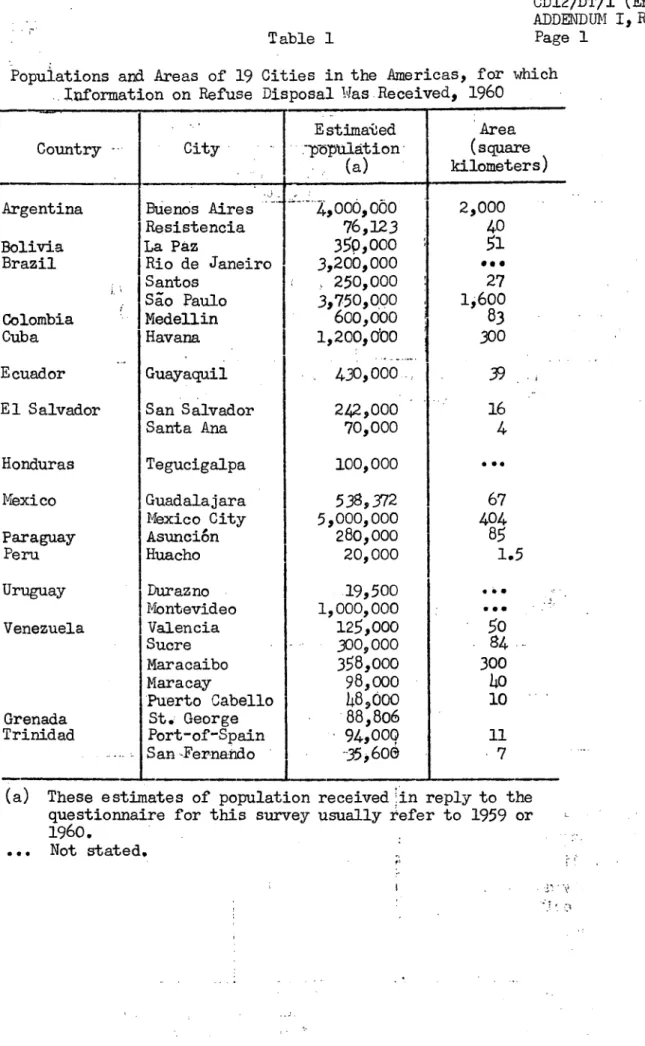
Table 1 Page 1
Populations and Areas of 19 Information on Refuse
Cities in the Americas, for which Disposal Was.Received, 1960
Estimaited Area
Country City :-.-population (square
- ...(a) kilometers) Argentina Bolivia Brazil Colombia Cuba Ecuador El Salvador Honduras Mexico Paraguay Peru Uruguay Venezuela Grenada Trinidad
Buenos Aires IResistencia
La Paz
Rio de Janeiro Santos
Sao Paulo Medellin Havana Guayaquil San Salvador Santa Ana Tegucigalpa Guadalajara Mexico City Asunci6n Huacho Durazno Montevideo IValencia Sucre Maracaibo Maracay
Puerto Cabello St. George Port-of-Spain San -Fernando 4-"':",000,000 76,123 350,000 3,200,000 250,000 3,750,000 600,000 1,200,0'00 430,000 242,000 70,000 100,000 538,372 5,000,000 280,000 20,000 19,500 1,000,000 125,000 3009 000 358,oo000 98,000 48,000 88,8o6 94,00O -:35,606 2,000 40
51
l.. 27 1,600 83 300 39 16 4 * .. 67 404 85 1.5 * . **-5084 -300
40
10
11 .7 (a) These estimates of population
questionnaire for this survey 1960.
... Not stated.
CD12/AT/1 (Eng., ADDENDUM I, Rev.
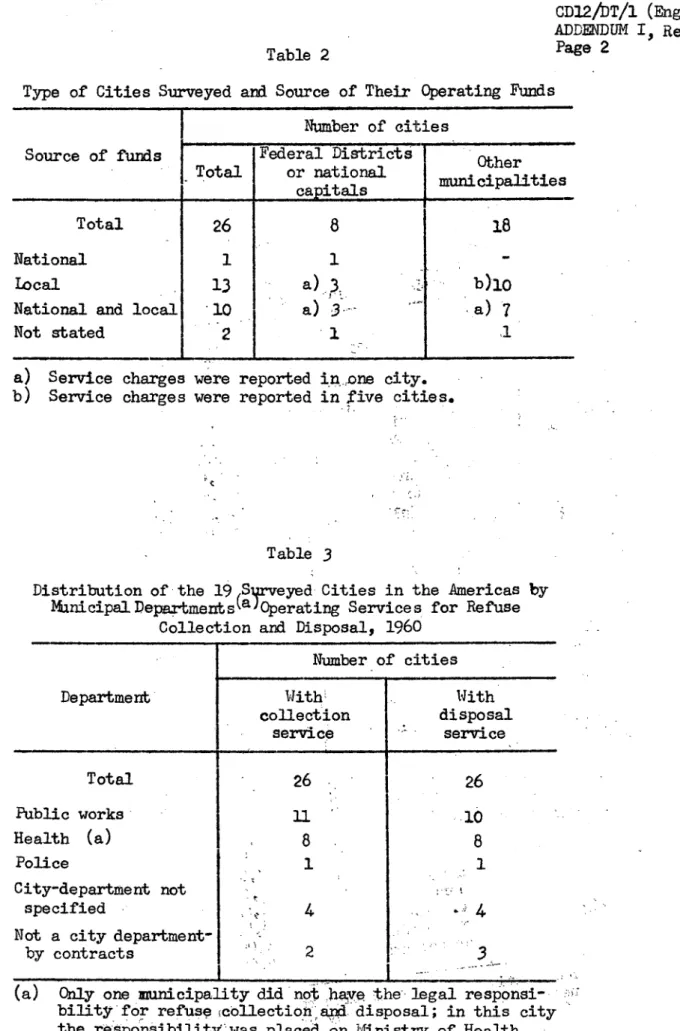
Table 2 Page 2
Type of Cities Surveyed and Source of Their Operating Funds Number of cities
Source of funds Federal Districts ther Total or national
municipalities
capitals
Total 26 8 18
National 1 1
Local 13 a) 3. b)10
National and local 1.0 a) 3-- a) 7
Not stated 2 1 1
Service charges Service charges
were reported int one city. were reported in five cities.
Table 3
Distribution of the 19 ,Surveyed Cities in the Americas by Municipal DepartmentskaJOperating Services for Refuse
Collection and Disposal, 1960
Department Total Public works, Health Police (a) City-department not specified
Not a city department-by contracts
Number of cities Withi collection service 26 11 8 1 4 2 a) b) With disposal ·- - service
-- --- --~~~~~~~~~~~~~~~~~~~4
26 ·10 8 1 4 3
I A
(a) Only one municipality did not have the- legal responsi
-bility for refuse icollectiqon and4 disposal; in this city the responsibility was placed on Ministry of Health.
--
--.'.
CD12/DT/1 (Eng.) ADDENDUM I, Rev.1
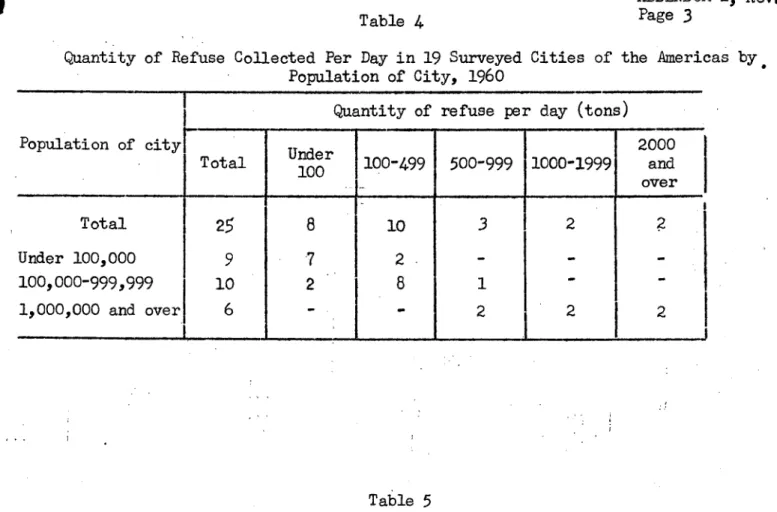
Table 4 Page 3
Quantity of Refuse Collected Per Day in 19 Surveyed Cities of the Americas by. Population of City, 1960
Quantity of refuse per day (tons)
Population of city 2000
Under
Total 100-499 500-999 1000-1999 and over
Total 25 8 10 3 2 2
Under 100,000 9 7 2 - -
-100,000-999,999 10 2 8 ' 1 '
1,000,000 and over 6 - - 2 2 2
,~~~~~~ ' 1, 2 2
Table 5
Nineteen Surveyed Cities in the Americas Distributed by Quantity of Refuse Collected Per Day and Major i'ethods of Disposal
&ua of
}
en Dumi lcoinerQuantity dof y Open Dumping Compost ncinerIncinera Inciner Sanitary refuse per day Total er plant tor and tor tor and landfill
(tons)
j
l open dump only landfillTotal 25 8 3 2 1 1 1 3
Under 100 9 51 1 - -
1
2100-499 10 2 2 1 5
500-999 3 2 - - - 1 -
-1000-1999 2 - -- - - 1 1
CD12/DT/1 (Eng.) ADDENDUM , Rev Page 4
Table 6
Total Cests and Per Capita Costs of Services for Refuse Collection and' Disposal in 19 Cities of the Americas for a Recent Year
I
Total (U.S. dollar:s)- Per capita (U.S. dollars-) Country
and... opulation .treet Street
city
J
Collection Disposal Colleti isposalleaniArgentina Buenos Aires Resistencia Bolivia-La Paz
Brazil
Rio de Janeiro Santos
Sao Paulo. Colembia-Medellin Cuba
i Havana Ecuador Guayaquil El Salvador San Satvador' Santa Ana Hondur'as Tegucigalpa Mexico Guadalajara Mexico ' 'City Paraguay-Asunci6n Peru . Huacho Uruguay Durazno Montevideo Venezuela-4iiaracaibi Suore Maracay
Puerto Cabello Valencia Grenada St. George Trinidad Port-of-Spain(a) San Fernando (a) Includes
s-- None
... Not stated
4,000,000 76,123 350,000 ?inonnnrn 31 1J 5, 250,000 ,750, 000 600,000 ,200, 000 430,000 242:,000 70,000 100,000 538,372 ,000,000'm 280,000 20,000 19,500 1,000,000
1 358,ooo
230,000 98,oo000 48,oo00o 125,000 88,806 94,o000o 35,600
$ 968,500
.7,
477,500
$ 1,8E
57
.f.
.
$966,500,
*5*S.'
83,700 73,900
1.e l
r· -ti
$1,717,400
* 0* a Sa
$ 2,941, 200
367,000
152,810 a) 33,364
..
* .S
13,200 784,000 823,000 843,ooo 180,000 88,400 239,000 15,600 280,000 147,000 treet cleaning.
l1,o700 2,
..
1
000,000: 80,000 5.. 483, 000 72,500 41,700 20,700 9,870 13,800 22,300 7,700 I I ________' 76,512
*..
s. *
(16% of
* * 0
0 #
$ 0.24
014
$ 0.59 2.29
· ·
$ 0.24
...· .
*6. .
. I.
$ 0.43
. .
$ 2.45
a area '... 194,000 99,700 ! 0.85 0.63 0.48 ' . a and 3C
0.66 0.78 2.30 3Q67 1.84 1;o84 1e91 0.18 2.98 4.13 0.26
*0 .
% pop.)
0.48 0.20 0,18 0.21 0.21 0.11 0.24 0.22 0.32 . . . . ,
*e *
*e.
2.06 2.80
. ._ I I
CD12/DT/1 (Eng.) ADDENDUM I, Rev.1
Page 5
Table 7
Haulage Distance to Refuse Disposal Points in 5 Cities in the Americas, 1960
Distance Country City in kilometers
Brazil Rio de Janeiro 25
Santos 11
Sao Paulo 13
Cuba Havana 15
CD12/DT/1 (Eng.) ADDENDUM I , Rev.l_
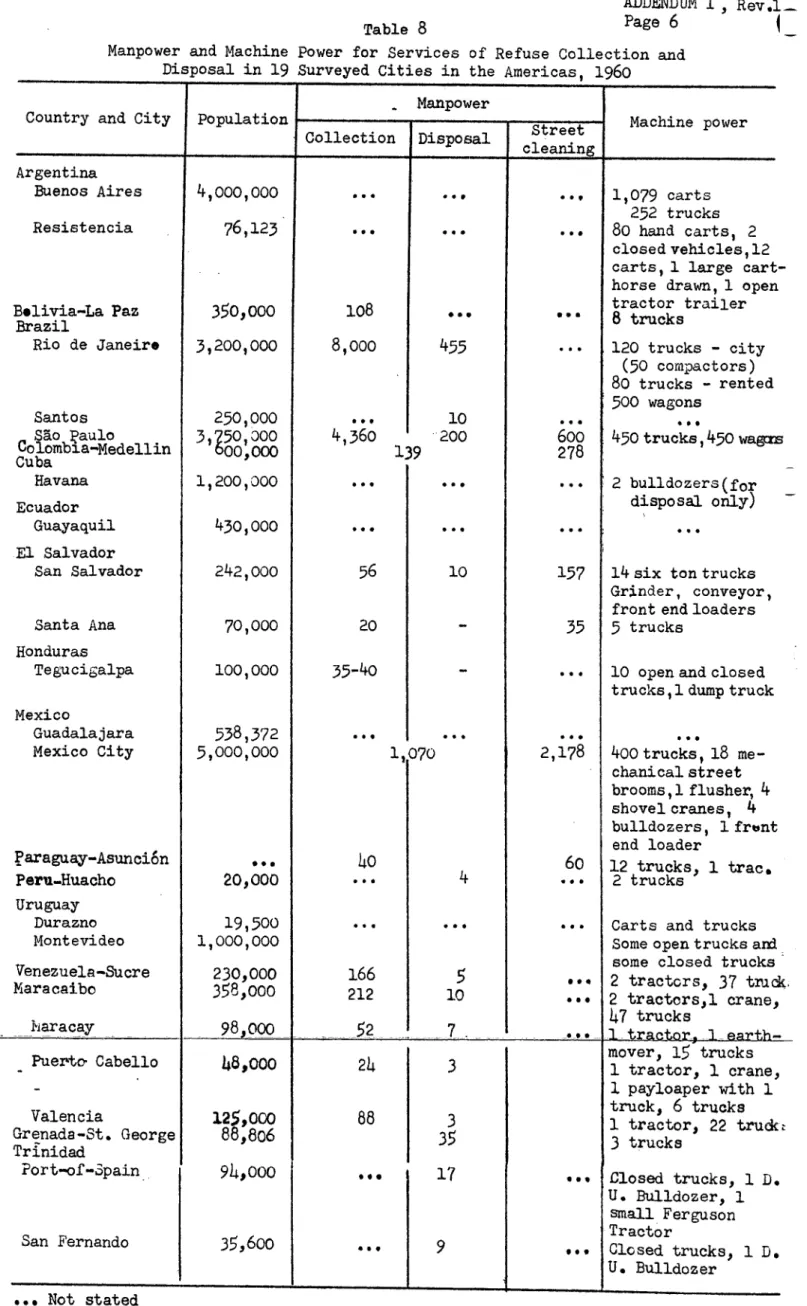
Table 8 Page 6
Manpower and Machine Power for Services of Refuse Collection and Disposal in 19 Surveyed Cities in the Americas, 1960
Manpower Collection Disposal
cleaning Argentina
Buenos Aires Resistencia
Belivia-La Paz Brazil
Rio de Janeire
Santos Slo paulo
Colombla-Medellin Cuba Havana Ecuador Guayaquil El Salvador
San Salvador
Santa Ana Honduras
Tegucigalpa Mexico
Guadalajara Mexico City
Paraguay-Asunci6n Peru-Huacho Uruguay Durazno Montevideo Venezuela-Sucre Maracaibo haracay
Puerto Cabello
Valencia Grenada-St. George Trinidad Port-of-Spain San Fernando 4,000,000 76,123 350,000 3,200,000 250,000 3,Z50,000 1,200,000 430,000 242,000 70,000 100,000 538,372 5,000,000 $@1 20,000 19,500 1,000,000 230,000
358,ooo
98,000 48,oo000 125,000 88,806 94,000 35,600 108 8,000 0le 4,360 56 20 35-40 139 l,o40
166 212 24 88 *00 . *e 0* 455 10 -200 10 .070 45
10 73
3
35 17 9 .* * I 600278 278 157 35 2,178 60 0i* *0 .001,079 carts 252 trucks 80 hand carts, 2 closed vehicles,12 carts, 1 large cart-horse drawn, 1 open tractor trailer 8 trucks
120 trucks - city (50 compactors) 80 trucks - rented 500 wagons
450 trucks, 450 wag=s 2 bulldozers(for
disposal only)
14 six ton trucks Grinder, conveyor, front end loaders 5 trucks
10 open and closed trucks,1 dump truck
400 trucks, 18 me-chanical street brooms,1 flusher, 4 shovel cranes, 4 bulldozers, 1 front end loader
12 trucks, 1 trac. 2 trucks
Carts and trucks Some open trucks and some closed trucks 2 tractors, 37 triuck 2 tractcrs,l crane, 47 trucks
1 tractor_ 1 v-+.h-mover, 15 trucks
1 tractor, 1 crane, 1 payloaper with 1 truck, 6 trucks 1 tractor, 22 trud~c
3 trucks
Closed trucks, 1 D. U. Bulldozer, 1 small Ferguson Tractor
Closed trucks, 1 D. U. Bulldozer
__%~~~~~~~ . I .
... Not stated
-= , * = =~~~~. .
_ _
--. --. --.