ferns on
Alsophila
setosa
Kaulf. (Cyatheaceae)
caudices in Rio Grande do Sul, Brazil
Schmitt, JL.
a,b* and Windisch, PG.
aaPrograma de Pós-Graduação em Botânica, Universidade Federal do Rio Grande do Sul – UFRGS, Av. Bento Gonçalves, 9500, CEP 91501-970, Porto Alegre, RS, Brazil
bPrograma de Pós-Graduação em Qualidade Ambiental, Universidade Feevale, RS-239 2755, CEP 93352-000, Novo Hamburgo, RS, Brazil
*e-mail: [email protected]
Received March 11, 2009 – Accepted July 16, 2009 – Distributed August 31, 2010 (With 2 figures)
Abstract
The extractive exploitation of the tree fern Alsophilasetosa Kaulf. alters forest formations and diminishes the availability of micro-habitat for epiphytes. A survey of epiphytic fern communities on A. setosa at 16 study sites in different forest formations in the State of Rio Grande do Sul, Brazil, documented the occurrence of 31 species representing 16 genera and six families. The greatest richness of species occurred in Polypodiaceae (39%) and in the genus Asplenium L. (22%). Habitual holoepiphyte was the predominant ecological category, representing 61% of the species. Similarity analysis demonstrated heterogeneity in the composition of the epiphytic ferns at the study sites and indicated that the vegetation type is not the main factor for floristic difference. The lowest total specific richness (5) was recorded for the seasonal deciduous forest site. The majority of the sites presented similar averages of phorophyte height and epiphyte richness per caudex. In 25% of the sites the height of the host plants presented significant correlation with specific richness. Considering that the majority of the epiphytes are habitual and that some of them occur exclusively or preferentially on tree ferns, the maintenance of these host plants in the vegetation is essential for the conservation of epiphytic species.
Keywords: composition, species richness, epiphytism, tree fern, conservation.
Biodiversidade e distribuição espacial de filicíneas epifíticas sobre cáudices
de
Alsophila setosa
Kaulf. (Cyatheaceae) no Rio Grande do Sul, Brasil
Resumo
A exploração extrativista da samambaia arborescente Alsophila setosa Kaulf. altera as formações florestais e diminui a disponibilidade de microhabitats para epífitos. Um levantamento das comunidades de filicíneas epifíticas sobre A. setosa
em 16 sítios de diferentes formações florestais, no Estado do Rio Grande do Sul, Brasil, documentou a ocorrência de 31 espécies representando 16 gêneros e seis famílias. A maior riqueza de espécies ocorreu em Polypodiaceae (39%) e no gênero Asplenium L. (22%). A categoria ecológica predominante foi a de holoepífito habitual, representando 61% das espécies. A análise de similaridade evidenciou heterogeneidade na composição de filicíneas epifíticas dos sítios estudados e indicou que o tipo vegetacional não é o principal fator de diferenciação florística. A menor riqueza específica total (5) foi registrada em sítio de floresta estacional decidual. A maioria dos sítios apresentou médias similares de altura dos forófitos e de riqueza de epífitos por cáudice. Em 25% dos sítios, a altura das plantas hospedeiras apresentou correlação significativa com riqueza específica. Considerando que a maioria dos epífitos é habitual e que alguns deles ocorrem exclusivamente ou preferencialmente sobre samambaias arborescentes, a manutenção dessas plantas hospedeiras, na vegetação, é essencial para a conservação de espécies epifíticas.
Palavras-chave: composição, riqueza de espécies, epifitismo, samambaia arborescente, conservação.
1. Introduction
Epiphytes constitute an important, yet little known, component of the biodiversity of tropical forests (Mucunguzi, 2007). Ferns compose a group of plants worthy of attention in the epiphytic environment, considering that about 2,600 species around the world are epiphytic (Kress, 1986). Among adaptive strategies that favour epiphytism in those plants, which can operate in several combinations, are: low light saturation point; poikilohydry; frond trichomes;
wind dispersal of spores; high tolerance for instability of substrate nutrients (Müller et al., 1981; Benzing, 1987, 1990; Page, 2002); fine to filiform, long and ramified rhizome, besides reduced radicular system and small fronds (Dubuisson et al., 2003).
and angiosperms), some of them growing exclusively or preferentially on this substratum (Sehnem, 1977; Cortez, 2001; Windisch, 2002; Moran et al., 2003; Roberts et al., 2005; Schmitt and Windisch, 2005 ). However, tree ferns are subject to commercial exploitation, decreasing the availability of microhabitats for epiphytic species.
Among the tree ferns used for decoration and landscape gardening in the State of Rio Grande do Sul, Brazil,
Alsophilasetosa is currently being extracted from primary and secondary forests (Windisch, 2002). Populations are also being reduced by deforestation for lumbering and for the use of land for grazing or agriculture (Schmitt and Windisch, 2005). The plants grow up to ca. 10 m tall (Schmitt and Windisch, 2005) have a caudex with scars (from fallen fronds) on the basal portion and remains of stipe bases (with blackish spines) on the distal part. The growth of the plants seems to be limited by the forest canopy. In adult plants, the crown is up to 3 m long and has fronds with tripinnate-pinnatisect laminae (Schmitt and Windisch, 2006).
The study of plant communities is essentially comparative and the physiognomy of a vegetation stand is the result of its composition in terms of plant species or types (Focht and Pillar, 2003). The richness and composition of the epiphytic flora is influenced by the phorophyte (Heatwole, 1993; Medeiros et al., 1993; Benzing, 1995; Rudolph et al., 1998; Nieder et al., 1999; Roberts et al., 2005; Schmitt et al., 2005; Fraga et al., 2008), as well as by the vegetation and climate within the forest (Gentry and Dodson, 1987; Nieder et al., 1997). Alsophilasetosa
grows in pioneer formations, dense humid forests, mixed humid forests with Araucariaangustifolia, seasonal semideciduous forests and seasonal deciduous forests in South and Southeastern Brazil, between 20 and 1,800 m elevation. This study analyses the species richness and floristic composition of epiphytic ferns on A. setosa in different types of vegetation in the State of Rio Grande do Sul (Southern Brazil); the similarity of these epiphytic communities among different sites; the influence of caudex height on species richness and compares the species richness among distinct sites.
2. Material and Methods
2.1. Study area
Floristic data of Alsophilasetosa epiphytes were obtained from 16 sites (Figure 1) in the State of Rio Grande do Sul (Southern Brazil) as listed in Table 1. The climate is humid-temperate, with rainfall throughout the year (Moreno, 1961). Average yearly temperatures range from 14 to 20 °C, with the coolest months from 10 to 15 °C, with frost occurring frequently in the highest altitudes (Quadros and Pillar, 2002).
2.2. Locations and main environmental variables of study sites
The geographical coordinates and altitude were acquired by Global Positioning System (GPS). The annual precipitation
data was obtained from the Climatic Information Bulletin, available on the database from the National Civil Defense Secretariat. The vegetational types followed the classification presented by the RADAMBRASIL Project (Teixeira et al., 1986), recognising the following types of forest: seasonal deciduous, seasonal semideciduous, mixed humid, dense humid, as well as pioneer formation (Table 1).
2.3. Floristic composition
At each site, ca. 20,000 m2 of forest area was surveyed to
establish the species of epiphytic ferns on Alsophilasetosa. The survey of the caudex surface was performed by direct observation of the plants or with the help of binoculars. The botanical classification followed the system proposed by Smith et al., (2006) and taxonomic identification was based on the specialised literature. Voucher specimens were deposited at the Herbarium Anchieta (PACA), at Universidade Vale do Rio dos Sinos, São Leopoldo – RS (Brazil). Presence-absence data of epiphytic species were subjected to Palaeontological Statistics – PAST Program in order to determine the floristic similarity among sites (by Ward’s method for cluster analysis). In Ward’s method, a Euclidean distance measure is the inherent algorithm and clusters are joined so that the within-group variance is minimised (Hammer et al., 2003).
2.4. Ecological categories
The epiphytes were classified according to the phorophyte, using the categories proposed by Benzing (1990): habitual holoepiphytes (mostly present in the epiphytic habitat), facultative (occurring in the epiphytic habitat as well as terrestrial plants), accidental (preferentially terrestrial) and secondary hemiepiphytes (germinates on/in soil but after contact with the phorophyte the basal part with radicular/ caulinar portions degenerates).
2.5. Phorophyte height and species richness
At each study site, 10 caudices were randomly selected among those with epiphytes (based on the previous records for floristic composition). The average values of species richness and caudex height were compared from distinct localities using the ANOVA test. In case of statistical differences of average values, the Tukey test was applied to distinguish group differences, at a 5% significance level. Linear regression analysis was used to evaluate the relationship between caudex height and species richness. Data analysis was performed as described by Vieira (1980) and Zar (1999) using the SPSS 16.0 programme installed at Universidade Feevale.
3. Results
Figure 1. Locations of the 16 study sites in State of Rio Grande do Sul, Brazil. 1 - DeSDF, 2 - BoSDF, 3 - MaMHF, 4 - ApSDF, 5 - VeMHF, 6 - MsDHF, 7 - TcPF, 8 - SsSDF, 9 - SfMHF, 10 - RiSSF, 11 - SaSSF, 12 - SmSDF, 13 - CaDHF, 14 - EsSSF, 15 - CmSSF, 16 - PePF. Acronyms formed according to Table 1.
(3%). The genus Asplenium L. presented the most species (22%), followed by Trichomanes L. (13%).
The highest total specific richness (16 species or 52%) was recorded for mixed humid forest in São Francisco de Paula (SfMHF) and seasonal semideciduous forest in Sapiranga (SaSSF). The lowest total specific richness (5 or 16%) was recorded for seasonal deciduous forest in Salvador do Sul (SsSDF). Except for seasonal semideciduous forest in Riozinho (RiSSF), Polypodiaceae presented highest species richness in all sites.
The genera Asplenium and Trichomanes were among those with highest richness in nine study sites. The species presenting generalised occurrence were Trichomanes
angustatum Carmich. and Blechnum binervatum
(Poir.) C.V.Morton and Lellinger, found in all sites.
Campyloneurumnitidum C.Presl. occurred in all sites
except in EsSSF, while Vittarialineata (L.) Sm. and
Peclumapectinatiformis (Lindm.) M.G.Price were not
found in four sites (Table 2).
The distribution of the total epiphytic species in different ecological categories (Table 2) showed the dominance
of habitual (HAB) holoepiphytes (61%), followed by accidental (ACI) holoepiphytes (23%), facultative (FAC) holoephytes (13%) and secondary (HMS) hemiepiphytes (3%). The family presenting only habitual holoepiphytes was Hymenophyllaceae. Polypodiaceae presented the largest number of habitual holoepiphytes. The category of secondary hemiepiphytes is only represented by Blechnum binervatum, which usually germinates on the ground and grows up on the caudex as a hemiepiphyte. However it was also observed germinating directly on the caudex.
At all of the 16 sites, the habitual (HAB) holoepiphytes represented the ecological category with highest specific richness (often > 50% of the total). At six sites accidental (ACI) holoepiphytes were not found and at five of them this category presented the lowest specific richness. Except for Aspleniumclaussenii Hieron. and A. inaequilaterale
Willd., all accidental holoepiphytes occurred in a single site (Table 2).
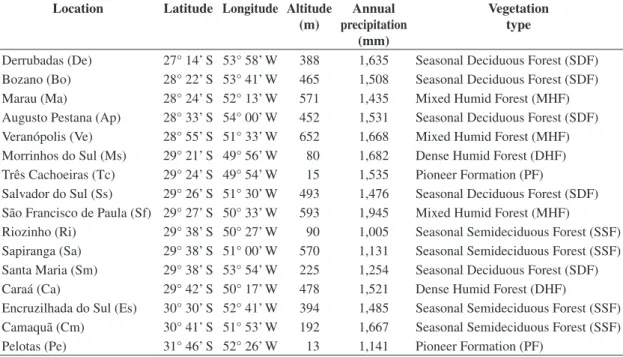
Table 1. Details of sampling sites. Annual precipitation data were obtained from www.defesacivil.rs.gov.br and vegetation types follow the classification of Teixeira et al. (1986).
Location Latitude Longitude Altitude (m)
Annual precipitation
(mm)
Vegetation type
Derrubadas (De) 27° 14’ S 53° 58’ W 388 1,635 Seasonal Deciduous Forest (SDF) Bozano (Bo) 28° 22’ S 53° 41’ W 465 1,508 Seasonal Deciduous Forest (SDF) Marau (Ma) 28° 24’ S 52° 13’ W 571 1,435 Mixed Humid Forest (MHF) Augusto Pestana (Ap) 28° 33’ S 54° 00’ W 452 1,531 Seasonal Deciduous Forest (SDF) Veranópolis (Ve) 28° 55’ S 51° 33’ W 652 1,668 Mixed Humid Forest (MHF) Morrinhos do Sul (Ms) 29° 21’ S 49° 56’ W 80 1,682 Dense Humid Forest (DHF) Três Cachoeiras (Tc) 29° 24’ S 49° 54’ W 15 1,535 Pioneer Formation (PF)
Salvador do Sul (Ss) 29° 26’ S 51° 30’ W 493 1,476 Seasonal Deciduous Forest (SDF) São Francisco de Paula (Sf) 29° 27’ S 50° 33’ W 593 1,945 Mixed Humid Forest (MHF)
Riozinho (Ri) 29° 38’ S 50° 27’ W 90 1,005 Seasonal Semideciduous Forest (SSF) Sapiranga (Sa) 29° 38’ S 51° 00’ W 570 1,131 Seasonal Semideciduous Forest (SSF) Santa Maria (Sm) 29° 38’ S 53° 54’ W 225 1,254 Seasonal Deciduous Forest (SDF) Caraá (Ca) 29° 42’ S 50° 17’ W 478 1,521 Dense Humid Forest (DHF)
Encruzilhada do Sul (Es) 30° 30’ S 52° 41’ W 394 1,485 Seasonal Semideciduous Forest (SSF) Camaquã (Cm) 30° 41’ S 51° 53’ W 192 1,667 Seasonal Semideciduous Forest (SSF) Pelotas (Pe) 31° 46’ S 52° 26’ W 13 1,141 Pioneer Formation (PF)
Table 2. Epiphytic ferns on Alsophila setosa Kaulf. at 16 study sites in the State of Rio Grande do Sul, Brazil, and respective ecological categories.
Family/species Ecol. cat.
PF DHF MHF SSF SDF
Tc Pe Ms Ca Ma Ve Sf Ri Sa Es Cm De Bo Ap Ss Sm
ASPLENIACEAE
Aspleniumclaussenii
Hieron. ACI X X X X X X X X
Aspleniumgastonis Fée FAC X X X
Aspleniumharpeodes
Kunze HAB X
Aspleniuminaequilaterale
Willd. ACI X X
Aspleniumincurvatum Fée HAB X
Aspleniummucronatum
C.Presl HAB X X X
Aspleniumscandicinum
Kaulf. HAB X X X X X X X X X X
BLECHNACEAE
Blechnumbinervatum
(Poir.) C.V.Morton & Lellinger
HMS X X X X X X X X X X X X X X X X
DRYOPTERIDACEAE
Ctenitis sp.* ACI X
Lastreopsisamplissima
(C.Presl) Tindale ACI X
Polystichum sp.* ACI X
Rumohraadiantiformis
(G.Forst.) Ching FAC X X X X X X X X
HYMENOPHYLLACEAE
Trichomanesanadromum
Rosenst. HAB X X
Family/species Ecol. cat.
PF DHF MHF SSF SDF
Tc Pe Ms Ca Ma Ve Sf Ri Sa Es Cm De Bo Ap Ss Sm Trichomanesangustatum
Carmich. HAB X X X X X X X X X X X X X X X X
Trichomanespolypodioides
L. HAB X X
Trichomanesradicans Sw. HAB X
PTERIDACEAE
Adiantumraddianum
C.Presl ACI X
Doryopterispedata (L.)
Fée ACI X
Vittarialineata (L.) Sm. HAB X X X X X X X X X X X X
POLYPODIACEAE
Campyloneurum
austrobrasilianum (Alston) de la Sota
HAB X X X X
Campyloneurumnitidum
C.Presl FAC X X X X X X X X X X X X X X X
Microgrammasquamulosa
(Kaulf.) de la Sota HAB X X X X X X X X X
Microgrammatecta
(Kaulf.) Alston HAB X
Microgrammavacciniifolia
(Langsd. & Fisch.) Copel. HAB X X X X
Niphidiumrufosquamatum
Lellinger FAC X X X X
Peclumapectinatiformis
(Lindm.) M.G.Price HAB X X X X X X X X X X X X
Peclumarecurvata (Kaulf.)
M.G.Price HAB X X
Peclumatruncorum
(Lindm.) M.G.Price HAB X X X X
Pleopeltisangusta Humb.
& Bonpl. ex Willd. HAB X X
Polypodiumcatharine
Langsd. & Fisch. HAB X X X X
Polypodiumhirsutissimum
Raddi HAB X X X
Total 10 10 14 11 6 8 16 10 16 6 13 8 6 8 5 7
Abbreviation of location and vegetation types according to Table 1. Ecol. cat. = Ecological category; ACI = accidental holoepiphytes; FAC = facultative holoepiphytes; HAB = habitual holoepiphytes; HMS = secondary hemiephytes; * sterile plants.
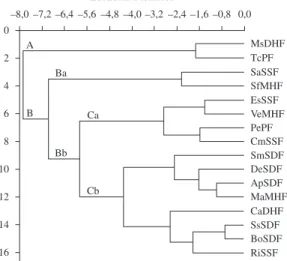
close sites, but with distinct vegetation. The second group (B) included the remaining sites and reflects the natural heterogeneity of the floristic composition in these habitats. Two subgroups can be recognised, one formed only by two close sites presenting different vegetation (Ba), and the other (Bb) where all seasonal deciduous forest sites (SDF) appear together (Cb) (Figure 2).
The average height of the phorophytes in 14 sites was similar. The lower average height was found for seasonal semideciduous forest in Sapiranga (SaSSF), and the highest for seasonal deciduous forest in Santa Maria (SmSDF). The majority of sites (13) presented similar average richness of epiphytes per caudex. In only 25% of the sites the height of the host plants presented significant relation with specific richness (Table 3).
4. Discussion
The 31 species on Alsophila setosa represent approximately 10% of the total of fern species cited by Falavigna (2002) for the State of Rio Grande do Sul. This result shows the importance of this single host species as a microhabitat for epiphytic ferns in the forest environment.
A previous work by Schmitt and Windisch (2005) on the epiphytic ferns in a tract of seasonal semideciduous forest in the State of Rio Grande do Sul reported 14 species on Alsophilasetosa. In the present study, the sampled sites within this vegetation revealed 22 species showing low similarity among sites and indicating heterogeneity of the epiphytic fern flora. The total of 31 species indicates that the surrounding environment affects the biodiversity of the
epiphytic ferns on A. setosa. Habitual holoepiphytes such as Trichomanesanadromum Rosenst., T. polypodioides
L., Microgrammatecta (Kaulf.) Alston and Pecluma
recurvata (Kaulf.) M.G.Price were found on A. setosa
only in dense humid forest, mixed humid forest or pioneer formations. The assembly of several distinct vegetation types presenting heterogenic environmental conditions contributes to the establishment of species with distinct ecological requirements.
Figure 2. Dendogram of the epiphytic fern communities of the 16 study sites in the State of Rio Grande do Sul, Brazil. Acronyms formed according to Table 1.
A
B Ba
Bb Ca
Cb
Table 3. Average phorophyte height and richness of epiphytic ferns on Alsophila setosa Kaulf.; linear regression equations and correlation coefficients (R2) from the relation between phorophyte height and richness at 16 study sites in the State of
Rio Grande do Sul, Brazil.
Study sites
Phorophyte height
Richness Parameters of regression analysis
Average ± Sd (m)
Maximum (m)
Average ± Sd Maximum Regression equation
R2
TcPF 5.12 ± 0.98abc 6.20 3.20 ± 1.03abcd 5 y = –0.0010x + 3.77 0.010 ns
PePF 4.40 ± 1.10abc 5.80 4.29 ± 1.60d 7 y = 0.0080x + 0.66 0.320 ns
MsDHF 4.46 ± 1.21abc 6.90 1.80 ± 0.63ab 3 y = –0.0006x + 2.09 0.020 ns
CaDHF 3.67 ± 0.82ab 5.20 3.40 ± 1.65bcd 6 y = 0.0140x – 1.71 0.484**
MaMHF 4.06 ± 0.58abc 4.95 3.40 ± 1.14bcd 5 y = 0.0110x – 1.13 0.322 ns
VeMHF 4.86 ± 1.08abc 5.86 2.10 ± 0.74abc 3 y = 0.0009x + 1.66 0.020 ns
SfMHF 4.19 ± 1.01abc 5.70 4.00 ± 1.83cd 6 y = 0.0140x – 2.03 0.641**
RiSSF 4.58 ± 1.21abc 6.00 1.88 ± 1.13ab 4 y = 0.0043x – 0.10 0.215 ns
SaSSF 3.33 ± 1.24a 5.02 2.80 ± 1.23abcd 5 y = 0.0073x + 0.35 0.548*
EsSSF 4.09 ± 1.13abc 5.32 2.20 ± 1.03abc 4 y = 0.0074x – 0.85 0.672*
CmSSF 4.00 ± 1.22abc 5.70 2.00 ± 1.15ab 4 y = 0.0058x – 0.33 0.384 ns
DeSDF 5.56 ± 2.14bc 9.00 2.40 ± 0.97abcd 4 y = 0.0023x + 1.10 0.271 ns
BoSDF 5.69 ± 0.99abc 8.50 2.56 ± 0.88abcd 4 y = 0.0004x + 2.31 0.004 ns
ApSDF 4.84 ± 0.99abc 6.10 2.44 ± 0.73abcd 4 y = 0.0035x + 0.73 0.236 ns
SsSDF 4.57 ± 0.89abc 5.50 1.40 ± 0.89a 3 y = 0.0058x – 1.25 0.336 ns
SmSDF 5.93 ± 1.63c 8.00 2.00 ± 1.07ab 4 y = 0.0021x + 0.74 0.106 ns
ANOVA P < 0.01 P < 0.01
Acronyms of the study sites according to Table 1. Averages with same letter are same (Tukey test 5%). Sd = Standard deviation ; *P < 0.05; **P < 0.01; ns = non-significant.
Polypodiaceae, with a larger number of epiphytic species in the study sites (and 39% of the total) is also the family with the highest richness of epiphytes worldwide (Madison, 1977; Kress, 1986; Benzing, 1990), as well as in the neotropical region (Gentry and Dodson, 1987). The genera Asplenium and Trichomanes, which presented the
largest number of species in this study, are considered the richest (more than 100 epiphytic species) on a worldwide basis by Madison (1977) and Kress (1986).
Even in other epiphytic fern surveys, with different sampling methods and distinct phorophyte species, habitual holoepiphytes present highest richness (de la Sota, 1971, 1972; Labiak and Prado, 1998; Schmitt et al., 2005; Fraga et al., 2008). Habitual holoepiphytes present more specialised and diversified adaptations which probably account for their generalised occurrence.
Morphological adaptations of epiphytic species from the Trichomanes genera such as a branched, fine to filiform rhizome, with reduced radicular system and frond size (Dubuisson et al., 2003) contributed to the occurrence of
T. angustatum in all studied sites. Other adaptations such as poikilohydry (Benzing, 1987; 1990), fleshy rhizome, nidular habit (Waechter, 1992), trichomes (Müller et al., 1981) and scales, probably account for the generalised occurrence of
a single site in our study, probably due the lack of proper vegetative/biological adaptations.
The distinction between accidental holoepiphytes and facultative ones is not clear cut, and their classification may vary according to the author or local predominant environmental conditions. Rumohraadiantiformis (G.Forst.) Ching, for example, here treated as a facultative epiphyte, was considered by Kersten and Silva (2002) as accidental holoepiphyte in a mixed humid forest in the State of Paraná (Brazil). The classification in ecological categories in the present study is based on the most frequent situation observed in the sampling sites.
The reduced total number of species and the lower average richness observed for seasonal deciduous forest in Salvador do Sul (SsSDF) agree with the observations of Sehnem (1977; 1979) that in Southern Brazil the seasonal deciduous forests (SDF) present low fern richness. According to this author, the low specific richness can be due to the lack of connections between the seasonal deciduous forest and dense humid forest.
The floristic similarity analysis demonstrated the heterogeneity of epiphytic ferns in study sites, and indicated that the vegetation type is not the main contributor for this difference. The relevant factors in defining habitats within sites were not evident. Micro-climatic differences were likely to account for much of the different epiphytic assemblages among study areas, and disturbance history, animal interactions and dispersal limitations are also factors that can influence the distribution of species (Roberts et al., 2005).
The affinity between the epiphytes found in mixed humid forest and in the seasonal semideciduous forest (SfMHF and SaSSF) or in the seasonal deciduous forest (MaMHF and ApSDF), confirms the continuity of these forests cited by Rambo (1961), Sehnem (1977) and Marchiori (2004) and the occurrence of some fern species is common as presented by Sehnem (1977, 1979), in the State of Rio Grande do Sul. The TcPF site (pioneer formation in Três Cachoeiras) probably has climatic conditions comparable to the MsDHF site (dense humid forest in Morrinhos do Sul) which is located only some 6.5 km away, on the North coast of the State. This explains the presence of typical dense humid forest (DHF) epiphytic species in pioneer formations (PF) and the great similarity among these two sites.
The present results indicate that once Alsophilasetosa
is established in the vegetation, the type of forest exerts little influence on the average richness of epiphytes on the caudices. The average richness of similar epiphytic ferns on A. setosa may be related to the fact that space and colonisation time availability are similar, because these host plants also had, in a general way, the same mean average height among the studied sites. Based on the yearly frond production rates and the total frond vestiges on the caudex, Schmitt and Windisch (2006) estimated the age of 4 m tall Alsophilasetosa sporophytes at 28-34 years, in secondary forest formations in the northeastern part of the State of Rio Grande do Sul.
The maximum number of epiphytic fern species found by Heatwole (1993) on Blechnumpalmiforme (Thouars) C. Char (5) and by Schmitt et al. (2005) on Dicksonia
sellowiana Hook. (6) was lower than the maximum for
Alsophilasetosa (7). The averages of 3.1 species on
B. palmiforme (Heatwole, 1993) and 2.46 species on
D. sellowiana (Fraga et al., 2008) are within the range observed on A. setosa. Heatwole (1993) and Schmitt et al. (2005) discovered a correlation between epiphytic species richness and the height of tree ferns, such as occurred in four sites in the present study. Longer caudices (older plants) may present different conditions of microclimate and water supply along their extension, favouring spatial and temporal distribution of the epiphytes. Nieder et al. (1999) indicated that old, structurally diverse trees with many different microhabitats host many different epiphyte species. Yeaton and Galdstone (1982) considered that the period of time during which the substrate is available constitutes a major factor for the colonisation of the phorophytes.
Some of the epiphytic species in this study were observed exclusively or preferentially on tree ferns by previous authors:
Aspleniummucronatum C.Presl, A. scandicinum Kaulf.,
A. harpeodes Kunze, Peclumatruncorum, Trichomanes anadromum, T. angustatum and T. polypodioides (Sehnem, 1977; Waechter, 1992; Cortez, 2001; Sylvestre, 2001). Extraction of adult plants and deforestation are threatening the existence not only of the tree fern species but also of microhabitats for epiphytic fern species, some of them exclusively (or mostly so) found on this kind of substrate. Therefore, additional research on the biology of the tree fern as well as of the epiphytic species is urgently needed as their interactions are still poorly understood.
Acknowledgements — This study was made possible by support and facilities from the Universidade Federal do Rio Grande do Sul – UFRGS (Porto Alegre), Universidade Feevale (Novo Hamburgo) and the Brazilian National Research Council – CNPq. Students of Feevale provided welcome help in the project activities. Dr. Joanne Sharpe and Dr. Annette Droste provided welcome suggestions.
References
BENZING, DH., 1987. Vascular epiphytism: taxonomic participation and adaptative diversity. AnnalsoftheMissouriBotanicalGarden, vol. 74, no. 2, p. 183-204.
BENZING, DH., 1990. Vascularepiphytes. Cambridge: Cambridge University Press. 354 p.
BENZING, DH., 1995. The physical mosaic and plant variety in forest canopies. Selbyana, vol. 16, no. 2, p. 159-168.
CORTEZ, L., 2001. Pteridófitas epifitas encontradas en Cyatheaceae y Dicksoniaceae de los bosques nublados de Venezuela. Gayana, vol. 58, no. 1, p. 13-23.
DUBUISSON, JY., HENNEQUIN, S., RAKOTONDRAINIBE, F. and SCHNEIDER, H., 2003. Ecological diversity and adaptive tendencies in the tropical fern Trichomanes L. (Hymenophyllaceae) with special reference to climbing and epiphytic habits. Botanical JournaloftheLinneanSociety, vol. 142, no. 1, p. 41-63. FALAVIGNA, TJ., 2002. Diversidade, formasdevidaedistribuição altitudinaldaspteridófitasdoParquedaFerradura, Canela (RS),
FOCHT, T. and PILLAR, VD., 2003. Spatial patterns and relations with site factors in a campos grassland under grazing. Brazilian JournalofBiology, vol. 63, no. 3, p. 423-436.
FRAGA, LL., SILVA, LB. and SCHMITT, JL., 2008. Composição e distribuição vertical de pteridófitas epifíticas sobre Dicksonia sellowiana Hook. (Dicksoniaceae), em floresta ombrófila mista no sul do Brasil. BiotaNeotroprica, vol. 8, no. 4, p. 123-129.
GENTRY, AH. and DODSON, CH., 1987. Diversity and biogeography of neotropical vascular epiphytes. AnnalsoftheMissouriBotanical Garden, vol. 74, no. 2, p. 205-233.
HAMMER, Ø., HARPER, DAT. and RYAN, PD., 2001. PAST: Paleontological Statistics: Software Package for Education and Data Analysis. PalaeontologiaElectronica, vol. 4, no. 1, 9 p. Available from: http://palaeo-electronica.org/2001_1/past/ issue1_01.htm. Access in: 16/01/2008.
HEATWOLE, H., 1993. Distribution of epiphytes on trunks of the arborescent fern, Blechnumpalmiforme, at Gough Island, south Atlantic. Selbyana, vol. 14, p. 46-58.
KERSTEN, RA. and SILVA, SM., 2002. Florística e estrutura do componente epifítico vascular em floresta ombrófila mista aluvial do rio Barigüi, Paraná, Brasil. RevistaBrasileiradeBotânica, vol. 23, no. 3, p. 259-267.
KRESS, WJ., 1986. The systematic distribution of vascular epiphytes: an update. Selbyana, vol. 9, no. 1, p. 2-22.
LABIAK, PH. and PRADO, J., 1998. Pteridófitas epífitas da Reserva Volta Velha, Itapoá, Santa Catarina, Brasil. Boletimdo InstitutodeBotânica, vol. 11, p. 1-79.
MADISON, M., 1977. Vascular epiphytes: their systematic occurrence and salient features. Selbyana, vol. 2, no. 1, p. 1-13.
MARCHIORI, JNC., 2004. FitogeografiadoRioGrandedoSul: campos sulinos. Porto Alegre: EST.
MEDEIROS, AC., LOOPE, LL. and ANDERSON, SJ., 1993. Differential colonization by epiphytes on native (Cibotium spp.) and alien (Cyatheacooperi) tree ferns in a Hawaiian rain forest.
Selbyana, vol. 14, p. 71-74.
MORAN, RC., KLIMAS, S. and CARLSEN, M., 2003. Low-trunk epiphytic ferns on tree ferns versus angiosperms in Costa Rica. Biotropica, vol. 35, no. 1, p. 48-56.
MORENO, JA., 1961. ClimadoRioGrandedoSul. Porto Alegre: Secretaria da Agricultura.
MUCUNGUZI, P., 2007. Diversity and distribution of vascular epiphytes in the forest lower canopy in Kibale National Park, western Uganda. AfricanJournalofEcology, vol. 45, suppl. 3, p. 120-125.
MÜLLER, L., STARNECKER, G. and WINKLER, S., 1981. Zur ökologie epiphytisher farne in Südbrasilien. I. Saugschuppen.
Flora, vol. 171, p. 55-63.
NIEDER, J., IBISCH, PL. and BARTHLOTT, W., 1997. Biodiversidad de epífitas: una cuestión de escala. RevistadelJardínBotánico Nacional, vol. 17/18, p. 59-62.
NIEDER, J., ENGWALD, S. and BARTHLOTT, W., 1999. Patterns of neotropical epiphyte diversity. Selbyana, vol. 20, no. 1, p. 66-75.
PAGE, CN., 2002. Ecological strategies in fern evolution: a neopteridological overview. ReviewofPalaeobotanyandPalynology, vol. 119, no. 1, p. 1-33.
QUADROS, FLF. and PILLAR, VP., 2002. Transições floresta-campo no Rio Grande do Sul. RevistaCiênciaeAmbiente, vol. 24, p. 109-118.
RAMBO, B., 1961. Migration routes of the south Brazilian rain forest. Pesquisas, SérieBotânica, vol. 12, p. 1-54.
ROBERTS, NR., DALTON, PJ. and JORDAN, GJ., 2005. Epiphytic ferns and bryophytes of Tasmanian tree-ferns: a comparison of diversity and composition between two host species. Austral Ecology, vol. 30, no. 2, p. 146-154.
RUDOLPH, D., RAUER, G., NEIDER, J. and BARTHLOTT, W., 1998. Distributional patterns of epiphytes in the canopy and phorophyte characteristics in a western Andean rain forest in Ecuador. Selbyana, vol. 19, no. 1, p. 27-33.
SCHMITT, JL. and WINDISCH, PG., 2005. Aspectos ecológicos de Alsophilasetosa Kaulf. (Cyatheaceae, Pteridophyta) no sul do Brasil. ActaBotanicaBrasilica, vol. 19, no. 4, p. 861-867.
SCHMITT, JL. and WINDISCH, PG., 2006. Growth rates and age estimates of Alsophilasetosa Kaulf in Southern Brazil. American FernJournal, vol. 96, no. 4, p. 103-111.
SCHMITT, JL., BUDKE, JC. and WINDISCH, PG., 2005. Aspectos florísticos e ecológicos de pteridófitas epifíticas em cáudices de Dicksoniasellowiana Hook. (Pteridophyta, Dicksoniaceae), São Francisco de Paula, RS, Brasil. Pesquisas, SérieBotânica, vol. 56, no. 1, p. 161-172.
SEHNEM, A., 1977. As filicíneas do sul do Brasil, sua distribuição geográfica, sua ecologia e suas rotas de migração. Pesquisas, Série Botânica, vol. 31, p. 1-108.
SEHNEM, A., 1979. Semelhanças e diferenças nas formações florestais do sul do Brasil. ActaBiologicaLeopoldensia, vol. 1, no. 1, p. 111-135.
SMITH, AR., KATHLEEN, MP., SCHUETTPELZ, E., KORALL, P., SCHNEIDER, H. and WOLF, PG., 2006. A classification for extant ferns. Taxon, vol. 55, no. 3, p. 705-731.
SOTA, ER., 1971. El epifitismo y las pteridofitas en Costa Rica (America Central). NovaHedwigia, vol. 21, no. 2-4, p. 401-465.
SOTA, ER., 1972. Las pteridofitas y el epifitismo en el Departamento del Choco (Colombia). AnalesdelaSociedadCientificaArgentina, vol. 31, no. 5-6, p. 245-278.
SYLVESTRE, LS., 2001. Revisãotaxonômicadasespéciesda FamíliaAspleniaceaeA. B. FrankocorrentesnoBrasil. São Paulo: Universidade de São Paulo. [Tese de Doutorado]
TEIXEIRA, MB., COURA NETO, AB., PASTORE, U. and RANGEL FILHO, ALR., 1986. Vegetação. In Levantamentode recursosnaturais. Rio de Janeiro: Instituto Brasileiro de Geografia e Estatística - IBGE. p. 541-620. (vol. 33)
VIEIRA, S., 1980. Introduçãoàbioestatística. 3 ed. Rio de Janeiro: Campus.
WAECHTER, JL., 1992. OepifitismovascularnaPlaníciecosteira doRioGrandedoSul. São Carlos: Universidade Federal de São Carlos. [Tese de Doutorado]
WINDISCH, PG., 2002. Fern conservation in Brazil. FernGazette, vol. 16, no. 6-8, p. 295-300.
YEATON, RI. and GLADSTONE, DE., 1982. The pattern of colonization of epiphytes on Calabash Trees (Crescentiaalata
HBK.) in Guanacaste Province, Costa Rica. Biotropica, vol. 14, no. 2, p. 137-140.