DOI: 10.1590/S1414-32832013005000025
The use of scientific argumentation in choosing risky lifestyles
within the scenario of aids
George Moraes De Luiz1
1 Discente, Programa de Estudos Pós-Graduados em Psicologia Social, Pontifícia Universidade Católica de São Paulo. Rua Monte Alegre, 984, Perdizes. São Paulo, SP, Brasil. 05014-901. [email protected]
This article deals with the use of scientific arguments that circulate in the day-to-day lives of men who have
sex with men (MSM) in casual partnerships, as a strategy for managing the risks relating to sexual practices.
The theoretical basis for this investigation was the discursive practices regarding risky lifestyles within the
scenario of AIDS. Through the snowball technique, seven participants were chosen and they gave responses
in semi-structured interviews. The results showed that scientific information circulating in the daily lives of the
interlocutors of this study had been assimilated and that these individuals interpreted this information as a
potential source for risk management. In summary, these men had developed risk management strategies
relating to infection by STD and HIV and/or HIV reinfection, without necessarily basing them on the Brazilian
government’s official preventive policies.
Keywords: Scientific argumentation. Risk management. Sexual practices among men
who have sex with men.
This article results from a master’s study within social psychology in which the objective was to
understand how men who have sex with men (MSM) in casual partnerships manage the risks of
infection caused by sexually transmitted diseases (STDs) and the human immunodeficiency virus
(HIV), and/or HIV reinfection, when they choose to have sexual practices without using condoms.
For this discussion, we elected to bring together the interlocutors’ discourse and the scientific
knowledge in the field of AIDS. It is worth emphasizing that the information discussed here is taken
to form discursive practices that circulate in the day-to-day lives of our interlocutors, and is used as
a potential source of risk management for these men.
The greatest hope of a cure or discovery of other strategies for AIDS prevention lies in the
development of vaccines that might impede establishment of the virus in the human organism and,
in the case of infected individuals, might eliminate it. To this end, billions of dollars have been
invested in studies with the aim of producing results with the field of AIDS. Until such time that
discoveries may be made, society has to become accustomed to the epidemic scenario and deal in
some way with the infection risks that are implicated both in clinical trials on human beings (Spink,
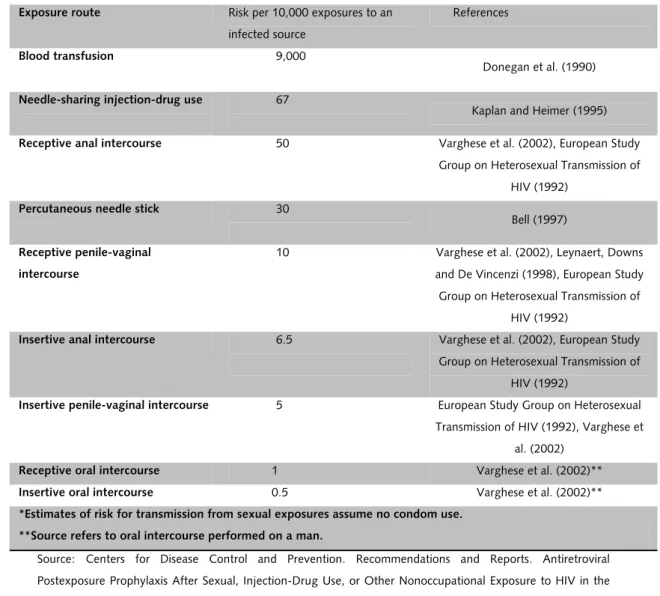
For example, Table 1 was drawn up by the Centers for Disease Control and Prevention
(2005) in order to help healthcare managers working within the field of prevention to analyze the
risk of HIV according to exposure route.
Table 1. Estimated risk of HIV according to exposure route* Exposure route Risk per 10,000 exposures to an
infected source
References
Blood transfusion 9,000
Donegan et al. (1990)
Needle-sharing injection-drug use 67
Kaplan and Heimer (1995)
Receptive anal intercourse 50 Varghese et al. (2002), European Study Group on Heterosexual Transmission of
HIV (1992)
Percutaneous needle stick 30
Bell (1997)
Receptive penile-vaginal intercourse
10 Varghese et al. (2002), Leynaert, Downs and De Vincenzi (1998), European Study Group on Heterosexual Transmission of
HIV (1992)
Insertive anal intercourse 6.5 Varghese et al. (2002), European Study Group on Heterosexual Transmission of
HIV (1992)
Insertive penile-vaginal intercourse 5 European Study Group on Heterosexual Transmission of HIV (1992), Varghese et
al. (2002) Receptive oral intercourse 1 Varghese et al. (2002)** Insertive oral intercourse 0.5 Varghese et al. (2002)** *Estimates of risk for transmission from sexual exposures assume no condom use.
**Source refers to oral intercourse performed on a man.
Source: Centers for Disease Control and Prevention. Recommendations and Reports. Antiretroviral Postexposure Prophylaxis After Sexual, Injection-Drug Use, or Other Nonoccupational Exposure to HIV in the United States. MMWR, Atlanta, 2005.
In addition to the risk table, there is a series of studies on new biomedical prevention
technologies within the field of AIDS. The word technology comes from Greek and means
“conjugation of techniques with knowledge to satisfy people’s needs” (Kalichman, 2009, [s.n.]).
For human beings, these needs are constructed within the social framework and change according
to the context. From this perspective, Kalichman advocated that development of new technologies
aimed towards sexual prevention of AIDS among MSM should be envisaged, within a new scenario
of the epidemic differing greatly from what existed in past decades.
In this regard, researchers within the field of AIDS have developed new technologies that
can be grouped into two major types: “soft” and “hard”. According to Brito (2009), both
technologies relate to issues within administration and management of programmed actions and
social participation; organization of work processes; human resources; development of educational
and communicational techniques; reception; counseling; and comprehensive care. On the other
hand, hard technologies encompass condoms, vaccines, microbicides, surgical strategies such as
circumcision and drug strategies such as prophylaxis before and after sexual exposure in situations
of risk.
The monthly editions of the anti-HIV/AIDS Vaccine Bulletin (VAX) give information about
the main studies currently in progress, relating to anti-HIV immunobiological agents and the new
biomedical prevention technologies (Prevenção..., 2006). These are experiments that supposedly
may mitigate the possible risks of HIV infection and/or reinfection.
It can be said, in passing, that the profusion and polysemy of this
information, which is a compilation of evidence from present and past
investigations that are validated today and discredited tomorrow,
increase the responsibility for seeking information [...]. (Spink, 2007,
p.256)
The point at issue is that until the start of the 2010s, in relation to these new preventive
technologies, no study had proven their efficacy such that their safe use among the population
could not be guaranteed.
In an interview with Mary Jane Spink (2010), Nikolas Rose reported that experiments in
the fields of life sciences, biomedicine, neuroscience and biotechnology are very unstable. Nobody
knows for sure whether these tests will be successful. Thus, enormous hopes are placed on research
that may not confirm the data, as has been the case with gene therapy. The uncertain future and
expectations precipitate the time to conclude studies, which fail as often as they succeed. The
increasing development of biotechnologies can be explained by their power to offer people
strategies to compensate in advance for their deficiencies and weakness, even future ones (Amorin;
Szapiro, 2008).
Method
This study began in 2009. We resorted to the internet to gain access to men who choose
to have sex always or occasionally without a condom. Studies conducted by Silva (2009; 2008) and
Hine (2006) affirmed that the internet is a good resource for aiding researchers when dealing with
polemical topics, such as sexual practices without condoms, given that it enables free participation
by such individuals and, at the same time ensures their anonymity.
The first step was to create an e-mail address ([email protected]) and do a
search for relationship websites for MSM. For this, we used Google to identify the main websites
www.bareback.rt because they were in line with the purposes of this study. On these pages, we
used the descriptors bare, bareback and barebacking1 to locate men who self-identified with sexual
practices without using a condom.
Subsequently, we invited these men to take part in a discussion on the topic of
barebacking. Over a six-month period, 20 men participated in weekly discussions by means of
e-mail and/or MSN Messenger, through addresses created for this purpose. We made it clear to the
participants in the discussion that this was a moment of informal investigation and did not
constitute production of information for this study, given that the project was at the initial stage
and still had to be forwarded to the Research Ethics Committee of the Pontifical Catholic University
of São Paulo (PUC-SP), where the master’s research was accomplished. Likewise, we guaranteed
total confidentiality of the information and anonymity of the participants, who were all using false
profiles on the internet.
After six months of discussion by means of MSN, the research moved forward to another
stage: face-to-face interviews. For this, we resorted to the snowball technique. We invited all the
people on the researcher’s list and suggested that they could forward this invitation to their own
contact lists, successively. This allowed us to amplify our network of interlocutors. This method has
been debated and used by researchers working with delicate topics such as abortion, prostitution
and sexual practices without a condom, among whom we can cite Browne (2005) and Faugier and
Sargeant (1997).
As we went on receiving positive responses from possible participants in face-to-face
interviews, we evaluated whether they would fit within the study objectives. For this, we defined
the following inclusion criteria: a) affirmation that they had sexual intercourse with casual partners
without using condoms; b) living in the cities of São Paulo or Rio de Janeiro; c) age over 18 years.
These two cities were chosen because they present the largest numbers of AIDS cases in Brazil
(Dias; Nobre, 2001).
At the start of the interview, each participant signed a free and informed consent
statement that had been approved by the Research Ethics Committee of PUC-SP under registration
number 332/2009, in accordance with Resolution number 1 of the National Health Board (CNS),
which sets the standards for research involving human beings (Brasil, 1996).
The interviews were held between December 2009 and March 2010. Eighteen men were
interviewed in order to ascertain their risk management strategies within the context of sexual
practices without a condom. Out of the total number of interviews, eight were not used for the
following reasons: a) they affirmed that they only had unprotected sexual intercourse with a fixed
partner; b) they were in a distressed emotional state; c) they did not agree to sign the free and
1 The practice of barebacking is generally understood as intentional anal intercourse between MSM without using a condom
(Berg, 2009).
informed consent statement. Among the ten participants, seven showed through their words that
they had some familiarity with scientific knowledge, which is the basis of this article.
Below, we present a chart characterizing the participants. This information will facilitate
comprehension of the arguments discussed in the next section. Information that might identify
them has been omitted, including their names, which are fictitious here, as chosen by each of
them.
Chart 1. Characterization of the study participants
Fictitious name Age State of origin Schooling level HIV serological status
Gabriel 30 SP Master’s degree Unknown
Aristóteles 35 RJ Doctoral student Positive
Agileu 22 SP Undergraduate student Unknown
Yuri 43 SP MBA Unknown
Cristian 36 SP Specialization Positive
Edu 35 SP High school Unknown
Daniel 57 RJ Higher education Positive
We chose to use interviews as our source of discursive material. Audio recordings were
made and a field diary was kept. To analyze the material, a complete transcription of the
interviewees’ words was firstly made, using the convention of Jeffersonian Transcription Notation
(Jefferson, 1984). Following this, sequential transcription was performed: a summary of the
interviews according to the order of the dialogue between the researcher and the study
participants.
From this, dialogue maps as proposed by Spink and Menegon (1999) were produced in
order to identify the main topics present in the participants’ narratives. These maps were important
for systematizing the discursive material and enabling a search for repertoires relating to prevention
strategies. Moreover, they had a double objective: to assist in the interpretation process and to
facilitate communication in the steps connected with the interpretation process.
To present and discuss the results, we used passages from the narratives shown in the
dialogue maps. In this article, we focus on the topic of appropriation and use of scientific
information as potential sources for managing the risks relating to STDs, HIV and HIV reinfection.
Use of scientific arguments in constructing risk management strategies within a scenario of
uncertainties
The way in which MSM manage the risks implied in choosing to have sex without
of health, disease, life, death, risk, power and sexuality. Regarding the level of complexity of
knowledge production within these individuals’ daily lives, it has been observed that this is close to
the scientific production on AIDS that circulates by means of the internet, printed material and
academic studies (Camargo Jr., 1994). Information coming from knowledge sources, even if it does
not correspond to the official discourse of the Brazilian Ministry of Health regarding prevention, for
example, is increasingly incorporated and used by these individuals to manage the risks implied in
this practice.
Thus, MSM reflectively appropriate data published by specialists in which the premise is
better management of day-to-day life. Social relationships are regulated through this information,
guided by the scientific nature of studies that enable choices in calculating risks, because the
abstract systems are trusted. It can be seen from this that the Brazilian government’s AIDS
prevention strategies end up forming risk management actions, given that they aim both to protect
the health of the population at risk through nonuse of condoms and to enable recovery among
individuals who are infected with an STD or HIV (Czeresnia, 2004). This is a complex area
permeated by tensions between individual and collective rights, between individual autonomy and
the social order, between global and local contexts and between the public and private spheres
(Castiel, 1996).
One recent example is provided by evidence-based medicine studies. This approach seeks
to emphasize the scientific factors needed for the process of systematization and legitimization of
information. Through this emphasis, it is sought to bring together observable proof relating to the
subject under investigation, by means of techniques coming mainly from statistics, which can be
interpreted and applied by doctors to their patients (Lopes, 2000). In this regard, the CDC in the
United States conducted a meta-review on the existing literature, which resulted in the Risk Table.
This provides a summary of the state of the art relating to estimating the risk of acquiring HIV
according to the infection route (CDC, 2005).
The Risk Table can be found on the internet, hosted on American and Canadian websites.
Cristian, one of the participants in this study, reported that in seeking to understand whether and
how he could manage the possible risks resulting from his sexual practices without condoms, he
decided not to ejaculate inside his partner. When he was asked where he got this information
from, he referred to the Risk Table. He firstly set forth how to search for this information and then
specified it:
“Through searches on the internet, except that these were searches outside of Brazil, either on
American or on Canadian websites, investigating specific medical websites on HIV/AIDS. Hmm… I
got the information from the Risk Table, you know? About types of intercourse and forms in which
you have higher and lower risk, you know? So, practice without a condom is a risky practice, but
Cristian seemed to suggest that news found outside of Brazil was supposedly more valid
than news circulating inside Brazil, and that this made him feel more secure with regard to having
unprotected intercourse. He was middle-class, had done a postgraduate course and had access to
the internet, where he sought other possible sources of information that he considered to be
trustworthy. He said that he was an engineer and worked in a field connected with the exact
sciences. This profile may partly explain why he sought a way to manage the risks in his intimate
life through his own scientific rationality, i.e. something close to his day-to-day life as an engineer.
The Risk Table has been used as a consultation parameter in risk management, particularly
by the American government and some European governments. In Brazil, there is no evidence that
it has been adopted in the official prevention discourse of the National Department for STDs,
HIV/AIDS and Viral Hepatitis, of the Ministry of Health.
According to this table, the risk of HIV infection for active men is 6.5/10,000 cases. In the
case of the partner who has the receptive role, this risk is 50/10,000 cases. From this perspective,
in classifying his sexual practices as insertive, Cristian considered himself to be less exposed to HIV.
At the same time, in choosing not to ejaculate into his partner’s rectum, he managed his safety and
that of his partner. In this regard, according to Brasil (2009) and Parker et al. (1998), certain
strategies can be stimulated in order to diminish the risks of infection by the AIDS virus. Among
these are masturbation and prioritizing oral sex.
Another argument used in risk management is in relation to the viral load of people living
with HIV as an indicator of higher or lower risk of infection and/or reinfection by the AIDS virus. A
Swiss study published at the end of 2008 caused polemic within scientific circles through stating
that the possibility of HIV transmission was associated with the viral load (Vernazza et al., 2008).
Thus, supposedly, the lower the viral load of people living with HIV is, the lower the chance of
infecting a serologically negative partner would also be. This study was widely disseminated,
particularly through the internet, and has circulated around the world via e-mail.
Consequently, this notion has become part of many people’s day-to-day lives, and they
now use this information to manage the possible hazards present when choosing not to use
condoms. This was Cristian’s argument in explaining his notion of risk management:
“So, well then, what there has been relatively recently is the Swiss study of 2008, and I fitted
within the result that was given in the study. Well, I’ve been making use of the cocktail for a year
and a half now, regularly, constantly and religiously. Hmm… after two months, we’ll say? I now
have an undetectable viral load and, over the last few months, my CD42 has even been going up.
So, these data also add to the fact that I have zero chance or low risk of passing the virus to
someone. Because the Swiss study says that a person who is positive but has had an undetectable
viral load for more than six months and doesn’t have any other type of disease, or an STD, does
not present a risk of contaminating a negative partner.”
At first sight, by complying with the antiretroviral treatment to the letter, Cristian was
placed within the recommendation of the Swiss study. He used the expression “religiously” to
emphasize that he was taking the medical recommendations seriously. According to the parameters
for antiretroviral treatment, people living with the AIDS virus should make continuous and
systematic use of the anti-HIV cocktail, since any alterations to the intake pattern could cause a
gradual loss of efficacy of the drug arsenal. This is like a “religious ritual” (Cristian) that has to take
place every day at the same time, systematically. In reflecting on his undetectable viral load, he
considered that he had zero chance of infecting his partner. However, later on, he recognized that
there could be a small risk, which would make the possibility of transmission of the virus
contradictory from the point of view of the scientific literature on this subject.
This same issue appeared in the words of Agileu, although in an inverted form. He said
that he was serologically HIV-negative, but that he had intercourse with people who he knew to be
serologically positive, without ever having become infected. Consequently, he felt safe when he
chose to have sex with people who were serologically HIV-positive, because his partners had sent
him a study that presented a correlation between the viral load and the risks of infection. From his
words, we were led to think that Agileu was referring to the Swiss study. When asked about this
behavior, he said:
“[...] it’s that there were three seropositive guys who I had intercourse with, even knowing that
they were seropositive. And one of them sent me an article, from a doctor, stating that in
seropositive guys who take the cocktail, the virus remains concentrated in the lymph3, so that it’s
not so much in the blood. So, according to this article from a doctor, people who are treated with
the cocktail don’t transmit the virus, because the virus is under control and often undetectable. And
this is based on an article, isn’t it?”
Agileu ended his response and returned the question to the researcher in a sign of doubt
about the information. In addition, the undetectable viral load of his HIV-positive partners led him
to think that he was protected from the risks, given that the virus was concentrated in the lymph
and undetectable in the blood, which is the main channel for circulation and infection.
It is interesting to note that as information comes out of production laboratories and
circulates in people’s day-to-day lives (in this case, through the internet), it acquires different
meanings. Agileu’s report, which assumed that HIV was concentrated in the lymph, with
insignificant presence in the blood, indicates partial understanding of the scientific position on this
3 Lymph is a whitish transparent liquid that may also have a yellowish or pinkish tone. It has characteristics
similar to blood plasma and is responsible for transporting lymphocytes through the lymphatic vessels (Bergmann, 2000).
subject, given that the study he referred to does not state that the virus is located only in the
lymph but, rather, that it is “hidden” in organs that have not yet been identified, as well as in the
blood, which is the main source of HIV transmission (Vernazza et al., 2008).
What about STDs and the possibility of reinfection?
Studies that have based the likelihood of HIV transmission risk on the hypothesis of the
viral load have brought to light the possibility that people might experience their sexual practices
without a condom, through the possible reduction of the risk of infection by the virus caused by its
load in the blood. Among the interviewees, the effect of this factor was that HIV ceased to be their
greatest concern, and STDs became the main focus for care. Agileu reported:
“At a consultation with a doctor that I had at the time of a test to know whether I had HIV or not
(I do this test periodically), she gave me some interesting information, telling me that there was a
0.5% chance that I could infect someone with HIV in intercourse without a condom, and that there
was much more chance with other diseases like hepatitis and HPV. There are two types of hepatitis,
and I don’t remember the letters very well, and there’s more than 30% or 25% chance of infection
when you have intercourse without a condom. So, there’s a lot of noise about HIV infection, but
there are several other diseases that you can also get. Including me. It’s interesting to report in an
interview like this that I got syphilis recently.”
Thus, he brought his experience of already having been infected with syphilis, but not with
HIV, as a way of proving the statistical relationship that he thought existed.
There were also individuals who said that the AIDS virus was already incorporated into
their daily lives, and therefore formed part of them. Since there is still no cure, there is nothing that
can be done. In this manner, STDs become the great concern among these men. In Daniel’s words:
“the risks that left me more affected were those of diseases that are more common, like syphilis or
condyloma. It’s not AIDS any more. AIDS doesn’t frighten me any more: I’ve already got it.”
Cristian added:
“what concerns me most is the other types of infections by other STDs that might occur.”
However, according to Edu, STDs and HIV are at the same level and their risks are the
same as for the unpredictable events of day-to-day life. In this regard, there was a generalization of
“due to HIV, syphilis, gonorrhea, hard chancre, soft chancre, HPV and a series of things other than
just HIV.”
A second question is in relation to the possibility of reinfection in men living with HIV.
Attention was drawn to the fact that none of the participants believed in the possibility of
reinfection, although all of them had declared that they were aware of the guidance given by their
doctors that this event could occur and that, in this case, these individuals might acquire a virus
that would be resistant to the drugs that exist. According to Aristóteles, reinfection only had
meaning if he had intercourse with someone who was not following the antiretroviral treatment
correctly. For this reason, he believed that this criterion did not apply to him, since he had followed
the medical recommendations correctly and had sought to have intercourse with people in the
same situation. He also argued that he had read about this subject and talked to healthcare
professionals in this regard:
“The conclusion today is that the biggest risk when you have sex with someone without a condom
is that this guy isn’t undergoing treatment. When two people who are undergoing treatment have
sex without a condom, the likelihood of risk is very small, provided that they are in a good state of
health.”
Aristóteles recognized that there was a small risk but that, precisely because it was very
small, it was possible to have sexual intercourse without a condom. Along the same lines, Gabriel
followed scientific rhetoric to be able to explain the reasons why he did not believe in reinfection.
Thus, he started from the assumption that not even biomedicine had reached a consensus on this
process, and he highlighted the contradictions between the different versions of this topic in this
field:
“Firstly, there’s a line of medicine that preaches that it’s not like this. As I already mentioned and
spoke about, there are lines within medicine that are controversial, like in any field of study and like
in any field of knowledge. Going more deeply, you have lines that at certain times may even be
contradictory. This also exists in medicine. I’ve had access to this information, both from a doctor
and from my former partner, who is a pharmacist. And starting precisely from this argument or
explanation that there are indeed different strains of HIV. This is a matter of consensus. Every
individual, i.e. every seropositive person is infected by one strain specifically. From the time that I
become reinfected, the medical discourse starts from the notion that the reinfection will change the
virus that is inside the organism of the seropositive individual. First of all, this is not a plausible
argument, because the virus will become modified naturally. This is a characteristic of HIV.
Independent of whether I am infected and go into a state of abstinence, and don’t use injection
contact with another strain of HIV, the virus that’s inside me is always undergoing modifications,
on its own, without needing any other strain. There’s a possibility of creating a super-mega-ultra
virus formed by other, different strains, thus creating a megamutant monster, which takes care of
everything. I’ve read of two cases, via the internet, in specific journals, including within
infectology.”
It is worth noting that Gabriel went into specific characteristics of biomedicine in
presenting his position in relation to reinfection. At the end of his reasoning, he raised his tone of
voice and affirmed that he had knowledge of two possible cases of genetic mutation of HIV in the
world. He then described the source of this information as specific journals in the field of
infectology and the internet.
Some data in the study by Aza et al. (2010) indicated that four HIV subtypes existed within
the MSM population in five regions of Brazil, namely: type B (80.3%); type C (10.5%); type F
(4.9%); and other recombinant viruses (4.3%). Also according to these authors, the rate of
resistance to the anti-HIV cocktail among MSM is high and, for this reason, they emphasized the
importance of conducting new studies on this topic, with a larger sample from this population. This
information challenges researchers to think of new AIDS prevention strategies.
New biomedical preventive technologies or technologies of uncertainty?
The strategies of new biomedical preventive technologies relate to large multicenter studies
carried out around the world, which have generated estimates of the effects of reduction of the
risks of HIV infection for a given population (Prevenção, 2006). These investigations have been
disseminated through vaccine bulletins, journals, scientific articles, talks and reports published in
the general media, which circulate on the internet.
One of these strategies relates to the recently-launched postexposure prophylaxis, which
was not available at the time of the interviews and was then used only in two specific cases:
situations of rape and in pregnant women living with HIV, with a view to avoiding virus
transmission from mother to baby, i.e. so-called vertical transmission (Brasil, 2010). However,
according to the recommendations for antiretroviral therapy among adults, the results relating to
the possible efficacy of the method are controversial. The government’s document says the
following:
In the absence of direct studies and definitive evidence relating to
efficacy, effectiveness and safety of the recommendations for addressing
sexual exposure to HIV, biological plausibility, experiments on animals
and the theoretical model used in prophylaxis for use after occupational
In this regard, it can be seen that postexposure prophylaxis is used in risk management
relating to sexual practices among MSM. For example,
“I had sex without a condom. The guy asked me to cum inside him. Later on, I asked the doctor to
include an HIV test among the periodic blood tests. I was frightened and my friend the doctor
prescribed prophylactic use of antiretrovirals. [...] But this self-mutilation affected me and made me
cause the guy to be ashamed. In reality, even one side of me was hoping that I’d vomit and have
the adverse reactions that my friend the doctor could provide in order to generate trauma. You
can’t go home when the hormones return to normal and you think: ‘Shit! Do it again! I could make
myself unhappy with one of these by chance...’ I never thought it would be worth it, but at that
time…”. (Yuri)4
He told how, after having had sex without a condom, he went to a doctor who was his
friend, who in turn, noting his desperation, prescribed postexposure prophylaxis. However, Yuri
thought that his own attitude could, in effect, be one of “self-mutilation”, which in this case
related to the side effects from using antiretrovirals, to “vomit and have the adverse reactions that
my friend the doctor could provide in order to generate trauma” (Yuri). It was as if he needed to
suffer because he had had unprotected sexual intercourse. In his words, we can perceive the
feelings of guilt caused by having unprotected sex and the idea of atonement through suffering. It
was as if, because of the pleasure, he could not make use of antiretrovirals without having severe
side effects. Thus, sexual acts without a condom ended up occupying a place of suffering in his life,
to the point of necessarily having to generate “trauma” (Yuri), and thereby avoiding repetition of
this action.
Yuri was asked about his source of information for prophylactic use of antiretrovirals as a
possible form of mitigating the risks of HIV infection, and he pointed towards a magazine that
circulates in Brazil. In his words:
“I read it in Veja; it was a report on healthcare professionals who had had accidents. Some months
later, a friend who is doctor confirmed this for me. He prescribed the package for me for 28 days,
but was not sure about its efficacy.”
Yuri reported that at the time that this interview took place, the recommendation for using
post-exposure prophylaxis among MSM had not yet been published. For this reason, this method
did not form part of the official Brazilian AIDS prevention program, except in cases of sexual abuse.
In other words, he had had access to the method because of his closeness to a healthcare
professional who, in accordance with the medical consensus, advised him that the efficacy of the
technique was still under examination. Within this context, it was not possible to be sure that, if he
had come into contact with HIV, he would not have become infected. This information is
corroborated by Fischer et al. (2006), who highlighted the importance of establishing dialogue
between the doctor who prescribes postexposure prophylaxis and the patient, thereby making it
clear what the possible benefits, risks and side effects are. According to Benn (2001), the
implications coming from the side effects of postexposure prophylaxis vary from person to person
and may also include metabolic alterations, insulin resistance and intestinal and gastric problems.
In the same manner, we sought to understand other ways that the participants in this
study used in managing the risks implicated in sexual activities. For this, we once again refer to the
dialogue with Agileu, i.e. the participant who reported that the issue of an undetectable viral load
was one of the factors determining his choice not to use a condom. He said that he was
circumcised, and that this also contributed in some manner towards continuing to have sex without
a condom, even in the light of information on the risks. He said:
“Because I am circumcised, and when you are circumcised, there isn’t much of that anterior
lubrication before you cum, so this diminishes the chance of infection”.
In his view, circumcision supposedly produces less lubrication before ejaculation, which
would reduce the risk of possible infection. In an article published in the anti-HIV/AIDS Vaccine
Bulletin (VAX) (PREVENÇÃO..., 2006), the procedure is regarded as one of the new biomedical
prevention technologies. In theory, this would be capable of reducing the chances of HIV infection
by 60% among men who have sexual intercourse with women by means of vaginal coitus, but this
does not apply to MSM. Furthermore, the supposed efficacy of circumcision is related to the fact
that the foreskin that surrounds the glans penis is a region that facilitates entry of the virus and,
when it is removed, this makes HIV infection via this route more difficult. In addition, because
circumcision only benefits heterosexual men, it has not formed part of the Brazilian AIDS
prevention program, at least over the short term (RELATÓRIO..., 2007). On the other hand, this
notion is already circulating among MSM in Brazil, serving as an argument for risk management.
Final remarks
In this study, we have discussed the risk management strategies used by MSM in
intercourse with casual partners without using a condom. We have perceived that people are
increasingly developing their autonomy, appropriating scientific information and constructing
distinct ways of managing the risks relating to STDs and HIV/AIDS. Thus, we have noted that these
strategies mostly follow rational individual logic and do not reproduce the model used in the
In the arguments used by the men who were interviewed, different aspects of the issues
involved in the public policies are mixed: post-exposure prophylaxis; correlation between viral load
and the possibility of infection; and others that, although they have a scientific basis, are not part
of the reference framework of the government bodies involved, i.e. the Risk Table, the Swiss study
and circumcision.
Given the imperative need for healthy lifestyles, people have developed various risk
management strategies. For a variety of reasons, the dialogue in the present study was with a
population of MSM predominantly from the middle class, who were well informed about AIDS and
had access to condoms.
It was noted that these men had close contact with scientific production relating to AIDS,
mainly through schools, non-governmental organizations, general media (TV, newspapers and the
magazine Veja), doctors, internet, scientific journals, sexual partners, pharmacists and infectology
journals. It is worth bearing in mind that the information coming from foreign sources was
regarded as more trustworthy than the Brazilian information, or caused moral commotion. This was
because the interviewees believed that the debates in other countries are franker and more open,
while those that take place in Brazil preach caution in disseminating information that is still at the
study phase.
It can also be argued that, in the light of the possibility that these studies may present
alternatives for risk management, their possible effects do not apply to STDs. This leads to the
perception that there is little discussion on the possibility that people become infected with other
disease, in addition to HIV.
Another relevant question relates to the study participants’ disbelief regarding the
possibility of reinfection. None of them believed in this possibility because, supposedly, they had
never heard of occurences of similar cases. This leads to the idea that people’s belief in the
information that they use to manage their risks is linked to its proximity to their day-to-day lives.
From the perspective that this study might contribute towards development of new STD
and AIDS prevention strategies among the MSM population, we also stress that it is very important
to discuss this subject within all the segments involved in the debate on public policies for
combating AIDS. We also take the view that if everyone becomes aware of how to deal with this
topic, it will be possible not to fall into the old association of homosexuals/risk group/AIDS/stigma
that crystallized in some sectors of society.
References
AMORIM, C.M.; SZAPIRO, A.M. A domesticação das singularidades: reflexões sobre o paradigma da
prevenção & o caso da epidemia de HIV/AIDS. Estud. Pesqui. Psicol., v.8, n.3, p.646-57, 2008.
AZA, E.H.B. et al. Antirretroviral drug resistence in men who have sex men in Brazil. In: INTERNATIONAL
BELL, D.M. Occupational risk of human immunodeficiency vírus infection in healthcare workers: an overview.
Am. J. Med., v.102, supl.5B, p.9-15, 1997.
BENN, P. et al. Post-exposure prophylaxis using a nevirapine based regimen. The Lancet, v.357, n.9257, p.687-8, 2001.
BERG, R.C. Barebacking: a review of the literature. Arch. Sex. Behav., v.38, n.5, p.754-64, 2009.
BERGMANN, A. Prevalência de linfedema subsequente a tratamento cirúrgico para câncer de mama no Rio de Janeiro. 2000. Dissertação (Mestrado em Saúde Pública) – Escola Nacional de Saúde Pública, Rio de Janeiro. 2000.
BRASIL. Ministério da Saúde. Secretaria de Vigilância em Saúde Departamento de DST, Aids e Hepatites Virais.
Recomendações para terapia antirretroviral em adultos infectados pelo HIV- 2008:suplemento III – Tratamento e prevenção. Brasília: MS, 2010.
______. Centro de Referência e Treinamento DST/AIDS. Conjugalidades e prevenção às DST/Aids. São Paulo: Secretaria de Estado da Saúde, 2009. (Série: Prevenção às DST/AIDS).
______. Conselho Nacional de Saúde. Resolução n. 196, de 10 de outubro de 1996. Aprova as diretrizes e
normas regulamentadoras de pesquisas envolvendo seres humanos. Diário Oficial da União, Brasília, DF, 1996.Disponível em: <http://www.conselho.saude.gov.br/resoluções/1996/Reso196.doc>. Acesso em: 20
set. 2008.
BRITO, I. Desafios da prevenção. In:SEMINÁRIO PREVENÇÃO DAS DST/AIDS: NOVOS DESAFIOS, Rio de
Janeiro, 2009. Slides… Rio de Janeiro, 2009. Disponível em:
<http://www.abiaids.org.br/_img/media/Ivo%20Brito%20desafios%20da%20preven%C3%A7%C3%
A3o%2017%20de%20agosto.pdf>. Acesso em: 26 jan. 2011.
BROWNE, K. Snowball sampling: using social networks to research non-heterosexual women. Int. J. Soc. Res. Method., v.8, n.1,p.47-60, 2005.
CAMARGO JÚNIOR, K.R. As ciências da AIDS e a AIDS das ciências. Rio de Janeiro: Relume-Dumará, 1994.
CASTIEL, L.D. Vivendo entre exposições e agravos: a teoria da relatividade do risco. Hist. Cienc. Saude-Manguinhos, v.3, n.2, p.237-64, 1996.
CENTERS FOR DISEASE CONTROL AND PREVENTION. Recommendations and reports. Antiretroviral
postxposure prophylaxis after sexual, injection-drug use, or other nonoccupational exposure to HIV in the
United States. MMWR, v.54, p.1-20, 2005.
CZERESNIA, D.F. Ciência, técnica e cultura: relações entre risco e práticas de saúde. Cad. Saude Publica, v.20, n.2, p.447-55, 2004.
DE LUIZ, G.M. A gestão dos riscos no cenário da aids: um estudo sobre as estratégias adotadas por homens que fazem sexo com homens em parceria casual. 2011. Dissertação (Mestrado em Psicologia Social) –
Pontifícia Universidade Católica de São Paulo, São Paulo. 2011.
DONEGAN, E. et al. Infection with human immunodeficiency virus type 1 (HIV-1) among recipients of
antibody – positive blood donations. Ann. Int. Med., v. 113, n.10, p.733-9, 1990.
EUROPEAN STUDY GROUP ON HETEROSEXUAL TRANSMISSION OF HIV. Comparison of female to male
and male to female transmission of HIV in 563 stable couples. Br. Med. J., v.304, n.683, p.809-13, 1992.
FAUGIER, J.; SARGEANT, M. Sampling hard to reach populations. J. Adv. Nurs., v.26,n.4, p.790-7, 1997.
FISCHER, M. et al. UK Guideline for the use of post-exposure prophylaxis for HIV following sexual exposure.
Int. J. STD AIDS, v.17, n.2, p.81-92, 2006.
JEFFERSON, G. On the organization of laughter in talk about troubles. In: ATKINSON, M.; HERITAGE, J.
(Orgs.). Structures of social action: studies in conversation analysis. Cambridge: Cambridge University Press, 1984. p.346-69.
KALICHMAN, A. Novas tecnologias e o SUS. Rio de Janeiro, 2009. Disponível em: <http://www.abiaids.org.br/_img/media/Novas%20tecnologias%20
e%20o%20SUS-Artur%20Kalichman%20-%2019%2008.pdf>. Acesso em: 26 jan. 2011. 9 slides.
KAPLAN, E.H.; HEIMER, R. HIV incidence among new haven needle exchange participants: updated estimates
from syringe tracking and testing data. J. Acquir. Immune Defic. Syndr., v.10, n.2, p.175-6, 1995.
LEYNAERT, B.; DOWNS, A.M.; DE VINCENZI, I. Heterosexual Transmission of Human Immunodeficiency
Virus: variability of infectivity throughout the course of infection. Am. J. Epidemiol., v.148, n.1, p.88-96, 1998.
LOPES, A. Medicina baseada em evidências: a arte de aplicar o conhecimento científico na prática clínica. Rev. Assoc. Med. Bras., v.46, n.3, p.285-8, 2000.
PARKER, R.G. et al. Práticas sexuais e mudanças de comportamentos entre homens que fazem sexo com
homens no Rio de Janeiro, 1990-1995. In: PARKER, R.; TERTO JÚNIOR, V. (Orgs.). Entre homens: homossexualidade e aids no Brasil. Rio de Janeiro: ABIA, 1998. p.49-62.
PREVENÇÃO ganha destaque. VAX, v.4, n.9, p.1-4, 2006.
RELATÓRIO. OMS recomenda a cirurgia como forma de combater o contágio viral. Departamento de DST,
Aids e Hepatites Virais. Brasília, 4 abr. 2007. Disponível em:
<http://www.aids.gov.br/noticia/rio-o-brasil-nao-deve-adotar-circuncisao-como-pratica-de-saude-publica-para-evitar-propagaca>. Acesso em: 24 ago.
2010.
SILVA, L.A.V. Barebacking e a possibilidade de soroconversão. Cad. Saude Publica, v.25, n.6, p.1381-9, 2009.
______. Desejo à flor da tel@: a relação entre risco e prazer nas práticas de barebacking. 2008. Tese (Doutorado em Saúde Coletiva) – Programa de Estudos Pós-graduandos em Saúde Coletiva, Universidade
Federal da Bahia, Salvador. 2008.
SPINK, M.J.P. Cérebro, self e sociedade: uma conversa com Nikolas Rose. Physis, v.20, n.1, p.301-24, 2010.
______. Sobre a promoção da saúde: tensões entre o risco na modalidade da aventura e as estratégias
SPINK, M.J.; LIMA, H. Rigor e visibilidade: a explicitação dos passos da interpretação. In: SPINK, M.J. (Org.).
Práticas discursivas e produção de sentidos no cotidiano: aproximações teóricas e metodológicas. 2.ed. São Paulo: Cortez, 2000. p.93-122.
VARGHESE, B. et al. Reducing the risk of sexual HIV transmission: quantifying the peract risk for HIV on the
basis of choice of partner, sex act, and condom use. Sex. Transm. Dis., v.29, n.1, p.38-43, 2002.
VERNAZZA, P. et al. Les personnes séropositives ne souffrant d’aucune autre MST et suivant un traitment
antirétroviral efficace ne transmettent pas le VIH par voie sexuelle. Bull. Méd. Suisses, v.89, n.5, p.165-9, 2008.
ZEA, C. et al. Disclosure of HIV-positive status to latino gay men’s social networks. Am. J. Community Psychol., v.33, n.1, p.107-17, 2004.
Translated by David Elliff