Perception of physicians about medical education received
during their Nephrology residency training in Peru
Authors
Percy Herrera-Añazco 1
Luis Bonilla-Vargas 2
Adrian V Hernandez 3
Manuela Silveira-Chau 4
1 Universidad Nacional de Piura.
2 CTS GLOBAL.
3 Universidad Peruana de Ciencias Aplicadas. 4 Universidad Nacional Federico Villarreal.
Submitted on: 10/23/2014. Approved on: 03/10/2015.
Correspondence to:
Percy Herrera-Añazco. Universidad Nacional de Piura. Rua Olavegoya, nº 1879, dpto 701, Distrito de Jesús Maria, Lima, Peru.
E-mail: [email protected]
I
NTRODUCTIONIt was only recently that Nephrology started been formally taught in Peru.1
In 2002, the National Commission of Medical Residency (CONAREME) established the minimum standards for residency programs in this specialty.2 These requirements were
not reassessed to ensure they are in accordance to what the Peruvian society needs; and kidney problems - especially chronic kidney disease (CKD) - are currently considered a public healthcare issue.3
During this study, the CONAREME recognized six universities offering programs in this specialty, distributed in 12 hospitals in Lima and other cities. Each of the universities has its own syllabus, with mandatory rotations and recommended workload, which design was not defined by the Peruvian Society of Nephrology or by the CONAREME.
The evaluation of a residency syllabus is a complex task that includes many aspects. However, this assessment should always include the views of the residents themselves; based on this, the committee can establish whether what is taught is sufficient for training physicians to become experts. Spain, Argentina and the United States have published reports on the views of their residents in Nephrology, with results showing that there are perfectible aspects in their training.4-6
DOI: 10.5935/0101-2800.20150053
Introduction: In Peru there are different hospitals and university programs for training of specialists in nephrology. Objective: To assess the perception of physicians who attend such programs. Methods: We carried out a descriptive cross-sectional national-level study in physicians who were in the last two years of nephrology training during February 2012 and who had graduated from it in 2010 and 2011. A self-applied questionnaire was developed along with the Peruvian Society of Nephrology based on international standards. The questionnaire evaluated: mentoring, clinical training, procedures, external rotations, research and global perception. Results: Forty doctors were surveyed nationwide. 82.5% had tutors, 22.5% of them said their support was poor. A 27.5% described their theoretical formation as deficient. The practical training was perceived as acceptable globally; however, improvements in training on peritoneal dialysis and reading kidney transplant biopsies are necessary. A 90% have national external rotations and 65% reported to have an international rotation. In the assessment of research, 77.5% thought this is deficient. In addition, 82.5% believed that residency should last four years. However, 60% reported that their residency training was good. There is a decrease in the positive perception of the aspects studied among residents
regarding graduates. Conclusion:
The overall perception of nephrology residency training was considered good; however, areas of tutoring, and academic and research activities on average were deficient.
A
BSTRACTA recent report by the Peruvian Ministry of Health (MINSA) highlights the lack of medical specialists across the country. Nephrology is one of the most affected specialties, and in the year 2011, there were 46 nephrologists in the MINSA, with 72% working in the capital.7 Within this
context, CONAREME increased the number of vacancies for this specialty, opening up more spots and creating new training units to carry out the residency programs.8 On the other hand,
in an analysis of the accreditation process of residency programs in Peru, it was reported that CONAREME did not assess the existing syllabi before starting the evaluation and granted them the title of “authorized”, which represented 88% of existing programs until 2005.9 Both aspects
could have resulted in a poor assessment of residency training units in general and especially in Nephrology.
Given the lack of previous studies on the subject in our country, and considering that one of the priorities of studies proposed by the Ministry of Health is the training of human resources,10 we
assessed the perceptions of medical residents in Nephrology on their training, offering an insight into the perfectible aspects of their training.
M
ETHODSWe carried out a cross-sectional study involving doctors who were in the last two years of residency in nephrology in February 2012 (2nd
and 3rd year residents in the three-year training
syllabi and 3rd and 4th year residents in a
four-year syllabus) and on graduates from 2010 and 2011 in Peru.
The number of residents and graduates who participated was estimated after they answered a questionnaire sent via email to the heads of residents of each training unit registered in the CONAREME database as of February 2012.
The universities which had their residents and graduates assessed were: Universidade Nacional Mayor de San Marcos (UNMSM); Universidade Peruana Cayetano Heredia (UPCH); Universidade Nacional Federico Villarreal (UNFV); Universidade Ricardo Palma
(URP) and Universidade de San Martin de Porres (USMP), in Lima; Universidade Nacional Pedro Ruiz Gallo, in Lambayeque (UNPRG); Universidade Nacional San Agustín (UNSA), in Arequipa; and the Universidade San Antonio de Abad, in Cuzco.
Each of the universities has its own syllabus, even if it did not establish workload homogeneity and mandatory rotations, the biggest difference is the number of years in training. The UPCH offers a four-year program and the other universities offer a three-year program.
We used a self-administered questionnaire, developed based on similar published assessments,4-6 and the collaboration of three
former chairs of the Peruvian Society of Nephrology (SPN). The questionnaire assessed the perception of nephrology residents in the following fields: tutoring in Nephrology, clinical training, procedures, external rotations, research and overall perception. The first part of the survey included the collection of demographic data: age, gender, year of residency or graduation, university of the residency program, training hospital. The fields investigated included the following items:
a) Tutoring in Nephrology: explored the presence of the tutor, the quality of their work and the resident’s expectations about his/her teachings.
b) Clinical Training: investigated the university’s academic syllabus, the frequency of academic activities, their quality and the quality of their clinical training in the areas of glomerular diseases; tubule-interstitial and cystic diseases; acute kidney injury (AKI) and intensive care unit (ICU) in nephrology; arterial hypertension (AH); fluid, electrolyte and acid-base imbalance (EABI), dialysis and transplantation.
d) External rotation: questioned about the existence of rotations out of the teaching unit, both inside and outside the country.
e) Study: questioned about performing
additional studies to the thesis, presentation of papers at specialty conferences and individual qualifications of the training unit as a research center. f) Overall perception: explored the resident’s
overall opinion of their training during residency, their analysis of how long should the residency last and job prospects at the end of the program.
The pilot assessment was carried out with four nephrologists to assess how the questions were asked and to collect answers. Later, the participants were contacted via email and were asked for their consent to the virtual application of the questionnaire.
With the responses, we created a simple Excel database. Later, the data was analyzed using the Statistical Package for Social Sciences (SSPSS®)
10.1 software for Windows. The description of categorical variables was made with absolute and relative frequencies and for numerical variables we used the mean and standard deviation.
R
ESULTSWe invited 49 residents and graduates, with a rejection rate of 18%. The Cuzco hospital did not respond.
GENERALFEATURES
The mean age was 33 years (SD 3.6 years), 58% of respondents were males. Fifty percent were graduates and 50% were in the last two years of their residency. Table 1 depicts the general characteristics of the study population.
TUTORINGINNEPHROLOGY
With respect to mentoring in Nephrology, 83% of respondents reported having a tutor; 22.5% considered the tutor’s work as poor and 20% reported not having received any support from the tutor. In addition, 80% believed that the tutor’s role should be more active.
TABLE 1 GENERALCHARACTERISTIC
Three-year programs % N
R2 17.5 7
R3 20 8
Four-year programs
R3 5 2
R4 7.5 3
2010 graduates 27.5 11 2011 graduates 22.5 9 University of Residency
Public 57.5 23
Private 42.5 17
Residency hospital
Lima 85 34
Countryside 15 6
Residency hospital
Essalud 50 20
MINSA 35 14
FFAA 15 6
R2: Second-year resident; R3: Third-year resident; R4: Fourth-year resident; Essalud: Social security; MINSA: Ministry of Health; FFAA: Armed Forces.
CLINICALTRAINING
In their clinical training, 88% had the specialty syllabus issued by the university before the residency. The syllabus was read by 80% of respondents, while 12.5% read a little about it and 5% said they had not read it at all.
Among respondents, 40% said they had not made reviews of scientific publications during their training in nephrology and the remaining did it at variable frequencies - the most common being weekly (45%). Similarly, 12% reported that they did not review topics in their hospitals and among those who did it, the most common frequency was weekly (60%). Fifteen percent reviewed clinical cases and 37.5% did not have pathology sessions. Between the former two cases, those who did it, did it weekly (Figure 1).
Figure 1. Academic activities.
acid-base and electrolyte balance; 95% in acute hemodialysis; 57.5% in acute peritoneal dialysis; 95% in chronic hemodialysis; 62.5% in chronic peritoneal dialysis; 57.5% in renal transplant, and 78% in biopsy analyses (Figure 2).
Figure 2. Perception of the theoretical training of residents.
PROCEDURES
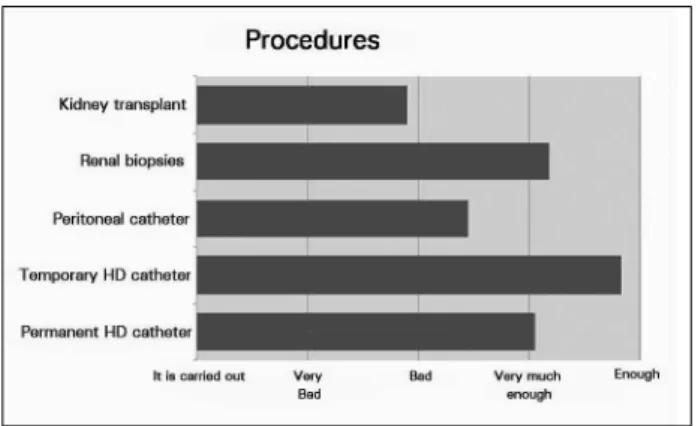
Of the respondents, 70% said that their syllabus had the minimum number of procedures required to graduate, 30% did not have or did not know if they had. Forty-seven point five percent felt that their training to insert a permanent hemodialysis catheter was sufficient, 12.5% did not have such training. Among the respondents, 82.5% felt that their training was enough to insert temporary hemodialysis catheter and 22.5% felt the same for the peritoneal dialysis catheter. Seven point five percent of the respondents did not insert this type of catheter during their training. They felt that their training was adequate for doing renal biopsies: 45% and evaluation of transplant patients, 22.5%. Of the respondents, 40% said their hospitals did not perform kidney transplants (Figure 3).
Figure 3. Frequency of procedures.
EXTERNALROTATION
Of those surveyed, 90% had or will have external rotations, and the renal transplantation area was the most common (57.5%), then peritoneal dialysis (15%) and pediatric nephropathy (15%). Sixty-five percent reported that they did or will do an international rotation, 96% in the field of renal transplantation, which they managed to get or will get by personal initiative in 77% of cases, and by means of their university in 23% of cases.
RESEARCH
Of the respondents, 67.5% had never carried out a research during their residency. Eight of the 13 residents who did research, presented in a meeting of the specialty. None of them published any study. Similarly, 77.5% considered deficient the level of research carried out in their hospitals.
OVERALLPERSPECTIVE
Among respondents, 60% said that their training was good in general and 20% said it was very good. Similarly, 35.5% believed that they had been partially assessed according to their syllabus and 12.5% did not think likewise. Among those evaluated, 40% believed that their job prospects were good and 30% believed them to be very good, usually in hospitals (80%) or private dialysis centers (82.5%). Of the respondents, 82.5% considered that the residency program should last at least 4 years.
Respondents felt that there is room for improvement in their residency programs, 57.5% demanding more academic activities, 45% suggesting improvements to the program organization, and 32.5% requesting expansion of their hospital services, these were the most requested improvements.
COMPARISONOFGRADUATESANDRESIDENTS
TUTORINGINNEPHROLOGY
Having a tutor appointed by the university was recognized by 90% of graduates and 75% of residents as an important issue. Nevertheless, 35% of graduates said their mentoring was good and 30% of residents said they did not have any of such support.
CLINICALTRAINING
They said they were taught the syllabus given by the university: 95% of graduates and 80% of residents. There were no differences in the frequency of academic activities, yet 55% of the graduates considered that their theoretical training was good; however, 40% of residents considered it deficient. Likewise, we found a decrease in the positive perception of all areas of clinical training by the resident compared to the graduates (data not shown).
PROCEDURES
They acknowledged that their syllabus had a minimum number of procedures needed to graduate: 65% of graduates and 75% of residents. However, as in the field of clinical training, there was a decrease in the positive perception of all procedures by residents compared to graduates (data not shown).
EXTERNALROTATION
They said their syllabus considered external rotations to complete their training: 95% of graduates and 85% of residents. They underwent or will go through an international rotation program: 70% of graduates and 60% of residents, in the same line, 55% of graduates and 45% of residents have been or will be on their own in this endeavor.
RESEARCH
They claimed to have done some research during their residency: 50% of graduates and only 10% of residents. Similarly, 30% of graduates and 20% of residents said they presented their research results in a meeting of the specialty. They considered their training poor in research: 60% of graduates and residents alike.
OVERALLPERCEPTION
They considered they were evaluated according to their syllabus: 50% of graduates and 55% of residents. With respect to their general education, this was considered good by 90% of graduates and 70% of residents; however, 30% of residents felt it was regular. As well as 75% of graduates and 65% of residents considered their job prospects as good or very good, 35% of residents deem it regular.
55% of graduates and 70% of residents considered working in the countryside.
Among the areas for improvement, graduates highlighted the encouragement of research in medical residency (50%) and improving the residency program overall organization (40%); residents highlighted more academic activities (65%) and improving the residency overall organization (50%).
D
ISCUSSIONThe main conclusions of our study reflects that while the general perception of participants regarding their residency in nephrology is favorable, it requires improvements in some aspects in the fields of mentoring, academic activities, procedures and research.
Although the majority of respondents said they had a tutor, his/her work was seen as deficient, which is worrisome in a system described as distant from training with mentoring, will have difficulties becoming a sustainable system in self-education.11 This is not strange in Peru which can
present, so that tutoring is usually performed by other hospital doctors.
The tutor’s work is recognized in all residency programs worldwide, so much so that a recent change in residency programs in the United States reduced the working hours of residents so that they could spend more time with their tutors.12 In Spain, the number of tutors has
increased, so that a third of teaching units have two or more tutors;4 on the other hand, in
Argentina, most residents do not have tutors with exclusive dedication and most residents depend on the education provided by more experienced physicians. The opening of new training facilities in our country should consider training both tutors and program managers.13
As far as clinical training is concerned, there are hospitals that do not carry out reviews of scientific publications, reviews of topics, clinical case discussions and pathology sessions, and one-third of respondents stated that academic training in their hospitals was poor. Even among residents of the same hospital the answers vary according to the year of training, possibly reflecting that the frequency of these activities varies from year to year. These results reflect the poor role of the university as the hub of medical training in the specialties, where it is common that training is the responsibility of the hospital to which the residents were appointed, many with residents from various universities. Thus, some services do not have a program including academic activities; and where there such activities could take place, they do not happen because of the multiple activities assigned to assistant physicians.
Residents recognize this lack of academic activities, since more than half of them requested more academic activities in their hospitals. In Argentina, 21% of the residents had no pathology session, 19% had only one clinical discussion per month and 19% had less than
one paper review per week.5 On the other
hand, in Spain, 70% of academic activities happen weekly.4 This is relevant, since it has
shown greater resident satisfaction regarding
their training with the increase in academic activities.14 In the US, residents recognized the
deficiencies in their training in aspects such as genetic diseases, pregnancy and kidney, pediatric nephrology, nutrition, palliative care at the end of life, plasmapheresis, imaging studies, kidney biopsy, management and research.6
As in the area of clinical training in the procedures, we also found noticeable aspects, as one third of respondents said they had no training in clinical procedures or they did not know whether there was a minimum percentage of procedures required for graduation. In many parts of the world, training programs discuss the need to define how many procedures are necessary to consider a trainee competent in nephrology; however, this is an issue not yet established.15 In Spain, there is a concern that
there are hospitals where 45% of residents stated they had not performed any renal biopsy during their program. And, in the case of inserting a peritoneal catheter, although it has been improved, it is still deficient.4 Likewise in
the US, the insertion of a peritoneal catheter and tunneled catheter for hemodialysis is carried out in less than 20% of the residency programs.6
Almost all respondents said their syllabus included external rotations, with international rotations, mostly made by personal initiative; it stands out because residents identified it as deficient in their training, and the university should facilitate such additional rotations. This practice is recognized and accepted by almost all resident training programs and even in programs having all fields of nephrology, it encourages residents to experience other realities.16
As far as research is concerned, our results showed deficiencies. The reasons are many, among which is the workload of the residents, which can be up to 80 hours a week in the United Unidos.12 There are successful experiences
Unfortunately in our country, although some authors have expressed concern on the issue,18
there is uncertainty whether medical regulatory institutions in Peru are committed to the development of scientific research.19
About half of our residents reported that they felt partially or not evaluated according to the content of their syllabi. Perhaps this happens because, just as in tutoring, in academic activities there are no criteria or defined programs for their assessment. However, one loses the opportunity to assess how was the trainee’s academic career, in order to make the necessary corrections for the resident, and the continuous monitoring of means of assessment should be one of the goals of our residency programs. This figure is greater than 32% among Argentine residents who felt poorly evaluated on their training;5 on the other
hand, in Spain, 37% believe that the development of their residency is little or nothing regulated.4
Among our respondents, what stands out is that the majority stated that the duration of residency should be at least four years; bearing in mind that less than a third of the respondents are residents of the four-year residency program, so that this fact is recognized by residents and graduates who had three years of training. It is noteworthy that 12.5% of residents believe that the residency should last five years, as 64% of the tutors of Spain, who believe that five years is the time required to train a nefrologist.4
Despite all the problems, most of our residents reported that their training in general was good or very good; perhaps because they believe they will have good job prospects. Another reason may be the emotional identification with their training hospital, which makes this answer very subjective. This appreciation is much higher than that of Spanish residents, which in 66% of cases qualify their residency program as good or very good and 13% considered it to be poor.4
Of course, despite a good perception of their training during residency, our residents received their training in a perfectible environment. Fundamental aspects such as mentoring, research, procedures and academic activities
are perceived as insufficient. Similarly, it is clear that the role of the university, in many cases, is passive in the training of residents, this is usually left in the hands of their hospitals, and what the latter offers them in terms of training, and in some cases they are not prepared to provide the resident an education in accordance with the requirements of current nephrology education.
We highlight the differences between residents and graduates with a general feeling that the medical residency in nephrology worsened, suggesting a decrease in overall positive perception and employment prospects, explained by the decreasing perception of the role of tutors, clinical training, procedures and research in residency, results that can be limited upon assessing perceptions and not objective parameters from the respondents, but it is worrisome because although it has been reported a decrease in the number of nephrology applicants in Peru,20 CONAREME increased the
number of spots available for residency programs in this specialty.20
Our study has limitations, such as the fact that despite our best efforts we could not get a 100% participation of residents in Peru, with the majority of people not participating coming from the countryside, and this may limit the generalizability of the results. Similarly, we must bear in mind that our assessment was on the perception of their training and does not specifically assess the quality of it, because subjective aspects that may overestimate the quality of the program can influence perception and we tried to limit it with the disintegration of perception of the aspects studied. Despite it all, our study is the first in our country, which evaluated the perception of nephrology residents and graduates on their training and can be used to start more specific evaluations of training of our residents.
R
EFERENCES1. Castillo H. Perú. Nefrología (Madr)1992;12;45-57.
2. Comité Nacional de Residentado Medico (CONAREME). Es-tándares Mínimos de Formación para el Programa de Segun-da Especialización en Nefrologia. 2002. Disponible en: http:// www.conareme.org.pe/Documentos/Estandares%20Minimos/ GRUPO%20II/nefrologia.pdf
3. Hallan SI, Coresh J, Astor BC, Asberg A, Powe NR, Romun-dstad S, et al. International comparison of the relationship of chronic kidney disease prevalence and ESRD risk. J Am Soc Nephrol 2006;17:2275-84. DOI: http://dx.doi.org/10.1681/ ASN.2005121273
4. Ortega-Suárez F. Resultados de la tercera encuesta de 2012 so-bre la formación docente del residente de Nefrología. Nefrolo-gia (Madr) 2014;34:323-9.
5. Villalonga MI, Di Bernardo JJ. La formación de los nefrólogos argentinos desde la óptica de los protagonistas. Nefrol Argent 2008;6:91-5.
6. Berns JS. A survey-based evaluation of self-perceived competen-cy after nephrology fellowship training. Clin J Am Soc Nephrol 2010;5:490-6. DOI:http://dx.doi.org/10.2215/CJN.08461109 7. Zevallos L, Pastor R, Moscoso B. Supply and demand of
me-dical specialists in the health facilities of the Ministry of Heal-th: national, regional and by type of specialty gaps. Rev Peru Med Exp Salud Publica 2011;28:177-85. DOI: http://dx.doi. org/10.1590/S1726-46342011000200003
8. Comité Nacional de Residentado Medico (CONAREME). Cuadro General de vacantes del proceso de admisión al residen-tado médico 2013[Acceso 20 Jun 2015]. Disponible en: http:// www.conareme.org.pe/admision.php
9. Paredes-Bodegas E. Análisis del proceso de acreditación del re-sidentado médico en el Perú, 2003-2005. Rev Soc Peru Med Interna 2007;20:69-82.
10. Caballero P, Yagui M, Espinoza M, Castilla T, Granados A, Velás-quez A, et al. Prioridades regionales y nacionales de investigación en salud, Perú 2010-2014: un proceso con enfoque participativo y descentralista. Rev Perú Med Exp Salud Pública 2010;27:398-411. DOI: http://dx.doi.org/10.1590/S1726-46342010000300013
11. Herrera, P, Galán E, Mezones E. Residentado médico en el Perú: una visión más allá de la demanda. Acta Med Peruana 2012;29:10-1.
12. Drolet BC, Christopher DA, Fischer SA. Residents' respon-se to duty-hour regulations-a follow-up national survey. N Engl J Med 2012;366:e35. DOI:http://dx.doi.org/10.1056/ NEJMp1202848
13. Norby SM, Karniski LP, Schmidt DW, Kohan DE. Mentoring for subspecialty training program directors: an unrecognized, unmet need? J Grad Med Educ 2010;2:206-9.
14. Takahashi O, Ohde S, Jacobs JL, Tokuda Y, Omata F, Fukui T. Residents' experience of scholarly activities is associated with higher satisfaction with residency training. J Gen In-tern Med 2009;24:716-20. DOI: http://dx.doi.org/10.1007/ s11606-009-0970-4
15. Berns JS, O'Neill WC. Performance of procedures by ne-phrologists and nephrology fellows at U.S. nephrology trai-ning programs. Clin J Am Soc Nephrol 2008;3:941-7. DOI: http://dx.doi.org/10.2215/CJN.00490108
16. Marini A, Petraglia G, Bonfante A, Fernandez A, Robaina J, Rosa Diez A, et al. Propuesta integradora para la forma-ción en Nefrologia, la acreditaforma-ción de centros formadores y la certificación y recertificación de la especialidad 2008. Nefrol Argent;7:76-88.
17. Polasek O, Kolcić I, Buneta Z, Cikes N, Pećina M. Scienti-fic production of research fellows at the Zagreb University School of Medicine, Croatia. Croat Med J. 2006;47:776-82.
18. Figueroa L. ¿Hay espacio para la investigación durante la residencia Médica en el Perú? Rev Peru Med Exp Salud Pú-blica 2011;4:688-99.
19. Castro JR. ¿Las instituciones médicas regulatorias del Perú apuestan por el desarrollo de la investigación científica? Rev Med Hered 2012;23:269-70.