R-C N + HOOH -OH
slow R-C N -OOH
H2O R-C
NH
OOH
(I)
O
+ RCONH2 fast
RCONH2 + H2O + O2 H2O2
fast Article
Experimental and Theoretical Study on the Reactivity of the R-CN/H
2O
2System in the
Epoxidation of Unfunctionalized Olefins
Maria Luiza A. von Holleben*, Paolo R. Livotto, Cristina M. Schuch#
Instituto de Química, Universidade Federal do Rio Grande do Sul, Av. Bento Gonçalves, 9500, Campus do Vale, 91501-970, Porto Alegre - RS, Brazil
A reatividade da acetonitrila, tricloroacetonitrila, benzonitrila, m-clorobenzonitrila,
3-cianopiridina, 1-naftonitrila e 9-antracenonitrila na geração in situ do respectivo ácido
peroxicarboximídico foi estudada por cálculos de OM, utilizando o método AM1, e experimentalmente na epoxidação do cicloexeno e R-(+)-limoneno. Os resultados experimentais
mostraram que a reatividade do sistema Cl3CCN/H2O2 foi semelhante ao MCPBA na epoxidação de olefinas não-funcionalizadas, quando o solvente utilizado foi uma mistura bifásica CH2Cl2/ H2O.
A study on the reactivity of peroxycarboximidic acids in situ generated from acetonitrile,
trichloroacetonitrile, benzonitrile, m-chlorobenzonitrile, 3-cyanopyridine, 1-naphthonitrile and
9-anthracenenitrile was performed by semiempirical AM1 method and experimentally in the epoxidation of cyclohexene and R-(+)-limonene. Experimental results showed that the reactivity of Cl3CCN/H2O2 was quite similar to MCPBA in the epoxidation of unfunctionalized olefins when a biphasic mixture CH2Cl2/H2O was employed as solvent.
Keywords: epoxidation, alkenes, peroxycarboximidic acid
Introduction
Many reagents have been utilized to epoxidize unfunctionalized olefins, among them peracids are the most widely used. The structurally related peroxycarboximidic acids1 have been much less explored in spite of non-acidic conditions and good yields obtained with peroxybenzimidic acid (Payne epoxidation)2a-d. The acid (I) is a highly reactive species which has not yet been isolated. It reacts with an alkene leading to epoxide and amide (Scheme 1). In the absence of the alkene, it reacts with a second mole of hydrogen peroxide affording oxygen, water and an amide.
The activation of the nitrile by hydrogen peroxide3 to form a peroxycarboximidic acid (I)occurs in methanol as
solvent and basic medium. An interesting variation of Payne epoxidation was introduced by Bach and coworkers4. These authors utilized trichloroacetonitrile instead of benzonitrile and a biphasic mixture of dichloromethane/water (1:1) as solvent in the epoxidation of some olefins. This work was preceded by a theoretical study of the structural and electronic features of peroxyformic and peroxyformimidic acids using ab initio level calculations5. The results
suggested that the reactivity of both species would be quite similar and that the presence of an electron withdrawing
R1CN/H2O2 solvent, KHCO3
O
2a 3a
R1=Me (1a); trichloromethyl (1b); phenyl (1c); m-chlorophenyl (1d); 3-pyridinyl (1e); 1-naphthyl (1f); 9-anthracenyl (1g).
R1CN/H2O2 solvent, KHCO3
O O
+
H O H O
+ +
3b' (trans) 3b" (cis) 3c' 3c"
3b (1,2-epoxides) 3c (8,9-epoxides) 2b
substituent should enhance the reactivity of the peroxycarboximidic acid on the epoxidation. To our knowledge, no other study has been put forward to investigate the effect of the nitrile substituent in the epoxidation of unfunctionalized olefins.
In this context, we studied the theoretical and experimental reactivity of the acetonitrile (1a), trichloroacetonitrile (1b),
benzonitrile (1c), 3-chlorobenzonitrile (1d), 3-cyanopyridine
(1e), 1-naphthonitrile (1f) and 9-anthracenenitrile (1g)in the
epoxidation of cyclohexene (2a) and R-(+)-limonene (2b). Our
goal was to develop a reagent based on hydrogen peroxide that could compete with MCPBA in cost and reactivity.
In the experimental study we employed some different solvents as methanol, a biphasic mixture of dichloromethane/ water (1:1) and water as depicted in the Scheme 2.
A theoretical study was carried out at the AM16a level implemented by MOPAC program6b in order to investigate the conformational features and intrinsic properties of each peroxycarboximidic acid.
Experimental
General
Unless otherwise noted, materials were obtained from commercial suppliers and used without further purification. R-(+)-limonene was distilled prior to use. Flash column chromatography was carried out using 230-400 mesh silica gel. 1H NMR spectra were obtained with a Varian VXR-200 spectrometer. Proton-decoupled 13C-spectra were obtained at 50MHz with the same instrument. GC analyses were carried out using a capilar column HP-1 (50m x 0.2mm x 0.11 µm).
Theoretical calculations were performed at Cray Y-MP2E/ 232 computer employing the AM1 method implemented by MOPAC 7.0 program. The energy minimization was realized with respect to all geometrical parameters from an appropriate region of the Potential Energy Surface (PES).
Typical procedure for the epoxidation of 2a or2b with ni-triles (1a, 1c-g)/H2O2:
In a typical run, olefin (2a or 2b, 10 mmol),nitrile (1a, 1c-g, 10 mmol) and KHCO3 (2 mmol) were dissolved in
methanol (20 cm3). The mixture was treated with hydrogen peroxide (30% wt. solution in water, 10 mmol) dropwise. The stirring was continued for 24 hours at room temperature. The mixture was diluted with water (5 cm3) and extracted three times with dichloromethane (10 cm3). The organic layer was washed with 20% aq. solution of NaHSO3 and dried over MgSO4. The yield of epoxide was determined by GC analysis based on internal standard (n-decane). The respective amide was isolated by filtration, washed with hexane and dried in vacuo. Purification by column chromatography on silica gel (10% EtOAc/hexane, v/v) afforded epoxides 3a or 3b-c (yields are indicated in
Table 1). Compounds 3a, 3b and 3c were isolated as
chromatographically pure materials and exhibited acceptable 1H NMR, 13C NMR, IR and MS spectral data, which were identical with those reported in the literature7.
Typical procedure for the epoxidation of 2a or 2b with Cl3CCN/H2O2:
To a solution of olefin (2a or 2b, 10 mmol) and Cl3CCN
(1b,10 mmol) in CH2Cl2 (10 cm3) was added 10 cm3 of
0.2 mol. dm-3 aqueous solution of KHCO
3. The biphasic mixture was cooled to 0oC and treated with hydrogen peroxide (30% wt. solution in water, 10 mmol) dropwise under vigorous stirring. The mixture was vigorously stirred for 24 hours at room temperature. The organic layer was separated, the aqueous layer was three times extracted with dichloromethane (10 cm3), and dried over MgSO
4. The solvent was removed under vacuum and trichloro-acetamide was isolated by filtration. Purification by column chromatography on silica gel (10% EtOAc/hexane, v/v) afforded epoxides 3a or 3b-c in 76% and 72% yield,
respectively. In the aqueous condition, 10 cm3 of dichloromethane was replaced by 10 cm3 of water.
Results and Discussion
The epoxidation of cyclohexene (2a) and R-(+)-limonene
(2b)with nitriles (1a-g),mediated by H2O2 and KHCO3was
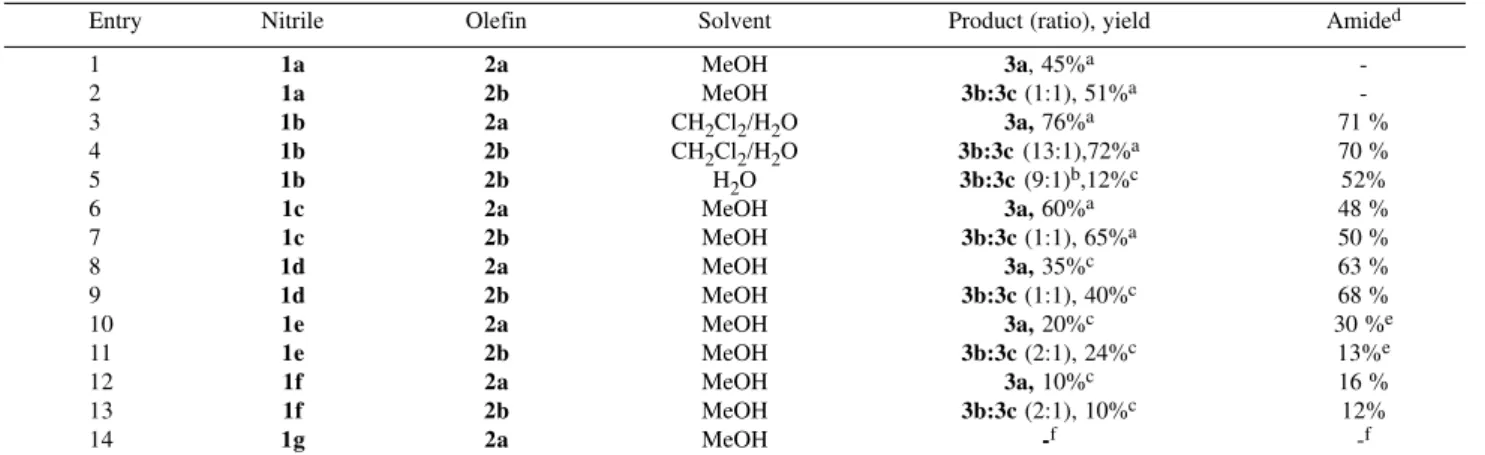
carried out. The results described in Table 1 were obtained after 24 hours at room temperature (standard procedure).
Epoxides were obtained in 10-65% yields with nitriles
1a, 1c-f (entries 1-2, 6-13, Table 1) using methanol as
solvent. Trichloroacetonitrile (1b) did not furnish epoxides
or amide in methanol. In this case, methyl trichloroaceti-midate was isolated as result of the nucleophilic attack of the solvent at the nitrile carbon. The trichloroacetimidic acid was formed only when a biphasic mixture of dichloromethane/water (1:1) (entries 3 and 4) or water (entry 5) were used as solvent. Interestingly, nitriles 1a, 1c-g did not furnish epoxides or amides using the biphasic
mixture of solvent. An amide/epoxide ratio superior to 1.0 was observed in some cases (entries 5, 8-10, and 12-13) and suggested that the peroxycarboximidic acid reacted with hydrogen peroxide in the fast step8. It is important to consider that the reduction of reactive intermediate can be
promoted by the olefin or the hydrogen peroxide, as represented in the Scheme 1.
The epoxidizing system Cl3CCN/H2O2 showed high chemoselectivity in the epoxidation of the more nucleophilic double bond of R-(+)-limonene (entries 4-5) in spite of the unselective behavior of the other systems RCN/H2O2 studied9. A 13:1 ratio of 3b:3c (Scheme 2) was obtained in CH2Cl2/H2O (entry 4) and 9:1 in water (entry 5), which were quite similar with results obtained in the epoxidation of R-(+)-limonene with MCPBA10. Besides, when the reaction was carried out in water (entry 5) the product 3b’ (trans) was obtained in 82% d.e. (ratio trans:cis
of 10:1, determined by 1H NMR). In this case the diastereoselectivity was attributed to a deleterious effect of the aqueous 0.1mol. dm-3 solution of KHCO
3 on the cis stereoisomer which resulted an enriched mixture of trans
isomer in only 12% yield. Jones and coworkers11 verified the same effect when an aqueous 1mol. dm-3 solution of NaHSO3 was employed. They noted that the oxirane ring opening in the cis isomer was faster than in the trans isomer.
The experimental reactivity order observed in the olefin epoxidation with nitriles 1a, c-g using a standard procedure
and methanol as solvent, was 1c > 1a > 1d > 1e > 1f > 1g.
This experimental behavior isnot in accordance with LUMO energies of nitriles 1a-g calculated by AM1 method12.
Besides, it is important to consider that Cl3CCN (1b)was
not included in the above order because good results only were attained when methanol was replaced by CH2Cl2/H2O. In order to attempt rationalize these results, a conformational analysis and intrinsic properties calculations of the conformers of each peroxycarboximidic acids (5a-g,
Figure 1) were performed13. The two most stable conformers of the eight possible5 were Z (C=N geometry), s-cis (C-O bond), antiperiplanar and E (C=N geometry), s-cis (C-O
bond), synperiplanar as represented in Figure 1. Table 1. Results for the epoxidation of 2a and 2b with RCN (1a-1g)/H2O2.
Entry Nitrile Olefin Solvent Product (ratio), yield Amided
1 1a 2a MeOH 3a, 45%a
-2 1a 2b MeOH 3b:3c (1:1), 51%a
-3 1b 2a CH2Cl2/H2O 3a, 76%a 71 %
4 1b 2b CH2Cl2/H2O 3b:3c (13:1),72%a 70 %
5 1b 2b H2O 3b:3c (9:1)b,12%c 52%
6 1c 2a MeOH 3a, 60%a 48 %
7 1c 2b MeOH 3b:3c (1:1), 65%a 50 %
8 1d 2a MeOH 3a, 35%c 63 %
9 1d 2b MeOH 3b:3c (1:1), 40%c 68 %
10 1e 2a MeOH 3a, 20%c 30 %e
11 1e 2b MeOH 3b:3c (2:1), 24%c 13%e
12 1f 2a MeOH 3a, 10%c 16 %
13 1f 2b MeOH 3b:3c (2:1), 10%c 12%
14 1g 2a MeOH -f -f
a. Yields are reported after purification of the crude mixture by column chromatography; b. Ratio 3b’:3b” (trans:cis) of 10:1, determined by 1H NMR, as
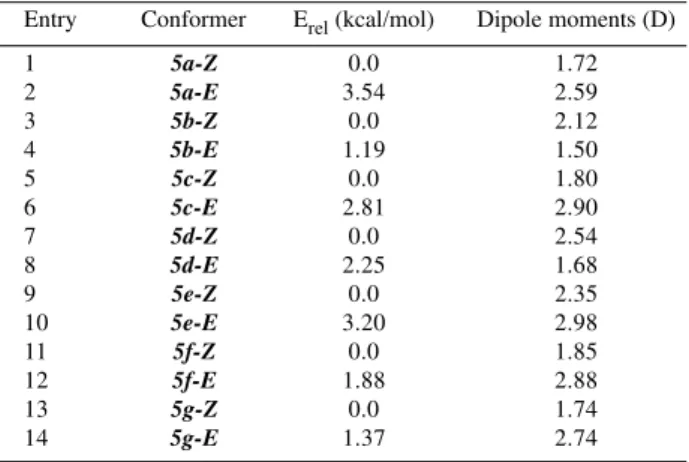
We calculated the relative energies and dipole moment values of the corresponding E and Z conformers of the
peroxycarboximidic acids 5a-g.The results are summarized
in Table 2.
group could be affecting the kinetics of the reaction. Unfortunately, it was impossible to compare the reactivity of all RCN/H2O2 systems studied in the same solvent. Further additional kinetics studies would be needed to understand the different reactivity showed by these systems.
Conclusion
In conclusion, the choice of a nitrile for olefin epoxidation mediated by hydrogen peroxide could not be carried out through a simple analogy between the peroxycarboximidic acid, in situ generated, and the
structurally related peracid.
Moreover, we concluded that the reactivity of benzonitrile, 3-chlorobenzonitrile and acetonitrile were quite similar in the epoxidation of unfunctionalized olefins, mediated by hydrogen peroxide and KHCO3 in methanol as solvent. Trichloroacetonitrile showed the best results in this study. In the epoxidation of R-(+)-limonene, the Cl3CCN/H2O2 system presented a chemoselective behavior similar to MCPBA. Besides, the utilization of a biphasic mixture of solvent makes the purification of oxiranes easier and avoids acidic conditions, which makes the Cl3CCN/ H2O2 system an excellent alternative method to MCPBA epoxidation.
Acknowledgments
The authors thank FAPERGS and CNPQ for financial support and studentship and CESUP/UFRGS (FINEP) for computer time.
References
1. Wiberg, K. B. J. Am. Chem. Soc.1953,75, 3961.
2. (a) Payne, G. B.; Williams, P. H. J. Org. Chem.1961,
26, 651. (b) Payne, G. B.; Deming, P.H.; Williams, P. H. J. Org. Chem. 1961,26, 659. (c) Payne, G. B. Tetrahedron
1962, 18, 763; (d) Bachmann,C.; Gesson, J. P.; Renoux,
B.; Tranoy, I. Tetrahedron Lett. 1998,39, 379. R
C
O O
H
H N
R
C
O
O
H H
N
Z(Erel=0) E
Figure 1. Representations of the geometry of the two most stable conformers of the peroxycarboximidic acids 5a-g (values of relative energies are summarized in Table 2).
Table 2. Calculated values of the intrinsic properties of E and Z
conformers of the peroxycarboximidic acids (5a-g).
Entry Conformer Erel (kcal/mol) Dipole moments (D)
1 5a-Z 0.0 1.72
2 5a-E 3.54 2.59
3 5b-Z 0.0 2.12
4 5b-E 1.19 1.50
5 5c-Z 0.0 1.80
6 5c-E 2.81 2.90
7 5d-Z 0.0 2.54
8 5d-E 2.25 1.68
9 5e-Z 0.0 2.35
10 5e-E 3.20 2.98
11 5f-Z 0.0 1.85
12 5f-E 1.88 2.88
13 5g-Z 0.0 1.74
14 5g-E 1.37 2.74
The calculations showed that Z is the conformer of
minimum energy with an internal hydrogen bond between
H imidic and hydroxyl group. The E conformer is an analog
of the peracids with an anti imine structure containing an
internal hydrogen bond between nitrogen atom and H
hydroperoxide. Both conformers showed a minimum conformation when H hydroperoxide was out of plane
formed by the functional group (Figure 1).
The butterfly mechanism is usually accept for Payne
epoxidation14. In this context, it was postulated that only the E conformer has an adequate geometry to react with
an olefin5. However, we assumed that Z conformer could be able to react with hydrogen peroxide in the fast step.
3. von Holleben, M. L. A.; Schuch, C. M. Quím. Nova,
1997, 20, 58.
4. Arias, L. A.; Adkins, S.; Nagel,C. J.; Bach, R. D.
J. Org. Chem. 1983,48, 888.
5. Lang, T. J.; Wolber, G. J.; Bach, R. D. J. Am. Chem. Soc.1981,103, 3275.
6. a) Dewar, M. J. S.; Zoebisch, E. G.; Healy, E. F.; Stewart, J. J. P. J. Am. Chem. Soc. 1985, 107, 3902.
b) Stewart, J. J. P. MOPAC 7.0, Quantum Chemistry Program Exchange, Program 452.
7. Carman, R. M.; DeVoss, J. J.; Greenfield, K. L. Aust. J. Chem. 1986, 39, 441.
8. On the mechanism of the conversion of nitriles to amides by hydrogen peroxide in the absence of olefin, see: McIsaac, J. J. E.; Ball, R. E.; Behrman, E. J.
J. Org. Chem. 1961, 36, 3048.
9. von Holleben, M.L.A.; Schuch, C.M.; Livotto, P.R.
VII Brazilian Meeting on Organic Synthesis, Rio de
Janeiro, Brazil, 1996,135, PS109.
10. Carlson, R. G.; Behn, N. S.; Cowles, C. J. Org. Chem.
1971, 36, 3832.
11. Santos,A. G.; Castro,F. L.; Jones Jr, J. Synthetic Commun. 1996, 26, 2651.
12. We calculated the LUMO energies of nitriles 1a-g by AM1
method. However, we cannot correlate the theoretical reactivity order, based in the LUMO energies of nitriles with the experimental reactivity order observed. (a) von Holleben, M. L. A.; Schuch, C. M.; Livotto, P.R. 5th European Symposium on Organic Reactivity (ESOR V),
Santiago de Compostela, Spain, 1995,95. (b) Schuch, C.
M. Dissertação de Mestrado, Universidade Federal do
Rio Grande do Sul, Brazil, 1996.
13. Geometrical Parameters for Peroxycarboximidic acids
5a-5g: Z Conformers: (O-O): 1.291 Å (5a, 5f); 1.290
Å (5b, 5c, 5d, 5e); 1.292 Å (5g). (O-H): 0.986 Å (5b,
5e, 5f); 0.985 Å (5a, 5c, 5d, 5g). (C-O): 1.434 Å (5a);
1.440 Å (5c); 1.438 Å (5d); 1.437 Å (5e, 5f, 5g); 1.433
Å (5b). (C=N): 1.279 Å (5a, 5f); 1.278 Å (5b); 1.282
Å (5c, 5e); 1.280 Å (5d, 5g). (N-H): 0.998 Å (5a);
1.000 Å (5b, 5e, 5g); 0.999 Å (5c, 5d, 5f). (C-R):
1.499 Å (5a); 1.525 Å (5b); 1.480 Å (5c); 1.479 Å
(5d); 1.474 Å (5e); 1.482 Å (5f); 1.484 Å (5g).
(O-C-R): 106.9o (5a); 108.5o (5b); 108.2o (5c); 108.4o (5d); 108.3o (5e); 107.1o (5f); 107.6o (5g). (O-C=N): 127.2o (5a); 127.3o (5b); 126.6o (5c); 126.5o (5d); 126.8o
(5e); 127.0 (5f); 127.1o (5g). (C=N-H) 116.1o (5a, 5b); 115.8o (5c, 5e, 5f, 5g). (O-O-C): 114.2o (5a, 5c, 5f); 113.6o (5b); 114.1o (5d, 5g). (O-O-H): 107.2o
(5a, 5b, 5e, 5f); 107.3o (5c); 107.4o (5d); 107.1o (5g).
E Conformers: (O-O): 1.286 Å (5a, 5d, 5f, 5g); 1.284
Å (5b); 1.290 Å (5c); 1.285 Å (5e). (O-H): 0.985 Å
(5a, 5f, 5g); 0.986 Å (5c, 5d); 0.987 Å (5b, 5e).
(C-O): 1.420 Å (5a); 1.422 Å (5b, 5d, 5f, 5g); 1.430 Å
(5c); 1.423 Å (5e). (C=N): 1.284 Å (5a, 5f, 5g); 1.277
Å (5b); 1.286 Å (5c); 1.285 Å (5d, 5e). (N-H): 0.996
Å (5a, 5e); 0.997 Å (5b, 5c, 5d, 5f, 5g). (C-R): 1.499
Å (5a); 1.530 Å (5b); 1.480 Å (5c, 5d); 1.475 Å (5e);
1.483 Å (5f); 1.485 Å (5g). (O-C-R): 107.4o (5a);
108.3o (5b); 108.8o (5c, 5e); 108.5o (5d); 108.1o (5g); 108.7o (5g). (O-C=N): 121.4o (5a,5g); 121.3o (5b); 121.0o (5c, 5e); 121.1o (5d); 121.5o (5f). (C=N-H) 115.2o (5a); 117.6o (5b); 115.3o (5c, 5f); 115.4o (5d,
5g); 115.5o (5e). (O-O-C): 117.5o (5a); 116.4o (5b);
117.1o (5c, 5f); 117.0o (5d, 5g); 117.2o (5e). (O-O-H): 108.9o (5a, 5d, 5f, 5g); 108.8o (5b); 109.0o (5c); 109.1o (5e).
14. In the olefin epoxidation, the electrophilic mechanism occurs in the cyclic transition state (Butterfly) or in the
opened transition state. For discussion see: Rebek, J.
Heterocycles1981,15, 517.