Article
J. Braz. Chem. Soc., Vol. 25, No. 2, 253-263, 2014. Printed in Brazil - ©2014 Sociedade Brasileira de Química 0103 - 5053 $6.00+0.00
A
*e-mail: [email protected]
Direct, Rapid and Convenient Synthesis of Esters and Thioesters Using
PPh
3/
N
-Chlorobenzotriazole System
Hamed Rouhi-Saadabad and Batool Akhlaghinia*
Department of Chemistry, Faculty of Sciences, Ferdowsi University of Mashhad, Mashhad 9177948974, Iran
Desenvolvemos um método eficiente de esterificação e tioesterificação de uma série de ácidos
carboxílicos com diferentes álcoois e tióis usando o reagente misto PPh3/N-clorobenzotriazol em
CH2Cl2 a temperatura ambiente.
We have developed an efficient method for esterification and thioesterification of various
carboxylic acids with different alcohols and thiols using PPh3/N-chlorobenzotriazole mixed reagent
in CH2Cl2 at room temperature.
Keywords: PPh3,N-chlorobenzotriazole (NCBT), esters, thioesters
Introduction
Esterification is the fundamental and routinely used functional group transformation in organic chemistry1 and
it is extensively employed for the protection and further manipulation of the carboxylic acid functional group as well as the synthesis of natural products. Traditionally, the simple condensation between a carboxylic acid and an alcohol is the most straightforward way to esterification. The difficulty stems primarily from the equilibration of the condensation reaction. The commonest approach to bias the equilibrium in favor of the product side is either by using the reactants in excess and/or continuously removing of the water formed during the reaction. The former treatment is not desirable in terms of “atom economy”2 since the excess
reactant remains to be separated from the reaction mixture. On the other hand, azeotropy is most frequently invoked, but a variety of dehydration methods have been put forth, although 100% conversion and, hence, 100% yield are, in general, not easy to achieve. Another problem emerges from the base or acid catalysts which are inevitably employed in this reaction. Under such conditions, the tolerance of a wide spectrum of functional groups that is often required in modern synthetic chemistry is not easy to achieve. Activation of the carboxylic acid or alcohol components with a stoichiometric amount of promoter such as carbodiimides,3
diethylazodicarboxylate,4 5,5´-dimethyl-3,3’-azoisoxazole,5
azopyridines,6 [{Cl(C
6F13C2H4)2SnOSn(C2H4C6F13)2Cl}2]
graphite bisulfate,7 functionalized acidic ionic liquids,8,9
TiO(acac)2,10 is another possible but uneconomical choice.
These reactions historically faced purification challenges and often haunt the chemist in the isolation of the desired product. Development a new, simple, efficient, and highly profitable esterification method under mild reaction conditions and without tedious and difficult purification steps, is highly desirable and challenging.
The N-halo reagents in combination with PPh3 have
found widespread use in synthetic organic chemistry.11
In the present study, esterification and thioesterification of carboxylic acids were investigated by using
N-chlorobenzotriazole (NCBT, as an N-halo reagent) PPh3 system. The reaction proceeds under mild, essentially neutral conditions and has been well documented for a variety of substrates.
Experimental
General
spectrometer. The nuclear magnetic resonance (NMR) spectra were provided on Bruker Ultrashield Avance III 400 MHz instruments in CDCl3. Mass spectra were recorded
with a CH7A Varianmat Bremem instrument at 70 eV, in
m/z (rel%). NCBT was prepared and purified by the method described in the literature.12 Preparation of benzyl benzoate
by using PPh3/5,5’-dimethyl-3,3’-azoisoxazole, PPh3
/4,4’-azopyridine, Ph2PCl/I2/imidazole and PPh3/[bis(acetoxy)
iodo]benzene/diethylazodicarboxylate (DEAD) mixed reagents was performed according the methods reported previously.5,6,13,14
Preparation of benzyl benzoate by using PPh3/
trichloroisocyanuric acid (TCCA)
To a cold solution of PPh3 (0.327 g, 1.25 mmol) in
CH2Cl2 (3 mL), TCCA (0.0974 g, 0.42 mmol) was added
with continuous stirring. Benzoic acid (0.122 g, 1 mmol) was then added and stirring was continued for 15 min. Benzyl alcohol (0.270 g, 2.5 mmol) was added and the temperature was raised up to room temperature. The white suspension was neutralized by triethylamine (0.175 mL). Stirring was continued for 2.5 h at room temperature. The progress of the reaction was followed by TLC. Upon completion of the reaction, the concentrated residue was passed through a short silica-gel column using n-hexane–ethyl acetate (8:1) as eluent. Benzyl benzoate was obtained with 85% yield after removing the solvent under reduced pressure.
Preparation of benzyl benzoate by using PPh3/
N-bromosuccinimide (NBS)
To a cold solution of PPh3 (0.327 g, 1.25 mmol) in
CH2Cl2 (3 mL), NBS (0.223 g, 1.25 mmol) was added with
continuous stirring. Benzoic acid (0.122 g, 1 mmol) was then added and stirring was continued for 15 min. Benzyl alcohol (0.270 g, 2.5 mmol) was added and the temperature was raised up to room temperature. The red suspension was neutralized by triethylamine (0.175 mL). Stirring was continued for 4.5 h at room temperature. The progress of the reaction was followed by TLC. Upon completion of the reaction, the concentrated residue was passed through a short silica-gel column using n-hexane–ethyl acetate (8:1) as eluent. Benzyl benzoate was obtained with 40% yield after removing the solvent under reduced pressure.
Preparation of benzyl benzoate by using PPh3/
N-chlorosuccinimide (NCS)
To a cold solution of PPh3 (0.327 g, 1.25 mmol) in
CH2Cl2 (3 mL), NCS (0.166 g, 1.25 mmol) was added with
continuous stirring. Benzoic acid (0.122 g, 1 mmol) was then added and stirring was continued for 15 min. Benzyl alcohol (0.270 g, 2.5 mmol) was added and the temperature was raised up to room temperature. The pale yellow solution was neutralized by triethylamine (0.175 mL). Stirring was continued for 3 h at room temperature. The progress of the reaction was followed by TLC. Upon completion of the reaction, the concentrated residue was passed through a short silica-gel column using n-hexane–ethyl acetate (8:1) as eluent. Benzyl benzoate was obtained with 80% yield after removing the solvent under reduced pressure.
Preparation of benzyl benzoate by using PPh3/NCBT
To a cold solution of PPh3 (0.327 g, 1.25 mmol)
in CH2Cl2 (3 mL), freshly prepared NCBT (0.194 g,
1.25 mmol) was added with continuous stirring. Benzoic acid (0.122 g, 1 mmol) was then added and stirring was continued for 15 min. Benzyl alcohol (0.270 g, 2.5 mmol) was added and the temperature was raised up to room temperature. The pale yellow solution was neutralized by triethylamine (0.175 mL). Stirring was continued for 40 min at room temperature. The progress of the reaction was followed by TLC. Upon completion of the reaction, the concentrated residue was passed through a short silica-gel column using n-hexane–ethyl acetate (8:1) as eluent. Benzyl benzoate was obtained with 95% yield after removing the solvent under reduced pressure.
Benzyl benzoate (Table 3, entry 1)
m.p. 20-21°C (Lit. 19-21 °C);15 IR (neat)υ max/cm−1
3423, 3088, 3064, 3033, 2949, 2892, 1716 (C=O), 1601, 1585, 1451, 1376, 1314, 1270 (C–O), 1175, 1109, 1069, 710, 697; 1H NMR (400 MHz, CDCl
3, 25 °C, ppm) δ
8.14-8.11 (m, 2H, ArH), 7.62-7.58 (m, 1H, ArH), 7.51-7.41 (m, 7H, ArH), 5.41 (s, 2H, PhCH2).
Benzyl 4-methylbenzoate (Table 3, entry 2)
Solid; m.p. 45-46 °C (Lit. 45-46 °C);16IR (KBr)υ max/cm−1
3391, 3088, 3031, 2962, 2896, 1706 (C=O), 1609, 1454, 1370, 1267 (C–O), 1175, 1100, 751, 700; MS (EI) m/z 226 (M+, 10%), 118 (M+–PhCH
2O, 100%), 91 (PhCH2, 90%).
Benzyl 3,5-dimethylbenzoate (Table 3, entry 3)
Solid; m.p. 65-66 °C (Lit. 66-67 °C);17IR (KBr)υ max/cm−1
3423, 3063, 3033, 3009, 2951, 2918, 1717 (C=O), 1608, 1498, 1555, 1308, 1211 (C–O), 1115, 1010, 766, 754,
697; 1H NMR (400 MHz, CDCl
3, 25 °C, ppm) δ 7.73 (s,
2H, ArH), 7.50-7.48 (d, 2H, J 6.8 Hz, ArH) 7.45-7.36 (m,
3H, ArH), 7.22 (s, 1H, ArH), 5.39 (s, 2H, PhCH2), 2.39
Benzyl 4-methoxybenzoate (Table 3, entry 4)
m.p. 24-26 °C (Lit. 25-27 °C);18IR (neat) υ max/cm
−1
3415, 3068, 2962, 2937, 2839, 1712(C=O), 1606, 1581, 1511, 1456, 1376, 1316, 1270, 1256 (C–O), 1167, 1099, 1029, 769, 696; 1H NMR (400 MHz, CDCl
3, 25 °C, ppm) δ
8.91 (td, 2H, J 9.2, 2.4 Hz, ArH), 7.49-7.46 (m, 2H, ArH), 7.44-7.29 (m, 3H, ArH), 6.97-6.93 (m, 2H, ArH), 5.37 (s, 2H, PhCH2), 3.89 (s, 3H, OCH3).
Benzyl 2-chlorobenzoate (Table 3, entry 5)
m.p. 18-20 °C; IR (neat) υmax/cm−1 3064, 3027, 2925,
2847, 1722 (Lit. 1729, C=O),19 1589, 1484, 1451, 1378,
1290 (C–O), 1131, 1046, 936, 751, 740.
Benzyl 4-chlorobenzoate (Table 3, entry 6)
m.p. 25-26 °C (Lit. 25-26 °C);16 IR (neat) υ max/cm
−1
3431, 3064, 3035, 2949, 1721 (C=O), 1594, 1487, 1400, 1270 (C–O), 1114, 1092, 1014, 758, 696.
Benzyl 4-bromobenzoate (Table 3, entry 7)
Solid; m.p. 51-52 °C (Lit. 52-53 °C);16 IR (KBr)
υ
max/cm
−1 3415, 3072, 3039, 2974, 2892, 1715 (C=O),
1588, 1455, 1396, 1269 (C–O), 1169, 1089, 1008, 759,
698; 1H NMR (400 MHz, CDCl
3, 25 °C, ppm) δ 7.97 (d,
2H, J 8.4 Hz, ArH), 7.61 (d, 2H, J 8.4 Hz, ArH), 7.49-7.38 (m, 5H, ArH), 5.40 (s, 2H, PhCH2); MS (EI) m/z 291 (M
+,
5%), 182 (M+–PhCH
2O, 87%), 91 (PhCH2, 87%).
Benzyl 3,4-dichlorobenzoate (Table 3, entry 8)
Solid; m.p. 57-58 °C (Lit. 58-60 °C);16 IR (KBr)
υmax/cm−1 3092, 3072, 3039, 2953, 2892, 1724 (C=O), 1585,
1564, 1458, 1379, 1273 (C–O), 1236, 1106, 1032, 757,
696; 1H NMR (400 MHz, CDCl
3, 25 °C, ppm) δ 8.16 (d,
1H, J 2 Hz, ArH), 7.91 (dd,1H, J 8.4, 2 Hz, ArH), 7.53 (d, 1H, J 8.4 Hz, ArH), 7.48-7.39 (m, 5H, ArH), 5.39 (s, 2H, PhCH2); MS (EI) m/z 284 (M+4, 5%), 282 (M+2, 26%), 280
(M+, 32%), 245 (M+–Cl, 38%), 173 (M+–PhCH
2O, 100%)
145 (M+–PhCl
2, 35%), 91(PhCH2, 100%).
Benzyl 4-nitrobenzoate (Table 3, entry 9)
Solid; m.p. 82-83 °C (Lit. 82-83°C);16 IR (KBr)
υ
max/cm
−1 3112, 3051, 1712 (C=O), 1604, 1522, 1347, 1277
(C–O), 1121, 1104, 744, 715.695; 1H NMR (400 MHz,
CDCl3, 25 °C, ppm) δ 8.32-8.25 (m, 4H, ArH), 8.50-8.40
(m, 5H, ArH), 5.44 (s, 2H, PhCH2); MS (EI) m/z 257 (M+,
10%), 150 (M+–PhCH
2O, 100%), 91 (M
+–PhCH
2, 100%).
Benzyl 3-nitrobenzoate (Table 3, entry 10)
Solid; m.p. 48-49 °C (Lit. 48-49 °C);20 IR (KBr)
υ
max/cm
−1 3436, 3084, 3039, 2962, 2872, 1727 (C=O), 1613,
1531, 1350, 1293, 1258 (C–O), 1130, 1070, 717, 697;
1H NMR (400 MHz, CDCl
3, 25 °C, ppm) δ 8.91 (s, 1H,
ArH), 8.45-8.41 (m, 2H, ArH), 7.68 (t, 1H, J 8 Hz, ArH), 7.51-7.29 (m, 5H, ArH), 5.45 (s. 2H, PhCH2).
Benzyl cinnamate (Table 3, entry 11)
Solid; m.p. 31-32 °C (Lit. 32-33 °C);21 IR (KBr)
υmax/cm−1 3064, 3027, 2966, 2896, 1711 (C=O), 1636,
1310, 1162 (C–O), 980, 767, 697; MS (EI) m/z 238 (M+,
10%), 130 (M+–PhCH
2O, 100%), 103 (PhCH2O, 90%), 91
(PhCH2, 90%).
(E)-Benzyl 3-(4-chlorophenyl)acrylate (Table 3, entry 12)
Solid; m.p. 122-124 °C;IR (KBr)υmax/cm−13064, 3027,
2953, 1708 (Lit. 1709, C=O),22 1637, 1488, 1309, 1166
(C–O), 988, 820, 695; 1H NMR (400 MHz, CDCl
3, 25 °C,
ppm) δ 7.70 (d, 1H, J 16 Hz, PhCH=CH–), 7.49-7.29 (m,
9H, ArH), 6.49 (d, 1H, J 16 Hz, PhCH=CH–), 5.29 (s, 2H, PhCH2); MS (EI) m/z 274 (M+2, 10%) 272 (M
+, 35%), 164
(M+–PhCH
2O), 91 (M+–PhCH2, 100%).
(E)-Benzyl 3-(3-nitrophenyl)acrylate (Table 3, entry 13)
Solid; m.p. 148-149 °C (Lit. 147-149 °C);22 IR (KBr)
υmax/cm−1 3072, 2925, 1711 (C=O), 1641, 1526, 1351, 1176
(C–O), 1008, 730; MS (EI) m/z 282 (M+, 10%), 175 (M+–
PhCH2O, 81%), 103 (PhCH2O, 80%) 91 (PhCH2, 100%).
Benzyl 2-phenylacetate (Table 3, entry 14)
Solid; m.p. 51-52 °C (Lit. 52 °C);23 IR (KBr)
υmax/cm−1 3084, 3060, 3031, 2953, 1737 (C=O), 1496, 1454,
1380, 1260 (C–O), 1145, 749, 695; 1H NMR (400 MHz,
CDCl3, 25 °C, ppm) δ 7.41-7.29 (m, 10H, ArH), 5.17 (s,
2H, PhCH2–O), 3.71 (s, 2H, PhCH2–CO).
Benzyl 2,2-diphenylacetate (Table 3, entry 15)
m.p. 34-35 °C (Lit. 35 °C);24 IR (neat) υ max/cm−1
3084, 3063, 3030, 2953, 1736 (C=O), 1600, 1496, 1453, 1184, 1144 (C–O), 1004, 975, 744, 696; MS (EI) m/z 193 (M+−PhCH
2O, 30%), 166 ((Ph)2CH, 100%), 91 (PhCH2,
80%).
Benzyl 2-(4-methoxyphenyl)acetate (Table 3, entry 16)
Solid; m.p. 142-144 °C (Lit. 141-144 °C);25 IR (KBr)
υmax/cm−13063, 3035, 2957, 2839, 1713 (C=O), 1606, 1511,
1455, 1315, 1257 (C–O), 1167, 1100, 1028, 768, 750, 796; MS (EI) m/z 256 (M+, 5%), 164 (M+–PhCH
2, 20%), 149
(M+–PhCH
2O, 80%), 91 (PhCH2, 80%).
Benzyl stearate (Table 3, entry 17)
Solid; m.p. 44-45°C (Lit. 44-45 °C);26 IR (KBr)
υ
max/cm
−1 3092, 2955, 2917, 2849, 1743 (C=O), 1471, 1393,
Benzyl thiophene-3-carboxylate (Table 3, entry 18)
Solid; m.p. 139-141°C (Lit. 140-142 °C);27IR (KBr)
υmax/cm−1 3111, 3035, 1716 (C=O), 1522, 1407, 1261
(C–O), 1187, 1100, 747; 1H NMR (400 MHz, CDCl 3, 25 °C,
ppm) δ 8.18-8.17 (m, 1H, ArH), 7.60-7.58 (m, 1H, ArH), 7.48-7.33 (m, 6H ArH), 5.36 (s, 2H, PhCH2).
Phenethyl 4-nitrobenzoate (Table 3, entry 19)
Solid; m.p. 60-61 °C (Lit. 59-61 °C);28 IR (KBr)
υ
max/cm
−1 3068, 1710 (C=O), 1597, 1486, 1450, 1379,
1362, 1287 (C–O), 1051, 940, 750, 695; MS (EI) m/z 164 (M+–PhCH
2CH2, 17%), 149 (4-NO2PhCO, 80%), 104
(PhCH2CH2, 100%), 91 (PhCH2, 80%).
3-Phenylpropyl 4-nitrobenzoate (Table 3, entry 20):
Solid; m.p. 46-47 °C (Lit. 47-48 °C);29 IR (KBr)
υmax/cm−1 3120, 2958, 1716 (C=O), 1602, 1523, 1352,
1286 (C–O), 1103, 870, 746, 717, 700; MS (EI) m/z 284 (M+, 5%), 149 (4-NO
2PhCO, 60%), 118 (PhCH2CH2CH2,
100%), 91 (PhCH2, 90%).
Butyl 4-nitrobenzoate (Table 3, entry 21)
m.p. 33-34 °C (Lit. 34-35 °C);30 IR (neat) υ max/cm−1
3117, 3080, 3060, 2963, 2938, 2868, 1717 (C=O), 1606, 1526, 1352, 1278 (C–O), 1103, 872, 846, 786, 714;
1H NMR (400 MHz, CDCl
3, 25 °C, ppm) δ 8.30 (d, 2H,
J 8.8 Hz,ArH), 8.22 (d, 2H, J 8.8 Hz,ArH), 4.39 (t, 2H,
J 6.8 Hz,OCH2CH2), 1.83-1.76 (m, 2H, OCH2CH2),
1.55-1.46 (m, 2H, CH2CH3), 1.01 (t, 3H, J 7.2 Hz,OCH2CH3).
1-Phenylethyl 4-nitrobenzoate (Table 3, entry 22)
Solid; m.p. 44-45 °C (Lit. 44 °C);31 IR (KBr)
υmax/cm−1 3113, 3039, 2978, 2933, 1723 (C=O), 1607, 1528,
1454, 1351, 1271 (C–O), 1102, 1060, 1014, 873, 841, 719;
1H NMR (400 MHz, CDCl
3, 25 °C, ppm) δ 8.32-8.29 (m, 2H,
ArH), 8.27-8.24 (m, 2H, ArH), 7.49-7.34 (m, 5H, ArH), 6.18 (q, 1H, J 6.4 Hz,OCH(Ph)CH3), 1.74 (d, 3H, J 6.4 Hz,OCHCH3).
Benzhydryl 4-nitrobenzoate (Table 3, entry 23)
Solid; m.p. 131-132 °C (Lit. 132 °C);32 IR (KBr)
υmax/cm−1 3109, 3051, 2859, 1721 (C=O), 1609, 1525, 1446,
1345, 1280 (C–O), 1261, 1116, 1103, 967, 763, 719, 699;
1H NMR (400 MHz, CDCl
3, 25 °C, ppm) δ 8.33 (s, 4H,
ArH), 8.47-8.35 (m, 10H, ArH), 7.17 (s, 1H, Ph2CH); MS
(EI) m/z 333 (M+, 10%), 182 (M+–2Ph, 88%) 165 (M+–
NO2PhCO2, 100%) 151 (M +–Ph
2CHO, 72%).
Cyclohexyl 4-nitrobenzoate (Table 3, entry 24)
Solid; m.p. 50-51 °C (Lit. 51-52 °C);33 IR (KBr)
υ
max/cm
−1 2117, 2938, 2860, 1720 (C=O), 1609, 1528, 1454,
1348, 1319, 1278 (C–O), 1115, 1013, 835, 719; MS (EI)
m/z 168 (M+–cyclohexyl, 45%), 149 (4-NO
2PhCO, 60%),
104 (PhCO, 100%), 82 (cyclohexyl, 90%).
Phenyl 4-nitrobenzoate (Table 3, entry 26)
Solid; m.p. 130-132 °C (Lit. 129-132 °C);34IR (KBr)
υ
max/cm
−1 3113, 1741 (C=O), 1609, 1520, 1484, 1348, 1269
(C–O), 1183, 1079, 1017, 847; 1H NMR (400 MHz, CDCl 3,
25 °C, ppm) δ 8.41 (dd, 2H, J 6.4, 2.8 Hz, ArH), 8.38 (dd, 2H, J 6.4, 2.8 Hz, ArH), 7.50-7.46 (m, 2H ArH), 7.36-7.33 (m, 1H, ArH), 7.28-7.24 (m, 2H, ArH).
m-Tolyl 4-nitrobenzoate (Table 3, entry 27)
Solid; m.p. 86-87 °C (Lit. 87 °C);35IR (KBr)υ max/cm−1
3109, 3080, 2985, 2921, 2850, 1736 (C=O), 1607, 1529, 1487, 1352, 1273 (C–O), 1236, 715; MS (EI) m/z 257 (M+,
5%), 149 (M+–(m-MePhO)), 103 (m-MePhO, 62%).
4-Chlorophenyl 4-methoxybenzoate (Table 3, entry 28)
Solid; m.p. 97-99 °C (Lit. 97-99 °C);36 IR (KBr)
υ
max/cm
−1 3015, 2982, 2847, 1727 (C=O), 1610, 1515, 1489,
1267 (C–O), 1204, 1167, 1072, 1021, 842, 761; 1H NMR
(400 MHz, CDCl3, 25 °C, ppm) δ 8.16 (dd, 2H, J 6.8, 2 Hz,
ArH), 7.41 (dd, 2H, J 6.8,2Hz, ArH), 7.17 (dd, 2H, J 6.8, 2 Hz,
ArH), 1.48 (dd, 2H, J 7.2, 2 Hz, ArH), 3.92 (s, 3H, OCH3).
Phenyl stearate (Table 3, entry 29)
Solid; m.p. 48-49 °C (Lit. 49-50 °C);37 IR (KBr)
υ
max/cm
−1 2954, 2917, 2849, 1743 (C=O), 1741, 1393
(C–O), 961, 754.
S-Cyclohexyl 3,5-dimethylbenzothioate (Table 3, entry 30)
Solid; m.p. 57-58 °C (Lit. 56-58 °C);38 IR (KBr)
υmax/cm−1 2929, 2853, 1659 (O=C–S), 1606, 1448, 1292,
1149, 1034, 697, 861, 786, 703; 1H NMR (400 MHz,
CDCl3, 25 °C, ppm) δ 7.58 (s, 2H, ArH), 7.20 (s, 1H, ArH),
3.73 (t, 1H, J 4 Hz, SCH–), 2.37 (s, 6H, 2CH3), 2.05-1.27
(m, 10H, CH2 cyclohexyl ring).
S-Octyl 4-methoxybenzothioate (Table 3, entry 31)
m.p. 24-26 °C (Lit. 25-27 °C);38 IR (neat) υ max/cm
−1 3011,
2955, 2926, 2854, 1655 (O=C–S), 1602, 1578, 1508, 1462, 1315, 1259, 1213, 1167, 1031, 913; 1H NMR (400 MHz,
CDCl3, 25 °C, ppm) δ 7.97 (d, 2H, J 8.8 Hz, ArH), 6.93 (d,
2H, J 8.8 Hz, ArH), 3.06 (t, 2H, J 7.6 Hz, S–CH2), 1.71-1.60
(m, 2H, CH2), 1.43 (q, 2H, J 6.8 Hz, R−CH2CH3), 1.32-1.29
(m, 8H, 4CH2), 0.89 (t, 3H, J 6.8 Hz, R–CH2CH3).
(E)-S-Cyclohexyl 3-(3-nitrophenyl)prop-2-enethioate (Table 3, entry 32)
Solid; m.p. 141-143 °C (Lit.142-145 °C);39 IR (KBr)
1050, 997, 736, 702; MS (EI) m/z 291 (M+, 5%), 175
(M+–cyclohexyl–S, 100%), 115 (cyclohexyl–S, 80%), 82
(cyclohexyl, 100%).
S-Octyl 4-nitrobenzothioate (Table 3, entry 33)
m.p. 27-29 °C (Lit. 28-30 °C);39 IR (neat) υ max/cm
−1
3105, 2953, 2927, 2855, 1666 (O=C–S), 1605, 1528, 1349, 1202, 923, 848.
S-Benzyl 4-nitrobenzothioate (Table 3, entry 34)
Solid; m.p. 85-86 °C (Lit. 85.4-86.5 °C);40IR (KBr)
υ
max/cm
−1 3113, 1643 (O=C–S), 1601 1521, 1349, 1318,
1203, 1193, 930, 850, 711, 691; 1H NMR (400 MHz,
CDCl3, 25 °C, ppm) δ 8.32 (dd, 2H, J 7.2, 2 Hz, ArH),
8.14 (dd, 2H, J 7.2, 2 Hz, ArH), 7.42-7.28 (m, 5H, ArH), 4.39 (s, 2H, PhCH2).
S-Cyclohexyl 4-nitrobenzothioate (Table 3, entry 35)
Solid; m.p. 139-140 °C;IR (KBr)υmax/cm−1 3109,2942,
2928, 2851, 1655 (O=C–S), 1604, 1523, 1349, 1318, 1195, 1174, 1109, 922, 885, 848, 690; 1H NMR 6 (400 MHz,
CDCl3, 25 °C, ppm) δ 8.32-8.29 (m, 2H, ArH), 8.13-8.10
(m, 2H, ArH), 3.82-3.76 (m, 1H, SCH–), 2.06-1.48 (m, 10H, CH2 cyclohexyl ring).
S-Benzyl 2,2-diphenylethanethioate (Table 3, entry 36)
Solid; m.p. 61-63 °C (Lit. 62-64 °C);41 IR (KBr)
υ
max/cm
−1 3333, 3088, 3064, 3027, 2917, 2843, 1680
(O=C–S), 1494, 1453, 1011, 994, 741, 698; MS (EI) m/z
317 (M+, 5%), 196 (M+–PhCH
2S, 10%), 166 ((Ph)2CH,
100%), 91 (PhCH2, 90%).
S-p-Tolyl benzothioate (Table 3, entry 37)
Solid; m.p. 75-77 °C (Lit. 76.5-77 °C);42IR (KBr) υ max/cm
−1
3047, 2917, 2847, 1668 (O=C–S), 1482, 1450, 1274, 1203, 1169, 897, 808, 773, 689; MS (EI) m/z 228 (M+, 10%), 122
(M+–p-MePhS, 80%), 105 (PhCO, 100%), 91 (PhCH 2, 90%).
S-p-Tolyl 2,2-diphenylethanethioate (Table 3, entry 38)
Solid; m.p. 96-98 °C (Lit. 98 °C);43IR (KBr)υ max/cm
−1
3084, 3059, 3027, 2917, 2843, 1674 (O=C–S), 1482, 1451, 981, 741, 698; MS (EI) m/z 316 (M+, 3%), 193 (M+
–4-MePhS, 60%), 166 ((Ph)2CH, 100%), 90 (PhCH2, 80%).
Results and Discussion
In continuation of our study to extend the scope of N-halo reagents in conjunction with PPh3,
11,44 we
investigated the applicability of PPh3/trichloroisocyanuric
acid (TCCA), PPh3/N-bromosuccinimide (NBS),
PPh3/N-chlorosuccinimide (NCS) and PPh3/(NCBT)
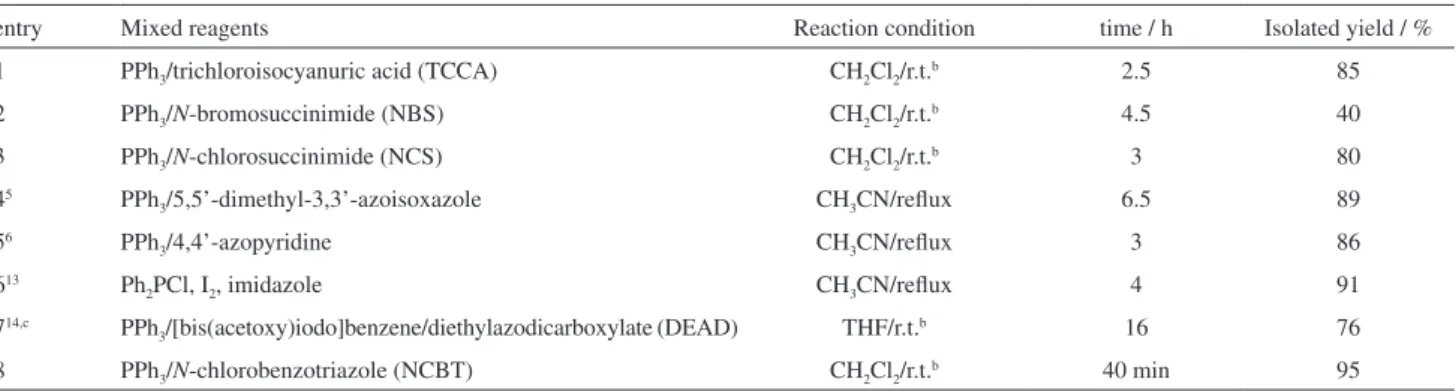
systems in direct esterification reaction of benzoic acid with benzyl alcohol (Table 1, entries 1-3 and 8). Recently, direct esterification reaction was also reported by using PPh3 and an electron deficient reagent such as PPh3
/5,5’-dimethyl-3,3’-azoisoxazole,5 PPh
3/4,4’-azopyridine, 6
Ph2PCl/I2/imidazole13 and PPh3/[bis(acetoxy)iodo]benzene/
diethylazodicarboxylate (DEAD)14 (Table 1, entries 4-7).
As is apparent from Table 1, PPh3/(NCBT) mixed reagent
is the most efficient mixed-reagent system, for conversion of benzoic acid to benzyl benzoate. Replacement of NCBT by every above-mentioned mixed reagent systems produces benzyl benzoate in longer reaction time.
According the data from Table 1,PPh3/NCBT system
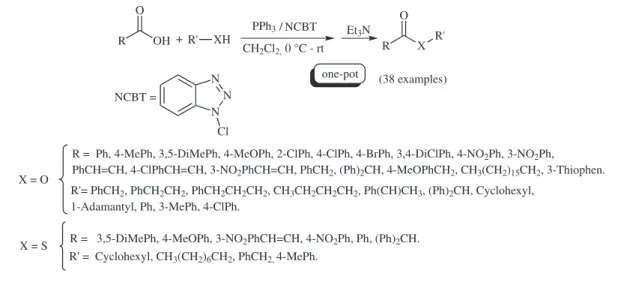
is the best choice for direct esterification of benzoic acid (Scheme 1).
To achieve high reaction efficiency, the reaction of benzoic acid with benzyl alcohol was chosen as model reaction to investigate the applicability of PPh3/NCBT
system in direct esterification and thioesterification reactions of carboxylic acids. The effects of different molar ratios of PPh3/NCBT/RCO2H/ROH in various solvents were
examined on the model reaction.
Treating a solution of PPh3 (1 equiv.) and NCBT
(1 equiv.) in CH3CN at room temperature with different
Table 1. Esterification of benzoic acid with benzyl alcohol by using different mixed reagent systema
entry Mixed reagents Reaction condition time / h Isolated yield / %
1 PPh3/trichloroisocyanuric acid (TCCA) CH2Cl2/r.t.b 2.5 85
2 PPh3/N-bromosuccinimide (NBS) CH2Cl2/r.t.b 4.5 40
3 PPh3/N-chlorosuccinimide (NCS) CH2Cl2/r.t.b 3 80
45 PPh
3/5,5’-dimethyl-3,3’-azoisoxazole CH3CN/reflux 6.5 89
56 PPh
3/4,4’-azopyridine CH3CN/reflux 3 86
613 Ph
2PCl, I2, imidazole CH3CN/reflux 4 91
714,c PPh
3/[bis(acetoxy)iodo]benzene/diethylazodicarboxylate (DEAD) THF/r.t.b 16 76
8 PPh3/N-chlorobenzotriazole (NCBT) CH2Cl2/r.t.b 40 min 95
aThe experimental details are shown in experimental section; br.t.: room temperature; cthe result corresponds to the esterification reaction of p-nitrobenzoic
molar ratios of benzoic acid and benzyl alcohol afforded benzyl benzoate in high yield over 2-5 h (Table 2, entries 1-4). Increasing the molar ratios of PPh3/NCBT and benzyl
alcohol in CH3CN gave 100% conversion of benzoic acid
to benzyl benzoate in 40 min (Table 2, entries 5-6). As the applying 1.25/1.25/1/2.5 molar ratios of PPh3/NCBT/
RCO2H/ROH in CH3CN gave 100% conversion of benzoic
acid to benzyl benzoate in 40 min, esterification reaction was examined in CH2Cl2 at the same conditions. Surprisingly,
there is no difference between the rate of esterification reaction in CH3CN and CH2Cl2 (Table 2, compare entries
5 and 7). At the same conditions performing the reaction in other solvents such as THF, CHCl3, 1,4-dioxane, acetone,
toluene and hexane produced the desired product with lower yield and in longer reaction time (Table 2, entries 8-13). The best result was obtained by applying 1.25/1.25/1/2.5 molar ratios of PPh3/NCBT/ RCO2H/ROH in CH3CN and
CH2Cl2. Because of economic consideration CH2Cl2 was
chosen for further experiments. To investigate the chemical activities of PPh3 and NCBT in the esterification reaction,
the model reaction was carried out in the absence of PPh3
and NCBT respectively. As summarized in Table 2, no desired product was detected in the absence of PPh3 and
NCBT (Table 2, entries 14-15).
To explore the generality and scope of the esterification and thioesterification reaction by using PPh3/NCBT mixed
reagent, the optimized reaction conditions 1.25/1.25/1/2.5
molar ratio of PPh3/NCBT/RCO2H/ROH or RSH in
CH2Cl2 were used for the synthesis of a series of esters
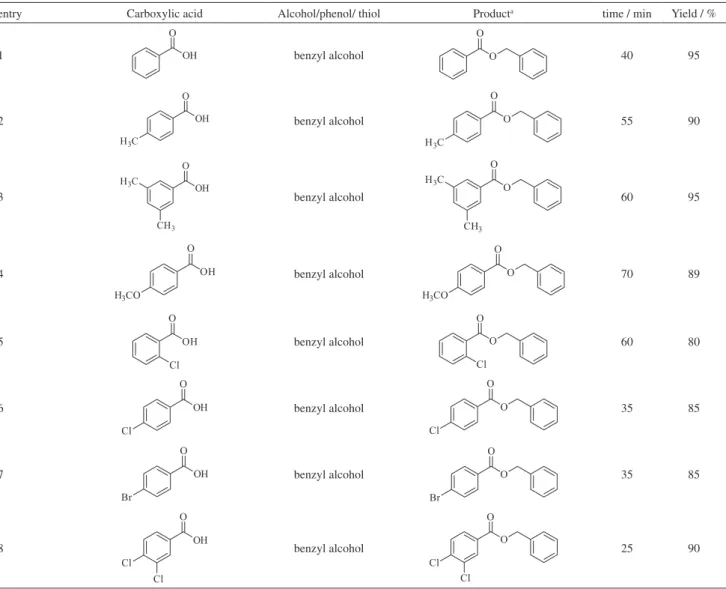
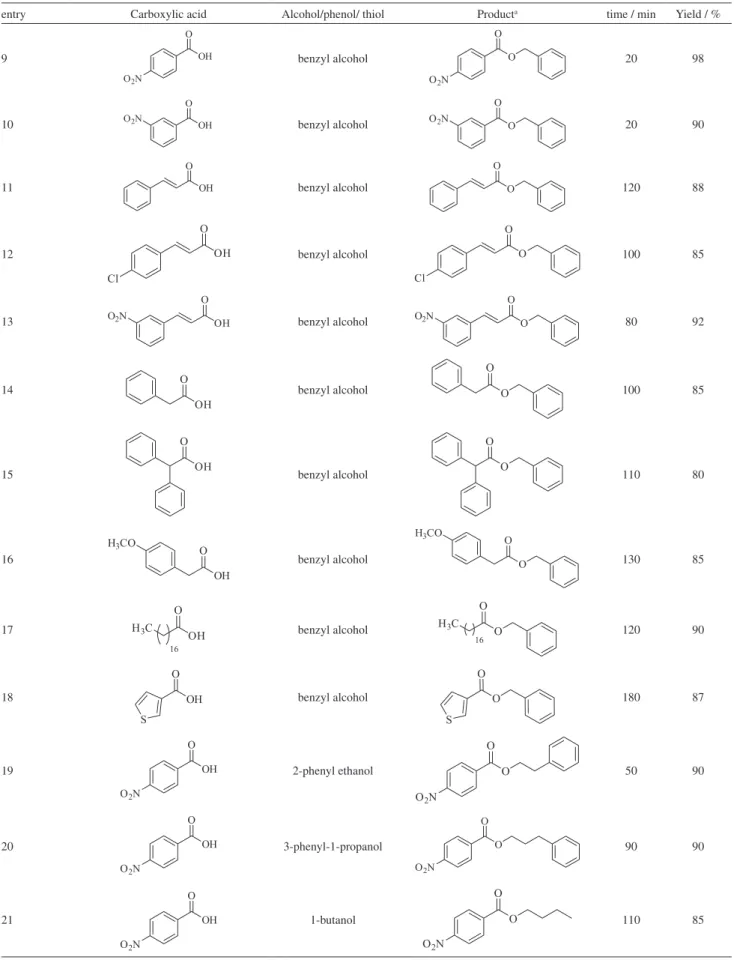
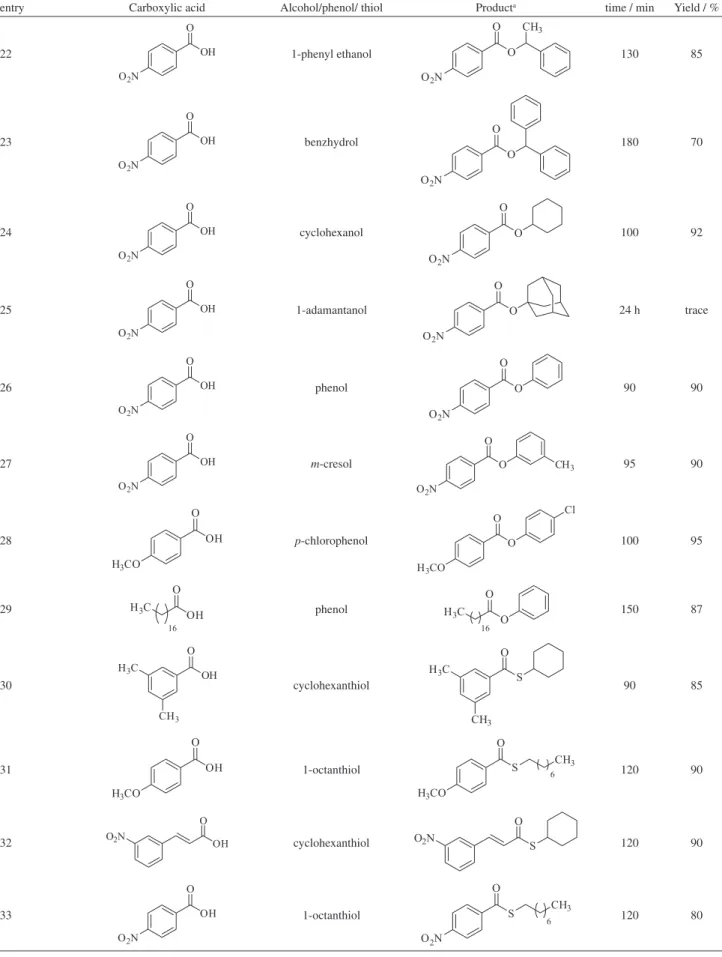
and thioesters (Table 3). According to the results obtained (Table 3) esters and thioesters were prepared from the reaction of aromatic and aliphatic carboxylic acids with primary and secondary aliphatic and benzylic alcohols, phenols and aliphatic and aromatic thiols by using PPh3/NCBT system in high isolated yields.
The aromatic carboxylic acids with electron-withdrawing substituents were rapidly reacted with benzyl alcohol and converted into their corresponding esters in a very short reaction time (20-35 min) with 100% conversion (Table 3, entries 6-10). In spite of inductive effect of chlorine which caused o-chlorobenzoic acid (pKa = 2.89)
stronger acid than p-chlorobenzoic acid (pKa = 4.03),
o-chlorobenzoic acid was converted to the corresponding ester in longer reaction time than p-chlorobenzoic acid (e.g., compare entry 5 with 6). Difference in reactivity between o-chlorobenzoic acid and p-chlorobenzoic acid can be rationalized by the steric effect of chlorine in
Scheme 1.
Table 2. Conversion of benzoic acid to benzyl benzoate with PPh3/NCBT/
benzyl alcohol system under different reaction conditions
entry Solvent
Molar Ratio PPh3/NCBT/ RCO2H/ROH
time / min Isolated yield / %
1 CH3CN 1/1/1/1 5 h 80
2 CH3CN 1/1/1/1.5 3 h 85
3 CH3CN 1/1/1/2 2 h 90
4 CH3CN 1/1/1/2.5 2 h 92
5 CH3CN 1.25/1.25/1/2.5 40 95
6 CH3CN 1.25/1.25/1/3.125 40 95
7 CH2Cl2 1.25/1.25/1/2.5 40 95
8 THF 1.25/1.25/1/2.5 100 80
9 CHCl3 1.25/1.25/1/2.5 80 90
10 1,4-dioxane 1.25/1.25/1/2.5 90 65
11 acetone 1.25/1.25/1/2.5 70 75
12 toluene 1.25/1.25/1/2.5 60 72
13 hexane 1.25/1.25/1/2.5 90 55
14 CH2Cl2 0/1.25/1/2.5 90 0
ortho position of aromatic ring. The reaction of aromatic carboxylic acids bearing electron-donating substituents, with benzyl alcohol was completed in longer reaction time (55-70 min) than the above-mentioned acids (e.g., compare entries 2-4 with 6-10). By now, we can conclude that the electron deficiency in carbonyl group plays an important role in the reaction rate of esterification. This effect has been observed in the esterification reaction of cinnanic acid and substituted cinnamic acids (e.g., compare entries 11 with 12-13). PPh3/NCBT system converted
aliphatic carboxylic acids to the corresponding esters in a more longer reaction time (Table 3, entries 14-17). In comparison, primary aliphatic alcohols have low reactivity than primary benzylic ones towards p-nitro benzoic acid (Table 3, entries 19-21). Also, secondary alcohols have little reactivity than primary alcohols in the presence of PPh3/NCBT system (Table 3, entries 22-24). As is to be
expected, tertiary alcohols because of steric hindrance
were resistant to react with carboxylic acids by using the above-mentioned mixed reagent (Table 3, entry 25). As far as we know, none of the reported methods on esterification reaction by using PPh3/5,5’-dimethyl-3,3’-azoisoxazole,
5
PPh3/4,4’-azopyridine,6 Ph2PCl/I2/imidazole13 and
PPh3/[bis(acetoxy)iodo]benzene/diethylazodicarboxylate
(DEAD)14 have shown any reactivity from tertiary alcohols
towards benzoic acids. In order to gain more insight into the general applicability of this method, we also studied the possibility of applying PPh3/NCBT system to the reaction
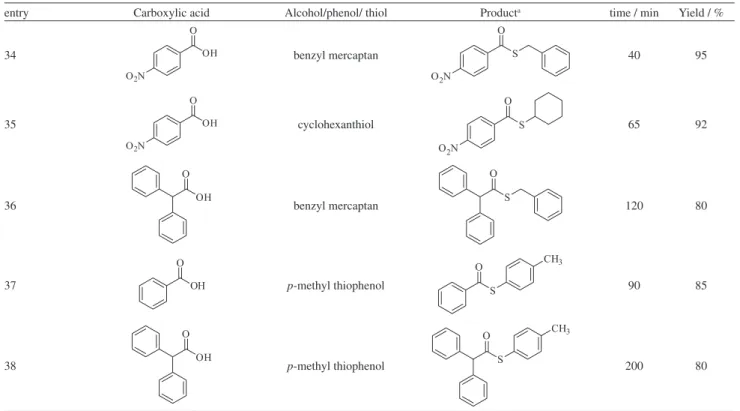
of carboxylic acids with phenols. On the basis of the results obtained from Table 3, aromatic and aliphatic carboxylic acids react smoothly with phenols, and the corresponding esters are produced with high yields (Table 3, entries 26-29). This mixed reagent system also converts aliphatic and aromatic carboxylic acids to the corresponding thioesters with primary and secondary aliphatic and aromatic thiols (Table 3, entries 30-38).
Table 3. Conversion of different carboxylic acids to different esters and thioesters by using PPh3/NCBT/alcohol (or phenol or thiol) system
entry Carboxylic acid Alcohol/phenol/ thiol Producta time / min Yield / %
1 benzyl alcohol 40 95
2 benzyl alcohol 55 90
3 benzyl alcohol 60 95
4 benzyl alcohol 70 89
5 benzyl alcohol 60 80
6 benzyl alcohol 35 85
7 benzyl alcohol 35 85
Table 3. continuation
entry Carboxylic acid Alcohol/phenol/ thiol Producta time / min Yield / %
9 benzyl alcohol 20 98
10 benzyl alcohol 20 90
11 benzyl alcohol 120 88
12 benzyl alcohol 100 85
13 benzyl alcohol 80 92
14 benzyl alcohol 100 85
15 benzyl alcohol 110 80
16 benzyl alcohol 130 85
17 benzyl alcohol 120 90
18 benzyl alcohol 180 87
19 2-phenyl ethanol 50 90
20 3-phenyl-1-propanol 90 90
Table 3. continuation
entry Carboxylic acid Alcohol/phenol/ thiol Producta time / min Yield / %
22 1-phenyl ethanol 130 85
23 benzhydrol 180 70
24 cyclohexanol 100 92
25 1-adamantanol 24 h trace
26 phenol 90 90
27 m-cresol 95 90
28 p-chlorophenol 100 95
29 phenol 150 87
30 cyclohexanthiol 90 85
31 1-octanthiol 120 90
32 cyclohexanthiol 120 90
Table 3. continuation
entry Carboxylic acid Alcohol/phenol/ thiol Producta time / min Yield / %
34 benzyl mercaptan 40 95
35 cyclohexanthiol 65 92
36 benzyl mercaptan 120 80
37 p-methyl thiophenol 90 85
38 p-methyl thiophenol 200 80
aAll the products were identified by comparing their spectral data with those of an authentic sample.
In our experiments, the completion of the reaction was confirmed by the disappearance of the carboxylic acids on TLC followed by the disappearance of acidic OH stretching frequency at 3400-2400 cm-1 in FTIR spectra.
Also, absorption bands at 1743-1706 and 1393-1144 cm-1
due to carbonyl and C–O group of esters in FTIR spectra confirmed the ester formation. Formation of thioesters was also confirmed by appearance of an absorption bands at 1681-1643 cm-1 due to carbonyl group (O=C–S) of
thioesters. All of the products were known compounds and characterized by the IR and comparison of their melting points with known compounds. The structure of selected products was further confirmed by 1H NMR spectroscopy
and mass spectrometry.
Conclusion
In this study, we introduced the application of NCBT (as an N-halo reagent) in conjunction with PPh3 for esterification
and thioesterification reactions. In comparison with the previously reported methods, the present protocol offers several advantages: (i) the reaction proceeds smoothly with a wide range of carboxylic acids (aromatic and aliphatic) and alcohols /or phenols and thiols. (ii) the reagents (PPh3
and NCBT) offers easy handling and simple work-up; (iii) this method has satisfactory yields of a variety of esters and
thioesters; (iv) in contrast to the previously reported systems, which proceeded by dehydration reaction between carboxylic acids and alcohols, in the present method, esters are produced in a short reaction time. (v) PPh3 and NCBT system could
be considered as an attractive and useful contribution to the present organic synthesis for direct esterification and thioesterification of different carboxylic acids.
Supplementary Information
Supplementary information is available free of charge at http://jbcs.sbq.org.br as PDF file.
Acknowledgement
The authors gratefully acknowledge the partial support of this study by Ferdowsi University of Mashhad Research Council (Grant no. p/3/19312).
References
1. Sutherland, I. O. In Comprehensive Organic Chemistry; Barton, D. H. R.; Ollis, W. D., eds.; Pergamon: Oxford, 1979, Vol. 2, p. 868.
3. Buzas, A.; Egnell, C.; Freon, P.; C. R. Acad. Sci.1962, 255, 945; Neises, B. Steglich, W.; Angew. Chem., Int. Ed.1978, 17, 522; Hassner, A.; Alexanian, V.; Tetrahedron Lett.1978, 19, 4475; Zhang, M.; Vedantham, P.; Flynn, D. L.; Hanson, P. R.; J. Org. Chem. 2004, 69, 8340.
4. Mitsunobu, O.; Synthesis1981, 1. 1.
5. Iranpoor, N.; Firouzabadi, H; Khalili, D.; Org. Biomol. Chem.
2010, 8, 4436.
6. Iranpoor, N.; Firouzabadi, H; Khalili, D.; Motevalli. S.; J. Org. Chem. 2008, 73, 4882.
7. Xiang, J.; Orita, A.; Otera, J.; Angew. Chem., Int. Ed.2002, 41, 4117.
8. Kore, R.; Srivastava, R.; Catal. Commun. 2011, 12, 1420. 9. Cai, Y. Q.; Yu, G. Q.; Liu, C. D.; Xu, Y. Y.; Wang, W.; Chin.
Chem. Lett.2012, 23, 1.
10. Chen, C. T.; Munot,Y. S.; J. Org. Chem. 2005, 70, 8625. 11. Hiegel, G. A.; Nguyen, J.; Zhou, Y.; Synthetic Commun.
2004, 34, 2507; Khazaei, A.; Mallakpour, S.; Zolfigol, M. A.;
Ghorbani-Vagheie, R.; Kolvari, E.; Phosphorus, Sulfur Silicon Relat. Elem.2004, 179, 1715.
12. Hughes, T. V.; Hammond, S. D.; Cava, M. P.; J. Org. Chem.
1998, 63, 401.
13. Nowrouzi, N.; Mehranpour, A. M.; Ameri Rad, J.; Tetrahedron
2010, 66, 9596.
14. But, T. Y. S.; Toy, P. H.; J. Am. Chem. Soc. 2006, 128, 9636. 15. Rosenberg, M. G.; Brinker, U. H.; J. Org. Chem. 2003, 68, 4819. 16. Li, Y.; Deng, W. P.; Du, W.; Tetrahedron2012, 68, 3611. 17. Yoshimasa, M.; Nobuhiro, K.; Toshikazu. T.; Chem. Lett.2007,
36, 102.
18. Eliel, E. L.; Anderson, R. P.; J. Am. Chem. Soc. 1952, 74, 547. 19. Jaszay, Z. M.; Petnehazy, I.; Toeke, L.; Synth. Commun. 1998,
28, 2761.
20. Niyogy, Y.; J. Indian Chem. Soc.1930, 7, 577. 21. Lu, X.; Long, T, E.; J. Org. Chem.2010, 75, 249.
22. Zhang, B.; Feng, P.; Cui, Y.; Jiao, N.; Chem. Commun.2012, 48, 7280.
23. Thalluri, K.; Nadimpally, K. C.; Chakravarty, M. P.; Paul, A.; Mandal, B.; Adv. Synth. Catal.2013, 355, 448.
24. Froeyen, P.; Phosphorus, Sulfur Silicon Relat. Elem.1994, 91, 145.
25. Bhawal, B. M.; Khanapure, S. P.; Biehl, E. R.; Synthesis1991, 2, 112.
26. Pereira, W.; Close, V. A.; Patton, W.; Halpern, B.; J. Org. Chem.
1969, 34, 2032.
27. Mackay, D.; Can. J. Chem.1966, 44, 2881.
28. Tian, J.; Gao, W. C.; Zhou, D. M.; Zhang, C.; Org. Lett.2012, 14, 3020.
29. Koga, K.; Seki, H.; Yamada, S.; Chem. Pharm. Bull.1967, 15, 1948.
30. Satoshi, I.; Takeshi, H.; Hirokazu, U.; Adv. Synth. Catal.2012, 354, 3480.
31. Strazzolini, P.; Giumanini, A.G.; Verardo, G.; Tetrahedron 1994, 50, 217.
32. Perusquia-Hernandez, C.; Lara-Issasi, G. R.; Frontana-Uribe, B. A.; Cuevas-Yanez, E.; Tetrahedron Lett.2013, 54, 3302. 33. Ohshima, T.; Iwasaki, T.; Maegawa, Y.; Yoshiyama, A.;
Mashima, K.; J. Am. Chem. Soc.2008, 130, 2944.
34. Arde, P.; Ramanjaneyulu, B. T.; Reddy, V.; Saxena, A.; Anand, R. V.; Org. Biomol. Chem.2012, 10, 848.
35. Baddeley, G.; J. Chem. Soc. 1944, 330.
36. Arisawa, M.; Igarashi, Y.; Kobayashi, H.; Yamada, T.; Bando, K.; Ichikawa, T.; Yamaguchi, M.; Tetrahedron2011, 67, 7846.
37. Hosseini-Sarvari, M.; Sodagar, E.; C. R. Chim.2013, 16, 229. 38. Burhardt, M. N.; Taaning, R. H.; Skrydstrup, T.; Org. Lett. 2013,
15, 948.
39. Takido, T.; Toriyama, M.; Itabashi, K.; Synthesis1988, 5, 404. 40. Henao Castañeda, I. C.; Pereanez, J. A.; Jios, J. L.; J. Mol.
Struct.2012, 1028, 7.
41. Romero; R.; Bol. Inst. Quim. Univ. Mexico, 1952, 4, 3. 42. Arisawa, M.; Kuwajima, M.; Toriyama, F.; Li, G.; Yamaguchi, M.;
Org. Lett.2012, 14, 3804.
43. Petrova, R. G.; Churkina, T. D.; Kandor, I. I.; Dostovalova, V. I.; Freidlina, R. Kh.; B. Acad. Sci USSR. CH+.1985, 34, 2331; Izv. Akad. Nauk SSSR, Ser. Khim. 1985, 11, 2519.
44. Akhlaghinia, B.; Rouhi-Saadabad, H.; Can. J. Chem.2013, 9, 181; Kiani, A.; Akhlaghinia, B.; Rouhi-Saadabad, H.; Bakavoli, M.; J. Sulfur Chem. 2013, DOI 10.1080/17415993.2013.801476;
Iranpoor, N.; Firouzabadi, H.; Akhlaghinia, B.; Nowrouzi, N.; J. Org. Chem. 2004, 69, 2562; Iranpoor, N.; Firouzabadi, H.;
Azadi, R.; Akhlaghinia, B.; J. Sulfur Chem. 2005, 26,133; Akhlaghinia, B.; Phosphorus, Sulfur Silicon Relat. Elem.
2004, 179, 1783; Akhlaghinia, B.; Phosphorus, Sulfur Silicon
Relat. Elem. 2005, 180, 1601; Akhlaghinia, B.; Samiei, S.;
Phosphorus, Sulfur Silicon Relat. Elem. 2009, 184, 2525;
Iranpoor, N.; Firouzabadi, H.; Akhlaghinia, B.; Azadi, R.; Synthesis2004, 1, 92; Akhlaghinia, B.; Pourali, A. R.; Synthesis
2004, 11, 1747; Akhlaghinia, B.; Synthesis2005, 12, 1955;
Iranpoor, N.; Firouzabadi, H.; Akhlaghinia, B.; Nowrouzi, N.; Tetrahedron Lett. 2004, 45, 3291.
Submitted: September 6, 2013