Short Report
S
J. Braz. Chem. Soc., Vol. 22, No. 4, 796-800, 2011. Printed in Brazil - ©2011 Sociedade Brasileira de Química 0103 - 5053 $6.00+0.00*e-mail: [email protected]
New Adducts of Lapachol with Primary Amines
Mirelly D. F. Santos,José T. Litivack-Junior,Roberto V. Antunes,Tania M. S. Silva and Celso A. Camara*
Departamento de Química, Universidade Federal Rural de Pernambuco, Campus Dois Irmãos, 52171-900 Recife-PE, Brazil
A reação do lapachol à temperatura ambiente, com aminas alifáticas primárias forneceu novos adutos identiicados como derivados do núcleo fenazina. Os produtos foram obtidos em rendimentos bons a razoáveis (52 a 88%), a temperatura ambiente e sem o uso de solvente, a partir da reação com alquilaminas funcionalizadas, como n-butilamina, etanolamina, 3-propanolamina, 2-metoxi-etilamina, 3-metoxi-propilamina e 2-feniletilamina.
New adducts of lapachol with neat primary aliphatic amines were obtained in a solvent-free reaction in good to reasonable yields (52 to 88%), at room temperature. The new compounds containing a phenazine moiety were obtained from suitable functionalized aminoalkyl compounds, including ethanolamine, 3-propanolamine, 2-methoxy-ethylamine, 3-methoxy-propylamine, n-butylamine and 2-phenetylamine.
Keywords: phenazines, lapachol, nitrogen adducts, quinones, 1,4-naphthoquinone
Introduction
Molecules containing a quinone moiety as a structural component constitute an important class of compounds in organic chemistry. The conjugated 1,4-dicarbonyl or 1,2-dicarbonyl moiety is responsible for a characteristic reactivity behavior, yielding a somewhat particular chemistry repertoire for these compounds. These functional groups are also involved in numerous biological activities, mostly cytotoxic ones. The wide range of biological activities includes anticancer,1 inhibitors of
topoisomerase II,2 highlighting their use as valuable
candidates in neglected tropical diseases, including leishmaniasis,3 tuberculosis4 and tripanosomiasis.5 Among
the naturally occurring naphthoquinones in Tabebuia spp, lapachol, α-lapachone and β-lapachone and xyloidones are the most abundant and studied compounds in these and related species.6β-Lapachone, in particular, showed
a more deined and impressive biological proile in anti-tumor screenings than the regioisomer α-lapachone or lapachol.7,8 The molecular mechanism involved in the
observed antitumoral and cytotoxic activities of these compounds seems to be mainly related to the ability of the quinone nucleus in participating in redox processes,
in which the cascade of one-electron radical enzymatic-mediated reactions results in the formation of superoxide radical anions, responsible for cellular damage in living media.9 In a continuing work concerning the reactivity
of lapachol and related quinones,10,11 we now present
our results concerning the reaction of lapachol with primary aliphatic amines. This smooth reaction conduced to new adducts with a cyclic structure consisting of a phenazine nucleus.12 Our initial observation, unlike
previous reports,13 is that lapachol 1 is almost entirely
consumed when mixed with primary amines, like n-butylamine, ethanolamine, 3-hydroxypropylamine, 2-methoxyethylamine, 3-methoxypropylamine, and 2-phenylethylamine. The reaction of some few secondary cyclic amines with lapachol have also been described previously, with some unusual spectroscopic data found.14
Results and Discussion
Santos et al. 797 Vol. 22, No. 4, 2011
2a-f shown, as an adduct of two molecules of lapachol with the corresponding amine (Scheme 1). The synthesis of compounds containing this type of phenazine nucleus was described previously for the reactions with aromatic amines.12 The previously described conditions in the
cited literature includes thermal treatment of the reaction mixtures. The present work extends this methodology to a more environmentally benign procedure, with reasonable to good yields (52-88%) of products in good purity, with easy isolation and reproducibility. The reaction was conducted in an open vessel, based on the experimental observation that the reaction proceeds faster in the presence of molecular oxygen. A closed sample in inert gas remains a blue liquid for a very long time, and, when opened, an instant precipitation of green crystals is observed in the lask. The procedure of isolation consists in iltering the formed crystals at vacuum followed by water washing with some methanol added. The crystals obtained are suficiently pure to TLC inspection and spectrometric analysis. Attempts to recrystalize in different solvent mixtures results in decomposition of the starting material, as observed by TLC. Although the detailed mechanism for this reaction remains to be further clariied, a lot of precedent data is available to clarify some points. The nucleophilic addition of amines to carbonyl of quinone nucleus is a known reaction, although the subsequent reactions of the formed adducts are characteristic of quinone chemistry.15 These
hydroxyquinone adducts on the carbonyl with amines can undergo a reaction called Strecker degradation,16 rather
than the conventional Schiff’s base addition followed by water elimination product. These alternative path probably consists in an imine-enamine isomerization, followed by hydrolysis in situ with formal dealkylation of the primary amine adduct. Recently the reaction of 2-hydroxy-1,4-naphthoquinone (lawsone) with primary amino acids was described as a new class of ingermark detection reagents.15
It is noteworthy that in the cited work the best proile for ingermark detection was achieved with the amino acid lysine. On the basis of our indings, we believe that this is due to the presence of a more nucleophylic amino alkyl
side chain residue. The authors in this work did not support the proposed adducts with any kind of experimental data; no attempts for isolation were made or spectroscopic characterization of products furnished. Additionally, the luorescence emission spectra of some of the adducts reported here are in agreement with the proile previously reported by Jelly et al.15 (see supplementary information,
SI, Figure S25). However, in opposition with the structure furnished by Jelly et al.,15 the elemental microanalysis
is consistent with the presence of two nitrogen atoms (see Experimental section), with just one alkyl residue from the amine, supporting a phenazine nucleus. Another observation concerns the extremely low reactivities of amino acids as glycine and phenylalanine. These amino acids, even in the presence of some inorganic and organic basis, reacts very slowly furnishing complex mixtures at TLC inspection. We also were unable to isolate some useful products from the reaction of lapachol with benzylamine. At the same conditions listed above, the reaction proceeds rapidly with a proliic proile of by-products, and attempts to purification by column chromatography were also unsuccessful. A proposed mechanism for the formation of (2) from (1) is presented in Figure 1. The characterization of 2a by 1H and 13C NMR analysis showed a simpliied
spectra, attributed to the assumption of canonical equivalent resonance forms on the proposed structure (Figure 1). A singlet at 1.79 ppm (6H) and a doublet at 1.62 ppm (0.5 Hz, 6H) were attributed to methyl signals of the prenyl side chain. The methyl groups are coupled with the vinylic proton at 5.31 ppm (m, 2H), and the vinylic proton coupled with the allylic methylene which appear at 3.47 ppm (m, 4H, 7 Hz). The aromatic protons are two double doublets at 8.69 ppm (2H, 8/0.5 Hz) and 8.16 ppm (2H, 8/0.5 Hz), attributed to the ortho hydrogens relative to quinone/ phenazine nucleus. The other two meta hydrogens absorbs as a double of double doublets at 7.60 (2H, 0.5/1/8 Hz) and 7.40 ppm (2H, 0.5/1/8 Hz). The methylene attached to nitrogen appears as a triplet at 2.84 ppm (2H, 5.5 Hz), and couples with another carbynolic methylene as a triplet at 3.56 ppm (2H, 5.5 Hz).
N N O R OH O O
OH R NH2
r.t., neat
(1)
R =
(2a) CH2OH (88%) (2b) CH2OCH3 (52%) (2c) CH2CH2OH (80%) (2d) CH2CH2OCH3 (58%) (2e) CH2CH2CH3 (77%) (2f) CH2Ph (58%)
New Adducts of Lapachol with Primary Amines J. Braz. Chem. Soc. 798
Conclusions
In the present study, we presented a new, simple and solvent-free procedure for the reaction of lapachol with primary amines at ambient temperature. The obtained yields were good to reasonable and reproducible, furnishing new derivatives of phenazines from lapachol, with suitable functionalized amines.
Experimental
General
Unless otherwise stated, all common reagents and solvents were used as obtained from commercial suppliers without further puriication. Lapachol was previously obtained by usual methods. Melting points were obtained from an electrically heated metal block apparatus (Quimis), and were not corrected. FTIR spectra were obtained in a Bomen-Michelson spectrophotometer using KBr ilm. NMR spectra were recorded in a Varian-Mercury 200 MHz
for 1H and 50.3 MHz for 13C, with DMSO-d
6 as solvents,
and HR mass spectra, on a VG Autospec spectrometer (electron-impact at 70 eV). The reaction progress was monitored using thin layer chromatography on a silicagel UV254 TLC aluminum sheet. The elemental analysis was performed on a CE EA1110 instrument at the Central Analítica (Departamento de Química Fundamental - Universidade Federal de Pernambuco).
General procedure for the synthesis of adducts 2a-f
A solution of lapachol 1 (0.5 g) and corresponding amine (1 mL) was stirred in an open lask, for a 48 h period at room tempertaure. The initially yellow solution turned to deep red, and inally to a greenish-blue precipitated material, or deep-blue solution with crystals was obtained. TLC inspection of the reaction mixture showed an almost complete consumption of lapachol after 48 h. With the aid of water with some methanol (5%), the solids were iltered in vacuum, washed with additional water, dried at room temperature as luorescent green or deep blue crystals.
O
O R OH R'CH2NH2
O R OH
R'CH2HN OH
−H2O
O R OH N R' O O R HO O R OH N+ R' OH O R HO H OH R OH N+ R' OH O R HO OH R OH HN OH O R HO −R'CHO
−H2O HOH OH R OH N OH R O OH R OH N
NCH2R' R OH
NH2CH2R'
OH R O N
NHCH2R' R OH
OH R N
NCH2R'
R OH OH O R N
NCH2R'
R OH
−H2O
−H2O
OH R N
NCH2R'
R O
(1)
(2) (2)
R= CH2CH=C(CH3)2
R'= any alkyl side chain
(1)
Santos et al. 799 Vol. 22, No. 4, 2011
9-Hydroxy-7-(2-hydroxyethyl)-6,8-bis(3-methylbut-2-enyl)dibenzo[a,j]phenazin-5(7H)-one (2a): 88% yield, deep blue crystals with mp 281-3 oC; IR (KBr) ν
max/cm-1:
3200, 3058, 2962, 2910, 2852, 1608, 1570, 1508, 1409, 1126, 1028, 789; UV (EtOH) λmax/nm: 650, 627, 528, 287; 1H NMR (DMSO-d
6, 200 MHz) d 1.62 (s, 6H), 1.79 (s,
6H), 2.84 (t, 2H, J 5.5 Hz), 3.47 (m, 4H, J 7 Hz), 3.56 (t, 2H, J 5.5 Hz), 5.31 (m, 2H), 7.40 (ddd, 2H, J 7/1/1 Hz), 7.60 (ddd, 2H, J 7/1/1 Hz), 8.16 (dd, 2H, J 8/0.5 Hz), 8.69 (dd, 2H, J 8/0.5 Hz); 13C NMR (APT, DMSO-d
6, 50 MHz)
d 17.9, 21.7, 25.5, 41.2, 57.5, 111.2, 121.7, 122.0, 123.5, 124.9, 128.7, 129.3, 130.0, 131.7, 148.4, 176.8. Elemental analysis for C32H32N2O3.H2O found: C, 72.89; H, 7.39; N,
5.41; Requires: C, 72.70; H 6.86; N, 5.30%.
9-Hydroxy-7-(2-methoxyethyl)-6,8-bis(3-methylbut-2-enyl)dibenzo[a,j]phenazin-5(7H)-one (2b): 52% yield, greenish blue crystals with mp 206-8 oC; IR (KBr) ν
max/cm -1:
3360, 2920, 2910, 1654, 1570, 1508, 1485, 1115, 759; UV (EtOH) λmax/nm: 648, 622, 522, 280;
1H NMR (DMSO-d 6,
200 MHz) d 1.62 (s, 6H), 1.69 (s, 6H), 2.96 (m, 2H), 3.25 (s, 3H), 3.48 (m, 4H), 5.31 (m, 2H), 7.42 (dd, 2H, J 7/7.8 Hz), 7.61 (dd, 2H, J 7/7.8 Hz), 8.18 (d, 2H, J 7.8Hz), 8.70 (d, 2H, J 7.8 Hz); 13C NMR (APT, DMSO-d
6, 50 MHz) d
17.9, 21.8, 25.5, 58.1, 68.2, 111.3, 121.7, 122.2, 123.5, 125.2, 128.7, 129.3, 130.1, 131.7, 148.4, 176.6; Elemental analysis for C33H34N2O3.3H2O found: C, 69.61; H, 6.67; N,
4.14; Requires C, 70.44; H, 6.67; N, 4.98%.
9-Hydroxy-7-(3-hydroxypropyl)-6,8-bis(3-methylbut-2-enyl)dibenzo[a,j]phenazin-5(7H)-one (2c):84% yield as a greenish blue solid with mp 251-3 ºC; IR (KBr) νmax/cm
-1:
3414, 2924, 1620, 1570, 1485, 1458, 1100, 779; UV (EtOH)
λmax/nm: 650, 622, 528, 287;
1H NMR (DMSO-d 6, 200
MHz) d 1.55, (s, 6H), 1.62 (m, 2H), 1.72 (s, 6H), 2.79 (t, 2H, J 7 Hz), 3.42 (m, 6H), 5.24 (m, 2H), 7.35 (ddd, 2H,
J 1/8/8 Hz), 7.54 (ddd, 2H, J 1/8/8 Hz), 8.11 (d, 2H, J 8 Hz), 8.63 (d, 2H, J 8 Hz); 13C NMR (APT, DMSO-d
6, 50
MHz) d 17.9, 21.8, 25.5, 30.1, 36.9, 58.0, 111.4, 121.8, 122.4, 123.5, 124.9, 125.1, 128.7, 129.3, 130.1, 131.7, 148.4, 176.6; Elemental analysis for C33H36N2O4.H2O
found: C, 72.90; H, 7.40; N, 5.00; Requires: C, 73.04; H, 7.06; N, 5.16%.
9-Hydroxy-7-(3-methoxypropyl)-6,8-bis(3-methylbut-2-enyl)dibenzo[a,j]phenazin-5(7H)-one (2d):58% yield as a greenish blue solid with mp 242-4 oC; IR (KBr) ν
max/cm-1:
3300, 2958, 2920, 1620, 1570, 1554, 1485, 1280, 1249, 1185, 1130; UV (EtOH) λmax/nm: 650, 622, 528, 290; 1H
NMR (DMSO-d6, 200 MHz) d 1.62 (s, 6H), 1.78 (s, 6H), 1.78 (m, 2H), 2.81 (m, 2H), 3.19 (s, 3H), 3.35 (m, 2H), 3.48
(d, 4H, J 6.6 Hz), 5.30 (m, 2H), 7.41 (dd, 2H, J 8/8 Hz), 7.61 (dd, 2H, J 8/8 Hz), 8.17 (d, 2H, J 8 Hz), 8.70 (d, 2H, J 8 Hz); 13C NMR (APT, DMSO-d
6, 50 MHz) d 18.0, 21.8,
25.5, 26.5, 37.0, 58.0, 68.9, 111.3, 121.7, 122.1, 123.5, 125.0, 128.8, 129.4, 130.1, 131.8, 148.5, 176.9; Elemental analysis for C34H38N2O4.2H2O found: C, 71.18; H, 7.61; N,
5.02; Requires: C, 71.06; H, 7.37; N, 4.87%.
7-Butyl-9-hydroxy-6,8-bis(3-methylbut-2-enyl) dibenzo[a,j]phenazin-5(7H)-one (2e): 80% yield of a greenish blue solid with mp 276-9 oC; IR (KBr) ν
max/cm-1:
3400, 2920, 2854, 1585, 1508, 1477, 1454, 1415, 1300, 1249, 1157, 1118; UV (EtOH) λmax/nm: 650, 622, 524,
284, 250, 245; 1H NMR (DMSO-d
6, 200 MHz) d 0.84 (t,
3H, J 7 Hz), 1.30 (m, 2H), 1.48 (m, 2H), 1.63 (s, 6H), 1.79 (s, 6H), 2.76 (t, 2H, J 7 Hz), 3.48 (m, 4H), 5.31 (m, 2H), 7.41 (dd, 2H, J 6.8/6.2 Hz), 7.61 (dd, 2H, J 6.8/6.2 Hz), 8.18 (d, 2H, J 6.8 Hz), 8.70 (d, 2H, J 6.8 Hz); 13C NMR
(APT, DMSO-d6, 50 MHz) d 13.4, 17.9, 19.1, 21.8, 25.5,
29.1, 38.6, 111.2, 121.7, 122.1, 123.5, 124.9, 124.9, 128.7, 129.3, 130.0, 131.7, 148.4, 176.8; Elemental analysis for C34H38N2O3.H2O found C, 75.81; H, 7.87; N, 5. 14;
Requires: C, 75.53; H, 7.46; N, 5.18%.
9 H y d ro x y 6 , 8 b i s ( 3 m e t h y l b u t 2 e n y l ) 7 -phenethyldibenzo[a,j]phenazin-5(7H)-one (2f): 62% of a greenish blue crystals with mp 217-9 oC; IR (KBr) ν
max/cm-1:
2890, 2920, 1564, 1509, 1474, 1374, 1299, 1250, 1161, 1128; UV (EtOH) λmax/nm: 650, 622, 524, 284, 250; 1H
NMR (DMSO-d6, 200 MHz) d 1.61 (s, 6H), 1.78 (s, 6H), 2.83 (dd, 2H, J 6.2/5.4 Hz), 3.03 (dd, 2H, J 6.2/5.4 Hz), 3.47 (d, 4H, J 6.2 Hz), 5.30 (m, 2H), 7.28 (m, 5H), 7.40 (ddd, 2H, J 1.2/6.8/8.2 Hz), 7.61 (ddd, 2H, J 1.2/6.8/8.2 Hz), 8.16 (dd, 2H, J 1.2/6.8 Hz), 8.69 (dd, 2H, J 1.2/6.8 Hz); 13C
NMR (APT, DMSO-d6, 50 MHz) d 17.9, 21.8, 25.5, 36.2,
38.2, 111.4, 121.7, 122.4, 123.4, 124.9, 125.0, 126.7, 128.1, 128.3, 128.4, 128.6, 128.7, 128.8, 128.2, 130.1, 131.7, 148.3, 178.5; Elemental analysis for C38H38N2O3.2H2O
found: C, 74.84; H, 7.16; N, 4.30; Requires: C, 75.22; H, 6.98; N, 4.62%.
Supporting Information
Supplementary information (Figures S1-S25) is available free of charge at http://jbcs.sbq.org.br, as a PDF ile.
Acknowledgments
New Adducts of Lapachol with Primary Amines J. Braz. Chem. Soc. 800
and useful suggestions. Finnancial support from the Coordenação de Aperfeiçoamento do Pessoal de Nível Superior (CAPES), and Fundação de Amparo à Pesquisa do Estado de Pernambuco (FACEPE) are gratefully acknowledged. We also thank the Conselho Nacional de Desenvolvimento Cientíico e Tecnológico (CNPq-Brazil), and Analytical Center of LTF-UFPB, DQ-UFPE and CENAPESQ-UFRPE.
References
1. Planchon, S. M.; Wuerzberger, S.; Frydman, B.; Witiak, D. T.; Hutson, P.; Church, D. R.; Wilding, G.; Boothman, D. A.; Cancer Res.1995, 55, 3706.
2. Krishnan, P.; Bastow, K. F.; Cancer Chemother. Pharmacol.
2001, 47, 187.
3. Fournet, A.; Angelo, A.; Munoz, V.; Roblot, F.; Hocquemiller, R.; Cava, A.; J. Ethnopharmacol.1992, 37, 159.
4. Silva, R. S. F.; Pinto, M. D. F. R.; Goulart, M. O. F.; de Souza, J. D.; Neves, I; Lourenço, M. C. S.; Pinto, A. V.; Eur. J. Med. Chem.2009, 44, 2334.
5. Pinto, A. V.; de Castro, S. L.; Molecules2009, 14, 4570. 6. Hussain, H.; Krohn, K.; Ahmad, V. U.; Miana, G. A.; Green, I.
R.; Arkivoc2007, 145.
7. Li, C. J.; Averboukh, L.; Pardee, A. B.; J. Biol. Chem. 1993, 268, 22463.
8. Silva, M. N.; Ferreira, V. F.; Souza, M. C. B. V.; Quim. Nova,
2003, 26, 407.
9. Kitamura, M.; Matsuda, H.; Kimura, S.; Iyanagi, T.; Adv. Exp. Med. Biol.2001, 500, 323.
10. Cunha, A. S.; Lima, E. L. S.; Pinto, A. C.; Esteves-Souza, A.; Echevarria, A.; Camara, C. A.; Vargas, M. D.; Torres, J. C.; J. Braz. Chem. Soc.2006, 17, 439.
11. Esteves-Souza, A.; Figueiredo, D. V.; Camara, C. A.; Vargas, M. D.; Pinto, A. C. ; Echevarria, A.; Braz. J. Med. Biol. Res.
2007, 40, 1399.
12. Neves-Pinto, C.; Malta, V. R.; Pinto, M. C. F. R.; Santos, R. H.; De Castro, S. L.; Pinto, A. V.; J. Med. Chem. 2002, 45, 2112. 13. Chaves, J. P.; Pinto, M. C. F. R.; Pinto, A. V.; J. Braz. Chem.
Soc.1990, 1, 21.
14. Oliveira, M. F.; Lemos, T. L. G.,; Mattos, M. C.; Segundo, T. A.; Santiago, G. M. P., Braz-Filho R.; An. Acad. Bras. Cienc.
2002, 74, 211.
15. Jelly, R.; Lewis, S. W.; Lennard, C.; Lim, K. F.; Almog J.; Chem. Commun.2008, 3513.
16. Spyroudis, S.; Molecules2000, 5, 1291.
Supplementary Information
S
I
J. Braz. Chem. Soc., Vol. 22, No. 4, S1-S13, 2011. Printed in Brazil - ©2011 Sociedade Brasileira de Química 0103 - 5053 $6.00+0.00
*e-mail: [email protected]
New Adducts of Lapachol with Primary Amines
Mirelly D. F. Santos,José T. Litivack-Junior,Roberto V. Antunes,Tania M. S. Silva and Celso A. Camara*
Departamento de Química, Universidade Federal Rural de Pernambuco, Campus Dois Irmãos, 52171-900 Recife-PE, Brazil
Figure S1. 1H NMR spectrum (DMSO-d
New Adducts of Lapachol with Primary Amines J. Braz. Chem. Soc.
S2
Figure S2.. 1H NMR expansion spectrum (DMSO-d
6, 200 MHz) of 2a.
Santos et al. S3 Vol. 22, No. 4, 2011
Figure S4.13C NMR (APT) spectrum expansion (DMSO-d
6, 50 MHz) of 2a.
New Adducts of Lapachol with Primary Amines J. Braz. Chem. Soc.
S4
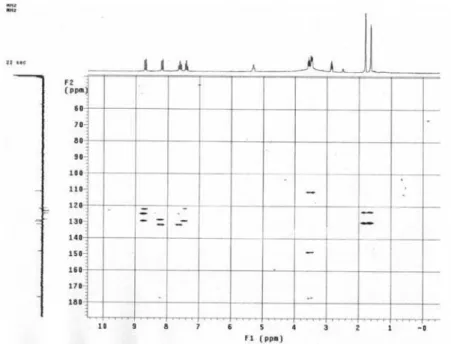
Figure S6.COLOC spectrum of 2a.
Santos et al. S5 Vol. 22, No. 4, 2011
Figure S8.1H NMR spectrum (DMSO-d
6, 200 MHz) of 2b.
Figure S9.13C NMR (APT) spectrum (DMSO-d
New Adducts of Lapachol with Primary Amines J. Braz. Chem. Soc.
S6
Figure S10.Infrared spectrum (KBr, cm-1) of 2b.
Figure S11.1H NMR spectrum (DMSO-d
Santos et al. S7 Vol. 22, No. 4, 2011
Figure S12.13C NMR (APT) spectrum (DMSO-d
6, 50 MHz) of 2c.
New Adducts of Lapachol with Primary Amines J. Braz. Chem. Soc.
S8
Figure S14.1H NMR spectrum (DMSO-d
6, 200 MHz) of 2d.
Santos et al. S9 Vol. 22, No. 4, 2011
Figure S16.13C NMR (APT) spectrum (DMSO-d
6, 50 MHz) of 2d.
New Adducts of Lapachol with Primary Amines J. Braz. Chem. Soc.
S10
Figure S18.1H NMR spectrum (DMSO-d
6, 200 MHz) of 2e.
Figure S19.1H NMR spectrum expansion (DMSO-d
Santos et al. S11 Vol. 22, No. 4, 2011
Figure S20.13C NMR (APT) spectrum (DMSO-d
6, 50 MHz) of 2e.
New Adducts of Lapachol with Primary Amines J. Braz. Chem. Soc.
S12
Figure S22.1H NMR spectrum (DMSO-d
6, 200 MHz) of 2f.
Santos et al. S13 Vol. 22, No. 4, 2011
Figure S24.Infrared spectrum (KBr, cm-1) of 2f.