3-Epiabruslactone A, a New Triterpene Lactone Isolated from
Austroplenckia populnea
Grácia Divina de Fátima Silvaa*, Lucienir Pains Duartea, Helena Clara da
Silva Paesa, José Rêgo de Sousaa, Maria Cristina Nonatob, Paulo José
Portezanib and Yvonne Primerano Mascarenhasb
aDepartamento de Química, ICEx, Univ. Fed. de Minas Gerais, C.P. 702,
30123-970 Belo Horizonte - MG, Brazil
bDepartamento de Física e Informática, IFSC, USP, 13560-280, S. Carlos - SP, Brazil
Received: May 17, 1997
Um triterpeno lactônico inédito isolado do cerne de Austroplenckia populnea (Celastraceae) foi caracterizado como 3α-hidroxiolean-12-en-29,22α-olídeo (a γ-lactona do ácido 3α,22α -diidrox-iolean-12-en-29α-óico), o epímero em C-3 da abruslactona A, com base em dados espectrais, oxidação e análise cristalográfica.
A new lactonic triterpene isolated from the heartwood of Austroplenckia populnea (Celas-traceae) was characterized as 3α-hydroxyolean-12-en-29,22α-olide (the γ-lactone of the 3α,22α -dihydroxyolean-12-en-29α-oic acid), the 3-epimer of the abruslactone A, on the basis of its spectral data, chemical transformations, and single crystal X-ray analysis.
Keywords: Austroplenckia populnea, Celastraceae, 3-epiabruslactone A, structure eluci-dation
Introduction
The investigation of chemical constituents of plants of the Celastraceae family has aroused considerable attention on account of the antitumoral and anti-leukemic activities found in maytansinoids and quinonemethide triterpenes isolated from plants of that family1.
In previous papers we described the chemical constitu-tion of the root bark2, bark wood3 and root wood4 of Austroplenckia populnea (Reiss) Lundell, specimen of the Celastraceae family. The plant is popularly known in the state of Minas Gerais as ‘‘mangabeira-brava’’, and it is a source of material for the industry of vimen furniture. The decoction of its branches is used as a traditional antidysen-teric medicine5.
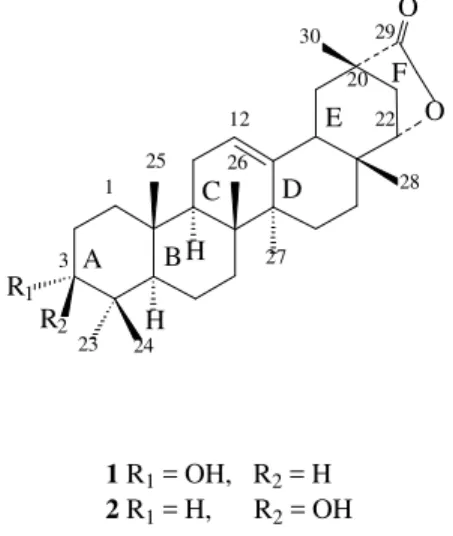
During our continued investigation of this species, one new oleanane derivative (1) has been isolated along with an extensive range of triterpenes including the known lactonic triterpene abruslactone A (2). The compound 1 showed spectral characteristics of an abruslactone A
de-rivative. Thus, in this paper we present the identification of abruslactone A and structural elucidation of a new triter-pene lactone, the epimer in C-3 (1) of abruslactone A, whose chemical structures are shown in Fig. 1. Both triter-penes were isolated from the ethanolic extract of the heart-wood of Austroplenckia populnea, from which were also isolated the following triterpenes previously found in other parts of the same plant: 3-oxofriedelan-29α-oic acid (po-pulnonic acid)1,2,3, 3-hydroxy-2-oxofriedelan-3-en-29α -oic acid, 3β-hydroxyolean-12-en-29α-oic acid (epikatonic acid)2, and 3-oxoolean-12-en-29α-oic acid (katononic acid)2.
Experimental
General experimental procedure
IR, NMR, mass spectroscopy, and melting point. IR spectra were obtained with a Galaxy FTIR 3000-Mattson in KBr pellets. A Bruker AC-200 (1H: 200 MHz; 13C: 50,3 Article
J. Braz. Chem. Soc., Vol. 9, No. 5, 461-464, 1998. © 1998 Soc. Bras. Química
MHz) was used for the measurement of the 13C-NMR and 1H-NMR, using CDCl
3 as solvent and TMS as internal standard. The multiplicities of the 13C signals were deter-mined by means of the DEPT method. Mass spectra were obtained using an HP mass spectrometer. Melting points were determined using a Leitz thermic microscope without corrections.
3-Epiabruslactone A (1)
Mp. 295-296 °C (CHCl3/MeOH), [α]20 + 40.1° (c = 1.0, CHCl3), MS: m/z 454 [M]+, 246 (100) and 207 [RDA C ring]+, IR max: 3550 and 1755 cm-1, 1H NMR (CDCl
3, 200 MHz): δ (m) 5.30 (t, 1H, J = 4.4 Hz), 4.14 (d, 1H, J = 5.6 Hz), 3.40 (t, 1H, J = 2.9Hz), 1.20, 1.09, 0.95, 0.95, 0.92, 0.86, 0.84 (s, 3H each), 13C-NMR: Table 1.
Abruslactone A (2)
Mp. 319.5-322.0 °C (CHCl3/MeOH), [α]20 -34.2° (c = 1.0, CHCl3), 1H NMR (CDCl3, 200 MHz): δ (m) 5.30 (t, 1H, J = 3.0 Hz), 4.17 (d, 1H, J = 5.0 Hz), 3.2 (1H, dd, J = 6.0, 9.0 Hz), 1.21, 1.07, 0.99, 0.94, 0.93, 0.87, 0.79 (s, 3H each) in good agreement with previously reported data by Budzikiewicz, Wilson and Djerassi10, Chang, Chiang and Mak11 and Nozaki et at.12
3-oxoolean-12-en-29,22-olide (Oxidation of 1 or 2)
10.0 mg of 1 (or 2) and 200.0 mg of BaMnO4 in 10.0 mL of CH2Cl2 were refluxed for 120 h. Filtration and evaporation of the solvent furnished a residue that was submitted to SiO2 gel column chromatography. The prod-uct of the reaction was obtained in 40% yield by elution with CHCl3/MeOH (19:1). Mp. 289-290 °C, IR max: 1770 and 1700 cm-1.
X-ray crystallography
Data collection and processing. The X-ray diffraction data were obtained at ca. 293 K on a CAD-4 Enraf Nonius diffractometer using Mo Kα radiation monochromated by graphite. Intensity data for both crystals were collected in the 2θ range from 1 to 21°, using ω − 2θ scans with the scan width given by (0.8 + 0.35tnθ) and corrected for the Lp factors using the Enraf Nonius Structure Determination Package6, hkl range: 0 < h < 11, 0 < k < 14, and -2 < l < 16. Single crystal size 0.53 x 0.45 x 0.35 mm. Total number of reflections measured: 1849 of which 1798 independent and 1677 had I > 2σ, and two standard reflections were moni-tored every hour which however did not present any sig-nificant changes in intensities.
Results and Discussion
Compounds 1 and 2 analyzed as C30H46O3 ([M]+, m/z 454), and presented a positive Liebermann-Burchard test for a pentacyclic triterpene. The presence of hydroxyl and lactonic carbonyl groups for 1 or 2 was shown by the bands at 3550 and 1755 cm-1 in the IR spectra. The 1H-NMR spectrum of 1 presented singlet signals corresponding to the seven tertiary methyl groups (δ 1.20, 1.09, 0.95, 0.95, 0.92, 0.86 and 0.84), a signal attributed to a vinylic proton at δ 5.30 (1H, t, J 4.4 Hz, H-12) and two signals assigned to protons of carbinol type: δ 4.14 (1H, d, J 5.6 Hz, H-22) and δ 3.4 (1H, t, J 2.9 Hz, H-3). The spectral analysis IR, 1H-NMR and 13C-NMR, which revealed the presence of
thirty signals, including δ 182.4 (C-29); 140.2 (C-13);
462 Silva et al. J. Braz. Chem. Soc.
R2
30
R1
H H
O
24 23
25 26
27
28
3
12
1
20
22
A B
C D
E F
O
29
1 R1 = OH, R2 = H 2 R1 = H, R2 = OH Figure 1. Chemical Structure for C30H46O3.
Table 1.13C-NMR data of compound 1 in CDCl3 (δ in ppm).
Carbon δ (m) Carbon δ (m)
1 33.8 (t) 16 24.2 (t)
2 25.2 (t) 17 35.2 (s)
3 76.0 (d) 18 43.4 (d)
4 37.3 (s) 19 39.8 (t)
5 48.9 (d) 20 42.6 (s)
6 18.2 (t) 21 33.1 (t)
7 33.0 (t) 22 83.1 (d)
8 39.4 (s) 23 28.2 (q)
9 47.3 (d) 24 16.9 (q)
10 37.1 (s) 25 15.4 (q)
11 23.4 (t) 26 21.0 (q)
12 124.6 (d) 27 24.9 (q)
13 140.2 (s) 28 24.2 (q)
14 39.5 (s) 29 182.4 (s)
124.6 (C-12); 76.0 (C-3) and 83.1 (C-22), was used to establish that compound 1 contains the backbone of β -amir-ine. Both compounds exhibited similar NMR spectra, but the doublet of doublets observed at δ 3.22 (J 6.0 and 10.5 Hz) for H-3 in 2 was replaced by a triplet at δ 3.4 (J 2.9 Hz) for H-3 in 1, indicating an axial position for the hydroxyl group at C-3 for 1. Both triterpenes on oxidation with barium manganate in dichloromethane13, gave 3-oxoolean-12-en-29,22α-olide, confirming that they are epimeric at C-3.
However, compounds 1 and 2 differ significantly in their melting points and optical rotations [295-296 °C, CHCl3/MeOH; [α]20 +40.1° (c. 1.0 CHCl3)] and [329-330 °C; 317-318 °C; [α]20 -33.4° (c. 0.2 CHCl
3)]10,11. The MS spectrum of compound 1 presented a retro-Diels Alder standard fragmentation10 [m/z 246 (base peak) and 207], indicating that the lactonic ring was localized at rings D and/or E.
The above data strongly suggested that 2 could be identical with abruslactone A isolated by Chang et al.11 from Abrusprecatorius (Leguminosae).
As a further confirmation of the structure and stereo-chemistry of 1 and 2, an X-ray analysis was carried out for both. As the structure abruslactone was fully confirmed, the X-ray crystal data will be given only for 3-Epiabruslactone. Crystal data. C30H46O3. M = 454.7 u., orthorhombic sys-tem, space group P212121, Z = 4, Dx = 1.202 g cm-3µ = 0.7 cm-1, F(000) = 1,000. Cell dimensions a = 11.205(1), b = 14.164(6), c = 15.894(3) Å, V = 2522(1) Å3.
Structure analysis and refinement. The structures were solved by direct methods using the program SHELXS-867 and refined by full matrix least-squares method using the program SHELX-938 considering anisotropic temperature factors for all atoms except for the hydrogen atoms that had their positional parameters fixed as determined from Fourier difference maps and a refined single isotropic tem-perature factor common for all hydrogens. Atomic scatter-ing factors from International Tables for X-ray Crystallography9. FinalR, (R = Σ (F
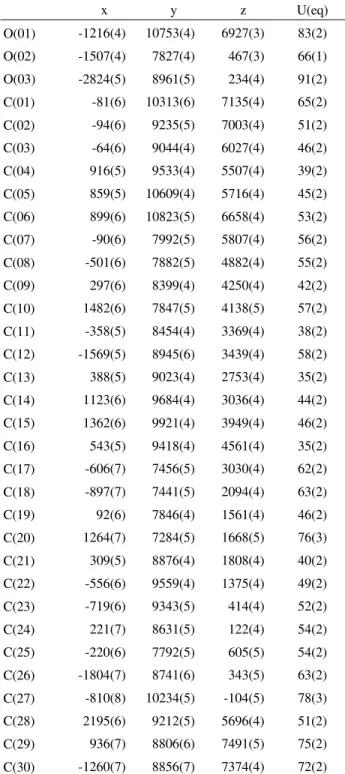
obs - Fcalc )/Σ Fobs), for all observed reflections with I > 2σ (I) and 300 refined parameters (atomic parameters, scale, extinction coeficint) was 5.3%. Final positional and equivalent isotropic tem-perature factors for all non-hydrogen atoms with estimated standard deviation in parentheses are given in Table 2. All calculated interatomic distances and angles were in agree-ment with the expected values for the respective bond types. Tables of hydrogen parameters, anisotropic tempera-ture factors and observed and calculated structempera-ture factors are available from one of the authors (YPM). Similar conformation of the rings A, B, C, D, E and F were found for compounds 1 and 2 in the crystal and are exactly the same as for the structure found for abruslactone A3 with the only difference residing, as expected, in the relative
posi-tion of O(1) of compound 1, the epimer of 2. In both crystal structures an intermolecular hydrogen bond is established in a head and tail fashion between O(1) and O(3) of mole-cules related, for epi-abruslactone by the symmetry opera-tions (x, y, z) and (0.5+x, 0.5-y, -z) with O(1)-O(3), O1-H1, and O3-H1 distances of 2.919(8), 1.157(8) and 1.902(8) Å
Vol. 9, No. 5, 1998 Triterpene Lactone Isolated from Austroplenckia populnea 463
Table 2. Atomic coordinates (x 104) and equivalent isotropic displace-ment parameters (Å2 x 10³) for Epiabruslactone. U(eq) is defined as one third of the trace of the orthogonalized Uij tensor.
x y z U(eq)
O(01) -1216(4) 10753(4) 6927(3) 83(2) O(02) -1507(4) 7827(4) 467(3) 66(1) O(03) -2824(5) 8961(5) 234(4) 91(2) C(01) -81(6) 10313(6) 7135(4) 65(2) C(02) -94(6) 9235(5) 7003(4) 51(2) C(03) -64(6) 9044(4) 6027(4) 46(2) C(04) 916(5) 9533(4) 5507(4) 39(2) C(05) 859(5) 10609(4) 5716(4) 45(2) C(06) 899(6) 10823(5) 6658(4) 53(2) C(07) -90(6) 7992(5) 5807(4) 56(2) C(08) -501(6) 7882(5) 4882(4) 55(2) C(09) 297(6) 8399(4) 4250(4) 42(2) C(10) 1482(6) 7847(5) 4138(5) 57(2) C(11) -358(5) 8454(4) 3369(4) 38(2) C(12) -1569(5) 8945(6) 3439(4) 58(2) C(13) 388(5) 9023(4) 2753(4) 35(2) C(14) 1123(6) 9684(4) 3036(4) 44(2) C(15) 1362(6) 9921(4) 3949(4) 46(2) C(16) 543(5) 9418(4) 4561(4) 35(2) C(17) -606(7) 7456(5) 3030(4) 62(2) C(18) -897(7) 7441(5) 2094(4) 63(2)
C(19) 92(6) 7846(4) 1561(4) 46(2)
C(20) 1264(7) 7284(5) 1668(5) 76(3) C(21) 309(5) 8876(4) 1808(4) 40(2) C(22) -556(6) 9559(4) 1375(4) 49(2) C(23) -719(6) 9343(5) 414(4) 52(2)
C(24) 221(7) 8631(5) 122(4) 54(2)
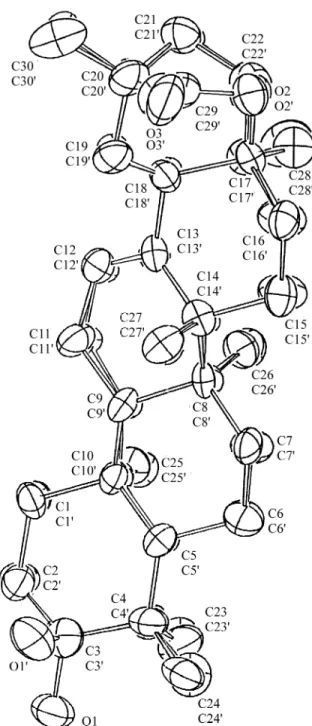
O(1)-H(1)-O(3) angle of 144.1(6)°. Figure 2 is an ORTEP14 representation of the superposition of the relative molecu-lar structures of compounds 1 and 2 including only the non-hydrogen atoms.
Conclusion
All the experimental findings in this work are conclu-sive of the existence of the two proposed configurations of the herein studied compound in the plant, compound 1 is 3α-hydroxyolean-12-en-29,22α-olide and compound 2 is
3β-hydroxyolean-12-en-29,22α-olide. The isolation of the epimeric pair gives rise to doubts on abruslactone precur-sor. Hitherto the maytenfolic acid (3β-22α -dihydroxy-olean-12-en-29α-oic acid) has been considered as abruslactone A precursor. But what could be the 3-epi-abruslactone A precursor? In the course of our future chemical investigations we will we will attempt to resolve this question. It would be very interesting to further investigate if the epimers present different biological activities.
Acknowledgments
The authors are grateful to Prof. Maria das Graças Lins Brandão from the Faculdade de Farmácia, UFMG for the determination of the optical rotation at the Institute of Pharmaceutical Biological, Karlstrasse, Germany, to Pro-fessor José Auri Pinheiro from the Universidade Federal do Ceará for the NMR and Mass spectra, to Prof. José Luis Pedersoli from ICB, UFMG for the identification and col-lection of the botanical material and to CNPq, CAPES, FINEP, FAPEMIG and FAPESP for financial support.
Refrences
1. Marine-Bettolo, G.B. Il Farmaco, Ed. Sci. 1974, 29, 551. 2. Sousa, J.R.; Jannotti, N.K.; Silva, G.D.F.; Pinheiro,
J.A. Gazz. Chim. Ital. 1988, 118, 821.
3. Sousa, J.R.; Silva, G.D.F.; Pedersoli, J.L.; Alves, R.J. Phytochemistry1990, 29, 3259.
4. Sousa, J.R.; Silva, G.D.F.; Pedersoli, J.L. Química Nova1990, 13, 252.
5. Corrêa, M.P. Dicionário das Plantas Úteis do Brasil; V. 152, Ministério da Agricultura, Rio de Janeiro, 1969.
6. SDP - Enraf -Nonius Structure Determination Packa-ge. Enraf Nonius, Delft, The Netherlands, 1985. 7. Sheldrick, G.M. SHELX86. Program for Crystal
Structure Determination. Univ. of Gotingen, Ger-many.
8. Sheldrick, G.M. SHELX93. Program for Crystal Structure Determination. Univ. of Cambridge, En-gland.
9. International Tables of X-ray Crystallography. Vol. IV, Birmingham: Kynoch Press. (Present Distributor Kluwer Academic Publishers, Dordrecht), 1974. 10. Budzikiewicz, H.; Wilson, J.M.; Djerassi, C. J. Am.
Chem. Soc. 1963, 85, 3688.
11. Chang, H.M.; Chiang, T-C.; Mak, C.W. J. Chem. Soc. Chem. Commun. 1982, 1197.
12. Nozaki, H.; Suzuki, H.; Lee, K-H.; McPhail, A.T. J. Chem. Soc. Chem. Commun. 1982, 1048.
13. Firouzabadi, H.; Ghaderi, E. Tetrahedron Lett. 1978, 839.
14. Johnson, C.K. ORTEP Report ORNL-3794, Oak Ridge National Laboratory, Tennessee, 1965.
FAPESP helped in meeting the publication costs of this article
464 Silva et al. J. Braz. Chem. Soc.