BRAZILIAN JOURNAL OF OCEANOGRAPHY, 63(4):429-442;2015 Campos et al.: Trophic relationships of ish assemblages
429
Trophic relationships among ish assemblages on a mudlat within a Brazilian
Marine protected area
The present study deals with the temporal variations
in diet and the trophic guilds of dominant ish
species on a tidal mudlat during the dry and rainy
seasons. We sought to classify the diet composition
of 17 species in the Mamanguape river estuary,
northeastern Brazil, identifying the dominant food
components and evaluating the effects of seasonality
on the guild organization. Diets varied little between
species and seasons, though they seemed to be more
heterogeneous during the rainy season. Five primary
feeding guilds were identiied, in accordance with
the importance of prey in the diets: (1) Detritivore,
(2) Zooplanktivore, (3) Zoobenthivore-epifaune,
(4) Zoobenthivore-infaune, and (5) Piscivore. Most
ishes fed on a diverse range of food items but relied
heavily on zooplankton prey. Several ish species
showed a tendency to a specialised diet, with almost
all species showing some degree of opportunistic
feeding. A high degree of diet overlap was found
among some species; however, the presence of
exploitative competition could not be determined.
A
bstrAct
Dafne Marcelle de Almeida Ramos Campos, Adna Ferreira da Silva, Natalice dos Santos Sales,
Ronnie Enderson Mariano Carvalho Cunha Oliveira, Andre Luiz Machado Pessanha*
Universidade Estadual da Paraíba.
(Rua Juvência Arruda, Bodocongó, Campina Grande - PB)
*Corresponding author: [email protected]
Descriptors:
Diet, Feeding ecology, Fish community,
Diet overlap, Estuary.
O presente estudo visa veriicar as variações
tem-porais na dieta e nas guildas tróicas nas espécies de
peixes dominantes em uma planície de maré, durante
as estações seca e chuvosa. A composição da dieta e
a organização tróica de 17 espécies foi estudada no
estuário do rio Mamanguape, Nordeste do Brasil.
Foram identiicados os itens dominantes e veriicado
os efeitos da sazonalidade sobre a organização das
guildas. A dieta variou pouco entre as espécies e as
estações; durante a estação chuvosa, a dieta das
espé-cies apresentou-se mais heterogênea. De acordo com
a importância de presas nas dietas, foram identiicadas
cinco guildas alimentares principais: (1) Detritívora,
(2) Zooplanctívora, (3) Zoobentívora-epifauna, (4)
Zoobentívora-infauna, e (5) Piscivora. A maioria dos
peixes predou uma variada gama de itens alimentares,
mas fortemente baseados em presas do zooplâncton.
Alguns peixes apresentaram tendência para uma dieta
especializada, com quase todas as espécies
mostran-do algum grau de alimentação oportunista. Um alto
grau de sobreposição de dieta foi encontrado entre as
espécies; no entanto, a ocorrência de competição por
exploração não foi observada.
r
esumo
Descritores: Dieta, Ecologia alimentar, Comuni-dades de peixes, Sobreposição alimentar, Estuário.
http://dx.doi.org/10.1590/S1679-87592015091306304
BJOCE
BRAZILIAN JOURNAL OF OCEANOGRAPHY, 63(4):429-442;2015 Campos et al.: Trophic relationships of ish assemblages
430
INTRODUCTION
Estuaries are recognised for encompassing a variety of habitats, including mangrove swamps, algal banks, and mudlats (TSE et al., 2008), with vegetated habitats exhibiting greater ish abundance and species richness than non-vegetated habitats (LUGENDO et al., 2006). This pattern is the result of the greater structural complexities and resources that develop on a vegetated substrate, providing greater protection from predators and increased food availability (WANG et al., 2009). This structural complexity increases the availability of consolidated substrates for the diatom colonisation of micro/macro algae that supports great ish diversity (HINDELL; JENKINS, 2004).
However, as non-vegetated habitats, tidal mudlats have been identiied as important environments for supporting the estuarine life cycle and are considered to be key habitats for the estuarine food chain because of their high primary productivity when compared with adjacent areas (FRANÇA et al., 2008, 2009). Mudlats are most commonly located at the mouth of estuaries and serve multiple roles, such as transit routes and/or habitats for some ish species in tropical and subtropical estuaries, particularly for juveniles and school-forming species (HINDELL; JENKINS, 2004; BARLLETA; BLABER, 2007), while the use of structured areas, such as mangrove swamps, has been suggested for small specimens, such as the Gobiidae (HINDELL; JENKINS, 2004).
The loss of these intertidal areas, due to the constant demands of human activities in coastal areas, is a global-scale problem (ROPER et al., 1988; BOER; PRINS, 2002; MARTINHO et al., 2007; TSE et al., 2008; FRANÇA et al., 2012). On tidal mudlats, ish ind refuge near the coast; thus, these habitats are considered to be additional recruitment areas that are essential for the life cycle of these ish species. However, contradictions exist, creating the need to study tidal mudlats independently to better understand how resources are used by different ish species, especially by juveniles.
In northeastern Brazil, river runoff is strongly inluenced by seasonal rainfall. Interannual and seasonal variability in river lows can cause changes in the circulation and physicochemical conditions of the estuary. Changes in salinity can affect several variables, from the submerged vegetation in tidal channels to the diversity of benthic organisms and ish. Salinity affects ish distribution in estuaries through its inluence on food
availability (VIVIER et al., 2010). Few studies have incorporated temporal heterogeneity when examining trophic structures, despite its apparent relevance for the structure and function of ish assemblages (WILSON; SHEAVES, 2001; HARRINSON; WHITFIELD, 2012).
Trophic ecology studies seek to identify the feeding habits of species through the analysis of the major items consumed. Knowledge of the diets of species is one of the basic requirements for a closer examination of the relationships among organisms in a given ecosystem, as very close relationships exist between the quantity, quality, and availability of food and the distribution and abundance of consumer organisms. The structures of ish assemblages that use the shallow areas of estuaries are strongly inluenced by trophic relationships. Knowledge of the trophic web allows one to describe energy lows in ecosystems and ecological relationships among organisms (PAIVA et al., 2008; DANTAS et al., 2013). Thus, it is important to understand the trophic relationships between ish and their potential prey to understand the relationships among ish in a community.
Marine Protected Areas (MPAs) are increasingly seen as important tools for the mangement of coastal ecosystems and isheries, where signiicant effects at the ish assemblage level is marked in the total abundance, species richness and diversity of ishes in these areas (CLAUDET et al., 2006). Therefore, the present study aimed to characterise the trophic ecology of the major ish species caught on a tropical tidal mudlat to accomplish the following: (1) describe and examine the diets of species during different phases of the hydrological regime and (2) deine the trophic guilds within the ish community of a tidal mudlat located in a tropical estuary with little anthropogenic inluence.
MATERIAL AND METHODS
Study area
The Mamanguape River estuary is located on the north coast of the Paraíba state and extends for 25 km in an east-west direction and for 5 km in a north-south direction. It is part of the Environmental Protection
Area (Área de Proteção Ambiental - APA) of Barra
BRAZILIAN JOURNAL OF OCEANOGRAPHY, 63(4):429-442;2015 Campos et al.: Trophic relationships of ish assemblages
431
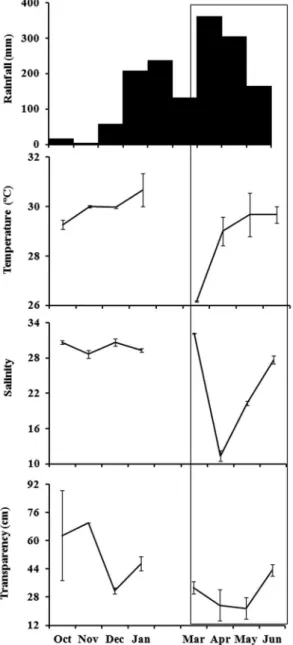
and humid). The rainy season begins in February and lasts until July, with maximum rainfall occurring from April to June, whereas the dry season occurs in the period from
August to January, the lowest rainfall occurring between
October and December (PEREIRA; ALVES, 2006). The average rainfall recorded in the area is between 1,750 and 2,000 mm annually, and the average temperature is approximately 24-26ºC. There is a well-preserved mangrove swamp in the area, composed of Avicennia germinans, Avicennia schaweriana, Conocarpus erectus, Laguncularia racemosa and Rhizophora mangle, which
extends for 600 ha around the primary channel and tidal creek, in addition to Atlantic Forest remnants (ROCHA et al., 2008). Endangered species, such as the seahorse,
Hippocampus reidi, and the West Indian manatee, Trichechus manatus, are also found in this estuary
(MOURÃO; NORDI, 2003; CASTRO et al., 2008). The Curva do Pontal beach (6º46’27’’ S; 34º55’20’’ W), located 2.3 km upstream from the estuary mouth, is 1,200 m long and has very calm waters because of the diminished inluence of waves (Figure 1). The beach is greatly inluenced by the entrance of ocean waters, where marine sediments are regularly exposed and submerged by tidal action, and has a maximum depth of 4 m. The tidal mudlat examined is a non-vegetated area with a gentle slope and ine muddy sediment in the intertidal
zone; in the subtidal zone, seagrass, sessile invertebrates, macroalgae, mangrove leaves, and fallen branches form the benthic cover (XAVIER et al., 2012).
Sampling programme
Samples were collected on monthly daytime excursions during spring low tides, in both the dry season (October 2010 to January 2011) and the rainy season (March to June 2011), to sample the ichthyofauna of the tidal mudlat more completely and eficiently during the local hydrological regime.
The ish were sampled using a beach seine (10.0 x 1.5 m; 8 mm mesh size). The seine hauls were 30 m long, parallel and close to the shore, and were taken out to a depth of approximately 1.5 m. The sampling unit was standardised with 5 replicates in an effort to capture individuals that use the area for feeding, 5 m apart to minimize the inluence on the following haul. The collected ish were ixed in 10% formalin for later identiication in the laboratory, according to FIGUEIREDO and MENEZES (1978, 1980, 2000), MENEZES and FIGUEIREDO (1980, 1985), and ARAÚJO et al. (2004). The total length (TL, mm)
and body weight (g) were measured for each individual. Temperature, salinity, and water transparency were measured, using a thermometer, an optical refractometer, and a Secchi disc, respectively.
BRAZILIAN JOURNAL OF OCEANOGRAPHY, 63(4):429-442;2015 Campos et al.: Trophic relationships of ish assemblages
432
Data analysis
Data from 17 predator species were included in the current analysis. We include numerically dominant, commercially valuable, and ecologically important species in the Mamanguape river estuary (XAVIER et al., 2012; OLIVEIRA; PESSANHA, 2014). To remove the stomach of each captured specimen, an incision was made in the abdominal region, from the anus toward the head. The stomachs were opened, and their contents arranged in a Petri dish for viewing. Content analysis was performed using a stereoscopic microscope, and food items were identiied to the lowest possible taxonomic level and subsequently grouped into the following taxonomic categories: Plant Material (plant and algae debris); Zooplankton (Decapoda larvae, Calanoida and Cyclopoida copepods, invertebrates, and ish eggs); Insects; Polychaeta; Fish (scales and ish); Mollusca (Bivalvia, Gastropoda, and Scaphopoda); Decapoda (crabs and shrimp); Benthic or Epibenthic Crustaceans (Isopoda, Tanaidacea, Ostracoda, Caprella amphipods, Mysidacea,
Gammaridea amphipods, Harpacticoida copepods, and Cirripedia); Infaune (Foraminifera, Sipuncula, Nematoda, and Trematoda); and Phytobenthos (diatoms).
To analyse each diet, the frequency of occurrence (%F), the percentage number (%N), and the volume (%V) of different food items were calculated (HYSLOP, 1980), and the Index of Relative Importance (IRI) was subsequently applied (PINKAS et al., 1971). Although the IRI may not be a good index, as pointed out by MACDONALD and GREEN (1983), it was used in this paper because IRI has often been used in other studies on stomach contents and it facilitates comparison with the results of other studies (BARRY et al., 1996). For items that cannot be counted, a value of 0.1 was given for their number (%N) when they were present in the diet, to offset distortions in the index (ABDURAHIMAN et al., 2010).
A non-hierarchical cluster analysis, based on the UPGAM (Unweighted Pair-Group Average) linkage method, was used to construct a dendrogram to identify guilds for each phase of the hydrological regime. These data were used to build a similarity matrix using the correlation coeficient. A cophenetic correlation analysis was employed to increase the reliability of conclusions drawn from the interpretation of the dendrogram. We adopted rc = 0.80 as the idelity criterion for this analysis (ROMESBURG, 1984; KOPP et al., 2007). The trophic guilds were deined according to ELLIOTT et al. (2007).
Non-metric multidimensional scaling (nMDS) was applied to obtain a graphical representation of the trophic groups, using the volumetric measurement of food items. The Bray-Curtis coeficient was calculated for each ish species after a fourth-root transformation. For easy interpretation, the items were coded and grouped according to the taxonomic categories previously described. An ANOSIM (analysis of similarity) was used to test for differences in species between the phases of the hydrological regime and among the guilds. Prior to ordination (nMDS), the volumetric dietary data of each category for the diets of each individual of each ish specieswere treated in different ways according to the purpose of the analysis.
The trophic niche breadth (diet breadth) for each period of the hydrologic cycle was calculated using Levins’ standardised index (KREBS,1989), which ranges from 0, where a species consumed only 1 type of prey, to 1, where a species similarly consumed various types of prey. To standardise the measure of each trophic niche we applied HURLBERT (1978). To calculate niche overlap, PIANKAS index (KREBS, 1989) was used, which measures the extent to which 2 species share a number of resources on a scale ranging from 0 to 1. A score of 0 indicates that the 2 species are completely dissimilar, while a score of 1 indicates complete overlap.
To explain trophic relationships, dietary data were summarised into a trophic diagram. Links between ish and their prey were constructed by incorporating the contribution of the volume of different food items in the diet of each ish species during the different phases of the hydrological regime (rainy and dry). The volumetric dietary data is the better metric for quantifying the relative importance of different food items (HAMMERSCHLAG et al., 2010).
RESULTS
BRAZILIAN JOURNAL OF OCEANOGRAPHY, 63(4):429-442;2015 Campos et al.: Trophic relationships of ish assemblages
433
Figure 2. Monthly total rainfall and mean (standard error) temperature, salinity, and transparency in the Mamanguape River Estuary, Brazil. Demarcated area indicating rainy season.
The stomach contents of the total 1,867 individuals (representing more than 80% of the numerical abundance of ish on the tidal mudlat) caught during both periods of the hydrological regime were analysed (Table 1). The diets of the species studied were composed of 35 prey items, the Crustacea group being the most diverse, primarily because of zooplankton and small benthic crustaceans (Tables 2 and 3).
The Zooplanktivore guild was the most species-rich, while the Zoobenthivore-infaune and Insectivore were the most species-poor, with the latter guild present only during the rainy season. An analysis of the trophic guilds
did not reveal any differences between the hydrological regime phases on the tidal lat studied (Figure 3). In the dry season, the cluster formed (cophenetic coeficient rc = 0.89) comprised 5 different trophic guilds separated at the 40% similarity level: the irst group consisted of 4 species of Zoobenthivore-epifaune feeding predominantly on Bivalvia and Gastropoda; the second group, containing 8 species, formed the Zooplanktivore guild; the third group, containing 2 species, formed the Piscivore guild; the fourth group consisted of only 1 species of the Zoobenthivore-infaune guild feeding predominantly on Polychaeta; and the ifth group consisted of 2 species that had diets based on organisms near the substrate (Detritivore), such as diatoms and foraminifera.
In the rainy season, 6 trophic guilds were formed via clustering (cophenetic coeficient rc = 0.92) separated at the 40% similarity level: the irst and second groups were each composed of only 1 species that fed on Insects and Polychaeta (Zoobenthivore-infaune), respectively; the third group consisted of 2 species of Mollusca eaters (Zoobenthivore-epifaune); the fourth group was formed by 6 species consuming zooplanktivorous organisms; the ifth group consisted of 4 species of ish consumers; and the sixth group was formed by 2 species that were consumers of organisms near the substrate, such as Infaune and Phytobenthos (diatoms) (Figure 4).
The dendrogram analysis revealed that most species remained within the same trophic guilds during both phases of the hydrological regime (Figure 3 and 4). However, 5 species changed guilds: during the dry season, A. brasiliensis
and H. unifasciatus were categorised as
Zoobenthivore-epifaune, but, in the rainy season, they moved to the Zooplanktivore and Insect eater guilds, respectively; B. soporator, which was part of the Zooplanktivore guild
in the dry season, was categorised as a Zoobenthivore-epifaune in the rainy season; and C. macrops and O. saurus
were in the Zooplanktivore guild during the dry season but were categorised as Piscivore during the rainy season.
The nMDS showed no distinction between hydrological periods, a result corroborated by the ANOSIM value (global R = 0.067, p = 0.122) (Figure 5). However, when
the samples were coded by trophic guild, a very clear separation was evident (global R = 0.404, p = 0.001): the
BRAZILIAN JOURNAL OF OCEANOGRAPHY, 63(4):429-442;2015 Campos et al.: Trophic relationships of ish assemblages
434 Table 1. Number of individuals captured on the tidal mudlat during the dry and rainy seasons in a tropical estuary in Brazil.
N: number of individuals; B: Biomass (in grams); F: frequency of occurrence; TL: total length, in mm. (mean ± SD - standard deviation).
Families Species
Dry season Rainy season
N B F TL
(mean ± SD) TL
(range) N B F
TL (mean ± SD)
TL (range)
Engraulidae Anchovia clupeoides 47 89.8 14.8 106 ± 6.7 95 - 134 20 84.6 12.0 81 ± 3.6 75 - 87
Lycengraulis grossidens 57 1704.1 40.0 58 ± 22.2 20 - 214 328 174.9 24.0 42 ± 12.3 25 - 143
Clupeidae Harengula clupeola 08 78.1 14.2 75 ± 11.1 65 - 95 08 35.4 10.3 65 ± 5.3 60 -76
Rhinosardinia bahiensis 155 8143.2 37.1 74 ± 8.0 60 - 106 119 350.0 16.0 73 ± 6.4 54 - 88
Hemiramphidae Hyphorhamphus unifasciatus 70 120.1 37.2 137 ± 38.7 60 - 183 26 198.1 36.0 154 ± 28.5 81 - 202
Atherinopsidae Atherinella brasiliensis 191 412.7 45.7 95 ± 19.9 27 -130 258 414.8 60.0 42 ± 32.4 17 -120
Mugilidae Mugil liza 45 43.4 20.0 29 ± 4.7 20 - 58 208 27.1 44.0 31 ± 4.1 17 - 52
Gerreidae Eucinostomus argenteus 20 79.0 28.5 63 ± 22.7 16 - 105 27 52.4 20.0 18 ± 13.7 10 - 100
Eucinostomus melanopterus 3 0.64 2.9 54 ± 11.9 47 - 68 31 7.0 24.0 23 ± 12.7 15 - 50
Carangidae Caranx latus 18 41.2 28.6 61 ± 14.5 42 - 104 29 148.6 28.0 68 ± 11.5 26 - 95
Oligoplites saurus 08 5.2 5.7 63 ± 25.0 31 - 103 06 6.5 20.0 62 ± 9.1 52 - 76
Gobiidae Bathigobius soporator 08 49.5 20.0 88 ± 15.8 70 - 122 04 45.9 20.0 74 ± 21.6 37 - 104
Paralichthyidae
Citharichthys spilopterus 16 43.7 8.6 82 ± 11.2 67 - 101 07 37.9 20.0 93 ± 37.1 14 - 143 Citharichthys macrops 33 50.9 20.0 72 ± 28.8 22 - 140 08 26.3 24.0 53 ± 20.9 18 - 130 Achirus lineatus 19 54.3 31.4 56 ± 46.1 15 - 114 03 43.6 8.0 45 ± 10.8 15 - 62
Tetraodontidae Sphoeroides testudineus 51 698.9 45.7 125 ± 48.9 21 - 197 27 1083.7 48.0 104 ± 54.5 12 - 236
Sphoeroides greeley 03 62.7 14.3 68 ± 17.3 39 - 81 06 75.4 20.0 52 ± 18.7 23 - 74
Overall, the niche breadth values were higher during the rainy season. The species A. lineatus, E. argenteus,
and A. clupeoides had the highest niche breadth values
during the rainy season, and O. saurus, L. grossidens,
and S. greeleyi had the highest values in the dry season.
The latish C. spilopterus showed the lowest values
during the dry season whereas O. saurus during the
rainy season (Figure 6). Interspeciic overlap values varied according to the period analysed, with only one comparison (Rb x Hc) remaining signiicant during both phases of the hydrological regime; the largest number of overlaps was observed among individuals within the same trophic guilds, primarily in the Zooplanktivore and Zoobenthivore-epifaune guilds (Table 4).
The trophic organisations differed during different phases of the hydrological regime, with a larger number of trophic links being observed during the rainy season when compared to the dry season (Figure 7). A pattern was also observed in the values of trophic links, with higher values occurring during the dry season when compared to the rainy season. During both phases of the hydrological regime, a larger number of links with low values was indicative of trophic resource partitioning
DISCUSSION
BRAZILIAN JOURNAL
OF OCEANOGRAPHY
, 63(4):429-442;2015
Campos et al.:
Trophic relationships of ish assemblages
435 Table 2. Volumetric frequency of food items in the diets of 17 ish species collected on the tidal mudlat during the dry season in a tropical estuary in Brazil. The number of
ish analysed (N) is in parentheses. The abbreviation used for each species is the irst letter of the taxa.
Items Lg
N = 111 Ac N = 47
Rb N = 155
Hc N = 8
Hu N = 70
Ab N = 191
Ml N = 45
Os N = 8
Cl N = 18
Ea N = 20
Em N = 3
Bs N = 8
Al N = 19
Cs N = 16
Cm N = 33
St N = 51
Sg N = 3
Diatoms 1.67 0.32 0.83 0.12 7.84 0.02 0.01
Foraminifera 0.27 3.88 0.90 0.11 0.21 76.19 0.14 0.27 0.10 < 0.01
Trematoda 11.56 1.80 0.28 0.19
Nematoda 0.13 9.06 1.88 0.90 0.17 0.10 0.28 1.24 0.65 0.71 0.48 0.30 0.07 0.54
Sipuncula 3.23 0.01 2.38 0.11
Gastropoda 4.04 8.08 11.17 13.23 63.65 2.38 1.93 0.10 1.48 13.58 Bivalvia 2.09 1.94 7.14 1.80 1.41 0.53 1.10 0.65 67.66 54.34
Scaphopoda 0.02
Polychaeta Errant 0.43 16.27 57.83 0.30 0.07 8.15
Polychaeta Sedentary 2.50 0.97 0.24 1.08 47.30 15.90 0.60 0.09 Brachyura 1.95 0.97 0.32 2.70 0.36 5.43 14.57 1.89 3.64 3.10 23.35 9.51
Dendobranchiata 5.43 30.31 1.56 2.70 0.07
Decapod larvae 20.76 12.56 0.17 0.06 18.47 0.28 0.27 0.03
Amphipod Caprellidae 0.43 < 0.01 0.27 0.01
Amphipod Gammaridae 0.64 3.51
Mysida 4.87 0.14
Copepoda n.i. 0.27 1.97 1.05 0.06 2.38 0.10
Cyclopoida 15.88 0.97 39.36 58.55 0.41 < 0.01 1.08 0.14 0.68 0.48 0.26 7.42 0.01 Calanoida 15.32 1.94 11.91 22.52 35.44 1.48 3.26 3.03 20.27 11.56 15.04
Isopoda 0.27 0.16 0.04 8.13
Tanaidacea 0.08 3.10
Ostracoda 0.41 12.94 8.37 3.60 1.23 0.83 1.08 0.87 1.24 1.44 0.10 0.02
Cirripedia 0.32 6.79
Insecta ni 0.41 0.01 2.38 0.13
Coleoptera 0.76 0.04
Diptera 1.70 < 0.01 0.39
Hymenoptera 20.92 0.31
Simuliidae pupae 0.17
Araneae 0.47
Fish eggs 0.13 0.32 1.15 3.60 0.05 79.87
Fish 17.14 0.05 4.34 49.22 0.94 12.04 93.73 63.27 0.38
Scale 0.91 0.64 0.41 1.80 0.11 0.01 2.33 30.43 0.14 0.27 1.89 0.10 0.03
Invertebrate eggs 0.65 6.29 1.11 2.38 1.08 39.69 0.20 5.97
Algae 0.64 2.11 < 0.01 0.47 54.74
BRAZILIAN JOURNAL
OF OCEANOGRAPHY
, 63(4):429-442;2015
Campos et al.:
Trophic relationships of ish assemblages
436
Table 3. Volumetric frequency of food items in the diets of 17 ish species collected in the tidal mudlat during the rainy season in a tropical estuary in Brazil. The number of
ish analysed (N) is in parentheses. The abbreviation used for each species is the irst letter of the taxa.
Items Lg
N = 144 Ac N = 20
Rb N = 119
Hc N = 14
Hu N = 26
Ab N = 258
Ml N = 208
Os N = 6
Cl N = 29
Ea N = 27
Em N = 31
Bs N = 4
Al N = 3
Cs N = 7
Cm N = 8
St N = 27
Sg N = 6
Diatoms 0.08 5.30 0.10 2.67 0.45 0.10 13.04 51.35 8.12 0.03
Foraminifera 0.33 24.48 0.23 0.44 0.06 36.58 0.05 0.65 Trematoda 4.96 2.67 0.02 0.02 0.32 Nematoda 0.33 0.15 0.89 0.06 0.41 2.43 0.02 1.48 0.66
Sipuncula 0.64 0.66 9.19
Gastropoda 7.28 4.08 1.66 0.44 0.12 1.87 6.09 0.04 7.55 84.04 Bivalvia 3.80 4.08 0.56 0.44 0.06 2.25 1.21 0.74 0.22 29.69 0.32 Scaphopoda
Polychaeta Errant 1.21 2.92 60.97 0.58 Polychaeta Sedentary 0.41 0.03 1.00 12.63
Brachyura 10.09 0.33 0.06 2.81 2.93 66.34 30.48 1.32 3.50 17.56 1.96 Dendobranchiata 0.22 6.94 1.33 47.88 1.10 0.65 Decapod larvae 2.06 8.16 11.00 0.22 1.03 27.24 3.65 0.66 0.09
Amphipod Caprellidae 0.75 0.26 0.02 Amphipod Gammaridae 0.08 0.03
Mysida 0.08 0.29
Copepoda ni 1.99 1.00 0.74
Cyclopoida 32.93 4.08 39.81 59.15 1.86 5.45 2.43 4.46 0.14 5.40 48.29 2.33 0.05 Calanoida 21.09 12.24 40.26 22.09 2.18 15.91 0.31 0.11 43.24 26.74 0.44 1.46 0.05 0.32 Isopoda 1.15 0.26 1.11 0.06 1.21 0.02
Tanaidacea 0.17
Ostracoda 1.07 8.16 0.94 4.24 0.38 1.25 7.31 0.02 0.29 0.06 1.31
Cirripedia 14.90
Insecta ni 0.83 0.71
Coleoptera 0.31
Diptera 5.21 5.07 0.08
Hymenoptera 0.22 84.14 20.64 0.89 0.21 Simuliidae pupae < 0.01
Ceratopogonidae 0.22
Araneae 0.06
Fish eggs 0.08 0.30 0.22 0.12 5.48
Fish 11.98 91.61 43.25 17.07 1.21 96.26 86.52 29.80
Scale 0.30 1.33 1.00 3.65 0.40 0.04 0.48 0.29 < 0.01
Invertebrate eggs 0.16 0.45 0.06 1.11 0.22 3.36 12.19 3.80
Algae 0.03 0.01
BRAZILIAN JOURNAL OF OCEANOGRAPHY, 63(4):429-442;2015 Campos et al.: Trophic relationships of ish assemblages
437
Figure 3. Dendrogram of the guild structure of the ish assemblage on the tropical tidal mud lat during the dry period, determined using correlation similarities of the Index of Relative Importance. The abbreviation used for each species is the irst letter of the taxa.
Figure 4. Dendrogram of the guild structure of the ish assemblage on the tropical tidal mud lat during the rainy season, determined using correlation similarities of the Index of Relative Importance. The abbreviation used for each species is the irst letter of the taxa.
Figure 5. Nonmetric multidimensional scaling (nMDS) ordination of the dietary similarities for 17 species collected on the tropical tidal mud lat: (A) during the dry (black diamond) and rainy (square) seasons; (B) Trophic guilds are: Gray square: Detritivore; triangle: Zooplanktivore; gray circle: Piscivore; black circle: Zoobenthivore-epifaune; asterisk: Insectivore; diamond: Zoobenthivore-infaune.
Figure 6. Dietary breadths of the 17 species collected in the tropical tidal mud lat during the dry and rainy seasons.
pelagic prey present in the water column (ANGEL; OJEDA, 2001). In addition, tidal mudlats are recognised as areas that are protected from wind and wave action,
having calm waters that retain holo- and meroplankton (ARCHAMBAULT et al., 1998), which, in the present study, stood out as consumed prey.
BRAZILIAN JOURNAL OF OCEANOGRAPHY, 63(4):429-442;2015 Campos et al.: Trophic relationships of ish assemblages
438 Figure 7. Trophic model of the ishes collected from the tidal mudlat
(Brazil) and their prey in the (A) dry and (B) rainy seasons. The ishes (top) are arranged from left to right in order of increasing population based on the dietary niche breadth. The widths of the linking lines correspond to the contributions by volume of different food items in the ish diets.
Table 4. Pianka overlap index between the diets of 17 species collected in the tropical tidal mud lat during the dry (lower
half of the matrix) and rainy period (upper half of the matrix). Values > 0.6 are in bold. The abbreviation used for each species is the irst letter of the taxa.
Dry/Rainy Al Ac Ab Bs Cl Cs Cm Ea Em Hc Hu Ml Os Rb Sg St Lg Al - 0.02 0.00 0.48 0.29 0.37 0.14 0.00 0.09 0.00 0.01 0.01 0.40 0.00 0.00 0.39 0.16 Ac 0.00 - 0.28 0.09 0.00 0.00 0.02 0.29 0.24 0.24 0.04 0.62 0.00 0.31 0.11 0.07 0.19 Ab 0.00 0.13 - 0.02 0.00 0.00 0.02 0.27 0.30 0.27 0.54 0.08 0.02 0.50 0.05 0.05 0.27 Bs 0.00 0.01 0.31 - 0.21 0.23 0.14 0.00 0.05 0.00 0.00 0.00 0.24 0.00 0.00 0.49 0.26 Cl 0.43 0.01 0.00 0.01 - 0.61 0.19 0.01 0.15 0.00 0.00 0.00 0.66 0.00 0.00 0.42 0.12 Cs 0.53 0.00 0.00 0.00 0.01 - 0.24 0.00 0.20 0.00 0.00 0.00 0.89 0.00 0.00 0.55 0.15 Cm 0.25 0.01 0.00 0.01 0.76 0.37 - 0.02 0.11 0.05 0.00 0.00 0.27 0.05 0.00 0.19 0.15 Ea 0.02 0.04 0.05 0.00 0.02 0.00 0.13 - 0.46 0.33 0.02 0.23 0.00 0.50 0.00 0.00 0.32 Em 0.02 0.17 0.00 0.00 0.00 0.00 0.00 0.00 - 0.95 0.03 0.08 0.26 0.91 0.00 0.14 0.27 Hc 0.04 0.08 0.01 0.00 0.03 0.00 0.24 0.17 0.06 - 0.03 0.08 0.04 0.88 0.01 0.00 0.18 Hu 0.03 0.12 0.29 0.00 0.04 0.00 0.23 0.36 0.01 0.29 - 0.08 0.01 0.03 0.00 0.00 0.01 Ml 0.00 0.07 0.03 0.00 0.00 0.00 0.00 0.00 0.00 0.00 0.01 - 0.00 0.06 0.15 0.04 0.11 Os 0.00 0.16 0.02 0.00 0.12 0.00 0.12 0.04 0.02 0.06 0.07 0.02 - 0.03 0.00 0.61 0.16 Rb 0.04 0.11 0.24 0.00 0.02 0.00 0.20 0.15 0.02 0.90 0.29 0.03 0.17 - 0.03 0.01 0.36 Sg 0.00 0.08 0.22 0.00 0.00 0.00 0.00 0.08 0.10 0.03 0.09 0.00 0.00 0.20 - 0.15 0.17 St 0.00 0.04 0.02 0.00 0.05 0.00 0.01 0.02 0.00 0.03 0.03 0.00 0.02 0.15 0.93 - 0.26 Lg 0.03 0.56 0.11 0.00 0.41 0.00 0.57 0.22 0.10 0.56 0.38 0.01 0.20 0.51 0.08 0.07
-species as they grow in the tropical estuary. DEGRÉ et al. (2006) found that the grazing ish, which kept a roughly balanced diet between microphytobenthos and detritus, changed their exclusively herbivorous diet during summer to prey on nematofauna during winter on a mudlat. This luidity among guilds exists because ecological interactions
among species are intensiied at certain periods, with the less competitive species or species more susceptible to predation being excluded or replaced by species with greater adaptability to environmental pressures (ARAÚJO et al., 2006). Although ontogenetic changes were not speciically examined in the present study, some authors have asserted that certain species may segregate into different guilds during growth (LEGUERRIERA et al., 2007; ABDURAHIMAN et al., 2010).
BRAZILIAN JOURNAL OF OCEANOGRAPHY, 63(4):429-442;2015 Campos et al.: Trophic relationships of ish assemblages
439
species of the families Engraulidae (A. clupeoides and L. grossidens) and Clupeidae (R. bahiensis and H. clupeola),
which were highly abundant in this tropical estuary. The clupeiformes were important consumers of this prey in the Guadalquivir Estuary (BALDÓ; DRAKE, 2002) and in habitats of the lower reaches of the Caeté Estuary (BARLETTA; BLABER, 2007).
The stability of biological communities partially depends on the availability of food items and on the stability of the trophic interactions among species. Changes in the proportion of available allochthonous and autochthonous resources and in the primary productivity of an estuarine system are common when comparing dry and rainy seasons, and the presence of some trophic guilds in one season but not the other may be the result of changes in prey availability (LOBRY et al., 2008). The input of allochthonous material during the rainy season and its importance to the tidal mudlat is evidenced by the formation of the Insectivorous guild (represented by H. unifasciatus). The uniform presence of some species in
the same guild, such as A. lineatus, C. spilopterus, and S. testudineus and S. greeleyi, during the periods studied was
also observed, indicating that the environmental stability of tidal mudlats may have contributed to this result.
A large number of possible interconnections among prey and predators relects the degree of opportunism, which is likely to be a key factor in promoting the survival of the species (DOLBETH et al. 2008), in addition to generalism, which tends to reduce overlap among estuarine ishes (GARRISON; LINK, 2000). Diet analysis showed changes in key prey types between hydrological periods, indicating an opportunistic trophic strategy for the species studied. The Brazilian silverside, A. brasiliensis,
consumed Gastropoda, Bivalvia, and algae, linked to the benthonic domain, during the dry season, while, in the rainy season, the species consumed items linked to zooplankton, such as copepods and Decapoda larvae; H. unisfasciatus consumed primarily algae, Gastropoda, and
Hymenoptera in the dry season, while, in the rainy season, only Hymenoptera had a signiicant value in the diet of this species; and, for the Clupeiformes, L. grossidens, A. clupeoides, and R. bahiensis, the diet during the dry season
consisted mostly of zooplankton or epibenthic organisms, while, in the rainy season, their diet was based primarily on zooplankton. In other shallow ecosystems along the Brazilian coast, both in subtropical and tropical areas, the reported dietary items have been very similar to those found in the present study (BORTOLUZZI et al., 2006;
ROCHA et al., 2008; VASCONCELOS-FILHO et al., 2009; CONTENTE et al., 2011).
When several teleosts are found in the same environment and are characterised by having wide a range of ecological niches and high trophic lexibility, the potential for interspeciic competition is reduced through resource partitioning (ROSS, 1986). In the estuary studied, teleosts took advantage of temporal variations that affect the density of prey and/or the abundance of resources. Trophic lexibility leads to high diet overlap among species, as there is no need to partition the available resources, especially among species of the same guild, as was observed in some comparisons between the Zooplanktivore and Zoobenthivore-epifaune. Despite signiicant overlap values, there was no indication of competition for resources because, when resources are abundant, competition is absent (SCHONER, 1982), and temporal segregation is a strategy that minimises direct confrontation in the use of resources. When resource partitioning becomes important in the organisation of ish assemblages, species segregate along the resource dimension and demonstrate decreased niche breadth to maintain the minimum level of niche separation (LABROPOULOU; ELEFTHERIOU, 1997).
Niche breadth was higher during one season of the hydrological regime than the other, depending on the species group analysed. Some Zooplanktivores and Piscivores had lower niche breadth values during the rainy season. During the rainy season, system productivity is greater because of increased organic matter input, resulting in greater prey abundance. Increased prey abundance should result in lower niche breadth values (WOOTON, 1990), as was observed for H. clupeola, S. greeleyi, R. bahiensis, and O. saurus. During the dry season, predators
become less selective and niche breadth increases, as was observed for M. liza, E. argenteus and A. clupeoides.
Resident estuarine species, such as A. brasiliensis, S. testudineus, A. linetaus, and C. spilopterus, had higher
niche breadth values in the rainy season, when dominant prey were abundant, but tended to specialise in the dry season, when organisms were less abundant. TSE et al. (2008) suggested that the foraging eficiency of juvenile ishes might be responsible for differences in diet breadth among juvenile ishes in a mudlat habitat.
BRAZILIAN JOURNAL OF OCEANOGRAPHY, 63(4):429-442;2015 Campos et al.: Trophic relationships of ish assemblages
440
By analysing trophic links in the dry and rainy seasons, a wide variety of items consumed by all species was observed, indicating high complexity and connectivity, as well as partitioning of the same food item by several species. Trophic web models are frequently used to describe relationships among individuals in estuaries because they summarise the vast complexity of the data (LUCZKOVICH et al., 2002). In the present study, most of the arrows in the trophic webs represented low percentage volume values, indicating the low consumption of certain food items, which allows more individuals to consume the items; that is, there was a greater partitioning of the resources available on this tidal mudlat. The large number of possible interconnections among prey and predators relects the degree of opportunism, which is most likely a key aspect that enables success in estuarine environments (DOLBETH et al., 2008).
ACKNOWLEDGEMENTS
We thank biologists Nathalia Italiano Medeiros, Gabriela Guerra Araújo Abrantes, Bianca Bezerra Fialho Soares and Renato Pereira Dantas for helping in the ield work and SISBIO for the permission to carry out the research in the protected area (24557). This study was partially supported by the National System of Research on Biodiversity (SISBIOTA/BRASIL) and CNPq - Brazilian National Agency for Scientiic and Technological Development (Proc. 563202/2010-6 and Proc. 477663/2011-7).
REFERENCES
ABDURAHIMAN, K. P.; NAYAK, T. H.; ZACHARIA, P.U.; MOHAMED, K. S. Trophic organisation and predator-prey interactions among commercially exploited demersal inishes in the coastal Waters of the southeastern Arabian sea. Estuar. Coast. Shelf Sci., v. 87, n. 4, p. 601-610, 2010. ANGEL, A.; OJEDA, F. P. Structure and trophic organization of
subtidal ish assemblages on the northern Chilean coast: the effect of habitat complexity. Mar. Ecol. Prog. Ser., v. 217, p. 81-91, 2001.
ARAÚJO, F. G.; GUIMARÃES, F. J. C.; COSTA, R. C. Environ-mental inluences on distribution of four Sciaenidae species (Actinopterygii, Perciformes) in a tropical bay at Southeast-ern Brazil. Rev. Bras. Zool., v. 23, n. 2, p. 497-508, 2006. ARAÚJO, M. E.; TEIXEIRA, J. M. C.; OLIVEIRA, A. M. E.
Peixes estuarinos do nordeste brasileiro: Guia Ilustrado. Recife: Universitária UFPE e EFC, 2004. 260 p.
ARCHAMBAULT, P.; ROFF, J. C.; BOURGET, E.; BANG, B.; INGRAM, G. R. Nearshore abundance of zooplankton in relation to shoreline coniguration and mechanisms involved. J. Plankton Res., v. 20, n. 4, p. 671-690, 1998.
BALDÓ, F.; DRAKE, P. A multivariate approach to the feeding habits of small ishes in the Guadalquivir Estuary. J. Fish Biol., v. 61, p. 21-32, 2002.
BARLLETA, M.; BLABER, S. J. M. Comparison of ish assemblages and guilds in tropical habitats of the Embley (Indo-West Paciic) and Caeté (Western Atlantic) estuaries. Bull. Mar. Sci., v. 80, n. 3, p. 647-680, 2007.
BARRY, J. M.; YOKLAVICH, M. M.; CAILLIET, G. M.; AMBROSE, D. A.; ANTRIM, B. S. Trophic ecology of dominant ishes in Elkhorn Slough, California, 1974-1980. Estuaries, v. 19, n. 1, p. 115-138, 1996.
BOER, W. F.; PRINS, H. H. T. The community structure of a tropical intertidal mudlat under human exploitation. ICES J. Mar. Sci., v. 59, n. 6, p. 1237-1247, 2002.
BORTOLUZZI, T.; ASCHENBRENNER, A. C.; SILVEIRA, C. R.; ROOS, D. C.; LEPKOSKI, E. D.; MARTINS, J. A.; GOULART, M. G.; QUEROL, E.; QUEROL, M. V. Hábito alimentar da Sardinha Prata, Lycengraulis grossidens (Spix & Agassiz, 1829), (Pisces, Engraulidae), Rio Uruguai Médio, Sudoeste do Rio Grande do Sul, Brasil. Biodivers. Pampeana, v. 4, p. 11-23, 2006.
BUSKEY, E. J.; COUTER, C.; STROM, S. Locomotory patterns of microzooplankton: potential effects on food selectivity of larval ish. Bull. Mar. Sci., v. 53, n. 1, p. 29-43, 1993. CASTRO, A. L. C.; DINIZ, A. F.; MARTINS, I. Z.; VENDEL,
A. L.; OLIVEIRA, T. P. R.; ROSA, I. M. L. Assessing diet composition of seahorses in the wild using a non-destructive method: Hippocampus reidi (Teleostei: Syngnathidae) as a study-case. Neotrop. Ichthyol., v. 6, n. 4, p. 637-644, 2008. CLAUDET, J.; PELLETIER, D.; JOUVENELC, J. Y.;
BACHETD, F.; GALZIN, R. Assessing the effects of marine protected area (MPA) on a reef ish assemblage in a northwestern Mediterranean marine reserve: identifying community-based indicators. Biol. Conserv., v. 130, n. 6, p. 349-369, 2006.
CONTENTE, R. F.; STEFANONI, M. F.; SPACH, H. L. Feeding ecology of the Brazilian silverside Atherinellabrasiliensis (Atherinopsidae) in a sub-tropical estuarine ecosystem. J. Mar. Biol. Assoc. U. K., v. 91, n. 6, p. 1197-1205, 2011. DANTAS, D. V.; BARLETTA, M.; RAMOS, J. A. A.; LIMA, A.
R. A.; COSTA, M. F. Seasonal diet shifts and overlap between two sympatric catishes in an estuarine nursery. Estuaries, v. 36, n. 2, p. 237-256, 2013.
DEGRÉ, D.; LEGUERRIER, D.; DU CHATELET, E. A.; RZEZNIK, J.; AUGUET, J.; DUPUY, C.; MARQUIS, E.; FICHET, D.; STRUSKI, C.; JOYEUX, E.; SAURIAU, P.; NIQUIL, N. Comparative analysis of the food webs of two intertidal mudlats during two seasons using inverse modelling: Aiguillon Cove and Brouage Mudlat, France. Estuar. Coast. Shelf Sci., v. 69, n. 1/2, p. 107-124, 2006. DOLBETH, M.; MARTINHO, F.; LEITÃO, R.; CABRAL, H.;
PARDAL, M. A. Feeding patterns of the dominant benthic and demersal ish community in a temperate estuary. J. Fish Biol., v. 72, n. 10, p. 2500-2517, 2008.
ELLIOTT, M.; DEWAILLY, F. The structure and components of European estuarine ish assemblages. Neth. J. Aquatic. Ecol., v. 29, n. 3/4, p. 397-417, 1995.
BRAZILIAN JOURNAL OF OCEANOGRAPHY, 63(4):429-442;2015 Campos et al.: Trophic relationships of ish assemblages
441
FIGUEIREDO, J. L.; MENEZES, N. A. Manual de peixes marinhos do sudeste do Brasil. II. Teleostei (1). São Paulo: Museu de Zoologia da Universidade de São Paulo, 1978. 110 p. FIGUEIREDO, J. L.; MENEZES, N. A. Manual de peixes
marinhos do sudeste do Brasil. III. Teleostei (2). São Paulo: Museu de Zoologia da Universidade de São Paulo, 1980. 90 p. FIGUEIREDO, J. L.; MENEZES, N. A. Manual de peixes
marinhos do sudeste do Brasil. VI. Teleostei (5). São Paulo: Museu de Zoologia da Universidade de São Paulo, 2000. 116 p. FRANÇA, S.; PARDAL, M. A.; CABRAL, H. N. Mudlat nekton
assemblages in the Tagus estuary (Portugal): distribution and feeding patterns. Sci. Mar., v. 73, n. 2, p. 591-602, 2008. FRANÇA, S.; VINAGRE, C.; PARDAL, M. A.; CABRAL, H.
N. Spatial and temporal patterns of benthic invertebrates in the Tagus estuary, Portugal: comparison between subtidal and an intertidal mudlat. Sci. Mar., v. 73, n. 2, p. 307-318, 2009. FRANÇA, S.; VASCONCELOS, R. P.; FONSECA, V. F.;
TANNER, S. E.; REIS-SANTOS, P.; COSTA, M. J.; CABRAL, H. N. Predicting ish community properties within estuaries: inluence of habitat type and other environmental features. Estuar. Coast. Shelf Sci., v. 107, p. 22-31, 2012. GARRISON, L. P.; LINK, J. S. Dietary guild structure of the ish
community in the Northeast United States continental shelf ecosystem. Mar. Ecol. Prog. Ser., v. 202, p. 231-240, 2000. HAJISAMAE, S.; IBRAHIM, S. Seasonal and spatial variations
of ish trophic guilds in a shallow, semi-enclosed tropical estuarine bay. Environ. Biol. Fish., v. 82, n. 3, p. 251-264, 2008.
HAMMERSCHLAG, N.; OVANDO, D.; SERAFY, J. E. Seasonal diet and feeding habits of juvenile ishes foraging along a subtropical marine ecotone. Aquat. Biol., v. 9, n. 3, p. 279-290, 2010.
HARRISON, T. D; WHITFIELD, A. K. Fish trophic structure in estuaries, with particular emphasis on estuarine typology and zoogeography. J. Fish Biol., v. 81, n. 6, p. 2005-2029, 2012. HINDELL, J. S.; JENKINS, G. P. Spatial and temporal
variability in the assemblage structure of ishes associated with mangroves (Avicennia marina) and intertidal mudlats in temperate Australian embayments. Mar. Biol., v. 144, p. 85-395, 2004.
HURLBERT, S. H. The measurement of niche overlap and some relatives. Ecology, v. 59, n. 1, p. 67-77, 1978.
HYSLOP, E. J. Stomach contents analysis - a review of methods and their application. J. Fish Biol., v. 17, n. 4, p. 411-429, 1980.
INOUE, T.; SUDA, Y.; SANO, M. Food habits in the surf zone of a sandy beach at Sanrimatsubara, Fukuoka Prefecture, Japan. Ichthyol. Res., v. 52, n. 1, p. 9-14, 2005.
KELLNREITNER, F.; POCKBERGER, M.; ASMUS, H. Seasonal variation of assemblage and feeding guild structure of ish species in a boreal tidal basin. Estuar. Coast. Shelf Sci., v. 108, p. 97-108, 2012.
KOPP, M. M.; DE SOUZA, V. Q.; COIMBRA, J. L. M.; LUZ, V. K.; MARINI, N.; OLIVEIRA, A. C. Melhoria da correlação cofenética pela exclusão de unidades experimentais na construção de dendogramas. Rev. Fac. Zoo. Vet. Agr., v. 14, n. 2, p. 46-53, 2007.
KREBS, C. J. Ecological methodology. New York: Harper-Collins Publ., 1989. 624 p.
LABROPOULOU, M.; ELEFTHERIOU, A. The foraging ecology of two pairs of congeneric demersal ish species: importance of morphological characteristics in prey selection. J. Fish Biol., v. 50, n. 2, p. 324-340, 1997.
LEGUERRIERA, D.; DEGRÉA, D.; NIQUILA, N. Network analysis and inter-ecosystem comparison of two intertidal mudlat food webs (Brouage Mudlat and Aiguillon Cove, SW France). Estuar. Coast. Shelf Sci., v. 74, n. 3, p. 403-418, 2007.
LOBRY, J.; DAVID, V.; PASQUAD, S.; LEPAGE, M.; SAUTOUR, B.; ROCHARD, E. Diversity and stability of an estuarine trophic network. Mar. Ecol. Prog. Ser., v. 358, p. 13-25, 2008.
LUCZKOVICH, J. J.; WARD, G. P.; JOHNSON, J. C.; CHRISTIAN, R. R.; BAIRD, D.; NECKLES, H.; RIZZO, W. M. Determining the trophic guilds of ishes and macroinvertebrates in a seagrass food web. Estuaries, v. 25, n. 6A, p. 1143-1163, 2002.
LUGENDO, B. R.; NAGELKERKEN, I.; VELDE, G. V.; MGAYA, Y. D. The importance of mangroves, mud and sand lats, and sea-grass beds feeding areas for juvenile ishes in Chwaka Bay, Zanzibar: gut content and stable isotope analyses. J. Fish Biol., v. 69, n. 6, p.1639-1661, 2006. MACDONALD, J. S.; GREEN, R. H. Redundancy of variables
used to describe importance of prey species in ish diets. Can. J. Fish. Aquat. Sci., v. 40, p. 635-637, 1983.
MARTINHO, F.; LEITÃO, R.; NETO, J. M.; CABRAL, H. N.; MARQUES, J. C.; PARDAL, M. A. The use of nursery areas by juvenile ish in a temperate estuary, Portugal. Hydrobiologia, v. 587, n. 1, p. 281-290, 2007.
MENEZES, N. A.; FIGUEIREDO, J. L. Manual de peixes marinhos do sudeste do Brasil. IV. Teleostei (3). São Paulo: Museu de Zoologia da Universidade de São Paulo, 1980. 96 p. MENEZES, N. A.; FIGUEIREDO, J. L. Manual de peixes marinhos
do sudeste do Brasil. V. Teleostei (4). São Paulo: Museu de Zoologia da Universidade de São Paulo, 1985. 105 p. MOURÃO, J. S.; NORDI, N. Etnoecologia de pescadores
artesanais do estuário do Rio Mamanguape, Paraíba, Brasil. Bol. Inst. Pesca, v. 29, n. 1, p. 9-17, 2003.
OLIVEIRA, R. E. M. C. C.; PESSANHA, A. L. M. Fish assemblage along a morphodynamic continuum on three tropical beaches. Neotrop. Ichthyol., v. 12, n. 1, p. 165-175, 2014.
PAIVA, A. C. G.; CHAVES, P. T. C.; ARAÚJO, M. E. Estrutura e organização tróica da ictiofauna de águas rasas em um estuário tropical. Rev. Bras. Zool., v. 25, n. 4, p. 647-661, 2008. PEREIRA, M. S.; ALVES, R. R. N. Composição Florística de
um remanescente de Mata Atlântica na Área de Proteção Ambiental Barra do Rio Mamanguape, Paraíba, Brasil. Rev. Biol. Ciênc. Terra, v. 6, n. 1, p. 357-366, 2006.
PINKAS, L.; OLIPHONT, M. S.; IVERSON, I. L. K. Food habits of albacore, bluein tuna, and bonito in California waters. California Fish Games, California Sacramento: State of California. Fish Bul., v. 152, p. 105, 1971.
ROCHA, M. S. P.; MOURÃO, J. S.; SOUTO, W. M. S.; BARBOZA, R. R. D.; ALVES, R. R. N. O uso dos recursos pesqueiros no estuário do Rio Mamanguape, estado da Paraíba, Brazil. Interciência, v. 33, n. 12, p. 903-909, 2008. ROMESBURG, H. C. Cluster analysis for researchers.
BRAZILIAN JOURNAL OF OCEANOGRAPHY, 63(4):429-442;2015 Campos et al.: Trophic relationships of ish assemblages
442 ROPER, D. S.; THRUSH, S. F.; SMITH, D. G. The inluence
of runoff on intertidal mudlat benthic communities. Mar. Environ. Res., v. 26, n. 1, p. 1-18, 1988.
ROSS, S. T. Resource partitioning in ish assemblages: a review of ield studies. Copeia, v. 1986, p. 352-388, 1986.
SCHOENER, T. W. The controversy over interspeciic competition. Am. Nat., v. 70, p. 586-595, 1982.
TSE, P.; NIP, T. H. M.; WONGCK, C. K. Nursery function of mangrove: A comparison with mudlat in terms of ish species composition and ish diet. Estuar. Coast. Shelf Sci., v. 80, n. 2, p. 235-242, 2008.
VASCONCELOS-FILHO, A. L.; NEUMANN-LEITÃO, S.; ESKINAZI-LEÇA, E.; OLIVEIRA, A. M. E.; PORTO-NETO, F. F. Hábitos alimentares de consumidores primários da ictiofauna do Sistema Estuarino de Itamaracá (Pernambuco - Brasil). Rev. Bras. Eng. Pesca, v. 4, n. 1, p. 21-31, 2009. VIVIER, L.; CYRUS, D. P.; JERLING, H. L. Fish community
structure of the St Lucia estuarine system under prolonged drought conditions and its potential for recovery after mouth breaching. Estuar. Coast. Shelf Sci., v. 86, n. 4, p. 568-579, 2010.
WANG, M.; HUANG, Z.; SHI, F.; WANG, W. Are vegetated areas of mangroves attractive to juvenile and small ish? The case of Dongzhaigang Bay, Hainan Island, China. Estuar. Coast. Shelf Sci., v. 85, n. 2, p. 208-216, 2009.
WILSON, J. P.; SHEAVES, M. Short-term temporal variations in taxonomic composition and trophic structure of a tropical estuarine ish assemblage. Mar. Biol., v. 139, n. 4, p. 787-796, 2001.
WOOTTON, R. J. Ecology of Teleost Fishes (Fish and Fisheries Series). Boston: Kluwer Academic Publishers, 1990. 386 p. XAVIER, J. H. A.; CORDEIRO, C. A. M. M.; TENÓRIO, G. D.;