629
Revista da Sociedade Brasileira de Medicina Tropical 36(5): 629-631, set-out, 2003.
COMUNICAÇÃO
Parasitoids of
Ophyra aenescens
(Wiedemann)
(Diptera: Muscidae): fly
of medical-sanitary importance collected in State of Goiás, Brazil
Parasitoides de
Ophyra aenescens
(Wiedemann)
(Diptera: Muscidae): mosca
de importância médico-sanitária coletado no Estado de Goiás, Brasil
Carlos H. Marchiori1, Luiz A. Pereira2, Otacilio M. Silva Filho2,
Lalyne C.S. Ribeiro2 and Vanessa R. Borges2
Abstract The objective of the study was to report the first occurrence of the parasitoid Brachymeria podagrica in pupae of Ophyra aenescens, a fly of medical-sanitary importance. Human feces was used as bait to collect the insects. In the study 20 pupae of Ophyra aenescens (Wiedemann) (Diptera: Muscidae) were obtained, of which 20% of the total yielded the parasitoid Brachymeria podagrica (Hymenoptera: Chalcididae).
Key-words: Medical-sanitary importance. Synanthropy. Parasitoid. Muscoid fly.
Resumo O objetivo do presente estudo é relatar a primeira ocorrência do parasitóide Brachymeria podagrica como inimigo natural de Ophyra aenescens, mosca de importância médico-sanitária. Para coleta dos insetos foi utilizado como isca fezes humanas. Obtiveram-se 20 pupas de Ophyra aenescens (Wiedemann) (Diptera: Muscidae), das quais 4 emergiram parasitóides pertencentes à espécie Brachymeria podagrica (Hymenoptera: Chalcididae), apresentando uma incidência de parasitismo de 20,0%.
Palavras-chaves: Importância médico-sanitária. Sinantropia. Parasitóide. Mosca.
1. Instituto Luterano de Ensino Superior de Itumbiara, Itumbiara, GO. 2. Curso de Iniciação Científica do Instituto Luterano de Ensino Superior de Itumbiara, Itumbiara, GO.
Address to:Prof. Carlos H. Marchiori. Instituto Luterano de Ensino Superior de Itumbiara/ULBRA. Av. Uruguai 686, Bairro Jardim América, 75500-000 Itumbiara, GO.
e-mail: [email protected] Recebido para publicação em 1/4/2002 Aceito em 20/8/2003
Diptera is an optimal model to study synanthropy, not only for its ecological importance, but also due to the medical-veterinary aspects, as vectors of etiological agents, such as amoeba cysts, helminth eggs, pathogenic enterobacteria, viruses and fungi2 5.
According to D’Almeida3Ophyra aenescens
(Wiedemann) (Diptera: Muscidae) possesses great capacity for colonizing a wide range of habitats and has an ecological versatility, that contributes to its geographic distribution, as such it as a very successful biological colonizer species.
All the representatives of Chalcididae behave as parasites and most involve Lepidoptera, Diptera,
Hymenoptera and Coleoptera6. The Chalcididae are
cosmopolitan insects1 with a high diversity in the
tropics4 including approximately 1500 species. They
are predominantly solitary endoparasitoids4.
Species of genus Brachymeria Westwood are important primary parasitoids of muscoid Diptera, such
as species of the Sarcophagidae family6 and
Calliphoridae. Some species are of economical importance, since they attack insect pests4. The aim
of this paper was to report a new host for Brachymeria podagrica in Brazil.
630
Marchiori CH et al
further identification. The contents of the traps were placed in plastic containers with a layer of sand to be used as a substratum for larvae to pupate. The sand was sifted after 15 days and pupae were extracted and placed individually in gelatin capsules (number 00) to obtain flies and/or the parasitoids.
The prevalence of parasitism was calculated by the following formula: P = (parasite pupae/total of pupae) x100. Through March to December 2001, four specimens
of Brachymeria podagrica (Fabricius) were collected
in 20 pupae of Ophyra aenescens (Wiedemann) (Diptera: Calliphoridae) demonstrating a 20% parasitism. The high prevalence of parasitism can also be related to the type of methodology used. The
species B. podagrica occurs almost everywhere
around the world and lives associated to synanthropic dipterous and other Diptera, emerging from their pupae. According to Roberts8 B. podagrica was collected
as a solitary parasitoid of Sinthesiomyia larvae
(Muscidae), Cochliomyia, Lucilia, Calliphora sp,
Calliphora coloradensis Hough, Callitroga macellaria (Fab.) Phaenicia sericata (Meig.) Phaenicia mexicana
(Macq.), Phormia regina (Meig.) (Calliphoridae),
Sarcophaga carnaria Linné, Sarcophaga haemorrhoidalis Fallén, Sarcophaga impar Aldrich and Sarcophaga peregtina Robineau-Desvoidy (Sarcophagidae)8.
This species occurred as a dipterous parasitoid, developed in rat carcasses in areas of tropical woods in the State of Goiás, Brazil. Its preferred host was Patonella intermutans (Walker) (Sarcophagidae) from which the predominantly female parasitoid pupae emerged9. The decomposition and colonies of insects
in the carcasses of rats during the summer and winter in South Carolina (EUA) collected B. podagrica in pupae ofSarcophaga sp (Sarcophagidae)10.
Fly control using insecticides usually selects resistant populations, albeit just a palliative measure. Some investigations7 believe that research into new
methods of fly control are needed. Natural regulators, such as parasitoids are agents responsible for reduction of fly populations7. The aim of this communication is to
report a new host for B. podagrica species in Brazil. This is the first report of B. podagrica in pupae of O. aenescens in Brazil.
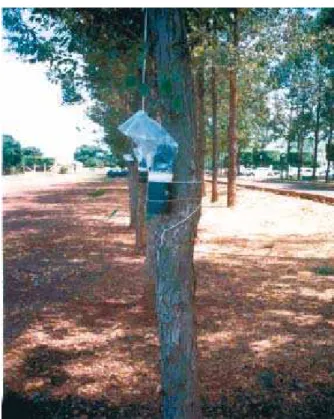
Figure 1- General aspects of the trap.
REFERENCES
1. Askew RR Further observations of Chalcididae (Hymenoptera) from Spain with some nomenclatural changes and the description of a new species. Graellsia 50: 29-34, 1994.
631
Revista da Sociedade Brasileira de Medicina Tropical 36:629-631, set-out, 2003
3. D’Almeida JM. Ovipositional substrates used by Calyptrate Diptera in Tijuca Forest, Rio de Janeiro. Memórias do Instituto Oswaldo Cruz 89: 261-264, 1994.
4. Gauld ID, Bolton B. The Hymenoptera. Oxford University Press, Oxford, 1988.
5. Greenberg B. Flies and disease: ecology, classification and biotic association. Princeton University Press, New Jersey, 1971. 6. Grissell EE, Schauff ME. A handbook of the families of Nearctic Chalcidoidea (Hymenoptera). The Entomological Society of Washington 2: 1-85, 1990.
7. Mendes J, Linhares AX. Atratividade por iscas, sazonalidade e desenvolvimento ovariano em várias espécies de Muscidae
(Diptera). Revista Brasileira de Entomologia 37: 289-297, 1 9 9 3 .
8. Roberts RA. Activity of blowflies and associated insects at various heights above the ground. Ecology 14: 306-314, 1933. 9. Silva AS. Himenópteros parasitóides associados a dípteros saprófagos, com especial referência aos Alysiinae (Braconidae). Dissertação de Mestrado, Universidade Federal de São Carlos, São Carlos, SP, 1991.