A proposal of continuing health
education to update health team
professionals in diabetes mellitus
A PROPOSTA DA EDUCAÇÃO PERMANENTE EM SAÚDE NA ATUALIZAÇÃO DA EQUIPE DE SAÚDE EM DIABETES MELLITUS
UNA PROPUESTA DE EDUCACIÓN PERMANENTE EN SALUD EN LA ACTUALIZACIÓN DEL EQUIPO DE SALUD EN DIABETES MELLITUS
1 Undergraduate Student of the Nursing School at Federal University of Minas Gerais. Belo Horizonte, MG, Brazil. [email protected] 2 Undergraduate
Student of the Nursing School at Federal University of Minas Gerais. Belo Horizonte, MG, Brazil. [email protected] 3 Post-doctorate in Public Health. Adjunct
O
RIGINAL
A
R
TICLE
RESUMO
O objetivo do estudo foi relatar a experiên-cia da Educação Permanente em Saúde na atualização da equipe de saúde de uma Unidade Básica de Saúde para a atenção integral e humanizada às pessoas com dia-betes tipo 2. A metodologia de escolha para a capacitação das equipes de saúde foi a Educação em Permanente em Saúde, por meio de oficinas educativas em diabetes com enfoque na problematização do pro-cesso educativo e profissional. Buscou-se, assim, construir um programa de educação em diabetes visando a modificar e a reori-entar a prática da equipe de saúde. A Edu-cação Permanente contribuiu para a inte-gração dos indivíduos, fortificou o compro-metimento profissional e desenvolveu a consciência de grupo. A experiência de in-serir o ensino no cotidiano das equipes de saúde favoreceu o progresso da integração entre universidade, serviço e comunidade, favorecendo o planejamento e organiza-ção do programa educativo, valorizando a interdisciplinaridade.
DESCRITORES
Educação em saúde. Diabetes melittus. Enfermagem.
Equipe de assistência ao paciente.
Andreia Cristina Seabra Rodrigues1, Gisele de Lacerda Chaves Vieira2, Heloisa de Carvalho Torres3
ABSTRACT
The objective of the study was to report the experience of Continuing Health Education to update the health team of a Health Cen-ter about comprehensive and humanized care to individuals with type 2 diabetes. The methodology used to train the health teams was Continuing Health Education by means of educational workshops in diabetes fo-cused on the problem-posing of the profes-sional and educational process. Hence, it was sought to design a program for educa-tion in diabetes with a view to changing and reorienting the practice of the health team. Continuing Education helped to integrate the individuals, strengthened the profes-sional commitment and developed the group awareness. The experience of includ-ing education in the everyday activities of the health teams helped to improve the integration among university, service and community, thus favoring the process of planning and organizing the educational program, valuing interdisciplinarity.
KEY WORDS
Health education. Diabetes melittus. Nursing.
Patient care team.
RESUMEN
El objetivo del estudio fue relatar la expe-riencia de la Educación Permanente en Sa-lud en las actualizaciones del equipo de sa-lud de una Unidad Básica de Sasa-lud para la atención integral y humanizada a las perso-nas con diabetes tipo 2. La metodología de elección para la capacitación de los equipos de salud fue la Educación Permanente en Salud, a través de talleres educativos sobre la diabetes, con enfoque en la proble-matización del proceso educativo y profesio-nal. Se buscó así construir un programa de educación en diabetes apuntando a modifi-car y reorientar la práctica del equipo de sa-lud. La Educación Permanente contribuyó en la integración de los individuos, fortaleció el compromiso profesional y desarrolló la con-ciencia de grupo. La experiencia de insertar la enseñanza en la rutina cotidiana de los equipos de salud favoreció el progreso de la integración entre universidad, servicio y co-munidad, facilitando el planeamiento y la organización del programa educativo valo-rizando la su faz interdisciplinaria.
DESCRIPTORES
Educación en salud. Diabetes melittus. Enfermería.
INTRODUCTION
Since the Brazilian health system has, among its pur-poses, the guarantee to systematically monitor subjects with chronic diseases, which affect the morbimortality of the population(1), the Brazilian Ministry of Health has imple-mented the National Plan for the Reorganization of Care for Arterial Hypertension and Diabetes Mellitus. This plan aims at establishing guidelines and goals for the reorgani-zation of care to these aggravated groups in the Unified Health System (UHS), investing in the update of health pro-fessionals from the basic network(1). In order to operate this qualification, the Continuing Education in Health – PEH arises as an investment strategy for the professional quali-fication aimed at overcoming the deformations and defi-ciencies in the education of health professionals(2-3).
In 2003, the National Policy of Continuing Education in Health, proposed by the Brazilian Ministry of Health to be the educational policy of the UHS, was approved by the National Health Committee and negotiated with the Tripartisan Intergovernmental Committee. The Continuing Education in Health is an educational activity of continu-ous character, whose guiding point is the
transformation of the work process, a privi-leged learning center(2-3). It aims at the edu-cational practice that is oriented by the daily routine of the services, starting from the criti-cal reflection about the problems regarding the care quality, assuring the collective par-ticipation - multiprofessional and interdisci-plinary, favoring the construction of new knowledge and the exchange of experiences; and representing the effort of changing the public health network into a
teaching-learn-ing space in the work execution. Besides, it allows to ques-tion the educaques-tional acques-tions in Diabetes that must be changed in order to improve the practice of health profes-sionals who work in the educational program in Diabetes, enabling them to build health actions that lead users to think about their disease and self-manage their care(4-5).
The Continuing Education in Health also meets new cur-ricular guidelines proposed to graduation courses in the health area, since it aims the transformation of the health care model, strengthening the promotion and prevention of aggravations in the Unified Health System, especially Diabe-tes, offering integral care and autonomy to health profes-sionals for the efficacy of the educational practice. It also aims at the education of a critical professional, who is able to learn, work in team, and consider the social reality to pro-vide quality and human care(2-3). It is a fact that the interest of health professionals, who are committed and dedicated to acquire knowledge, favor the transformation of the edu-cational practice, aimed at developing abilities and learning for the self-administration of the care required by Diabetes, in order to promote a healthy condition to users.
Therefore, the proposal to work the Continuing Edu-cation in Health as an activity of the discipline Supervised Training in Nursing I from the Nursing Course of the Fed-eral University of Minas Gerais (UFMG), developing educa-tional actions about Diabetes Mellitus Type 2 and involving the participation of professionals from the Family Health Teams - FHT, professors and students was considered ap-propriate to generate the reflection of the professionals regarding the doing and the thinking about how it’s being done, opening opportunities for the dialogue among the several types of knowledge, and for the construction of knowledge and critical and collective intelligence among those involved in the care of users with Diabetes. This ar-ticulation among the education, service, community and interdisciplinarity indicates an interactive character with high social and educational impact, and constitutes a privi-leged agency of the Continuing Education to lead combined actions and innovative experiences, in order to contribute to the implementation of a quality, equitable and compre-hensive health care system(3).
Some authors(5-6) add that educational programs in Dia-betes, developed by updated health professionals, contrib-ute to the decrease in hospitalizations and to the system users, who start to identify the diseases, to adopt measures for the reduction of risk factors and to receive a treatment that is capable of helping the changes in the be-havior associated to the eating pattern and the increase of physical activity for the con-trol of the disease and improvement of life quality.
OBJECTIVE
The objective of this study is to report the experience of the process of Continuing Education in Health through edu-cational workshops in Diabetes, for the update of the family health team of a Basic Health Unit aimed at providing inte-gral and humanized care to users with Diabetes Type 2.
METHOD
The methodology used for updating family health teams in Diabetes was the Continuing Education in Health through educational workshops, which constitute the establishment of spaces for the promotion of learning with the collective, multiprofessional and interdisciplinary participation through the dialogue, contributing to the construction of new knowledge(7). The study was carried out by professors and undergraduate students from the discipline Supervised Training in Nursing I, offered in the 8th period of the nursing course from the Nursing School of the Federal University of Minas Gerais – EE/UFMG in the period from August to December of 2006. The proposal was approved by the Com-mittee of Ethics in Research (Report n. 443a/05).
...the interest of health professionals, who are
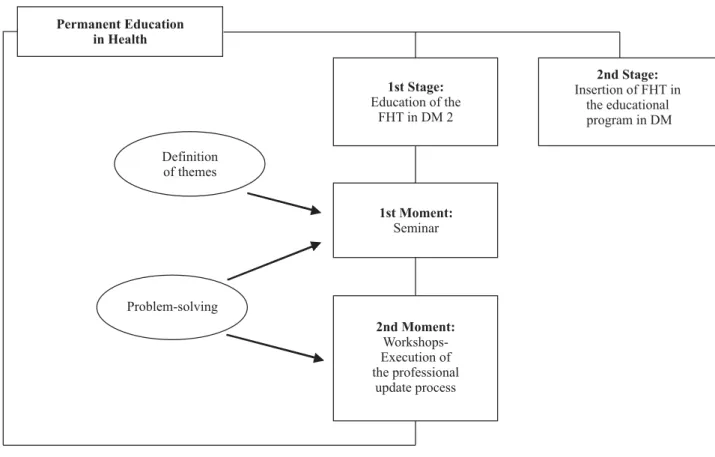
The educational activities with the family health team were organized in two moments, as presented in Figure 1: 1st Mo-ment – Seminar for the presentation and discussion of the intervention proposal, and 2nd Moment – Update of the health team through educational workshops about Diabetes, struc-tured in three stages regarding the following aspects: concep-tual update about DM, healthy nutrition and eating habits and the importance of practicing physical activities, diabetic
foot, self-monitoring. The themes were approached through recreational dynamics, educational games, case studies, board and lecture so that everyone present could externalize their knowledge, sharing it with the other members of the team, as described in Chart 1. The educational activities had the par-ticipation of nursing assistants and technicians, nurses, doc-tors, psychologists, dentists, social workers, Physiotherapy, Nu-trition and Nursing professors and Nursing students.
Figure 1 - Project proposed for the process of Continuing Education in Health - Belo Horizonte - 2006
Figure 1 presents the stages of the process of Continu-ing Education in Health developed in the Basic Health Unit (BHU). All health professionals were invited in advance, through posters displayed in visible places at the BHU. The agendas of the professionals from the family health team were reserved for the day and time scheduled for the meeting.
The following stages were established for the develop-ment of the workshop technique(8): Warm-up of the par-ticipants with strategies that facilitate the expression, prob-lem-solving of the questions, exchange process, analysis of
2nd Stage:
Insertion of FHT in the educational program in DM
1st Stage:
Education of the FHT in DM 2
1st Moment:
Seminar
2nd Moment:
Workshops-Execution of the professional
update process Definition
of themes
Problem-solving
Permanent Education in Health
the articulation of the professional to the integral care of the individual. In this study, the authors have adapted this PEH proposal aimed at providing the participants with a space for individual and collective reflection about the rou-tine of the health service and new possibilities to improve the care given to users with Diabetes.
Chart 1 - Program of the educational workshops about Diabetes, developed with the Health Team - Belo Horizonte - 2006
Workshops/ Themes Development Proposal Facilitating Techniques/Workshop Stages
I Education in health about Diabetes
? ?
Presentation of the experience of the health teams regarding the educational practices in Diabetes, highlighting the performance of each professional category
Possibilities of improving educational practices involving the performance of the multidisciplinary team
II PlanoAlimentar
III Atividade física
?Discussion about eating habits.
Reflection about the instructions given by the professionals on the diet of users with Diabetes.
The performance of the multidisciplinary team in the elaboration of an eating plan suitable to the profile of the clients.
? ?
Warm-up:
Development of the theme:
Collective construction of the Board with educational practices in Diabetes, performance of the
multidisciplinary team.
Synthesis of the group discussions.
Até que fogo persista. Não deixe o balão cair.
?
?
?Warm-up:
Development of the theme:
Reflection of the participants about eating habits. Combined elaboration of a food guide pyramid. Construction of an eating plan according to the needs and life conditions of the user with Diabetes.
Synthesis of the group discussions.
Which figures do I identify myself with?
? ? ? ? ?
?Discussion about the importance of the physical activity for the control of Diabetes.
Unification of concepts discussed in the two previous workshops.
Evaluation of the educational process.
? ?
? ? ? ? ? ?
Warm-up: Stretching Technique.
Experience and discussion of the technique for later use with the users.
Development of the theme:
Case study involving prevention and standardization of the procedures regarding the control of Diabetes.
Discussion of the attributions of the different family health professionals in educational activities and those for control of the disease.
Synthesis of the group discussions.
A diagnostic was carried out with the health team re-garding the need to plan workshops with community health agents (CHA) aimed at clarifying questions related to Diabe-tes so that they think about the importance of healthy eat-ing habits and daily physical activities for the control of the
disease and for better life quality. The development of spe-cific workshops is justified by the needs of the group regard-ing: the language, the content, the education level and the time availability. The workshops were organized by Nursing undergraduate students, as described in Chart 2.
Chart 2 - Program of the educational workshops about Diabetes developed with Community Health Agents - Belo Horizonte - 2006
Target Public:Community Health Agent (CHA).
I Education in health about Diabetes
-II Performance of
the CHA in the prevention and
control of Diabetes
?Reflection about the practice of the CHA regarding the home visit and user forwarding to the BHU.
Discussion about strategies to improve the quality of the CHA service and the articulation of health actions with the service and the community.
?
Workshops/Themes Development Proposal Facilitating Techniques/Workshop Stages
?Reflection about healthy life habits involving food and physical activity.
Discussion about Diabetes. Possibilities of prevention, treatment and monitoring.
Reflection about the educational practices in Diabetes and the performance of the multidisciplinary team.
? ?
?Warm-up:
Development of the theme:
Individual reflection about healthy eating habits and physical activity.
Construction of a food guide pyramid.
Analysis of a problem situation associated to the care of a user with Diabetes.
Synthesis of the group discussions.
Don't drop the balloon
What does this picture tell me?
? ? ? ? ?
?Warm-up:
Development of the theme:
Individual reflection about the CHA practice and his insertion in the family health team.
Construction of the Board with strategies to improve the care given to the user with Diabetes.
Synthesis of the group discussions.
What does it feel like to be an ACS?
Hot potato
RESULTS AND DISCUSSION
1st Moment: Seminar for the presentation and
discussion of the intervention proposal
The purpose of the seminar was to present the pro-posal of intervention to the service, to promote a space for the proposal of the Continuing Education in Health and to encourage the sensitization of the health team regarding the educational program in Diabetes Mellitus Type 2. A board was built with the profile of the users with Diabetes that corresponded to their coverage area, and then pre-sented to the teams, evidencing the importance of the work with operating groups for the education and promotion of health. A schedule was suggested for the meetings offered to the health teams, with the proposal of update in diabe-tes and another proposal for the work with operating groups directed at the users. A suggestion box was placed at an accessible location for the suggestions of topics to be approached about the theme, thus enabling all participants to express their opinions.
The first moment, dedicated to the seminar for the pre-sentation and discussion of the proposal of Continuing Edu-cation in Health, was fundamental to narrow our profes-sional relations and identify the true learning needs. In this context, activities were guided according to the speeches of the health professionals regarding the work process, stimulating the exchange of information and knowledge among the participants.
The dynamics in circle and the exchange devices favor the significant learning, characterizing a moment in con-tinuum for improving the quality of the care given, for its broad affinity to the routine of the professionals and the real users (implication). Besides, the intention was to use diversified methodological strategies, based on the dialogue and interaction, assuring a dynamic aspect to the activi-ties. The process of Continuing Education in Health must happen in a favorable and interactive way, so the authors believe the methodological proposal of work through work-shops assured the participative character and created op-portunities of reflection and discussion about the experi-ences(9-10) of the participants, encouraging mutual learning and enabling the dialogue among the teams.
The suggestion box promoted the freedom to choose the topics to be discussed and, among them, there was a selection of those that would create a better learning op-portunity in face of the theme diabetes(4) .
The presentation of the profile of the users with Diabe-tes who were treated at that unit promoted a reflective environment, stimulating the latent capability of detecting problems, since it evidenced that the great challenge of the health teams is to promote the compliance of the us-ers to the treatment. The professionals recognize Diabetes as a serious public health problem and the most prevalent in the population treated at the primary health level(1) and
it is the main aggravation reported by the service user. Therefore, the stage of sensitization of the professionals was completed, which was a preponderant factor to con-firm a conscious participation in the educational process.
2nd Moment: Update of the health team
The workshops aimed to develop and update the health professionals about the theme Diabetes, focused on the following topics: physiopathology, physical activity and eat-ing plan. The content was approached through recreational dynamics, flipbook, educational games, case study, board and lectures so that all participants could externalize their knowledge, sharing it with the other members of the team and providing constructive discussions about the ap-proached themes. The professionals also helped each other find solutions for the raised questions. The Nursing under-graduate students planned and coordinated the workshops. The program of educational workshops on Diabetes was organized in three meetings, whose descriptions are given in Chart 1.
The meetings were permeated by problem-solving situ-ations about the lack of prepare of the teams regarding “knowing how to teach”. The professionals expressed and discussed their difficulties, mentioning that their academic education was translated by traditional knowledge, whose health practices are established by the simplistic idea of applying the transmitted knowledge. Analyzing their pro-fessional performance, they reported that the high demand of users in the service often lead them to prescriptive prac-tices that separate the individuals from their life context, transforming them into symbols of the disease. In this con-text, the Continuing Education in Health becomes legiti-mate in the transformation of the work process for the improvement of the health practices in the services, a tool that is capable of leading the relations professionals-users with problem-based pedagogical proposals, designed for better life quality and health promotion(11-13). Being a pro-cess that involves long term results, the Continuing Educa-tion in Health is presented as a way to the disseminaEduca-tion of the pedagogical capability, to emphasize the educational potential in the institutional space(14-16). The strategy pro-posed to facilitate the group expression was considered ef-ficient and well accepted by the health team.
Regarding the observed possibilities, the use of the workshops allows to perceive that several possibilities were created, as highlighted below.
In the 1st workshop, specifically, it was observed that some participants already knew the concept of the disease, with a prevalence of common sense conceptions that are almost always related to Diabetes, which is the presence of sugar in the blood. The professionals got involved in the
complica-tions presented by the disease. A horizontal and dialogic relation was established, from the point of view of the hu-man relation that is permeated by trust among the team, facilitating the educational approach of the knowledge re-lated to the discussed theme, which was presented through the simulation of the transportation of glucose to the cell, carried by insulin.
The 2nd workshop lasted longer than it was scheduled for the program. Participants were excited with the topic about healthy eating habits and eating plan, expressing many doubts and making suggestions for the continuation of the work. The raised questions supported the discus-sion, the clarification of doubts and the effective participa-tion, indicating the incorporation of new elements in the work practice of the professionals. An opportunity was cre-ated for the development of strategic approaches to orient the care to the user with Diabetes, since the professionals built new knowledge, contributing to the reformulation of the care given, through the dialogue.
In the 3rd workshop, the professionals were more famil-iar with the theme physical activity. The compliance was inferior, since the highest volume of activities is concen-trated in this morning period. The participants exchanged information and knowledge that favored the construction of the systematized care to the user with Diabetes. The pedagogical strategies based the entire educational pro-cess, being positively evaluated by the professionals who emphasized the benefits of learning and narrowing the re-lations. Therefore, the Continuing Education in Health con-tributed to the integration of the individuals, strengthened the professional commitment and developed the group conscious.
The content discussed during the workshop encouraged the participants to rethink their knowledge, values and myths regarding healthy eating habits and Diabetes. Based on the recovery and reconstruction of knowledge, it was possible to broaden the discussion about the performance of the different health professionals in the prevention of the disease, the care given to the user with Diabetes at the health unit and the importance of the community partici-pation in the elaboration of strategies for the promotion of healthy life habits(4-6).
The workshops for community health agents (CHA) used recreational and interactive techniques, as presented in Chart 2, aimed at clarifying questions about diabetes and healthy eating habits, and a food guide pyramid was pre-sented, with the necessary instructions. There were discus-sions about the specific actions of the CHA and the group reflected about the community participation in actions that aim at the improvement of the community life quality.
The presentation of this workshop to the community health agents (CHA) was important due to the need to emphasize the specific problem-situations of this category and the convenience of listening to them longer for the continuity of the work. The time unavailability of the CHA
was also considered, since their main work location is the
street. It became necessary to adjust a better time for the participation of the CHA, as the schedule established with the other participants in the PEH was found incompat-ible. The CHA were highly satisfied after the execution of this educational activity, some reported it was a rather gratifying experience that should be repeated. The work-shop provided a space for reflection about the possibili-ties of performance of the CHA in the prevention of Dia-betes and the importance of his work as a member of the family health team.
In the synthesis of the activities, the positive repercus-sion of the workshops among the participants became evi-dent, being considered a recreational, interactive, motiva-tional and easily comprehended pedagogical strategy to develop future educational programs in health. The work-shop proposal as an educational modality favored the dis-cussion about the challenges and difficulties for structur-ing the practice of the education in Diabetes. On the other hand, they showed that it is possible to use and combine strategies for the prevention and promotion of health, ori-enting the continuation of the actions.
FINAL CONSIDERATIONS
Chronic diseases, specially Diabetes Mellitus, are get-ting more prevalent in the Brazilian population, and the update of professionals in the health area is absolutely nec-essary. Sensitizing and involving the team in discussions about their routine, the current information, the challenges of greater integration to the lifestyle of the users and those in the construction of the self-management of therapeutic attitudes and processes contribute significantly to change the situation of vulnerability that the disease imposes to its carriers, as well as to reduce or avoid its complications.
In a general way, the process of Continuing Education in Health contributed to improve the qualification of the professionals, unified and systematized the care to the user with Diabetes in terms of integrality, education in health and development of the self-management. The exchange and analysis of information favored the multiprofessional and interdisciplinary learning, in which action-reflection-action were conceived at the same time. The professionals made a self-analysis, focusing the work process, aimed at transforming the existing practices. In this environment, the learning space was transferred to the service environment and considered as a source of knowledge as well.
participants manifested their wish to continue the work-shops as a way to update the health team in the care to the user with Diabetes. This study generated the necessary
de-velopment for research regarding the evaluation of the education in health in operating groups of users with Dia-betes Mellitus in the Family Health Program.
REFERENCES
1. Brasil. Ministério da Saúde. Plano de Reorganização da Aten-ção à Hipertensão Arterial e ao Diabetes Mellitus. Proposta de Educação Permanente em Hipertensão Arterial e Diabetes Mellitus para os Municípios com população acima de 100 mil habitantes. Brasília; 2002.
2. Brasil. Ministério da Saúde. Portaria n. 198/GM/MS, de 13 de fe-vereiro de 2004. Institui a Política Nacional de Educação Perma-nente em Saúde como estratégia do Sistema Único de Saúde para a formação e desenvolvimento de trabalhadores para o setor e dá outras porvidências [legislação na Internet]. Brasília; 2004. [citado 2008 maio 15]. Disponível em: http:// www.unifesp.br/dmedprev/planejamento/pdf/port_GM 198. pdf 3. Ceccim RB. Educação permanente em saúde: desafio ambicioso e necessário. Interface Comum Saúde Educ. 2005; 9 (16):161-8. 4. Brasil. Ministério da Saúde. Secretaria de Atenção à Saúde. Departamento de Atenção Básica. Diabetes mellitus. Brasília; 2006. (Cadernos de Atenção Básica n. 16).
5. Tavares DMS, Rodrigues RAP. Educação conscientizadora do idoso diabético: uma proposta de intervenção do enfermeiro. Rev Esc Enferm USP. 2002;36(1):88-96.
6. Torres HC, Franco L, Stradioto M, Hortale V, Shall V. Avaliação estratégica de educação em grupo e individual no programa educativo em diabetes. Rev Saúde Pública. 2009;43(2): 431-9. 7. Freire P. Pedagogia da autonomia: saberes necessários à
práti-ca edupráti-cativa. 24a ed. São Paulo: Paz e Terra; 2002.
8. Chiesa AM, Westphal MF. A sistematização de Oficinas Educativas Problematizadoras no contexto dos Serviços Públi-cos de Saúde. Saúde Debate. 1995;(46):19-22.
9. Rodríguez SAM, Torres TT, Obeso AF, Rieumont ER, Ricardo AH, Rodríguez JR. Educacion permanente y perfeccionamiento del medico y la enfermera de la familia en Cuba: el caso de Pinar del Rio. Educ Med Salud.1993;27(4):528-40.
10. Ceccim RB. Educação Permanente em Saúde: descentralização e disseminação de capacidade pedagógica na saúde. Ciência Saúde Coletiva. 2005;10(4):975-86.
11. Silveira LMC, Ribeiro VMV. Grupo de adesão ao tratamento: espaço de "ensinagem" para profissionais de saúde e pacien-tes. Interface Comum Saúde Educ. 2005;9(16):91-104. 12. Merhy EE. O desafio que a educação permanente tem em si:
a pedagogia da implicação. Interface Comum Saúde Educ. 2004;9(16):161-77.
13. Torres HC, Monteiro MRP. Educação em saúde sobre doen-ças crônicas não transmissíveis no programa de saúde da fa-mília de Belo Horizonte - MG. Rev Min Enferm. 2007;10(4): 402-6.
14. Ceccim RB, Pinheiro RM, Ruben A. Ensinar saúde: a integrali-dade e o SUS nos cursos de graduação na área da saúde. Rio de Janeiro: IMS/UERJ; 2006.
15. Paschoal AS, Mantovani MF, Méler MJ. Percepção da educa-ção permanente, continuada e em serviço para enfermeiros de um hospital de ensino. Rev Esc Enferm USP. 2007;41(3): 478-84.