Original Article 505
-RELATION BETWEEN SLEEP QUALITY AND METABOLIC SYNDROME
AMONG UNIVERSITY STUDENTS
1Márcio Flávio Moura de Araújo2, Roberto Wagner Júnior Freire de Freitas3, Adman Câmara Soares Lima4, Dayse Cristina Rodrigues Pereira5, Maria Lúcia Zanetti6, Marta Maria Coelho Damasceno7.
1 Article extracted from the thesis titled - University students’ sleep quality and its interface with metabolic syndrome and health indicators, presented to the Postgraduate Program in Nursing, Universidade Federal do Ceará (UFC), in 2012. Research
inanced by the National Council for Scientiic and Technological Development (CNPq), through Universal Bid for Tenders
MCT/CNPq 14/2009, process 474902/2009-9.
2 Ph.D. in Nursing. Professor of the Nursing Course of the Universidade da Integração Internacional da Lusofonia Afro-Brasileira. Acarape, Ceará, Brazil. E-mail: [email protected]
3 Ph.D. in Nursing. Researcher at the Fundação Oswaldo Cruz (FIOCRUZ). Professor of the Nursing Course of the Universidade Federal do Piauí. Floriano, Piauí, Brazil. E-mail: [email protected]
4 M.Sc. in Nursing. Professor of the Nursing Course of the Faculdade de Educação e Cultura do Ceará. Fortaleza, Ceará, Brazil. E-mail: [email protected]
5 M.Sc. in Nursing. Professor of the Nursing Course of the Faculdade de Juazeiro do Norte. Juazeiro do Norte, Ceará, Brazil. E-mail: [email protected]
6 Ph.D. in Nursing. Associate Professor of the Escola de Enfermagem de Ribeirão Preto of Universidade de São Paulo. Ribeirão Preto, São Paulo, Brazil. Email: [email protected]
7 Ph.D. in Nursing, Professor of the Postgraduate Program in Nursing of the UFC. Fortaleza, Ceará, Brazil. E-mail: [email protected]
ABSTRACT: This transversal study aimed to analyze the relationship between poor sleep quality and metabolic syndrome among university students. The sleep quality and the components of metabolic syndrome of 701 university students from Fortaleza, Brazil, were evaluated during 2011 and 2012. In the evaluation of the scale of the associations, robust Poisson regression was used, adjusted
for sex and age. The prevalence of metabolic syndrome and poor quality sleep was 1.7% and 95.3% respectively. There was an increase in risk of 5% of developing metabolic syndrome among those university students who slept poorly (p=0.013). It is concluded that the university students in the sample who were poor sleepers present a greater probability of presenting metabolic syndrome.
DESCRIPTORS: Glucose metabolism disorders. Sleep. Students.
RELAÇÃO ENTRE QUALIDADE DO SONO E SÍNDROME METABÓLICA
EM UNIVERSITÁRIOS
RESUMO: Estudo de corte transversal, cujo objetivo foi analisar a relação entre má qualidade do sono e síndrome metabólica em universitários. Foram avaliados a qualidade do sono e os componentes da síndrome metabólica de 701 universitários de Fortaleza, Brasil durante 2011 e 2012. Na avaliação da magnitude das associações foi utilizada a regressão de Poisson robusta ajustada para sexo
e idade. A prevalência de síndrome metabólica e má qualidade do sono foi de 1,7% e 95,3% respectivamente. Houve um aumento do risco de 5% para o desenvolvimento de síndrome metabólica entre os universitários maus dormidores (p=0,013). Pode-se concluir que os universitários da amostra maus dormidores apresentaram mais chance de apresentar síndrome metabólica.
DESCRITORES: Transtornos do metabolismo de glucose. Sono. Estudantes.
RELACIÓN ENTRE CALIDAD DEL SUEÑO Y SÍNDROME METABÓLICO
EN ESTUDIANTES UNIVERSITARIOS
RESUMEN: Estudio cuantitativo, transversal, con el objetivo de analizar la relación entre la calidad del sueño de los pobres y el síndrome metabólico en estudiantes universitarios. Durante 2011 y 2012 se evaluaron la calidad del sueño y los componentes del síndrome metabólico de 701 estudiantes universitarios en Fortaleza, Brasil. En la evaluación de la magnitud de las asociaciones se utilizó robusto de regresión de Poisson ajustado por edad y sexo. La prevalencia del síndrome metabólico y la mala calidad del sueño fue de 1,6%
y 95,3% respectivamente. Hubo un aumento del 5% de riesgo de desarrollar el síndrome metabólico entre los universitarios malos
durmientes (p=0,013). Se puede concluir en la investigación que los estudiantes universitarios clasiicados como malos durmientes
eran más propensos a tener el síndrome metabólico.
INTRODUCTION
Metabolic syndrome (MetS) is an aggrega
-tion of cardiometabolic problems, characterized
by a rise in arterial pressure (AP), fasting venous
blood glucose (FVBG), plasma triglycerides (PT),
abdominal circumference (AC) and reduction in the levels of high density lipoprotein-cholesterol
(cholesterol) (HDL-C). This may or may not be
accompanied by the use of antidiabetic, antilipe-mic and anti-hypertensive medications. Today, approximately 40% of North Americans, 30% of
Europeans and 20-30% of Asians are affected by MetS,1-3 while in Africa and the Middle East, there are publications indicating prevalences of 25% and 20.4% for this metabolic disorder, respectively.4-5
In Brazil, general epidemiological data on the prevalence of MetS do not yet exist, although a recent review estimated the prevalence of MetS in Brazil at between 14.9% and 65.3%.6
MetS is responsible for approximately 7% of
deaths worldwide, regardless of cause, as it
sig-niicantly increases the chances of cardiovascular diseases (CVD), and cerebrovascular diseases,
type II diabetes, non-alcoholic hepatic steatosis, cancer and Parkinson’s disease. Today, one in
ive young adults (20-30 years old) will develop MetS, depending on their lifestyles. As a result,
10% of the world population in this age range will be vulnerable to developing the cardiometabolic
complications associated with MetS.7-8
Besides the classic diagnostic criteria cited
above, some studies have suggested the participa-tion of other factors, such as cardiovascular and
in-lammatory markers, pro-thrombotic substances, and sleep deprivation as precursors of MetS. These
factors, however, remain highly controversial and were not included in any of the diagnostic criteria
for MetS.9-13
There is robust evidence in the literature that imbalances in the sleep-wakefulness cycle act as a
risk factor for developing MetS. Epidemiological
data have shown, over the last century, a reduction in humanity’s sleep quality. This occurs voluntarily
so that people can work or enjoy leisure time. In
parallel, there has also been an increase in some of
the main components of MetS, namely: insulin resis -tance and obesity. Poor sleep quality, furthermore, seems to be related to hyperphagia, loss of mean mass, and increase in risk for dyslipidemias.9,11-13
Among people who simultaneously present
sleep problems and MetS, the chances of develop -ing coronary artery disease increase by a factor
of three. Among those who have both MetS and
sleep apnea syndrome, there is a worse prognosis
in inlammatory markers, uric acid and in the other components of MetS.14-16
Other aspects referent to poor sleep quality, such as snoring, sleep apnea, excessive daytime somnolence, working at night, and restless legs syndrome also seem to increase peoples’
vulner-ability regarding MetS.15,17 However, the authors
consulted emphasized that investigations on
the relation between sleep quantity and quality
and MetS remain incipient, mainly in the young
population. This is concerning, as the modulation of sleep in children can have future repercussions
on these subjects’ health.15-19
There is a considerable number of publica-tions focusing on the relation between duration of
sleep and the presence of MetS and its components,
either aggregated or in isolation. Nevertheless, the relation between the simultaneous presence of
MetS and poor sleep quality still requires a greater
amount of research. To our knowledge, there are only eight studies on the above-mentioned relation;
however, all were undertaken outside Brazil and
with people of middle age, adults, older adults, and adolescents.9,12,14,20-24 Thus, this relation has
not yet been analyzed in young adults, or among Brazilians. As a result, this article’s objective was to analyze the relation between sleep quality and the prevalence of MetS in university students of Fortaleza, in the state of Ceará (CE), Brazil.
METHOD
A transversal study, undertaken in 2011 and 2012 at the Universidade Federal do Ceará. The target population was undergraduate students of both sexes, properly enrolled in the campuses of
Fortaleza, Brazil. At the time of the study, the total
number of students registered in the
above-men-tioned institution was 17,228 subjects, distributed in six major areas of knowledge: the Humanities, the
exact sciences, the agricultural sciences, the health sciences, the technological sciences and sciences.
The sample calculation was based on a
formu-la for ininite popuformu-lations. A percentage of 50% was
adopted (P=50% and Q=50%), given that this value
provides a maximum sample size, when the level of signiicance (α=0.05) and the relative sample error of 8% are ixed (absolute error=4%). The sample size resulted in 600 subjects. A rate was calculated of
The following were used as inclusion criteria: to be a correctly enrolled university student in the on-site undergraduate courses run during the day;
to live in Fortaleza, Brazil; and to have telephone
and email for contact. University students who were pregnant were excluded.
From each one of the six areas of knowledge in the above-mentioned university, two under-graduate courses were selected, for convenience. However, in some academic units it was necessary to include more courses in order to complete the sample established. Among these, students from different academic semesters were selected for convenience; these were invited to participate in the study in the classroom, following explanation
of the study’s methods and objectives. It should be
highlighted that, during data collection, students from different courses attended a class in a single group, independently of the academic unit visited.
Data collection took place between March
and June 2011 and February and March 2012. All the stages of the data collection were undertaken by four nurses, who had previously undergone
16 hours’ training to be familiarized with the in -struments, with a view to ensuring quality in the checking of the measurements.
The evaluation of the sociodemographic data and data on sleep quality, undertaken through a structured questionnaire, took place at times distinct from those of collection of clinical data. In
this stage, systolic arterial pressure (SAP), diastolic arterial pressure (DAP) and AC were measured;
biochemical data were collected.
Sleep quality was analyzed based on a version of the Pittsburgh Sleep Quality Index (PSQI) validated, translated and adapted to Bra
-zilian standards. The above-mentioned version
evidenced a high degree of internal consistency (Cronbach alpha = 0.82) and was demonstrated to be equivalent to its respective original. The
university students with scores of over ive points were classiied as poor sleepers.25
In order to check AP, aneroid sphygmoma-nometers of the Tycos® brand were used, with cuffs of the Welch Allyn® brand, of different sizes, with the cuff width responding to 40% of the conference of the arm, and the length involving at least 80%. In
addition, biauricular stethoscopes of the Littman
brand® were used for auscultation. It is worth
em-phasizing that all these instruments were bought
at the time of data collection and were calibrated. Three measurements were taken, with a minimum interval of one minute between each, and the mean
of the last two measurements was calculated as the student’s arterial blood pressure value.
The study participants fasted for 12 hours
for the biochemical determination of FVBG, PT and HDL-C. The vacuum collection system BD
Vacutainer® was used in the venous puncture,
and commercial kits from Labtest Diagnostics S/
A® were used in the measurement of FVBG, PT
and HDL-C. The concentrations were determined
using the Labmax 240® automatic biochemical
analyzer.
During the process of checking the com
-ponents of MetS and their detection among the
university students, the guidelines of the National
Cholesterol Education Program Expert Panel on Detection, Evaluation, and Treatment of High Blood Cholesterol in Adults (Adult Treatment
Panel III) were adopted.26
The data were entered using double keying
on an Excel® spreadsheet, and were subsequently
exported to the STATA statistical software, version
8.0. The double keying was undertaken so as to detect incorrect, incomplete or absent informa-tion in the study’s database. The analysis of the data was preceded by the descriptive-exploratory study of the sociodemographic characteristics, the
components of MetS, and the variables related to
sleep quality, through the use of uni- and bi-variate frequencies for the qualitative variables, and the generation of means of central tendency for the quantitative variables.
In order to ascertain the differences between
the proportions of the components of MetS and the PSQI indicated, the Pearson Chi-squared test
or Fisher’s exact test were used (when
neces-sary). In order to analyze the relation between the quantitative variables (FVBG, SAP, DAP, AC, PT, HDL-C), sleep quality, and the PSQI score, the Mann-Whitney test and Spearman linear correla -tion (rs) were adopted, respectively.
In order to estimate the scale of the
associa-tion, the prevalence of the PSQI and MetS was
used as a measure of frequency. As a measure of association, the researchers used the Prevalence
Ratio (PR) and its respective conidence intervals
at 95%, estimated as a function of the relative risk (RR) of the robust Poisson regression. In all the
analyses, a level of signiicance of p£0.05 was ad
-opted. The associations were adjusted according
This study was approved by the Committee
for Ethics in Research with Human Beings, of the Health Sciences Center of the Universidade Federal do Ceará, under protocol N. 208/2010.
RESULTS
The study sample was made up of 701 university students from six areas of knowledge, distributed in 24 undergraduate courses.
How-ever, only 667 students illed out the statements
correctly and/or participated in all the stages of the methodology. Women predominated (62.6%) and the mean age of the sample was 21.5 years
(SD±4.5 years).
In relation to race, the university students stated that they were of mixed black and white descent (50.6%), white (36.1%), black (7.8%) and Asian (5.6%). Regarding the area of knowledge, the participants were distributed in the following way: human sciences (20.4%), sciences (18.5%), exact sci-ences (16.5%), technological scisci-ences (16%), health sciences (15%) and agricultural sciences (13.6%).
Students who were in the third (20.8%) and the irst semester (19.5%) predominated.
The majority of the students were single
(93%), lived with their parents (71.2%), and only studied (65.2%). The students were mainly from
socioeconomic classes C (39.6%) and B (39.7%),
considered to have median purchasing power in
Brazil. These students live with a monthly family income of US$1,705 (SD±US$200). It is important to emphasize that 15% of the participants did not
state the value of their monthly income.
The value of AC was elevated in 5.4% of the students, while only 3.0% of the participants were
classiied as hypertensive. The participation of
students using antihypertensive, oral antidiabetic or antilipemic drugs was not detected. The preva-lence of poor quality sleep was 95.3%, which made the event studied a common outcome.
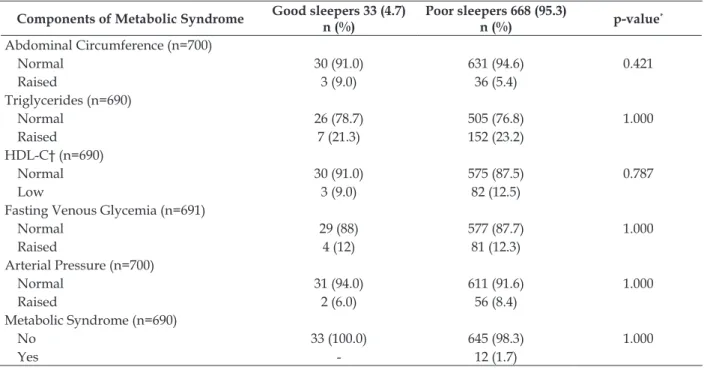
The university students who slept well pre-sented greater values of normality for PT (82%),
HDL-C (91%), FVBG (87.8%) and AP (94%) in
relation to the students who slept badly. These pre-sented a higher percentage (94.6%) for normal AC in relation to those who slept well (91%). However, these proportional differences between good and
poor sleepers and the components of MetS were not statistically signiicant (Table 1).
The prevalence of MetS in the study popula -tion was below 2%. We did not identify
statisti-cally signiicant proportional differences between the groups in relation to the prevalence of MetS
(p=1.000) (Table 1). However, all the participants
with MetS were classiied as poor sleepers.
Table 1 - Characteristics of the components of metabolic syndrome in relation to sleep quality (n=701). Fortaleza-CE, Brazil, 2012
Components of Metabolic Syndrome Good sleepers 33 (4.7) n (%)
Poor sleepers 668 (95.3)
n (%) p-value
*
Abdominal Circumference (n=700)
Normal 30 (91.0) 631 (94.6) 0.421
Raised 3 (9.0) 36 (5.4)
Triglycerides (n=690)
Normal 26 (78.7) 505 (76.8) 1.000
Raised 7 (21.3) 152 (23.2)
HDL-C† (n=690)
Normal 30 (91.0) 575 (87.5) 0.787
Low 3 (9.0) 82 (12.5)
Fasting Venous Glycemia (n=691)
Normal 29 (88) 577 (87.7) 1.000
Raised 4 (12) 81 (12.3)
Arterial Pressure (n=700)
Normal 31 (94.0) 611 (91.6) 1.000
Raised 2 (6.0) 56 (8.4)
Metabolic Syndrome (n=690)
No 33 (100.0) 645 (98.3) 1.000
Yes - 12 (1.7)
Table 2 presents the scale of the associations
found between the components of MetS and poor sleep quality. In accordance with adjust
-ments for age and sex, a statistically signiicant,
positive raw association was found between the
presence of MetS and poor sleep quality. That is,
among the university students who slept badly, there was a 5% increase in risk of developing
MetS (PR=1.05). On the other hand, we observed
that the university students who slept badly had
the same probability of presenting raised FVBG
(PR=1.00) (Table 2).
Table 2 - Association between the components of metabolic syndrome and poor sleep quality among university students (n=701). Fortaleza-CE, Brazil, 2012
Components of Metabolic Syndrome Prevalence in the
group n (%) PR* CI 95%*
Prevalence of metabolic syndrome in the study population (n=690) 1.7
Abdominal circumference (n=700)
Normal 95.4 1.00
--Raised 92.3 0.98 0.91 - 1.06
Triglycerides 690)
Normal 95.1 1.00
--Raised 95.6 1.00 0.95 - 1.04
HDL-C† (n=690)
Normal 95.0 1.00
--Low 96.4 1.02 0.97 - 1.07
Glycemia (n=691)
Normal 95.2 1.00
--Raised 95.2 1.00 0.95 - 1.02
Arterial pressure (n=700)
Normal 95.1 1.00
--Raised 96.6 1.00 0.95 - 1.06
Metabolic syndrome (n=690)
No 95.1 1.00
--Yes 100.0 1.03 - 1.07
*PR=Prevalence Ratio estimated through the robust Poisson regression with adjustments for age and sex; † High density
lipoprotein-cholesterol.
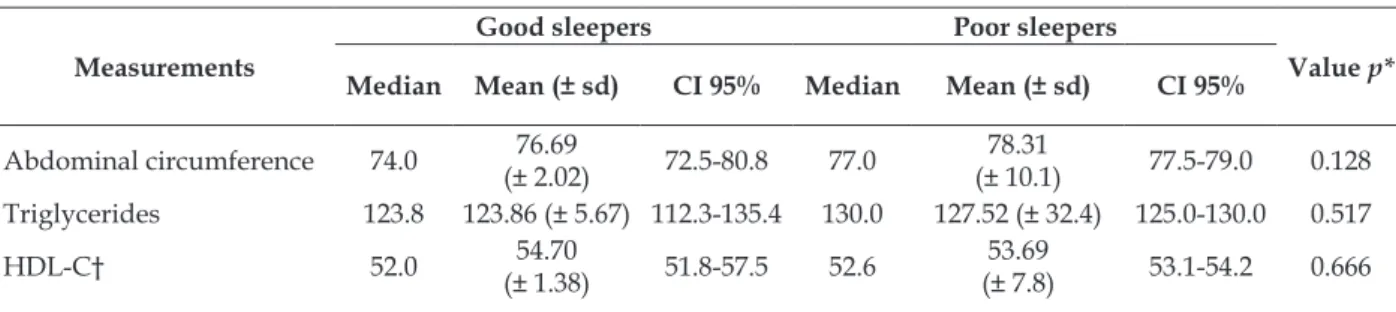
The values of the means and medians of the
components of MetS obtained were within the
normal limits. This result is expected, in the light
of the low prevalence of MetS found in the study
population (1.7%) (Table 3).
In the comparison between components of
MetS among the groups, a raised dispersion and
concentration of values above the median point for AC and PT and reduction of the median value
for DAP were observed among those who slept
poorly. Among those who slept well, lower glyce-mic values were observed. However, statistically
signiicant values were not observed between the continuous values of the components of MetS, ac
-cording to the classiication of sleep quality. Also
ascertained were asymmetric distributions for all
the measures of the components of MetS in both
groups (Table 3).
Table 3 - Distribution of the mean (± standard deviation) and median values of the components of metabolic syndrome, according to sleep quality. Fortaleza-CE, Brazil, 2012
Measurements
Good sleepers Poor sleepers
Value p* Median Mean (± sd) CI 95% Median Mean (± sd) CI 95%
Abdominal circumference 74.0 (± 2.02)76.69 72.5-80.8 77.0 (± 10.1)78.31 77.5-79.0 0.128
Triglycerides 123.8 123.86 (± 5.67) 112.3-135.4 130.0 127.52 (± 32.4) 125.0-130.0 0.517
Systolic pressure 110.0 108.21 (± 1.83) 104.4-111.9 109.0 109.68 (± 11.9) 108.7-
110.5 0.578
Diastolic pressure 72.0 (± 1.45)71.2 68.2-74.1 70.0 (± 8.5)71.05 70.4- 71.7 0.809
Venous fasting glycemia 87.0 87.0 (±1.89) 83.1-90.9 90.0 (± 10.6)88.70 87.8- 89.5 0.376
* Mann-Whitney Test; † High density lipoprotein-cholesterol.
Statistically signiicant differences were not
found between sleep duration (in hours) and the
measurements of the components of MetS in isola
-tion: AC (p=0.686), PT (p=0.223), HDL-C (p=0.638), SAP/DAP (p=0.487) and FVBG (p=0.468).
The components of MetS, PT (ρ=-0.055; p=0.1591), HDL-C (ρ=0.025; p=0.5096), AC (ρ=-0.033; p=0.3821), FVBG (ρ=-0.035; p=0.3589), SAP (ρ=-0.034; p= 0.3761) and DAP (ρ=-0.027; p=0.4764) did not present a statistically signiicant correla
-tion with the PSQI indicator.
DISCUSSION
The prevalence of MetS identiied was low,
while that of poor sleep quality was a common
event in the population. It is worth emphasizing that the worldwide prevalence of MetS varies from
<10% to up to 84%, depending on the region, the environment (urban or rural), the composition of the population studied (sex, age, race and ethnic
group) and on the deinition adopted for MetS.6 In relation to sleep quality, this may diverge as a result of the natural difference there is between biological age and chronological age. Restorative sleep (slow waves) reduces as biological age ad-vances, this process being more harmful when it occurs among younger people.28
In this study, all the subjects affected by MetS were poor sleepers. It was also observed that
among the university students who slept badly, there was an increase in the risk of developing
MetS of 5%. No study was found which had ana
-lyzed the relation between university students’ sleep quality and the prevalence of MetS.
Based in a vast bibliographic survey, in da -tabases such as PubMed, Ulrich, High Wire and
Scopus, few publications were found with similar objectives to this article. The few investigations detected and analyzed were undertaken with
adults of middle age, adolescents, older adults and
people working in speciic professions. In spite of
this, the above-mentioned studies consulted are unanimous in indicating that quantitative and qualitative changes in sleep present robust
epide-miological associations with MetS, in particular,
with the components of abdominal obesity and glycemia.9,12,14,20-24
The exact mechanism through which sleep
can raise the risk for MetS is not yet clear. How -ever, some authors consulted have elaborated hypotheses in order to explain this phenomenon. This vulnerability results from obesity triggered by the poor quality of the sleep. The increase in appetite (due to the rise in ghrelin) and the appear-ance of resistappear-ance to leptin naturally induce a rise in weight and the chances of insulin resistance.
Once this scenario is installed, obesity chroniies
the poor quality of the sleep, which is determinant for the appearance of the other components of
MetS.10-11,15,19
In analyzing the components of MetS in
isolation, with the exception of glycemia, none
presented a statistically signiicant association
or correlation with poor sleep quality. This fact diverges from the results of other studies found on the issue.9,12,14,20-24 However, it is appropriate to
emphasize that none of these studies consulted
investigated young adults. The youth of the uni-versity students, in principle, could protect them from the physiological decline which occurs with age and which can naturally predispose them to cardiovascular and metabolic changes.
This study’s indings in relation to the associ
-ation between poor sleep quality and raised FVBG
diverge from the discourse of other researchers. These assert that this relation is independent of obesity and is predictive for prediabetes and type
II diabetes mellitus (DM 2). Furthermore, in young
adults, the presence of sleep problems and intol-erance to glucose can reach 40%, and the risk for
DM2 increases ive times in relation to those with
healthy sleep.18,29-31
imply greater vulnerability of these young people
in relation to DM 2. This disease is, nowadays, one
of the main challenges for global public health. It is a matter of urgency that all health
profession-als should make a joint effort to curb any factor
which can contribute to the rise in the risk for this disease. Hence, young adults’ sleep quality should also be on the list of items to be evaluated in the
prevention of DM 2.
Currently, poor sleep quality among univer-sity students is a global public health problem. In recent decades, the insertion of new technologies has transformed cultural habits and the lifestyle of university students worldwide and has con-tributed to the appearance of sleep disturbances
among these young people. Some of their behav -iors are determinant for sleep hygiene: irregular arrangement of sleeping times, prolonged naps during the day, the use of alcohol and electronic devices prior to sleeping, and studying in bed.33
In the practice in the health services, nurses habitually deal with issues related to human sleep, as observed in the nursing diagnoses of Improved
sleep disposition and Sleep deprivation, above all
in adults. However, it is strongly indicated that
these issues should also be analyzed in schools
and universities among the young population. In developed countries, school health is already a strong labor niche, but it remains incipient in
Brazil. In the school environment, the nurse can
contribute to the evaluation and monitoring of sleep quality, but particularly in the undertaking of health education actions, geared towards im-proving the sleep and duration of the sleep, the rest environment, and substance use.
CONCLUSIONS
There was an increase of 5% in the risk of
developing MetS in the university students who
were poor sleepers.
As this is a transversal study, one cannot establish causal relations. The research adopted a psychometric scale in evaluating the sleep quality of those studied, which, in spite of being equiva-lent, has a lower accuracy in relation to other analytical methods, such as polysomnography and
actigraphy. In addition to this, the data of the PSQI
were self-reported, that is, errors, facts which are untrue or little exact, due to memory faults, may have occurred.
Other limitations may be raised in the study design. A substantial percentage of university
stu-dents mentioned not suffering sleep disturbances,
however, the great majority slept alone. This
limited the evaluation of the presence or absence of problems such as snoring or apnea, as well as
their association with MetS. There was no control of the inluence of the dietary pattern on the lipid
levels. Neither was there association between the sleep quality with markers for vascular oxidation and hormones involved in energy metabolism.
As a result, it is recommended that this study should be replicated with university students of other localities and even nationalities, with longi-tudinal or experimental designs, so as to generate more robust evidence. It is advisable, furthermore,
that, in addition to the components of MetS, as -sociations should be established with the young peoples’ chronotypes, markers for vascular oxida-tion and some hormones such as insulin, cortisol and somatotropin.
REFERENCES
1. Reaven GM. The metabolic syndrome: time to get off the merry-go-round? J Intern Med. 2011 Feb; 269(2):127-36.
2. Ram CV, Farmer JA. Metabolic syndrome in South
Asians. J Clin Hypertens. 2012 Aug; 14(8):561-5.
3. Pan WH, Yeh WT, Weng, LC. Epidemiology of
metabolic syndrome in Asia. Asia Pac J Clin Nutr.
2008 Jan; 17 (Supp 1):37-42.
4. Onyegbutulem HC, Onyegbutulem PI, Reimann M,
Li J, Bornstein SR, Schwarz PE. Metabolic syndrome
in Africa: an emerging perspective. Horm Metab Res. 2009 Feb; 41(2):75-8.
5. Ashraf H, Rashidi A, Noshad S, Khalilzadeh O,
Esteghamati A. Epidemiology and risk factors of the cardiometabolic syndrome in the Middle East. Expert Rev Cardiovasc Ther. 2011 Mar; 9(3):309-20.
6. Carvalho-Vidigal F, Bressan J, Babio N,
Salas-Salvadó J. Prevalence of metabolic syndrome in Brazilian adults: a systematic review. BMC Public Health. 2013 Dec; 13:1198.
7. Dugan CE, Fernandez ML. Effects of dairy on
metabolic syndrome parameters: a review. Yale J
Biol Med. 2014 Jun 6; 87(2):135-47.
8. Poyrazoglu S, Bas F, Darendeliler F. Metabolic
syndrome in young people. Curr Opin Endocrinol Diabetes Obes. 2014 Feb; 21(1):56-63.
9. Okubo N, Takahashi I, Sawada K, Sato S, Akimoto N,
Umeda T, et al. Relationship between self-reported sleep quality and metabolic syndrome in general
population. BMC Public Health. 2014 Jun, 14:562.
10. Drager LF, Lopes HF, Maki-Nunes C, Trombetta
IC, Toschi-Dias E, Alves MJNN. The impact
inlammatory markers in consecutive patients with
metabolic syndrome. Plos One. 2010 Aug, 5(8):12065.
11. Wolk R, Somers VK. Sleep and metabolic syndrome.
Exp Physiol. 2007 Jan; 92: 67-78.
12. Mesas AE, Guallar-Castillón P, López-García E,
León-Muñoz LM, Graciani A, Banegas JR, et al. Sleep quality and the metabolic syndrome: the role of sleep duration and lifestyle. Diabetes Metab Res
Rev. 2014 Mar; 30(3):222-31.
13. Depner CM, Stothard ER, Wright KP Jr. Metabolic
consequences of sleep and circadian disorders. Curr
Diab Rep. 2014 Jul; 14(7):507.
14. Lee J, Choi YS, Jeong YJ, Lee J, Kim JH, Kim SH, et
al. Poor-quality sleep is associated with metabolic
syndrome in Korean adults. Tohoku Jour Exp Med. 2013 Dec; 231(4):281-91.
15. Hall MH, Muldon MF, Jennings JR, Buysse DJ,
Flory JD, Manuck SB. Self-reported sleep duration
is associated with metabolic syndrome in midlife
adults. Sleep. 2008 May; 31(5):635-43.
16. Loponen M, Hublin C, Kalimo R, Mänttäri M,
Tenkanen L. Joint effect of self-reported sleep
problems and three components of the metabolic syndrome on risk of coronary heart disease. J Psychosom Res. 2010 Feb; 68(2):149-58.
17. Leineweber C, Keckclund G, Akerstedts T, Janszky I,
Orth-Gomér K. Snoring and the metabolic syndrome in women. Sleep Med. 2003 Nov; 4: 531-6.
18. Jennings JR, Muldoon MF, Hall M, Buysse DJ,
Manuck SB. Self-reported sleep quality is associated with the syndrome metabolic. Sleep. 2007 Feb;
30(2):219-23.
19. Schimid SM, Schultes B. Schlechter. Schlaf als
risikofaktor für das metabolische syndrom. Der
Internist. 2011 Apr; 52(11):383-8.
20. Yoo H, Franke WD. Sleep habits, mental health, and
the metabolic syndrome in law enforcement oficers. J Occup Environ Med. 2013 Jan; 55(1):99-103.
21. Kazman JB, Abraham PA, Zeno SA, Poth M,
Deuster PA. Self-reported sleep impairment and
the metabolic syndrome among African Americans.
Ethn Dis. 2012 Dec; 22(4):410-5.
22. Countryman AJ, Saab PG, Llabre MM, Penedo FJ,
McCalla JR, Schneiderman N. Cardiometabolic risk
in adolescents: associations with physical activity,
fitness, and sleep. Ann Behav Med. 2013 Feb;
45(1):121-31.
23. Hall MH, Okun ML, Sowers M, Matthews KA,
Kravitz HM, Hardin K, et al. Sleep is associated with
the metabolic syndrome in a multi-ethnic cohort of
midlife women: the SWAN sleep study. Sleep 2012
Jun; 35(6):783-90.
24. Hung HC, Yang YC, Ou HY, Wu JS, Lu FH, Chang
CJ. The association between self-reported sleep
quality and metabolic syndrome. PLoS One 2013
Jan; 8(1):54304.
25. Bertolazi AN, Fagondes SC, Hoof L, Dartora EG,
Miozzo IC, Barba ME, et al. Validation of the Brazilian Portuguese version of the Pittsburgh Sleep Quality Index. Sleep Med. 2011 Jan; 12(1):70-5.
26. Grundy SM, Cleeman JI, Daniels SR, Donato
KA, Eckel RH, Franklin BA, et al. Diagnosis and
management of the metabolic syndrome: an
American Heart Association/National Heart, Lung, and Blood Institute Scientiic Statement. Curr Opin
Cardiol. 2006 Jan; 21(1):1-6.
27. Barros AJD, Hirakata VN. Alternatives for logistic
regression in cross-sectional studies: an empirical comparison of models that directly estimate the
prevalence ratio. BMC Med Res Methodol. 2003
Oct 20;3:21.
28. Tuik S. Medicina e biologia do sono. Barueri (SP):
Manole; 2008.
29. Hancox, RJ, Landhus, C.E. Association between
sleep duration and haemoglobin A1c in young
adults. J Epidemiol Community Health. 2012 Oct;
66(10):957-61.
30. Ganwisch JE, Heymsield SB, Boden-Albala B, Buijis
RM, Kreier F, Pickering TG, et al. Sleep duration as a risk factor for diabetes incidence in a large US sample. Sleep. 2007 Dec; 30(12):1667-73.
31. Liu R, Zee PC, Chervin RD, Arquelles LM, Birne
J, Zhang S. Short sleep duration is associated with
insulin resistance independent of adiposity in
Chi-nese adult twins. Sleep Med. 2011 Oct; 12(9): 914-9.
32. Knuston KL. Impact of sleep and sleep loss on
glucose homeostasis and appetite regulation. Sleep
Med Clin. 2007 Jun; 2(2):187-97.
33. Araújo MFM, Lima ACS, Araújo TM, Veras VS,
Zanetti ML, Damasceno MMC. Relações entre fa
-tores sociodemográicos e qualidade do sono em universitários brasileiros. Texto Contexto Enferm
[online]. 2014 Mar [acesso 2014 Aug 30]; 23(1):176-84.
Disponível em: http://www.scielo.br/scielo.php?
-pid=S0104-07072014000100176&script=sci_arttext
Correspondence:Márcio Flávio Moura de Araújo
Rua Conselheiro da Silva, 708
60862610 - Jardim Violeta, Fortaleza, CE, Brazil E-mail: [email protected]
Received: August 30, 2014