Rev Saúde Pública 2004;38(6) www.fsp.usp.br/rsp
Epidemiological aspects of suicide in Rio
Grande do Sul, Brazil
Stela N azareth M eneghela, Cesar Gomes Victorab, N eice M üller Xavier Fariac, Lenine
Alves de Carvalhod e João Werner Falke
aPrograma de Pós Graduação em Ciências da Saúde. Universidade do Vale do Rio dos Sinos. São
Leopoldo, RS, Brasil. bDepartamento Medicina Preventiva e Social. Universidade Federal de Pelotas
(UFPel). Pelotas, RS, Brasil. cPrograma de Pós Graduação em Epidemiologia. UFPel. Pelotas, RS,
Brasil. dAgência Nacional de Vigilância Sanitária. Brasília, DF, Brasil. eDepartamento Medicina
Social. Universidade Federal do Rio Grande do Sul. Porto Alegre, RS, Brasil
Correspondence to: Stela Nazareth Meneghel
Universidade do Vale do Rio dos Sinos Av. Unisinos, 950
93022-000 São Leopoldo, RS, Brasil E-mail: [email protected]
Project sponsored by the Conselho Nacional de Desenvolvimento Cientifico e Tecnológico - Plano Sul de Pesquisa (CNPq - Process n. 400208/1999-7) and BIC/FAPERGS (Process n. 01501239).
Received on 7/11/2003. Reviewed on 30/4/2004. Approved on 12/5/2004.
Keywords
Suicide. Statistics numeric data. Mortality rate. Mortality.
Abstract
Objective
To describe epidemiological aspects of suicide mortality in a 10-year time series. Methods
Suicide deaths reported in the state of Rio Grande do Sul (RS), Brazil, were put together as historical time series based on data from the Ministry of Health Mortality Reporting System for the period 1980 to1999. Suicides were grouped according to the WHO criteria and analyzed using standard demographic variables.
Results
Suicide rates (proportional mortality and mortality rates) in RS during the study period were the highest in Brazil. The standardized rates grew from around 9 per 100,000 in the 1980s to 11 per 100,000 in 1999. This increase in mortality was attributed mainly to male mortality rates that grew from 14 per 100,000 to the current 20 per 100,000. The male:female ratio increased from 3 to 5. The highest ratios were seen among the elderly although this ratio has been increasing in young adults as well. Widows, widowers and farmers/fishers had the highest mortality rates.
Conclusions
The study highlights suicide as a collective health problem in RS and shows aspects that could contribute to preventive action.
INTRODUCTION
Suicide is a complex phenomenon investigated in several scientific fields through complementary at times antagonistic approaches. Psychiatry has gener-ally considered suicide as an individual phenomenon while social sciences, based on Durkheim6 (1982) clas-sic descriptions, has regarded it as a collective behavior.
Researchers10 point out to the occurrence of sui-cide cultures where self-destructive behaviors asso-ciated to the so-called “toxic existence” proliferate.
In the last decades scientific output on the subject of suicide has taken on a prevailing technical-realistic
approach. Following this path, the majority of studies have sought to identify risk factors, which has implied in separating suicide into multiple variables at biologi-cal, psychologibiologi-cal, and social levels. Apparently, these studies have not been able to produce any changes in the increasing suicide trends seen in many countries.
Suicide could be defined as a human act of inter-rupting one’s own life.12 By this definition, it is im-plied that the term suicide can only be applicable in case of death or in circumstances where the causal outcome is death and the agent deliberately intended to produce death.
dif-Rev Saúde Pública 2004;38(6) www.fsp.usp.br/rsp
Características epidemiológicas do suicídio no RS Meneghel SN et al
*Data from the Internet, http://www.saude.gov.br/datasus **Data from the Internet, http://www.ibge.gov.br
***Data from the Internet, http://www.ibge.gov.br/trabalho and rendimento/PNAD2001
fields, especially those working in social sciences and health. They have pointed out ethnic background and culture, social instability, and even the local cli-mate as potential intervening factors.
The present study was designed to investigate high suicide mortality in some tobacco producing regions of RS. This is part of a large ecological study, “Toxic agricultural pesticides and other risk factors for sui-cide in RS,” that aims at ascertaining the association between exposure to toxic agricultural pesticides and suicide mortality rates.2
The study aims at describing epidemiological as-pects of suicide in RS. A historical time series was carried out from 1980 to 1999, highlighting descrip-tive aspects of suicide found in death certificates.
M ETH O D S
A descriptive study was carried out to describe as-pects of suicide mortality in RS. Suicide mortality rates and proportional mortality were obtained from statistical mortality data of the Ministry of Health National Unified System Department of Information Technology (Datasus).* Population data were ob-tained from the Brazilian Statistical Institute (IBGE) website.** Denominators used for estimating rates according to occupation were obtained from the Na-tional Survey of Community-Dwelling Samples (PNAD-2001) data. They were also used in estimat-ing approximate rates as data were not available from previous population censuses.***
The Ninth Review of International Disease Classi-fication (IDC-9) – three digits for the period between 1980 and 1995 including coded categories between E950 and E959 –, was used for estimating the number of suicides. The Tenth Review of International Dis-ease Classification (IDC-10) was used for the period between 1996 and 1999 including X60 to X84 and Y87 categories.
Historical time series were created for the period 1980 to 1999. Rates were standardized based on the standard population provided by the World Health Organization (WHO).1 The standard population com-prises less children and more older adults aged more than 70 years, thus balancing the excess weight given to children in a previous estimate known as “Segi’s standard population”.1 Creating a new standard world population was needed mainly because of an increase in the old age group.
ferent regions and cultures since suicide is a taboo topic in most societies.9
Suicide-related factors include previous attempts, affective disorders, social withdrawal, family history, voicing of one’s intentions and several demographic and socioeconomic variables.22 In Canada, risk groups for suicide comprise Native peoples, young-sters, elderly, prisoners, homosexuals and individu-als with family history of suicide. To that it is asso-ciated cases of drug addiction, stressing life events and terminal disease.24 Five situations are currently described as most relevant in suicidal behavior: 1) increase prevalence of depressive disorders; 2) in-creasing abuse of psychoactive drugs; 3) psycho-biological changes such as early puberty; 4) increas-ing social stressors; 5) change in accepted patterns of suicidal behavior and increasing availability of suicidal models.5 Mental disturbances and addic-tions co-occur in 90% of suicides reported in Eu-rope and the US.18
Researchers have postulated the association between alcohol consumption and suicide based on the assump-tion that suicide rates are inversely associated to social integration and that alcohol abuse produces social dis-approval and gradual deterioration of social links. Be-sides the indirect association of alcohol consumption and suicide through social disintegration, some re-searchers have pointed out a direct relationship between alcohol consumption and suicide claiming that the in-dividual’s reduced self-control would act as a trigger to a previous predisposition for self-destructive behavior.19
In Brazil, though underestimated, suicide deaths are low when compared to other deaths. But these have increased mostly among male young adults. Mello Jorge16 (2000) seems it as concerning issue, especially because there were no methodological changes in suicide reporting and data collection.
Regarding socioeconomic status, suicide is found among individuals at extremes: those less privileged and those well-off.11 Besides, a lowering in socioeco-nomic status is also associated to suicide.
Divorce, women becoming part of the labor force, economical variables and unemployment were also described as risk factors for suicide.3,14
!
Rev Saúde Pública 2004;38(6) www.fsp.usp.br/rsp
Características epidemiológicas do suicídio no RS Meneghel SN et al
Data analysis was conducted using the Ministry of Health TabWin software program.17 The following sui-cide mortality rates in RS were calculated: total mortal-ity rates according to sex, age group, occupation, school-ing, marital status and means of suicide. Schooling data were not presented here due to their low quality; more than 50% were classified as “unknown”. Linear regres-sion analysis of standardized mortality rates
was carried out using Statistical Package of So-cial Sciences (SPSS), version 10.0.
RESU LTS
The highest suicide rates were found in the southern region of Brazil, more specifically in RS (mean of 10.2 suicides per 100,000 in-habitants for the period 1980 to 1999). Dur-ing the 20-year-period comprised in the study, the southern states of Santa Catarina and Paraná had mean rates of 7.9 and 7.1 per 100,000, respectively, while the national mean for the period was 4.3 deaths per 100,000. RS ranked first in suicide mortality in all and every year comprised in the time series. Sui-cide proportional mortality was also estimated for every Brazilian state as a way of control-ling for distortions caused by regional differ-ences in the Mortality Data System reliabil-ity. Similarly to mortality rates, suicide pro-portional mortality in RS showed the highest rates in Brazil. It is worth noting that, often seen as taboo, suicide deaths could be reported as an “unknown” external cause of death lead-ing to underreportlead-ing.
Table 1 shows crude and standardized
sui-cide mortality rates in RS in an historical time series from 1980 to 1999. Standardized mortality rates for both sexes grew from 9.5 in 1980 to 11.7 per 100,000 in 1999. There was an increase in standardized rates for males from 14.0 in 1980 to 20.2 per 100,000 in 1999, while female rates ranged from 3.2 to 4.7 per 100,000 in the same period. Male/female ratio
in-Figure 1 – Standardized suicide rates by sex in Rio Grande do Sul,
1980-1999.
2000 1990
1980 21
20
19
18
17
16
15
14
13 ObservedReg Linear
2000 1990
1980 6,0
5,5
5,0
4,5
4,0
3,5
3,0
Observed Reg Linear
Y = 14.5 + 0.18 x P=0.009
Y= 4.7 - 0.046 x P=0.031 Male mortality rate Female mortality rate
Figure 2 – Suicide mortality rates according to age groups, Rio Frande
do Sul, 1980-84, 1985-89, 1990-94 and 1995-99. 0
5 10 15 20 25 30 35
15-19 20-29 30-39 40-49 50-59 60-69 70-79 80+ 80-84
85-89
90-94
95-99
Table 1 – Suicide deaths and crude and standardized mortality rates by sex and total (IDC-9 e IDC-10). Rio Grande do Sul, RS,
Brazil. 1980-99.
Year M al e Femal e Total
D eaths M ortality rate D eaths M ortality rate D eaths M ortality rates
O bserved Standardi zed O bserved Standardi zed O bserved Standardi zed
1980 459 11.9 14.0 183 4.7 4.7 642 8.3 9.5
1981 467 12.0 14.0 170 4.3 4.7 637 8.1 9.2
1982 481 12.1 14.7 156 3.9 4.2 637 8.0 9.2
1983 610 15.2 18.5 183 4.5 5.9 793 9.7 11.5
1984 595 14.6 17.3 181 4.3 4.2 776 9.4 10.7
1985 596 14.4 17.0 178 4.2 4.6 774 9.2 10.5
1986 571 13.6 16.4 185 4.3 4.6 756 8.9 10.1
1987 561 13.2 16.0 168 3.8 4.1 729 8.4 9.7
1988 556 12.9 15.1 186 4.2 4.4 742 8.5 9.5
1989 557 12.7 14.6 158 3.5 3.8 715 8.0 8.9
1990 523 11.8 13.6 180 3.9 4.2 703 7.8 8.6
1991 601 13.4 15.6 192 4.1 4.4 793 8.7 9.7
1992 658 14.5 16.1 162 3.5 3.6 820 8.9 9.6
1993 601 13.0 14.9 146 3.1 3.2 747 8.0 8.7
1994 669 14.3 16.3 165 3.4 3.5 834 8.8 9.6
1995 753 16.0 18.3 203 4.2 4.5 956 10.0 11.1
1996 737 15.6 16.7 216 4.4 4.4 953 9.9 10.2
1997 807 16.8 18.6 190 3.8 3.9 998 10.2 10.9
1998 874 18.0 19.5 215 4.3 4.3 1089 11.0 11.5
1999 889 18.1 20.2 204 4.0 4.1 1093 11.0 11.7
" Rev Saúde Pública 2004;38(6) www.fsp.usp.br/rsp
Características epidemiológicas do suicídio no RS Meneghel SN et al
Figure 3 - Frequency by means of suicide, Rio Grande do Sul, 1980-98.
0 100 200 300 400 500 600 700
80 81 82 83 84 85 86 87 88 89 90 91 92 93 94 95 96 97 98
hanging
firearm
sharp instrument
drugs
unknow creased from 3 in 1980 to 5 per 100,000 by
the end of the study period. The temporal trend showed a sudden increase in 1983, an overall reduction between 1984 and 93 and a subsequent increase up to date.
Regression lines drew from standardized mortality rates revealed an ascending trend for suicide among males and a slightly de-scending trend for suicide among females (Figure 1).
Rates according to age groups had a gradual increase as age advanced (Figure 2). The highest rates were seen among eld-erly aged more than 70 years. However, younger age groups showed increased rates in the recent years, mostly in the last five
years, which could indicate a trend toward juvenili-zation of suicide.
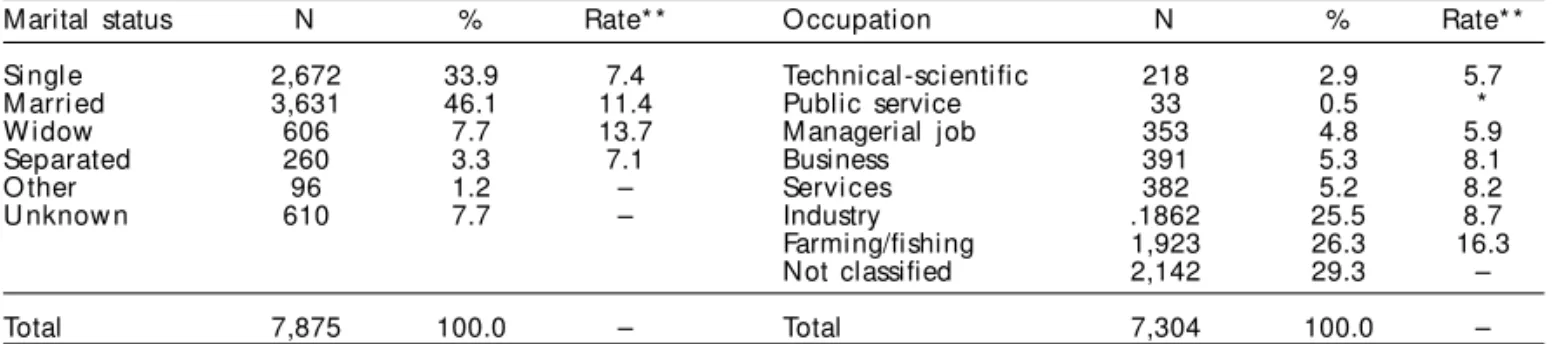
Table 2 show suicide deaths, proportional mortal-ity and mortalmortal-ity rates according to marital status and occupation for the period between 1990 and 1998.
Higher suicide rates were seen among married peo-ple but the highest rates were found among widows. Separated and single people had the lowest rates. The risk almost tripled among those working in farming and fishing activities, i. e., 16.3 per 100,000 com-pared to 5.7 per 100,000 among technical-scientific workforce. Rate standardization in Table 2 was not conducted because no census data were available.
The most common means of committing suicide was hanging (62.5%), followed by firearms (21.5%) and unknown (6.9%) (Figure 3). These three catego-ries added up to 90% of reported cases. It is worth stressing that the relative increase of hanging and firearm use, as well as reduction of unknown means, could probably indicate easier access to arms and improvement of the mortality data system. Hanging was also the means of choice by farmers.
D ISCU SSIO N
RS showed the highest suicide rates – both mortal-ity rates and proportional mortalmortal-ity – in Brazil dur-ing the study period. Mello Jorge16 (2000) pointed out that despite suicide mortality rates in Brazil are knowingly underestimated, increasing rates are seen among young male adults. This is concerning since this trend cannot be explained by any methodologi-cal changes in either reporting or data collection.
An overview of 31 WHO countries4 reporting sui-cide reveals varying suisui-cide mortality among coun-tries and both high and low rates are seen in almost all continents – Americas, Asia, and Europe. Accord-ing to mortality classification criteria, rates below 5 per 100,000 are considered low; those ranging from 5 to 15 are viewed as moderate; those between 15 and 30 as high, and those above 30, very high.4 By this classification, suicide mortality rates in RS can be considered moderate in the general population but, among males, they are classified as high with an in-creasing trend.
A well-documented aspect of suicide
epidemiol-Table 2 – Suicide deaths and proportional mortality in Rio Grande do Sul according to demographic characteristics (marital
status and occupation), 1990-98.
Marital status N % Rate* * O ccupation N % Rate* *
Si ngl e 2,672 33.9 7.4 Technical-scientific 218 2.9 5.7
M arri ed 3,631 46.1 11.4 Public service 33 0.5 *
W idow 606 7.7 13.7 M anagerial job 353 4.8 5.9
Separated 260 3.3 7.1 Business 391 5.3 8.1
O ther 96 1.2 – Servi ces 382 5.2 8.2
U nknow n 610 7.7 – Industry .1862 25.5 8.7
Farming/fishing 1,923 26.3 16.3
Not classified 2,142 29.3 –
Total 7,875 100.0 – Total 7,304 100.0 –
#
Rev Saúde Pública 2004;38(6) www.fsp.usp.br/rsp
Características epidemiológicas do suicídio no RS Meneghel SN et al
ogy is male:female ratio, which is higher than 3:1 in many countries but has remained stable over the years in almost all countries with available data. In the US, increasing financial, individual and social opportu-nities for women were parallel to lower suicide rates.11 In India and China, women have high suicide risk.21
Lower suicide rates among women have been attrib-uted to lower prevalence of alcohol dependence, re-ligiosity, and accommodating attitudes concerning their social aptitudes and roles. Also, women generally manage to recognize early risks for depression, sui-cide, and mental disease, and they are used to seeking help during crisis and social support.23 The fulfillment of maleness involves more suicide-prone behaviors such as competitiveness, impulsiveness and easier ac-cess to lethal weapon and fire arms. Failure to fulfill traditional male gender role, i. e., being the family’s financial provider, happens to a stressor for men. As part of a patriarchal society, men are more susceptible to financial losses, such as unemployment, impover-ishment, and therefore more prone to suicide.13
Individuals working in farming and fishing sectors showed higher suicide mortality rates. In the 1990s, Brazil went through an economy crisis, which resulted in increasing unemployment and shift of labor force to different working sectors. Suicide rates according to occupation, using a constant denominator, could have been overestimated given that there could have been a reduction in the total population working in the farming sector recorded in the PNAD/2001. Even so, the authors opted for these estimates because the proportional mortality found for those working in farming came close to 30% of deaths and the estima-tion of rates, though approximate, provides further epidemiological information on suicide in RS.
Being widowed can be viewed as a life stressor and this life event is related to suicide in several coun-tries. Though it is often associated with age, the ef-fect of both variables –being widowed and age – could not be differentiated in the present analysis. Correla-tions between suicide, divorce and/or separation have been described by other authors.8 There might be in-formation bias regarding marital status because higher rates were found among older people who are more likely to become widowed.
Concerning the means of suicide, anthropological studies have showed the central role of hanging in the gaúcho culture.13 In fact, this means was used in more than 60% of suicides. Leal13 (1992) studied suicide from an anthropological perspective as an event closely related to the patriarchal “gaúcho” (Latino macho) culture. After investigating suicide in the
German-de-scent rural community of Santo Cristo (RS), Heck7 (1994) concluded that settlers’ problems aggravated following the implementation of a new farming model in the 1970s and 1980s. The advance of the capitalist production system in rural areas led to leasing and loss of small lands and, consequently, mounting debts, land monopoly, migration from rural areas to cities, disinte-gration of culture and moral values and, ultimately, anomy. However, it is worth stressing the relative in-crease in firearms use as a suicide means. Some au-thors have suggested the availability of firearms at home as a precipitating situational factor of suicide.18
Suicide mortality rates are known to increase with age but there has been a shift in age groups, suggest-ing narrower life perspectives to younger populations. In several countries, such as Canada, Sri Lanka, Aus-tria, Finland and Switzerland, suicide among teenag-ers and young adults has reached epidemic propor-tions.4 Other countries, such as Uruguay, in the Ameri-cas; Japan, Singapore and Sri Lanka, in Asia; Austria, Belgium, Denmark, France, Germany, Hungary and Sweden, in Europe, have high mortality rates among individuals older than 30 years.4 By any means, over-all rates do not effectively indicate an older age group pattern; for instance, in Finland, there has been de-scribed an epidemic pattern of suicide among teen-agers but moderate rates in the general population.4
In RS, the highest mortality rates according to age group are found among the elderly (older than 70 years). However, there has been an increasing trend among younger age groups, 20 to 59 years old, by the end of 1990s. This could be explained by the fact that younger adults are more likely to get unemployed and suffer the effects of the capitalist production system in rural areas. According to Mattoso15 (1999), “regard-less of the methodology used, current unemployment rates are unprecedented in Brazil”. Using IBGE data, he stressed that unemployment rates in six urban areas grew from 3.4% in 1989 to 7.6% in 1998. Thus, high unemployment rates allied to economy instability could have contributed to an increase of suicide mor-tality rates. Recent studies have depicted a different scenario from that described by Durkheim6 (1982) in the last century, when she considered suicide part of a collective behavior, minimizing the burden of poverty and underscoring social anomie as a triggering factor. According to Durkheim6 (1982), anomie reflects a cir-cumstance where new values, habits and ways of life are introduced in societies creating a void – an anomic space – in which people are no longer able to exert any control on their peers, leaving them unattended by themselves and more susceptible to suicide.
predispos-$ Rev Saúde Pública 2004;38(6) www.fsp.usp.br/rsp
Características epidemiológicas do suicídio no RS Meneghel SN et al
REFEREN CES
1. Ahmad OB, Bochi-Pinto C, Lopez A, Murray C, Lozano R, Imone M. Age standardization of rates: a new WHO standard. Geneva; 2000. (GPE Discussion Paper Series, 31).
2. Csillag C. Brazil’s soaring suicide rate revealed. Lancet 1996;348:1651.
3. Chuang H, Huang W. A reexamination of sociological and economic theories of suicide: a comparasion of the USA and Taiwan. Soc Sci Med 1996;43:421-3.
4. Diekstra RFW, Gulbinat W. The epidemiology of suicidal behaviour: a review of three continents. World Health Statist Q 1993;46:52-68.
5. Diekstra RFW, Garnefski W. On the nature, magnitude and casuality of suicidal behavior on international perspective. Suicide Life Threat Behav 1995;25:36-57.
6. Durkheim E. O suicídio: estudo sociológico. Rio de Janeiro: Zahar; 1982.
7. Heck MR. Suicídio: um grito sem eco - contexto social de Santo Cristo. Pelotas: Ed. UFPEL; 1994.
8 Heikkinen ME, Isometsa ET, Marttunen MJ, Aro HM, Lonnqvist JK Social factors in suicide. Br J Psychiatry 1995;167:747-53.
9. Hillman J. Suicídio e alma. Rio de Janeiro: Vozes; 1993.
10. Kalina E, Kovadloff S. As cerimônias da destruição. Rio de Janeiro: Francisco Alves; 1983.
11. Kastembaum R. Psicologia da morte. São Paulo: Ed. USP; 1983.
12. Krug EG, organizador. Informe Mundial sobre la violencia y la salud. Washington (DC): OPS/OMS; 2003. [OPS - Publicacion Científica, 588].
13. Leal OF. Suicídio, honra e masculinidade na cultura gaúcha. Cad Antropologia UFRGS 1992:7-21.
14. Mäkinen I. Are the social correlates to suicide? Soc Sci Med 1997;44:1919-29.
15. Mattoso J. Produção e emprego: renascer das cinzas. In: Lebaupin J, organizador. O desmonte da nação: balanço do governo FHC. Rio de Janeiro: Vozes; 1999.
16. Mello Jorge MHP. As condições de saúde no Brasil. Rio de Janeiro: Fiocruz; 2000.
17. Ministério da Saúde. Departamento de Informática do SUS/Datasus. TAB, TABWIN, TABNET. Brasília (DF): Ministério da Saúde; 2001.
18. Moscicki EH. Epidemiology of suicidal behavior. Suicide Life Threatn Behav 1995;25:25-35.
19. Norstrom T. Alcohol and suicide: a comparative analysis of France and Sweden. Addict 1995;90:463-70.
20. Pickett W, King WD, Lees REM, Bienefeld M, Morrison HI, Brison RJ. Suicide mortality and pesticide use among canadian farmers. Am J Indl Med 1998;34:364-72.
21. Phillips MR, Li X, Zhang Y. Suicide rates in China, 1995-99. Lancet 2002;359:835-40.
22. Rogers JR. Theoretical grounding: ‘the missing link’ in suicide research. J Counsel Dev 2001;79:16-29.
23. Stack S. Suicide: a 15-year review of the sociological literature Part I: cultural and economic factors. Suicide Life Threaten Behav 2000;30:145-62.
24. Weir E. Suicide: the hidden epidemic. Canadian Med Assoc J 2001;165:634-6.
25. Stallones L, Beseler C. Pesticide poisoning and depressive symptoms among farm residents. Ann Epidemiol 2002;12:389-94.
ing condition to suicide, which is associated with un-employment, financial stress, and family instability.23 Unemployment can directly or indirectly impact on sui-cide mortality by producing higher levels of anxiety in individuals facing layoffs. In contrast, emotionally com-promised individuals are the first to be laid off in times of economy recession23 and also higher suicide rates are found in unemployed individuals,3,5 especially in males who are more susceptible to financial adversities. Thus, an increase in suicide rates could suggest an aggrava-tion caused by economic policies inflicted on working population, especially to those most susceptible – younger or older individuals, emotionally weakened and with poor job qualifications. The RS has the high-est suicide rates in Brazil especially among farmers be-cause the region was one of the first farming work fronts
to be eliminated. When suicide occurs mostly in an age, ethnic, or occupational group or in geographically iso-lated groups, one should question whether this finding would be working as a barometer of the pressure sub-jected to a society. High suicide mortality among farm-ers could be reflecting these populations’ poor living conditions – mounting debts, land monopoly, migra-tion and anomie – or severe occupamigra-tional exposure to toxic agricultural pesticides that could cause depres-sion triggered by neuroendocrine mechanisms.2,22 and 27