A
R
T
I
G
O
A
R
T
I
C
L
E
1 Centro Latino-Americano de Estudos de Violência e Saúde Jorge Careli, Escola Nacional de Saúde Pública, Fundação Oswaldo Cruz. Avenida Brasil 4.036/700, Manguinhos. 21040-361 Rio de Janeiro RJ. [email protected] 2 Departamento de Epidemiologia e Métodos Quantitativos, Escola Nacional de Saúde Pública, Fundação Oswaldo Cruz.
Suicide mortality trends in people aged 60 years or more
in the Brazilian states: 1980 to 2009
Evolução temporal da mortalidade por suicídio em pessoas
com 60 anos ou mais nos estados brasileiros, 1980 a 2009
Resumo Este artigo objetiva verificar a evolução temporal da mortalidade por suicídio em pessoas com 60 anos ou mais segundo a unidade da fede-ração no período de 1980 a 2009. Na construção das séries históricas empregaram-se dados da mortalidade por suicídio (CID-9 códigos E950 a E959 e CID-10 códigos X60 a X84 e Y87.0) obtidos do Sistema de Informação sobre Mortalidade (SIM/ MS). Dados referentes à contagem populacional foram obtidos do Instituto Brasileiro de Geogra-fia e Estatística. Na avaliação da tendência tem-poral empregou-se o modelo de regressão de Pois-son, no qual a variável resposta foi o número de óbitos e a variável explanatória o ano calendário centralizado. Foram consideradas tendências es-tatisticamente significativas aquelas cujo p-valor < 0,05. Os resultados mostram a presença de ten-dência estatisticamente significativa de aumento para quatro estados e de queda para dois (popula-ção geral; 60 anos ou mais). Na popula(popula-ção mascu-lina houve aumento em cinco e redução em dois. As taxas femininas exibiram aumento em um es-tado e queda em três. Verificou-se tendência de aumento no Piauí, Ceará e Rio Grande do Norte e de redução no Amazonas, São Paulo e Roraima para aqueles com idades entre 60 e 69 anos. Ob-servaram-se taxas crescentes na população de 70 a 79 anos do Piauí e decrescentes em Roraima. Palavras-chave Suicídio, Idosos, Tendência temporal, Regressão de Poisson
Abstract The scope of this paper is to determine the temporal evolution of mortality by suicide in people aged 60 or more per State in Brazil be-tween 1980 and 2009. Historical mortality by suicide data (9 codes E950 to E959 and ICD-10 codes X60 to X84 and Y87.0) were obtained from the Mortality Information System (SIM / MS). Data regarding population counts were ob-tained from the Brazilian Institute of Geography and Statistics. In the assessment of temporal trends the Poisson regression model was used, in which the dependent variable was the number of deaths and the centralized calendar year was the explan-atory variable. Statistically significant trends were considered those whose p-value was d” 0.05. The results revealed the presence of a statistically sig-nificant increasing trend in four states and a de-crease in two (general population; 60 years or more). In the male population there was an in-crease in five states and a reduction in two. The female rate showed an increase in one state and a decrease in three. There was an increasing trend in Piauí, Ceará and Rio Grande do Norte and a reduction in Amazonas, Roraima, and São Paulo for people aged between 60 and 69. Increasing rates were observed in the population aged 70-79 in Piauí and decreasing trends in Roraima. Key words Suicide, The elderly, Temporal trends, Poisson regression
Liana Wernersbach Pinto 1
Thiago de Oliveira Pires 1
Cosme Marcelo Furtado Passos da Silva 2
P
in
Introduction
Suicide is a form of self-inflicted violence in which individuals intentionally take their own lives. Sui-cidal behavior ranges from ideations about kill-ing oneself to comkill-ing up with a plan and obtain-ing the means to perform the act1
. It is today an important public health problem worldwide2
. According to the WHO elderly individuals are the population group with the highest risk of suicide. Despite this fact, the phenomenon still receives little attention from public health author-ities, researchers and the media, who usually pri-oritize younger population groups in their con-siderations and actions3
.
In Brazil approximately 1,200 people who are 60 or older die each year of suicide4
. According to the WHO, the worldwide suicide rate in 20005
among men aged 65 or older was 41 deaths for every 100,000 inhabitants. This rate is even higher if one takes into account only those aged 75 or older (50 deaths/100,000 inhabitants)5
. Among women rates are usually lower; among women aged 75 or older the global female rate reaches a maximum of 15.8 deaths for each 100,000 inhab-itants5
. Still according to the WHO suicide rates (not considering the issue of age range) have in-creased by approximately 60% in the last 45 years5
. The WHO provides data about suicide mor-tality trends for 104 countries6
. Among those 91 have data generated from 2000 onward, that is, they provide information that may be consid-ered recent and updated since this is a phenome-non that usually has a pattern across time. The steadiness with which data about suicide are sent to the WHO varies widely among member coun-tries; only 11 have been providing information on a regular basis since 1950. There is nearly no information about countries in Africa. There is little data about Southeast Asia and the East Med-iterranean region. Information about the phe-nomenon in Latin American countries and parts of the Western Pacific7
is considered irregular. A study conducted by De Leo et al.8
analyzes suicide mortality in 32 countries and showed a decrease in suicide deaths among male and fe-male populations older than 65 form the 1980’s decade onward. According to the author, coun-tries such as Australia, Singapore and United States have shown a decrease in male rates and Australia and Ireland have shown a decrease in female rates. Of all 32 countries included in the study only six showed an increase in male rates when compar-ing the first and final years within the study peri-od (Ireland, Canada, Sweden, Hong Kong, Japan
and South Korea). For women over 65 nine coun-tries showed increased rates (Northern Ireland, Canada, New Zealand, Denmark, Finland, Greece, Hong Kong, Japan and South Korea).
A few national studies show details about suicide among the elderly. When analyzing sui-cide mortality from 1980 to 2006 in Brazilian re-gions and capital cities Lovisi et al.2
found that deaths in the age range above 70 were predomi-nant (average of 7.8 deaths in the period ana-lyzed). According to those authors, when the first and final years were compared the age group from 20 to 59 had greater increase (30%) than the group of individuals over 60 (19%). Mello-Santos et al.9
identified that elderly individuals over 65 years old had the highest suicide rates in the period ranging from 1980-2000 in Brazil when compared with other age ranges. A study conducted in Rio Grande do Sul about epidemi-ological features of suicide showed that the high-est coefficients of mortality were found among the elderly; however authors state that rates are also increasing among the young10
. A similar study conducted in the State of Santa Catarina showed the presence of increasingly higher coef-ficients with advancing age for both sexes in stud-ied years11
.
This article proposes to analyze suicide mor-tality trends in individuals aged 60 or older from 1980 to 2009, by Brazilian state.
Methods
This paper presents an analysis of suicide mor-tality trends of individuals aged 60 or older from 1980 to 2009 by state (UF). Data about complet-ed suicides that form time series were gathercomplet-ed from the Ministry of Health’s Mortality Infor-mation System (SIM/MS), available from the DATASUS website4
. From 1980 to 1995 the 9th
Revision of the International Classification of Diseases (ICD) was used - events with codes E950-E959; from 1996 to 2009 ICD’s 10th
Revi-sion was used - codes X60 to X84 and Y87.0.
When calculating suicide mortality rates we considered as numerator the number of deaths by suicide in a given year and as denominator the estimated population provided by the Brazilian Institute for Geography and Statistics (Fundação Instituto Brasileiro de Geografia e Estatística (IBGE)12
standard-ú
d
e C
o
le
tiv
a, 17(
8)
:1973-1981,
2012
ized by age according to WHO criteria13
using Brazil’s 2000 population as standard.
When conducting the initial exploratory anal-ysis of time series using the autocorrelation func-tion (ACF) and the Durbin-Watson test14
, we verified the presence of time dependence in series. Data were used as rates to conduct an initial ex-ploratory analysis of time series.
The number of suicide deaths refers to a counting event; therefore we performed trend analysis by Poisson’s regression method. We have used as dependent variable the expected values15
for the number of deaths in each UF and as inde-pendent variable the centralized year16
. We have identified trends in series (stable, increasing or decreasing) by analyzing relative risk obtained based on the coefficient of the regression model (RR = exponential of the coefficient of regres-sion), as well as its 95% confidence interval (CI). We considered as decreasing trend series those whose relative risk values were less than 1, as well as the lower and upper CI limits. To diagnose an increasing trend, coefficient values and CI limits should be greater than 1. We considered as stable series whose lower CI limits were under 1 and whose upper limits were above 1.
This research was approved by the Research Ethics Committee of the National School of Pub-lic Health/Oswaldo Cruz Foundation, according to opinion number 119/10.
To perform analyses we used the stats and
lmtest libraries of public domain software R
2.12.217
.
Results
Figure 1 shows suicide mortality trends in Brazil among the elderly (aged 60 or older) according to sex. One notices that rates for the male popu-lation are substantially higher than those for the female population throughout the entire period of analysis. One also notices that male rates were above 10 deaths for every 100,000 inhabitants throughout the entire period of analysis, except for 1981 when they reached a low of 9.8 deaths for every 100,000 inhabitants. Female rates var-ied significantly throughout the years; overall, however, they ranged from 0 to 8 deaths for ev-ery 100,000 inhabitants throughout the entire period. The full line corresponds to the general population and is practically constant through-out 30 years, with rates ranging from 6 to 8 deaths for every 100,000 inhabitants.
Table 1 shows suicide rates among the elderly (aged 60 or older) by state in selected years (1980, 1990, 2000 and 2009) for the general population, male and female.
For states in the North region one observes floating rates ranging from zero to 184.1 deaths for every 100,000 inhabitants. This oscillation suggests issues with suicide reporting data in that region; it could also be caused by the effects of having a small population where a single case may cause the rate to change considerably.
Considering the overall population only, one notices an increase in suicide mortality rates across all states in the Northeast between 1980 and 2009. The same occurred with the male population. In six out of nine northeastern states rates were high-er than 10 deaths for evhigh-ery 100,000 inhabitants among the male population in 2009. The highest rate was found in the State of Rio Grande do
Figure 1. Suicide mortality trend of the Brazilian population aged 60 or older according to sex, 1980-2009.
80 81 82 83 84 85 86 87 88 89 90 91 92 93 94 95 96 97 98 99 00 01 02 03 04 05 06 07 08 09 0,0
2,0 4,0 6,0 8,0 10,0 12,0 14,0 16,0 18,0
M
o
rt
al
it
y
race
/1
0
0
.0
0
0
i
n
h
ab
.
General Male Female
P
in
Norte: 21.5 deaths for every 100,000 inhabitants, among males. Female rates ranged from zero to 4.3 deaths for every 100,000 inhabitants. Among women the highest rate was found in the State of Sergipe in 2009 (4.3).
Rates in the Southeast were low, fluctuating around 5 deaths for every 100,000 inhabitants in studied years. The lowest rate is found in the State of Rio de Janeiro (2.1) in 2009 and the highest is in São Paulo (10.1) in 1980. Rates are higher among the male population, especially in the State of São Paulo where rates remain above 10 deaths for every 100,000 in all four years presented. The rate was also above 10 in 2009 in the State of Minas Gerais (12.1). Once again female rates were much lower than male rates. The highest figure appeared in 1980 in São Paulo (4.1).
For the South region where rates are sub-stantially higher in all states one notices a de-crease in suicide rates among the overall popula-tion. However, rates are still high; over 14 deaths for every 100,000 inhabitants in the States of San-ta CaSan-tarina and Rio Grande do Sul. One also observes a decrease in rates among male and fe-male populations. However, rates are still at alarming levels in the States of Rio Grande do Sul (35.6) and Santa Catarina (27.3) among the male population in 2009.
In the Middle West region rates in the State of Mato Grosso do Sul (overall population) are particularly striking, at over 15 deaths for every 100,000 inhabitants in 2009. Among the male population the rate is above 10 deaths for every 100,000 inhabitants across all states; the highest
Region/State Rondônia Acre Amazonas Roraima Pará Amapá Tocantins* Maranhão Piauí Ceará
R.Grande do Norte Paraíba Pernambuco Alagoas Sergipe Bahia Minas Gerais Espírito Santo Rio de Janeiro São Paulo
Paraná Santa Catarina Rio Grande do Sul
Mato Grosso do Sul Mato Grosso Goiás
Distrito Federal
Brazil
Table 1. Suicide mortality rates in people aged 60 or older for selected years (1980, 1990, 2000 and 2009) by state.
2009 5,4 2,3 3,2 0,0 3,5 3,4 5,8 4,9 10,1 5,9 10,4 7,3 5,1 6,4 10,5 4,5 6,7 5,8 2,1 6,6 7,0 14,5 18,1 15,2 9,2 7,2 5,1 7,1 1980 0,0 0,0 6,2 84,2 3,6 0,0 -1,8 0,8 2,4 4,2 5,5 2,6 3,9 0,0 1,2 5,9 8,6 5,5 10,1 11,4 10,8 22,4 21,4 0,0 4,3 2,4 7,4 1990 4,0 9,5 4,0 0,0 3,5 0,0 0,0 2,0 2,4 3,1 5,2 7,7 6,2 2,6 3,1 1,6 5,1 2,4 5,3 7,3 13,5 19,8 18,8 6,4 9,0 9,5 5,4 7,1 2000 4,0 0,0 4,2 9,4 2,6 4,8 8,9 1,7 5,9 5,4 6,3 1,4 6,8 3,4 2,0 3,4 3,1 5,6 4,5 6,2 8,2 18,1 22,1 15,3 6,5 11,2 6,9 6,9 General population 2009 6,2 4,7 5,5 0,0 6,3 6,9 9,3 7,8 18,7 11,8 21,5 13,1 9,0 10,9 18,3 8,1 12,1 9,1 3,9 11,6 12,3 27,3 35,6 24,0 16,9 13,1 9,7 12,9 1980 0,0 0,0 8,9 184,1 6,1 0,0 -1,8 1,6 3,0 5,5 8,5 4,5 6,3 0,0 2,2 10,3 15,9 7,9 17,6 19,3 19,0 41,3 33,1 0,0 6,2 5,3 12,5 1990 0,0 17,3 8,4 0,0 5,4 0,0 0,0 4,1 2,5 6,2 7,5 14,2 10,5 5,6 4,4 2,4 9,5 2,8 8,8 12,5 23,8 30,4 33,0 12,4 16,6 15,8 3,0 12,0 2000 7,1 0,0 5,6 19,3 4,8 9,7 17,0 2,5 9,9 10,0 11,0 3,2 12,1 5,4 3,2 6,5 5,7 11,6 9,0 11,6 15,6 32,6 41,6 25,7 11,0 19,4 15,2 12,6 Male 2009 4,3 0,0 1,0 0,0 0,8 0,0 2,0 2,4 2,7 1,4 1,9 2,7 2,0 2,9 4,3 1,5 2,4 3,1 0,8 2,7 2,5 3,8 5,3 7,1 1,0 1,8 1,9 2,4 1980 0,0 0,0 3,3 0,0 1,2 0,0 -1,7 0,0 1,8 2,8 2,6 0,9 1,5 0,0 0,3 1,9 1,6 3,9 4,1 3,1 3,7 7,5 7,0 0,0 2,3 0,0 3,0 1990 9,6 0,0 0,0 0,0 1,7 0,0 0,0 0,0 2,3 0,4 3,0 2,0 2,7 0,0 1,9 1,0 1,1 2,3 3,0 3,4 3,9 10,9 8,7 0,0 0,0 3,2 6,8 3,1 2000 0,0 0,0 2,8 0,0 0,6 0,0 0,0 0,9 2,3 1,6 2,3 0,0 2,8 1,8 1,1 0,8 0,9 0,8 1,4 2,1 1,8 6,3 8,2 5,1 1,3 3,2 1,5 2,3 Female M iddl e W e st No rt e No rt h ea st S o u th ea st S o u th
ú d e C o le tiv a, 17( 8) :1973-1981, 2012
rate is found in 2009 in the state of Mato Grosso do Sul. The highest female rate is also found in this state (7.1).
Brazilian rates for people aged 60 or older are approximately at 7 deaths in every 100,000 in-habitants throughout the entire period. Among the male population the rate remained at approx-imately 12 deaths for every 100,000 inhabitants in presented years. One notices a decrease in fe-male rates, which fell from 3.0 (1980) to 2.4/ 100,000 inhabitants (2009).
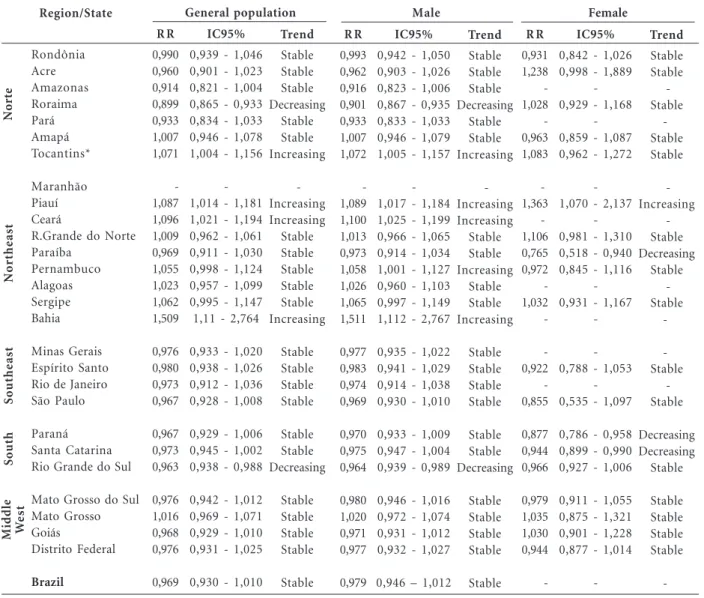
Poisson’s regression model adjustment to data about suicide among the population aged 60 or older, presented in Table 2, has shown there is an increasing trend in the following states: Tocantins, Piauí, Ceará and Bahia. A decreasing trend was found in Roraima and Rio Grande do Sul. Other
states had stable rates, without any statistically significant trends.
For the male population we also identified an increasing trend in the states of Tocantins, Piauí, Ceará, Bahia and Pernambuco. Once again in Rio Grande do Sul and Roraima there was a de-creasing trend; in the latter this decrease should be regarded with care due to highly unstable rates during that period. There were increasing rates for the female population in the state of Piauí only and decreasing rates for the states of Paraí-ba, Paraná and Santa Catarina.
Considering the overall Brazilian population and the male sex, rates remained stable through-out the period analyzed, with no statistically sig-nificant trends. There was a model convergence issue for the studied female population.
Region/State Rondônia Acre Amazonas Roraima Pará Amapá Tocantins* Maranhão Piauí Ceará
R.Grande do Norte Paraíba Pernambuco Alagoas Sergipe Bahia Minas Gerais Espírito Santo Rio de Janeiro São Paulo
Paraná Santa Catarina Rio Grande do Sul
Mato Grosso do Sul Mato Grosso Goiás
Distrito Federal
Brazil
Table 2. Suicide mortality trends in people aged 60 years old or more by sex and state. Brazil, 1980 to 2009.
General population Male Female
M iddl e W e st No rt e No rt h ea st S o u th ea st S o u th Trend Stable Stable Stable Decreasing Stable Stable Increasing -Increasing Increasing Stable Stable Stable Stable Stable Increasing Stable Stable Stable Stable Stable Stable Decreasing Stable Stable Stable Stable Stable R R 0,990 0,960 0,914 0,899 0,933 1,007 1,071 -1,087 1,096 1,009 0,969 1,055 1,023 1,062 1,509 0,976 0,980 0,973 0,967 0,967 0,973 0,963 0,976 1,016 0,968 0,976 0,969 IC95%
0,939 - 1,046 0,901 - 1,023 0,821 - 1,004 0,865 - 0,933 0,834 - 1,033 0,946 - 1,078 1,004 - 1,156
-1,014 - 1,181 1,021 - 1,194 0,962 - 1,061 0,911 - 1,030 0,998 - 1,124 0,957 - 1,099 0,995 - 1,147 1,11 - 2,764
0,933 - 1,020 0,938 - 1,026 0,912 - 1,036 0,928 - 1,008
0,929 - 1,006 0,945 - 1,002 0,938 - 0,988
0,942 - 1,012 0,969 - 1,071 0,929 - 1,010 0,931 - 1,025
0,930 - 1,010
Trend Stable Stable Stable Decreasing Stable Stable Increasing -Increasing Increasing Stable Stable Increasing Stable Stable Increasing Stable Stable Stable Stable Stable Stable Decreasing Stable Stable Stable Stable Stable R R 0,993 0,962 0,916 0,901 0,933 1,007 1,072 -1,089 1,100 1,013 0,973 1,058 1,026 1,065 1,511 0,977 0,983 0,974 0,969 0,970 0,975 0,964 0,980 1,020 0,971 0,977 0,979 IC95%
0,942 - 1,050 0,903 - 1,026 0,823 - 1,006 0,867 - 0,935 0,833 - 1,033 0,946 - 1,079 1,005 - 1,157
-1,017 - 1,184 1,025 - 1,199 0,966 - 1,065 0,914 - 1,034 1,001 - 1,127 0,960 - 1,103 0,997 - 1,149 1,112 - 2,767
0,935 - 1,022 0,941 - 1,029 0,914 - 1,038 0,930 - 1,010
0,933 - 1,009 0,947 - 1,004 0,939 - 0,989
0,946 - 1,016 0,972 - 1,074 0,931 - 1,012 0,932 - 1,027
0,946 – 1,012
Trend Stable Stable -Stable - Stable Stable -Increasing -Stable Decreasing Stable -Stable - - Stable -Stable Decreasing Decreasing Stable Stable Stable Stable Stable - R R 0,931 1,238 -1,028 -0,963 1,083 - 1,363 - 1,106 0,765 0,972 -1,032 -0,922 -0,855 0,877 0,944 0,966 0,979 1,035 1,030 0,944 -IC95%
0,842 - 1,026 0,998 - 1,889
-0,929 - 1,168
-0,859 - 1,087 0,962 - 1,272
-1,070 - 2,137
-0,981 - 1,310 0,518 - 0,940 0,845 - 1,116
-0,931 - 1,167
-0,788 - 1,053
-0,535 - 1,097
0,786 - 0,958 0,899 - 0,990 0,927 - 1,006
0,911 - 1,055 0,875 - 1,321 0,901 - 1,228 0,877 - 1,014
-P
in
Table 3 shows results from Poisson’s regres-sion model adjustment to verify trends in time series of elderly individuals according to state and age range (60-69 years old; 70-79 years old; and 80 or older).
There is a statistically significant increasing trend in the states of Piauí, Ceará and Rio Grande do Norte among the population aged 60 to 69; within that same age range there is a decreasing trend in Amazonas, Roraima and São Paulo. Among the population aged 70 to 79 it was pos-sible to identify an increasing trend in rates in the state of Piauí. Among individuals aged 80 or old-er we identified a decreasing trend in rates in Ro-raima.
Discussion
Results show that overall Brazilian suicide rates among the elderly have been stable throughout 30 years of analysis at 7 for each 100,000 for both sexes and 12 for each 100,000 inhabitants among men in that age range. Such results place Brazil on an average level of suicide episodes worldwide, according to the WHO (between 5-15 deaths for each 100,000 inhabitants). Among women rates have remained low (less than 5 for each 100,000 inhabitants)18
.
The decreasing trend stands out in a few states where rates have been historically the highest in the country (states in the South region, especially Rio Grande do Sul). However, despite the signifi-cant decreasing trend rates are still very high, which
Table 3. Suicide mortality trends in people aged 60 years or older by age and state. Brazil, 1980 to 2009.
60-69 years 70-79 years 80 years or older
Trend Stable Stable Decreasing Decreasing -Stable Stable -Increasing Increasing Increasing Stable Stable -Stable -Stable Stable -Decreasing Stable Stable Stable Stable Stable Stable Stable Stable R R 1,021 0,942 0,861 0,935 0,964 1,053 1,073 0,974 1,270 1,296 1,205 1,024 1,002 0,979 1,040 0,976 1,211 1,008 0,977 0,859 0,97 0,969 0,966 1,007 1,033 1,046 0,987 1,021 IC95%
0,941 - 1,122 0,877 - 1,009 0,695 - 0,995 0,888 - 0,985
-0,963 - 1,181 0,984 - 1,197
-1,084 - 1,631
1,07 - 1,806 1,057 - 1,472 0,924 - 1,148 0,913 - 1,107
-0,947 - 1,165
-0,901 - 2,597 0,91 - 1,132
-0,713 - 0,980
0,929 - 1,014 0,931 - 1,01 0,929 - 1,005
0,955 - 1,068 0,968 - 1,114 0,988 - 1,118 0,911 - 1,077
0,910 - 1,168
Trend Stable Stable -Stable -Stable Stable -Increasing Stable -Stable -Stable Stable Stable Stable Stable Stable Stable -R -R 0.963 1.106 0.957 0.963 0.965 1.001 1.338 0.975 1.628 1.958 1.314 0.980 0.976 0.979 0.978 0.974 0.966 0.945 0.968 0.963 0.967 0.959 0.969 0.984 1.019 0.982 0.916 0.967 IC95%
0,881 - 1,059 0,853 - 1,893
-0,887 - 1,052
-0,920 - 1,100 0,991 - 2,717
-1,049 - 4,895 0,997 - 2,429
-0,787 - 1,116
-0,871 - 1,073 0,915 - 1,006 0,929 - 1,010
0,908 - 1,072 0,926 - 1,143 0,888 - 1,095 0,788 - 1,047
-Trend Stable -Decreasing -Stable -Stable Stable Stable -Stable -R -R 0.867 0.930 0.937 0.789 0.945 0.889 0.944 0.945 0.954 0.959 0.959 0.960 0.957 0.958 0.959 0.954 0.952 0.953 0.957 0.952 0.949 0.949 0.883 1.003 0.982 0.943 0.919 0.953 IC95%
0,749 - 2,777 -0,708 - 0,859
-0,635 - 1,14
-0,735 - 1,012
0,787 - 1,413 0,767 - 1,350
-0,697 - 1,188
-Region/State Rondônia Acre Amazonas Roraima Pará Amapá Tocantins* Maranhão Piauí Ceará
R.Grande do Norte Paraíba Pernambuco Alagoas Sergipe Bahia Minas Gerais Espírito Santo Rio de Janeiro São Paulo
Paraná Santa Catarina Rio Grande do Sul
ú
d
e C
o
le
tiv
a, 17(
8)
:1973-1981,
2012
requires further studies to expand knowledge about this issue and to foster action being taken by authorities. The state of Mato Grosso do Sul also has high rates throughout the entire period of analysis. In the abovementioned states a possi-ble explanation is the influence of pesticides used in farming and the significant numbers of indi-viduals from European and Indigenous de-scent10,19,20
.
Santa Catarina, Rio Grande do Sul and Mato Grosso do Sul stand out for showing high rates in some years of the series (between 15 and 30 for each 100,000 inhabitants), according to WHO criteria. For male elderly individuals the rates in the latter two states in some of the years are con-sidered very high (above 30 for each 100,000)18
. Evidence of higher rates among male elderly individuals throughout the entire period confirms the results of national and international studies. Such differences may be related to the fact that women use less lethal means in their suicide at-tempts and seek more help in the social environ-ment where they live, according to several au-thors2,21-24
.
In this study, which used standardized rates, we have not found higher rates among older eld-erly individuals, as other authors have9,24,25
. A Brazilian study that used non-standardized rates found higher coefficients among elderly individ-uals older than 70 when compared with the group aged 60-69, from 1980 to 20062
; among elderly individuals aged 60 to 69 there was a higher in-crease in rates, 27% (comparing the first trienni-um, 1980-1982, with the last, 2004-2006), than among individuals aged 70 and older (12.5%). However, according to this study the latter group had higher rates throughout the entire studied period.
With respect to trends between 1980 and 2009, our study used Poisson’s regression model (with standardized rates) and found a significant in-creasing trend in four states and dein-creasing trend in two states. Among the male population there was an increasing trend in five and decreasing trend in two states. Female rates increased in one state and decreased in three. Considering the sub-division into age ranges (60-69, 70-79 and 80 or older), we have verified an increasing trend in Piauí, Ceará and Rio Grande do Norte and a de-creasing trend in Amazonas, São Paulo and Ro-raima. We have observed increasing trends among the population aged 70 to 79 in Piauí and decreasing trends in Roraima.
Those results differ from the ones found by Brzozowski et al.25
, who studied the period
rang-ing from 1980 to 2005 and found an increase in male rates (aged 60 or older) across 14 states and a decrease in two states; female rates (aged 60 or older) decreased in seven states and increased in four, by using Prais-Winsten generalized linear regression models to verify the trend. Differences in results may arise from using different models for analysis (Poisson’s Regression and Linear Regression) and/or from result standardization performed by the authors of this study.
Results should be interpreted with care. Data provided by some states should be analyzed care-fully, since a sharp increase or decrease in rates suggests there are problems with case reporting, or it could be a consequence of a small elderly population - in this case a single death can result in high rates.
Another aspect worthy of attention is that detailed analysis results by age range (60-69, 70-79 and 80 or older) were compromised by exces-sive zeros across the time series. This was espe-cially the case with the age range of individuals aged 80 or older and in such cases the chosen Poisson model did not converge. Additionally, deaths by suicide are known to be underreport-ed26
, despite the declining percentage of deaths from unclear causes in the country in the last two decades, from 20% to 13%275
. This precarious-ness may hide the real situation of suicide statis-tics throughout different states and municipali-ties in Brazil28
.
Final Considerations
This paper is part of a study about elderly suicide in Brazil where magnitude and meanings were crossed in an attempt to understand the prob-lem and possibilities for action toward preven-tion. Several perspectives related both to promot-ing quality of live and specific attention and care are described in the other articles published in this edition. This research was conducted using standardized rates; therefore it presents different results in Brazil than those cited in national and international literature, which show higher sui-cide rates among the population older than 75. In any case, there is evidence that suicide among elderly males is relevant across the country, espe-cially in states in the South and Middle West.
P
in
deaths. Such action is being taken in several mu-nicipalities in the last few years.
The healthcare and social sectors have a cru-cial role providing support and protection to eld-erly individuals, above all to encourage them to feel useful, active and socially integrated. Those who start losing physical, psychological and eco-nomic autonomy require more care and there-fore their lives tend to lose some meaning. The WHO29
and the Ministry of Health30
provide guidelines that help professionals who work in this field, especially those in Mental Health, to take effective preventive action and to promote life.
Collaborations
ú
d
e C
o
le
tiv
a, 17(
8)
:1973-1981,
2012
Berry JG, Harrison JE. A guide to statistical methods
for injury surveillance. Injury Technical Paper Seri-es No 5. (AIHW cat. no. INJCAT 72). Adelaide: AIHW; 2005.
Oliveira TCR, Latorre, MRDO Tendências da inter-nação e da mortalidade infantil por diarréia: Brasil,
1995 a 2005. Rev Saude Publica 2010; 44(1):102-111.
R 2.12.2. [computer program]. Viena; The R Foun-dation for Statistical Computing: 2012. [acessado 2012 jul 2]. Disponível em: http://www.r-project.org.
World Health Organization (WHO). Guidelines for
the primary prevention for mental, neurological e psychological disorders. Suicide. Geneva: WHO; 1993. [citado 2010 out 10]. Disponível em: http://whqlib doc.who.int/hq/1993/WHO_MNH_MND_93.24.pdf
Santos J. Suicídio em Mato Grosso do Sul, Brasil:
fatores sociodemográficos [dissertação]. Campo Grande (MS): Escola Nacional de Saúde Pública -Fiocruz; 2010.
Pires DX, Caldas ED, Recena MCP. Uso de agrotó-xicos e suicídios no Estado do Mato Grosso do Sul,
Brasil. Cad Saude Publica 2005; 21(2):598-605.
Marín-León L, Barros MBA. Mortes por suicídio:
diferenças de gênero e nível socioeconômico. Rev
Saude Publica 2003; 37(3):357-363.
Brasil. Ministério da Saúde (MS). Mortalidade por
Suicídio. In: Saúde Brasil 2006 – Uma análise da desigualdade em saúde. Brasília: MS; 2006. Australia. Australian Government Department of Health and Ageing. Australian Institute for Suicide
Research and Prevention. International Suicide
Ra-tes – Recent Trends and Implications for Australia. Canberra; Australian Government Department of Health and Ageing: 2003.
Conwell Y, Duberstein PR, Cain ED. Risk factors
for suicide in later life. Biol Psychiatry 2002;
52(3):193-204.
Brzozowski FS, Soares GB, Benedet J, Boing AF, Peres MA. Suicide time trends in Brazil from 1980
to 2005. Cad Saude Publica 2010; 26(7):1293-1302.
Laurenti R, Mello Jorge MHP, Lebrão ML, Gotlieb SLD, Almeida MF. Estatísticas Vitais: contando os
nascimentos e as mortes. Rev Bras Epidemiol 2005;
8(2):108-110.
Rede Interagencial de Informações para a Saúde
(RIPSA). Indicadores e Dados Básicos IDB-2004.
Bra-sília: RIPSA; 2005.
Pinto LW, Assis SG, Pires TO, Minayo MCS. Morta-lidade por suicídio em pessoas com 60 anos ou mais nos municípios brasileiros no período de 1996
a 2007. Cien Saude Colet 2012; 17(8):1963-1972.
Organização Mundial da Saúde (OMS). Prevenção
do Suicídio: um manual para profissionais da saúde em atenção primária. Genebra: OMS, 2000. Brasil. Ministério da Saúde (MS). Portaria n.1.876, de 14 de agosto de 2006. Define diretrizes nacionais
de prevenção ao suicídio. Diário Oficial da União
2006; 15 ago.
Artigo apresentado em 21/03/2012 Aprovado em 10/05/2012
Versão final apresentada em 06/06/2012 15.
16.
17.
18.
19.
20.
21.
22.
23.
24.
25.
26.
27.
28.
29.
30. References
World Health Organization (WHO). World Report
on Violence and Health. Genève: WHO; 2002. Lovisi GM, Santos AS, Legay L, Abelha L, Valencia E. Análise epidemiológica do suicídio no Brasil
en-tre 1980 e 2006. Rev Bras Psiquiatr 2009; 31(Supl. 2):
S86-S93.
O’Connell H, Chin AV, Cunningham C, Lawlor BA.
Recent developments: Suicide in older people. BMJ
2004; 329(7471):895-899.
Datasus. Sistema de Informações sobre Mortalidade.
[página da Internet]. [acessado 2012 mar 6]. Dispo-nível em: http://www2.datasus.gov.br/DATASUS/ i n d e x . p h p ? a r e a = 0 2 0 5 & VO b j = h t t p : / / t a b n e t . datasus.gov.br/cgi/deftohtm.exe?sim/cnv/ext10
World Health Organization (WHO). Suicide rates
per 100,000 by country, year and sex (Table). [página da Internet]. [acessado 2012 mar 6]. Disponível em: http://www.who.int/mental_health/prevention/ suicide_rates/en/index.html
World Health Organization (WHO). Suicide
Preven-tion – SUPRE. 2002. [página da Internet]. [acessa-do 2012 mar 6] Disponível em: http://www.who.int/ m e n t a l _ h e a l t h / p r e v e n t i o n / s u i c i d e _ r a t e s / e n / index.html
Bertolote JM, Fleischmann A. A global perspective in the epidemiology of suicide. Suicidologi 2002; 7(2):6-8.
De Leo D, Padoani W, Scocco P, Lie D, Bille-Brahe U, Arensman E, Hjelmeland H, Crepet P, Haring C, Hawton K, Lonnqvist J, Michel K, Pommereau X, Querejeta I, Phillipe J, Salander-Renberg E, Schmidtke A, Fricke S, Weinacker B, Tamesvary B, Wasserman D, Faria S. Attempted and completed suicide in older subjects: results from the WHO/
EURO Multicentre study of suicidal behavior. Int J
Geriatr Psychiatry 2001; 16(3):300-310.
Mello-Santos C, Bertolote JM, Wang YP. Epidemi-ology of suicide in Brazil (1980 – 2000):
character-ization of age and gender rates of suicide. Rev Bras
Psiquiatr 2005; 27(2):131-134.
Meneghel SN, Victora CG, Faria NMX, Carvalho LA, Falk JW. Características epidemiológicas do
suicídio no Rio Grande do Sul. Rev Saude Publica
2004; 38(6):804-810.
Schmitt R, Lang MG, Quevedo J, Colombo T. Perfil epidemiológico do suicídio no extremo oeste do
estado de Santa Catarina, Brasil. Rev psiquiatr RS
2008; 30(2):115-123.
Departamento de Informática do SUS (DATASUS). Informação de saúde. População residente por ano segundo município período: 1980-2009. [documen-to na Internet]. 2012 jul. [acessado 2012 jul 09]. Dis-ponível em: http://tabnet.datasus.gov.br/cgi/ tabcgi.exe?ibge/cnv/popbr.def
Ahmad OB, Boschi-Pinto C, Lopez AD, Murray CJL, Lozano R, Inoue M. Age standartization of rates: a
new who standard. World Health Organization - GPE
discussion papers series. 2000; 31:1-14.
Durbin J, Watson GS. Testing for Serial
Correlati-ons in Least Squares Regression. Biometrika 1951;
37(3/4):409-428. 1.
2.
3.
4.
5.
6.
7.
8.
9.
10.
11.
12.
13.