TECHNICAL NOTE
Assessment of organ transplants from donors with
markers of hepatitis B
Edson Abdala,ILuis Se´rgio Fonseca de Azevedo,IIVivian Iida Avelino-Silva,III,IVSı´lvia Figueiredo Costa,III Marlova Luzzi Caramori,VTania Mara Vareja˜o Strabelli,VILı´gia Camera Pierrotti,IVHeloisa Helena de Souza Marques,VIIMarta Heloisa Lopes,IIIGlaucia Fernanda Varkulja,VIIIVera Aparecida Santos,IXMaria Aparecida Shikanai-Yasuda,III Comissa˜o de Infecc¸a˜o em Imunodeprimidos, Hospital das Clı´nicas da Faculdade de Medicina da USP
IHospital das Clı´nicas da Faculdade de Medicina da Universidade de Sa˜o Paulo (HCFMUSP), Liver Transplant Service, Sa˜o Paulo/SP, Brazil.IIHospital das
Clı´nicas da Faculdade de Medicina da Universidade de Sa˜o Paulo (HCFMUSP), Kidney Transplant Unit, Urology Division, Sa˜o Paulo/SP, Brazil.IIIFaculdade
de Medicina da Universidade de Sa˜o Paulo (FMUSP), Department of Infectious and Parasitic Diseases, Sa˜o Paulo/SP, Brazil.IVHospital das Clı´nicas da
Faculdade de Medicina da Universidade de Sa˜o Paulo (HCFMUSP), Clinical Division of Infectious Diseases, HCFMUSP Sa˜o Paulo/SP, Brazil.VInstituto do
Corac¸a˜o do Hospital das Clı´nicas da Faculdade de Medicina da Universidade de Sa˜o Paulo (INCOR-HCFMUSP), Lung Transplant Unit, Sa˜o Paulo/SP, Brazil.
VIInstituto do Corac¸a˜o do Hospital das Clı´nicas da Faculdade de Medicina da Universidade de Sa˜o Paulo (INCOR-HCFMUSP), Heart Transplant Area, Sa˜o
Paulo/SP, Brazil.VIIHospital das Clı´nicas da Faculdade de Medicina da Universidade de Sa˜o Paulo (ICr-HCFMUSP), Instituto da Crianc¸a, HCFMUSP Sa˜o Paulo/
SP, Brazil.VIIIHospital das Clı´nicas da Faculdade de Medicina da Universidade de Sa˜o Paulo (ICHC-HCFMUSP), Infection Control Committee of the Instituto
Central, Sa˜o Paulo/SP, Brazil.IXHospital das Clı´nicas da Faculdade de Medicina da Universidade de Sa˜o Paulo (ICHC-HCFMUSP), Division of the Central
Laboratory, Sa˜o Paulo/SP, Brazil.
Email: [email protected] Tel.: 55 11 3061-7048
Organ transplantation (TX) is currently a therapeutic alternative in the management of end-stage or lethal diseases and, in some cases, for improving the quality of life and reducing the complications of chronic conditions. The scarcity of organ grafts or donors due to the limited number of deceased donors or to a lack of compatible living donors is one of the main limitations for the execution of organ TX. In Brazil, there is a great disparity between the number of patients on waiting lists and TX procedures, especially for liver and kidney TX. As a result of this inequality, grafts from donors who are considered marginal or not ideal have been used, including those with higher risk of failure following TX or those with potentially transmissible infections, involving donors with positive serologic markers for the hepatitis B virus (HBV).
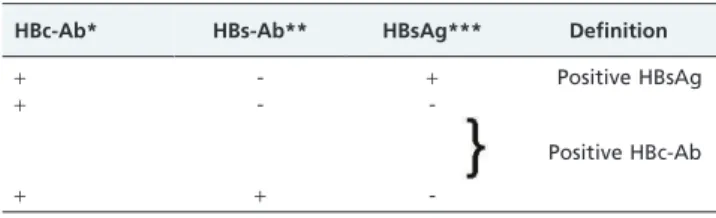
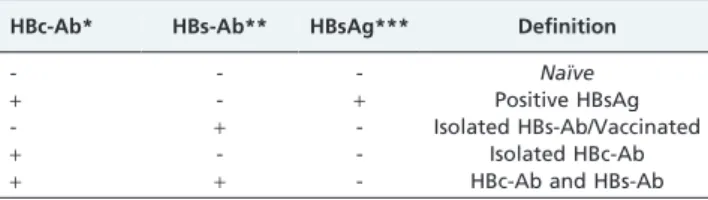
Donors who are positive for HBV markers have been routinely used in some TX centers. Four aspects should be considered for the assessment of the risk-benefit ratio of this procedure: 1. donor serologic profile, 2. recipient serologic profile, 3. TX variety and 4. the use of preventive therapy with human-specific HBV immunoglobulin and/or antiviral drugs. To establish recommendations, our group held discussions based on the data available in the medical literature and on the accumulated experience of the TX units at Hospital das Clı´nicas da Faculdade de Medicina da Universidade de Sa˜o Paulo. The definitions of serologic profiles for donors and recipients are described in Tables 1 and 2, respectively. The following transplants have been evaluated: liver, kidney, heart, lung, and hematopoietic stem cell transplants (HSCT). The IDSA (Infectious Diseases
Society of America) rating system was used to assess the quality of evidence for graft acceptance and to identify the appropriate preventive strategy.
1. Liver TX
HBsAg-positive donor: few reports are available, under particular circumstances, and there is a high risk of ‘‘de novo’’ HBV infection.
HBc-Ab-positive donor:
N
HBsAg-positive recipient: regardless of the donor’s serologic profile, this recipient must be administered combined prophylaxis with HBIG and an antiviral drug. The risk of viral reactivation does not seem to be increased by the involvement of an HBc-Ab-positive donor.N
Recipients who are positive for HBc-Ab and HBs-Ab:there are no reports of ‘‘de novo’’ HBV infection, with or without prophylaxis.
N
Recipients with isolated HBc-Ab or a history of vaccina-tion: the risk of ‘‘de novo’’ HBV is reduced in case series that described lamivudine and/or HBIG prophylaxis.Copyrightß2012CLINICS– This is an Open Access article distributed under
the terms of the Creative Commons Attribution Non-Commercial License (http:// creativecommons.org/licenses/by-nc/3.0/) which permits unrestricted non-commercial use, distribution, and reproduction in any medium, provided the original work is properly cited.
Table 1 -Definitions of HBV serologic profiles – Donors.
HBc-Ab* HBs-Ab** HBsAg*** Definition
+ - + Positive HBsAg
+ -
-+ +
-Positive HBc-Ab
*anti-core hepatitis B antibody,
N
Naı¨ve recipient: group at highest risk; case series that described lamivudine and HBIG prophylaxis have demonstrated a reduction in risk.2. Kidney TX
The largest case series of donors with positive serologic markers for HBV were published in kidney TX. However, some studies describe only the post-TX clinical course and fail to assess HBV serology.
HBsAg-positive donor: among 48 donors, ‘‘de novo’’ HBV infection has been detected in three recipients with variable pre-TX serologic profiles, while liver enzyme elevation has been detected in nine recipients.
HBc-Ab-positive donor:
N
HBsAg-positive recipient: when lamivudine is used as preventive therapy, the clinical evolution is similar to that of recipients whose donors have negative HBV serology.N
Recipients with isolated HBc-Ab: without any prophy-laxis, the seroconversion of HBsAg has been observed in 0.5% of recipients after TX. No reports have described seroconversion under lamivudine prophylaxis.N
Vaccinated or Naı¨ve recipient: after TX, without any prophylaxis, seroconversion of HBc-Ab occurs in 2% of cases, and seroconversion of HBsAg occurs in less than 0.5% - without any impact on the clinical course. No reports have described seroconversion under lamivu-dine prophylaxis.3. Heart TX
There are two case series on heart TX that report lamivudine prophylaxis in some recipients. Only one case of ‘‘de novo’’ HBV infection is reported in a naı¨ve recipient with an HBsAg-positive donor.
4. Lung TX
In two small case series of HBc-Ab-positive donors, no cases of recipient post-TX seroconversion were described. Among the two case series, one involved lamivudine prophylaxis.
5. Hematopoietic Stem Cell Transplant
In HSCT, the most relevant consideration is the risk of reverse seroconversion (loss of HBs-Ab after TX).
HBsAg-positive donor: in a study of HBsAg-negative recipients with a historical control group, the risk of ‘‘de novo’’ HBV was significantly reduced with lamivudine prophylaxis.
HBc-Ab-positive donor: when the bone marrow donor is naturally immunized (HBc-Ab and HBs-Ab positive), there is an unmistakable reduction in the risk of reverse seroconversion.
Assessment of organ transplants from donors with hepatitis B-positive markers
Recommendations:
A. General recommendations
1. Potential TX recipients should receive HBV vaccina-tion before TX, if possible (AII).
2. HSCT donors should receive HBV vaccination before TX, if possible (BII).
3. HSCT recipients who are negative for HBsAg must be directed to HBV vaccination, starting six months after TX (BIII).
4. Liver TX recipients who are HBsAg positive must be prescribed an antiviral drug and HBIG as preventive therapy, regardless of the donor’s serologic profile, due to the risk of post-TX recurrence (AII).
5. TX recipients (except for those undergoing liver TX) who are HBsAg positive must be prescribed an antiviral drug, due to the risk of viral replication following TX (AII).
6. HSCT donors who are HBsAg positive with active viral replication (positive polymerase chain reaction) must start on antiviral treatment before TX (BIII).
B. Specific recommendations:
1. Liver TX (B1). 2. Kidney TX (B2).
3. Heart and Lung TX (B3).
4. Hematopoietic Stem Cell Transplantation TX (B4). Table 2 -Definitions of HBV serologic profiles –
Recipients.
HBc-Ab* HBs-Ab** HBsAg*** Definition
- - - Naı¨ve
+ - + Positive HBsAg
- + - Isolated HBs-Ab/Vaccinated
+ - - Isolated HBc-Ab
+ + - HBc-Ab and HBs-Ab
*anti-core hepatitis B antibody,
**anti-hepatitis B surface antigen antibody, ***hepatitis B surface antigen.
B1. Liver TX: Specific Recommendations
Donor Recipient
HBsAg+ HBc-Ab+HBs-Ab+ HBc-Ab- HBs-Ab+ Isolated HBc-Ab+ Naı¨ve
HBsAg+ No (DII) No (DII) No (DII) No (DII) No (EI)
HBc-Ab+ Yes (BII) Yes (BII) Yes (BIII) Yes (BIII) No (DII)
Prophylaxis LAM+HBIG* (AII) LAM (BIII)** LAM (BIII)** LAM (BIII)** _
LAM = lamivudine
ACKNOWLEDGMENTS
We thank the Clinical Directors from Hospital das Clı´nicas da Faculdade de Medicina da Universidade de Sa˜o Paulo (Prof. Jose´ Otavio Costa Auler Junior, Prof. Tarcı´sio Eloi Pessoa de Barros Filho and Prof. Eloı´sa Bonfa´) for all their support.
AUTHOR CONTRIBUTIONS
Abdala E wrote the manuscript (Portuguese), supervised the revision that addressed the recommendation for liver transplantation, participated in the discussion of the final recommendations and revised the English version of the text. Azevedo LSF presented the kidney transplantation recommendation and discussed the final recommendations. Avelino-Silva VI presented the liver transplantation recommendation and translated the text into English. Costa SF, Strabelli TMV, Caramori ML presented the recommendation for bone marrow, heart and lung transplantation, respectively, and discussed the final recommendations. Pierrotti L, Souza Marques HH, Lopes MH, Varkulja GF, Santos VA participated in the discussion of the recommendations. Shikanai-Yasuda MA coordinated the presentations and discussion of the recommenda-tions, helped revise the final recommendations and to prepare the manuscript for submission.
Conflicts of interests:Edson Abdala - clinical research with Bristol.
Heloisa Helena de Souza Marques - clinical research with Boehringer Ingelheim. Tania Mara Vareja˜o Strabelli - speaker of Novartis, works with Novartis, clinical research with Merck
REFERENCES
1. Akalin E, Ames S, Sehgal V, Murphy B, Bromberg JS. Safety of using hepatitis B core antibody or surface antigen-positive donors in kidney or pancreas transplantation. Clin Transplant. 2005;19(3):364-6, http:// dx.doi.org/10.1111/j.1399-0012.2005.00350.x.
2. Barcena R, Moraleda G, Moreno J, Martı´n MD, de Vicente E, Nun˜o J, et al. Prevention of de novo HVB infection by the presence on anti-HBs in transplanted patients receiving core antibody-positive livers. World J Gastroenterol. 2006;12(13):2070-4.
3. De Feo TM, Grossi P, Poli F, Mozzi F, Messa P, Minetti E, et al. Kidney transplantation from anti-HBc+ donors: results from a retrospective Italian study. Transplantation. 2006;81(1):76-80, http://dx.doi.org/ 10.1097/01.tp.0000189930.89031.1b.
4. Fong TL, Bunnapradist S, Jordan SC, Cho YW. Impact of hepatitis B core antibody status on outcome of cadaveric renal transplantation: analysis of United network of organ sharing database between 1994 and 1999. Transplantation. 2002;73(1):85-9, http://dx.doi.org/10.1097/00007890-200201150-00016.
5. Gallegos-Orozco JF, Vargas HE. Should antihepatitis B virus core positive or antihepatitis C virus core positive subjects be accepted as
B4. Hematopoietic Stem Cell Transplantation: Specific Recommendations
Donor Recipient
HBsAg+
HBc-Ab+
HBs-Ab+
HBc-Ab-HBs-Ab+
Isolated
HBc-Ab+ Naı¨ve
HBsAg+ Yes (BII) Yes (BII) Yes (BII) Yes (BII) Special circumstances
(CIII)
Prophylaxis LAM (AII)* LAM (AII)** LAM (AII)** LAM (AII)** LAM (AII)**
HBc-Ab+HBs-Ab- Yes (BII) Yes (BII) Yes (BII) Yes (BII) Yes (BII)
Prophylaxis LAM (AII)* *** *** *** ***
HBc-Ab+HBs-Ab+ Yes (AII) Yes (AII) Yes (AII) Yes (AII) Yes (AII)
Prophylaxis LAM (AII) # - -
-*Indefinitely; **For at least one year; ***Request donor PCR – If positive, treat as if donor HBsAg+; if negative, treat as if donor HBc-Ab+and HBs-Ab+; #Follow up with serologic assessment every three months.
Obs.: lamivudine may be replaced by an alternative antiviral. B2. Kidney TX: Specific Recommendations
Donor Recipient
HBsAg+
HBc-Ab+
HBs-Ab+
HBc-Ab-HBs-Ab+
Isolated
HBc-Ab+ Naı¨ve HBsAg+ Exceptional
circumstances* (CIII)
Exceptional circumstances* (CIII)
Exceptional circumstances* (CIII)
Exceptional circumstances* (CIII)
No (DIII)
Prophylaxis LAM (AII)** LAM (BIII)*** LAM (BIII)*** LAM (BIII)***
-HBc-Ab+ Yes (BII) Yes (BII) Yes (BII) Yes (BII) No (DIII)
Prophylaxis LAM (AII)** LAM (CIII)**** LAM (CIII)**** LAM (CIII)**** _ *Exceptional circumstances, defined by the TX group; **Indefinitely; ***For at least one year; ****Optional use.
Obs.: lamivudine may be replaced by an alternative antiviral.
B3. Heart and Lung TX: Specific Recommendations
Donor Recipient
HBsAg+
HBc-Ab+
HBs-Ab+
HBc-Ab-HBs-Ab+
Isolated
HBc-Ab+ Naı¨ve AgHBs+ Exceptional
circumstances* (CIII)
Exceptional circumstances* (CIII)
Exceptional circumstances* (CIII)
Exceptional circumstances* (CIII)
No (DIII)
Prophylaxis LAM (AII)** LAM (BIII)*** LAM (BIII)*** LAM (BIII)***
-Anti-HBc+ Yes (BII) Yes (BII) Yes (BII) Yes (BII) No (DIII)
Prophylaxis LAM (AII)** LAM (CIII)*** LAM (CIII)*** LAM (CIII)***
organ donors for liver transplantation? J Clin Gastroenterol. 2007;41(1):64-74.
6. Avelino-Silva VI, D’Albuquerque LA, Bonazzi PR, Song AT, Miraglia JL, De Brito Neves A, et al. Liver transplant from Anti-HBc-positive, HBsAg-negative donor into Hbs-Ag-negative recipient: is it safe? A systematic review of the literature. Clin Transplant. 2010;24(6):735-46, doi: 10.1111/j.1399-0012.2010.01254.x.
7. Gross PA, Barrett TL, Dellinger EP, Krause PJ, Martone WJ, McGowan JE Jr, et al. Purpose of quality standards for infectious diseases: Infectious Diseases Society of America. Clin Infect Dis. 1994;18(3):421, http:// dx.doi.org/10.1093/clinids/18.3.421.
8. Hartwig MG, Patel V, Palmer SM, Cantu E, Appel JZ, Messier RH, et al. Hepatitis B core antibody positive donors as a safe and effective therapeutic option to increase available organs for lung transplantation. Transplantation. 2005;80(3):320-5, http://dx.doi.org/10.1097/ 01.tp.0000165858.86067.a2.
9. Hui CK, Lie A, Au WY, Ma SY, Leung YH, Zhang HY, et al. Effectiveness of prohylatic anti-HBV therapy in allogeneic hematopoietic stem cell transplantation with HbsAg positive donors. Am J Transplant. 2005;5(6):1437-45, http://dx.doi.org/10.1111/j.1600-6143.2005.00887.x. 10. Idilman R, Ustu¨n C, Karayalc¸in S, Aktemel A, Turkyilmaz AR, Ozcan M,
et al. Hepatitis b virus vaccination of recipients and donors of allogeneic peripheral blood stem cell transplantation. Clin Transplant. 2003;17(5):438-43, http://dx.doi.org/10.1034/j.1399-0012.2003.00070.x. 11. Ko WJ, Chou NK, Hsu RB, Chen YS, Wang SS, Chu SH, et al. Hepatitis B
virus infection in heart transplant recipient in a hepatitis B endemic area. J Heart Lung Transplant. 2001;20(8):865-75, http://dx.doi.org/10.1016/ S1053-2498(01)00280-7.
12. No authors listed. Screening of donor and recipient prior to solid organ transplantation. Am J Transplant. 2004;4(Suppl 10):10-20.
13. Pinney SP, Cheema FH, Hammond K, Chen JM, Edwards NM, Mancini D. Acceptable recipients outcomes with the use of hearts from donors with hepatitis-B core antibodies. J Heart Lung Transplant. 2005;24(1):34-7, http://dx.doi.org/10.1016/j.healun.2003.09.036.
14. Prakoso E, Strasser SI, Koorey DJ, Verran D, McCaughan GW. Long-term lamivudine monotherapy prevents development of hepatitis B virus infection in hepatitis B surface-antigen negative liver transplant recipients from hepatitis B core-antibody-positive donors. Clin Transplant. 2006;20(3):369-73, http://dx.doi.org/10.1111/j.1399-0012.2006.00495.x.
15. Rubin RH, Schaffner A, Speich R. Introduction to the Immuno-compromised Host Society Consensus Conference on Epidemiology, Prevention, Diagnosis, and Management of Infections in Solid-Organ Transplant Recipients. Clin Infect Dis. 2001;33(Suppl1):S1-S4, http:// dx.doi.org/10.1086/320896.
16. Shitrit AB, Kramer MR, Bakal I, Morali G, Ben Ari Z, Shitrit D. Lamivudine prophylaxis for hepatitis B virus infection after lung transplantation. Ann Thorac Surg. 2006;81(5):1851-2, http://dx.doi.org/ 10.1016/j.athoracsur.2005.12.026.
17. [No authors listed]. Preface to the 1997 USPHS/IDSA guidelines for the prevention of opportunistic infections in persons infected with human immunodeficiency virus. USPHS/IDSA Prevention of Opportunistic Infections Working Group. US Public Health Service/Infectious Diseases Society of America. Clin Infect Dis. 1997;25(Suppl3):S299-S312.
APPENDIX
USO DE DOADORES COM MARCADOR
SOROLO´ GICO PARA VI´RUS DA HEPATITE B EM TRANSPLANTES
O transplante (tx) consiste, atualmente, em alternativa terapeˆutica para doenc¸as terminais e fatais ou, em alguns casos, para melhoria da qualidade de vida e diminuic¸a˜o dos riscos de complicac¸o˜es de doenc¸as croˆnicas. Uma das principais limitac¸o˜es atuais para a realizac¸a˜o de tx e´ a escassez de o´rga˜os ou de doadores, por dificuldades na captac¸a˜o de doadores falecidos ou pela indisponibilidade de doadores vivos compatı´veis. Ha´, no Brasil, um grande nu´mero de pacientes em lista de espera, especialmente para tx de fı´gado e de rim, em relac¸a˜o ao nu´mero de procedimentos realizados. Como consequeˆncia destas limit-ac¸o˜es, doadores considerados na˜o ideais teˆm sido utiliza-dos, incluindo-se aqueles cujo enxerto apresenta maior risco de na˜o funcionamento apo´s o transplante e doadores com risco potencial de transmissa˜o de alguma infecc¸a˜o. Entre estes u´ltimos encontram-se aqueles com marcador sorolo´-gico para o vı´rus da hepatite B (VHB).
Doadores com algum marcador sorolo´gico para VHB teˆm sido utilizados como rotina por alguns grupos. A relac¸a˜o risco-benefı´cio desta medida e´ dependente de quatro fatores: 1. Estado sorolo´gico do doador, 2. Estado sorolo´gico do receptor, 3. Tipo de transplante e 4. Uso de profilaxia com imunoglobulina especı´fica e/ou droga antiviral. Com o
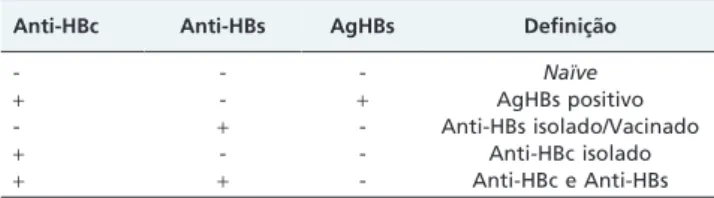
objetivo de estabelecer uma recomendac¸a˜o em nosso meio, realizamos discusso˜es baseadas nos dados disponı´veis na literatura e na experieˆncia dos grupos de transplante do Hospital das Clı´nicas da Faculdade de Medicina da Universidade de Sa˜o Paulo. As definic¸o˜es dos perfis sorolo´gicos possı´veis para doador e receptor encontram-se nas Tabelas 1 e 2, respectivamente. Foram analisados os seguintes transplantes: fı´gado, rim, corac¸a˜o, pulma˜o e transplante de ce´lulas-tronco hematopoie´ticas (TCTH). Para a determinac¸a˜o dos nı´veis de evideˆncia para aceitar o enxerto e indicar profilaxia foi utilizado o sistema da IDSA (Infectious Diseases Society of America).
1. Transplante de Fı´gado
Doador AgHBs positivo: existem poucos relatos, sob circunstaˆncias especiais. Risco de desenvolvimento de hepatite B ‘‘de novo’’ muito alto.
Doador Anti-HBc positivo:
N
Receptor AgHBs positivo: este receptor recebe, inde-pendentemente do estado sorolo´gico do doador, profilaxia combinada com imunoglobulina especı´fica (HBIG) e antiviral. Aparentemente, o risco de reativa-c¸a˜o na˜o aumenta nos casos de doadores Anti-HBc positivos.N
Receptor Anti-HBc e Anti-HBs: na˜o ha´ casos de hepatite B ‘‘de novo’’ descritos, com ou sem profilaxia.Tabela 1 -Definic¸o˜es para perfis sorolo´gicos para o vı´rus da hepatite B – Doadores.
Anti-HBc* Anti-HBs** AgHBs*** Definic¸a˜o
+ - + AgHBs positivo
+ -
-+ +
-Anti-HBc positivo
*Anticorpo anti-core vı´rus hepatite B, ** anticorpo anti-antı´geno de superfı´cie do vı´rus da hepatite B, ***Antı´geno de superfı´cie do vı´rus da hepatite B.
Tabela 2 -Definic¸o˜es para perfis sorolo´gicos para o vı´rus da hepatite B – Receptor.
Anti-HBc Anti-HBs AgHBs Definic¸a˜o
- - - Naı¨ve
+ - + AgHBs positivo
- + - Anti-HBs isolado/Vacinado
+ - - Anti-HBc isolado
+ + - Anti-HBc e Anti-HBs
N
Receptor vacinado ou Anti-HBc isolado: a ocorreˆncia de hepatite B ‘‘de novo’’ e´ menor nas se´ries de casos em que foi utilizada profilaxia com lamivudina e/ou HBIG.N
Receptor naive: grupo de maior risco. Se´ries de casos sob profilaxia com lamivudina e HBIG demonstraram diminuic¸a˜o deste risco.2. Transplante de Rim
As maiores se´ries de doadores com marcador sorolo´gico para VHB sa˜o em tx de rim. Entretanto, em algumas delas e´ descrita apenas a evoluc¸a˜o clı´nica po´s-transplante, sem avaliac¸a˜o sorolo´gica.
Doador AgHBs positivo: em um total de 48 doadores, detectou-se hepatite B ‘‘de novo’’ em 3 receptores (perfis sorolo´gicos pre´-tx variados) e aumento de enzimas hepa´ti-cas em 9.
Doador Anti-HBc positivo:
N
Receptor AgHBs positivo: a evoluc¸a˜o e´ semelhante aos caos de doadores sem marcador sorolo´gico para o VHB, utilizando-se profilaxia com lamivudina.N
Receptor Anti-HBc isolado: soroconversa˜ o doAgHBs apo´s o tx de 0,5% sem profilaxia. Na˜o ha´ relatos de soroconversa˜o sob profilaxia com lami-vudina.
N
Receptor vacinado ou naive: apo´s o tx, sem uso de profilaxia, soroconversa˜o do Anti-HBc de 2% dos casos, e do AgHBs de menos de 0.5% - sem alterac¸a˜o na evoluc¸a˜o clı´nica. Utilizando-se profilaxia com lamivudina, na˜o ha´ descric¸a˜o de soroconversa˜o.3. Transplante de Corac¸a˜o
Existem duas se´ries de casos em tx de corac¸a˜o, utilizando-se profilaxia com lamivudina em alguns casos. Ha´ apenas um relato de hepatite B ‘‘de novo’’, em um receptornaive
com doador AgHBs positivo.
4. Transplante de Pulma˜o
Duas se´ries pequenas com doadores Anti-HBc positivos na˜o demonstraram soroconversa˜o do receptor apo´s o tx. Lamivudina profila´tica foi utilizada em uma delas.
5. Transplante de Ce´lulas-Tronco Hematopoie´ticas (TCTH)
Em TCTH, a considerac¸a˜o mais significativa e´ o risco de soroconversa˜o reversa (perda do Anti-HBs po´s-tx).
Doador AgHBs positivo: estudo com controle histo´rico, em receptores AgHBs negativos, demonstrou diminuic¸a˜o significativa do risco de hepatite B ‘‘de novo’’ com profilaxia com lamivudina.
Doador Anti-HBc positivo: existe um evidente benefı´cio sobre o risco de soroconversa˜o reversa quando o doa-dor e´ naturalmente imunizado (Anti-HBc e Anti-HBs positivos).
Uso de doadores com marcador sorolo´gico para vı´rus da hepatite B em transplantes
Recomendac¸o˜es:
A. Gerais
1. Todo candidato a transplante de o´rga˜o so´lido deve ser encaminhado para vacinac¸a˜o contra o VHB antes do transplante, se possı´vel (AII).
2. Todo doador de ce´lulas-tronco hematopoie´ticas deve ser encaminhado para vacinac¸a˜o contra o VHB antes do transplante, se possı´vel (BII).
3. Todo receptor de ce´lulas-tronco hematopoie´ticas que for AgHBs negativo deve ser encaminhado para vacinac¸a˜o contra o VHB, a partir de 6 meses do transplante (BIII). 4. Todo receptor de transplante de fı´gado que for AgHBs
positivo deve receber profilaxia com droga antiviral e HBIG, independentemente do estado sorolo´gico do doador, pelo risco de recidiva po´s-transplante (AII). 5. Todo receptor de transplante (exceto fı´gado) que for
AgHBs positivo deve receber profilaxia com droga antiviral, pelo risco de replicac¸a˜o apo´s o transplante (AII).
6. Todo doador de ce´lulas-tronco hematopoie´ticas que for AgHBs positivo e estiver com replicac¸a˜o viral (PCR positivo) deve iniciar tratamento com antiviral antes do transplante (BIII).
B. Especı´ficas
1. Transplante de Fı´gado: Recomendac¸o˜es Especı´ficas (B1). 2. Transplante de Rim: Recomendac¸o˜es Especı´ficas (B2). 3. Transplantes de Corac¸a˜o e Pulma˜o: Recomendac¸o˜es
Especı´ficas (B3).
4. Transplante de Ce´lulas Tronco-Hematopoie´ticas: Reco-mendac¸o˜es Especı´ficas (B4).
B1. Transplante de Fı´gado: Recomendac¸o˜es Especı´ficas
Doador Receptor
AgHBs+ Anti-HBc+Anti-HBs+ Anti-HBc- Anti-HBs+ Anti-HBc+isolado Naive
AgHBs+ Na˜o (DII) Na˜o (DII) Na˜o (DII) Na˜o (DII) Na˜o (EI)
Anti-HBc+ Sim (BII) Sim (BII) Sim (BIII) Sim (BIII) Na˜o (DII)
Profilaxia LAM+HBIG* (AII) LAM (BIII)** LAM (BIII)** LAM (BIII)** _
B3. Transplantes de Corac¸a˜o e de Pulma˜o: Recomendac¸o˜es Especı´ficas
Doador Receptor
AgHBs+
Anti-HBc+
Anti-HBs+
Anti-HBc-Anti-HBs+ Anti-HBc+isolado Naive
AgHBs+ Situac¸o˜es excepc.* (CIII) Situac¸o˜es excepc.* (CIII) Situac¸o˜es excepc.* (CIII) Situac¸o˜es excepc.* (CIII) Na˜o (DIII)
Profilaxia LAM (AII)** LAM (BIII)*** LAM (BIII)*** LAM (BIII)***
-Anti-HBc+ Sim (BII) Sim (BII) Sim (BII) Sim (BII) Na˜o (DIII)
Profilaxia LAM (AII)** LAM (CIII)**** LAM (CIII)**** LAM (CIII)**** _
*Situac¸o˜es excepcionais, definidas pelo grupo de transplante; **Indefinidamente; ***Por pelo menos 1 ano; ****O Nu´cleo sugere o uso, por pelo menos 1 ano. Obs.: outro antiviral pode ser utilizado, no lugar da lamivudina.
B4. Transplantes de Ce´lulas Tronco-Hematopoie´ticas: Recomendac¸o˜es Especı´ficas
Doador Receptor
AgHBs+
Anti-HBc+
Anti-HBs+
Anti-HBc-Anti-HBs+ Anti-HBc+isolado Naive
AgHBs+ Sim (BII) Sim (BII) Sim (BII) Sim (BII) Situac¸o˜es especiais (CIII)
Profilaxia LAM (AII)* LAM (AII)** LAM (AII)** LAM (AII)** LAM (AII)**
Anti-HBc+ Anti-
HBs-Sim (BII) Sim (BII) Sim (BII) Sim (BII) Sim (BII)
Profilaxia LAM (AII)* *** *** *** ***
Anti-HBc+ Anti-HBs+
Sim (AII) Sim (AII) Sim (AII) Sim (AII) Sim (AII)
Profilaxia LAM (AII) # - -
-*Indefinidamente; **Por pelo menos 1 ano; ***fazer PCR do doador – se positivo, tratar como doador AgHBs
+, se negativo, tratar como doador Anti-HBc+ e Anti-HBs+;#Acompanhar com sorologia a cada 3 meses.
Obs.: outro antiviral pode ser utilizado, no lugar da lamivudina. B2. Transplante de Rim: Recomendac¸o˜es Especı´ficas
Doador Receptor
AgHBs+ Anti-HBc+Anti-HBs+ Anti-HBc- Anti-HBs+ Anti-HBc+isolado Naive AgHBs+ Situac¸o˜es excepc.* (CIII) Situac¸o˜es excepc.* (CIII) Situac¸o˜es excepc.* (CIII) Situac¸o˜es excepc.* (CIII) Na˜o (DIII)
Profilaxia LAM (AII)** LAM (BIII)*** LAM (BIII)*** LAM (BIII)***
-Anti-HBc+ Sim (BII) Sim (BII) Sim (BII) Sim (BII) Na˜o (DIII)
Profilaxia LAM (AII)** LAM (CIII)**** LAM (CIII)**** LAM (CIII)**** _
ERRATA
CLINICS 2011;66(2):313-20
Page 313
ReplaceAlberto Pochini
ForAlberto de Castro Pochini
ReplacePochini A
ForPochini AC
CLINICS 2012;67(1):77-8
ReplacePandemrix
ForArepanrix
CLINICS 2012;67(4):399-404
Page 399
ReplaceHeloisa Helena Marques da Silva