AR
TICLE
1 Programa de Pós-Graduação em Atenção à Saúde, Universidade Federal do Triângulo Mineiro. R. Frei Paulino, 30, NS Abadia. 38025-180 Uberaba MG Brasil.
[email protected] 2 Curso de Fisioterapia, Universidade Federal do Amapá. Macapá AP Brasil. 3 Departamento de Terapia Ocupacional, Universidade Federal do Rio de Janeiro. Rio de Janeiro RJ Brasil.
Factors associated with quality of life among the elderly
in the community of the southern triangle macro-region,
Minas Gerais, Brazil
Abstract This study sought to establish the so-cioeconomic and health factors associated with quality of life among the elderly in the communi-ty. An analytical study with a cross-sectional and quantitative approach was conducted in 2012 and 2013 with 3430 senior citizens in 24 munic-ipalities in the Southern Triangle Macro-region of the State of Minas Gerais in Brazil. A struc-tured questionnaire was used for socioeconomic and health variables, as well as the Katz scale, the World Health Organization Quality of Life-Bref (WHOQOL-BREF) and the World Health Or-ganization Quality of Life Assessment for Older Adults (WHOQOL-OLD). Descriptive, bivariate statistical analysis was performed and a multiple linear regression model (p < 0.05) was created. Lower quality of life (QoL) scores were found in the environment and autonomy domains asso-ciated with advanced age, lack of schooling and income, a negative perception of health and func-tional disability. The salient key factor was neg-ative health perception. The conclusion drawn was that socioeconomic and health factors were associated with the quality of life of the elderly, highlighting the lowest scores in the environmen-tal domain and from the aspect of autonomy, a key influencing factor being negative health per-ception.
Key words Quality of life, Elderly, Health of the
Elderly, Health status, Socioeconomic factors
Michelle Helena Pereira de Paiva 1
Maycon Sousa Pegorari 2
Janaína Santos Nascimento 3
Pai
va MHP
Introduction
Despite the increase in the number of elderly people being an achievement for mankind, this does not necessarily guarantee them the dignity
to live well1, in other words, quality of life (QoL)
has not kept pace with the evolution that has tak-en place in terms of demographic and epidemi-ological profile.
In view of this, the greatest challenge has been to take care of a large population of old people, the majority of which have a low socioeconomic and educational level and a high prevalence of
chronic and incapacitating diseases2, which in
turn has demanded greater investment in QoL research into old age.
QoL can be understood as being3:
“Individual perception of one’s position in life, in the context of the culture and system of values in which a person lives, in relation to their goals, expectations, standards and interests. It is a wide-reaching concept, affected in complex ways by the physical health of the person, their psychological state, level of dependency, social relationships and relationships with the most important aspects within their environment.”
Studies that aim to evaluate health, QoL, and
associated factors are still insufficient in number4
in order to be able to establish a sound body of knowledge, so managing to obtain a better un-derstanding of the factors involved in QoL is a growing concern in Brazilian and international literature5.
The studies reveal divergences with respect to factors associated with QoL among the elderly. In addition to this, regional and cultural differences can have an influence in the association between
QoL and their potential factors6. One study has
shown that the age bracket with the best QoL is from 60 to 69 years of age, and is reduced with each subsequent decade of life so that less than half of the elderly of eighty years old and over
have a QoL that can be considered satisfactory7.
Differently from another research study8 which
showed that QoL does not diminish with age when making a comparison between a young and very elderly group.
Other results indicate that elderly of the mas-culine sex enjoy a better QoL in all aspects, except for the aspect of intimacy. In addition to this, the highest QoL scores were associated with elderly married white people, who follow a religion, live with family, are not retired, do work that is remu-nerated and who have an income of between one
and three minimum wages7.
It is believed that investigations into QoL among the elderly are important for the future of health, principally, in the case of Brazil, where the population is ageing rapidly and which
suf-fers from major inequality4.
In addition to this, research such as this can help to gain a deeper and better understanding of the aspects related to ageing, as well as the plan-ning and organization of health services, and the implementation of initiatives based on the pop-ulational context observed. Thus, this study has the object of verifying the socioeconomic and health factors associated with QoL among the el-derly in the community.
Methods
This is an analytical study with a cross-sectional and quantitative approach, based on a
popula-tion of 79,924 people of 60 and over9, and is part
of a research project entitled “Health Profile of the Elderly Population in Municipalities Covered by the Regional Health Superintendency - Uber-aba/Minas Gerais”. The region studied is located in the so-called Minas Gerais Triangle, in the state of Minas Gerais, in the Southeast of Brazil. For this study, elderly residents were analyzed in 24 municipalities, these being: Água Comprida, Araxá, Campo Florido, Campos Altos, Carneirin-ho, Comendador Gomes, Conceição das Alagoas, Conquista, Fronteira, Frutal, Ibiá, Itapagipe, Itu-rama, Limeira do Oeste, Pedrinópolis, Perdizes, Pirajuba, Planura, Pratinha, Sacramento, Tapira, Uberaba, União de Minas and Veríssimo. In total, the municipalities analyzed represent a territorial
area of 33,594,041Km2 with a human
develop-ment index of 0.71710.
To calculate the sample size, a reference was taken of the elderly population in each
munic-ipality9 and the following parameters: sampling
error of 0.05; reliability rate of 95% and their proportion of the population in each municipal-ity (elderly population in the municipalmunicipal-ity divid-ed by its total population). Thus, the calculation of the minimum sample resulted in a figure of 3,198 elderly people, being a simple random sampling process.
The criteria for inclusion were: agreement to take part in the study, the signing of a free and clear consent form; to have attained a minimum score in accordance with the level of schooling
in the Mini-Mental State Examination11 and be
e C
ole
tiv
a,
21(11):3347-3356,
2016
being dependent on a wheelchair, having serious hearing or vision problems, significantly increas-ing the difficulty of communication, and beincreas-ing confined to bed provisionally or definitively. This study counted on the participation of 3,430 el-derly people.
The data were collected from the period from May 2012 to April to 2013, in public local-ities provided by the municipal authorlocal-ities cit-ed above, with the research being conductcit-ed by graduate and postgraduate students. The follow-ing were used: a structured questionnaire on so-cioeconomic and health variables, a Mini-Mental
State Examination, the Katz scale and the World
Health Organization Quality of Life-Bref
(WHO-QOL-BREF), World Health Organization
Qual-ity of Life Assessment for Older Adults (WHO-QOL-OLD).
The Mini-Mental State Examination (MMSE) compiled by Folstein and McHugh in
1975 and translated by Bertolucci et al.11, consists
of questions that evaluate the following cogni-tive functions: concentration, language,
prax-is, orientation, memory and attention span12.
These questions are grouped into seven catego-ries, which are: orientation by time [of day] (5 points), orientation by place (5 points), record-ing of three words (3 points), attention [span] and calculation (5 points), recall of three words (3 points), language (8 points) and constructive visual capacity (1 point). The MMSE score can range from a minimum of 0 to a maximum total
of 30 points13. The cut-off point for cognitive
de-cline takes into account schooling level, with 13 points for those who are illiterate, 18 points or less for those with 1 to 11 years of schooling and
26 points for schooling of more than 11 years11.
The structured questionnaire was compiled by researchers from this study [group], covering socioeconomic and demographic characteristics of the elderly being surveyed, such as: age, sex, marital status, schooling and household income, and questions regarding the health status of the elderly person in question, such as: self-as-sessment of health status, self-reported diseases (quantity and types of disease) and medication consumption (quantity and type of medication).
For assessment of functional capacity, the Daily Living Activity Independency Index (Katz index) was used, developed by Katz (1963) and
adapted for Brazilian reality by Lino et al.14. This
scale consists of six items that measure the per-formance of the person in terms of self-care
ac-tivities14. An elderly person was considered to be
independent when they had no difficulty in
per-forming any of the basic activities of daily living (BADL) and dependent, when they had difficulty in performing one or more of these activities.
QoL of the elderly was evaluated using the WHOQOL-BREF and WHOQOL-OLD instru-ments. The WHOQOL-BREF was translated and validated in Brazil by Fleck et al.15, and consists of
26 items, two of which relate to global QoL and health in general, and the other 24 organized into four domains (physical, psychological,
environ-mental, and social relationships)15. The
WHO-QOL-OLD was validated for Brazil’s elderly
pop-ulation by Chachamovich et al.16 and consists of
24 items distributed among six aspects: function-ing of senses; autonomy; past, present and future activities; social participation; death and dying and intimacy. This is a specific instrument for the
evaluation of QoL in elderly people16, and should
be applied together with WHOQOL-BREF. In both these instruments, the domains and aspects consist of questions the scoring of which, on the
Likert scale, vary from 1 to 5 according to degree of satisfaction. The final scores vary from 0 to 100 and calculated by a criterion, with the highest number corresponding to the best QoL.
An electronic spreadsheet was drawn up for the storage of data using the Microsoft Office
2007 Excel® program. The data collected were
typed in by two people, with double-entry, with subsequent checking for the existence of incon-sistencies. In the event of discrepancies, the re-searchers referred back to the original interview to carry out the pertinent corrections.
The database was imported into version 17.0 of the Statistical Package for Social Sciences (SPSS) program. Each domain of WHOQOL-BREF and WHOQOL-OLD was weighted in isolation with its respective criteria. The categories of variables were analyzed by absolute and percentage fre-quency and numerically using average and stan-dard deviation. To verify the factors associated with QoL, a preliminary bivariate analysis
pro-cedure was carried out, using the t-student test
Pai
va MHP
The variables of interest in accordance with the inclusion criteria established (p < 0.10) were introduced into the multi-variable regression model. The variables of age, number of self-re-ported morbidities, medications and functional
incapacity forBADL were considered
quantita-tively. Factors associated with QoL were identi-fied using a variable analysis of the multi-ple linear regression model (enter method), con-sidering a level of significance of 5% (p < 0.05). Minimum prerequisites necessary were included in the analysis of the residual aspects (normality, linearity and homoscedasticity) and multi-col-linearity.
This work was approved by the Ethics Com-mittee of the Minas Gerais Triangle Federal University. The interviews were conducted after consent and the signing of a Free and Informed Consent form.
Results
In the 24 municipalities that make up the South-ern Triangle Macro Region, 3430 elderly people aged 60 years and over were interviewed. The majority of the elderly were between the ages of 60 and 69 (52.6% - n = 1805), of the feminine sex (61.5% - n = 2111), lived with a partner (56.2% - n = 1920) and had one to four years of school-ing (54.2% - n = 1859). The majority of the el-derly had white skin (60.1% - n = 2058) and the highest percentage received an income of one to three minimum wages (48.6% - n = 1658), Ta-ble 1. They showed a perception of regular health (39.2% - n = 1342), the presence of one to four morbidities (73.7% - n = 2527), use of one to four types of medication (79.3% - n = 2721) and independency in terms of BADL (Basic Activi-ties of Daily Living) (85.2% - n = 2923), Table 2. A significant percentage of the elderly had high blood pressure (65.8% - n = 2256), followed by musculoskeletal diseases (35.8% - n = 1227), hyperlipidemia (30.9% - n = 1060), arthritis (30.5% - n = 1045), heart disease (24.5% - n = 839) and diabetes (19.9% - n = 682). The highest percentage use anti-hypertensives (64.7% - n = 2218), followed by analgesics (39.2% - n = 1346), diuretics (32.1% - n = 1102), anti-depressants (16.4% - n = 562) and hypoglycemic (14.5% - n = 497).
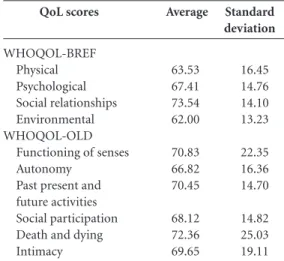
The social relationships domain and the as-pect of death and dying show the highest average scores (73.54 and 72.36 respectively). The lowest average scores were observed in the environment
Variables
Age bracket 60 to 69 70 to 79 80 and over Sex
Masculine Feminine Marital status
Living with partner Living without partner Schooling
Illiterate 1 to 4 years 5 to 8 years 9 or more Skin color
White Black Brown Yellow Income
No income
Up to 1 minimum wage 1 one minimum wage 1 to 3 minimum wages 4 to 7 minimum wages 7 wages and over
n
1805 1219 406
1319 2111
1920 1497
1036 1859 334 201
2058 459 834 74
51 549 755 1658 342 58
(%)
52.6 35.5 11.8
38.5 61.5
56.2 43.8
30.2 54.2 9.7 5.9
60.1 13.4 24.4 2.2
1.5 16.1 22.1 48.6 10.0 1.7
Table 1. Distribution of socioeconomic and demographic variables among the elderly. Southern Triangle Macro Region, Minas Gerais, Brazil, 2013.
* Minimum wage refers to the period in Brazil (2012-2013): R$678.00.
Variables
Health perception Very good Good Regular Bad Morbidities
0 1 to 4 5 or more Use of medications
0 1 to 4 5 or more
Basic Activities of Daily Living Independent
Dependent
n
377 1268 1342 435
345 2527 558
507 2721 202
2923 507
(%)
11.0 37.1 39.2 12.7
10.1 73.7 16.3
14.8 79.3 5.9
85.2 14.8
e C ole tiv a, 21(11):3347-3356, 2016
domain and from the aspect of autonomy (62.00 and 66.82 respectively), Table 3.
With respect to the associated factors, the variables in the preliminary bivariate analysis were submitted to multi-variable analysis, in ac-cordance with the inclusion criteria established
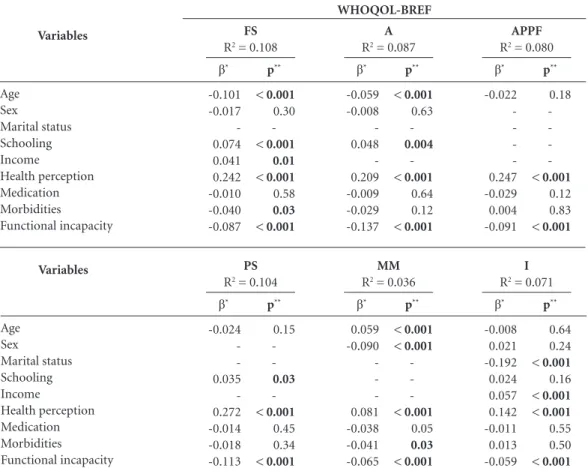
(p < 0.10). Tables 4 and 5 show linear regression
models for QoL scores for the domains of WHO-QOL-BREF and the aspects of WHOQOL-OLD among the elderly. The minimum prerequisites
considered were met, and the determination co-efficients varied from 0.036 to 0.293. It can be verified that the salient factor which most con-tributed to the lowest scores in all the domains and aspects of QL was the negative perception of health.
All the variables studied show association with at least one domain or aspect. There was as-sociation between the feminine sex and the low-est QoL scores in the psychological domain and from the aspect of death and dying. The advanced age variable was associated with the lowest scores in the physical domain and from the aspects of functioning of the senses and autonomy; except for death and dying in which the highest QoL scores were observed. The absence of a partner (a) was associated with the lowest scores in the social relationship domain and in the aspect of intimacy. The absence of schooling was associ-ated with low scores in the physical, psycholog-ical, environmental domains; and the aspects of functioning of the senses, autonomy and social participation. Absence of income was associated with low QoL scores in the physical, psycholog-ical, environmental domains and the aspect of intimacy. The highest number of self-reported morbidities is associated with low scores in the physical domain and the functioning of the sens-es, death and dying aspects. The highest number of self-reported morbidities is associated with low scores in the physical domain and the aspects for functioning of the senses and death and dy-ing, while the highest number of medication cat-QoL scores WHOQOL-BREF Physical Psychological Social relationships Environmental WHOQOL-OLD
Functioning of senses Autonomy
Past present and future activities Social participation Death and dying Intimacy Average 63.53 67.41 73.54 62.00 70.83 66.82 70.45 68.12 72.36 69.65 Standard deviation 16.45 14.76 14.10 13.23 22.35 16.36 14.70 14.82 25.03 19.11
Table 3. Distribution of QoL scores in the domains of WHOQOL-BREF and aspects of WHOQOL-OLD. Southern Triangle Macro Region, Minas Gerais, Brazil, 2013. Variables Age Sex Marital status Schooling Income Health perception Medication Morbidities Functional incapacity
Table 4. Multi-variable linear regression models for QoL scores in WHOQOL-BREF in relation to the variables studied. Southern Triangle Macro Region, Minas Gerais, Brazil, 2013.
R2= Coefficient of determination; * Standardized linear regression coefficients; F: Physical; P: Psychological; RS: Social Relationships; MA: Environmental; ** p< 0,05.
β* -0.065 -0.017 0.011 0.090 0.033 0.423 -0.061 -0.099 -0.146 p** < 0.001 0.26 0.46 < 0.001 0.02 < 0.001 < 0.001 < 0.001 < 0.001 F
R2 = 0.293
WHOQOL-BREF β* -0.006 -0.091 -0.030 0.094 0.035 0.340 -0.022 -0.027 -0.096 p** 0.70 < 0.001 0.06 < 0.001 0.02 < 0.001 0.23 0.12 < 0.001 P
R2 = 0.178
β* --0.058 -0.166 -0.019 -0.013 -0.064 p** -< 0.001 -< 0.001 0.32 0.49 < 0.001 RS
R2 = 0.042
β* --0.005 -0.008 0.091 0.057 0.304 0.014 -0.015 -0.093 p** -0.77 0.64 < 0.001 < 0.001 < 0.001 0.45 0.41 < 0.001 MA
Pai
va MHP
egories is associated with the lowest scores in the physical domain, Tables 4 and 5.
Discussion
With regard to the QoL domains, the highest score was obtained for the social relationships domain and the lowest for the environment. Di-vergences in results were found in research with 2052 elderly people in Sete Lagoas – MG, where the highest score was in the psychological do-main (80.30) and the lowest score in the physical
domain (41.00)4. The lowest score in the
environ-mental domain suggests that the elderly people in this study may encounter difficulties in adapt-ing to the locality where they live. These aspects may lead to dependency, lack of autonomy and social isolation17.
In addition to this, the lowest score in the en-vironmental domain may have been influenced by the higher percentage of elderly people in this study that live on an income of 1 to 3 minimum wages (48.6%). This situation may compromise the ability to meet the needs of the elderly people and consequently increase the risk of falling sick
and have negative repercussions on their QoL18.
A study carried out in the town of Barra Bonita – SP obtained the lowest score from the aspect of autonomy, compared to the others, a result which is consistent with the results of this
research17. This condition may be related to the
difficulty that elderly people have in making their own decisions; acting with freedom and in
accor-dance with their wishes19. Furthermore, in this
study, this result may have been influenced by the lower score in the environmental domain. As a result of this, health professionals should plan, Variables Age Sex Marital status Schooling Income Health perception Medication Morbidities Functional incapacity
Table 5. Multi-variable linear regression models for QoL scores in WHOQOL-OLD in relation to the variables studied. Southern Triangle Macro Region, Minas Gerais, Brazil, 2013.
R2 = Coefficient of determination; * Standardized linear regression coefficients; FS: Functioning of senses; A: Autonomy; APPF: Past, present and future activities; PS: Social participation; MM: Death and dying; I: Intimacy; ** p < 0.05.
WHOQOL-BREF β* -0.101 -0.017 -0.074 0.041 0.242 -0.010 -0.040 -0.087 p** < 0.001 0.30 -< 0.001 0.01 < 0.001 0.58 0.03 < 0.001 FS
R2 = 0.108
β* -0.024 -0.035 -0.272 -0.014 -0.018 -0.113 p** 0.15 -0.03 -< 0.001 0.45 0.34 < 0.001 PS
R2 = 0.104
β* -0.059 -0.008 -0.048 -0.209 -0.009 -0.029 -0.137 p** < 0.001 0.63 -0.004 -< 0.001 0.64 0.12 < 0.001 A
R2 = 0.087
β* 0.059 -0.090 -0.081 -0.038 -0.041 -0.065 p** < 0.001 < 0.001 -< 0.001 0.05 0.03 < 0.001 MM
R2 = 0.036
β* -0.022 -0.247 -0.029 0.004 -0.091 p** 0.18 -< 0.001 0.12 0.83 < 0.001 APPF
R2 = 0.080
β* -0.008 0.021 -0.192 0.024 0.057 0.142 -0.011 0.013 -0.059 p** 0.64 0.24 < 0.001 0.16 < 0.001 < 0.001 0.55 0.50 < 0.001 I
e C
ole
tiv
a,
21(11):3347-3356,
2016
organize and coordinate their health initiatives in areas other than those were the elderly people are living, and in a way that aims to encourage the elderly to make decisions and declare their preferences.
The highest score in the death and dying as-pect indicates that the elderly people are facing their concerns, worries and fears about the end of
their life, in an optimistic manner20. For the
oth-er eldoth-erly people, awareness of their own age and expectations of a shorter future leads to a closer relationship with the idea of death, accepting it as
an inevitable occurrence21.
In addition to the domains and aspects which are the most negatively impacted among the el-derly, it becomes fundamental to get to know the factors associated with these, in view of the fact
that they can affect their health4. Furthermore,
they contribute to the creation of support policies and systematic initiatives in the health services.
As seen in this research, advancing age is as-sociated with low QoL, corroborating with the
data found in national4,22 and international
inves-tigations23. Although ageing is not synonymous
with diseases, with the increase in age, the elderly become more susceptible to the appearance of one or more diseases, principally those which are
chronically degenerative24; as well as a
progres-sive decline in functional capacity22, which can
in turn negatively impact the QoL of the elderly. Thus, health professionals should take a broad view of the elderly, and be attentive to possible demands with the advancing of age.
Research carried out among the elderly that live in Poland showed that a high QoL depends on a good education (OR = 2.31; p < 0.05) and an income that is sufficient to live on (OR = 1.
63; p < 0.05)25, thus diverging from the findings
in this research. It should be pointed out that so-cial determinants, such as schooling and income, should be considered in the practices carried out by health professionals, so as to maintain a bal-ance between health and interference in terms of well-being, functional independence, and the QoL of the elderly18.
Negative health perception is associated with the lowest scores in all the domains and aspects. Research carried out in Curitiba – PR found that the perception of negative health can have an
in-fluence on the QoL of elderly people26. Another
investigation conducted among elderly people living in Sete Lagoas – MG found, after adjust-ment for sociodemographic variables, that the perception of positive health was among the
principal determining factors for a good QoL4.
A study has also indicated that elderly people who assessed their health better and have report-ed that they have no diseases, have the highest average scores in the physical and environmental
domains27. In addition to this, for those elderly
people who have a negative health perception, sentiments related to death and dying are more present for those who evaluate their health as
good or very good27. It is thus believed that there
is a need for health professionals to evaluate health perception, and that interventions should be applied bearing in mind this health indicator.
Another association found was between old people without partners (a) and the lowest score in the intimacy aspect, corroborating with the result found in a study conducted amongst old
people living in the South of Brazil27. The absence
of a partner may result in difficulties in the abil-ity of the elderly person to form other personal and intimate relationships, thus having a great
impact on the intimacy aspect15.
Inadequate social support and insufficient health services, to achieve the highest longevity associated with a satisfactory QoL is one of the greatest challenges relating to public policies, with an increase in the allocation of resources to
meet socioeconomic and sanitary demands28. In
addition to this, these aspects may contribute to a tendency towards functional disability or im-pose new limitations on the lifestyle of elderly people18.
In light of this, it is necessary for health pro-fessionals to consider the network support struc-ture of a given elderly person, particularly those who do not have a partner (a), adopting a sys-tematic approach and a way of stimulating and strengthening interaction and affectionate
con-tacts with their family and the community18,29.
An association was observed between the higher number of medication categories, with the lowest scores in the physical domain. The multiple use of medication by the elderly can af-fect morbidity/mortality and their QoL. Adverse reactions to medications are associated with neg-ative therapy outcomes and may influence the doctor-patient relationship, as confidence in the professional can be shaken; delaying treatment, limiting the autonomy of the elderly person and affecting QoL; Furthermore, in many cases the treatment of adverse reactions involves the pre-scription of new medications, increasing the risk of cascade iatrogenesis30.
Pai
va MHP
aspect of evaluated in the physical domain15 due
to the fact that the elderly person may experience difficulties with respect to telling the time, and the appropriate use of the medication.
The greater number of self-reported morbid-ities is associated with low scores in the physical domain and the aspects of functioning of the senses and death and dying. A study carried out among elderly people who live in the town of Jyväskylä, in Finland, showed that the increase in the number of morbidities had a negative
in-fluence on the QoL of the elderly31. In view of
this, they need is seen for health professionals to be involved in the managing and control of risk factors; of morbidities and already existing com-plications.
Functional disability is associated with the lowest scores in all the domains and aspects, cor-roborating the findings of other investigations22,24.
Functional capacity features in a broader sense than only maintaining the health of the elderly, also having the purpose of giving emphasis to a life of self-sufficiency and independence, even
with the presence of one or more diseases32,33.
Thus, functional capacity is a central aspect
for the obtaining of a good QoL in old age22 and
the results of the evaluation should be considered
Collaborations
MHP Paiva contributed to the design and writ-ing of the article, revision critique and approv-al of the version to be published. MS Pegorari contributed to the concept, design, analysis and interpretation of the data, revision critique and approval of the version to be published. JS Na-scimento contributed to the design, revision cri-tique and approval of the version to be published. AS Santos contributed to the design, revision cri-tique and approval of the version to be published.
for the drawing-up of strategies for the promo-tion of health among elderly people, and inter-ventions for difficulties already present.
The study presents a number of limitations, such as cross-sectional delineation, which does not enable causality links to be established, hav-ing not evaluated the activities instrumental in daily life and chronic diseases and self-reported medications, which could lead to underestima-tion or overestimaunderestima-tion of some of the informa-tion found. In addiinforma-tion to this, there is a shortage of studies using the WHOQOL-OLD.
The socioeconomic and health factors associ-ated with QoL among the elderly, with particular emphasis on the lowest QL scores in the environ-mental domain associated with the absence of schooling and income, negative health perception and functional disability; and from the autonomy aspects, with greater age, absence of schooling, negative health perception and functional disabil-ity. The salient factor that exercises the greatest influence was negative health perception.
e C
ole
tiv
a,
21(11):3347-3356,
2016
Fleck MPA, Louzada S, Xavier M, Chachamovich E, Vieira G, Santos L, Pinzon V. Aplicação da versão em português do instrumento abreviado de avaliação da qualidade de vida “WHOQOL-bref ”. Rev Saude Publica 2000; 34(2):178-183.
Chachamovich E, Trentini C, Fleck, MP. Develop-ment and validation of the Portuguese version of the WHOQOL-OLD module. Rev Saude Publica 2006; 40(5):185-191.
Dias DSG, Carvalho CS, Araújo CV. Comparação da percepção subjetiva de qualidade de vida e bem estar de idosos que vivem sozinhos, coma a família e institucio-nalizados. Rev bras geriatr geront 2013; 16(1):127-138. Geib LTC. Determinantes sociais da saúde do idoso.
Cien Saude Colet 2012; 17(1):123-33.
Fonseca MGUP, Firmo JOA, Filho AIL, Uchoa E. Papel da autonomia na auto-avaliação da saúde do idoso. Rev
Saude Publica 2010; 44(1):159-165.
Tavares DMS, Bolina AF, Dias FA, Santos NMF. Qua-lidade de vida de idosos com incontinência urinária.
Rev. Eletr. Enf. 2011; 13(4):695-702.
Barbosa CG, Melchiori LE, Neme CMB. O significado da morte para adolescentes, adultos e idosos. Paidéia 2011; 21(49):175-185.
Campolina AG, Dini PS, Ciconelli RM. Impacto da doença crônica na qualidade de vida de idosos da co-munidade em São Paulo (SP, Brasil). Cien Saude Colet 2011; 16(6):2919-2925.
Kumar SG, Majumdar AGP, Pavithra G. Quality of Life (QOL) and Its Associated Factors Using WHO-QOL-BREF Among Elderly in Urban Puducherry, In-dia. Journal of Clinical andDiagnostic Research: JCDR 2014; 8(1):54-57.
Tavares DMS, Dias FA. Capacidade funcional, mor-bidades e qualidade de vida de idosos. Texto Contexto
Enferm 2012; 21(1):112-120.
Bryla M, Burzynska M, Maniecka-Bryła IM. Self-rated quality of life of city-dwelling elderly people benefit-ting from social help: results of a cross-sectional study.
Health and Quality of Life Outcomes 2013; 11(1):1-11.
Vagetti GC, Moreira NB, Barbosa Filho VC, Oliveira V, Cancian CF, Mazzardo O, Campos W. Domínios da qualidade de vida associados à percepção de saúde: um estudo com idosas de um programa de atividade física em bairros de baixa renda de Curitiba, Paraná, Bra-sil. Cien Saude Colet 2013; 18(12):3483-3493. Grillo LP, Felipe MR, Callefi F, Canto FB, Tauil KC, Ma-chado MR, Silva VS. Qualidade de vida, estado nutri-cional e hábitos alimentares de idosos pertencentes a uma equipe estratégia saúde da Família no sul do Bra-sil. A terceira idade 2014; 25(59):6-22.
Jóia LC, Ruiz T, Donalisio MR. Grau de satisfação com a saúde entre idosos do Município de Botucatu, Estado de São Paulo. Epidemiol Serv Saúde 2008; 17(3):187-194.
Alvarenga MRM, Oliveira MAC, Domingues MAR, Amendola F, Faccenda O. Rede de suporte social do idoso atendido por equipes de Saúde da Família. Cien
Saude Colet 2011; 16(5):2603-2611.
Secoli SR. Polifarmácia: interações e reações adversas no uso de medicamentos por idosos. Revista Brasileira
de Enfermagem 2010; 63(1):136-140.
15.
16.
17.
18. 19.
20.
21.
22.
23.
24.
25.
26.
27.
28.
29.
30. References
Brasil. Ministério da Saúde (MS). Secretaria de Aten-ção à Saúde. Departamento de Ações Programáticas e Estratégicas. Atenção à saúde da pessoa idosa e
envelhe-cimento. Brasília: MS; 2010.
Ramos LR. Fatores determinantes do envelhecimen-to saudável em idosos residentes em centro urbano: Projeto Epidoso, São Paulo. Cad Saude Publica 2003; 19(3):793-798.
World Health Organization Quality Of Life Group. The World Health Organization Quality of Life assessment (WHOQOL):position paper from the World Health Organization. Soc Sci Med 1995; 41(10):1403-1409. Campos ACV, Ferreira EF, Vargas AMD, Abdala C. Aging, Gender and Quality of Life (AGEQOL) study: factors associated with good quality of life in older Brazilian community-dwelling adults. Health Qual Life
Outcomes 2014 12:166.
Oliveira SES, Hohendorff JV, Müller JL, Bandeira DR, Koller SH, Fleck MPA, Trentini CM. Associations be-tween self-perceived quality of life and socio-demo-graphic, psychosocial, and health variables in a group of elderly. Cad Saude Publica 2013; 29(7):1436-1448. Molzahn AE, Kalfoss M, Marakoff KS, Skevington SM. Comparing the importance of different aspects of quality of life to older adults across diverse cultures.
Age Ageing 2011; 40(2):192-199.
Faller JW, Melo WA, Versa GLGS, Marcon SS. Qualida-de Qualida-de Vida Qualida-de Idosos cadastrados na Estratégia SaúQualida-de da Família de Foz do Iguaçu-PR. Escola Anna Nery
Re-vista de Enfermagem 2010; 14(4):803-810.
Maués CR, Paschoal SMP, Jaluul O, França CC, Filho WJ. Avaliação da qualidade de vida: comparação entre idosos jovens e muito idosos. Revista Brasileira de
Clí-nica Médica 2010; 8(5):405-410.
Instituto Brasileiro de Geografia e Estatística (IBGE). Resultados Preliminares do Censo Demográfico 2010. [acessado 2014 out 10]. Disponível em: http://www. ibge.gov.br/home/estatistica/populacao/censo2010/re-sultados_preliminares/preliminar_tab_zip.shtm. Instituto Brasileiro de Geografia e Estatística (IBGE).
Informações sobre os municípios brasileiros 2010.
[aces-sado 2014 out 10]. Disponível em: http://cidades.ibge. gov.br/xtras/uf.php?coduf=31&search=minas-gerais. &lang=
Bertolucci PHF, Brucki SMD, Campacci SR, Juliano Y. O mini- exame do estado mental em uma população geral: impacto da escolaridade. Arquivo Neuropsiquia-tria 1994, 52(1):1-7.
Valle EA, Castro-Costa E, Firmo JOA, Uchoa E, Lima-Costa MF. Estudo de base populacional dos fatores associados ao desempenho no Mini Exame do Estado Mental entre idosos: Projeto Bambuí. Cad Saude Publi-ca 2009; 25(4):918-926.
Converso ME, Iartelli I. Caracterização e análise do es-tado mental e funcional de idosos institucionalizados em instituições públicas de longa permanência. Journal
Brasileiro de Psiquiatria 2007; 56(4):267-272.
Lino VTS, Pereira SRM, Camacho LAB, Filho STR, Buksman S. Adaptação transcultural da Escala de In-dependência em Atividades da Vida Diária (Escala de Katz). Cad Saude Publica 2008; 24(1):103-112. 1.
2.
3.
4.
5.
6.
7.
8.
9.
10.
11.
12.
13.
Pai
va MHP
Rantakokko M, Iwarsson S, Kauppinen M, Leinonen R, Heikkinen E, Rantanen T. Quality of Life and Barriers in the Urban Outdoor Environment in Old Age Merja.
J Am Geriatr Soc 2010; 58(11):2154-2159.
Cardoso JH, Costa JSD. Características epidemioló-gicas, capacidade funcional e fatores associados em idosos de um plano de saúde. Cien Saude Colet 2010; 15(6):2871-2878.
Almeida MHM, Litvoc J, Perez MP. Dificuldades para atividades básicas e instrumentais de vida diária, referi-das por usuários de um centro de saúde escola do mu-nicípio de São Paulo. Rev. bras. geriatr. gerontol 2011; 15(2):187-200.
Article submitted 30/11/2014 Approved 11/09/2015
Final version submitted 13/09/2015 31.
32.