Sleep disorders in high school
and pre-university students
Célia R.S. Rocha1, Sueli Rossini2, Rubens Reimão3ABSTRACT
Adolescence is a period in which youngsters have to make choices such as applying for university. The selection process is competitive, and it brings distress and anxiety, risk factors for the appearance of sleep disorders. Objective: To verify the occurrence of sleep disorders in third-year high school and pre-university students. Method: This cross-sectional descriptive study comprised a sample of 529 students (M=241, F=288) from three public schools, four private schools and two pre-university courses - a middle-class neighborhood in the city of São Paulo - aged between 16 and 19 years old. We used the Pittsburgh Sleep Quality Index (PSQI) - a standardized questionnaire. Results: The participants (52.9%) took about 30 minutes to fall asleep, with an average of 306.4 minutes asleep, moderate daytime sleepiness (n=243, 45.9%) and indisposition (n=402, 75.9%) to develop the activities. The scores (M and F) were similar regarding problems that affect sleep. Conclusion: The investigated population showed sleep disorders and poor sleep quality.
Key words: sleep quality, sleep disorders, adolescents, high school.
Distúrbios do sono em estudantes do ensino médio e curso pré-vestibular RESUMO
A adolescência é tida como um período em que o jovem tem que fazer escolhas; a entrada na universidade é uma delas. O processo seletivo é concorrido, trazendo à tona angústia e ansiedade, fatores de risco para o surgimento de distúrbios do sono. Objetivo: Verificar a ocorrência de distúrbios do sono em estudantes do terceiro ano do ensino médio e de curso pré-vestibular. Método: Foi realizado um estudo transversal, descritivo. A amostra de 529 estudantes (M=241; F=288) de três escolas públicas, quatro escolas privadas e dois cursos pré-vestibulares, de um bairro de classe média, da cidade de São Paulo, na faixa etária entre 16 e 19 anos. Utilizou-se o Índice de Qualidade do Sono de Pittsburgh (IQSP) - questionário padronizado. Resultados: Verificou-se que os participantes (52,9%) levavam cerca de 30 minutos para dormir, com a média de 306,4 minutos dormidos, apresentavam sonolência diurna moderada (n=243, 45,9%) e indisposição (n=402, 75,9%) para desenvolver as atividades. Os escores (M e F) são semelhantes, no que se refere aos problemas que influenciam o sono. Conclusão: Existe a ocorrência de distúrbios do sono e má qualidade do sono na população estudada.
Palavras-chave: qualidade do sono, distúrbios do sono, adolescentes, ensino médio.
Correspondence
Célia Regina Silva Rocha Rua Paulo Ornellas Carvalho de Barros 98 / 44F
02344-030 São Paulo SP - Brasil E-mail: [email protected]
Received 1 March 2010 Received in final form 8 June 2010 Accepted 15 June 2010
1Ph.D., Psychologist, Program in Child and Adolescent Health, Faculty of Medical Sciences, University of Campinas (UNICAMP),
Campinas SP, Brazil; 2PhD, Psychologist, Division of Clinical Neurology, Hospital das Clínicas, University of São Paulo Medical
School, São Paulo SP, Brazil; 3MD, PhD, Pediatric Neurologist, Division of Clinical Neurology, Hospital das Clínicas, University
of São Paulo Medical School, São Paulo SP, Brazil. In recent decades, adolescence has been considered a crucial phase of hu-man development, period in which pro-found both physical and social changes oc-cur, often causing tension, stress and other forms of disorders1.
conlicts generated by choices, since when they choose a course, they will give up others, even though temporarily. he students’ emotional state changes as well. D’Ávila and Soares2 claims that they are more reserved inward looking during the period of university entrance exami-nations, manifesting feelings of anxiety and distress.
hus, the physical and social alterations, along with the insertion into the adult world and career choice, make the proximity of the exam, which is a rite of passage in the lives of individuals, one of several risk factors for this group age.
In addition, the possibility and sense of failure related to family and social group’s expectations can lead to so-cial isolation and low self-esteem, factors diicult to bear and which lead the adolescent to develop symptoms of depression and sleep disorders1.
Since sleep is essential for maintaining the balance of the human psyche, its deprivation causes signiicant dam-age to concentration, memory and emotional control.
Nowadays, sleep deprivation in adolescence may oc-cur because of external factors, such as class schedule, nights out with friends, long night hours awake or watch-ing television or surwatch-ing the internet3,4.
Other factors may contribute to restless sleep: feelings and concerns experienced by youth in the face of pressure from parents and family members to fulill their obliga-tions, uncertainties relative to school diiculties and the future, which usually are accompanied by bodily changes inherent in the stage of development. However, Carskadon and Acebo5 emphasize that the possibility of these aspects of pubertal maturation inluence the behavioral factors re-sponsible for this reorganization is not yet well determined. During adolescence, the period of sleep varies from 8 hours and 36 minutes to 6 hours and 4 minutes, with an average of seven hours4. According to Halbower and Mar-cus6, insomnia is a common sleep disorder in adolescence, with a prevalence ranging from 2.2% to 17%. Lui et al.7 found that 18.8% of adolescents have poor sleep, diiculty initiating sleep and daytime sleepiness (17.9%), and that ap-proximately 26.2% are dissatisied with their sleep quality. Adolescents tend to delay the sleep phases, i.e. they prefer to sleep and awake later 8,9 due to changes in bi-ological rhythms and aspects of individual variability: morning and evening.
In addition to the reported problems, there may be extrinsic sleep disturbances caused by external factors, such as school and family pressure, poor sleep hygiene and sleep deprivation, as well as stimulant and alcohol use. Among them, we can highlight the anxiety caused by the proximity of the university entrance exams, which can be a determining factor for a poor sleep quality.
he aim of this study was to verify the occurrence of sleep disorders in third-year high school and pre-univer-sity students.
METHOD
he survey was conducted in three public schools, four private schools and two pre-university courses in a mid-dle-class neighborhood of São Paulo, comprising a popu-lation of 529 students, 451 high school courses and 78 pre-entrance exam courses, by using a convenience sample. he inclusion criteria were as follows: age between 16 and 19 years old; be a third-year student in secondary ed-ucation in a public school, private school or pre-univer-sity course; have the written permission from parents or guardians (after clariication); and answer the Pittsburgh Sleep Quality Index (PSQI)10.
We conducted a descriptive cross-sectional study by using socio-demographic data, such as type of school (public or private), age, gender, parental education and family income, and by applying the Pittsburgh Sleep Qual-ity Index10, which evaluated the sleep-wake cycle pattern (the usual sleeping and waking time).
When answering the standardized questionnaire, which included 19 closed questions to measure and pro-vide information about habits and sleep quality, adoles-cents reported data on sleeping and waking time during the last month.
he cutof level was established in ive points in order to characterize sleep disorders in students.
he PSQI was initially read along with the students, allowing doubt clariication.
he schools were chosen for convenience, ease ac-cess and availability to cooperate with the study. he sam-ple comprised 529 students of both genders: 288 (54%) females and 241 (45.7%) males. Among them, 451 were high school and 78 pre-university students aged between 16 and 19 years old.
Considering that PSQI variables are categorical, Chi-square and Fisher’s exact tests were applied, as well as the Mann-Whitney test and Spearman’s correlation for cal-culating position measurements. he level of signiicance was set at 95% (p<0.05) for all statistical calculations.
his research project was approved by the Research Ethics Committee Medical Sciences School , University of Campinas (UNICAMP).
RESULTS
he characterization and multivariate analysis of the sleep-wake cycle pattern was performed under qualitative and quantitative aspects, using data obtained by the sleep habits questionnaire. he irst two topics presented calcu-lations of position measurements (minimum, maximum, median, quartile 1 and quartile 3) and the Mann-Whit-ney test results, which showed diferences between the groups: “good sleepers” and “bad sleepers”, and preparato-ry students and students who did not attend the courses. In order to verify whether these co-relational results would repeat after dividing participants into “bad sleep-ers” and “good sleepsleep-ers”, preparatory course students and students who did not attend them were submitted to the Spearman’ test.
Most of the 529 students of diferent age groups who responded to the questionnaires study in the morn-ing, attend high school (77.7%) and preparation courses (97%), with percentage varying from 72% to 87%. Only 73 (13.8%) students attend preparatory courses in par-allel to school.
Among the participants, 195 (36.9%) took about 15 minutes and 172 (32.5%) from 15 to 30 minutes to sleep. he average sleep duration was 306.4 minutes. he av-erage of those who took longer than 30 minutes to fall asleep varied between 1 and 2.5, with the exception of 16-year-old girls (md=3); the average of those who woke up at night or too early varied between 1 and 2.5, with the exception of 16-year-old girls (md=4) and 19-year-old boys; the average of those who woke up to go to the bath-room varied between 1 and 2.5; the average of those who
had trouble breathing was 1, with the exception of 18-year-old boys (md=2); the average of those who coughed or snored too loud was 1; the average of those who felt heat and cold and had bad dreams varied between 1 and 3; the average of those who sufered pains varied between 1 and 2.5; the sleep quality varied between 3 and 4, the average of those who took sleep medication was 1 for all categories; and the average of those who felt drowsy and unwell varied between 1 and 3.
he percentage distribution of participants working or not is similar in gender and age categories, although there are some small percentage changes between boys and girls that work or not: 68% and 73.1%, respectively, do not work. In general, most participants did not work. he exception referred to 17-year-old girls (45.5%), 16-year-old boys (25%) and 17-year-16-year-old boys (47.5%).
Most of the students (n=456, 86.2%) did not attend the preparatory course for college entrance exams, and among those who attended preparatory school, the high-est percentages were found as follows: 18-year-old boys (33.3%) and 19- year-old boys (50%).
Most of the students (n=478, 92.8%) aimed to attend college, and among those who had no such goal were youth aged 18 years old (2.6%) and 17 years old (2.4%).
Concerning the PSQI results, sleep disturbances, re-gardless of gender, indicated that 274 (51.8%) of partici-pants sleep 6-7 hours, males (6h47) and females (5h36). he average of minutes of sleep per night was 300 minutes, with a minimum of 110 and maximum of 720 minutes.
Respecting the gender, the average was 420 minutes
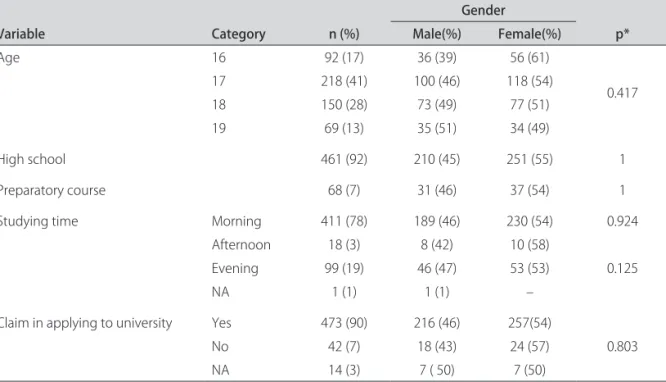
Table 1. Distribution of absolute and relative frequencies of participants according to gender, age, study time and type of school.
Variable Category n (%)
Gender
p* Male(%) Female(%)
Age 16 92 (17) 36 (39) 56 (61)
0.417 17 218 (41) 100 (46) 118 (54)
18 150 (28) 73 (49) 77 (51) 19 69 (13) 35 (51) 34 (49)
High school 461 (92) 210 (45) 251 (55) 1
Preparatory course 68 (7) 31 (46) 37 (54) 1
Studying time Morning 411 (78) 189 (46) 230 (54) 0.924 Afternoon 18 (3) 8 (42) 10 (58)
0.125 Evening 99 (19) 46 (47) 53 (53)
NA 1 (1) 1 (1) –
Claim in applying to university Yes 473 (90) 216 (46) 257(54)
0.803
No 42 (7) 18 (43) 24 (57)
NA 14 (3) 7 ( 50) 7 (50)
for boys and 390 minutes for girls, i.e. according to this study, males slept more than females.
he position measurements calculated were similar mainly in categories: wake up to go to the bathroom, dif-icult breathing, coughing or snoring loudly, feeling very cold, feeling very hot, having bad dreams or nightmares and cramps, with average 1 and maximum and minimum values of 1 and 4, respectively.
he descriptive analysis of the sleep quality had an inluence on sleep. Drowsiness and upset symptoms re-vealed that the scores were similar in various categories.
he exception referred to have bad dreams: the average of 1 for male students and 2 for female students.
Considering people with good sleep as those who had scores up to five in the subtotal PSQI, and those with poor sleep with score at or above six, 378 participants (71.4%) revealed bad sleep quality.
When comparing the sleep quality of students tending pre-university courses and those who did not at-tend them, there was no diference in overall score. Ac-cording Table 2, the averages of subjective sleep quali-ty of students who did not attend pre-universiquali-ty cours-es were better than the students of pre-university prepa-ratory courses.
here was no statistically signiicant diference, be-tween the two groups of students, regarding data correla-tion coeicients: –0.005 (p=0.9062) for subjective quality, 0.0467 (p=0.2982) for sleep duration, 0.0574 (p=0.2008) for normal eiciency, 0.0158 (p=0.7237) for sleep disor-ders, 0.0463 (p=0.3023) for use of medication and 0.0798 (p=0.0755) for daytime sleepiness.
he averages were equal for boys and girls, observ-ing small variations in the minimum and maximum val-ues and dispersion, suggesting that the study participants had poor quality sleep. Although the students’ sleep qual-ity has been considered good (md=3. 50%), they had trou-bles to be awake up to three times a week, while doing
Table 2. Standard and quality of sleep according to gender.
Variable Category
Gender
p* Female (%) Male (%)
Subjective quality of sleep Very good 45 (15.7) 40 (16.6)
Good 173 (60.1) 148 (61.4) 0.0335
Bad 56 (19.4) 44 (18.4)
Very bad 14 (4.8) 9 (3.7)
Sleep latency Up to 15 m 72 (25) 73 (30.4)
Between 16-30 m 162 (56.3) 118 (48.9) 0.0451 Between 31-60 m 38 (13.2) 27 (11.2)
More than 60m 16 (5.5) 23 (9.5)
Habitual sleep eiciency More than 85 34 (11.8) 27 (11.2)
Between 75-84 193 (67) 175 (72.6) 0.1512 Between 65-74 57 (19.8) 31 (12.9)
Less than 65 4 (1.4) 8 (3.3) 1 or 2 times per week 156 (54.2) 132 (54.8) 3 times per week 12 (4.2) 4 (1.6)
Somnolency None 2 (0.7) 1 (0.4)
Small 144 (50) 146 (60.6) 0.2539
Moderate 66 (22.9) 47 (19.5)
A lot 76 (26.4) 47 (19.5)
*p-value Chi-square test.
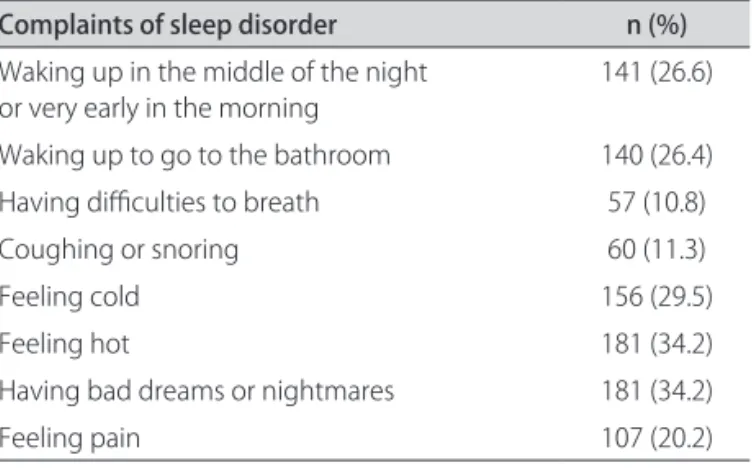
Table 3. Distribution of the incidence of frequency sleep complaints (at least once a week).
Complaints of sleep disorder n (%)
Waking up in the middle of the night
or very early in the morning 141 (26.6) Waking up to go to the bathroom 140 (26.4) Having diiculties to breath 57 (10.8) Coughing or snoring 60 (11.3)
Feeling cold 156 (29.5)
Feeling hot 181 (34.2)
Having bad dreams or nightmares 181 (34.2)
their activities (236 participants, 44.6%) and lack of en-thusiasm and willingness to develop their daily activities (402 participants, 75.9%) (Table 3).
DISCUSSION
Sleep in children and adolescents usually show chang-es in a predictable way, with sleep duration decrease with age11. In adolescence, environmental factors and experienced stress may alter the regulation and circadi-an rhythm sleep12. Technological advances and lifestyle of modern society are also risk factors for the occur-rence of such changes, especially of adolescents in urban centers13,14. his research aimed to verify the sleep pattern in third-year high school and pre-university students.
he high prevalence of sleep disorders (88.2%) found in this study shows that a large number of students (teenag-ers) probably have some type of sleep disorder. here were no signiicant diferences regarding age, which is consistent with other indings in the literature. he study data showed that most participants studied in the morning and did not perform any paid work and intended to enroll in higher education. he results presented here were in accordance with the indings in the literature4,6. In this sample, most students took 30 minutes to fall asleep; while the boys slept about 420 minutes per night, the girls slept 390 min-utes, that is, males in this group slept more than females. Regarding the time remaining asleep, these results dif-fer from those found in a study of 37 adolescents14, in which the lack of electricity, was a decisive factor for the presence of longer sleep longer duration among students in the afternoon, as they slept on average 9h per night. And they are smaller than the results found by Iglowstein et al.4 and Lui et al.7 (6:50 a.m. and 6:36 a.m. respectively). here were no signiicant diferences between ages, cor-roborating other results1,6.
In comparison with the global PSQI score, qualita-tively, the sleep of both groups of adolescents was con-sidered bad.
here were no signiicant diferences between ages, except for having bad dreams, which rate was higher among women, corroborating other results6.
he quality or sleep disturbances between those who wanted to enroll in higher education, those who did not perform paid work or studied in the morning had no sig-niicant variations.
he PSQI subjective data, when comparing the per-formance of high school and pre-university students, showed that students from public high schools had poor sleep quality when compared with their peers in private schools and preparatory courses.
Other subjective data, such as sleep duration, habit-ual efficiency, sleep disturbances, medication use and daytime sleepiness, were similar in the diferent
catego-ries. he participants assessed the quality of their sleep as good; however, the records indicated lack of enthusiasm and unwillingness to carry on daily activities.
Hinds et al.11, state that the breakage or poor quality sleep, cause increased daytime sleepiness. Although day-time sleepiness, such as partial sleep deprivation has been reported as a characteristic of adolescence3,15.
here was a relationship between the minutes of sleep and sleep quality, suggesting that the period of sleep had an impact on subjective sleep quality in participants. he main problem presented by the participants of this study was the 30-minute delay to take to get to sleep. hese re-sults were close to the indings3,6 thus, we can infer the presence of sleep disorders in students of diferent levels of education, speciically the high school and pre-uni-versity courses.
Peixoto et al.14 and Brand et al.12 suggest that preven-tive interventions, may reduce the impact on the teenag-ers sleep pattern and quality.
Sleep researches in high school students are scarce. he increase in complaints of insomnia in adolescence by par-ents and professionals should always be evaluated; it may be associated with other emotional or behavioral manifes-tations, typical of this age group. his study highlighted dif-iculties in initiating and maintaining sleep pattern; there-fore, the sleep quality in participants of this study is bad.
REFERENCES
1. Bahls SC. Epidemiology of depressive symptoms in adolescents of a public school in Curitiba, Brasil. Rev Bras Psiquiatr 2002;24:63-67.
2. D’Ávila GT, Soares DHP. Vestibular: fatores geradores de ansiedade na “cena da prova”. Rev Bras Orient Prof 2003;4:1-2.
3. Mesquita G, Reimão R. Sono na adolescência. In: Reimão R (Ed). Sono atual-idades. São Paulo: Associação Paulista de Medicina 2006:34-36. 4. Iglowstein I, Jenni OG, Molinari L, Largo RH. Sleep duration from infancy to
adolescence: reference values and generational trends. Pediatrics 2003;111: 302-307.
5. Carskadon MA, Acebo C. Regulation of sleepiness in adolescents: update, insights and speculation. Sleep 2002;25:606-614.
6. Halbower AC, Marcus CL. Sleep disorders in children. Curr Opin Pulm Med 2003;9:471-476.
7. Lui X, Zhoo Z, Jia C, Buysse DJ. Sleep patterns and problems among Chinese adolescents. Pediatrics 2008;121:1165-1173.
8. Wolfson AR, Carskadon MA, Acebo C, et al. Evidence for the validity of a sleep habits survey for adolescents. Sleep 2003;26:213-216.
9. Fischer FM, Nagai R, Teixeira LR. Explaining sleep duration in adolescents: the impact of socio-demograic and lifestyle factors and working status. Chronobiol lnt 2008;25:359-372.
10. Buysse DJ, Monk TH, Bernan SR, Kupfer DJ, Reynolds CF. The Pittsburgh Sleep Quality Index: a new instrument for psychiatric practice and research. Psychiatry Res 1989;28:193-213.
11. Hinds PS, Hockenberry MJ, Gattuso JS, et al. Dexamethasone alters sleep and fatigue in pediatric patients with acute lymphoblastic leukemia. Cancer 2007;110: 2321-2330.
12. Brand S, Markus G, Martin H, Beck J, Trachsler EH. Evidence for similarities be-tween adolescents and parents in sleep patterns. Sleep Med 2009;10: 1124-1131. 13. Mindell JA, Meltzer LJ, Carskadon MA, Chervin RD. Developmental aspects
of sleep hygiene indings from the 2004 National Sleep Foundation Sleep in America Poll. Sleep Med 2009;10:693-816.
14. Peixoto CA, Silva AG, Carskadon MA Louzada FM. Adolescents living in homes without electric lighting have earlier sleep times. Behav Sleep Med 2009;7:73-80.