ARTICLE
Quality of life in patients with HTLV-I associated
myelopathy/tropical spastic paraparesis
Qualidade de vida em pacientes com mielopatia associada ao HTLV-I/paraparesia
espástica tropical
José Vicente Pereira Martins1, Abrahão Fontes Baptista2, Abelardo de Queiroz Campos Araújo1,3
he human t-cell lymphotropic virus type 1 (HTLV – I), a human deltaretrovirus, is the etiological agent of adult T-cell leukemia and various inlammatory diseases, includ-ing HTLV–I associated myelopathy (HAM)/tropical spastic paraparesis (TSP)1. HTLV-I infection was irst described in
the 1980s, being endemic in Southern Japan, the Caribbean, Central and South Africa, and South America2.
In 1989, the World Health Organization created the term HTLV–I associated myelopathy/tropical spastic paraparesis (HAM/TSP) for the neurological syndrome associated with this virus3. HAM/TSP is mainly a spinal cord syndrome
char-acterized by a chronic progressive spastic paraparesis, mild sensory signs and neurogenic bladder,but in some patients it can show a rapid deterioration4.
he neurological examination usually shows weakness and spasticity in the lower limbs, increased deep tendon
relexes, bilateral Babinski sign, clonus and gait abnormali-ties5
. Other complaints include low back pain, numbness and
dysesthesias in the legs and foot.
As HAM/TSP causes limitations on daily living activities, so it is important to evaluate the association of these con-ditions with the quality of life of the patients6. In a
popula-tion with chronic diseases, measurement of the quality of life (QoL) provides a meaningful way to understand the conse-quences of the illness when cure is not possible.
Quality of life, as deined by World Health Organization, takes into account the perception of the individuals about their own position in life and involves cultural context, goals, expectations, parameters and social relations7.
Researchers have examined a myriad of phenomena that inluence QOL in older adults. For example, spirituality, social networks, supportive communities and a variety of
health-1 Federal University of Rio de Janeiro (UFRJ), Rio de Janeiro RJ, Brazil;
2 Biomorphology Department, Federal University of Bahia (UFBA), Salvador BA, Brazil;
3 Reference Center on Neuroinfections and HTLV, Evandro Chagas Clinical Research Institute (IPEC), FIOCRUZ, Rio de Janeiro, Brazil.
Correspondence: José Vicente Pereira Martins; Rua Jornalista Henrique Cordeiro 120 / 1405; 22631-450 Rio de Janeiro RJ - Brasil; E-mail: [email protected]
Conflict of interest: There is no conflict of interest to declare.
Received 18 September 2011; Received in final form 16 November 2011; Accepted 23 November 2011
ABSTRACT
Objective: To assess the quality of life (QoL) of patients with HTLV-I-associate myelopathy/tropical spastic paraparesis (HAM/TSP) and to correlate it with specific aspects of the disease. Methods: Fifty-seven HAM/TSP patients completed the SF-36 QoL questionnaire. They were also asked about common complaints related to the disease, and we looked for associations between QoL and these complaints. Results:
Patients with HAM/TSP showed a strong negative association to QoL. Pain was the condition which most affected their QoL. The practice of physical activity is associated with better QoL in five out of eight domains of the scale. Conclusion: HAM/TSP leads to a poor QoL, mostly influenced by pain. Physical activity may have a positive association to QoL of these patients.
Key words: HTLV-I-associate myelopathy/tropical spastic paraparesis, quality of life, SF-36, motor activity.
RESUMO
Objetivo: Avaliar a qualidade de vida (QV) em pacientes com mielopatia associada ao HTLV-I/paraparesia espástica tropical (MAH/PET) e cor-relacioná-la com aspectos específicos da doença. Métodos: Cinquenta e sete pacientes com MAH/PET completaram o questionário de qua-lidade de vida SF-36. Também foram feitas perguntas sobre queixas comuns relacionadas à doença e investigadas posteriormente associa-ções entre QV e essas queixas. Resultados: Pacientes com MAH/PET apresentaram uma associação negativa com a QV. A dor foi a condição que mais afetou a QV. A prática de atividade física foi associada a uma melhor QV em cinco dos oito domínios da escala. Conclusão: MAH/PET leva a uma pior QV, principalmente influenciada pela dor. A atividade física pode estar positivamente associada à QV destes pacientes.
promoting activities were associated with improved QOL. At the same time, loneliness, depression, fear and isolation were associated with decreased QOL in older adults8.
Over the past 20 years, hundreds of instruments have been developed to measure patient’s quality of life. he SF-36 Health Survey was created to be a generic questionnaire for the evaluation of the quality of life with an easy and compre-hensive administration. It is a measure of health status as op-posed to one that targets a speciic age, disease or treatment group. Accordingly, the SF-36 has been proven to be useful in comparing general and speciic population, estimating the relative burden of diferent disease, diferentiating the health beneits produced by a wide range of diferent treatments and screening individuals’ patients, and is used for people with chronic illness, such as spinal cord injury, multiple scle-rosis and stroke9.
Sustaining an injury to the spinal cord may result in neurogenic bowel and bladder function, varying degrees of motor paralysis, sensory dysfunction and spasticity. For this reason, many studies have measured the consequence of the traumatic spinal cord injury negatively on a QOL, us-ing the SF-3610. he SF-36 could be a very useful tool for
as-sessing the quality of life of the patients with HAM/TSP and can help healthcare professionals to focus their therapeutic strategies in areas that may jeopardize the welfare of these patients.
herefore, the primary aim of this study was to evaluate patients sufering from HAM/TSP by applying the SF-36 ques-tionnaire and to compare it with some more relevant indings related to the condition itself. hese indings are complaints which are usually mentioned by patients with HAM/TSP dur-ing regular assessments, such as: problems with locomotion, lack of the bladder control, pain, some important aspects concerning time of the duration of symptoms and if they are treated with physiotherapy and exercises. hese questions were asked and compared with SF-36 questionnaire.
METHODS
his was an observational, cross-sectional, study con-ducted at the Reference Center for Neurological Infections (Evandro Chagas Hospital, IPEC-FIOCRUZ) in Rio de Janeiro, Brazil, from March to December of 2007. he initial sample was composed of 107 patients who fulilled the World Health Organization11 (WHO)criteria for HAM/TSP and were in
regular follow up at the HTLV outpatient clinic of the IPEC-FIOCRUZ. he exclusion criteria were: patients with HAM/TSP who showed some comorbidities not related to HTLV-I in-fection (diabetes, chronic limiting osteoarticular diseases, kidney and liver failure, neoplasm, blindness, chronic ob-structive pulmonary disease, decompensate hypo or hyper-thyroidism, congestive heart failure, chronic hepatitis in
activity and acquired immunodeiciency syndrome); patients with HAM/TSP with some cognitive, behavioral or psychiat-ric dysfunction that would not allow proper completion of the questionnaire; patients who had changes in their phar-macological or physical therapy treatment in the four weeks before the date of completion of the questionnaire and illit-erate patients. Based on these criteria, 50 patients had to be excluded.
Only one patient was excluded due to illiteracy. he oth-ers were excluded due to their medical comorbidities or due to the presence of other diseases.
Quality of life was assessed by the validated Brazilian ver-sion of the SF-36 questionnaire9. he SF-36 is a generic health
status measure. It contains 8 domains: physical function, role physical, mental health, role emotional, vitality, pain, social functioning and general health. he 8 domains can be aggre-gated to form 2 summary scales, a physical component score (PCS) and a mental component score (MCS). he score for each scale ranges from 0 to 100. A high score indicates favor-able quality of life measures. An additional question in the SF-36 relates to changes in health over time.
he SF-36 was translated into Portuguese in 1997 and has shown validity and internal consistency when used in gen-eral populations9. he subjects answered the questionnaire
in a room in the HTLV-I outpatient department at IPEC - FIOCRUZ, Rio de Janeiro. In case of any doubt, the examiner could only repeat the question once, without any further ex-planation. he SF-36 was read aloud by the same researcher, with the same voice intonation in order not to have any kind of inluence on the answers.
After answering the SF-36, patients were also questioned about some important aspects concerning their health. he questions were:
1. What does bother you the most at the moment? Options: a) pain, b) locomotion, c) no bladder control, d) to depend on others.
2. How long have you been feeling the symptoms related to the HAM/TSP for? Options: a) 10 years, b) more than 10 years. 3. Can you walk or do you need a wheelchair? Options:
a) walk, b) wheelchair.
4. Do you have bladder control? Options: a) yes, b) no. 5. Do you feel low back pain or/and pain in the lower limbs?
Options: a) yes, b) no.
6. Have you been doing physiotherapy or exercising regular-ly assisted by a professional? Options: a) yes, b) no. he assessment of the association of HTLV-I to the qual-ity of life related to health of these patients was done by com-paring the scores of the SF-36 domains with the answers to the questions 2 till 6 mentioned above.
The Mann-Whitney test, the variance analysis of Kruskal-Wallis (ANOVA non-parametric) and the Spearman correlation coefficient were used in the statis-tical analysis with an alpha value of 5% (p<0.05) for sig-nificance. The descriptive data was presented as medians, minimum and maximum values.
RESULTS
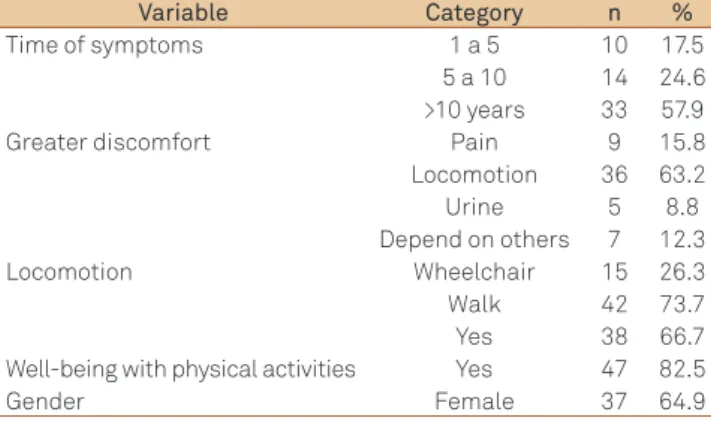
Out of 57 patients, 37 were female (64.9%) and the mean age was 52.4 years. he majority of participants had symp-toms for more than 10 years (57.9%). Regarding locomotion, 73.7% of the patients were able to walk, while 26.3% were wheelchair bound. Most patients (63.2%) reported that their greater discomfort was related to their gait impairment, fol-lowed by pain (Table 1).
Patients with pain had lower SF-36 scores in the domains: general health, pain, vitality and mental health, when com-pared with the subgroup of patients without pain (Table 2). Patients who practiced regular physical exercises had bet-ter scores in other domains (Table 3). Regarding locomotion, patients restricted to a wheelchair presented lower scores of functional capacity than the subgroup who were still able to walk. he subgroup of patients who had bladder control showed scores of functional capacity signiicantly higher than the group without it. here was no statistically signiicant dif-ference in terms of age, gender and the SF-36 questionnaire.
Variable Category n %
Time of symptoms 1 a 5 10 17.5 5 a 10 14 24.6 >10 years 33 57.9 Greater discomfort Pain 9 15.8 Locomotion 36 63.2 Urine 5 8.8 Depend on others 7 12.3 Locomotion Wheelchair 15 26.3 Walk 42 73.7 Yes 38 66.7 Well-being with physical activities Yes 47 82.5
Gender Female 37 64.9
Table 1. Sociodemographic and general health status data.
SF-36 (%) Exercise n Median Min. Max. p-value*
General health yes 28 67.0 15 97
0.0003
no 29 30.0 0 87
Physical function yes 28 15.0 0 80
0.10
no 29 5.0 0 70
Physical role yes 28 50.0 0 100
0.42
no 29 25.0 0 100
Emotional role yes 28 100.0 0 100
0.22
no 29 0.0 0 100
Social function yes 28 62.5 0 100
0.024
no 29 50.0 0 100
Bodily pain yes 28 61.5 0 100
0.024
no 29 51.0 0 100
Vitality yes 28 57.5 20 100
0.0001
no 29 25.0 0 75
Mental health Yes 28 80.0 20 100
0.0002
No 29 48.0 0 96
Table 3. Physical exercise and SF-36.
*Mann-Whitney, p<0.05.
SF-36 (%) Pain n Median Min. Max. p-value*
General health yes 38 38.5 0 97
0.009
no 19 67.0 5 92
Physical function yes 38 10.0 0 80
0.42
no 19 15.0 0 55
Physical role yes 38 37.5 0 100
0.43
no 19 75.0 0 100
Emotional role yes 38 16.7 0 100
0.14
no 19 100.0 0 100
Social function yes 38 50.0 0 100
0.10
no 19 62.5 0 100
Bodily pain yes 38 46.5 0 100
0.0001
no 19 100.0 31 100
Vitality yes 38 35.0 0 100
0.017
no 19 55.0 20 95
Mental health yes 38 52.0 0 100
0.024
no 19 76.0 0 100
Table 2. Correlation between low back pain and SF-36.
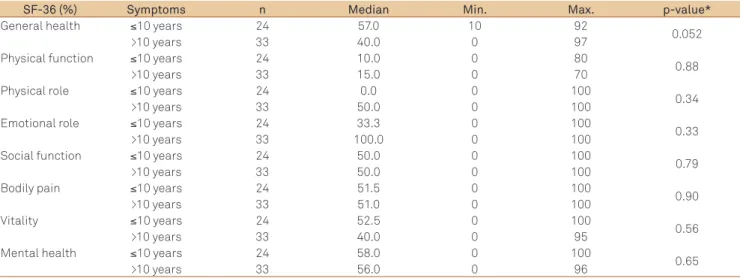
Patients with more than 10 years of symptoms showed lower general health domain score than the subgroup with duration of symptoms ≤10 years. he relationship between duration of symptoms and SF-36 can be seen in Table 4.
DISCUSSION
he aim of this study was to evaluate the association of HAM/TSP to the quality of life of the patients with it. he sam-ple had low scores in two components: physical and mental, showing that patients with HAM/TSP reported changes in their quality of life in both physical and emotional aspects.
Most patients were female, had a mean age of 52.4 years and manifested symptoms of the disease for more than ten years, which is consistent with epidemiological data already described in the literature5.
he most common complaint was change in gait pat-terns, followed by pain. Franzoi and colleagues12 identiied
that gait disorders was the most common complaint in a sample of 60 patients with HAM/TSP, followed by com-plaints related to a lack of bladder control, which in our sample was the third biggest complaint. Most patients re-ported low back pain, which is consistent with previous studies that demonstrated the relevance of this symptom in patients with HAM/TSP13.
As locomotion disorders were common complaints, strat-egies to improve patients’ gait or prescription of walking aid should be the aims in rehabilitation programs for these indi-viduals. Future studies should be done in order to investigate the usefulness of preventive physical therapy or regular exer-cises aiming to postpone the use of a wheelchair.
Patients who reported low back pain and/or pain in the lower limbs had lower scores in the domains of general health, pain, vitality and mental health. he questionnaire revealed that pain afects both the physical and mental as-pects of the quality of life. his symptom is often found in the
initial stages of the disease and is associated with worsening of functionality14 and quality of life.
Boureau and colleagues15 found that the pain in these
patients had neuropathic and nocioceptive characteristics, which demonstrates that the persistence and intensity of this symptom can interfere in their daily routine. he vitality do-main contains items that assess the level of fatigue and ener-gy. he lowest score of vitality in patients who reported pain is consistent with the work of Miller and colleagues16, who
demonstrated that fatigue is a common symptom in neuro-logical patients and that pain increases the feeling of fatigue. herefore, there is a need to study better ways to control and relieve patient’s pain by administering pharmacological and non-pharmacological therapy.
Patients who reported practicing regular physical exercis-es had higher scorexercis-es in the domains of general health, pain, vitality, mental health and also in social functioning. his sug-gests that the regular practice of any physical activity can be efective in the perception of quality of life of these patients. Literature has shown the beneits of exercise to improve the quality of life in individuals with chronic neurological condi-tions and other diseases17. Because patients with HAM/TSP
frequently show secondary muscle impairment and postur-al problems due to inadequate biomechanicpostur-al gait patterns, exercise can minimize these musculoskeletal abnormalities, leading to a better overall well-being. In addition, patients conined to a wheelchair could prevent many side-efects of such inactivity.
Urinary symptoms are found in the early stages of the dis-ease18 and are considered important factors that worsen the
quality of life of patients with HAM/TSP. Patients with bet-ter bladder control had higher scores in the domain of func-tional capacity. his item assesses the presence and extent of limitations related to physical capacity. his is in accordance with a previous paper6 which assessed the functional
pro-ile of patients with HAM/TSP using the FIM – Functional Independence Measure. his study demonstrated that
SF-36 (%) Symptoms n Median Min. Max. p-value*
General health ≤10 years 24 57.0 10 92
0.052
>10 years 33 40.0 0 97
Physical function ≤10 years 24 10.0 0 80
0.88
>10 years 33 15.0 0 70
Physical role ≤10 years 24 0.0 0 100
0.34
>10 years 33 50.0 0 100
Emotional role ≤10 years 24 33.3 0 100
0.33
>10 years 33 100.0 0 100
Social function ≤10 years 24 50.0 0 100
0.79
>10 years 33 50.0 0 100
Bodily pain ≤10 years 24 51.5 0 100
0.90
>10 years 33 51.0 0 100
Vitality ≤10 years 24 52.5 0 100
0.56
>10 years 33 40.0 0 95
Mental health ≤10 years 24 58.0 0 100
0.65
>10 years 33 56.0 0 96
Table 4. Duration of the symptoms and SF-36.
1. Gessain A, Barin F, Vernant JC, et al. Antibodies to human T-lymphotropic virus type-I in patients with tropical spastic paraparesis. Lancet 1985;2:407-410.
2. Vrielink H, Zaaijer HL, Reesink HW. The clinical relevance of HTLV type I and II in transfusion medicine. Transfus Med Rev 1997;11:173-179.
3. World Health Organization. Report of the scientific group on HTLV-I infection and associated diseases. WHO Wkly Epidemiol Rec 1989;49:382-383.
4. Osame M, Usuku K, Izumo S, et al. HTLV-I associated myelopathy, a new clinical entity. Lancet 1986;1:1031-1032.
5. Milagres AC, Jorge ML, Marchiori PE, Segurado AA. Human T cell lymphotropic virus tipe 1-associated myelopathy in São Paulo, Brazil. Epidemiologic and clinical features of an university hospital cohort. Neuroepidemiology 2002;21:153-158.
6. Franzoi AC, Araujo AQ. Disability profile of patients with HTLV-I associated myelopathy/tropical spastic paraparesis using The Functional Independence Measure (FIM). Spinal Cord 2005;43:236-240.
7. The WHOQOL Group. The World Health Organization quality of life assessment (WHOQOL): position paper from the World Health Organization. Soc Sci Med 1995;41:1403-1409.
8. Register ME, Herman J. Quality of life revisited: the concept of connectedness in older adults. ANS Adv Nurs Sci 2010;33:53-63.
9. Ciconelli RM, Ferraz MB, Santos W, Meinão I, Quaresma MR. Tradução para a língua portuguesa e validação do questionário genérico de avaliação de qualidade de vida SF-36 (Brasil SF-36). Rev Bras Reumatol 1999;39:143-150.
10. Hill MR, Noonan VK, Sakakibara BM, Miller WC (SCIRE Research Team). Quality of life instruments and definitions in individuals with spinal cord injury: a systematic review. Spinal Cord 2010;48:438-450.
11. Osame M. Review of WHO Kagoshima meeting and diagnostic guidelines for HAM/TSP. In: Blattner W (Ed). Human Retrovirology: HTLV. 1st ed. Raven Press: New York 1990:191-197.
12. Franzoi AC, Araújo AQC. Disability and determinants of gait performance in tropical spastic paraparesis/HTLV-I associated myelopath (HAM/TSP). Spinal Cord 2007;45:64-68.
13. Ferreira AS, Costa VV, Saraiva RA. The incidence of neuropathic pain in patients with myelopathy associated with HTLV-1. Braz J Infect Dis 2008;12(Suppl 1):S14.
14. Tavares IR, Franzoi AC, Araújo AQC. Low-back pain in HTLV-I-associated myelopathy/tropical spastic paraparesis: nociceptive or neuropathic? Spinal Cord 2010;48:134-137.
15. Boureau F, Doubrère JF, Luu M. Study of verbal description in neuro-pathic pain. Pain 1990;42:145-152.
16. Miller RG. Role of fatigue in limiting physical activities in humans with neuromuscular diseases. Am J Phys Med Rehabil 2002;81(Suppl):S99-S107.
17. Drory VE, Goltsman E, Reznik JG, Mosek A, Korczyn AD. The value of muscle exercise in patients with amyotrophic lateral sclerosis. J Neurol Sci 2001;191:133-137.
18. Diniz MS, Feldner PC, Castro RA, Sartori MG, Girão MJ. Impact of HTLV-I in quality of life and urogynecologic parameters of women with urinary incontinence. Eur J Obstet Gynecol Reprod Biol 2009;147:230-233.
19. Tate DG, Kalpakjian CZ, Forchheimer MB. Quality of life issues in individuals with spinal cord injury. Arch Phys Med Rehabil 2002;83(Suppl 2):S18-S25.
20. Ku JH. Health-related quality of life in patient with spinal cord injury: review of the short form 36 Health Questionnaire Survey. Yonsei Med J 2007;48:360-370.
References
the most afected functional area was the handling of the bladder.
It was observed that patients with longer duration of symptoms had a lower score in the general health domain. his domain assesses how a person feels about their overall health. Since HAM/TSP is a chronic progressive disease, pa-tients could feel less healthy when self-evaluating their own health over the years.
he duration of symptoms and the quality of life is the subject of great controversy in literature. Some authors found an inverse correlation19,20, conirming a higher score on the
quality of life in chronic spinal cord patients, believing that this was due to resignation or acceptance of their condition.
It was observed in the SF-36 questionnaire that patients who performed physical activities presented higher scores in ive out of eight domains. Nevertheless, type, frequency or intensity of physical activities that improved these patients’ well-being were not asked. Future studies should be done to investigate these aspects and check which are the best advices and exercise pre-scriptions for patients with HAM/TSP and what are the best therapeutic tools for reducing the pain of these subjects.
As a note of caution, the SF-36, as a generic questionnaire, is an instrument that does not assess speciic issues related
to patients with HAM/TSP and has its limitations on the questions asked to patients who are conined to a wheelchair. However, it is widely used, validated and useful for compari-sons with other chronic and disabling diseases.
In conclusion, we found that patients with HAM/TSP showed low scores in all domains in the quality of life ques-tionnaire SF-36. here was no statistically signiicant difer-ence in terms of age, gender and SF-36. Patients with bladder control had higher scores in the domain of functional capac-ity and patients with longer duration of symptoms had a low-er score in the genlow-eral health domain.
Patients who reported practicing regular physical exercis-es had higher scorexercis-es in the domains of general health, pain, vitality, mental health and also in social functioning, showing that physical exercises can be related to a better quality of life of these individuals.