VIEWS AND REVIEWS
Lexical-semantic processing in the semantic
priming paradigm in aphasic patients
Processamento léxico-semântico no paradigma de priming semântico em pacientes afásicos
Jerusa Fumagalli de Salles1, Candice Steffen Holderbaum2, Maria Alice Mattos Pimenta Parente3, Letícia
Lessa Mansur4, Ana Inès Ansaldo5
APHASIA AND APHASIA TYPES
Aphasia is deined as the loss of or deiciency in expres-sive and/or receptive language, and is generally caused by a left hemisphere lesion, such as a stroke. Aphasias are a fre-quent source of neuropsycholinguistic (or cognitive-linguis-tic) impairment, and represent the most disabling of stroke conditions, interfering with communicative, social and work
abilities, as well as (re)integration into society. Most aphasic pa-tients have deicits in more than one cognitive process1. here
are various approaches classifying aphasias. Combining ana-tomical and linguistic classiications, the classic division pro-poses two large groups: (1) the anterior Broca’s aphasias (or “non-luent”), and (2) the posterior Wernicke’s aphasias (or “lu-ent”). Considering the anatomical location of the brain dam-age, they may also be called pre-rolandic and post-rolandic2.
1Professor of the Department of Developmental and Personality Psychology, Graduate Studies Program in Psychology, Institute of Psychology, Universidade Federal do Rio Grande do Sul (UFRGS), Porto Alegre RS, Brazil;
2Doctorate student of the Graduate Studies Program in Psychology, Institute of Psychology, UFRGS, Porto Alegre RS, Brazil;
3Prof. Dr. of Department of Developmental and Personality Psychology, Institute of Psychology, Graduate Studies Program in Psychology, UFRGS, Porto Alegre RS, Brazil;
4Professor associated of Speech Therapy Course of the Department of Physical Therapy, Speech Therapy and Occupational Therapy of the School of Medicine at the Universidade de São Paulo (USP), São Paulo SP, Brazil;
5Laboratoire de Plasticité Cérébrale, communication et vieillissement (LPCV), Centre de Recherche de l’Institut Universitaire de Gériatrie de Montréal, University of Montréal, Montreal, Quebec, Canada.
Correspondence: Jerusa Fumagalli de Salles; Avenida Ramiro Barcelos 2600/114; 90035-003 Porto Alegre RS - Brasil; E-mail: [email protected]
Conflict of interest: There is no conlict of interest to declare.
Received 06 February 2012; Received in inal form 23 February 2012; Accepted 05 March 2012
ABSTRACT
There is evidence that the explicit lexical-semantic processing deicits which characterize aphasia may be observed in the absence of implicit semantic impairment. The aim of this article was to critically review the international literature on lexical-semantic processing in aphasia, as tested through the semantic priming paradigm. Speciically, this review focused on aphasia and lexical-semantic processing, the meth-odological strengths and weaknesses of the semantic paradigms used, and recent evidence from neuroimaging studies on lexical-semantic processing. Furthermore, evidence on dissociations between implicit and explicit lexical-semantic processing reported in the literature will be discussed and interpreted by referring to functional neuroimaging evidence from healthy populations. There is evidence that semantic priming effects can be found both in luent and in non-luent aphasias, and that these effects are related to an extensive network which includes the temporal lobe, the pre-frontal cortex, the left frontal gyrus, the left temporal gyrus and the cingulated cortex.
Key words: aphasias, mental processes, language, stroke.
RESUMO
Há evidências de que os déicits de processamento léxico-semântico explícitos que caracterizam a afasia podem ser observados na au-sência de déicits semânticos implícitos. O objetivo deste artigo foi analisar criticamente a literatura internacional sobre processamento léxico-semântico na afasia, avaliado por meio do paradigma de priming semântico. Especiicamente, esta revisão teve seu foco na afasia e processamento léxico-semântico, pontos fortes e fracos da metodologia dos paradigmas léxico-semânticos usados, e evidências recentes de estudos de neuroimagem sobre o processamento semântico. Além disso, evidências de dissociações entre processamento léxico--semântico implícito e explícito relatadas na literatura serão discutidas e interpretadas, relacionando-se aos dados de neuroimagem funcio-nal de amostras saudáveis. Há indícios de que os efeitos de priming semântico podem ser encontrados tanto em afasias luentes como em não luentes, e que esses efeitos são relacionados a uma extensa rede que inclui o lobo temporal, o córtex pré-frontal, o giro frontal esquerdo, o giro temporal esquerdo e o córtex cingulado.
Recently, Ardila3 proposed a new aphasia classiication,
em-phasing that there are two fundamental forms of aphasia: one characterized by impairments in lexical/semantic systems of language (Wernicke-type aphasia) and the other characterized by impairments in grammatical systems of language (Broca-type aphasia). hese are called primary language disturbances or central aphasias. In addition, the author demonstrated that lexical/semantic and grammatical systems depend on difer-ent types of memory and learning (declarative and procedural). Broca’s aphasia is characterized by impaired spontane-ous speech, repetition of sentences, reduced phrase length, prosody, deicient articulatory programming, fewer words spoken per minute, production of agrammatical sentences and word-inding deicits (anomia), as well as a greater dif-iculty in naming verbs than nouns. hese diiculties can-not be explained by a single underlying deicit1. Additionally,
phoneme-grapheme association deicits can afect read-ing and writread-ing. hese features are observed in the context of relatively well-preserved language comprehension abili-ties. People with Broca’s aphasias, despite having more pro-nounced language-expression deicits, also exhibit diicul-ties with sentence comprehension, which have been related to lexical-semantic processing deicits4.
Wernicke’s aphasia is characterized by luent senseless production (jargon) with no articulatory efort, as well as impaired word, sentence and discourse comprehension. In contrast with Broca’s aphasia, people with Wernicke’s apha-sia are generally not aware of their language impairment (anosognosia). Written language presents a similar proile to that of oral language, both at the receptive and production levels. Wernicke’s aphasia is considered to be a result of dei-cient lexical control, which prevents a person from selecting the appropriate word, sound or meaning within a compet-ing context of concurrent activation1. In Wernicke’s aphasias,
comprehension impairments relect more the inability to ac-cess, use or manipulate semantic information than a loss of the semantic representations of the words5.
A distinctive feature of aphasia is anomia — a word-inding impairment which is the most frequent clinical sign across all aphasia types —. Two types of anomia have been described: (a) phonological anomia and (b) semantic anomia. Phonological anomia results from impaired access to the tar-get’s phonological information, and intact access to the cor-responding semantic representations. It may give raise to phonological or semantic paraphasia; patients with phono-logical anomia are aware of the fact that the errors they pro-duce are semantically or phonologically related to the target1.
Regarding semantic anomia, it is characterized by impaired semantic processing resulting in semantic errors (e.g.: dog-cat) at the comprehension and production levels and pre-served repetition abilities1. Semantic errors can be the
ex-pression from many types of semantic processing problem: modality and category-speciic impairments or input and
output semantic impairments6. he possibility of using
se-mantic knowledge will depend on the type and level of im-pairment. Both luent and non-luent aphasias present a cer-tain degree of impaired explicit lexical-semantic processing, as measured by speciic tasks; conversely, they may show pre-served implicit semantic abilities, as evidenced by indirect assessment tasks, such as the semantic priming paradigm.
he purpose of this paper was to critically review the lit-erature on implicit lexical-semantic processing, in particular by referencing the results obtained with the semantic priming paradigm. Focus will be placed on luent and non-luent apha-sias. Methodological issues regarding the semantic priming paradigm will be discussed and examined across aphasia sub-types, in particular by referencing the dissociations between explicit and implicit lexical-semantic processing (semantic priming efect) observed in these populations. Furthermore, the neural correlates of implicit semantic processing as as-sessed by semantic priming paradigms will be discussed.
LEXICAL-SEMANTIC PROCESSING
Lexical-semantic processing encompasses access to the lexicon and to the semantic system. Lexical processing in-cludes a set of processes through which the listener or reader recognizes word forms (orthographic and phonological), per-ceives and understands their meaning, and accesses other tar-get properties stored in his mental dictionary or mental lexi-con7. he mental lexicon stores word-related knowledge as
word sound, spelling and grammatical properties (word class, gender), as well as morphological structure and meaning8.
According to cascade models, word recognition (compre-hension) involves not only simultaneous bottom-up sensorial information from the target word but also top-down contextual information represented by the listener/reader’s expectations, context, memory and attention. hus, lexical knowledge com-prises the representational domains of word form and mean-ing8. In parallel, distributed processing or connectionist models,
target-related information, whether phonological or semantic, is represented in terms of distributed patterns of activity in dis-tinct groups of processing units, similar to neurons9,10.
The semantic and lexical systems are functionally inde-pendent11,12 — each word has a phonological/orthographic
representation and a semantic one13 — as evidenced by
he importance of word meaning in the processing of words is undeniable8. Semantic representations comprise a
number of semantic features (visual, sensory and functional, among others) that deine the meaning of a word11. According
to McClelland and Rogers14, semantics involves spreading
activation between simple processing units (nodes), similar to neurons, and their connections. Experience models the strength or weight of these connections and determines the degree of representation (strong versus weak) of a particular
lexical item. his is one of the most commonly used theories to explain the results of the semantic priming efect(SPE)15.
THE SEMANTIC PRIMING PARADIGM
Priming efects concern implicit, unconscious memory abilities of past experiences, which have an indirect inluence on future behavior16. he assessment of such efects is done
by means of indirect tests, that is, those which involve mo-tor or cognitive activities related to a learning event, but in which the instructions do not directly refer to that. Implicit memory is generally disregarded in most neuropsychological assessment batteries17,18 and has proven to be an
interven-tion resource in people with explicit memory19 and
commu-nication deicits20.
Semantic priming paradigms speciically examine priming efects on lexical stimuli, particularly by examining the role of semantic context in word recognition (top-down processing). In semantic priming paradigms, the target presentation is pre-ceded by a prime — a word that can provide a semantic con-text and for which no response is required —. Primes can be words or non-words. In lexical decision tasks, the presentation of the prime is followed by a target, a string of letters which may or may not correspond to a word. Participants are asked to decide whether the stimulus is a real word or not, either by providing an oral or a motor response.
he priming efect corresponds to the diference in speed or accuracy between responses to target words preceded by related primes and those preceded by unrelated or neutral primes (e.g. non-linguistic stimuli). In studies that add a neu-tral prime context and use it as baseline, the resulting difer-ence is called facilitation (when reaction time to the related condition is shorter) or inhibition (when reaction time to the related condition is longer)15.
Several theories have been proposed to explain the se-mantic priming efects found so far. According to Neely15,
none of these theories provides an explanation for all the ex-isting data and probably no new theory would be able to do so ( for more details see McNamara21). Among these theories,
some consider semantic priming to be an automatic process (i.e. “spreading activation” theories) and others consider it to be a result of expectancy (i.e. “expectancy-induced” theories). his is one the most commonly used theories to explain the results of the semantic priming efect (SPE).
In a given experiment, the main factor used to modulate automatic versus controlled priming is the stimulus onset
asynchrony (SOA). SOA represents the interval between the onset of the prime presentation and the beginning of the tar-get. It is considered that short SOAs (smaller than 300 ms) is mainly due to automatic processes, whereas a long SOAs (longer than 300 ms) will cause semantic priming efects trig-ger specially by controlled processes. Although until recently SPE was considered to be driven by automatic processes with SOAs smaller than 300 ms, in the last few years evidence has suggested that it should preferably be less than 150 ms to rely on the automatic process22. Still, there is evidence that, even
with a short SOA, a certain degree of controlled processing may be involved15. hus, spreading activation and strategic
processes are not totally independent; rather, the contribu-tion of the former mechanism is greater for short SOAs.
NEURAL CORRELATES OF LEXICAL-SEMANTIC PROCESSING AND THE SEMANTIC PRIMING EFFECTS
From a neurofunctional perspective, it is widely accept-ed that the neural basis of semantic knowlaccept-edge is extensive-ly distributed in the brain; the evidence comes from neuro-imaging studies with healthy participants23-25 and also from
studies with brain-damaged patients with semantic dei-cits14. In a fMRI study, Hauk, Davis, Kherif and Pulvermüller23
examined the brain activation patterns of words with difer-ent semantic associations during a sildifer-ent reading paradigm in a group of healthy subjects. hey concluded23 that
action-related words signiicantly activate action-processing brain areas, as the left-middle temporal gyrus, whereas words al-lowing for visual imagery signiicantly activate visual-pro-cessing areas, speciically the left fusiform gyrus.
he processing of words (lexical-semantic processing) is primarily dependent upon the left temporal neocortex26,
whereas the right hemisphere complements and enriches the left hemisphere’ work5. his perspective5 is in line with
previous evidence provided by Mummery et al.27 who
report-ed that the left anterior temporal lobe and the anterior cin-gulate activations observed in their PET study co-varied with the proportion of related pairs in the experiment.
In another fMRI study, in a semantic priming paradigm, O’Hare, Dien, Watersona and Savageb24 employed a visual
lexical decision task with an SOA of 500 ms with a group of 17 participants. he authors found a signiicant activation in the right posterior cingulated, with related prime pairs as com-pared to unrelated prime pairs. his data replicated a previ-ous event-related potentials (ERP) study28 which observed a
word N300 in a word similar experiment.
Wible et al.29, using a long SOA (750 ms) and an oral
divided by the number of associates — reported reduced cor-tical activation for related word pairs of high connectivity, fol-lowed by related word pairs of low connectivity. Besides, the signiicant and bilateral activations observed in the posterior, superior and middle temporal regions declined as the seman-tic priming of the word pairs increased. his may express com-plexity issues once fMRI studies on lexical learning show that more activation is associated to efortful processing, as opposed to more automatic processing, which results in less activation30.
Regarding automatic semantic priming efects (SOA of 200 ms), Sachs et al.25 examined 16 healthy males with a
vi-sual semantic priming task, including taxonomic (i.e. classi-ication) and thematic (context) relations. Signiicant signal changes associated to the taxonomic priming efect were observed in the right precuneus, the postcentral gyrus and the middle frontal and superior frontal gyri; thematic prim-ing efects resulted in signiicant activations in the right-middle frontal gyrus and the anterior cingulate. Also exam-ining automatic semantic priming efects, Liu, Hub, Peng, Yang and Li31 tested a 50 ms SOA in a visual lexical
deci-sion task. hey compared conceptual and afective priming, and found involvement of the left-middle/superior tem-poral gyrus, frontal gyrus and right superior temtem-poral gy-rus involved in both types of priming. However, some areas were conceptual speciic, such as left inferior frontal gyrus and right superior temporal gyrus. hese results31,25
demon-strate that, despite comparable behavioral efects (between taxonomic and thematic relations, and between conceptual and afective priming), there are both neural dissociation and shared neural bases working on these processes32.
Examined the patterns of neural activation during a se-mantic judgment task and a lexical decision task within a semantic priming paradigm, the former required explicit se-mantic analysis, whereas the latter required implicit seman-tic processing. Although both tasks signiicantly activated the left inferior frontal gyrus, activation maps were larger and included the superior temporal gyrus only with the seman-tic activation task. he authors argued that the greater acti-vation observed in the semantic judgment task relected the deeper semantic processing of semantic judgment, as com-pared to lexical decisions. hus, this study showed that the recruitment of the left frontal areas, as well as the posterior areas, during lexical semantic tasks is modulated by the type of semantic processing induced by the task.
In Sass et al.33 study, they assessed the semantic
prim-ing efect durprim-ing an event-related fMRI lexical decision task (visual and auditory) with related and unrelated primes in a group of healthy adults. he prime duration was approx-imately 355 ms. he authors showed signiicant left frontal and temporal parietal activations. Moreover, an increase in the BOLD response was observed in all the main clusters of activation with the related prime condition, as compared to those with the non-related condition. hese data suggest
once again that part of the semantic priming efect involves retrieval of semantic and/or episodic information33.
Henson34 reviewed the PET and fMRI studies of priming
in humans within speciic paradigms (as word-stem comple-tion and visual object priming). Referring speciically to se-mantic priming studies, he summarizes that imaging studies are starting to use priming as a tool to investigate language systems, at least at the level of lexical-semantics. he seman-tic priming efect has been related to inferior and superior temporal lobe processing35, to the left pre-frontal cortex36,37
and to the left inferior frontal gyrus and the left medial and left inferior temporal gyri38. Determining the neurological
ba-sis of semantic priming is diicult, mainly because it arises from complex processes39.
In summary, there is evidence that semantic priming ef-fects are related to an extensive network which includes the temporal lobe, the pre-frontal cortex, the left frontal gyrus, the left temporal gyrus and the cingulated cortex. he neuro-imaging evidence on the semantic priming efect is not con-vergent regarding the activation pattern. hus, some authors reported reduced activations under the related condition29,40,
whereas other authors report the opposite pattern24,33,41,42.
Also, the literature reports increased cortical activity (“re-sponse enhancement”) at the same related condition, as well as the opposite pattern. Still, the most common inding in functional imaging studies on semantic priming efects is a reduced response for primed versus unprimed stimuli, called
“repetition suppression”34.
STUDIES CONCERNING SEMANTIC PRIMING IN APHASIC PATIENTS
he literature on semantic priming efects in aphasic pa-tients is controversial. Researchers do not agree on whether priming efects can be preserved in patients with language comprehension deicits (such as in Wernicke’s aphasia) or whether they are impaired in cases of a relative preservation of language comprehension, as in Broca’s or non-luent apha-sias43-45. here are studies which show that patients with both
comprehensive ( luent) and expressive (non-luent) lan-guage deicits are able to use the semantic knowledge in im-plicit (indirect) tasks, even if they are not able to use it in an explicit way44,46 such as naming tasks. Nevertheless, Baum47
shows that, despite non-luent aphasic patients present pat-terns similar to the controls in terms of semantic priming, only 50% of them (the ones with less serious deicits in se-mantic processing) showed the sese-mantic priming efect. On the other hand, they were found semantic priming efects only in luent aphasics44,45.
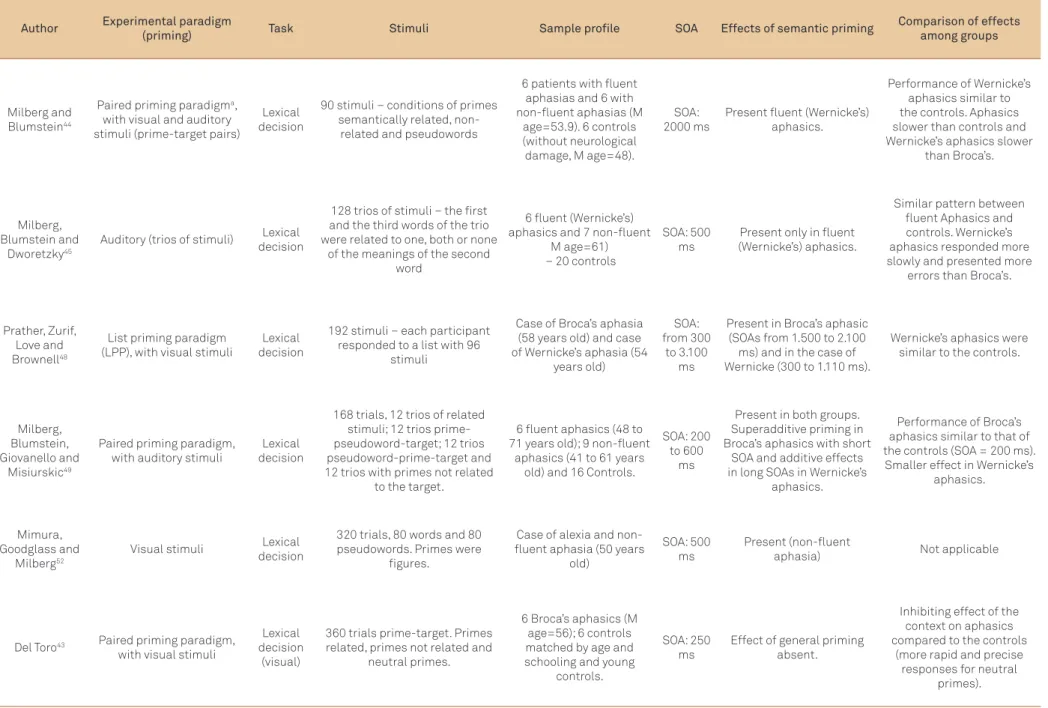
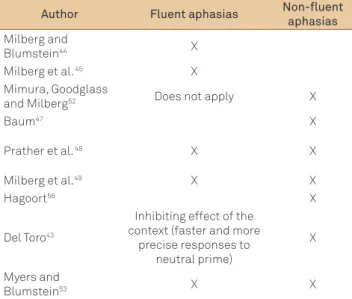
participant selection issues and other experimental vari-ables48. Tables 1 and 2 summarize the indings of some of the
studies presented in this section.
Milberg and Blumstein44 studying two clinical groups —
luent and non-luent aphasias — compared to a control group, found the performance of Wernicke’s aphasics simi-lar to controls, but found no priming efect in Broca’s apha-sics. Milberg, Blumstein and Dworetzky45 concluded that
Wernicke’s aphasics are more capable of dealing with lexical-semantic processing than may be expected given their ability to make semantic judgment, to understand names of objects and to understand language in general. In contrast, Broca’s aphasics did not demonstrate semantic facilitation in any priming situation, suggesting that their deicits are related to automatic access to lexical representations of words45. It
is noteworthy that Milberg and Blumstein44 used an SOA of
2000 ms and that Milberg et al.45 tested with an SOA of 500
ms. Nowadays, it is known that these SOAs can activate con-trolled processes as well21. Additionally, each of the clinical
samples in these studies was small (n=6) and heterogeneous. Later, using an actually short SOA (250 ms), Del Toro43
didn’t ind semantic priming efect. He examined a group of participants with Broca’s aphasia and assessed lexical deci-sion abilities with a semantic priming paradigm. he author43
reported faster (lower RT) and more accurate responses for the neutral prime condition (baseline) as compared to the other two conditions in that the primes were words related or unrelated to target, which indicates that context has an inhibiting efect. he global semantic priming efect was ab-sent, as shown by the lack of diference between response times for unrelated and related word pairs. hese results lead the author to conclude that participants with Broca’s aphasia have impaired automatic lexical access43. It is, however,
im-portant to stress that this study used a small group of partici-pants, and thus the lack of semantic priming efect may have resulted from poor statistical power.
On the other hand, the results of the study by Milberg et al.49 showed that participants with Broca’s aphasia are, in
part, similar to the controls and diferent from those with Wernicke’s aphasia in terms of semantic priming. hey used experiments with an inter-stimulus-interval (ISI) of 200 and 600 ms (automatic and controlled processes, respectively). he authors argued that in Broca’s aphasia the pattern for short SOAs may relect a reduction in the lexibility and the speed of access to lexical information, which may contrib-ute to diiculty in producing luent speech. In contrast, the pattern found in Wernicke’s aphasia suggests a lesser ability to use context to interpret words. Prather, Zurif, Stern and Rosen50 andGrindrod and Baum51 agree that there is slower
access to lexical information in non-luent (Broca’s) aphasias. In a case study with list priming paradigm (LPP), Prather et al.50 used an ISI ranging from 500 to 1800 ms. he
non-lu-ent aphasic patinon-lu-ent showed a semantic priming efect only
at a delay of 1.500 ms, which is consistent with the theory of controlled process efects. Grindrod and Baum51 evaluated
left-hemisphere-damaged (LHD) non-luent aphasic, right-hemisphere-damaged (RHD) and non-brain-damaged (NBD) control subjects with a cross-modal semantic priming task. he aim of this study was to investigate the ability to use a discourse context to resolve lexically ambiguous words.
Furthermore, in studying non-luent aphasias, Mimura, Goodglass and Milberg52 assessed a patient with alexia who
exhibited serious deicits in the semantic combination of words and igures in an SOA of 500 ms with visual stimuli. In spite of that, the patient showed the semantic priming efect, responding more quickly and accurately to words preceded by primes semantically related. he study suggests that, even in severe cases of alexia, implicit access to semantic informa-tion may be preserved. Both designed single-case studies50,52.
In order to investigate reasons for comprehension dei-cits in Broca’s aphasic subjects, Myers and Blumstein53
de-signed three experiments. Only the irst study evaluated se-mantic priming efects, comparing the aphasics with normal subjects. Auditory stimuli were presented with an ISI of 250 ms. Results once again showed a similar pattern of seman-tic priming efect between groups with both reacting faster for the semantic related condition than for the unrelated one. he same results were found in Utman, Blumstein and Sullivan54 study. hey used a lexical decision task with
audito-ry stimuli and ISIs of 50 ms and 250 ms. Broca’s aphasics and normal subjects showed semantic priming efect with both ISIs. In another study, using visual stimuli and SOAs ranging from 300 to 3100 ms, Prather, Zurif, Love and Brownell48
as-sessed a patient with Broca’s aphasia who showed the prim-ing efect with an SOA of 1500 ms — he was capable of ac-cessing the lexical information as long as he had time for such processing. his result is the same as in the previous study50.
On the other hand, the participant with Wernicke’s aphasia exhibited priming efect with all SOAs ( from 300 to 1100 ms), relecting deicits in the ability to inhibit lexical activation.
Howard, Hickin, Redmond, Clark and Best55 divided the
group of aphasics according to the extent of their semantic deicits. he task used was the word-igure combination and later naming of the target. he efect of semantic (contextual) facilitation was broader and longer-lasting for cases with fewer semantic deicits. Aphasics with semantic deicits showed sig-niicant facilitation only with a short stimulus onset asynchro-ny, while cases with less severe semantic deicits showed fa-cilitation for both long and short stimulus onset asynchronies. Hagoort56 found that patients with Broca’s aphasia
723
Jer
usa F
umagalli de Sall
es e
t al
. Aphasic pa
tients:
semantic par
adigm
Table 1. Summary of some experimental results of priming obtained in studies with Broca’s and Wernicke’s aphasic patients.
Author Experimental paradigm
(priming) Task Stimuli Sample profile SOA Effects of semantic priming
Comparison of effects among groups
Milberg and Blumstein44
Paired priming paradigma,
with visual and auditory stimuli (prime-target pairs)
Lexical decision
90 stimuli – conditions of primes semantically related,
non-related and pseudowords
6 patients with luent aphasias and 6 with non-luent aphasias (M
age=53.9). 6 controls (without neurological damage, M age=48).
SOA: 2000 ms
Present luent (Wernicke’s) aphasics.
Performance of Wernicke’s aphasics similar to the controls. Aphasics slower than controls and Wernicke’s aphasics slower
than Broca’s.
Milberg, Blumstein and
Dworetzky45
Auditory (trios of stimuli) Lexical decision
128 trios of stimuli – the irst and the third words of the trio were related to one, both or none
of the meanings of the second word
6 luent (Wernicke’s) aphasics and 7 non-luent
M age=61) – 20 controls
SOA: 500 ms
Present only in luent (Wernicke’s) aphasics.
Similar pattern between luent Aphasics and controls. Wernicke’s aphasics responded more slowly and presented more
errors than Broca’s.
Prather, Zurif, Love and Brownell48
List priming paradigm (LPP), with visual stimuli
Lexical decision
192 stimuli – each participant responded to a list with 96
stimuli
Case of Broca’s aphasia (58 years old) and case of Wernicke’s aphasia (54
years old)
SOA: from 300
to 3.100 ms
Present in Broca’s aphasic (SOAs from 1.500 to 2.100
ms) and in the case of Wernicke (300 to 1.110 ms).
Wernicke’s aphasics were similar to the controls.
Milberg, Blumstein, Giovanello and
Misiurskic49
Paired priming paradigm, with auditory stimuli
Lexical decision
168 trials, 12 trios of related stimuli; 12 trios prime-pseudoword-target; 12 trios pseudoword-prime-target and 12 trios with primes not related
to the target.
6 luent aphasics (48 to 71 years old); 9 non-luent
aphasics (41 to 61 years old) and 16 Controls.
SOA: 200 to 600
ms
Present in both groups. Superadditive priming in Broca’s aphasics with short
SOA and additive effects in long SOAs in Wernicke’s
aphasics.
Performance of Broca’s aphasics similar to that of the controls (SOA = 200 ms).
Smaller effect in Wernicke’s aphasics.
Mimura, Goodglass and
Milberg52
Visual stimuli Lexical decision
320 trials, 80 words and 80 pseudowords. Primes were
igures.
Case of alexia and non-luent aphasia (50 years
old)
SOA: 500 ms
Present (non-luent
aphasia) Not applicable
Del Toro43 Paired priming paradigm,
with visual stimuli
Lexical decision
(visual)
360 trials prime-target. Primes related, primes not related and
neutral primes.
6 Broca’s aphasics (M age=56); 6 controls matched by age and schooling and young
controls.
SOA: 250 ms
Effect of general priming absent.
Inhibiting effect of the context on aphasics compared to the controls
(more rapid and precise responses for neutral
primes).
characterized by deicits in the post-lexical integration pro-cesses of the meaning of words. he author56 highlighted
an-other point that challenges the automatic access hypothesis in Broca’s aphasia, and argued that this point of view implic-itly conveys the idea that studies on the semantic priming of words extract only or predominantly automatic process-ing of the lexical information, includprocess-ing the meanprocess-ing of the word. In fact, the author56 argued that semantic priming
ef-fects may result from both automatic processing and a con-trolled mechanism, and thus the integrity of lexical-semantic representations is not guaranteed by the mere presence of automatic semantic priming efects8.
To summarize, aphasia is characterized by dissociation between linguistic knowledge representation and the access to such representations49. his dissociation is the source of a
variety of communication deicits. herefore, those who have aphasias with predominant comprehension-based deicits are more likely to demonstrate low performance in tasks re-quiring explicit semantic, syntactic or phonological process-ing. However, they generally exhibit better performance in semantic implicit tasks (like those in the semantic priming paradigm). In contrast, predominantly expressive aphasias are characterized by preserved explicit semantic judgment49,
but the literature is not convergent about the implicit seman-tic processing and, thus, further studies are necessary.
FINAL REMARKS
Some of the reviewed studies showed evidence of the semantic priming efects presence in both luent and non-luent aphasias. Still, the evidence is not convergent, and thus more studies are necessary. A series of factors could be interfering in this diversity of indings, for example: the
experimental paradigm of priming (paired priming para-digm or LPP), the stimulus selection criteria and presenta-tion modality (visual or auditory), the type of stimulus (words or igures), the number of trial in the experiment, the base line or control condition in the experiment (presence of neu-tral primes), the sample selection criteria, the sample hetero-geneity and small clinical groups, the presence of a control group, the SOA or ISI used in the priming experiment (con-trolled or automatic semantic processes), etc.
he type of priming paradigm may explain performance diferences in behavioral studies48 and in neuroimaging
studies23,24,29,40-42. Regarding studies on clinical populations,
the challenge is even bigger, given the variability across pa-tients and the numerous factors that may prevent rigorous methodological control and lead to inconsistent indings, in-cluding age44, lesion type, location and extension. It should
be noted that many studies of semantic priming efects in Broca’s aphasia have been carried out with auditory stimu-li. Also, caution is necessary when interpreting single-case data; the generalization of such indings to one aphasia type should be avoided.
From a clinical aphasiology perspective, it could be noted that, given the complexity of the language-communication function, a global cognitive picture of the aphasic person should be considered57. hus, assessment with a semantic
priming paradigm may contribute to establish a more com-plete proile of the patient’s neuropsychological status and
provide relevant information to guide therapy choices in terms of priming efects facilitation in diferent therapy con-texts, which in turn may contribute to improve language, communication abilities20. his information may be used to
develop intervention programs and strategies, serving as ba-sis for minimizing deicits. Also, considering the impact of short versus long SOAs on priming efects may provide cues
regarding the processing time required to attain optimal per-formance in each speciic aphasia case.
Priming is one of the most basic expressions of human memory, influencing how we perceive and interpret the world34. Therefore, by examining the relative preservation
or impairment of implicit and explicit access to lexical-se-mantic knowledge, it is possible to determine to what ex-tent either of them can be used to assist in effective com-munication of people with aphasia and their proxies. So, on-line studies of semantic priming have been widely used to investigate the nature of the semantic memory deficits in aphasias. This knowledge can be further used to orient therapy on the disturbed and preserved dimensions of se-mantic priming effects basis. We hope this review helps the researcher and clinical professional to plan their as-sessment battery and the rehabilitation procedures. The possible dissociation between direct and indirect mea-sures of lexical-semantic processes is an important data for these planning.
Table 2. Studies that found preservation of semantic priming effects on aphasic patients, according to the type of aphasia (luent and non-luent).
Author Fluent aphasias Non-fluent
aphasias Milberg and
Blumstein44 X
Milberg et al. 45 X
Mimura, Goodglass
and Milberg52 Does not apply X
Baum47 X
Prather et al. 48 X X
Milberg et al.49 X X
Hagoort56 X
Del Toro43
Inhibiting effect of the context (faster and more
precise responses to neutral prime)
X
Myers and
1. Hillis AE. Aphasia: progress in the last quarter of a century. Neurology. 2007;69:200-213.
2. Benson DF, Ardila A. Aphasia: a clinical perspective. New York: Oxford University Press; 1996.
3. Ardila A. A proposed reinterpretation and reclassiication of aphasic syndromes. Aphasiology 2010;24:363-394.
4. Baumgaertner A, Tompkins CA. Testing contrasting accounts of word meaning activation in Broca’s aphasia: experiences from a cross-modal semantic priming study. Aphasiology 2002;16:397-411.
5. Kahlaoui K, Joanette Y. Normal and pathological semantic processing of words. In: Ball M, Perkins M, Müller N, Howard S (eds). The handbook of clinical linguistics. Oxford, UK: Blackwell Publishing; 2008.
6. Raymer AM, Rothi LJG. Cognitive approaches to impairments of word comprehension and production. In: Chapey R (ed). Language intervention strategies in aphasia and related neurogenic communication disorders. 4. ed. Philadelphia: Lippincott Williams & Wilkins; 2001:524-550.
7. Carmona MB, González JMI, Gómez AR. Psicología del lenguage. Investigación y teoría. Madrid: Editorial Trotta; 1992.
8. Hagoort P. The shadows of lexical meaning in patients with semantic impairments. In: Stemmer B, Whitaker HA (Eds). Handbook of neurolinguistics. New York: Academic Press; 1998.
9. Plaut DC, McClelland JL, Seidenberg MS, Patterson K. Understanding normal and impaired word reading: computational principles in quasi-regular domains. Psychol Rev 1996;103:56-115.
10. Seidenberg MS, McClelland JL. A distributed, developmental model of word recognition and naming. Psychol Rev 1989;96:523-568.
11. Hillis AE. The organization of the lexical system. In: Rapp B (Ed). What deicits reveal about the human mind/brain: a handbook of cognitive neuropsychology. Philadelphia: Psychology Press; 2001:185-201.
12. Rapp B, Goldrick M. Speaking words: contribution of cognitive neuropsychological research. Cogn Neuropsychol 2006;23:39-73.
13. Miller G. On knowing a word. Annu Rev Psychol 1999;50:1-19.
14. McClelland JL, Rogers TT. The parallel distributed processing approach to semantic cognition. Nat Rev Neurosci 2003;4:310-322.
15. Neely JH. Semantic priming effects in visual word recognition: a selective review of current indings and theories. In: Besner D, Humphreys GW (eds). Basic processes in reading, visual word recognition. New Jersey: Lawrence Erlbaum Associates; 1991:264-336.
16. Del Vecchio N, Liporace J, Nei M, Sperling M, Tracy J. A dissociation between implicit and explicit verbal memory in left temporal lobe epilepsy. Epilepsia 2004:1124-1133.
17. Strauss E, Sherman EMS, Spreen O. A compendium of neuropsychological tests: administration, norms and commentary. 3rd ed. New York: Oxford University Press; 2006.
18. Fonseca RP, Salles JF, Parente MAMP. Ferramenta útil na pesquisa e clínica de neuropsicologia: um compêndio de testes neuropsicológicos. Rev Interamer Psicol 2007;41:403-406.
19. Bolognani SA, Gouveia PA, Brucki SM, Bueno OF. Memória implícita e sua contribuição à reabilitação de um paciente amnéstico. Arq Neuropsquiatr 2000;58:924-930.
20. Renvall K, Laine M, Martin N. Treatment of anomia with contextual priming: Exploration of a modiied procedure with additional semantic and phonological tasks. Aphasiology 2007;21:499–527.
21. McNamara TP. Semantic priming: perspectives from memory and word recognition. New York, USA: Routledge; 2005.
22. Altarriba J, Basnight-Brown DM. Methodological considerations in performing semantic – and translation – priming experiments across languages. Behav Res Methods 2007;39:1-18.
23. Hauk O, Davis MH, Kherif F, Pulvermüller F. Imagery or meaning? Evidence for a semantic origin of category-speciic brain activity in metabolic imaging. Eur J Neurosci 2008;27:1856-1866.
24. O’Hare AJ, Dien J, Waterson LD, Savageb CR. Activation of the posterior cingulate by semantic priming: a co-registered ERP/fMRI study. Brain Res 2008;1189:97-114.
25. Sachs O, Weis S, Zellagui N, et al. Automatic processing of semantic relations in fMRI: neural activation during semantic priming of taxonomic and thematic categories. Brain Res 2008;1218:194-205.
26. Cappa SF, Perani D. The neural correlates of noun and verb processing. J Neurolinguistics 2003;16:183-189.
27. Mummery C, Shallice T, Price CJ. Dual-process model in semantic priming: a functional imaging perspective. Neuroimage 1999;9:516-525.
28. Franklin MS, Dien J, Neely JH, Waterson LD, Huber L. Semantic priming modulates the N400, N300, and N400RP. Clin Neurophysiol 2007;118:1053-1068.
29. Wible CG, Han SD, Spencer MH, et al. Connectivity among semantic associates: an fMRI study of semantic priming. Brain Lang 2006;97:294-305.
30. Raboyeau G, Marcotte K, Adrover-Roig D, Ansaldo AI. Brain activation and lexical learning: the impact of learning phase and word type. Neuroimage 2010;49:2850-2861.
31. Liu H, Hub Z, Peng D, Yang Y, Li K. Common and segregated neural substrates for automatic conceptual and affective priming as revealed by event-related functional magnetic resonance imaging. Brain Lang 2010;112:121-128.
32. Ruff I, Blumstein SE, Myers EB, Hutchison E. Recruitment of anterior and posterior structures in lexical-semantic processing: an fMRI study comparing implicit and explicit tasks. Brain Lang 2008;105:41-49.
33. Sass K, Krach S, Sachs O, Kircher T. Lion – tiger – stripes: neural correlates of indirect semantic priming across processing modalities. Neuroimage 2009;45:224-236.
34. Henson RNA. Neuroimaging studies of priming. Progr Neurobiol 2003;70:53-81.
35. Verfaellie M, Keane MM. The neural basis of aware and unaware forms of memory. Semin Neurol 1997;17:153-161.
36. Raichle M, Fiez JA, Videen TO. Practice-related changes in human brain functional anatomy during nonmotor learning. Cereb Cortex 1994;4:8-26.
37. Demb J, Desmond J, Wagner A, Vaidya CJ, Glover GH, Gabrieli JD. Semantic encoding and retrieval in the left inferior prefrontal cortex: a functional MRI study of task dificulty and process speciicity. J Neurosci 1995;15:5870-5878.
38. Blaxton T. Cognition: memory, 2: conceptual and perceptual memory. Amer J Psychiatry 1999;156:1676.
39. Kahlaoui K, Ska B, Degroot C, Joanette Y. Neurobiological bases of the semantic processing of words. In: Guendozi J, Loncke F, Williams MJ (Eds). The handbook of psycholinguistic and cognitive processes: perspectives in communication disorders. LEA: Taylor & Francis; 2008.
40. Rissman J, Eliassen JC, Blumstein SE. An event-related FMRI investigation of implicit semantic priming. J Cogn Neurosci 2003;15:1160-1175.
41. Kotz SA, Cappa SF, von Cramon DY, Friederici AD. Modulation of the lexical-semantic network by auditory semantic priming: an event-related functional MRI study. Neuroimage 2002;17:1761-1772.
42. Raposo A, Moss HE, Stamatakis EA, Tyler LK. Repetition suppression and semantic enhancement: an investigation of the neural correlates of priming. Neuropsychologia 2006;44:2284-2295.
43. Del Toro JF. An examination of automatic versus strategic semantic priming effects in Broca’s aphasia. Aphasiology 2000;14:925-947.
44. Milberg W, Blumstein SE. Lexical decision and aphasia: evidence for semantic processing. Brain Lang 1981;14:371-385.
45. Milberg W, Blumstein SE, Dworetzky B. Processing of lexical ambiguities in aphasia. Brain Lang 1987;31:138-150.
46. Bondi MW, Kaszniak AW, Rapcsak SZ, Butters MA. Implicit and explicit memory following communicating anterior artery aneurysm rupture. Brain Cogn 1993;22:213-229.
47. Baum SR. Phonological, semantic, and mediated priming in aphasia. Brain Lang 1997;60:347-359.
48. Prather PA, Zurif E, Love T, Brownell H. Speed of lexical activation in nonluent Broca‘s aphasia and luent Wernicke‘s aphasia. Brain Lang 1997;59:391-411.
49. Milberg W, Blumstein S, Giovanello KS, Misiurski C. Summation priming in aphasia: evidence for alterations in semantic integration and activation. Brain Cogn 2003;51:31-47.
50. Prather P, Zurif E, Stern C, Rosen TJ. Slowed lexical access in nonluent aphasia: a case study. Brain Lang 1992;43:336-348.
51. Grindrod CM, Baum SR. Hemispheric contributions to lexical ambiguity resolution in a discourse context: evidence from individuals with unilateral left and right hemisphere lesions. Brain Cogn 2005;57:70-83.
52. Mimura M, Goodglass H, Milberg W. Preserved semantic priming effect in alexia. Brain Lang 1996;54:434-446.
53. Myers EB, Blumstein SE. Selectional restriction and semantic priming effects in normals and Broca`s aphasics. J Neurolinguistics 2005;18:277-296.
54. Utman JA, Blumstein SE, Sullivan K. Mapping from sound to meaning: reduced lexical activation in Broca’s aphasics. Brain Lang 2001;79:444-472.
55. Howard D, Hickin J, Redmond T, Clark P, Best W. Re-visiting “semantic facilitation” of word retrieval for people with aphasia: facilitation yes but semantic no. Cortex 2006;42:946-962.
56. Hagoort P. Semantic priming in Broca’s Aphasics at a Short SOA: no support for an automatic access deicit. Brain Lang 1997;56:287-300.