ARTICLE
Neurological disorders associated with
glutamic acid decarboxylase antibodies: a
Brazilian series
Distúrbios neurológicos associadas a anticorpos anti-GAD (descarboxilase do ácido
glutâmico): uma série de casos brasileira
Maurício Fernandes1, Renato P. Munhoz2,Paulo Eduardo Mestrinelli Carrilho3, Walter O. Arruda1,
Paulo J. Lorenzoni1, Rosana H. Scola1, Lineu César Werneck1, Hélio A. G. Teive1
Neurological disorders associated with glutamic acid decar-boxylase (GAD) antibodies include stif-person syndrome (SPS) and its variants — stif trunk syndrome, stif limbs syndrome, progressive encephalomyelitis with rigidity, SPS-plus and para-neoplastic SPS — as well as epilepsy and ataxia1-8. hese
syn-dromes are often found in association with other autoimmune disorders, such as diabetes mellitus, in more than one thirds of all cases, and, less commonly, those caused by antithyroid, anti-nuclear and antiparietal cell antibodies (5–10%)1-3,9-13.
GAD is a cytoplasmic enzyme that accelerates the conver-sion of glutamic acid to gamma-aminobutyric acid (GABA), an inhibitory neurotransmitter present in the brain and spi-nal cord. GAD is synthesized mainly in presynaptic GABAergic neurons in the central nervous system and in the b cells in
the islets of Langerhans in the pancreas. GAD autoantibodies are found in around 60 to 80% of SPS cases. Although there are two GAD isoforms ¾ GAD65 and GAD67 ¾ the main target for GAD autoantibodies in SPS is GAD659-14.
he pathogenetic role of autoantibodies in SPS is unclear. However, all SPS autoantigens identiied to date are synaptic proteins involved in inhibitory synaptic transmission, such as GAD and amphiphysin (presynaptic antigens) and GABA(A) receptor-associated protein (GABARAP) and gephyrin (post-synaptic antigens). he autoantibodies anti-amphiphysin and anti-gephyrin have been linked to paraneoplastic SPS9-15.
he objective of this study was to present the clinical and laboratory indings of 12 patients with neurological disorders associated with anti-GAD antibodies.
1Movement Disorders Unit, Neurology Service, Internal Medicine Department, Hospital de Clínicas, Universidade Federal do Paraná (UFPR), Curitiba PR, Brazil; 2Neurology Service, Pontifícia Universidade Católica (PUC) do Paraná, Curitiba PR, Brazil;
3Neurology Service, Medical School, Universidade Estadual do Oeste do Paraná (UNIOESTE), Cascavel PR, Brazil.
Correspondence: Hélio A. G. Teive; Rua General Carneiro 1103/102; 80060-150 Curitiba PR - Brasil; E-mail: [email protected] Conflict of interest: There is no conflict of interest to declare.
Received 01 April 2012; Received in final form 19 April 2012; Accepted 26 April 2012 ABSTRACT
Neurological disorders associated with glutamic acid decarboxylase (GAD) antibodies are rare pleomorphic diseases of uncertain cause, of which stiff-person syndrome (SPS) is the best-known. Here, we described nine consecutive cases of neurological disorders associated with anti-GAD, including nine patients with SPS and three cases with cerebellar ataxia. Additionally, four had hypothyroidism, three epilepsy, two
diabetes mellitus and two axial myoclonus.
Key words: glutamic acid decarboxylase antibodies, anti-GAD, neurological disorders, stiff-person syndrome, cerebellar ataxia.
RESUMO
Distúrbios neurológicos associados com anticorpos anti-GAD são doenças pleomórficas, raras, de causa incerta, das quais a rigidez muscu-lar espasmódica (SPR) é a mais conhecida. Neste estudo, descrevemos nove casos consecutivos de distúrbios neurológicos associados com a presença de anticorpos anti-GAD, incluindo nove pacientes com SPR e três casos com ataxia cerebelar. Adicionalmente, foram encontrados quatro casos com hipotireoidismo, três com epilepsia, dois com diabetes mellitus e dois casos com mioclonia axial.
METHODS
Twelve consecutive patients with neurological disor-ders associated with anti-GAD antibodies were evaluated over a 17-year period at the Movement Disorders Unit in the Neurology Service, Hospital de Clínicas, Universidade Federal do Paraná, Pontíicia Universidade Católica do Paraná (Curitiba, PR, Brazil) and Medical School of UNIOESTE (Cascavel, Paraná, Brazil). Extensive workups, including neu-roimaging, cerebrospinal luid (CSF) analysis, electroenceph-alography (EEG) tracing, electroneuromyography (ENMG) and immunological tests (serum anti-GAD, antithyroid, an-tinuclear and antiparietal cell antibodies), were carried out.
he Dalakas criteria16 for the diagnosis of typical SPS were
used. SPS variants were deined in accordance with Baker et al.5 as stif trunk syndrome, stif limb syndrome,
progres-sive encephalomyelitis with rigidity and paraneoplastic SPS. Seven patients were females. Mean age of diagnosis was 47.25 years (11 to 58 years). Two of the patients have been previously described17,18.
RESULTS
Among a total of nine SPS cases, four presented the classic form and ive the variants (two cases of stif lower limbs, two of stif one-limb and one of stif three-limbs). Additionally, we found three cases of cerebellar ataxia. No cases of progressive encephalomyelitis with rigidity or paraneoplastic SPS were found. With one exception, all patients had elevated serum anti-GAD titers, ranging from 20 to 800 U/mL (normal ≤1).
ENMG results were compatible with a diagnosis of SPS in six cases. Neuroimaging and EEG tracings were normal in all the patients. CSF analysis revealed nonspeciic changes (mild pleocytosis) in two cases.
hree patients sufered from epileptic seizures (one with the classic form of SPS, the other with stif lower limb variant
and the last with cerebellar ataxia). Two patients (one with the classic form and the other with stif lower limb variant) had segmental axial myoclonus.
A total of ive patients had clinical and laboratory signs of autoimmune endocrinopathy ( four patients with Hashimoto’s thyroiditis, two with diabetes mellitus).
he patients with SPS were treated with diazepam (15 to 30 mg/day), baclofen (30 to 60 mg/day) and intravenous im-munoglobulin (IVIg, 0.4 g/kg/day for 5 days, followed by single monthly doses). Among the nine SPS patients, seven showed signiicant clinical improvement and two (with stif one-limb) were partially responsive. he patients with cerebellar ataxia were treated with IVIg and responded well to this therapy. he Table summarizes the results for all the patients.
Two illustrative cases of neurological disorders associat-ed with anti-GAD antibodies are describassociat-ed below.
ILLUSTRATIVE CASES
CASE 1
A 50-year-old female patient with four years history of progressively worsening signs and symptoms, consisting lumbar muscles contractures, pain and diiculty walking, sought medical attention in her hometown, initially with suspected postural lumbago and later with a possible diag-nosis of ankylosing spondylitis. As her condition progressed, increased contracture and rigidity of the paravertebral mus-cles was observed (mainly in the lumbar region) with hyper-lordosis (Fig 1). Her condition luctuated, alternating be-tween periods when the muscular contracture and rigidity worsened and she experienced pain and diiculty walking, with frequent falls, and periods when there was a partial im-provement. She had a positive family history of breast can-cer. She had also been treated for breast cancer, and there was no evidence of a relapse. On her latest assessment, in ad-dition to muscular rigidity and bilateral contractures in the
Table. Neurological disorders associated with anti-GAD antibodies. Syndrome associated with
anti-GAD: 12 cases
Classic stiff-person synd.
Stiff lower limbs synd.
Stiff three-limbs synd.
Stiff one-limb synd.
Cerebellar ataxia synd.
Number of cases 4 2 1 2 3
Gender (M/F) M/M/M/F M/F F F/F M/F/F
Age (years) 48/45/50/55 45/58 11 57/58 43/45/52
EMG +/+/+/+ +/- - - NC
Neuroimaging - - - -
-CSF - - - -
+/+/-EEG - - - -
-/-/-Anti-GAD Ab (Blood) +/+/-/+ +/+ + +/+ +/+/+
Epilepsy +/-/-/- +/- - -/-
+/-/-Hypothyroidism (HT) +/-/-/- + - -/-
+/+/-Diabetes mellitus -/-/+/- - - -
+/-Myoclonus +/-//-/- -/+ - -
paravertebral region, particularly the lumbar region and low-er limbs, she sometimes has sudden, jlow-erky, movements and falls to the ground. She reports increasing diiculty walking because of severe muscular rigidity and is taking baclofen (40 mg/day) and diazepam (30 mg/day.)
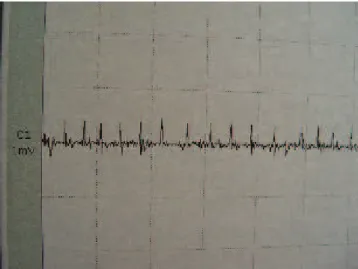
The patient underwent extensive additional tests, in-cluding MR neuroimaging of the skull and cervical/tho-racic and lumbosacral spine, which revealed L4-L5 discop-athy. The following tests were unremarkable: CSF analysis, complete blood count, fasting blood sugar, lipid profile, creatinine, TSH, T3, T4F, TGO, TGP, amylase, VDRL, elec-trolytes, mammography, chest X-ray, abdominal echog-raphy, whole-body PET-CT, antinuclear antibody (ANA), protein electrophoresis, muscle enzymes, erythrocyte sed-imentation rate (ESR) and C-reactive protein (CRP). Bone densitometry showed osteopenia. ENMG showed the presence of continuous muscular activity (Fig 2). The pa-tient is receiving IVIg therapy with a progressive improve-ment in her clinical picture.
CASE 2
A 52-year-old female patient who presented initially with diplopia had diiculty walking and had progressively wors-ening imbalance, which deteriorated markedly over 20 days. She had an ophthalmic assessment, which proved incon-clusive, and was referred for neurological assessment in her hometown. his revealed gait ataxia, diiculty with tandem gait and the presence of horizontal gaze-evoked nystagmus, as well as a complaint of diplopia. he patient was receiving thyroid hormone therapy (100 μg/day). Further investiga-tion revealed normal routine blood tests, except for ESR (60). Brain neuroimaging (CT and MRI) was normal. CSF analy-sis revealed the presence of 16 cells (100% lymphomono-nuclear), but no other abnormalities. Over time the patient complained of nausea and vomiting, and used an antiemetic (metoclopramide), dimenhydrinate and clonazepam. Viral
cerebellitis was suspected. She later presented with a clinical picture of urinary infection, which subsequently improved with norloxacin. he clinical picture of ataxia remained un-changed, and 30 days later the patient had a generalized ton-ic-clonic seizure while asleep, which was repeated the fol-lowing day. he patient was hospitalized and phenytoin was administered intravenous (i.v.). Neurological examination re-vealed cerebellar ataxia with nystagmus and diplopia; a new brain MRI was normal. Phenytoin was replaced by lamotrig-ine in a daily dose of 200 mg, and methylprednisolone pulse therapy (1 g/day for 5 days) was started. At the end of the ive days, the methylprednisolone was substituted by prednisone (40 mg/day). New CSF tests were unremarkable, and a fur-ther detailed investigation, including tests for vasculitis and screening for occult neoplasms, infections (serologic tests to detect antibodies against HIV, Epstein-Barr, varicella-zoster and herpes simplex viruses) and Hu, Ri and Yo antibodies, was normal. EEG tracing was also unremarkable.
Because the patient’s clinical picture deteriorated, she was referred for specialized assessment. She continued to complain of dizziness, imbalance and diplopia, and neuro-logical examination revealed marked gait ataxia (she could not perform tandem gait unsupported) with horizontal and vertical gaze-evoked nystagmus, as well as slight dysarthria.
As autoimmune cerebellar ataxia was suspected, fur-ther investigations were again carried out, including routine blood chemistry, VDRL, complete blood count, coagulogram, ESR, liver function, thyroid tests, anti-DNA tests, a new MRI and a new CSF examination, as well as measurement of anti-gliadin, antithyroglobulin and antiperoxidase antibodies, all of which were unremarkable, except for the GAD anti-body test (39 IU/mL; normal value <1.0 IU/mL).
As the diagnosis was cerebellar ataxia and epileptic sei-zures associated with anti-GAD antibodies, the patient under-went IVIg treatment (0.4 g/kg/day) for ive days followed by a single monthly i.v. dose ( for 12 months) and, subsequently,
Fig 1. Electromyography of patient 1, with continuous motor unit activity in paravertebral muscles.
azathioprine p.o. (2 mg/kg/day). here was a gradual improve-ment in the clinical picture and, one year after the start of the speciic treatment, neurological examination showed only mild gait ataxia (more apparent in tandem gait) and the pres-ence of mild horizontal nystagmus in both extreme gazes. Lamotrigine (200 mg/day) p.o. and clonazepam (1.0 mg/night) were continued; complete blood count and liver function tests were normal and azathioprine was discontinued.
DISCUSSION
Classical SPS is a rare neurological disorder character-ized by severe and incapacitating axial and proximal limb ri-gidity and stifness due to continuous motor unit activity1-8.
his unusual syndrome was irst described by Moersch and Woltman in 1956, who deined it as “progressive luctuating muscular rigidity and spasm” (“Stif-man” syndrome) after re-porting one case and studying 13 others19.
Rigidity is often exacerbated by anxiety, sudden move-ments or external stimuli, causing intermittent pain-ful spasms and frequently leading to skeletal deformity. Exaggerated lumbar lordosis and pain are almost univer-sal findings, and diagnosis is supported by a finding of anti-GAD antibodies in the blood or CSF2. SPS frequently
presents with psychiatric symptoms, such as anxiety, pho-bias and depression, and psychogenic movement disorder is a common misdiagnosis1.
In our series of patients with neurological disorders as-sociated with anti-GAD antibodies, we found nine patients with SPS and its variants. Four had a classical clinical pre-sentation of SPS, and the other ive presented with SPS vari-ants (two with stif lower limbs, two with stif one-limb and one with stif three-limbs). ENMG examination was diagnos-tic in all the patients with classical SPS and stif lower limbs syndrome; however, in the patients with stif three-limbs or stif one-limb syndrome, it was not diagnostic, and the diag-nosis was conirmed after high serum anti-GAD antibodies had been detected. Autoimmune endocrinopathies, particu-larly diabetesmellitus and hypothyroidism (Hashimoto’s
thy-roiditis), were found in some of the patients. Two patients sufered from epileptic seizures and segmental myoclonus af-fecting the trunk.
Clinically, stif-person syndrome presents as neurologi-cal paraneoplastic syndromes in about 5% of cases1,20,21. In
such cases, paraneoplastic stif-person syndrome is usual-ly associated with amphiphysin or anti-gephyrin antibod-ies20. While a few cases of paraneoplastic SPS have been
described in anti-GAD-antibody-positive patients with thymoma and other solid tumors, a inding of anti-GAD
antibodies in patients with other classical paraneoplastic neurological syndromes is rare10,20.
Progressive encephalomyelitis is a rare form of SPS characterized by brainstem, extrapyramidal and spinal cord dysfunction with acute onset of painful rigidity and muscle spasm in association with nystagmus, opsoclonus, ophthalmoparesis, deafness, dysarthria, dysphagia and autonomic dysfunction21,22.
In our series, there were no cases of paraneoplastic SPS or progressive encephalomyelitis with rigidity.
Ataxia associated with anti-GAD antibodies is a very rare condition and is considered to be a component of a polyglandular autoimmune syndrome in patients with cir-culating anti-GAD antibodies (10%)23. Most patients with
ataxia and anti-GAD antibodies are women and have insu-lin-dependent diabetes mellitus. In general, there is a slowly
progressive pancerebellar syndrome, and cerebellar atro-phy is sometimes found in MRI examinations1-3,23,24. hree
of our patients had acquired secondary cerebellar ataxia associated with anti-GAD antibodies, and two, whose CSF analysis revealed mild pleocytosis, had Hashimoto’s thy-roiditis. One patient in this group had diabetes mellitus and
epileptic crises without myoclonus. here was no diference in anti-GAD levels between this group of cerebellar ataxia patients and the SPS group.
he prevalence of neurological disorders associated with anti-GAD antibodies in epileptic patients is low (less than 10%)25,26. In this series, we found two patients who sufered
from epileptic seizures (one from the SPS group and the other from the cerebellar ataxia group). Some authors recommend actively searching for anti-GAD antibodies in patients with atypical refractory epilepsy either on its own or in association with diabetes mellitus or cerebellar ataxia25,26.
he heterogeneity of the neurological presentation in patients with neurological syndromes associated with anti-GAD antibodies is probably related to the widespread distri-bution of GABAergic neurons in the central nervous system as these cells have a large amount of GAD22.
In conclusion, in this series of neurological disorders as-sociated with anti-GAD antibodies, we found nine patients with stif-person syndrome (the classical form and its vari-ants) and three with cerebellar ataxia. Four had hypothyroid-ism, three epilepsy, two diabetes mellitus and two had
seg-mental myoclonus afecting the trunk.
ACKNOWLEDGMENTS
1. Hadavi S, Noyce AJ, Leslie RD, Giovannoni G. Stiff person syndrome. Pract Neurol 2011;11:272-282.
2. Saiz A, Blanco Y, Sabater L, et al. Spectrum of neurological syndromes associated with glutamic acid decarboxylase antibodies: diagnostic clues for this association. Brain 2008;131:2553-2563.
3. Vasconcelos OM, Dalakas MC. Stiff-person syndrome. Curr Treat Options Neurol 2003;5:79-90.
4. Lorish TR, Thorsteinsson G, Howard FM Jr. Stiff-Man syndrome updated. Mayo Clin Proc 1989;64:629-636.
5. Barker RA, Revesz T, Thom M, Marsden CD, Brown P. Review of 23 patients affected by the stiff man syndrome: clinical subdivision into stiff trunk (man) syndrome, stiff limb syndrome, and progressive encephalomyelitis with rigidity. J Neurol Neurosurg Psychiatry 1998;65:633-640.
6. Gershanik OS. Stiff-person syndrome. Parkinsonism Relat Disord 2009;15:S130-S134.
7. Meinck HM, Thompson PD. Stiff-Man syndrome and related conditions. Mov Disord 2002;17:853-866.
8. Hijazi J, Bedat-Millet AL, Hannequim D. Le syndrome de l’homme raide et autres maladies neurologiques associées aux anticorps anti-GAD. Rev Med Interne 2010;31:23-28.
9. Boronat A, Sabater L, Saiz A, Dalmau J, Graus F. GABA B receptor antibodies and anti-GAD-associated neurologic disorders. Neurology 2011;76:795-800.
10. Grauss F, Saiz A, Dalmau J. Antibodies and neuronal autoimmune disorders of the CNS. J Neurol 2010;257:509-517.
11. Solimena M, Folli F, Aparisi R, Pozza G, De Camilli P. Autoantibodies to GABA-ergic neurons and pancreatic beta cells in stiff-man syndrome. N Engl J Med 1990;322:1550-1560.
12. Ali F, Rowley M, Jayakrishnan, Teuber S, Gershwin ME, Mackay IR. Stiff-person syndrome (SPS) and anti-GAD-related CNS degenerations: protean addictions to the autoimmune central neuropathies. J Autoimmun 2011;37:79-87.
13. Alexopoulos H, Dalakas MC. A critical update on the immunopathogenesis of Stiff Person Syndrome. Eur J Clin Invest 2010;40:1018-1025.
14. Dalakas MC, Fujii M, Li M, McElroy B. The clinical spectrum of anti-GAD antibody-positive patients with Stiff-Person syndrome.
Neurology 2000;55:1531-1535.
15. Dalakas MC. Advances in the pathogenesis and treatment of patients with Stiff-Person syndrome. Curr Neurol Neurosci Rep 2008;8:48-55.
16. Dalakas MC. Stiff-Person syndrome: advances in pathogenesis and therapeutic interventions. Curr Treat Options Neurol 2009;11:102-110.
17. Teive HAG, Munhoz RP, Cardoso J, Amaral VCG, Werneck LC. Stiff-three limbs syndrome. Mov Disord 2009;24:311-312.
18. Munhoz RP, Fameli H, Teive HAG. Stiff person syndrome as the intial manifestation of systemic lupus erythematosus. Mov Disord 2010;25:516-517.
19. Moersch FP, Woltman HW. Progressive fluctuating of muscular rigidity and spasm (“stiff-man” syndrome): report of a case and some observations in 13 other cases. Proc Staff Meet Mayo Clin 1956;31:421-427.
20. Grant R, Graus F. Paraneoplastic movement disorders. Mov Disord 2009;24:1715-1724.
21. Spay AJ, Chen R. Rigidity and spasm from autoimmune encephalomyelopathies: stiff-person syndrome. Muscle Nerve 2006;34:677-690.
22. Pittock SJ, Yoshikawa H, Ahlskog E, et al. Glutamic acid decarboxylase autoimmunity with brainstem, extrapyramidal, and spinal cord dysfunction. Mayo Clin Proc 2006;81:1207-1214.
23. Klockgether T. Acquired cerebellar ataxias and differential diagnosis. In: Brice A, Pulst SM (Eds). Spinocerebellar degenerations. The ataxias and spastic paraplegias. Philadelphia, PA, USA: Butterworth Heinemann Elsevier; 2007:61-77.
24. Kono S, Miyajima H, Sugimoto M, Suzuki Y, Takahashi Y, Hishida A. Stiff-person syndrome associated with cerebellar ataxia and high glutamic-acid decarboxylase antibody titer. Intern Med 2001;40:968-971.
25. Vulliemoz S, Vanini G, Truffert A, Chizzolini C, Seeck M. Epilepsy and cerebellar ataxia associated with anti-glutamic acid decarboxylase antibodies. J Neurol Neurosurg Psychiatry 2007;78:187-189.
26. Yoshimoto T, Doi M, Fukai N, et al. Type 1 diabetes mellitus and drug-resistent epilepsy: presence of high titer of anti-glutamic acid decarboxylase autoantibodies in serum and cerebrospinal fluid. Intern Med 2005;44:1174-1177.