Construction and Validation of the CADE-Q for Patient Education in
Cardiac Rehabilitation Programs
Gabriela Lima de Melo Ghisi
1, Adriana Durieux
1, Waldomiro Carlos Manfroi
2, Artur Haddad Herdy
3, Tales de
Carvalho
1, Alexandre Andrade
1, Magnus Benetti
1Centro de Ciências da Saúde e do Esporte (CEFID) - Universidade do Estado de Santa Catarina (UDESC)1, Florianópolis, SC; Universidade Federal do Rio Grande do Sul (UFRGS)2, Porto Alegre, RS; Hospital Regional de São José (HRSJ)3, São José, SC - Brazil
Abstract
Background: Being aware of the coronary artery disease can be considered the first step to reduce the risk of cardiac complications.
Objective: Building and validating a tool to assess and describe coronary patients’ awareness in cardiac rehabilitation programs, with the purpose of education.
Methods: For the construction, we analyzed articles and field studies to submit items to multidisciplinary team associated to cardiac rehabilitation. After this analysis, we generated the version tested in a pilot study. The tool, named CADE-Q (Questionnaire for Coronary Patient Education) was applied in 155 patients aged 61 ± 9 (min = 36, max = 86) in response to cardiac rehabilitation programs. Out of the 155 patients, 114 were men. Internal consistency was measured by Cronbach’s alpha coefficient. Reproducibility was tested by the intraclass correlation coefficient (ICC) and construct validity was performed by exploratory factor analysis. The analysis compared the total scores as a function population characteristics and rehabilitation groups (private and public).
Results: The final version has 19 questions with 4 alternatives, with 4 quadrants of awareness. Cronbach’s alpha was 0.68 and ICC was 0.783. The factor analysis revealed 6 factors, covering three areas of awareness, which demonstrates the multifactorial nature of the instrument. The population characteristics as a function of the total score showed significant differences depending on the socioeconomic status variables (type of rehabilitation, household income and education level).
Conclusion: CADE-Q has proper validity and reliability to be used in the Brazilian population in future research. (Arq Bras Cardiol 2010;94(6) : 763-771)
Key words: Questionnaires/utilization; education; coronary diseases; rehabilitation.
Mailing address: Gabriela Lima de Melo Ghisi •
Rua Dom Joaquim, 827 apto 302 - Centro, Florianópolis, SC - 88015-310 - Brazil
E-mail: [email protected]
Manuscript received April 15, 2009; revised manuscript received August 20, 2009; accepted December 28, 2009.
Introduction
In recent years, the concept of health has evolved and changed from ‘state of absence of disease’ to ‘a positive concept focusing on personal and social aspects as well as physical, mental and spiritual aspects’ related to many factors, including the opportunity to education and awareness1,2.
Every year, cardiovascular diseases (CVD) are responsible for 16.7 million deaths around the world, and according to the World Health Statistics (2008), these deaths will increase to 23.4 million worldwide in 20303.
Cardiac rehabilitation programs aim getting coronary patients back to an optimal level of recovery, enabling this individual to acquire and maintain better health conditions
and reduce the risk of death and acute events related to their disease. To achieve these goals, interventions are combined, and correctly and conveniently applied. These interventions include educational programs4,5.
The raising of awareness associated with multidisciplinary programs to control coronary artery disease (CAD) helps patients achieve an adequate perception of their health status, changing beliefs, behaviors and bad habits5-9.
However, for coronary patients to be truly aware of their disease, symptoms, lifestyle, risk factors and treatments, it is necessary to evaluate how much patients know about their disease. Therefore, the development and/or improvement of instruments capable of undertaking such an evaluation become critical10,11.
Psychometric analyses were performed to evaluate the validity and reliability of the CADE-Q.
The construct validity was assessed through the factor analysis. To check the suitability of the data to such analysis, we assessed Keiser-Meyer Olkin’s index (KMO), to assess the factorability of intercorrelation matrices on which the factor analysis is based. Then, Bartlett’ sphericity test was performed to determine whether the data met the sphericity requirement14,15.
We used the principal component analysis to extract factors, considering only those with eigenvalues greater than one, combined with scree plot. After the factors have been selected, a factorial matrix was generated to observe the relationships between items and factors by means of factor loadings. To interpret the matrix, we applied the method of Principal Component Extraction by orthogonal rotation, using the method Equamax14,15.
The reliability assessment includes two main ways: internal consistency and reproducibility. Internal consistency was assessed by Cronbach’s alpha in all individuals subject to the application of the instrument, based on the minimum value of 0.6014. Reproducibility was assessed using the intraclass
correlation coefficient, using test and retest situations. The time interval between tests was two weeks, testing 25 individuals of the pilot study, also selected in a simple and random manner.
To check CADE-Q’s outcomes for some population characteristics (age, sex, comorbidities, surgical procedures related to CAD, type and time of cardiac rehabilitation, education level and household income), we compared the total scores according to such variables. We also checked the outcomes as a function of the 4 quadrants of awareness. By testing the distribution of data through the Kolmogorov-Smirnov test, it was found that the variables of the scale resultants were normally distributed (p> 0.1). Considering this, we used ANOVA and Bonferroni’s post hoc test.
There are other types of validity of instruments found in literature12, such as the Concurrent Validation, which
consists in the correlation of an instrument under validation with a scientifically validated one12. However, as there are
few instruments in literature that assess coronary patients’ awareness and most of them consist of yes/no and true/ false questions - such as MICRO-Q7 - which may not reflect
patient’s real awareness of the disease, this method was discarded.
The research was conducted within the standards required by Helsinki Declaration and approved by the Ethics and Human Research Committee of the University of Santa Catarina (UDESC) according to resolution CNS 196/96. All individuals were informed about the goals of the research, data confidentiality, and signed a Consent Form.
Results
Preparation of the questionnaire
To select important items for the composition of the instrument, we performed a field research with patients in cardiac rehabilitation programs. Patients were mainly interested in learning about the following: physical symptoms, Therefore, the purpose of this study was to construct
and validate a tool to assess and describe coronary patients’ awareness in cardiac rehabilitation programs, for the purposes of education.
Methods
Preparation of the questionnaire
Based on Pasquali13, the process of developing and
validating the tool named CADE-Q - Questionnaire for Education on Coronary Artery Disease - included three steps with three different procedures: theoretical, empirical and analytical. The theoretical procedure referred to the theoretical foundation on the construct for which we intended to develop a measurement tool. The empirical procedure is also called experimental and consisted of steps and techniques for applying the pilot instrument, as well as collecting information that could evaluate the properties of the instrument. The analytical procedure determined the statistical analyses of data in order to validate the instrument.
Therefore, the development of the CADE-Q instrument consisted of the following steps:
1) Searching texts and articles to build up an inventory. Such inventory was supposed to carry key information that patients need to know about CAD, as well as, for the selection of items that should be known by coronary patients, a qualitative field research was performed with patients in cardiac rehabilitation programs with 50 items to be part of the instrument;
2) Presenting items to a multidisciplinary team of professionals associated with the Cardiac Rehabilitation Program – composed of physicians, nurses, physical educators, physiotherapists, nutritionists and psychologists - to assess the content, relevance and conceptual and cultural analysis of the questions, generating the First Version with 20 multiple choice questions, each question containing 4 choices;
3) The First Version was submitted to a pilot study in 30 patients to evaluate the understanding of the issues (clarity) and dispel doubts about the structure of questions and answers. Using a scale from zero to 10, each patient should assign a score to the clarity of the questions, giving rise to the level of clarity, according to Pasquali’s13 clarity criterion.
4) After the analysis, some items were developed and one question was removed, creating the Final Version of CADE-Q with 19 questions.
Validation
such as shortness of breath, chest pain (48.0%), exercising and sport (39.0%), recovery of the heart (29.0%) and questions about how life goes with the disease (22.0%). These results are similar to other studies evaluating the quantity and quality of information gained about the disease in everyday life of coronary patients16,17.
After this research, were prepared and presented 50 items to the multidisciplinary team of professionals associated to the Cardiac Rehabilitation Program, which generated the First Version of CADE-Q with 20 questions.
In the pilot test performed in 30 patients, on a zero to 10 scale, the index of clarity13 of questions was 9.4 ± 1.3,
indicating that the questionnaire is easily understood by the target population. However, examining the questions separately, question 17 (Angiotensin-converting Enzyme Inhibitors (ACE) are?) showed a level of clarity of 1.5 ± 1.4, and was later excluded from the questionnaire13. Still in the
pilot test, we observed the average time required for patients to fill out the questionnaire: 13 ± 4 minutes.
CADE-Q’s final version is a self-applied questionnaire comprising 19 multiple choice questions with 4 alternatives each: a correct statement representing full knowledge, a correct statement representing incomplete knowledge, an incorrect statement representing wrong knowledge, and an ‘I do not know’ statement representing no knowledge (Annex 1). Both alternatives, ‘full knowledge’ and ‘incomplete knowledge’, are correct. The difference lies in the point of view of the level of knowledge: the complete alternative brings a more scientific and thorough knowledge, which is probably transmitted by health professionals to the patient; the incomplete alternative brings a correct knowledge of the question, but a popular one, which may be acquired, for example, through non-scientific media.
The aim of the questionnaire is educating patients with coronary disease, by assessing and describing the level of knowledge of such patients. Patients with other heart diseases cannot be assessed with such instrument.
The questions were divided into 4 areas of knowledge: A1, related to coronary artery disease; A2, diagnosis and drug therapy; A3, on risk factors and lifestyle; and A4, related to exercising. The questions were randomly arranged and could be part in more than one quadrant.
For each alternative, we established scores which, together, lead to a total score, which indicate the degree of knowledge about CAD, as well as knowledge of each specific area. The scores established for each alternative are: correct statement representing full knowledge = three; correct statement representing incomplete knowledge = one; incorrect statement representing wrong knowledge = zero; and ‘do not know’ statement, representing no knowledge = zero. Based on Sommaruga et al7, in spite of representing different
situations, the ‘incorrect’ and ‘do not know’ statement received equal scores, because in the case of instruments of knowledge, they have similar implications. Whereas the purpose of this instrument - patient education - having a wrong understanding or not having any understanding about a given subject determines the need for education, which justifies the scores given.
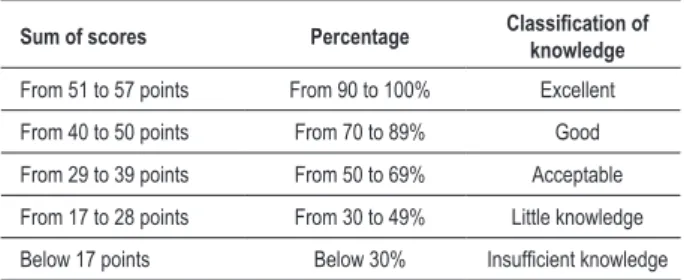
The sum of the scores establishes the patient’s total level of knowledge, and the maximum score is 57 points. Table 1 shows the classification of knowledge level based on other studies7,13.
The participants are characterized by a personal data sheet attached to the instrument.
Validation
The sample consisted of 155 patients, of which 114 were men. The 155 patients participated in cardiac rehabilitation programs (40.0% private, 60.0% public), with participation time of 33 ± 46 months (min = 1, max = 360, Md = 18) and age 61 ± 9 (min = 36, max = 86). All patients had comorbidities associated with CAD and hypertension (HBP) was the most frequently found (72.0%), followed by dyslipidemia (64.0%) and congestive heart failure (CHF) (24.0%). Regarding the surgical procedures related to the disease, 105 individuals have undergone some type of cardiac surgery.
Socioeconomic status was characterized by household income and educational level. In the analysis of the types of rehabilitation - public and private - we observe that patients in public programs have lower income and educational level, and 66.0% earn 1 to 5 minimum wages per month and 39.0% have completed primary education. Patients in private programs have greater income and higher education levels: 45.0% earn more than 20 monthly wages and 61.0% have university degree.
The characteristics of the population under study are described in Table 2.
Validity
Regarding construct validity, we performed a preliminary analysis to ensure normality of data and suitability for factor analysis. The Kolmogorov-Smirnov test revealed normal distributions for all items. After the data were found normal, we analyzed Keiser-Meyer Olkin’s index (KMO) and Bartlett’s sphericity test to check suitability of data for factor analysis14,15.
The KMO index was 0.608 and Bartlett’s sphericity indicated that the correlation matrix is not an identity matrix (X ² = 348.8, p < 0.001). Together, these indicators ensured that the data set has the necessary requirements for factor analysis15.
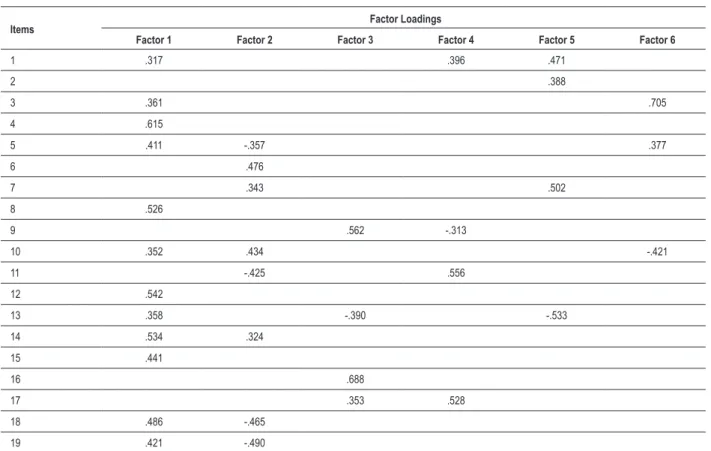
The factor analysis of data was done by “Principal Component Extraction” by “orthogonal” rotation, by the method Equamax. Considering the load factors above 0.314
Table 1 - Classiication of patients’ level of knowledge according to scores
Sum of scores Percentage Classiication of knowledge
(4 items), risk factors and lifestyles (4 items) and exercising (4 items). The third factor included 4 items, with greater predominance in the field of risk factors and lifestyles. Therefore, it was called “Risk Factors Factor”. As factors 4, 5 and 6 did not prevail in areas, they have been termed “Other Factors”.
Internal consistency - tested via Cronbach’s alpha coefficient - was 0.68. The test-retest reliability was assessed by intraclass correlation coefficient (ICC), whose value was 0.783.
Descriptive analysis
Through the Personal Data Sheet attached to the instrument, we analyzed the characteristics of the population according to the total score obtained: age, sex, comorbidities associated (hypertension, CHF, diabetes mellitus type I - DMI, diabetes mellitus type II - DMII, peripheral arterial disease - PAD, dyslipidemia, and chronic obstructive pulmonary disease - COPD), surgical procedures related to CAD, type of cardiac rehabilitation (public or private), time of cardiac rehabilitation, education level and monthly household income16,17.
It was observed that there are no significant differences in total scores due to age (p = 0.240), comorbidities - having hypertension or not (p = 0.487), having CHF or not (p = 0.310), having DMI or not (p = 0.612), having DMII or not (p = 0.335), having PAD or not (p = 0.781), having dyslipidemia or not (p = 0.625), having COPD or not (p = 0.999), duration of cardiac rehabilitation (p = 0.599).
However, total scores revealed significant differences according to gender (p = 0.04), surgical procedures (p = 0.02), type of cardiac rehabilitation (p = 0.02), monthly household income (p < 0.001) and education level (p = 0, 02). These data demonstrate the influence of socioeconomic status in patient’s level of awareness, as reported in studies7,18-25.
By analyzing cardiac rehabilitation groups (public and private) according to the characteristics, we found no significant differences regarding age, gender, comorbidities, surgical procedures related to CAD and cardiac rehabilitation time. However, significant differences (p <0.001) were found according to educational level, monthly household income and total score.
At this stage, the average time of application of the instrument was 14 ± 4 minutes. This time was higher in individuals with lower levels of knowledge (17 minutes).
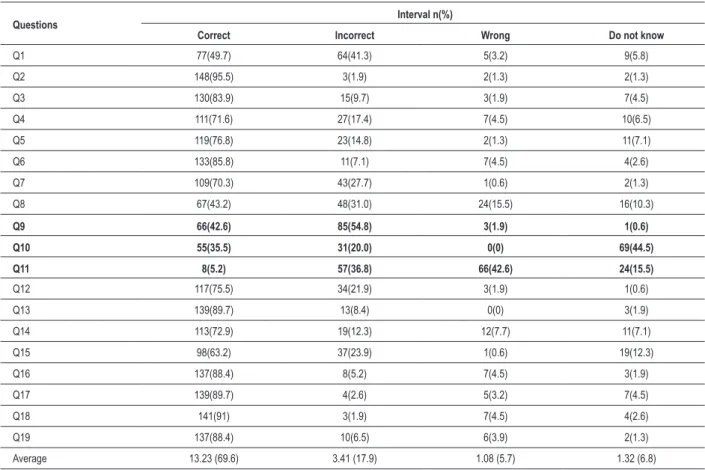
The implementation of CADE-Q revealed a total score of 43.01 ± 6.5, which corresponds to a knowledge of 75.0% of the total scoring presented in the questionnaire. As for classification, we found a prevalence of ‘good knowledge’ type in 66.0% of patients (n = 102). As for the alternatives identified, it is observed that 69.63% of the questions had the full knowledge option checked, 17.9% of incomplete knowledge, 5.7% of wrong knowledge and 6.8% of “do not know”.
Examining the questions, we observe that such behavior does not occur in questions 9, 10 and 11, considered critical items. The interval and the average of correct answers per question are shown in Table 4.
Regarding the 4 areas of knowledge into which the questionnaire is divided, the comparison between the averages pointed out significant differences between the areas studied
Table 2 - Characteristics of coronary patients participating in the research (n = 155)
Variable Category n % total
Gender Male 114 73.
Female 41 26.5
Comorbidities*
HBP 111 71.6
Dyslipidemia 99 63.9
CHF 37 23.9
DMII 31 20
PAD 27 17.4
DMI 9 5.8
COPD 2 1.3
Surgeries**
MR 33 21.3
Angioplasty 47 30.3
MR+Angioplasty 24 15.5
Other 1 0.6
None 50 32.3
Type of rehabilitation
Private 62 40
Public 93 60
Monthly household income
Up to 1 salary 12 7.7
From 1 to 5 salaries 63 40.6 From 5 to 10 salaries 25 16.1 From 10 to 20 salaries 24 15.5
Above 20 salaries 31 20
Education level
Never attended school 1 0.6 Incomplete elementary/middle
education 22 14.2
Complete elementary/middle
education 36 23.2
Incomplete high school 6 3.9 Complete high school 29 18.7 Incomplete higher education 9 5.8 Complete higher education 42 27.1 Post-graduate education 10 6.5 * HBP - high blood pressure; CHF - Congestive heart failure; DMI - diabetes mellitus type I; DMII - diabetes mellitus type II; PAD - peripheral arterial disease; COPD - chronic obstructive pulmonary disease. **MR - myocardial revascularization.
with the aid of the method of “Principal Axis Analysis”, several extractions were made and the solution found to be most appropriate13 was the 6-factor one, which explain 56.1% of
total variance of individuals’ responses. Table 3 presents the empirical structure of the instrument with the factor loadings of each question in the 6 factors extracted.
Table 3 - Empirical structure of the tool
Items Factor Loadings
Factor 1 Factor 2 Factor 3 Factor 4 Factor 5 Factor 6
1 .317 .396 .471
2 .388
3 .361 .705
4 .615
5 .411 -.357 .377
6 .476
7 .343 .502
8 .526
9 .562 -.313
10 .352 .434 -.421
11 -.425 .556
12 .542
13 .358 -.390 -.533
14 .534 .324
15 .441
16 .688
17 .353 .528
18 .486 -.465
19 .421 -.490
(p = 0.03). The best scores were observed in A2 (risk factors and lifestyles), concentrating 90.0% of responses between great and good. The worst levels of knowledge were found in the area of diagnosis, treatment and medicines (A3), with 34.0% of responses ranging from acceptable to poor.
Discussion
The process of constructing and validating an instrument in the field of health requires a great effort10. Because of this,
in Brazil we note a lack of instruments to measure knowledge about CAD. This study contributes towards equipping health professionals with an instrument to establish educational strategies focused on patients’ real needs.
In the construct validity, although the KMO indicator and Bartlett’s sphericity test have pointed out that the data sets had the prerequisites for factor analysis, the factor solution was not appropriate because the instrument items have multidimensional characteristics, mostly comprising more than one field of knowledge. However, the factor analysis alone cannot determine that an instrument is invalid13. In
this case, CAD is a multifactorial disease. Because of that, the instrument was adapted to cover the largest number of factors related to the disease, which the factor analysis eventually corroborated, since each of the 6 factors includes at least three fields of knowledge.
Also concerning validity, the results show that there is consistency of measures in successive applications in the same
group, that is, accurate and stable data14. This is because, in
terms of internal consistency, Cronbach’s alpha revealed no homogeneity among the questions, since it was above the minimum value of 0.60 reported by some authors14, despite
the multifactorial nature of the disease previously reported. Looking at the test-retest reliability, the ICC value was very close to what literature suggests14 (0.8), demonstrating stability
of the instrument, i.e., successive applications of the same instrument produced the same or similar outcomes.
The final version of CADE-Q (Questionnaire for Education on Coronary Artery Disease) is self-applied and consists of 19 multiple-choice questions with 4 alternatives each, divided into 4 quadrants of knowledge: coronary artery disease, diagnosis and medication, risk factors and lifestyle, and exercising.
Concerning the descriptive analysis, total scores revealed significant differences according to the variables representing socioeconomic status (type of cardiac rehabilitation, monthly household income and educational level). This shows that socioeconomic status is influencing coronary patients’ knowledge of their disease, as reported in studies7,18-25.
Table 4 - Intervals and average of correct answers to CADE-Q Questionnaire
Questions Interval n(%)
Correct Incorrect Wrong Do not know
Q1 77(49.7) 64(41.3) 5(3.2) 9(5.8)
Q2 148(95.5) 3(1.9) 2(1.3) 2(1.3)
Q3 130(83.9) 15(9.7) 3(1.9) 7(4.5)
Q4 111(71.6) 27(17.4) 7(4.5) 10(6.5)
Q5 119(76.8) 23(14.8) 2(1.3) 11(7.1)
Q6 133(85.8) 11(7.1) 7(4.5) 4(2.6)
Q7 109(70.3) 43(27.7) 1(0.6) 2(1.3)
Q8 67(43.2) 48(31.0) 24(15.5) 16(10.3)
Q9 66(42.6) 85(54.8) 3(1.9) 1(0.6)
Q10 55(35.5) 31(20.0) 0(0) 69(44.5)
Q11 8(5.2) 57(36.8) 66(42.6) 24(15.5)
Q12 117(75.5) 34(21.9) 3(1.9) 1(0.6)
Q13 139(89.7) 13(8.4) 0(0) 3(1.9)
Q14 113(72.9) 19(12.3) 12(7.7) 11(7.1)
Q15 98(63.2) 37(23.9) 1(0.6) 19(12.3)
Q16 137(88.4) 8(5.2) 7(4.5) 3(1.9)
Q17 139(89.7) 4(2.6) 5(3.2) 7(4.5)
Q18 141(91) 3(1.9) 7(4.5) 4(2.6)
Q19 137(88.4) 10(6.5) 6(3.9) 2(1.3)
Average 13.23 (69.6) 3.41 (17.9) 1.08 (5.7) 1.32 (6.8)
Note: Bold questions represent critical items.
levels, which we define as the influence of socioeconomic status, also reported in this study7-9, 19.
Although only the characteristics related to socioeconomic status have shown significant differences, other factors (age, sex, associated comorbidities, time of cardiac rehabilitation, surgical interventions related to the disease) may influence the acquisition of knowledge of coronary patients and should be described in studies using this instrument4,7,10,26.
The inclusion of patients with different times of participation in cardiac rehabilitation programs showed no influence on the knowledge neither on the reliability of the questions, perhaps because the samples have shown large asymmetry (SD = 46.21). It was found that patients who have been 1-6 months in the programs had scores of 43 ± 7. Patients with over 120 months in programs had lower knowledge scores (42 ± 8). Despite the insignificant results, the time of cardiac rehabilitation is an important point in studies evaluating patients in treatment programs, which can be explored in future studies, addressing, for example, knowledge before and after a certain period.
The average of total scores, corresponding to 75.0% of knowledge of the total presented in the questionnaire, differs from studies where it is estimated that 30 to 78.0% of coronary patients do not fully understand educational information transmitted to them27. This reveals that education in clinical
practice is often inappropriate, inconsistent and inaccurate, but when patients are enrolled in cardiac rehabilitation programs, they have greater contact with knowledge, once the team of professionals involved in these programs reviews concepts, sets aside misleading ideas and beliefs and encourages healthy habits, educating patients4.
The critical items (questions 9, 10 and 11) reveal that, although the patients had good total scores, some important and fundamental information to coronary patients are missing17,
such as appropriate diet, optimal blood lipid values and absolute contraindication for physical exercising, respectively.
Although it is not the goal of this study, it is known that using such tools provides groups and individuals with an opportunity of increasing their levels of understanding of CAD, that is, it provides education targeted at cardiac rehabilitation programs7,27. Moreover, such studies and can be quite useful
in developing strategies to encourage patients’ adherence to cardiac rehabilitation programs, as well as interfering with the success of this intervention, since it is not known how patient’s knowledge is translated into concrete actions towards optimal health28,29.
Conclusion
CADE-Q questionnaire produced appropriate levels of reliability and validity and can be used to assess the knowledge of coronary patients in cardiac rehabilitation and, where necessary, establish educational programs focusing on patients’ education about their disease.
Potential Conflict of Interest
No potential conflict of interest relevant to this article was reported.
Sources of Funding
There were no external funding sources for this study.
Study Association
This article is part of the thesis of master submitted by Adriana Durieux, from Universidade do Estado de Santa Catarina (UDESC).
Annex 1 - Full questionnaire CADE-Q
validated.
1. Coronary arterial disease (CAD) is:
a. An alteration to heart arteries found in the elderly, affecting smokers with high cholesterol.
b. An alteration to heart arteries that usually begins in childhood. It is influenced by bad lifestyles and can be genetic and immunoinflammatory.
c. An alteration to heart arteries related to age which, over time, impairs the memory of those affected.
d. I do not know.
2. Which combination of factors has greater influence on the development of CAD?
a. Intake of small amounts of alcohol.
b. Environmental (such as climate) and socioeconomic factors (such as household income).
c. Smoking, abnormal levels of blood fats (dyslipidemia) and hypertension.
d. I do not know.
3. Which of the following is related to a typical symptom of CAD?
a. Headache after meals.
b. Chest pain or discomfort during physical exercising. c. Chest pain or discomfort at rest or while exercising, which can migrate to arms and/or back and/or neck.
d. I do not know.
4. Also concerning CAD, we can statethat:
a. Ii is associated with obstruction of the arteries that supply
the heart due to the formation of atherosclerotic plaque (fat deposits on the artery wall), which may lead to angina (chest pain).
b. Acute myocardial infarction (AMI) is the only manifestation of CAD.
c. The presence of angina suggests the diagnosis of CAD. d. I do not know.
5. The best time on the day for CAD patients to practice exercises prescribed is:
a. In the afternoon or evening, as morning exercising may increase the risk.
b. At no time because physical exercising it is not recommended for individuals with CAD, due to high risk.
c. At any time of the day, because the benefit outweighs the risk.
d. I do not know.
6. From the tests listed below, which are the most accurate ones in diagnosing and prognosing CAD:
a. X-ray and chest MRI.
b. Stress test (ergometric) and cardiac catheterization. c. Electrocardiogram at rest and clinical history. d. I do not know.
7. What isthe optimal treatment to reduce blood lipids (blood fats)?
a. Physical exercising and diet are enough.
b. Physical exercising and diet and, whenever required, statin.
c. There is no treatment, because high levels of cholesterol and triglycerides are genetic.
d. I do not know.
8. About coronary vasodilators such as nitrates and nitrites, whyand how should they be used?
a. These drugs should be used continuously and/or in situations of chest pain, their administration is oral and/or sublingual, improving the flow of blood into the heart arteries.
b. These drugs should be used sublingually in emergency situations to relief chest pain.
c. These drugs are used to decrease blood pressure and bad cholesterol (LDL) in patients with cardiac problems. They are administered only orally.
d. I do not know.
9. What is the diet recommended for patients with CAD?
a. A diet with low salt, low fat and rich in fibers.
b. A diet based on: whole meal pasta, vegetables, fish, extra virgin olive oil and nuts.
d. I do not know.
10. Which values of total cholesterol, LDL and HDL are, respectively, ideal in patients with CAD (values in mg/dl):
a. Below 200, below 100 and above or equal to 60. b. Below 200, between 100 and 129 and between 40 and 60.
a. Above 240, above 100 and below 40. d. I do not know.
11. Which corresponds to an absolute contraindication for physical exercising?
a. Recent acute myocardial infarction (AMI). b. Acute infections (e.g. influenza). c. Hypertensive crisis (high blood pressure). d. I do not know.
12. If you feel any discomfort related to his heart problem, such as angina (chest pain), you must:
a. Drive your car straight to the hospital seeking medical attention.
b. Try to relax, wait the pain to stop and, during this period of time, seek medical attention.
c. Chew one or two tablets of acetylsalicylic acid and/or use a sublingual vasodilator (nitrate), coughing vigorously, trying to relax and seek medical advice.
d. I do not know.
13. Based on your knowledge on exercising and CAD, please answer the following:
a. It is part of the treatment because it helps control risk factors, increases survival and improves quality of life.
b. Should never be performed by patients with this disease because of the high risk of death.
c. Should only be included in the treatment when the patient is clinically stable.
d. I do not know.
14. Physical activity for CAD patients must:
a. Respect the patient’s needs, which are analyzed by stress test and be prescribed individually.
b. Start as soon as the disease is diagnosed with mild physical activity.
c. Be equal for same sex and same age, because this group of individuals has the same fitness and risk.
d. I do not know.
15. Which alterations, considered favorable and
resulting from regular physical exercise, are most important to patients with CAD?
a. Improvement in endothelial function, increased collateral circulation, and even a possible regression of the atherosclerotic plaque.
b. Decreased heart rate (HR) at rest, increased force of heart contraction and improved lipid profile.
c. Increased blood pressure (SBP), triggering episodes of tachycardia and increased triglycerides.
d. I do not know.
16. Physical activity for individuals with CAD should be performed:
a. Anywhere, lasting for 30 minutes on a daily basis, and may be cumulative (10 min in the morning, 10 minutes in the afternoon and 10 min in the evening).
b. At an appropriate place, monitored by a qualified professional, aiming at self- sufficiency.
c. In a clinical or hospital environment. d. I do not know.
17. High values of blood pressure (BP) indicate a state of hypertension (high blood pressure). Therefore, in CAD:
a. Having normal pressure or hypertension does not interfere with this disease.
b. A BP 140/90 mmHg is normal. c. An ideal PA is 120/80 mmHg. d. I do not know.
18. On stress, so present in our daily lives, we can say that:
a. It is one of the risk factors that trigger MI (myocardial infarction).
b. It is part of the group of risk factors that are less important for CAD.
c. It does not interfere with cardiac diseases, once this disease is totally physical and not related to psychological factors.
d. I do not know.
19. Which interventions used in treating CAD can extend and improve quality of life?
a. Changes in lifestyle + medical treatment + in some cases, surgical treatment.
References
1. Bethel H, Lewin R, Dalal H. Cardiac rehabilitation in the United Kingdom. Heart. 2009; 95 (4): 271-5.
2. Cohen JD. ABCs of secondary prevention of CHD: easier said than done. Lancet. 2001; 357 (9261): 972-3.
3. World Health Organization. World Health Statistics. Genebra; 2008. 4. Sociedade Brasileira de Cardiologia. Diretriz de reabilitação cardiopulmonar
e metabólica: aspectos práticos e responsabilidades. Arq Bras Cardiol. 2006; 86 (1): 74-82.
5. Hirani SP, Patterson DLH, Newman SP. What do coronary artery disease patients think about their treatments? An assessment of patients’ treatment representations. J Health Psychol. 2008; 13 (3): 311-22.
6. Calwell MA, Peters KJ, Dracup KA. A simplified education program improves knowledge, self-care behaviour, and disease severity in heart failure patients in rural settings. Am Heart J. 2005; 150 (5): 983.
7. Sommaruga M, Vidotto G, Bertolotti G, Pedretti RF, Tramarin R. A self administered tool for the evaluation of the efficacy of health education interventions in cardiac patients. Monaldi Arch Chest Dis. 2003; 60 (1): 7-15. 8. Kayaniyil S, Winstanley J, Parsons C, Brister S, Oh P, Stewart DG, et al.Degree
and correlates of cardiac knowledge and awareness among cardiac impatients. Patient Educ Couns. 2009; 75 (1): 99-107.
9. Yehle KS, Sands LP, Rhynders PA, Newton GD. The effect of shared medical visits on knowledge and self-care in patients with heart failure: a pilot study. Heart Lung. 2009; 38 (1): 25-33.
10. Osborne RH, Elsworth GR, Whitfield K. The Health Impact Questionnaire (heiQ): An outcomes and evaluation measure for patient education and self-management interventions for people with chronic conditions. Patient Educ Couns. 2007; 66 (2): 192-201.
11. Gazmararian JA, Williams MV, Peel J, Baker DW. Health literacy and knowledge of chronic disease. Patient Educ Couns. 2003; 51 (3): 267-75. 12. Guillemin F. Cross-cultural adaptation and validation of health status
measures. Scand J Rheumatol. 1995; 24 (2): 61-3.
13. Pasquali L. Psicometria: teoria dos testes na psicologia e na educação. Rio de Janeiro: Vozes; 2003.
14. Dancey CP, Reidy J. Statistics without maths for Psychology: using SPSS for Windows. 3rd ed. London: Prentice Hall; 2005.
15. Hair JF, Anderson RE. Multivariate data analysis. 5th ed. New Jersey: Prentice Hall; 1998.
16. Bolman C, Brug J, Bar F, Martinali J, van den Borne B. Long-term efficacy of
a checklist to improve patient education in cardiology. Patient Educ Couns. 2005; 56 (2): 240-8.
17. Martinali J, Bolman C, Brug J, van den Borne B, Bar F. A checklist to improve patient education in a cardiology outpatient setting. Patient Educ and Couns. 2001; 42 (3): 231-8.
18. Albert MA, Glynn RJ, Buring J, Ridker PM. Impact of traditional and novel risk on the relationship between socioeconomic status and incident cardiovascular events. Circulation. 2006; 114 (24): 2619-26.
19. Muennig P, Sohler N, Mahato B. Socioeconomic status as an independent predictor of physiological biomarkers of cardiovascular disease: evidence from NHANES. Am J Prev Med. 2007; 45 (1): 35-40.
20. Cohen B, Vitinghoff E, Whooley M. Association of socioeconomic status and exercise capacity in adults with coronary heart disease (from the Heart and Soul Study). Am J Cardiol. 2008; 101 (4): 462-6.
21. Ranjit N, Diez-Roux AV, Shea S, Cushman M, Ni H, Seeman T. Socioeconomic position, race/ethnicity, and inflammation in the multi-ethnic study of atherosclerosis. Circulation. 2007; 116 (21): 2383-90.
22. Alter DA, Naylor CD, Austin P, Tu JV. Effects of socioeconomic status on access to invasive cardiac procedures and on mortality after acute myocardial infarction. N Engl J Med. 2008; 341 (18): 1359-67.
23. Fiscella K, Tandredi D. Socioeconomic status and coronary heart disease risk prediction. JAMA. 2008; 300 (22): 2666-8.
24. Fiscella K, Tandredi D, Franks P. Adding socioeconomic status to Framingham scoring to reduce disparities in coronary risk assessment. Am Heart J. 2009; 157 (6): 988-94.
25. Loucks EB, Lynch W, Pilote L, Fuhrer R, Almeida ND, Richard H, et al. Life-course socioeconomic position and incidence of coronary heart disease - The Framingham Offspring Study. Am J Epidemiol. 2009; 169 (7): 819-26.
26. Piegas LS, Avezum A, Pereira JCR, Neto JM, Hoepfner C, Farran JA, et al. Risk factors for myocardial infarction in Brazil. Am Heart J. 2003; 146 (2): 331-8.
27. Scott JT, Thompson DR. Assessing the information needs of post-myocardial infarction patients: a systematic review. Patient Educ Couns. 2003; 50 (2): 167-77.
28. Santos RD, Sposito AC, Santos JE, Fonseca FH, Moriguchi EH, Martinez TLR, et al. Programa de avaliação nacional do conhecimento sobre a prevenção da aterosclerose (PANDORA). Arq Bras Cardiol. 2000; 75 (6): 289-95. 29. Redfern J, Ellis E, Briffa T, Freedman SB. Development and testing of innovate