Revista Brasileira de
Engenharia Agrícola e Ambiental
Campina Grande, PB, UAEA/UFCG – http://www.agriambi.com.br
v.21, n.11, p.785-790, 2017
Hydrochemistry of alluvial aquifer in the Cobra River sub-basin
Alexandre de O. Lima
1, Nildo da S. Dias
2, Francisco P. Lima Filho
3,
Miguel Ferreira Neto
2, Priscila R. do A. Rego
4& Anderson de M. Souza
5 DOI: http://dx.doi.org/10.1590/1807-1929/agriambi.v21n11p785-790A B S T R A C T
The regional characteristics of waters from alluvial aquifers are different, since they depend on geology and climate. Also, there may be local variation in the quality of the available water when the water source is superficial (rivers and lakes) or is underground due to geology. In order to investigate the groundwater quality of the alluvial aquifer in the Sub-Basin of the Cobra River (RN) for construction of underground dams, five wells, four in the main river and one in the tributary, were monitored in dry and rainy seasons, during two hydrological years. Fifteen water samples from ‘Amazonas’ wells were collected for hydrochemical assessment. Multivariate analysis were performed to evaluate the origin of aquifer recharge and water hydrochemical characteristics. Hydrochemical assessment results indicated that Na+ and Cl- ions have greater influence on the salinization of the
studied area. There are risks of worsening salinization and toxicity problems in the middle and lower courses of the Cobra River Sub-Basin.
Hidroquímica do aquífero aluvial na sub-bacia do Rio Cobra
R E S U M O
As características regionais das águas dos aquíferos aluvionais são diferentes, uma vez que dependem da geologia e do clima. Também pode haver variação local da qualidade da água disponível quando a fonte hídrica é superficial (rios e lagos) ou subterrânea em função da geologia. Objetivando investigar a qualidade da água subterrânea do aquífero aluvial na Sub-Bacia do Rio das Cobra (RN) para fins de construção de barragens subterrâneas, foram monitorados 5 poços amazonas, 4 no rio principal e 1 do afluente, em épocas de estiagem e chuvosa, durante 2 anos hidrológicos. Para caracterização hidroquímica do aquífero foram coletadas 15 amostras de água dos poços amazonas. A origem da recarga dos aquíferos e avaliação hidroquímica da água foram avaliadas utilizando-se a análise estatística multivariada. Os resultados da avaliação hidroquímica indicaram que os íons Na+ e Cl- são mais influentes na salinização da área estudada. Há riscos de agravamento dos
problemas de salinidade e toxicidade no médio e baixo curso da Sub-Bacia do Rio Cobra.
Key words:
water quality salinization
environmental impacts
Palavras-chave:
qualidade de água salinização
análise multivariada
1 Universidade do Estado do Rio Grande do Norte/Departamento de Gestão Ambiental. Mossoró, RN. E-mail: [email protected]
2 Universidade Federal Rural do Semi-Árido/Centro de Ciências Agrárias. Mossoró, RN. E-mail: [email protected] (Corresponding author); [email protected] 3 Universidade Federal do Rio Grande do Norte/Departamento de Geologia. Natal, RN. E-mail: [email protected]
4 Instituto Nacional de Colonização e Reforma Agrária. Natal, RN. E-mail: [email protected] 5 Instituto Federal da Paraíba. Picuí, PB. E-mail: [email protected]
Introduction
Underground dams are social technologies to coexist with the drought in arid and semi-arid zones, built to allow the use of waters available in the alluvium. According to Lima et al. (2017), dams are promising water constructions that stand out for the low cost and easy construction and maintenance, and can be replicated in different situations and physical and socioeconomic contexts. Hence, underground dams gain importance as a possible solution for part of the problem generated by the scarcity of water resources in arid and semi-arid regions.
One of the critical aspects, which deserves special attention of researchers and managers, is related to the quality of the water provided to the populations. Regarding groundwater quality, it depends on hydrochemical parameters, which are highly influenced by geological formations, climate and anthropic activities (Bahia et al., 2011; Barroso et al., 2011; Oliveira et al., 2015). In this context, before the implementation of any water construction, it is opportune to evaluate physico-chemical characteristics that define the quality of the water contained in the alluvial reservoir, in order to measure the potentialities of the aquifer (human consumption, animal watering, irrigation, among others).
Despite the importance of these waters for the Brazilian semi-arid region, the evaluation of their quality has been very limited, especially with respect to hydrochemical parameters of the alluvial aquifer for the location of underground dams. Therefore, this study aimed to evaluate the hydrochemical parameters of the groundwaters of the alluvial aquifer of the Cobra River Sub-basin (RN) and identify the factors with highest influence on their chemical composition, for the utilization in the construction of underground dams in the lower, middle and upper courses of the river.
Material and Methods
The study was conducted in the Cobra River Sub-basin, which is part of the Piranhas-Açu Water Basin and integrates the Seridó’s Desertification Nucleus, occupying an area of 159.13 km², which encompasses the municipalities of Parelhas, Carnaúba dos Dantas and Jardim do Seridó, in the state of Rio Grande do Norte.
According to Köppen’s classification, the climate in this region is Bsw’h’. Regarding rainfall distribution, the annual
mean is 612.4 mm with two well-defined seasons: a dry
one and another with rainfall expected between January and May. The region has mean, minimum and maximum
temperatures of 26.1, 21.2 and 32.0 °C, respectively, and
potential evapotranspiration of 1,552.40 mm year-1 (EMPARN,
2009). The drainage network of the region is composed by intermittent rivers, with alluvium of a few meters thick and surface water flow restricted to rainy seasons. The sub-basin cuts metamorphic rocks of the crystalline basement of the Seridó Belt, located on the extreme northeast of the Borborema Province.
For hydrochemical characterization, 5 ‘Amazonas’ wells (wells dug in the alluvium to collect subsurface water) were selected, 4 along the main river and 1 in one of the tributaries, to collect water samples immediately after the end of the rainy season and dry season. Collection points were distributed in the lower course (PA Ademar and PA Deda), middle course (PA Passagem Molhada) and upper course (PA Lajedo and PA Riacho do Saco), spatially covering all the Sub-basin (Figure 1)
Collected water samples were taken to the Soil and Water Analysis Laboratory of the Rio Grande do Norte Agricultural Research Company (EMPARN) for the determination of the following parameters: electrical conductivity (ECw), pH, soluble ions calcium (Ca+2), magnesium (Mg+2), sodium (Na+),
potassium (K+), chloride (Cl-), carbonate (CO 3
-2), bicarbonate
Figure 1 .Geological map indicating the covered area and location of the groundwater collection points in the Cobra River Sub-basin, RN, Brazil (Sá, 1988)
(HCO
-3), sulfate (SO4
-), iron (Fe+2), nitrate (NO 3
-) and nitrite
(NO2-) (EMBRAPA, 1999).
Statistical Release 7 (Version 2004) was employed to treat the data of water hydrochemical analyses using multivariate statistics through the technique of Factorial Analysis/Principal Component Analysis (FA/PCA) (Nosrati & Eeckhaut, 2012).
Results and Discussion
The results indicate that there were variations in maximum values (2.5, 2.29 and 2.88 dS m-1), mean values (1.46, 1.58 and
1.76 dS m-1) and minimum values (0.3, 0.96 and 0.47 dS m-1) of
the ECw of waters collected in the rainy season in 2009, rainy season in 2010 and dry season in 2010, respectively (Table 1). Considering the ECw mean values in both hydrological cycles, all waters exhibit a saline nature (EC > 1 dS m-1), according to
Rattan et al. (2005). For pH mean values, all well waters were
alkaline (8.3, 7.7 and 7.6 in the dry season in 2009, rainy season
in 2010 and dry season in 2010, respectively) and are within the pH tolerance limit established by Patel et al. (2004), except for the dry season of 2009.
The increase in ECw in the rainy season is related to the rainfall distribution in both hydrological years of collection in the sub-basin, which showed cumulative rainfall of approximately 730 mm (87% of the total in the year) from January to May 2009, representing an increase of 27.8% compared with the historical average for the same period. In 2010, the cumulative value was equal to 407 mm and rainfalls remained slightly below the historical average of the region
(438.6 mm).
It is important to point out that ECw variations between dry and rainy seasons were proportional to the variations found for chloride and sodium ions, and it can be inferred that these ions are responsible for the increment of ECw in the well waters in the dry season, probably due to the increase in the concentration of these ions. On the other hand, no increment was observed in the concentration of the cations Ca and Mg in the well waters in the dry season, which can be related to their precipitation during the process of concentrations of salts in the dry period. Such fact can be confirmed by the titratable
quantities of carbonate, bicarbonate and sulfate in the waters (Table 1), which possibly precipitated Ca and Mg in the form of carbonate and Ca sulfate, since these are the compounds with lowest solubility among the accumulated ones.
Still referring to Table 1, absence or very low contents of nitrite were found in the well waters. However, higher mean content of nitrate was found in the rainy season, probably due to the anthropic action in surrounding areas and its consequent deposition in well waters through mass flow movement of floods. Mean contents of Ca, Mg and K did not vary between dry and rainy seasons in the hydrological year of 2010. In addition, the mean Fe content in well waters in the dry season was superior to that of the rainy season, approximately 4 and
2 times (2.11 and 0.96 mg L-1 in 2009 and 2010, respectively)
the Fe content of the rainy season (0.48 mg L-1).
Although well waters have considerable contents of nitrate and Fe in different collection periods, they do not pose serious risks of contamination according to the threshold values of the World Health Organization (Hach, 2002).
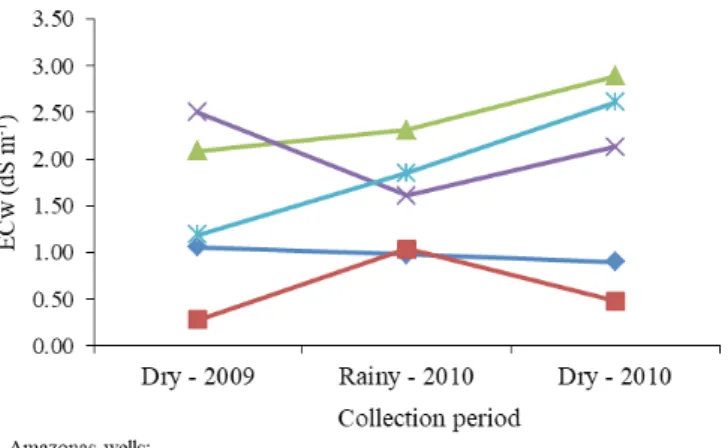
ECw variation was found between the spatial sampling positions in the sub-basin (upper, middle and lower courses). ECw is lower in the upper course and higher in the lower course (Figure 2), possibly due to the transport, deposition and accumulation of salts in lowland areas (surface or underground lateral flow) by the rains.
*pH - Hydrogen potential; ECw - Water electrical conductivity; NO 2
- - Nitrite; NO 3
- - Nitrate, Ca+2 - Calcium, Mg+2 - Magnesium, Na+ - Sodium, K+ - Potassium, Fe+2 - Iron, CO 3
-2 - Carbonate,
HCO3-1 - Bicarbonate, SO 4
-2 - Sulfate; Cl- - Chloride Parameters
Collection
1 2 3
(Dry 2009) (Rainy 2010) (Dry 2010)
Max. Min. Mean Max. Min. Mean Max. Min. Mean
pH 9.00 7.70 8.34 8.30 7.05 7.70 8.50 6.70 7.61
ECw (dS m-1) 2.5 0.3 1.46 2.29 0.96 1.58 2.88 0.47 1.76
NO2-(mg L-1) 0.01 0.00 0.00 0.02 0.00 0.01 0.38 0.00 0.11
NO3-(mg L-1) 2.66 0.00 0.76 2.96 0.00 1.55 0.47 0.20 0.33
Ca+2(mg L-1) 115.85 12.60 67.73 82.69 39.11 56.47 85.91 33.96 57.92
Mg+2(mg L-1) 64.44 4.69 33.30 86.80 35.30 65.06 81.60 14.87 53.05
Na+(mg L-1) 372.41 21.74 179.80 380.95 90.48 239.84 470.00 29.57 263.52
K+(mg L-1) 14.12 3.60 8.66 12.07 4.28 8.00 8.82 3.20 6.47
Fe+2(mg L-1) 6.07 0.09 2.11 0.92 0.22 0.48 2.27 0.23 0.96
CO3-2(mg L-1) 60.48 0.00 21.01 0.00 0.00 0.00 18.09 0.00 5.17
HCO3-1(mg L-1) 477.58 68.04 294.66 581.42 157.09 393.89 446.30 161.85 308.10
SO4-2(mg L-1) 90.34 6.86 34.05 97.35 34.37 54.66 100.16 1.29 50.47
Cl-(mg L-1) 781.30 29.07 342.63 743.52 56.90 407.53 849.74 34.14 460.91
In the collection period of the dry season in 2009, there
were ECw mean values of 0.28 and 1.06 dS m-1 in the upper
course of the basin (Riacho do Saco and Lajedo, respectively), 2.09 dS m-1 in the middle course (Passagem Molhada) and
2.5 and 1.19 dS m-1 in the lower course (Ademar and Deda,
respectively).
Considering ECw as general criterion for the location of underground dams, we highlight that the ones located in the lower course have higher risk of salinization, compared with those in middle and upper courses. However, for any point of location, water management should be adopted to avoid salinization (Porto Filho et al., 2011).
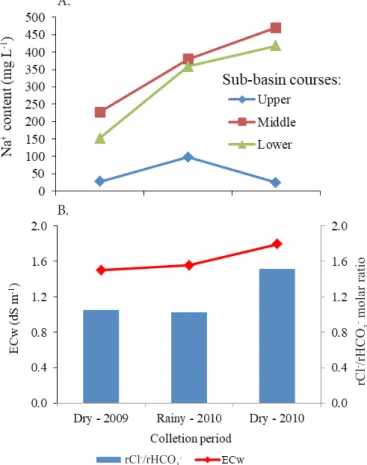
According to the spatial and temporal variation of Na+
along the Cobra River Sub-basin between the hydrological years (Figure 3A), the behavior was similar to that of ECw (Figure 2), indicating that it is strongly influenced by Na+.
Rodrigues et al. (2007) concluded that Na+ contents in waters
of ‘Amazonas’ wells of the Baixo Acaraú Irrigation District strongly influenced ECw values, and the contents of this cation can be used to estimate ECw.
The upper course has the lowest Na+ contents, and the
behavior of upper and middle courses had the same trajectory of growth along the collection periods (Figure 3A). It should be highlighted that, in the upper course, the waters undergo less evaporation, interact less with the rock and, generally, terrain gradients are more elevated and subjected to renewal, resulting in greater dilution.
The analysis of the rCl-/rHCO 3
- ionic ratio of the hydrological
years evidenced an increment in the last collection as the quantity of Cl- dissolved in the water increased (Figure 3B).
The increment in the rCl-/rHCO 3
- ionic ratio may be due
to the low rainfalls in the collection periods, which, resulting in low water levels in the underground reservoirs, increase the concentrations of organic matter (main source of Cl-) and
ECw for the points sampled in the middle and lower courses (Figure 2). The increase of drained area in these portions of the sub-basin, combined with the practice of grass planting by farmers for animal feed, probably influenced the accumulation of sediments.
According to the correlation matrix, there were higher correlations for ECw and Na+ (0.97) and for ECw and Cl- (0.96).
High correlations between ECw and the ions Na+ and Cl- are
expected, because this index represents the salts dissolved in the water (Palácio et al., 2011) and Cl- and Na+ ions were the
most abundant in the studied area (Table 2).
pH ECw NH4- Ca++ Mg++ Na+ K+ Fe+2 HCO3- SO2- Cl
-pH 1.00
ECw 0.11 1.00
NH4- 0.48 -0.27 1.00
Ca+2 0.23 0.71 0.11 1.00
Mg+2 0.56 0.63 -0.04 0.57 1.00
Na+ 0.17 0.97 -0.21 0.77 0.58 1.00
K+ -0.09 0.08 0.08 0.36 0.30 -0.06 1.00
Fe+2 -0.39 -0.20 -0.47 -0.21 -0.33 -0.19 0.05 1.00
HCO3- 0.41 -0.11 0.47 0.28 0.42 -0.12 0.42 -0.67 1.00
SO2- 0.18 0.57 -0.03 0.55 0.58 0.45 0.64 -0.49 0.50 1.00
Cl- 0.10 0.96 -0.32 0.71 0.56 0.98 -0.07 -0.07 -0.24 0.38 1.00
Table 2.Correlation matrix of the analysed variables in the Cobra River Sub-basin, RN
Figure 3. Seasonal evolution of Na+ content (A) and variation of the rCl-/rHCO
3
- molar ratio and ECw for the
groundwater (B) in the Cobra River Sub-basin, RN
B. A.
rCl-/rHCO 3
-rCl
-/rHCO
3
- molar ratio
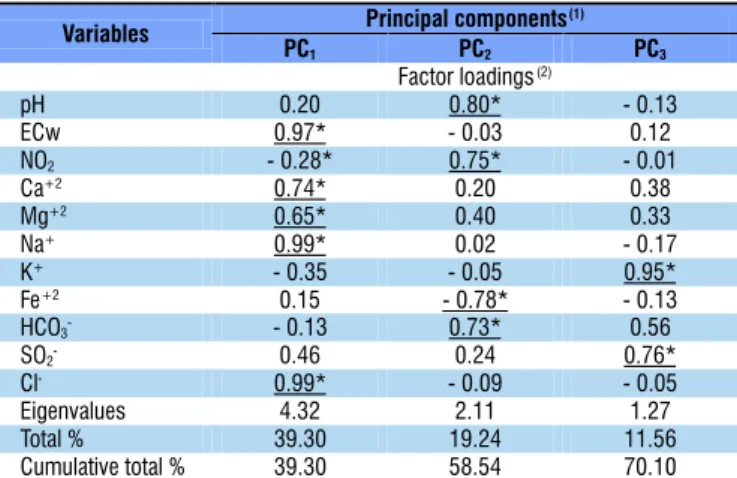
Regarding the principal components (Table 3), the model with best fit was the one that generated three principal components (PC) and, therefore, it was possible to identify or distinguish the main sources of hydrochemical variation, which together expressed 70.10% of the total variation existing in the sub-basin.
The cluster of the principal component 1 (PC1) grouped the variables ECw, Ca+2, Mg+2, Na+ and Cl-, and the principal
component was responsible for 39.3% of the total hydrochemical variation found in the sub-basin, which can be considered as the cluster with most important variables in terms of contribution to salinity, sodicity and toxicity by specific ions (Table 3).
It is worth highlighting the high factor loading of ECw and the ions Na+ and Cl- in this cluster, which leads to the
conclusion that ECw is strongly influenced by these two ions.
Brito et al. (2006) evaluated groundwater samples in the
Salitre River basin, BA, and found similar results analysing the relationship of the principal components, i.e., Na+ and Cl- ions
participated in the same ECw component.
The second principal component (PC2) has the ions NO2-,
HCO3- and Fe+2, besides pH, as the variables with highest factor
loadings. The ion HCO3-, besides being a product resulting
from silicate weathering, its origin is related to the presence of CO2 dissolved in the rainwater and biochemical activity via organic degradation. Because of the proximity and contact with the atmosphere, the alluvial aquifer tends to have higher contents of HCO3-, compared with confined aquifers (Souza
Neto et al., 2008).
Nitrate (NO3-) also has its origin related to non-geological
factors, being the most frequent form of N and the most common contaminant of underground and surface waters, because of its solubility and mobility in the aqueous solution (Jalali, 2007). Thus, it can be claimed that no signs of anthropic contamination were found in the studied sub-basin, since the
maximum value of nitrate (2.96 mg L-1) is much lower than
the maximum limit allowed by the Brazilian legislation, which is 10 mg L-1, according to CONAMA (1986).
The third member of this PC is composed of iron (Fe+3),
which may have its origin related to the weathering of biotite, very frequent in the local geology. However, remnants of organic plant residues and biosphere activity may have strong influence with the presence of iron (Fe+2) in the water. Another
remarkable characteristic of this ion, which corroborates with its possible source of organic origin, is its low mobility, because it is immediately complexed in the structure of the oxides-hydroxides formed in the soil. Thus, this principal component is strongly influenced by the presence of decomposing organic plant material existing along the alluvial aquifer.
The cluster PC3 has the contents of K+ and SO 2
-as the
components with highest factor loadings (0.78 and 0.73, respectively). K+ has low mobility and its contribution to
natural waters is always very modest due to the tendency to
be fixed in clay minerals and participate in the formation of secondary minerals (Jalali, 2007). This cluster also represents the influence of the local geology on the hydrochemical variation existing in the sub-basin.
Conclusions
1. Hydrochemical assessment results indicated that Na+ and
Cl- ions have greater influence on the salinization of the soils
in the Cobra River Sub-basin, RN.
2. Na+ and Cl- ions participated in the same ECw component
and showed the highest factor loadings.
Literature Cited
Bahia, V. E.; Fenzl, N.; Leal, L. R. B.; Mora-Les, G. P.; Luíz, J. G. Caracterização hidrogeoquímica das aguas subterrâneas na área de abrangência do reservatório de abastecimento público do Utinga - Belém (PA). Revista Águas Subterrâneas, v.25, p.1-14, 2011.
Barroso, A. de A. F.; Gomes, G. E.; Lima, A. E. de O.; Palácio, H. A. de Q.; Lima, C. A. de. Avaliação da qualidade da água para irrigação na região centro sul no estado do Ceará. Revista Brasileira de Engenharia Agrícola e Ambiental, v.15, p.588–593, 2011. https:// doi.org/10.1590/S1415-43662011000600008
Brito, L. T. de; Silva, A. de S.; Srinivasan, V. S.; Galvão, C. de O.; Gheyi, H. R. Uso de análise multivariada na classificação das fontes hídricas subterrâneas da bacia hidrográfica do Salitre. Engenharia Agrícola, v.26, p.36-44, 2006. https://doi.org/10.1590/ S0100-69162006000100005
CONAMA - Conselho Nacional de Meio Ambiente. Resolução nº 20, 18 de junho de 1986. Brasília: SEMA, 1986, 92p.
EMBRAPA - Empresa Brasileira de Pesquisa Agropecuária. Manual de análises de solos, plantas e fertilizantes. 1.ed. Rio de Janeiro: Centro Nacional de Pesquisa em Solos, 1999, 370p.
EMPARN - Empresa de Pesquisa Agropecuária do Rio Grande do Norte. Caracterização dos recursos naturais da bacia do Rio Cobra, município de Parelhas-RN. Natal: EMPARN, 2009. 35p. Relatório Técnico
HACH. Water analysis handbook, Loveland, Colorado, 2002. p.61-62. Jalali, M. Assessment of the chemical components of famenin
groundwater, western Iran. Environment Geochemical and Health, v.29, p.357-374, 2007. https://doi.org/10.1007/s10653-006-9080-y
Lima, A. de O.; Lima Filho, F. P.; Dias, N. da S.; Rego, P. R. do A.; Blanco, F. F.; Ferreira Neto, M. Mechanisms controlling surface water quality in the Cobra River Sub-Basin, northeastern Brazil. Revista Caatinga, v.30, p.181-189, 2017. https://doi. org/10.1590/1983-21252017v30n120rc
Nosrati, K.; Eeckhaut, M. van der. Assessment of groundwater quality using multivariate statistical techniques in Hashtgerd Plain, Iran. Environmental Earth Sciences, v.65, p.331-344, 2012. https://doi. org/10.1007/s12665-011-1092-y
Oliveira, G. A.; Nascimento, E. L. do; Rosa, A. L. D. da; Lauthartte, L. C.; Bastos, W. R.; Barros, C. G. D.; Cremonese, E. R.; Bent, A. Q.; Malm, O.; Georgin, J.; Corti, A. M. Avaliação da qualidade da água subterrânea: Estudo de caso de Vilhena – RO. Águas Subterrâneas, v.29, p.213-223, 2015.
Table 3. Principal components (PC) for groundwater and their respective factor loadings, total variance and cumulative total variance rotated by the Varimax method
Variables Principal components
(1)
PC1 PC2 PC3
Factor loadings(2)
pH 0.20 0.80* - 0.13
ECw 0.97* - 0.03 0.12
NO2 - 0.28* 0.75* - 0.01
Ca+2 0.74* 0.20 0.38
Mg+2 0.65* 0.40 0.33
Na+ 0.99* 0.02 - 0.17
K+ - 0.35 - 0.05 0.95*
Fe+2 0.15 - 0.78* - 0.13
HCO3- - 0.13 0.73* 0.56
SO2- 0.46 0.24 0.76*
Cl- 0.99* - 0.09 - 0.05
Eigenvalues 4.32 2.11 1.27
Total % 39.30 19.24 11.56
Cumulative total % 39.30 58.54 70.10
Palácio, H. A. Q.; Araújo Neto, J. R.; Meireles, A. C. M.; Andrade, E. M.; Santos, J. C. N.; Chaves, L. C. G. Similaridade e fatores determinantes na salinidade das águas superficiais do Ceará, por técnicas multivariadas. Revista Brasileira de Engenharia Agrícola e Ambiental, v.5, p.395-402, 2011. https://doi.org/10.1590/S1415-43662011000400011
Patel, K. P.; Pandaya, R. R.; Maliwal, G. L.; Patel, K. C.; Ramani, V. P.; George, V. Heavy metal content of different effluents and their relative availability in soils irrigated with effluent waters around major industrial cities of Gujarat. Journal of the Indian Society of Soil Science v.52, p.89-94, 2004.
Porto Filho, F. Q. de; Medeiros, J. F. de; Gheyi, H. R.; Dias, N. da S.; Sousa, P. S. de; Dantas, D. da C. Evolução da salinidade e do pH de solo sob cultivo de melão irrigado com água salina. Revista Brasileira de Engenharia Agrícola e Ambiental, v.15, p.1130-1137, 2011. http://dx.doi.org/10.1590/S1415-43662011001100004
Rattan, R. K.; Datta, S. P.; Chhonkar, P. K.; Suribabu, K.; Singh, A. K. Long-term impact of irrigation with waste water effluents on heavy metal content in soils, crops and groundwater - A case study. Agriculture, Ecosystems & Environment, v.109, p.310-322, 2005. https://doi.org/10.1016/j.agee.2005.02.025
Rodrigues, J. O.; Andrade, E. M. de; Crisóstomo, L. A.; Teixeira, A. dos S. Modelos da concentração iônica em águas subterrâneas no Distrito de Irrigação Baixo Acaraú. Revista Ciência Agronômica, v.38, p.360-365, 2007.
Sá, E. F. J. de. Mapa geológico do Estado do Rio Grande do Norte. 1: 500.000. Natal: DNPM/UFRN/PETROBRÁS/CPRM, 1998. Souza Neto, J. A.; Legrand, J. M.; Volfinger, M.; Pascal, M. L.; Sonnet,