T
T
h
h
e
e
S
S
u
u
b
b
p
p
r
r
i
i
m
m
e
e
C
C
r
r
i
i
s
s
i
i
s
s
a
a
n
n
d
d
t
t
h
h
e
e
G
G
l
l
o
o
b
b
a
a
l
l
P
P
u
u
b
b
l
l
i
i
c
c
P
P
o
o
l
l
i
i
c
c
y
y
R
R
e
e
s
s
p
p
o
o
n
n
s
s
e
e
E
Em
ma
an
nu
ue
el
l
R
R.
.
L
L
eã
e
ão
o
P
P
ed
e
dr
ro
o
R
R.
.
L
L
eã
e
ão
o
2
2
0
0
1
1
2
2
W
W
P
P
n
n
.
.
º
º
2
2
0
0
1
1
2
2
/
/
1
1
6
6
DOCUMENTO DE TRABALHO WORKING PAPER*
Departament of Political Economy, ISCTE- Lisbon University Institute and DINAMIA’CET - IUL, Av.das Forcas Armadas, 1649-026 Lisboa, Portugal – Phone: 00351217903490; Fax: 00351217964710e-mail: [email protected]
**
Department of Economics, Technical University of Lisbon - Instituto Superior de Economia e Gestão, and UECE, Rua Miguel Lupi, No 20, 1200 Lisboa, Portugal - e-mail: [email protected].The Subprime Crisis and the Global Public Policy
Response
Emanuel R. Leão
*
Pedro R. Leão
**
WP n.º 2012/16
1. INTRODUCTION ... 3
2. THE ROOT CAUSES OF THE CRISIS ... 4
3. RESPONSE TO THE CRISIS: GENERAL OVERVIEW ... 9
4. THE DECISION PROCESS ... 10
5. DETAILED MEASURES REGARDING REGULATION ... 11
6. CONCLUDING REMARKS ... 13
2
DINÂMIA’CET – IUL, Centro de Estudos sobre a Mudança Socioeconómica e o Território ISCTE-IUL – Av. das Forças Armadas, 1649-026 Lisboa, PORTUGAL
Tel. 210464031 - Extensão 293100 E-mail: [email protected] www.dinamiacet.iscte.pt
The subprime crisis and the Global Public Policy
Response
ABSTRACT
In this paper, we look at the root causes of the 2007-2009 subprime financial crisis and its consequences. We then examine the way public authorities responded to the crisis. We emphasize the fact that, from the start, public policy developed along two complementary, but distinct, lines: (i) short term macroeconomic management; (ii) medium to long term reshaping of the financial regulation framework. We point out that the decision process occurred as a global approach instead of having worked at the national level; and we mention the details of this process. Finally we examine the detailed measures concerning required capital ratios, bank liquidity and bank leverage requirements, transparency measures and bankers bonuses proposals.
Keywords: subprime financial crisis; macroeconomic policy; financial regulation.
3
DINÂMIA’CET – IUL, Centro de Estudos sobre a Mudança Socioeconómica e o Território ISCTE-IUL – Av. das Forças Armadas, 1649-026 Lisboa, PORTUGAL
Tel. 210464031 - Extensão 293100 E-mail: [email protected] www.dinamiacet.iscte.pt
1. INTRODUCTION
The 2007-2009 crisis had its origins in the financial sector. In fact, excess of bank credit and excess of risk taking led to huge defaults on bank loans which in turn generated mistrust inside the financial system (due to the fact that many of these loans had been securitized and sold throughout the financial system).
Regulatory failures were also responsible for the crisis. As examples, we could cite the proliferation of informal “over the counter” trading – which made it difficult to see the owners of each asset thus contributing to the general mistrust – and the practice of loan securitization by banks which allowed them to sell the loans to institutions, like hedge funds, not subject to capital requirement ratios (thus evading the already loose controls on the banks’ ability to leverage).
When distrust inside the financial system led to the freezing of interbank markets, the banking system’s ability to supply loans to firms and households was strongly affected and, from this moment, the crisis started to affect the real economy. Forward looking financial markets, anticipating the impact on the economy, initiated a plunge which made household wealth fall (further undermining private demand). On the other hand, banks who had taken over houses for unpaid loans wanted to sell these houses thus creating downward pressure on house prices and reinforcing the damage to household wealth and consumption.
The G20 response to the crisis was in two fronts. First, there was a decision to compensate for the fall in private demand by increasing public expenditure. This, coupled with the lowering of interest rates by central banks, which made loans cheaper, stemmed the collapse of aggregate demand. Second, the root causes of the crisis started being addressed. Of these, we would single out: (i) the proposed increase in capital ratios and a more rigorous understanding of what counts as capital; (ii) the initiative to transform informal trading into formal exchanges of which records are taken (quantities, prices and asset owners); (iii) the attempt to link bankers bonuses to the medium term performance of the financial institutions they serve (with the aim of discouraging risk taking that may generate big profits in the short term but lead to the collapse of those institutions in the medium term).
The G20 has asked the IMF to asses the specific macroeconomic packages of each individual country. On the other hand, the G20 has asked the Basel Committee to put forward specific proposals on the three areas – see above - where regulatory changes are most needed.
While the ideas we have exposed so far have been widely present in the literature – e.g. Goodhart (2008), Reinhart and Rogoff (2008), Wolf (2008), Hellwig (2009), Krugman (2012) – we try to present a synthesis of our own and be slightly more specific on some key issues.
4
DINÂMIA’CET – IUL, Centro de Estudos sobre a Mudança Socioeconómica e o Território ISCTE-IUL – Av. das Forças Armadas, 1649-026 Lisboa, PORTUGAL
Tel. 210464031 - Extensão 293100 E-mail: [email protected] www.dinamiacet.iscte.pt
The structure of the article is as follows. Section 2 examines the root causes of the financial crisis and explains how the problems in the financial sector started affecting the real economy. Section 3 summarizes the public policy response. Section 4 looks at the decision process centred on the G20. Section 5 examines the detailed measures in terms of financial regulation. Section 6 concludes.
2. THE ROOT CAUSES OF THE CRISIS
In modern economies, both bank and nonbank firms operate using: (i) funds supplied by the owners/shareholders of the firm; (ii) non-distributed profits; (iii) funds borrowed from banks or from the bond markets.
Banks are a special type of firm because they also rely on their ability to create money. In the case of banks, the capital supplied by the owners corresponds to a very tiny fraction of the total amount of funds they use. In other words, they operate with a high degree of leverage.
In the years that preceded the crisis - when everything was going well – several developments and practices evolved that contained dangerous elements and proved unsustainable.
First, American banks engaged in a process of extending credit as much as possible and ended up making loans in huge amounts to high risk individuals – those belonging to the so called
subprime segment of the loans market. The incentives that led them to follow this route were
clear: the voracious search for new costumers; the fact that the rate of interest charged to high risk borrowers is higher – it includes a risk premium – which means high returns in the short term (before default rates start to increase); the fact that the bonuses of bank managers were linked to the short term performance of the bank; the fact that securitization and other techniques allowed managers to transfer risk to third parties (the good ratings attributed to some of these financial products helped hide their bad quality).
Second, banks and other financial institutions had no problem in rolling over their debts: whenever a loan they had obtained in the past reached maturity, it was easy to find a new loan to pay and replace the previous one - and so they started taking this ability to rollover for granted. So what did disrupt this equilibrium state where everything seemed to be working fine? Subprime borrowers started defaulting on their loans is huge amounts. Since these loans had been securitized – i.e., broken into small slices with each slice then attached to a security – the value of these securities fell abruptly (because they stood for the loans) causing big losses on those who held them. People started calling them “toxic assets”, because they could cause the death (bankruptcy) of the owners. Because informal over-the-counter trading had rocketed before the crisis, it was virtually impossible to know who held those “toxic assets” and this led
5
DINÂMIA’CET – IUL, Centro de Estudos sobre a Mudança Socioeconómica e o Território ISCTE-IUL – Av. das Forças Armadas, 1649-026 Lisboa, PORTUGAL
Tel. 210464031 - Extensão 293100 E-mail: [email protected] www.dinamiacet.iscte.pt
to widespread mistrust among financial institutions. Whenever a financial institution was asked to make a loan to another financial institution, it did not want to lend for fear the other might be holding huge amounts of “toxic assets” and so could go bankrupt overnight. It was like treading a mine field: nobody knew when the next financial institution, burdened with “toxic assets”, would implode. In this context of mistrust, financial institutions that rely significantly on rolling over their debts get into serious trouble when trying to find new lenders and- in the cases where they can’t obtain the funds they need – find themselves unable to fulfil their obligations (if, as is common with financial institutions, the capital base is too short when compared to their commitments). In other words, they go bankrupt. Several banks entered the bankruptcy stage, one after the other in a short period of time: Bear Sterns, Fannie Mae, Freddy Merck, in the US; and Northern Rock in the UK are notable examples1. When in September 2008 the American investment bank Lehman Brothers started having problems and the American government decided neither to nationalise it nor to support an acquisition by another bank – Barclays, of the UK, said it was interested provided the US government gave some guarantees – the 158 year old bank had to file for bankruptcy. The consequence was brutal: mistrust inside the financial world was transformed into panic; not only did we have dozens of banks laden with financing problems but also the evidence was there, open to anyone, that governments do not always support ailing financial institutions. This widespread fear caused a steep fall in interbank lending - some segments of the interbank market even disappeared, specially the ones for longer maturities – and interbank interest rates increased sharply due to the rise in risk premia2. In this context, the ability of the banking system to provide loans to companies and households was severely damaged and so - from this moment - the problems in the financial sector started affecting the real economy. Banks started being more rigorous in supplying loans and started charging higher interest rates on these loans.
Forward looking equity markets, anticipating the damage to the real economy in the months ahead, initiated a fall which depressed household wealth thus creating pessimism which translated into less consumption (savings increase when people fear the future).
1 The first was bought by another American bank; the other three were nationalised.
2 The story almost repeated itself in Europe in the first half of 2010, with the Treasury Bonds of Greece,
6
DINÂMIA’CET – IUL, Centro de Estudos sobre a Mudança Socioeconómica e o Território ISCTE-IUL – Av. das Forças Armadas, 1649-026 Lisboa, PORTUGAL
Tel. 210464031 - Extensão 293100 E-mail: [email protected] www.dinamiacet.iscte.pt
Figure 1: S&P 500 Stock Price Index
Source: Federal Reserve Economic Data (FRED), Federal Reserve Bank of St. Louis, USA.
Since consumption amounts to about two thirds of total expenditure in the US, aggregate demand fell significantly.
Figure 2: Real Retail Sales in the US
Source: Federal Reserve Economic Data (FRED), Federal Reserve Bank of St. Louis, USA.
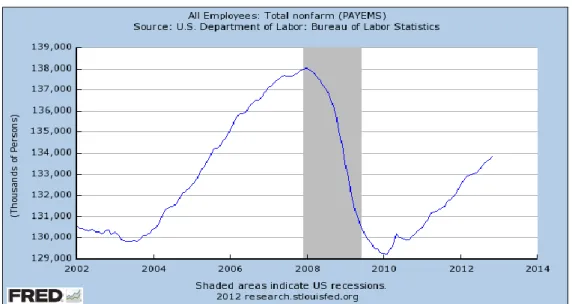
Facing difficulty in obtaining bank credit and less demand for their products – which materialised in increasing stocks of unsold goods – firms started cutting production and investment and firing workers.
7
DINÂMIA’CET – IUL, Centro de Estudos sobre a Mudança Socioeconómica e o Território ISCTE-IUL – Av. das Forças Armadas, 1649-026 Lisboa, PORTUGAL
Tel. 210464031 - Extensão 293100 E-mail: [email protected] www.dinamiacet.iscte.pt
Figure 3: Real GDP in the US
Source: Federal Reserve Economic Data (FRED), Federal Reserve Bank of St. Louis, USA.
Figure 4: Real Gross Private Domestic Investment in the US
8
DINÂMIA’CET – IUL, Centro de Estudos sobre a Mudança Socioeconómica e o Território ISCTE-IUL – Av. das Forças Armadas, 1649-026 Lisboa, PORTUGAL
Tel. 210464031 - Extensão 293100 E-mail: [email protected] www.dinamiacet.iscte.pt
Figure 5: Nonfarm Payrolls in the US
Source: Federal Reserve Economic Data (FRED), Federal Reserve Bank of St. Louis, USA.
This further increased the fall in consumption which coupled with less investment translated into lower and lower aggregate demand.
Meanwhile, the selling of houses - by banks who had taken them as collateral - and the tightening of credit were having its effects on housing market prices, which over the crisis fell by more than 20%.
Figure 6: Case Shiller Home Price Index in the US
Source: Federal Reserve Economic Data (FRED), Federal Reserve Bank of St. Louis, USA.
Because for American households homes are a significant part of their wealth, the fall in the price of housing made them feel even less wealthy and this was another factor putting downward pressure on consumption and aggregate demand.
9
DINÂMIA’CET – IUL, Centro de Estudos sobre a Mudança Socioeconómica e o Território ISCTE-IUL – Av. das Forças Armadas, 1649-026 Lisboa, PORTUGAL
Tel. 210464031 - Extensão 293100 E-mail: [email protected] www.dinamiacet.iscte.pt
3. RESPONSE TO THE CRISIS: GENERAL OVERVIEW
The way authorities responded to the crisis may be summarized in the following way:
- Macroeconomic policy measures: the immediate response was to stem the fall in
aggregate demand using standard instruments of macroeconomic policy (governments increased public expenditure; central banks lowered interest rates to stimulate private expenditure);
- Financial regulation changes: almost simultaneously, a strategy started do develop to
address the root causes of the crisis (banks operating with excessive leverage; securitization and other forms of transferring risk created an incentive to increase risk exposure; the pay structure of bank managers; the informality of many transactions);
Before going into greater detail on these measures, it should be remembered that the major world economies were wise enough to recognize that it was important to involve the big emerging economies in the shaping of commitments to be adopted. The BRICS, Turkey, South Africa, and another seven countries together with the G-7 countries constitute the G-20 (group of twenty). In terms of macroeconomic policy, the coordination is important because if, for example, all countries except China did increase public expenditure and lower interest rates, the result would be a rise in demand which would greatly benefit Chinese exports to these countries. China would be obtaining benefits without bearing the costs and without rewarding the others by creating demand for their goods. Regarding the changes in financial regulation, some kind of coordination is needed to avoid creating competitive advantages in the financial laws of one country which would lead financial institutions to transfer operations to that country. If, as an example, one country decided to set bank capital requirements less stringent than the rest, many banks would move to that country to escape the heavier requirements.
The deepening of the financial crisis created by the Lehman Brothers bankruptcy in September 2008 led to an emergency meeting of the G-7 in October where the then US President George W. Bush defended the need of a G-20 meeting to respond to the crisis. In this context, the then UK prime minister Gordon Brown – who, has chancellor of the Exchequer, had witnesses the usefulness of the G-20 forum - suggested that the gravity of the situation recommended the meeting of the G-20 should take place at the level of heads of state (instead of taking place, as usual, at the level of finance ministers and central bank governors). This proposal was adopted and the heads of state of the G-20 met in November in Washington. This meeting was followed by other G-20 meetings at the level of head of state: April 2009 (in
10
DINÂMIA’CET – IUL, Centro de Estudos sobre a Mudança Socioeconómica e o Território ISCTE-IUL – Av. das Forças Armadas, 1649-026 Lisboa, PORTUGAL
Tel. 210464031 - Extensão 293100 E-mail: [email protected] www.dinamiacet.iscte.pt
London; with special emphasis on the coordination of macroeconomic policy); September 2009 (in Pittsburgh; to discuss financial regulation and assess the results of the macro policy measures); June 2010 (in Toronto); November 2010 (in Seoul); November 2011 (in Cannes); June 2012 (in Los Cabos).
4. THE DECISION PROCESS
As we have seen, the G-20 has become the premier forum for international economic policy coordination.
It is a forum where the main policy directions are adopted both in terms of macroeconomic policy and of financial regulation. However, because it is, after all, an informal platform – there are no offices and permanent support staff –, the G-20 relies on the IMF and on the Financial Stability Board (FSB) based in Basel, Switzerland, for the details of the conception, implementation and assessment of the policy guidelines it sets. Although finance ministries and central banks are also involved in the process, the coordination is by the IMF and FSB.
The IMF uses its expertise to examine the coordination and the overall coherence of the macroeconomic policies of G-20 countries. This includes not only monetary and fiscal policy but also an analysis of several types of imbalances that may arise in several countries (excessive public deficits and public debt, big current account deficits and external debt, exchange rate behaviour).
The FSB3 is asked to come forward with detailed proposals for implementation of the policy objectives in terms of financial regulation; and to monitor the compliance of each country to the agreed orientations and rules.
3 The FSB, located in Basel, Switzerland, is hosted by the Bank for International Settlements. It aims to
promote the implementation of effective regulatory and supervisory financial sector policies. It differs from the Basel Committee on Banking Supervision (a forum to improve the quality of banking supervision worldwide).
11
DINÂMIA’CET – IUL, Centro de Estudos sobre a Mudança Socioeconómica e o Território ISCTE-IUL – Av. das Forças Armadas, 1649-026 Lisboa, PORTUGAL
Tel. 210464031 - Extensão 293100 E-mail: [email protected] www.dinamiacet.iscte.pt
5. DETAILED MEASURES REGARDING REGULATION
In this section, we look in detail at some of the main measures regarding regulation: (i) New rules in terms of the requires capital ratio, bank liquidity and bank leverage; (ii) Increase transparency in transactions; and (iii) Introduction of a cap on bankers’ bonuses.
New rules in terms of the required capital ratio, bank liquidity and bank leverage
The Basel III Accord4 - agreed in 2011 and to be implemented from 2013 until 2018 - constitutes a new global regulatory standard on bank capital adequacy, stress testing and market liquidity risk agreed upon by the members of the Basel Committee on Banking Supervision (BCBS) . As a response to the deficiencies in financial regulation revealed by the financial crisis, Basel III strengthens bank capital requirements and introduces new regulatory requirements on
bank leverage and bank liquidity.
As is well known, banks are required to set aside a certain amount of capital (in proportion to the loans and investments they make). It has been considered of utmost importance to increase both the quantity and the quality of the capital banks hold.
In terms of the quantity of capital, Basel III recommends that – as a percentage of risk-weighted assets – there should be an increase in the minimum threshold of common stock from 2% to 4,5%; and an increase from 4% to 6% in terms of tier-1 capital - common stock plus retained earnings – also as a percentage of risk-weighted assets. It also proposes the introduction of additional capital buffers: (i) a compulsory “Capital Conservation Buffer” of 2.5% (composed only of common stock) and (ii) a discretionary “Countercyclical Buffer”, which allows national regulators to require up to another 2.5% of common stock capital during periods of high credit growth.
In terms of the quality of capital, the core tier-1 ratio can now only be built using common stock issued by the bank plus retained earnings. The tier-2 ratio should be harmonized across countries. The need for these measures stems from the fact that in the years that preceded the onset of the financial crisis a deterioration in the quality of capital eligible took place. For example, subordinate bonds – bonds issued by the banks which offer little protection for investors in the case of default – were considered equivalent to capital (now they will only be considered if they have loss-absorption features in the sense that bond holders be protected – e.g.
4 The Basel Accords refer to the recommendations on banking regulations and supervision —Basel Accord
I, Basel Accord II and Basel Accord III—issued by the Basel Committee on Banking Supervision (BCBS). They are called the Basel Accords because the BCBS maintains its secretariat at the Bank for International Settlements in Basel, Switzerland and the committee normally meets there. The BCBS consists of representatives from central banks and regulatory authorities of the G-20 countries as well as some other major banking centers such as Hong Kong and Singapore. The committee does not have the authority to enforce recommendations, although most member countries as well as some other countries tend to implement the Committee's policies. This means that recommendations are enforced through national laws and regulations, rather than as a result of the committee's recommendations. (source: Wikipedia)
12
DINÂMIA’CET – IUL, Centro de Estudos sobre a Mudança Socioeconómica e o Território ISCTE-IUL – Av. das Forças Armadas, 1649-026 Lisboa, PORTUGAL
Tel. 210464031 - Extensão 293100 E-mail: [email protected] www.dinamiacet.iscte.pt
by conversion to equity – before public money needs to be used). The same was true of projected earnings which the bank could register as retained earnings and thus as a component of bank capital.
In addition, Basel III introduces a minimum 3% bank leverage ratio – tier 1 capital over total loans – which means loans can only be extended up to 33 times the capital base.
Finally, two required liquidity ratios are suggested : (i) The “Liquidity Coverage Ratio” requires a bank to hold sufficient high quality easy-to-sell assets, such as government bonds, to cover what its clients might be expected to withdraw over 30 days in a crisis (important in times of crisis when many depositors flee and many potential lenders stop lending); (ii) the “Net Stable Funding Ratio” requires the bank to hold an amount of stable funding – i.e., obtained from long term financial instruments - to exceed the amount of stable funding needed over a one-year period of extended stress. In other words, banks should rely less on short term sources of funding which in times of crisis may turn out to be difficult to rollover.
Banks have said these increased requirements augment the costs associated with supplying loans and will thus end up reducing credit growth, both directly and indirectly (by forcing them to increase interest rates). As a consequence, the real economy will be affected. In our view, the financial crisis made clear there was a real need to strengthen the financial system. Even banks that had capital ratios above the legal requirement entered bankruptcy stages – due to problem loans and/or the fall in the price of the securities they held - and were ultimately bought by other banks or bailed out by the government.
On the one hand, we need a more resilient financial system. On the other hand, we should avoid excessive damage to credit growth which may contribute to new recessions. The right balance is difficult to achieve. Some economic growth will have to be sacrificed in order to create a more robust financial system. This in turn will in the future create a world with fewer financial crisis and more stable economic growth.
The long transition period 2013-2019 will allow banks to adjust gradually to the new requirements. In particular, they will be able to use retained profits over the period to strengthen their capital base. As a consequence, the effect on the supply of credit to the economy should not be a major problem.
Increase transparency in transactions
The outbreak of the crisis was closely linked to the degree of mistrust that grew within the financial system in the aftermath of the Lehman Brother bankruptcy. This mistrust spread easily because, in the period that preceded the crisis, informal operations – trades between financial institutions with no public disclosure - became common practice. In this context, to know which
13
DINÂMIA’CET – IUL, Centro de Estudos sobre a Mudança Socioeconómica e o Território ISCTE-IUL – Av. das Forças Armadas, 1649-026 Lisboa, PORTUGAL
Tel. 210464031 - Extensão 293100 E-mail: [email protected] www.dinamiacet.iscte.pt
institutions were exposed to risky positions became an impossible task. This accelerated the growth of mistrust. In particular, the securitization of credits and ensuing sale of the securitized credits throughout the world’s financial system made it impossible to know who was holding them (in other words, who was holding securities whose value fell to zero when the underlying loans suffered default). Thus, the new securitized loans were baptized “toxic financial assets” because whoever was holding them was holding something which could cause its bankruptcy. And the world financial system became a “minefield” where mistrust reigned.
The consequence in terms of regulation was that proposals emerged to make compulsory the trading of derivatives – including securitized loans - in organized and transparent formal markets (where the quantities, traders and prices are made publicly available). In short, we witnessed a big move against informal trading.
This move towards transparent trading and central clearing for standardized derivatives was accompanied by measures to give the regulators instruments to sanction the abuse of power and market manipulation.
Introduction of a cap on bankers’ bonuses
As explained above, the excess of risk taking - which was one of the key factors behind the crisis - happened in part because bankers had an incentive to enter “high risk-high return” activities (their bonuses were linked to the current year earnings of the bank, not its long term performance). As a consequence, proposal emerged to cap bankers bonuses and link them to the medium to long term results of the bank.
On the 13th of December 2012, the European Union started debating a proposal from the European Parliament to limit bankers’ bonuses to a maximum of two times the fixed salary.
6. CONCLUDING REMARKS
The 2007- 2009 subprime financial crisis was a strong event. While explanations of the business cycle giving emphasis to excess of credit as the main cause are old, this crisis had specificities of its own and the public policy response was likewise new in many aspects. We tried to explain the details of the decision process and show that the response to the crisis evolved on two dimensions: macroeconomic policy and financial regulation measures.
This crisis should remind us of the perils of excess liberalization. In fact, it happened after several decades of a liberalizing drive which fundamentally changed the legal framework of the financial system.
Since the crisis officially ended in 2009, it would be interesting to relate it to the ensuing eurozone sovereign debt crisis.
14
DINÂMIA’CET – IUL, Centro de Estudos sobre a Mudança Socioeconómica e o Território ISCTE-IUL – Av. das Forças Armadas, 1649-026 Lisboa, PORTUGAL
Tel. 210464031 - Extensão 293100 E-mail: [email protected] www.dinamiacet.iscte.pt
REFERENCES
Buiter, W. (2008). What G20 Leaders Must Do to Stabilise our Economy and Fix the Financial System, Barry Eichengreen and Richard Baldwin (eds.), London, Centre For Economic Policy Research.
Goodhart, C. (2008). The regulatory response to the financial crisis. CESifo working paper, No 2257.
Hellwig, M. (2009). “Systemic Risk in the Financial Sector: an Analysis of the Subprime-Mortgage Financial Crisis”, De Economist 157: 129 – 207.
Koo, R. C. (2008). The Holy Grail of Macroeconomics: Lessons from Japan’s Great Recession, Singapore, John Wiley & Sons, Inc.
Krugman, P. (2012). End this Depression Now, New York, W. W. Norton & Company, Inc.
Reinhart, C. and Rogoff, K. (2008). “Is the 2007 U. S. Sub-Prime Financial Crisis So Different? An International Historic Comparison”, NBER Working Paper No 13761.
Shiller, R. J. (2008). The Subprime Solution: How Today’s Global Financial Crisis Happened
and What to do About It, New Jersey, Princeton University Press.
Wolf, M. (2008). Fixing Global Finance, Baltimore Maryland, The John Hopkins University Press.