International Journal of Operations & Production Management
Supply chain resilience: the whole is not the sum of the partsMarcelo Martins de Sá, Priscila Laczynski de Souza Miguel, Renata Peregrino de Brito, Susana Carla Farias Pereira,
Article information:
To cite this document:Marcelo Martins de Sá, Priscila Laczynski de Souza Miguel, Renata Peregrino de Brito, Susana Carla Farias Pereira, (2019) "Supply chain resilience: the whole is not the sum of the parts", International Journal of Operations & Production Management, https://doi.org/10.1108/IJOPM-09-2017-0510 Permanent link to this document:
https://doi.org/10.1108/IJOPM-09-2017-0510 Downloaded on: 03 June 2019, At: 12:29 (PT)
References: this document contains references to 51 other documents. To copy this document: [email protected]
Access to this document was granted through an Emerald subscription provided by emerald-srm:606159 []
For Authors
If you would like to write for this, or any other Emerald publication, then please use our Emerald for Authors service information about how to choose which publication to write for and submission guidelines are available for all. Please visit www.emeraldinsight.com/authors for more information.
About Emerald www.emeraldinsight.com
Emerald is a global publisher linking research and practice to the benefit of society. The company manages a portfolio of more than 290 journals and over 2,350 books and book series volumes, as well as providing an extensive range of online products and additional customer resources and services.
Emerald is both COUNTER 4 and TRANSFER compliant. The organization is a partner of the Committee on Publication Ethics (COPE) and also works with Portico and the LOCKSS initiative for digital archive preservation.
*Related content and download information correct at time of download.
Supply chain resilience: the whole
is not the sum of the parts
Marcelo Martins de Sá and Priscila Laczynski de Souza Miguel
Department of Operations Management, Fundacao Getulio Vargas, Sao Paulo, Brazil
Renata Peregrino de Brito
IAG Business School,
Pontificia Universidade Catolica do Rio de Janeiro, Rio de Janeiro, Brazil, and
Susana Carla Farias Pereira
Department of Operations Management, Fundação Getulio Vargas, São Paulo, Brazil
Abstract
Purpose– The purpose of this paper is to investigate how resilience at different nodes in the supply chain influences overall supply chain resilience (SCRES) during an extreme weather event.
Design/methodology/approach– Based on 41 in-depth interviews, this qualitative study examines two Brazilian agri-food supply chains (AFSC). The interviews explored the impacts, preparedness, response and adaptation strategies adopted by farmers, processors and manufacturers during Brazil’s extreme drought of 2014–2015.
Findings– SCRES does not depend on all organizations in the supply chain but rather on the company able to reconfigure the resources to control for the disruption. In a supply chain with low interdependence among players, individual firm resilience elements might be preferable to interorganizational ones.
Research limitations/implications – This study is based on the context of AFSCs with low interdependence among players and during the experience of a climatic event. The results might not be generalizable to other sectors and phenomena.
Practical implications – Firms must evaluate their positions in supply chains and their interfirm relationships to determine which resilience strategy to invest in and rely on. Moreover, to leverage resilience at the supply chain level, firms must intensify information sharing and improve proactive resilience strategies upstream as well as downstream in the supply chain.
Originality/value – This study presents a broader perspective of resilience by comparing resilience elements at both the node and supply chain levels and by discussing their interactions and trade-offs. Keywords Resilience, Case study, Agri-food supply chain
Paper type Research paper
1. Introduction
The increasing frequency and impact of unexpected adverse events have led researchers and practitioners to shift from a traditional risk management approach to the resilience approach ( Jüttner and Maklan, 2011; Pettit et al., 2013). Resilience enables systems to cope with the unexpected (van der Vegt et al., 2015) and to ensure continuity of operations and delivery to final customers (Christopher and Peck, 2004; Ponomarov and Holcomb, 2009; Stone and Rahimifard, 2018). Although resilience seems to engage all organizations in a system, rarely has it been investigated how each part contributes to the overall process, such as in the context of supply chains.
Since organizations are interconnected, their interdependencies can magnify the consequences of local events and cause disruptions across the whole supply chain ( Jüttner et al., 2003; van der Vegt et al., 2015; Stone and Rahimifard, 2018). Building resilience is strategic and helps organizations anticipate disruptions and adapt to new post-event states (Ponomarov and Holcomb, 2009; Ali et al., 2017). However, resilience strategies implemented at individual nodes can be detrimental to upstream or downstream
International Journal of Operations & Production Management © Emerald Publishing Limited 0144-3577 DOI 10.1108/IJOPM-09-2017-0510 Received 4 September 2017 Revised 5 March 2018 2 July 2018 14 September 2018 11 December 2018 11 January 2019 12 February 2019 Accepted 19 February 2019
The current issue and full text archive of this journal is available on Emerald Insight at: www.emeraldinsight.com/0144-3577.htm
Supply chain
resilience
stages and may not contribute to the creation of a stronger supply chain (Tukamuhabwa et al., 2015; Stone and Rahimifard, 2018). Despite that, the literature on supply chain resilience (SCRES) has focused on the organizational level ( Jüttner, 2005), particularly on focal companies, which are usually in a position to structurally influence the supply chain (Christopher and Peck, 2004; Wieland and Wallenburg, 2013; Brandon-Jones et al., 2014; Tukamuhabwa et al., 2017). Thus, while investigating the effects from the perspective of focal firms, the study of SCRES might overlook consequences for the overall supply chain. Another gap relates to the development of resilience elements at the different phases of preparedness, response, recovery and adaptation (Hohenstein et al., 2015; Tukamuhabwa et al., 2015; Kamalahmadi and Parast, 2016; Ali et al., 2017). Resilience elements are management practices that support SCRES capabilities, such as flexibility, redundancy, collaboration, visibility and velocity (Ponis and Koronis, 2012; Hohenstein et al., 2015; Tukamuhabwa et al., 2015). Each phase requires the development of different elements that can be implemented by firms individually or at the supply chain level. To date, there is no empirical evidence that all resilience elements are relevant in all different supply chains (Stone and Rahimifard, 2018). Additionally, little is known about how interfirm relationships influence the development of resilience elements at each phase of a disruption.
This study addresses these gaps by investigating SCRES from the perspective of different supply chain nodes, instead of addressing the singular point of view of a focal firm. Hence, this study poses the following research question:
RQ1. How does resilience, built at different nodes of a supply chain, influence SCRES? For that purpose, we conducted a qualitative, inductive study regarding the process of resilience building in the sugarcane and orange supply chains during an extreme drought in the Southeast region of Brazil. Climatic events are associated with high levels of uncertainty. The agri-food supply chains (AFSC) is particularly sensitive to these uncertainties, which requires building resilience. Thus, based on 41 in-depth interviews with farmers, processors, manufacturers and relevant stakeholders, our research analyzed the resilience at each node of the supply chain as well as the SCRES and compared the resilience elements adopted by each node at each resilience phase.
The contribution of our study is twofold. First, this study brings a broader system-wide perspective of SCRES that addresses the implications for all firms in upstream and downstream nodes, rather than a focal firm perspective. By investigating three different nodes in two AFSC, the research reveals the interaction between firm and SCRES and the contribution of each node to the overall process, providing a more holistic understanding of SCRES. Our findings highlight the role of different nodes for SCRES, even when upstream organizations are not resilient. SCRES does not necessarily mean that every organization in the supply chain is resilient; rather, it is more dependent on one company’s ability to reconfigure resources and players to control for the disruption.
Second, driven by the AFSC context, this study empirically explores the influence of interfirm relationships on the development of certain resilience elements at each resilience phase. SCRES literature has focused primarily on the most cited resilience elements, without adapting it to different contexts (Stone and Rahimifard, 2018). By comparing resilience elements at both the node and supply chain level as well as at each phase of a disruption, our results provide evidence about the importance of considering supply chain context specificities when making investment decisions for building resilience.
This paper is organized as follows. The first section presents a literature review on SCRES. Next, data collection and data analysis are described in the Methods section. The Findings section describes the concept that emerged from the data, and in the Discussion section, propositions are formulated. Finally, in the Conclusions section, academic and managerial implications, limitations, and possibilities for future research are presented.
IJOPM
2. Literature review
2.1 Firm and supply chain resilience
Resilience is widely defined as the ability of organizations and supply chains to plan for, respond to, and recover from disruptions in a timely and cost-effective manner; it is the ability to take actions that should return them to an original or perhaps better state than before the disruption (Ponomarov and Holcomb, 2009; Wieland and Wallenburg, 2013; Tukamuhabwa et al., 2015). This definition covers the moments before, during and after the disruption (Sheffi and Rice, 2005; Ali et al., 2017) and encompasses different phases of resilience: preparedness, response, recovery and growth or adaptation (Hohenstein et al., 2015; Ali et al., 2017; Stone and Rahimifard, 2018).
The concept of resilience addresses different units of analysis: the firm and the supply chain (Kamalahmadi and Parast, 2016; Ali et al., 2017). Firm resilience refers to an organization’s capacity to anticipate, prepare for, quickly respond to, and then recover from a crisis by learning from the experience and adapting to the new scenario (Hohenstein et al., 2015; Ali et al., 2017; Stone and Rahimifard, 2018). Resilient firms are less vulnerable to disturbances and better able to manage internal resources, such as routines and systems, to cope with unexpected disturbances (Ponomarov and Holcomb, 2009; Ambulkar et al., 2015). Firms depend on individuals, processes and organizational culture to build resilience (Bhamra et al., 2011; Kamalahmadi and Parast, 2016).
SCRES, in turn, refers to how supply chain stakeholders contain and control a disturbance from spreading to other organizations within the system. In particular, SCRES focuses on maintaining the core function of supplying goods to end consumers by anticipating disruptions and developing strategies to decrease a disturbance’s impact, thus providing immediate response and recovery (Kamalahmadi and Parast, 2016; Ali et al., 2017). Despite the acknowledged interdependence between the firm and SCRES, the SCRES literature has not thoroughly investigated the interaction between these two levels.
Supply chains are dynamic systems that connect different organizations, which means SCRES is impacted by these interfirm relationships, the compatibility amongst firms, the number of players and the length of the supply chain (Tukamuhabwa et al., 2015; Kamalahmadi and Parast, 2016; Kaufmann et al., 2018). In this sense, the supply chain context may influence firm-level decision-making during the crisis, which affects the SCRES level (Burnard et al., 2018; Stone and Rahimifard, 2018).
For example, transactional and arm’s length relationships do not encourage information sharing or the development of cooperative and cohesive endeavors among partners, which are important features of SCRES (Liu et al., 2009; Kaufmann et al., 2018). On the other hand, interfirm efforts increase supply chain response capacity (Christopher and Peck, 2004; Revilla and Saenz, 2017). Consequently, it is important to investigate the development of resilience elements under different contexts of interfirm relationships.
2.2 Resilience elements
Current SCRES research has analyzed what management and operational elements a firm can adopt to build resilience capabilities (Hohenstein et al., 2015; Ali et al., 2017; Stone and Rahimifard, 2018). The most cited resilience elements in the literature are flexibility, redundancy, collaboration, velocity and visibility (Ponis and Koronis, 2012; Hohenstein et al., 2015; Tukamuhabwa et al., 2015). Flexibility refers to how easy it is for a supply chain to change based on its range of options (Stevenson and Spring, 2007; Ali et al., 2017). Flexibility can be achieved by using multiple suppliers’ strategies, flexible supply bases and flexible processes for operations, transportation and order fulfillment (Kamalahmadi and Parast, 2016; Ali et al., 2017). Redundancy involves maintaining an idle response capacity to access in case of disruptions. This is done primarily through investments in capital and capacity, such as safety stocks and backup suppliers or storage (Rice and Caniato, 2003;
Supply chain
resilience
Kamalahmadi and Parast, 2016). Collaboration refers to the level and degree of shared information, knowledge and decisions between two or more members of the supply chain (Christopher and Peck, 2004; Wieland and Wallenburg, 2013; Scholten and Schilder, 2015). Both vertical and horizontal forms of collaboration are based on trust and synergies (Cao and Zhang, 2011; Leat and Revoredo-Giha, 2013; Ali et al., 2017). Velocity encompasses the ability to react rapidly to changes (Christopher and Peck, 2004; Brandon-Jones et al., 2014), while visibility addresses the extent to which supply chain participants have access to or share information regarding their operations during the crisis (Barratt and Oke, 2007; Wieland and Wallenburg, 2013).
Each phase of a disruption requires different elements. Ali et al. (2017) have proposed a framework that organizes these elements and the supporting managerial practices into different resilience phases. During the preparedness phase, companies should anticipate the situation by evaluating and interpreting possible risks, while simultaneously building redundancy to develop robustness and a security plan. Firms should also increase visibility by monitoring structures, processes and information at all nodes in the supply chain. During disruptions, companies must use their flexibility, redundancy and velocity capacities, as well as use collaboration with other players to respond to an event. After the disruption, organizations should review and learn from the event and then prepare new contingency plans for future occurrences.
Resilience elements also differ in scope. Some elements are adopted to manage disruptions at the organizational level, like firm flexibility and redundancy. Others address collective efforts to prevent supply chain disruptions, such as collaboration and visibility (Stone and Rahimifard, 2018). According to Stone and Rahimifard (2018), it is important to optimize solutions at each resilience phase; however, solutions at each level need to consider the entire system.
Given the lack of empirical validation, there is poor consensus regarding how these elements interact to build SCRES. The individual firm’s response to any event depends on the context in which the organization is embedded, its own resource configurations, as well as the interactions among organizations and with the natural environment (Tukamuhabwa et al., 2015; Burnard et al., 2018; Stone and Rahimifard, 2018). Thus, SCRES research should go beyond simply identifying constructs and begin to explore their interactions. This means considering how they might complement, reinforce, or conflict with each other (Tukamuhabwa et al., 2015; Kamalahmadi and Parast, 2016; Stone and Rahimifard, 2018).
In summary, our research aims to fill two gaps identified in the literature:
(1) investigate resilience at the node and the supply chain level to explore the role of different organizations in the SCRES; and
(2) analyze the influence of interfirm relationships on the resilience elements adopted by each node at each resilience phase.
3. Methods
This study applies a multiple-case method to investigate how firms at each node of the AFSC built resilience during a major drought and its overall impact on SCRES. Given the specificity of the phenomenon investigated in the AFSC, the case study is the most suitable method (Eisenhardt, 1989; Barratt et al., 2011). Moreover, the inductive approach is appropriate for building and refining theory regarding specific research questions and settings such as this one (Eisenhardt, 1989).
The central phenomenon of this study, the extreme drought, took place during the summer of 2014–2015. One of the most impacted industries was agriculture, particularly the orange and sugarcane plantations located in the southeast region of Brazil. Given the extensive
IJOPM
impact on agricultural activities, this study investigates the effects of the extreme drought through all nodes of the AFSCs, starting upstream with the farmers.
A generic AFSC includes farmers, processors, manufacturers and distributors of food (Roth et al., 2008; Stone and Rahimifard, 2018). Unlike a traditional linear supply chain, it can include thousands of firms, especially upstream in the supply chain (Stone and Rahimifard, 2018). In contrast to most supply chain studies, AFSCs are not based on downstream focal firms, but rather on upstream firms, as each supply chain has its own characteristics depending on the product (Maloni and Brown, 2006; Roth et al., 2008).
The AFSC provides a unique context in which to study the interactions of different resilience elements since it involves organizations which are vulnerable to different, yet interconnected risks and must constantly adapt to a changing environment (Roth et al., 2008; Stone and Rahimifard, 2018). Each node in the supply chain introduces different vulnerabilities that could impact the overall SCRES, such as a product’s shelf life or specific climatic and environmental risks (Leat and Revoredo-Giha, 2013; Stone and Rahimifard, 2018). Therefore, we have adopted an embedded, multiple-case design in which the firms become part of a larger unit, the supply chain node, which is our unit of analysis (Yin, 1989). Figure 1 illustrates the two supply chains analyzed and their respective nodes.
3.1 Sugarcane and orange supply chains
Sugarcane’s economic and sociocultural relevance for Brazil goes back to the fourteenth century. Operations have evolved to produce not only quality sugar but also biofuels, bioenergy and bioplastics, among others. Today, there are approximately 370 sugarcane mills and more than 70,000 independent sugarcane farmers (UNICA, 2015). The development of research centers, industry associations and government agencies has helped to achieve product
Cachaça_A Cachaça_C Cachaça_D SugarFarm F&B_Large F&B_MNE F&B_New F&B_Small OrangeFarm OrangeProc_A ConCoop OrangeProc_B LargeCoop OrangeProc_C LocalCoop SugarMill_I Bioenergy SugarMill_V SugarMill_B SugarMill_Z SugarMill_C Cachaça_Big SugarMill_E SugarCoop
Sugar Supply Chain
Orange Supply Chain
Node 1: Farmers Generic AFSC Node 2: Processors Node 3: Manufacturers
Associations and Government Entities Sugar Bioenergy Association Gov Assistance Orange Association Gov Research
Figure 1. Analyzed supply chains
Supply chain
resilience
Downloaded by FGV At 12:29 03 June 2019 (PT)flexibility in the processing phase. Typically, farmers sell sugarcane to mills (processors) which sell the sugar either via a cooperative for export or directly to manufacturers. Relationships between farmers and processors are based on formal contracts. Spot market purchases are not a typical alternative, and most processors are vertically integrated (producing up to 80 percent of their own supply).
In 2007, sugarcane farmers and processors in the state of São Paulo signed the Environmental Protocol and committed to mechanizing the harvesting process, in order to avoid the practice of burning sugarcane, and to reduce the use of water in processing (UNICA, 2015). Over the last decade, farmers and processors have adapted their procedures to the new regulation: in farming, new types of seedlings and new ways of planting sugarcane were developed; in processing, sugarcane mills implemented closed-circuit processes to reuse water by treating (regenerating) effluents to reuse either in the mills or on the plantations (Mosqueira-Salazar et al., 2013).
Brazil is the world’s number one producer of frozen concentrated orange juice, and most of it is produced in the state of São Paulo (Neves et al., 2013). Orange farmers sell products to processors (cooperatives) that either resell the products in natura or produce orange juice. In the orange supply chain, contracts between farmers and processors are based on quality and volume requirements, making it more difficult for smaller farmers to compete (Neves et al., 2013). Recently, the orange sector was consolidated into fewer, larger integrated processors.
3.2 Case study data collection
The selected cases studies consist of 28 organizations. A total of 24 firms are grouped into three nodes: farmers (5 firms), processors (15 firms, 10 of them vertically integrated) and manufacturers (4 firms). Additionally, we included sector associations (two organizations) and government entities (two organizations). To determine the theoretical sampling, we selected respondents from the first node ( farmers) of the impacted region based on their ability to provide information regarding the event (Eisenhardt, 1989). The first respondents in this node were identified with help from industry associations. As the interviews progressed, they were asked to provide additional names based on their supply chain relationships so that the impacts could be followed along the supply chain.
The selected cases bring diversity in terms of firm size and structure (vertical integration), which are relevant aspects in the capacity to build resilience (Sullivan-Taylor and Branicki, 2011). Table I presents descriptions of the selected firms and their positions in the supply chain as well as the respondents’ profiles.
The interviews took place during two separate periods after the event – July to
November 2015 and the same timeframe in 2016. The interviews followed a protocol, involving semi-structured questions (Appendix) regarding broad aspects of the event impacts, the measures undertaken to adapt operations, the involvement of supply chain partners, and the plans and preparations for future events. During the initial data collection, the results were analyzed, and the protocol was adjusted with additional questions to increase our understanding of the phases of SCRES (Ali et al., 2017). In the second round of interviews, the initial cases were revisited to complement and clarify the initial responses. A total of 41 semi-structured interviews were conducted.
Interviewees agreed to have the interviews recorded. The respondents were key informants responsible for operations at the firms and were involved in the supply chain relationships. In some cases, the interviews were conducted with more than one respondent, which allowed us to validate the information. Whenever possible, two researchers conducted the interviews to increase internal validity (Eisenhardt, 1989; Barratt et al., 2011). For triangulation purposes, we collected additional data from documents and web sources (e.g. websites, reports and organization newsletters). Finally, we interviewed industry
IJOPM
Supply
chain SC node Name Product Size
Respondents job function (No. of interviews)
Interviews length Sugarcane Farmer Cachaça_A Cachaça Micro Owner (2) 43/32 min
Cachaça_C Cachaça Micro Owner (2) 38/45 min Cachaça_D Cachaça Micro Owner (1) 25 min SugarFarm Sugar/
Ethanol/ Bioenergy
Medium Owner (1) 27 min
Farmer/ Processor
Bioenergy Ethanol/ Bioenergy
Large Managers: Supply Chain (2) and Legal (2)
30/18 min Cachaça_Big Cachaça Large Managers: Agriculture (1),
Industrial (1) and Sustainability (1) 58/82/20 min SugarMill_B Sugar/ Ethanol/ Bioenergy
Large Operations Director (1) 45 min
SugarMill_C Sugar/ Ethanol/ Bioenergy
Large Operations Director (1) 32 min
SugarMill_E Sugar/ Ethanol/ Bioenergy
Large Agricultural Manager (2) 85/25 min
SugarMill_I Sugar/ Ethanol/ Bioenergy
Large Industrial Manager (1) 35 min
SugarMill_V Sugar/ Ethanol/ Bioenergy
Large Industrial Manager (1) 51 min
SugarMill_Z Sugar/ Ethanol/ Bioenergy
Large Production Manager (1) 37 min
Processor SugarCoop Sugar/ Ethanol/ Bioenergy
Large Sustainability Manager (2) and Institutional Advisor (2)
76/50 min
Orange Farmer OrangeFarm Oranges Small Owner (2) 20/21 min Farmer/
Processor
OrangeProc_A Oranges Large Operations Manager (3) and Operations Director (3)
25/32/40 min OrangeProc_B Oranges Medium Owner (1) 25 min Processor OrangeProc_C Oranges Medium Operations Manager (1) 21 min ConCoop Oranges Small Agricultural Manager (1) 32 min LargeCoop Oranges Large Agricultural Manager (2) 44/49 min LocalCoop Oranges Small Operations Director (1) 30 min Sugarcane
and Orange
Manufacturer F&B_Large Food Large Sustainability Manager (1) 43 min F&B_MNE Beverage Large Purchasing Manager (1) 36 min F&B_New Beverage Large Quality Manager (1) 27 min F&B_Small Beverage Small Operations Manager (1) 23 min Associations and government
Sugarcane Association SugarAssoc n/a n/a Water Resources Consultant (1)
39 min Orange Association OrangeAssoc n/a n/a Agricultural Manager (1) 32 min Sugarcane
and Orange
Government GovAssist Assistance n/a Directors: Agricultural (3) Engineering (3) 106/72/35 min Sugarcane and Orange
Government GovResearch Research and assistance
n/a Agricultural consultant 30 min
Table I. Cases studied
Supply chain
resilience
associations and government entities for a better understanding of the AFSCs and to confirm our findings. This study applied several measures to ensure the rigor of data collection and analysis, as well as the credibility of our findings (Table II).
3.3 Data analysis
The process of data analysis was iterative throughout the data collection, and the results were constantly compared to the existing literature to determine the categories that should be expanded (Eisenhardt and Graebner, 2007). The data analysis followed the inductive method described by Gioia et al. (2013), and it evolved in three stages, resulting in the data structure presented in Figure 2.
In the first stage, an open coding process (in vivo coding) of the interviews was adopted by each researcher, using the informants’ own expressions and terms. During this process, attention was paid to how firms were impacted by the unexpected event, and how they responded to it using their own resources or those of the supply chain. The researchers’ coding schemes were shared and discussed by the research team to reach a consensus in terms of interpretation. The selection of codes was based on their relevance and predominance during the interviews. For example,“nothing to do” was a typical response to the event. After comparing the interviews, the codes were refined, and we began grouping and categorizing similar ones, resulting in the first-order categories (Gioia et al., 2013). The composition of the first-order categories is demonstrated in the Findings section, with representative quotes for each category.
In the second stage, we compared the first-order categories to the theoretical concepts from the literature to consolidate them into the second-order themes (Gioia et al., 2013). For example, we identified the practices of “multi-sourcing” and “conserving water” in response to the event as evidence of flexibility. In terms of preparation, the attitudes of “surprise”, “climate perception” and “lack of information” configured the state of low risk awareness.“Friction in the supply chain” and “contracts” at different nodes characterized the power asymmetry of the supply chains context.
Trustworthiness criteria Study method Credibility (extent to which the results appear to
be acceptable representations of the data)
Used the research protocol and definition of questions identified in the literature
Two researchers collected data, and four researchers analyzed the data
3-page summary of initial interpretations was provided to the respondents for feedback
Transferability (extent to which the findings from one study in one context will apply to other contexts)
Theoretical sampling based on the food supply chain in two distinct industries: sugarcane and orange
Sample presented firms from different nodes of the supply chain and different sizes
Dependability (extent is unique to time and place; the stability or consistency of explanations)
Respondents recounted experiences covering the phenomenon studied (water crisis), as well as historic data from other severe events
More than one informant per firm
Triangulation with associations and government, as well as with documents
Confirmability (extent to which interpretations are the results of the participants and the phenomenon, as opposed to researcher biases)
All of the interviews and documents were analyzed by four co-researchers
Summary of preliminary findings was analyzed by other team members who acted as controllers
Sources: Based on Flint et al. (2002), Kaufmann and Denk (2011) Table II.
Trustworthiness of the study and the findings
IJOPM
We also compared the codes across nodes during the different phases of the resilience process to investigate their impact at the supply chain level. This analysis provided a better understanding of the differences among nodes ( farmers, processors and manufacturers) as well as the differences between supply chains (sugarcane and orange).
The second-order themes were aggregated into six broader theoretical dimensions that served as foundations for our discussion (Strauss and Corbin, 1998; Gioia et al., 2013) and are linked to each phase of resilience and to the supply chain context.
The aggregate dimensions were named: impact of the event, preparedness of the firms, responses of the firms, adaptation for the future, preparedness of the supply chain, response of the supply chain and supply chain context. The impact of the event dimension refers to the direct impact of the event for the different nodes and also reflects how the direct impact at one node affected all other stages in the chain. The preparedness of the firms dimension emerged as the degree to which respondents were aware of the risk of drought and their capacity to anticipate the disruption. Responses of the firms relate to the strategies chosen and decisions made by firms to manage and adjust their resources and minimize the negative impact. Adaptation for the future describes the degree to which different nodes learned from the crisis and whether they were willing to adapt for future occurrences. The preparedness of the supply chain dimension refers to collective efforts to exchange information and prepare the supply chain to maintain the flow of goods, while the response of the supply chain relates to how organizations jointly planned and coordinated processes to address the drought. Finally, the supply chain context refers to the structure of the supply chain in terms of the players, the industry and their relationships.
Relationships between the emergent concepts were then summarized in a model that illustrates the phenomenon and became the foundation for the propositions presented in the Discussion section.
Productivity decrease Restricted water supply
No significant impact Surprise Climate perception Lack of information Nothing to do Conserve water Multi-sourcing No prevention Negative cost benefit
New investments No dialogue Direct impact No response Low awareness Flexibility No support Cooperatives’ support Collaboration between buyer–supplier
Friction in the SC
Fragmented sector Contracts
Sector consolidation
First-order categories Second-order themes Aggregate dimensions
Redundancy No adaptability Willingness to adapt Low visibility Collaboration Power asymmetry Lack of cohesion
Impact of the event
Preparedness SC response Response Adaptation SC context Node Level S
upply chain Level
Increased product cost
Lower quality Indirect Impact
No Collaboration SC preparedness Figure 2. Data structure
Supply chain
resilience
Downloaded by FGV At 12:29 03 June 2019 (PT)4. Findings
This section begins by describing our findings on how the drought impacted each node and the supply chain. It then examines the node findings by providing an overview of how each node managed the unexpected event on three aggregate dimensions: preparedness of the firms, responses of the firms and adaptation for the future. In the supply chain findings section, results were compared to generate an understanding of the three aggregate dimensions– preparedness of the supply chain, response of the supply chain and supply chain context– and the two supply chains are then compared.
4.1 Impact of the event
Analysis of the drought’s impact focused on direct effects (node level) as well as indirect effects (supply chain level) (Table III). The perceived direct effects were decreased productivity and restricted water supply. Farmers suffered major losses as in terms of decreased productivity. Processors suffered from restricted water supplies but recognized that the major impacts were to farming activities. In contrast, manufacturers did not report relevant negative impacts on their operations; instead, the water shortage caused an increase in the sales of soft drinks:
And as a result, we had a large loss in productivity, around 40% […] (SugarFarm).
What we noticed was that we had no impact […] in fact, we were favoured because my sales increased […] (F&B_MNE).
The drought’s indirect impacts were the result of spillover from other nodes. Decreased farming productivity resulted in supply shortages for sugarcane and orange supply chains and increased costs for orange processors. Orange processors also perceived deterioration in fruit quality.
Overall, the drought resulted in farmers suffering major losses. Processors were less affected, and manufacturers were not impacted by the drought. In both the sugarcane and orange supply chains, the upstream impacts did not cause disruptions for end customers, suggesting that the downstream nodes were resilient. The next sections aim to clarify this finding by providing a detailed analysis of each node’s resilient phases.
4.2 Node findings
4.2.1 The preparedness of firms. The findings documented three main first-order categories of low awareness. We have categorized the reactions and attitudes of organizations toward the unexpected drought as follows: surprise, climate perception and lack of information (Table IV ). In general, the respondents were not monitoring climatic changes beyond the very short term. They had no knowledge of eminent climate risks and vulnerabilities, which resulted in low awareness and did not help them to anticipate the event.
First, despite the climate sensitive aspects of AFSC, farmers were surprised by the extreme weather event and, therefore, were not prepared for it. Weather is regarded as an “act of God,” and they did not realize how serious the situation was until they were fully impacted. Processors were also surprised by the event. While processors recognized climate as a well-known risk in farming, it was the first time the water restriction impacted the production capacity of the mills in the sugarcane supply chain:
Not in our worst of nightmares could [we] have imagined that the drought would truly be of this size and this proportion. (OrangeProc_A)
The novelty was the impact on processors and not the impact on farming, which is common, though perhaps not at this scale; but we always have droughts and rainy periods. However, processing plants have never suffered it [the impact]. (SugarAssoc)
IJOPM
Second, organizations perceived and understood climate based on historical events, which resulted in implicitly denying upcoming climate changes. Although respondents recognized climate variations had increased in frequency and amplitude, those events were regarded as “an exception.” The respondents had not reconciled historical perceptions of climate with recent events; therefore, most were confident that there was no need to change traditional procedures, such as choosing not to irrigate:
[…] there was a paradigm that, in the south of São Paulo, it was unnecessary to irrigate oranges […]. (OrangeProc_A)
[…] in our region the rainfall on average is very good […]. (SugarMill_I) Second– order theme First-order categories Position SC Supply chain Quote Direct impact Productivity decrease
Farmer Sugarcane And as a result, we had a large loss in productivity – around 40% […] (SugarFarm)
Sugarcane Was there a decline in productivity? A lot– around 30% or more (Cachaça_D)
Gov. […] some sugar plantations lost 30% of their production of sucrose and alcohol (GovAssist) Processor Sugarcane So less sugarcane was grown, and there was less
productivity per hectare (SugarMill_B)
Sugarcane We ended 2014 […] with a shortfall (productivity) of 17%, compared with what we planned (Cachaça_Big)
Orange We are producing less than we produced previously […] [less than] our potential (OrangeProc_A)
Orange Yes, there were losses. There was a producer that lost as much as 40% with the drought (ConCoop) Orange It impacted our business here by more or less
R$ 150,000, some 5% [of revenues] (LocalCoop) Orange In the crop it was productivity [impact] […] around
30% (OrangeProc_C) Restricted
water supply
Sugarcane We didn’t actually stop the mill, but we rationed [water] a lot. Our supply was very scarce (SugarMill_V )
Sugarcane We started to use […] to treat water and reuse for washing containers (CachaçaBig)
No significant impact
Sugarcane We had very little impact […] from this water crisis (Bioenergy)
Manufacturer Sugarcane/ Orange
What we noticed was that we had no impact […] in fact, we were favoured because my sales increased […] (F&B_MNE)
Sugarcane/ Orange
However, in general, we were not very affected […] (F&B_New)
Sugarcane/ Orange
The crisis in the operations did not upset us. It did not bring losses […] (F&B_Large)
Indirect impact
Lower quality
Processor Orange When the fruit came with production, the quality was worse […] (OrangeProc_B)
Orange What happened was a reduction in fruit size (LargeCoop)
Increased product cost
Processor Orange Therefore, the processor also had productivity problems and price problems for the product (LargeCoop)
Manufacturer Sugarcane/ Orange
[…] the price was absurd. The price of oranges increased by 70% […] (F&B_Small)
Table III. Impact of the event
Supply chain
resilience
Seco nd-order theme First-o rder categ ories Position SC Supply chain Quote Prepa redness Low awar eness Surprise Farmer Oran ge No. It was all ver y sur prising (Ora ngeFarm) Sugarc ane It was ver y fr ightening [… ]w e’ d never experienc ed a per iod as criti cal as tha t one (Suga rFarm) Proc essor Sugarc ane Therefore, we started to become desperate [… ]“ and now what ’s the plan? ” (SugarM ill_B) Oran ge [… ] w e were caught b y surprise, and w e were unable to prepare (Ora ngeProc_A) Clima te perce ption Farmer Gov. You don ’t irrigate sugarcane (GovAss ist) Sugarc ane I think there ’s a beli ef tha t this drought w as an exc eption [… ] (Cacha ça_C) Proc essor Oran ge [… ] there was a p a radigm th at, south of Sã o Paulo, it was unne cessary to irrig ate oranges [… ] (OrangeProc_A) Sugarc ane Drought only occ urs sporadically [… ]i n o u r reg ion, the rainfall, on average, is very good [… ](SugarM ill_I) Lack o f informat ion Farmer Oran ge We get ver y lit tle info rmation [… ] (Or angeFa rm) Proc essor Sugarc ane We get wee kly bulle tins, and things do n’ t materialize [… ] (Suga rMill_C ) Oran ge The producers ’ acc ess to informat ion is a chr onic proble m w e h a v e in agric ulture (LargeCoop) Sugarc ane This is a weakne ss we ha ve because w e truly need more informatio n (Suga rCoop) Res ponse No response Nothing to d o Farmer Sugarc ane There was nothing we could do (SugarFarm) Oran ge Because in fact w e didn ’t see many measure s bein g tak en (Or angeFa rm) Proc essor Sugarc ane Therefore, yo u a b ort [produc tion], and it’ s n o use. You have to live wit h it (Suga rMill_E) Oran ge [… ] there ’s not muc h you can do . W e just pra yed to God to send rain (Or angeProc_C) Flexibility Conserve water Proc essor Oran ge [… ] in sugarcane, we have vinasse; w e use vinasse to help , but it doesn ’t solve the problem (OrangeProc_A) Sugarc ane In fact, we have too much water. We reu se it in some proce sses, and in others, there ’s not an oppo rtunity to reuse it [… ] (Cachaça_Bi g) Sugarc ane As we have a lot of equipment w ith a closed circ uit, we ha d n o major proble ms (SugarM ill_V ) Manufacture r Sugar/O range I detaile d int ernal proje cts to red uce waste (F&B_ Large) Redundancy Mul ti-sourcing Proc essor Oran ge Because w e went after groves tha t had been irrigated (Or angeProc_B) Sugarc ane There are 11 mills in 5 different states, and so, it’ s unlikely you ’re going to ha ve a cata strophe (SugarMill_B) Oran ge They normally buy fr om a wide reg ion (Large Coop) Manufacture r Sugar/ Oran ge [… ] w e weren ’t affe cted because the company also has oth er mills in the northeast, mid-we st, sout heast and south. (F&B_ MNE) (continued ) Table IV. Preparedness, response and adaptation– node level
IJOPM
Downloaded by FGV At 12:29 03 June 2019 (PT)Seco nd-order theme First-o rder categ ories Position SC Supply chain Quote Ada ptation No ad aptability No prevention Farmer/ Proc essor Sugarc ane [… ] if tom orrow we get an other ver y severe crisis, I think we ’re going to ha ve proble ms (SugarM ill_C) Oran ge At least fro m o u r side , w e h a ven ’t d o n e anyt hing effective yet (Large Coop) Gov. Regarding th e sugarcane, w e truly do depend on the rain (GovAssist) Asso ciation [… ] the irrigated area has not been incr easing as it should (Or anges Asso c) Negat ive cost/benefit Farmer Sugarc ane What could be do ne is you irrigate the sugarcane, but it was not ec onomically feasible (Cachaça_A) Sugarc ane In our cas e, there ’s not muc h to b e d o n e [… ]I t’ s n o t economically feasible to irrig ate sugarcane (Cachaça_D) Sugarc ane [… ] Irri gation of sugarcane is very expensive (SugarF arm) Proc essor Oran ge You ’re not go ing to irrigate; yo u’ re no t going to invest R$ 10,000 or R$ 12,000 per hec tare to wait for a weather event like this tha t might occur every 10 to 15 or 20 years (Or angePro c_A) Sugarc ane I think that [t he proble ms are] the av ailable tec hnology and the cost, the inve stment (Cac haça_Big) Wil lingness to adapt New investments Proc essor Sugarc ane We decided in 2014 that w e weren ’t going to fail to ma ke these investments [crop management ] (SugarMill_B) Sugarc ane [… ] w e sought out these technical alternatives [wa ter cons ervation] (Suga rMill_Z ) Sugarc ane We gradually increased our closed-circuit system (SugarMill_V ) Sugarc ane Some decis ions about varie ties [in crops] were made because o f th eir water resis tance (SugarM ill_I) Manufacture r Sugar/ Oran ge We have plans to dig a new well to have a b a ckup (F&B_ New) Table IV.
Supply chain
resilience
Downloaded by FGV At 12:29 03 June 2019 (PT)Finally, these climate perceptions were corroborated by a lack of information regarding climate change and extreme events. The main available weather sources provided, on average, a 30-day forecast and did not anticipate long-term climate variance. Even manufacturers acknowledged that there was a lack of awareness regarding the impacts of climate change:
Look, we get very little information [climate]. (OrangeFarm)
4.2.2 The responses of firms. The way organizations responded to the event was grouped into three different first-order categories: nothing to do, conserving water, and multi-sourcing. Basically, reactions corresponded either to a no-response strategy or the use of existent flexibility and redundancy to cope with the unexpected event (Table IV ). Given the agricultural production cycle, farmers had no capacity to develop an immediate response to the drought and lamented their losses. Most claimed that there was nothing to be done regarding the drought:
The strategy was to pray a lot to see if it rains. (Cachaça_D)
Processors and manufacturers, in contrast, were able to react and respond to the drought due to existing flexible processes. To manage the water shortage in the sugarcane mills and the orange processing plants, processors accelerated the implementation of closed-circuit and water conservation processes. Originally designed to comply with the Environmental Protocol, the closed-circuit projects provided flexibility to processors in the reuse of water. Manufacturers also analyzed how to reduce water consumption during their manufacturing process and how to avoid wastewater in their facilities.
In addition to this flexibility, processors and manufacturers also responded to the event by using multi-sourcing strategies to prevent indirect impacts. Integrated processors accessed proprietary farms, which were geographically diversified. Non-integrated processors and manufacturers searched for alternative providers in other regions to ensure supply, given that the drought only affected the southeast region. In this sense, both groups managed to mitigate the impact of the event with supply diversification and low dependence on suppliers.
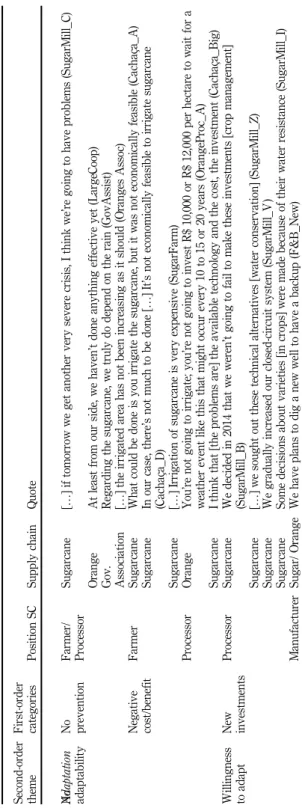
4.2.3 The adaptation for the future. During the interviews, firms were still in the process of making sense of the past event, and recovery projects were not fully implemented. Nevertheless, evidence of their intended adaptive strategies could be organized as follows: no prevention, negative cost/benefit of projects and plans of new investments (Table IV ).
Some firms demonstrated no ability to adapt – mainly farmers and processors. A few
processors and manufacturers were willing to adapt, however, changing was not a priority for most firms.
Regarding farming activities, respondents continued to view extreme events as rare and not justifying an investment in adaptation measures. Some respondents recognized the need to be prepared for future events, but they assessed the trade-off between costs and benefits as negative and therefore preferred not to act. In both AFSCs, irrigation technologies were considered too expensive and perceived as not economically viable, considering the uncertainty of climatic events:
At least from our side, we have not done anything effective yet. (LargeCoop)
Therefore, even though it was a disaster, we thought that it was not worth investing because of the cost [of the investment] and the return. (SugarMill_I)
Nevertheless, we could identify processors and manufacturers willing to invest in new processes and strategies to mitigate the future occurrence of extreme weather events, such as drilling new wells, crop management and water conservation projects. In the case of
IJOPM
manufacturers, aggravation of the crisis in major cities (including São Paulo) generated a sense of responsibility and public accountability in terms of water management. Concerned with their public image, manufacturers accelerated the development and the implementation of eco-efficiency and water reuse projects; for them, the event was a catalyst for adaptation:
Some decisions about varieties [in crops] were made because of their water resistance. (SugarMill_I)
In summary, our data provided evidence that the nodes in the supply chain were affected in distinct ways by the same event, resulting in a disturbance that had a limited effect on the firms positioned downstream in the supply chain (Table V ). The vulnerability of farmers to weather events confined them to a higher risk position in the supply chain. Farmers were less prepared for the drought. With rigid configurations of processes and resources, they were not able to respond to the event. Despite this fact, farmers continued to neglect the climate risk and were reluctant to undertake any future action. Processors also demonstrated low risk awareness but were able to respond to the event with flexible processes and multi-sourcing strategies. The event also served as a catalyst for some projects. Their investments in technologies and processes, however, depended greatly on the cost-benefit ratio, which, for most processors, was still perceived as negative. Finally, manufacturers were less impacted by the event but developed prompt responses to manage supply risks. They also demonstrated a better understanding of the implications of climate change and were willing to invest in new adaptation projects.
4.3 Supply chain findings
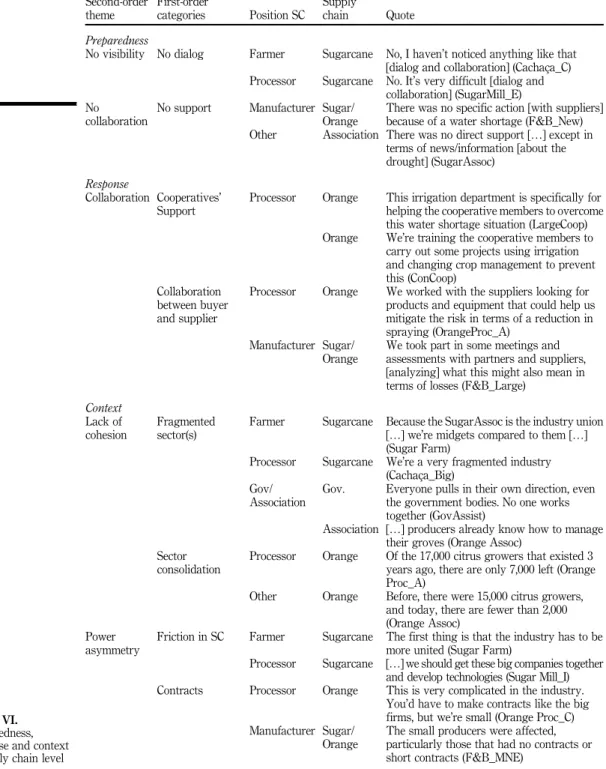
4.3.1 The supply chain’s preparedness. Our interviews provided evidence that there was no dialogue among nodes and players in both supply chains. In fact, there was a general perception of lack of information sharing among partners about the crisis, especially from farmers and processors’ perspective (Table VI). Farmers and processors did not appear to have a clear picture of the downstream supply chain and instead were mainly focused on their own businesses. At the same time, the interviews did not provide any evidence regarding a formal governance mechanism to promote the exchange of information about the event in the supply chain. Even though information sharing and connectivity
Farmer Processor Manufacturer
Supply chain (Orange and Sugarcane) Event impact Direct impact
on productivity
Direct impact on farming units and restricted water supply (processing)
Quality issues and price increases due to impact to farmers
No significant direct impact; some impact on the supply chain
No impact to final consumer
Preparedness Low awareness
Low awareness Low awareness No visibility Response No response
capability
Used flexibility and redundancy to avoid major impacts
Used flexibility and redundancy to avoid impacts Few collaboration initiatives in the supply chain Adaptation Reluctance to undertake preventive measures
Reactive learning from the event. Some reluctance in undertaking preventive measures and some willingness to act
Willingness to adapt with new investments and environmental climate analysis
No evidence
Resilience No Some Yes Yes
Table V. Summary
Supply chain
resilience
Second-order theme First-order categories Position SC Supply chain Quote Preparedness
No visibility No dialog Farmer Sugarcane No, I haven’t noticed anything like that [dialog and collaboration] (Cachaça_C) Processor Sugarcane No. It’s very difficult [dialog and
collaboration] (SugarMill_E) No
collaboration
No support Manufacturer Sugar/ Orange
There was no specific action [with suppliers] because of a water shortage (F&B_New) Other Association There was no direct support […] except in
terms of news/information [about the drought] (SugarAssoc)
Response
Collaboration Cooperatives’ Support
Processor Orange This irrigation department is specifically for helping the cooperative members to overcome this water shortage situation (LargeCoop) Orange We’re training the cooperative members to
carry out some projects using irrigation and changing crop management to prevent this (ConCoop)
Collaboration between buyer and supplier
Processor Orange We worked with the suppliers looking for products and equipment that could help us mitigate the risk in terms of a reduction in spraying (OrangeProc_A)
Manufacturer Sugar/ Orange
We took part in some meetings and assessments with partners and suppliers, [analyzing] what this might also mean in terms of losses (F&B_Large)
Context Lack of cohesion
Fragmented sector(s)
Farmer Sugarcane Because the SugarAssoc is the industry union […] we’re midgets compared to them […] (Sugar Farm)
Processor Sugarcane We’re a very fragmented industry (Cachaça_Big)
Gov/ Association
Gov. Everyone pulls in their own direction, even the government bodies. No one works together (GovAssist)
Association […] producers already know how to manage their groves (Orange Assoc)
Sector consolidation
Processor Orange Of the 17,000 citrus growers that existed 3 years ago, there are only 7,000 left (Orange Proc_A)
Other Orange Before, there were 15,000 citrus growers, and today, there are fewer than 2,000 (Orange Assoc)
Power asymmetry
Friction in SC Farmer Sugarcane The first thing is that the industry has to be more united (Sugar Farm)
Processor Sugarcane […] we should get these big companies together and develop technologies (Sugar Mill_I) Contracts Processor Orange This is very complicated in the industry.
You’d have to make contracts like the big firms, but we’re small (Orange Proc_C) Manufacturer Sugar/
Orange
The small producers were affected, particularly those that had no contracts or short contracts (F&B_MNE)
Table VI. Preparedness, response and context – supply chain level
IJOPM
throughout the supply chain are key to preparing the whole supply chain for any unexpected event, we found no evidence of visibility in the studied supply chains.
4.3.2 The supply chain’s response. The supply chain responses depend on the collective efforts of more than one node. Our findings revealed three different types of attitudes: no support, cooperative support and vertical collaboration (Table VI). Most firms reported there was no collaboration and that they were working in isolation with no joint action or support from others. The interviews suggest only a few collective initiatives among the nodes to manage the unexpected event, mainly restricted to orange cooperatives and occasional initiatives:
The mills have that salvage irrigation because they work with the vinasse [a sugarcane by-product] and we do not have access to that vinasse […] They say “but the vinasse is at your disposal”, but then, we have to have the trucks, and we have to have everything, and all [collaboration] ends. (SugarFarm)
In the orange supply chain, vertical collaboration was mainly identifiable in the support of cooperatives for farmers. Cooperatives searched for partnerships with irrigation experts and acted as important coordinators of farmers’ activities by helping farmers in terms of information and training. Apart from those, coordinated initiatives in the two analyzed supply chains were scarce, and two manufacturers and two processors promoted discussion only with first-tier suppliers and partners to evaluate losses in the supply chain:
This irrigation department is specifically for helping cooperative members overcome this water shortage situation. (LargeCoop)
Thus, our findings revealed that there was no collaboration among nodes, except for a few cases downstream in the studied AFSCs and the vertical collaboration between farmers and cooperatives in the orange supply chain.
4.3.3 The supply chain context. In terms of sector structure and relationship interdependencies, four aspects of supply chain context emerged from our data analysis. Specifically, both the fragmented nature of sectors and the process of sector consolidation culminated in a lack of cohesion amongst the firms. Additionally, relationship friction and governance based on ( formal) contracts demonstrated the power asymmetry in the two analyzed supply chains (Table VI).
Both AFSCs have a larger number of players upstream than downstream– with only a few manufacturing companies. Given the abundance of alternative players upstream, both supply chains were regarded as highly fragmented. This structural aspect did not favor the commitment of players to join forces; therefore, there was a lack of cohesion in the supply chains:
Everyone pulls in their own direction, even the government bodies. No one works together. (GovAssist)
The non-cohesive context in both supply chains is related to a secondary contextual aspect: the nature of the relationships. Relationship frictions demonstrated the conflict of interest among players in orange and sugarcane supply chains. Additionally, the asymmetry in the contractual relationships and the reliance on formal contracts configured the power asymmetric context. Companies of both supply chains tended to manage their businesses independently and have more formal governance mechanisms based on contracts:
If tomorrow for some reason […] you cannot produce, you will not be able to meet your contracts, and this would be very damaging. (SugarMill_C)
In summary, our data analysis provides no evidence of some of the most cited elements in the literature, such as velocity or adaptation, at the supply chain level. Similarly, the findings at the supply chain level do not provide much evidence of visibility and collaboration,
Supply chain
resilience
suggesting that resilience was primarily developed at the firm level. In terms of supply chain context, both supply chains can be regarded as highly fragmented and with few interactions among actors within and across nodes. In the next section, we discuss our findings vis-à-vis the literature based on the emergent model proposed in Figure 3 by comparing the resilience built at each node within the overall SCRES.
5. Discussion
In this section, we explain the relational dynamic among the aggregate dimensions that emerged from our findings to answer our research question:
RQ1. How does resilience, built at different nodes of a supply chain, influence SCRES? Literature suggests that to cope with and recover from the impacts of unexpected events, organizations need to build different resilience elements at the individual and supply chain level, and at each phase of the disruption (Hohenstein et al., 2015; Ali et al., 2017; Stone and Rahimifard, 2018).
Figure 3 illustrates the elements found in our study at each resilience phase and the interaction with the contextual aspects of those supply chains. While lack of awareness, responsiveness and adaptation capability was traits identified at upstream nodes, SCRES was mainly supported by the flexibility and redundancy of processors and manufacturers, instead of visibility and collaboration in the supply chain. The occasional collaborative initiatives were related to adaptation plans; however, not all adaptation plans were based on collaboration. Therefore, our study evidences that resilience elements were primarily built at the node level, not at the supply chain level. In the investigated supply chains, firms sought isolated solutions rather than using common strategies to cope with the risk for the whole supply chain.
Our research suggests that the preference for individual strategies, rather than supply chain solutions, is related to a lack of cohesion and asymmetry in the supply chains. Thus, the interfirm relationship context is important to the development of resilience at firms and the supply chain levels, as explained herein.
SC level Supply Chain Context Resilience Elements No response (upstream) Low awareness Flexibility (downstream) Redundancy (downstream) No adaptability (upstream) Willingness to adapt (downstream) No collaboration Power asymmetry Lack of cohesion
Preparedness Response Adaptation
Low visibility Resilience Phases Node level Collaboration Figure 3. Emergent model of nodes and supply chain dynamics
IJOPM
5.1 Resilience at the node level and SCRES
We found no evidence of significant impact or disruption at the end of the supply chain. Considering that SCRES is the capacity of the supply chain to maintain operational continuity and satisfy the end consumer (Ponomarov and Holcomb, 2009; Kamalahmadi and Parast, 2016; Stone and Rahimifard, 2018), our findings reveal that both supply chains were resilient, despite the evidence of no resilience at farmers’ node.
However, the compared analysis demonstrates different levels of impact as well as different degrees of preparedness, response and adaptation among the three nodes (Table V ). Farmers, the most vulnerable node to the climatic events, were the least resilient, with no evidence of elements to anticipate, respond, or even to learn from the event. As we moved downstream in the AFSC, we identified different resilience elements adopted by processors and manufacturers, such as flexibility and redundancy, that were developed in advance, and allowed them to respond and control the disturbance and fulfill the demands of end consumers. Our findings highlighted that their resilience strategies were not dependent on the development of resilience at previous stages in the supply chain. Instead, SCRES depended on the capacity of downstream organizations to manage unexpected events. Our study demonstrates that SCRES is not dependent on the resilience of each node, as suggested in the literature (Leat and Revoredo-Giha, 2013; Stone and Rahimifard, 2018) and that different levels of resilience in a supply chain may not jeopardize SCRES. Thus:
P1. SCRES is not dependent on the resilience of all firms in the SC.
This proposition also suggests that SCRES may not require resilience in the overall system but rather specifically from some key players. Most studies emphasize the perspective of a focal company in the analysis of supply chain and thus overlook the impacts, response and recovery at some nodes (Leat and Revoredo-Giha, 2013; Tukamuhabwa et al., 2015; Birkie et al., 2017). Our approach allows the observation of the role of different nodes in the continuity of the supply chain operations and reveals that SCRES can be achieved even when upstream organizations are not resilient. In this sense, it is important to understand that the concept of SCRES does not apply to all organizations in the supply chain but is primarily associated with the company that is able to reconfigure the resources and players to control the disruption. Therefore, the analysis of the nodes offered a different perspective of SCRES.
5.2 Resilience elements
SCRES depends on both firm and SCRES elements that should be developed prior to, during and after the disruption (Hohenstein et al., 2015; Ali et al., 2017; Stone and Rahimifard, 2018). Organizations may adopt different resilience strategies depending on the risk source (Tukamuhabwa et al., 2015) and the supply chain context and environment (Birkie et al., 2017; Stone and Rahimifard, 2018). Nevertheless, the empirical studies on SCRES still have to analyze the relationship among the resilience elements (Tukamuhabwa et al., 2015; Stone and Rahimifard, 2018). By investigating different nodes in the supply chain, our research brings new insights into how the supply chain context influences the adoption of different elements to cope with vulnerabilities.
The data analysis revealed a context of low connectivity and contractual relationships among firms that did not foster cohesion and joint efforts to manage the disruption (Lawler and Yoon, 1996; Fiksel, 2003). In the environment of relative independence and asymmetric relationships between buyer–suppliers, companies focus on their own interests rather than on common goals, and there is no great need for coordination of activities between partners. Consequently, firms make individual decisions in response to any changes in their environments (Pathak et al., 2007). Therefore, when facing unexpected events, stronger firms will hedge their risks through redundant capacity and independent
Supply chain
resilience
resources (Caniëls and Gelderman, 2007; Jüttner and Maklan, 2011). In this sense, the lack of cohesion in both supply chains investigated and the power asymmetry among the nodes seemed to drive the resilience strategies towards firm-level elements, such as flexibility and redundancy, rather than supply chain elements, such as collaboration. Our results corroborate with those of Stone and Rahimifard (2018) in that resilience elements are enabled by different variables at the node and the supply chain level. Therefore:
P2. In a supply chain context of low interdependence, resilience elements at the node level will be preferred to those at the supply chain level.
This proposition highlights the importance for managers to understand their specific supply chain context in order to better allocate resources and invest in the most appropriate resilience elements to reduce vulnerabilities (Fiksel et al., 2015). Nevertheless, the choice of node level solutions might not result in the best overall performance for the supply chain. For example, although the multi-sourcing strategy was successful for processors and manufacturers, it did not provide support for the development of the farming stage. Consequently, farmers– with no information, no visibility and no support – were not willing to adapt to the new climatic scenario. The current process forces downstream nodes to search for individual solutions to assure the continuity of their operations and might have a negative effect on SCRES. Alternatively, if the whole supply chain is involved in building resilience elements for each phase, results in terms of time and cost might be optimized.
System solutions, rather than end-user focus, are crucial in networks such as AFSC (Stone and Rahimifard, 2018). Interfirm ties are important for adaptation and learning; therefore, a lack of collaboration in a supply chain does not promote the development of adaptation capabilities (Zollo et al., 2016) and represents a high risk to AFSC due to the cyclical and cumulative nature of the resilience building process (Stone and Rahimifard, 2018). 6. Conclusions
This research investigated how resilience, built at different nodes of a supply chain, influences overall SCRES, bringing a new perspective to the literature that normally focuses on the analysis of a focal company (Wieland and Wallenburg, 2013; Brandon-Jones et al., 2014; Tukamuhabwa et al., 2015). In this sense, this research contributes to knowledge about SCRES in two ways.
First, it provides a broader perspective of resilience in the supply chain by analyzing and comparing the impact, preparedness, response and adaptation at each supply chain node. The analysis of different perspectives ( farmers, processors and manufacturers) demonstrates an independence of firms in the supply chain and the different relevance of firms when securing SCRES. Moreover, it suggests that SCRES can be primarily associated with a resilient organization downstream in the supply chain.
Second, this study compares node and SCRES elements in a supply chain context with low interdependence among firms. In this case, node resilience elements are preferred to those at the supply chain level. Therefore, this study also sheds light on the influence of the supply chain context (interfirm relationships) in the process of developing resilience strategy.
6.1 Managerial and social implications
This study highlights the interdependence of firms’ resilience and SCRES, and the
importance of individual resilience elements in certain supply chain contexts. For managers, our findings suggest the need to evaluate vulnerabilities and alternative resilience elements at different supply chain nodes to assure SCRES.
IJOPM
For more vulnerable nodes, the findings suggest that exchange of information and collaboration in the supply chain have to be built prior to disruptive events. Specifically, in AFSC, there is a need to intensify the dissemination of climate information, particularly among farmers, to increase their risk awareness and willingness to adapt. As suggested in this study, associations, cooperatives and government organizations are relevant in fostering the knowledge and training in upstream AFSC. They may also promote knowledge exchange and collaboration in the supply chain. This aspect is key to increasing the overall SCRES.
The research indicates that, for firms located downstream in the supply chain, current choices of resilience strategy have been able to assure continuity of operations but fail to address future uncertainties. In scenarios with an increasing frequency of climate extremes, current solutions may not be sufficient. Particularly in AFSC, downstream companies could help upstream companies build resilience in order to prepare for climatic events, such as slow-onset droughts that are cumulative and difficult to perceive immediately. Developing SCRES elements rather than organizational ones might improve the SCRES.
6.2 Limitations and further research
Our study has some limitations. The first limitation refers to the case studies. Although our research contained firms from two different AFSC, the agribusiness has peculiarities in terms of climate dependence and market environment that are not present in all industries. Our study was performed in a single institutional context of an emerging economy, with implications for the dynamics of interfirm relationships. The second limitation relates to the case study method and the difficulty in establishing the external validity of the study findings (Eisenhardt, 1989). Triangulation with other documents and interviews with associations and influential stakeholders were intended to reduce this problem, but the findings of this study should be tested in different institutional and supply chain contexts to validate the findings. Further research should also explore the difference between slow-onset and sudden-onset events.
References
Ali, A., Mahfouz, A. and Arisha, A. (2017), “Analysing supply chain resilience: integrating the constructs in a concept mapping framework via a systematic literature review”, Supply Chain Management: An International Journal, Vol. 22 No. 1, pp. 16-39.
Ambulkar, S., Blackhurst, J. and Grawe, S. (2015),“Firm’s resilience to supply chain disruptions: scale development and empirical examination”, Journal of Operations Management, Vols 33-34 No. 1, pp. 111-122.
Barratt, M. and Oke, A. (2007),“Antecedents of supply chain visibility in retail supply chains: a resource-based theory perspective”, Journal of Operations Management, Vol. 25 No. 6, pp. 1217-1233.
Barratt, M., Choi, T.Y. and Li, M. (2011),“Qualitative case studies in operations management: trends, research outcomes, and future research implications”, Journal of Operations Management, Vol. 29 No. 4, pp. 329-342.
Bhamra, R., Dani, S. and Burnard, K. (2011),“Resilience: the concept, a literature review and future directions”, International Journal of Production Research, Vol. 49 No. 18, pp. 5375-5393. Birkie, S.E., Trucco, P. and Fernandez Campos, P. (2017),“Effectiveness of resilience capabilities in
mitigating disruptions: leveraging on supply chain structural complexity”, Supply Chain Management: An International Journal, Vol. 22 No. 6, pp. 506-521.
Brandon-Jones, E., Squire, B., Autry, C.W. and Petersen, K.J. (2014),“A contingent resource-based perspective of supply chain resilience and robustness”, Journal of Supply Chain Management, Vol. 50 No. 3, pp. 55-73.