Chapter VIII
Manipulating Constraints to Train Decision Making in Rugby Union
Abstract
This chapter focuses on the paradoxical relationship between game unpredictability and the certainty of players’ actions in team ball sports. Our research on this relationship leads us to suggest a method for training decision making, which we exemplify in the team sport of Rugby Union. The training methodology is based on application of theoretical insights from Ecological Psychology, Complex Dynamical Systems and the Constraints-led Approach. The paper starts with a critical overview of traditional approaches to studying decision making in sport. Next we describe the sport of Rugby Union to exemplify a complex dynamical system, and explain how that conceptualisation captures the interactions of players within that
performance context. We conclude our analysis by describing how to manipulate task constraints to improve decision making performance, as players search for an appropriate blend of stability and variability in their actions. In the final part of the paper we suggest some methods to train decision making based on four stages: i) identifying the problem; ii) setting out a strategy to solve it; iii) creating an action model; iv) building a decision making
exercise. The main conclusion from our work for coaches and sports scientists is that decision making should be improved through training methods that provide an accurate balance
between stability of actions, which gives structure to the players’ performance, and
variability, which allows them to cope with the uncertainty of situational constraints, such as the behaviour of specific opponents.
Introduction
This chapter seeks to raise important questions about the methods used to train decision making in team sports like Rugby Union. Most team game coaches will agree that a competitive game is a source of unpredictability and uncertainty for all players. A major question faced by all coaches is: How can we reduce the uncertainty inevitably faced by players in all performance contexts? Given this major focus, we pose the related question: Why do traditional training methods in team ball games typically prepare players for the certainty of their actions (i.e. consistency as Handford (2006) termed it) instead of preparing them for game uncertainty? By uncertainty, we mean unpredictability about the final outcome of the interactions that emerge amongst team-mates and/or opponents in a match. Even the previous knowledge that players may acquire about their opponents is never enough to solve the problems that emerge during sub-phases of games like Rugby Union. This is a key issue in every team sport: players never know with 100% certainty what their opponents are going to do at every moment of the game.
In this paper, we argue that, in order to accurately answer the first question, it may be useful to understand a team sport as a complex dynamical system. Our attempt to theoretically resolve the first question will lead us to discuss methods on how to prepare players
(regardless of whether they are defenders or attackers) for the interpersonal interactions that occur during a match e.g., in typical 1 v 1, 2 v 1 or 3 v 3 sub-phases of Rugby Union, for example. In answering the second question, we will take the opportunity to critically examine the typical methods used nowadays to prepare teams and players for the problems that emerge in games. If we examine the Rugby Union coaching and performance literature (e.g.,
trend in coaching mirrors a significant theme in psychological science which proposes that automatising motor skill performance can reduce the information processing burden on individuals, discussed in more detail below (Davids, Button & Bennett, 2007).
However, competitive team games are not stable contexts in which information is certain. In contrast, successful players need to adapt their actions to the dynamically changing environment that characterises the typical team game. Despite the usefulness of traditional training methods at particular periods of the competitive season, we will argue that these kinds of methods are not enough to prepare the players for the non-linear characteristics of a competitive match (Lebed, 2006), and that they might actually be encouraging players to become too predictable. A major criticism is that traditional methods focus on the consistent performance of specific movement skills by an individual player or group of players, rather than actually focusing on the player-environment relationship. The former focuses on movement stability, whereas the latter relationship emphasises adaptability and variability in movement patterns as a player interacts with team-mates and opponents, events and objects (e.g., the ball, posts, line markings etc).
How can we successfully prepare the players and the teams to cope with the
uncertainty present in team games? Focusing attention on the player-environment relationship during training in team ball sports encourages athletes to search for successful solutions to disturb a system (if attacking) or maintain a system (if defending). Movement skills are important because they provide a way for players to create instabilities or maintain stability and to solve tactical problems that emerge during a rugby match. Rod Thorpe, in a
Finally, we briefly discuss some generic performance principles common to several team sports (e.g. rugby, soccer, basketball, etc), such as the creation and use of the space to advance into opposition territory (when in possession of the ball), as well as creating pressure to recover ball possession when in defence. The theoretical background used on this paper could be used in a variety of team sports but the examples presented here are exemplified in the sport of Rugby Union as a vehicle of analysis. Due to the specificity of individual, task and situational constraints that characterize each individual team sport context, the
implementation of these ideas from nonlinear pedagogy will vary accordingly. For example, because the perception action couplings that support decision making are context specific, the practical examples discussed in this paper may not be necessarily be transferable to other team sports. A major point in this regard is that decision making training should be mainly unique to the task constraints of specific team sports.
Theoretical Assumptions of Traditional Coaching Methods
The “one size fits all” method that the English Volleyball development coach Craig Handford criticized contains the implicit assumption that there is a common ‘optimal movement pattern’ which acts as a template for a movement skill towards which each individual player is progressing. In idealising a specific motor pattern, traditional motor learning theories show how they are infused by the assumption of movement programming (e.g. there are assumptions about the existence of a ‘text book’ tackle, a hooker’s throw, scrummaging technique, a place kick, all of which may be considered as discrete skills and taught using a ‘one-size-fits all’ approach). This concept is based on the assumption that the human brain acts like a computer. It implies that decision making is programmable in learners and that the best way to encourage decision making skill is from a stimulus-response
approach during training. This decision making approach is conceptualized through information processing models of motor control, which simply view individuals as
observable patterns of movement (e.g. a pass, a kick or a dribble) required to achieve a specific outcome such as moving the ball to a specific location of the field (e.g. players are taught to perceive information from an opponent’s hip, and not the ball, in order to make a ‘text-book’ type tackle. Players often practice in order to act at a breakdown situation in a sequenced manner so that the first defender to arrive must contest for the ball, followed by defenders covering the far side of the breakdown, then deep in behind and finally the near side so as to limit the opposing teams attacking opportunities This rather simplistic response to a breakdown situation ignores the evolving dynamics of the situation which may indeed provide player’s with critical information leading to a more appropriate solution to the immediate problem. These are examples of how the uncertainty of a player’s actions can be reduced in response to situational cues irrespective of sudden process or outcome changes within the particular performance situation).The success of the outcome “depends primarily on the computational “programs” within the central nervous system that are responsible for selecting and then controlling the movement” (Abernethy et al 1997, pp. 298). Thus, for a performance of a skill to succeed, computational models suggest that skills (e.g. the pass, the tackle) emanate from programs that must be developed and continuously improved through repeated use and practice. Therefore, drills that involve little or no uncertainty or decision making ability are encouraged, so that players can practise achieving the same performance solution repeatedly. Typically, this form of practice occurs with little or no manipulation of the situation (e.g. few task constraints; in the presence of few neighbouring players), to prevent players searching for unique solutions. This is exemplified in drills which involve players stepping or passing around cones and poles, tackling tackle bags, ‘shadowing’ i.e. practising offensive or defensive patterns without any opposing players etc.). In summary, information processing models describe decision making based on the assumption that, in a particular performance context, a specific stimulus (i.e. input information) will trigger a specific automated response (i.e. a programmed output), which is stored in the performer’s memory due to intense and repetitive practice. Williams, Davids and Williams (1999, pp. 96) showed how in traditional theories decision making is mediated by knowledge structures stored in the memory.
specific response, if the ‘triggers’ (i.e. the stimulation) are unique (i.e. never repeated in an identical way)? This is a question we will try to resolve in the next section by arguing that a different theoretical framework may be needed to explain perception, decision making and action in humans in such complex performance environments. An alternative view is that the unpredictable nature of team sports can actually benefit from the inherent variability that is available to the players as components of complex dynamical systems.
A Conceptual Background to a Nonlinear Pedagogy Provided by Dynamical Systems Theory and Ecological Psychology
Understanding the Team Sport of Rugby Union as a Complex Dynamical System
A complex system in nature is composed of many different interacting components. Because team games, considered as complex systems, are highly integrated, being composed of multiple components (i.e. individual players) affords the emergence of rich patterns of behaviour in dynamically changing environments. During a competitive game the decisions and actions of each player are constrained by multiple causes that produce multiple effects. According to Bar-Yam (2004) this is a primary feature in considering complexity during team games. The potential for interaction between players in a Rugby Union match, viewed as a complex system, signifies that it is not possible to accurately describe a specific outcome that occurs in a game as sustained by a single cause-effect relationship.
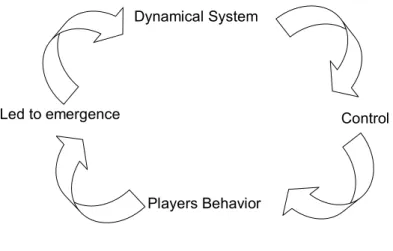
neighbouring components of the system leads to an interdependency of decisions and actions. The context dependence of behaviour leads to non-linearity that characterizes actions in team sports i.e. outputs of the interactions are not deterministic (entirely predictable), nor are they completely random (entirely variable).
Dynamical System
Led to emergence
Players Behavior
Control
Figure 1. Circular causality of perception and action.
The interdependence of system components makes it challenging to predict in advance the final outcomes of system interactions (i.e. tackle, pass, dribble, or try). This is because the characteristics of the interactions between neighbouring components for each performance of the players in the 2 v 1 sub-system are unique. Although the players can display similar patterns of movement on different occasions, those movements are never repeated identically (e.g. the players’ respective velocities and running lines are never the same; the players’ relative positions are never the same; the locations on the field with respect to the try line and side line are never identical). Since the constraints imposed by neighbouring components always exhibit different characteristics, it follows that each individual players’ specific decisions and actions must satisfy those constraints. This type of rapid and refined
behavioural adaptation forms the basis of practice in all team sports and is made possible by the capacity for variability in movement behaviour in each player. Similar principles of
complexity define the capacity of individual players to produce variable patterns of movement in achieving a similar performance outcome. The many components of the human movement system (e.g., muscle complexes and joints) provides each player with the means to adjust his/her behaviour in order to maintain goal direct activity (i.e. adapt a dribbling action to avoid an approaching defender or adjust the position of the ball in the hands to pass the ball to a team-mate). In complex dynamical systems, a consistent outcome (move the ball towards the try line) can be achieved or maintained by variability of actions of individual components (pass, dribble, kick). The players’ variability leads to system unpredictability which sustains the consistency of actions in teams (attack or defend a try line). Therefore, an implication for practice of these ideas on consistency of outcome and variability of movements is that performers should not be encouraged to develop common ‘optimal movement patterns’ as a type of ‘sol’ (specific target) value. Instead, practice task constraints should aim to get players into a ‘ball park’ area of movement solutions from which they need to practise finding a functional ‘emergent’ action, based on the current context.
number of team mates involved, situational characteristics of opponents (e.g. relative position; approach speed); and iii), the characteristics of the environment, including physical
characteristics such as the weather, surface conditions, altitude, and social factors such as societal expectations, the presence of the media, and the presence and characteristics of an audience.
The constraints that bound players’ decisions and actions at every moment of a Rugby Union match are the multiple causes that shape the behaviour of the whole dynamical system (i.e. the game) created by the interactions of adjacent players and the multiple outcomes from those ongoing interactions (e.g. a ruck, a tackle, a grubber kick).
Players’ interactions With the Environment - the Contribution of Ecological Psychology
The theoretical background that sustains the training and development of decision making in Rugby could also be advanced by insights from Ecological psychology. Ecological psychology emphasizes the role of information available to performers in specific
environments which provide affordances or opportunities for actions. Other key concepts that need to be defined include perception and action couplings, as well as the players’ attunement to actions. These insights from Ecological psychology allow us to understand that tactical behaviours emerging during a Rugby Union match are dependent on the information available in specific contexts, and that, in turn, information is created by each individual player’s
tactical behaviours (Passos, Araújo, Davids, Gouveia & Serpa, 2006). Indeed, the concept of attunement, discussed later, should be clearly understood by practitioners because the aim of every training session is for players to increase the degree to which they are attuned to the information of specific performance contexts. This theoretical rationale proposes that the most relevant informational constraints for decision making and controlling action in dynamic environments (e.g. such as a Rugby match) are those which emerge during ongoing performer-environment interactions, not information from past experiences stored as
representations in the brain (Araújo, Davids & Hristovski, 2006; van Orden et al., 2003). This idea shows how deterministic solutions such as programming of actions based on past
separate sub-systems mediated by mental representations of the outside world stored in the brain (Ranyard, Crozier & Svenson, 1997).
Gibbs (2006) highlighted an important implication of these criticisms of traditional approaches to decision making behaviour: “Perception cannot be understood without
reference to action. People do not perceive the world statically, but by actively exploring the environment.” (Gibbs, 2006, pp. 49). This observation on the need for a tight coupling between perception and action means that, in a Rugby match, an attacker can create
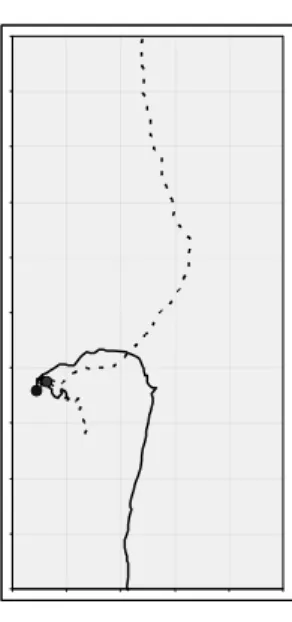
information by moving. He/she has to act in order to perceive a defender’s behaviour, who in turn also needs to act to perceive the attacker’s behaviour. Although an individual may use previous experiences to consider a ‘ball park’ performance outcome solution, in team games an opponent’s specific movements forms a major task constraint which shapes emergent decision making behaviour in each individual performer. Acting on perceived information from an opponent’s movements leads to the emergence of nonlinear trajectories of both players as a coupled system as displayed in Figure 2. Such movements create information which is specific to the game environment that each player must learn to explore (become attuned to) through his/her actions (Figure 2).
2.a) Try 2.b) Tackle
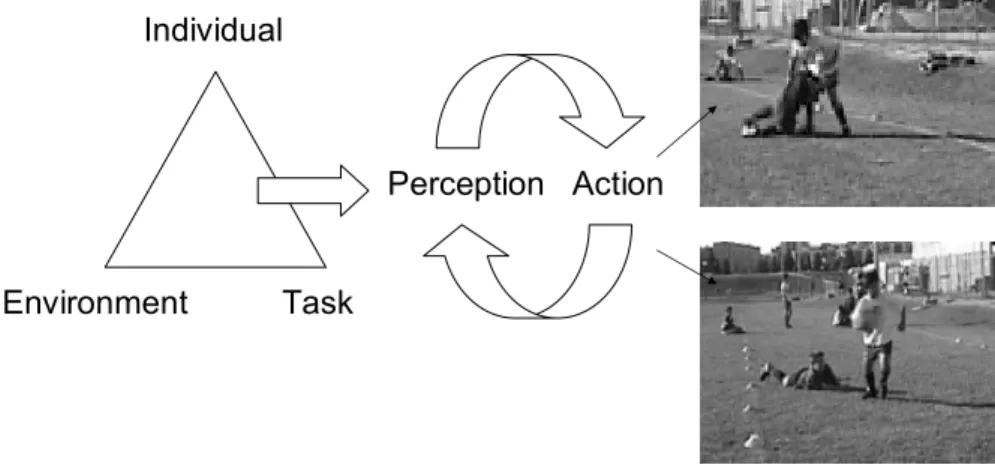
Gibbs (2006) proposed how perception of an opponent’s actions is dependent on the dynamics of performer-environment interactions. Through on-line perceptual control (using information to regulate action), perception-action couplings can be developed to adjust to environmental demands (i.e. a specific opponent’s actions) and allow anticipation. However, anticipation is only possible if the players are attuned to (i.e. sensitive to or aware of) the most relevant sources of information needed to maintain their goal direct behaviours. To be attuned to what the most relevant perceptual variables are in a performance context is the basis of outstanding decision making behaviour in team sports. Attunement is what makes the difference between novices and experts. The latter are more sensitive to the relevant sources of information to successfully perform a task than novices. To improve decision making, training sessions should aim to attune the interaction that a player has with the performance environment (i.e. by including within the practice task information from boundary markings, pitch surface, teammates, and opponents). In other words, all the tasks in a training session should aim to attune key perception-actions couplings in performers. To achieve this aim, the information available to be actively explored by players during practice must closely resemble the same task and environmental constraints faced in competitive settings. Otherwise, the perception-action couplings that emerge during practice will be attuned to perceptual
variables (e.g. speed of approach towards an opponent; the space left available by defenders; the depth of the players on a backward line; the space left available to go forward) different than that available in competitive contexts. A major point of this approach to practice is that it is not enough to try and change a player’s characteristics (i.e. improve emotional control, improve positive thoughts, power, speed, technical skills, etc.), and then expect that such changes will improve performance. Coaches actually need to change the nature of the player-environment engagement. Therefore, the conception of training sessions should be soundly based on the interactions that will occur in a specific Rugby match, and to improve decision making we propose a performer-environment interaction-based approach rather than a traditional performer-based approach.
competitive performance. Based on the constraints-led premise, in the next section we outline a nonlinear pedagogy for manipulating key constraints to improve decision making in Rugby Union.
Individual
Environment Task
Perception Action
Figure 3. A constraints led-perspective on motor learning emphasising the interaction of performer, task and environmental constraints.
How Manipulating Constraints can Improve Decision Making in Rugby Union
The aim of constraints manipulation by the practitioner is for the player to become better attuned to the relevant perceptual variables required to successfully perform a specific task. Manipulating constraints allows performers to search for alternative task solutions (improving their ability to cope with inherent performance variability) in dealing with
unpredictability. But as Warren (2006) suggested, human behaviour patterns demonstrate two balancing features that need to be accounted for: stability and flexibility. He stated that: “The patterns are stable in the sense that the functional form of movement is consistent over time and resist perturbation and reproducible in that a similar pattern may recur on separate occasions. On the other hand, behaviour is not stereotyped and rigid but flexible and
immediate task and environmental constraints, which signifies flexibility or adaptive variability, supported by on-line perceptual control of actions.
In that line of reasoning, Handford (2006) has suggested that a very important question is: When do performers need stability and when do they need variability? From a pedagogical viewpoint Handford’s question can be viewed from two perspectives: i) from the technical development perspective; and ii) from the tactical development perspective. Handford’s (2006) concerns were more focused on the first perspective when he suggested that, despite the stability needed to produce a specific movement pattern, some elements should be left free to vary in order to satisfy immediate task demands. We can add to these important insights for coaching by proposing how this balance between stability and variability can be applied to tactical aspects of team games like Rugby Union. Tactical behaviours are constrained by the sub-system formed by micro units of up to three to four players (Greenwood, 2003; Biscombe and Drewett, 1999). The stability to this sub-system’s behaviour is provided by the task constraint of being part of a larger dynamical system. This means that players perform their actions inside the boundaries imposed by that global system (e.g., in a micro unit of three players, the ball carrier will be the player in the front and the supporters must be located behind the ball carrier, one at the left side and the other on the right side). These boundaries avoid randomness in players’ actions, increasing consistency and stability of team actions but also increasing the certainty of the actions to be performed. At this point we also need
variability to ensure that the sub-system does not become too deterministic and predictable. Specific tactical constraints will lead to the formation of specific patterns in the dynamical system (i.e. the micro unit will adopt particular formations). Once this is achieved, the functional behaviour of the micro unit, as a sub-system of the whole game system, must vary in order to satisfy specific task demands (e.g. the attacking micro unit may change the angle of the running line in order to exploit the space available from a sudden gap emerging in the defensive line). Consequently, the variability of actions of individuals within the micro unit increases uncertainty for opponents. Although the basic micro unit performance outcome requirements are to maintain forward movement and to keep the ball away from the
opponents, specific decisions and actions of individual players in the micro unit must account for decisions and actions of team mates (which provide stability) and also the number and relative position of the opponents (which yield variability), both working as instantaneous task constraints on the sub-system.
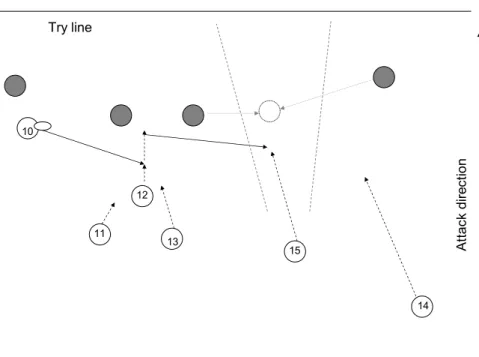
line out. The task constraint is to form a micro unit with three attackers (i.e. one ball receiver at the center and two support players, one at the left side and other at the right side, forming a pointing arrow shape), in a specific area of the field ready to receive the ball from the fly half. The aim of this micro unit may be to advance in space and create a fixation point, since ideally the collective goal of any micro or global attack is to create and penetrate space. If unsuccessful, then this attacking micro unit needs to re-stabilise through effective rucking and mauling before counter attacking again. Sub-system stability is provided by the role that each attacker has to perform, as well as the collective goal of the micro unit, which constrains each player’s decisions and actions. However, the specific way that the players in the micro system will create that fixation point will vary and is dependent on the defenders’ positions and actions, which in turn constrains the attackers’ search for a solution to maintain goal directed behaviour (Figure 4).
A
tta
ck
d
ir
e
cti
o
n
Try line
10
14 15
11
13 12
Figure 4. How to explore the space left available in a micro unit.
Grey circle represents the defenders’ positions. White circle with numbers represents the attackers’ positions. Oval white shape represents the ball.
The numbers represent players’ positions: 10) the fly-half; 11) the blind side winger; 12) the center; 13) the outside center; 14) the open side winger; 15) the full-back.
grey arrows represent the possible defenders’ displacements in order to cover the space left available.
This example showed how the neighboring components of the dynamical (sub) system (i.e. team mates) provided stability in the micro unit, whereas adjacent opponents raised the need to seek alternative solutions to maintain goal direct behaviour, which is only made possible by variability of actions. The example demonstrated a continuous need for a delicate balance between stability and variability of behaviour in any dynamical system, including team games.
However, there are periods of a match (e.g. lineouts, scrums, hooker throw, etc.), that demand an increase in stability of actions due in part to significant task constraints such as less space left available to be explored or the knowledge of the initial starting positions. This feature leads to an increase in predictability of actions to be performed. In these situations the attack is easier to predict and hence a defensive subsystem may gain advantage through intent to act out a pre-determined attack structure in a rather closed-system manner. Alternatively, a more open-system would reorganise and adapt to the defence in order to attack spaces left in their positioning. Both are commonly used strategies in elite players whereas learners tend to be constrained into more structured patterns and decisions. The less adaptive the defensive lineout is, the greater opportunity this provides the attacking team to pre-call lineouts with relative ease and success, a strategy which could be determined by the defence’s level of ability to adapt to change. From an applied perspective and despite the need for stability of the performance outcome, variability in movement behaviour is always present due to
changes in individual constraints (e.g. level of fatigue or emotions), task constraints (e.g. wet ball, number of players in the line out) or situational constraints (e.g. time to end of the match and score). There is also a need to maintain a certain level of unpredictability of actions, causing uncertainty in the opposition. In summary, despite the contextual demands of greater stability (e.g. set plays such as scrums or lineouts) or less stability (e.g. open play), the tasks comprising a coaching session should seek an appropriate balance between stability and variability.
Finally, in accordance with the three constraints categories in Newell’s (1986) model, we can split our practice planning as follows: i) individual constraints with on-field
changing rules, changing field dimensions, increasing or decreasing the numbers of players); iii) environment constraints (e.g., training in wet or dry surface conditions; training at altitude; adjusting to new time zones for performance).
How Can We Use These Ideas to Train Decision Making?
We begin this section by paraphrasing the two main questions posed by Greenwood (2003) regarding coaching activity: What needs to be improved? and How can we improve it? To answer these questions we follow the theoretical rationale of a constraints-led perspective on motor learning (e.g., Davids et al, 2001; Araújo et al, 2004; Davids et al., 2007) in
developing a nonlinear pedagogical methodology with four stages: i) identifying the problem; ii) setting out a strategy to solve it; iii) creating an action model (stability); iv) building an exercise.
Identifying the Problem
As stated before, players support their decisions following interactions with adjacent ‘others’ in the field, with a major focus on the tactical strengths and weaknesses of their teammates and opponents. Tactical problems within a team arise when actions of key parts of the system (e.g. players as components of a micro unit) are not successfully coupled. An example occurs when a micro unit of four players cannot disturb a defensive line in order to pass the gain line. This outcome could be due to several causes, such as, support players not being able to regulate the pace and direction of their running lines (i.e. being too flat or too deep, receiving the ball in front of the defender instead of receiving it in the space between defenders), or due to the ball carrier (e.g. the fly half) not passing the ball at the right time to be caught by a support player in the space left available by the defenders. Two main features emerge as constraints that lead to such undesirable outcomes like these: (i) the timing of decisions and actions; and (ii), the space left available to be used by attackers. For
analyze how players use the space left available by defenders. If that use of space allows attackers to cross the gain line (e.g. a support player altering his running line to receive the ball in the space left available by two defenders), then it is likely to have been a “good” use of space. If only one or none of these situations occur, then a problem has been identified.
Setting a Strategy
After problem identification coaches should decide what kind of constraints must be manipulated in order to solve the problem. Following the constraints-led perspective the first step to face the problem is to detect action possibilities, and this could be done with off-field manipulations. For example, video analysis is a powerful tool to recognize patterns of play and detect action possibilities. Another example is the use of notational analysis that provides statistics of opponents’ patterns of play that allow identification of strengths and weakness. Finally, there is the use of cognitive strategies such as imagery or self-talking which are useful techniques to detect and anticipate action possibilities. Detecting action possibilities provides the coach with important information to build an action model, and this will lead to the second step in the strategy: to define the main characteristics of the action model such as, the initial conditions as well as the final desirable outcome to be achieved. These steps involve setting the number of players needed to execute the action possibilities, as well as identifying the role of each player in the model.
Creating an Action Model
Despite the tight task constraints imposed by this action model, each player in face of opponents has “order for free” as the micro unit seeks to maintain its goal directed behaviour. In this case, the term ‘order for free’ refers to the potential for organization or
self-adjustment between the players that is inherent to the sub-system which is still able to achieve its intended goal. As stated earlier, the aim of the micro unit is to advance in space and create a fixation point (e.g. a ruck). To achieve these goal players within the micro unit should adjust their decisions and actions to the time and space left available by the defenders. To exemplify, maintaining the tasks constraints imposed as components of a micro unit, after receiving a pass from the fly-half, the ball carrier may have the intention to move forward, promote contact and create a ruck. But due to a delay in a defender acquiring a suitable position in the defensive line, the ball carrier noted that the outside supporter had space available right in front, so the most functional decision to emerge should be to pass the ball and immediately support the “new” ball carrier. In other words, a successful action model requires an accurate balance between tasks constraints that avoid randomness in each player’s actions, and the “order for free” that allows each player to seek the best solution to maintain the goal directed behaviour of the micro unit.
Building a Training Exercise
Developing a training exercise aims to allow players to explore the variability of the performance context to improve the quality of their decisions and actions. To build an appropriate training exercise, we suggest manipulating individual constraints based on two approaches: i) On-field manipulation. As examples, through feedback, task goals can be reinforced, maintaining motivation and effort towards the desire outcomes, and instructional feedback can also set rules that work as boundaries to direct players’ behaviours; ii) Off-field manipulation techniques aim to improve the players’ atentional skills, through watching DVDs, videos, using imagery, and self-talking.
encourages young players to learn to run with two hands on the ball, which also increases passing options. To improve tactical skills coaches can set up a rule so that the ball receiver only receives the ball when running in the channel between defenders. This rule as a task constraint aims to improve the positioning of the receiver with respect to the ball carrier, as well as decision making to change the running line and/or increase running speed; ii) Changing field dimensions is important if a basic goal of an attacker is to make things difficult for defenders. To implement this task constraint coaches could widen the practice field, leaving more space available to be explored by attackers. In this practice situation, defenders must work together to restrict space which means that their decisions and actions have to take account of their adjacent team mates. In contrast, if the goal is to increase attacking difficulty, coaches could narrow the field dimensions, which will leave less time and space for decision making and actions. Applying this task constraint will demand a higher level of accuracy of the actions to be performed by the ball carrier in order to safely pass the ball to the support players.
A fundamental 2 v 1 (two attackers against one defender) practice task is a good example where this constraint manipulation can be applied; iii) Manipulate player starting positions; this coaching strategy varies the amount of time attackers and defenders have to act (e.g. varying offside line or getting players to start deep or shallow); iv) Increasing or
decreasing the number of players involved in a practice task (i.e. team mates as well as opponents). As with the previous point, these task constraint manipulations concern the space left available to be explored by the players. Once again, if the goal is to increase the difficulty for defenders, coaches can involve more attackers in the task, and if the goal is to increase attackers’ difficulty, then more defenders can be involved. A good example is the drift defence practice task, where the defenders are outnumbered by the attackers, which means that the defenders have to act collectively drifting and maintaining their relative positions. Keeping the defensive line intact will drive the attackers to the side lines, reducing the space and time left available to be explored by them.
Finally, the least accessible constraints on individuals for manipulation are
Table1. A nonlinear pedagogical methodology with four stages Identifying the
problem
Setting out a strategy
Creating an action model
Building an exercise Tactical problems
Causes: 1. Timing of decisions and actions. 2. Space left available. Space related to player movement trajectories (running lines) which help create the space to be penetrated.
Guidelines:
1. Analyze relative timing to see if space in the defensive line is being created or not.
2. Analyze how players use the space left available; if they are allowed or not to cross the gain line. How the players penetrate the space created.
The first step is: i) to detect action possibilities through off-field manipulations, such as video analysis and statistics; ii) to detect and anticipate action possibilities through cognitive strategies, such player review sessions, imagery and self-talking. The second step is to create an action model: setting initial conditions, defining the desirable outcome, as well as the number of players involved and the role of each player.
Provide stability to team’s collective actions through task constraints.
Provide variability with “order for free”.
The model should acquire equilibrium between stability and variability of players’ actions. Constraints manipulation. 1. Individual constraints: On-field manipulation with feedback. Off-field manipulation, watching DVDs, imagery, self-talking.
2. Task constraints: changing rules, changing field dimensions, changing the numbers of players to be involved. 3. Environmental constraints: weather, surfaces, altitude, lights, simulations of “biased” officials, “hostile” spectators.
Take Home Messages
unique solutions to the problems created by opponents and the positioning of their own team-mates. For this reason, these practice tasks should simulate very closely many different
References
Abernethy, B., Kippers, V., MacKinnon, L.T., Neal, R.J., Hanrahan, S. (1997). The Biophysical Foundations of Human Movement. Human Kinetics.
Araújo, D., Davids, K., Bennett, S., Button, C., & Chapman, G. (2004). Emergence of Sport Skills under Constraints. In A. M. Williams, N.J. Hodges (Ed.), Skill Acquisition in Sport: Research, Theory and Practice (pp. 409-433). London: Routledge, Taylor & Francis.
Araújo, D., Davids, K., & Hristovski, R. (2006). The ecological dynamics of decision making in sport. Psychology of Sport and Exercise, 7, 653–676.
Bar-Yam, Y. (2004). Making things work. Solving complex problems in a complex world. NECSI Knowledge Press.
Biscombe, T. & Drewett, P. (1998). Rugby. Steps to Success. Champaign, IL: Human Kinetics.
Davids, K., Button, C. & Bennett, S.J. (2007). Acquiring movement skill: A Constraints-Led perspective. Champaign, Ill.: Human Kinetics.
Davids, K., Williams, M., Button, C. & Court, M. (2001). An integrative modelling approach to the study of intentional movement behaviour. In Singer, R., Hausenblas, H. and Janelle, C. (Eds.). Handbook of Sport Psychology. John Wiley & Sons, Inc.
Gibbs, R. (2006). Embodiment and Cognitive Science. Cambridge, UK: Cambridge University Press.
Greenwood, J. (2003). Total Rugby. Fifteen-man Rugby for Coach and Player. 5th Edition. London: A & C Black.
Gibson, J.J. (1979). An Ecological Approach to Visual Perception. Boston, MA: Houghton-Mifflin.
Handford, C. (2006). Serving up Variability and Stability. In Davids, Bennett and Newell (Eds.) Movement System Variability. Human Kinetics.
Juarrero, A. (1999). Dynamics in Action. Intentional Behaviour as a Complex System. Massachusetts: MIT Press.
Newell, K. M. (1986). Constraints on the Development of Coordination. In M. Wade & H.T.A.Whiting (Eds.), Motor Development in Children: Aspects of Coordination and Control (pp. 341-360). Dordrecht, Netherlands: Martinus Nijhoff.
New Zealand Rugby Football Union (2002). Rugby Skills and Drills Manual. Passos, Batalau and Gonçalves (2006). Comparação entre as abordagens ecológica e cognitivista para o treino da tomada de decisão no Ténis e no Rugby. Revista Portuguesa de Ciências do Desporto. Vol. 6, nº3, 305-317.
Passos, Araújo, Davids, Gouveia & Serpa (2006). Interpersonal Dynamics in Sport: The Role of Artificial Neural Networks and Three-dimensional Analysis. Behaviour and Research Methods.Vol. 38, No. 4, 683–691.
Ranyard, R., Crozier, W. R., & Svenson, O. (1997). Decision Making: Cognitive Models and Explanations. London: Routledge.
Van Orden, G., Holden, J.G. & Turvey, M. (2003). Self-Organization of Cognitive Performance. Journal of Experimental Psychology: General. Vol. 132, 331-350.
Warren, W. (2006). The Dynamics of Perception and Action. Psychological Review. Vol. 113, Nº2, 358-389.