CUIDADO É FUNDAMENTAL
UNIVERSIDADE FEDERALDO ESTADODO RIODE JANEIRO. ESCOLADE ENFERMAGEM ALFREDO PINTO
R E V I S T A O N L I N E D E P E S Q U I S A
INTEGRATIVE REVIEW OF THE LITERATURE
CUIDADO É FUNDAMENTAL
UNIVERSIDADE FEDERALDO ESTADODO RIODE JANEIRO. ESCOLADE ENFERMAGEM ALFREDO PINTODOI: 10.9789/2175-5361.2017.v9i1.259-264
DOI: 10.9789/2175-5361.2017.v9i1.259-264 | Barretta JC; Auda JM; Barancelli MDC; et al. | Postoperative in cardiac surgery...
Pós-operatório em cirurgia cardíaca: refletindo sobre o cuidado
de enfermagem
Postoperative in cardiac surgery: reflecting about nursing care
Pos-operatório en cirugia cardíaca: reflexionando el cuidado de enfermería
Jeana Cristina Barretta1; Jéssica Maria de Auda2; Marcia Domênica Cunico Barancelli3; Daiane Antoniolli4
How to quote this article:
Barretta JC; Auda JM; Barancelli MDC; et al. Postoperative in cardiac surgery: reflecting about nursing care. Rev Fund Care Online. 2017 jan/mar; 9(1):259-264. DOI: http://dx.doi.org/10.9789/2175-5361.2017. v9i1.259-264
ABSTRACT
Objective: Getting to know the nursing care for the postoperative cardiac surgical patient, with or without cardiopulmonary bypass. Method: It is an integrative review done using BIREME and Scielo databases. Results: Most scientific articles were developed by nurses, 7 (60%), followed by 5 (40%) articles developed by doctors. It is observed that the majority of scientific articles were published in 2012, by nursing professionals, developed with quantitative and qualitative analysis. Conclusion: We conclude that the systematization of nursing assistance is of utmost importance since the preoperative until the postoperative period of cardiac surgery and among the alternative means of recovery from cardiovascular damage, the procedure with cardiopulmonary bypass, though it brings some complications, it is still the most effective.
Descriptors: Cardiac surgery, Caring, Nursing.
1 Undergraduate student of the 6th period of Nursing at the Federal Institute of Paraná - campus. Research Scholarship Student,
Palmas. Palmas, Parana, Brazil.
2 Undergraduate student of the 6th period of Nursing at the Federal Institute of Paraná- Campus Palmas. PROEPI Extention
Scholarship Student, Palmas, Paraná, Brazil.
3 Nurse. Master’s in Regional Development from UTFPR. Public Health Specialist - FADEP. Undergraduate Nursing Professor at the
Federal Institute of Paraná - Campus Palmas, Palmas, Paraná, Brazil.
4 Nurse. Master’s student in Nursing at UFRGS . Public Health Specialist - FADEP . Undergraduate Nursing Professor at the Federal
RESUMO
Objetivo: Conhecer os cuidados de enfermagem ao paciente pós-operatório
de cirúrgica cardíaca, com ou sem circulação extracorpórea. Método: Trata-se de uma revisão integrativa realizada utilizando as baTrata-ses de dados BIREME e Scielo. Resultados: A maioria dos artigos científicos, foi desenvolvida por profissionais de enfermagem, 7 (60%), seguidos por 5 (40%) artigos científicos desenvolvidos por profissionais médicos. Observa-se que a maioria dos artigos científicos foi publicada em 2012, por profissionais de Enfermagem, desenvolvidas com analise quantitativa e qualitativa. Conclusão: Conclui-se que a sistematização de assistência de enfermagem é de extrema importância desde o período pré-operatório até o pós-operatório de cirurgia cardíaca e, dentre os meios alternativos para recuperação de dano cardiovascular, o procedimento com circulação extracorpórea, embora acarrete algumas complicações, ainda é o mais efetivo.
Descritores: Cirurgia cardíaca, Cuidado, Enfermagem.
RESUMEN
Objetivo: Conocer los cuidados de enfermería al paciente pos-operatorio
de cirugía cardíaca, con o sin circulación extracorpórea. Método: Se trata de una revisión integrada realizada en BIREME e Scielo. Resultados: La mayoría de los artículos científicos, fue desarrollada por profesionales de enfermería, 7 (60%), seguidos por los desarrollados por médicos, 5 (40%) de los artículos científicos. Se observa que la mayoría de los artículos científicos fue publicada en 2012, por profesionales de enfermería, desarrollados con análisis cuantitativa y cualitativa. Conclusión: Se concluye que la sistematización de asistencia de enfermería es de extrema importancia desde el período pre-operatorio hasta el pos-operatorio de cirugía cardíaca y de entre los medios alternativos para la recuperación del daño cardiovascular, el procedimiento con circulación extracorpórea, aunque pueda traer algunas complicaciones, aún así es el más efectivo.
Descriptores: Cirugía cardíaca, Cuidado, Enfermería.
INTRODUCTION
Cardiovascular diseases result in significant numbers of morbidity and mortality worldwide, accounting for one-third of all deaths in the planet¹. In Brazil, it poses a serious public health problem and represents the leading cause of death in the country. This increase stems from the people’s poor living habits, including unfavorable eating habits, sedentary lifestyle, smoking, diabetes, hypertension, alcoholism, and other factors that increase the risk for its development.² In the Brazilian population, in 2008, the diseases of the circulatory system were the cause of 31.8% of deaths. In northeastern Brazil, this scenario is similar to the rest of the country, circulatory diseases account for 32.4% of total mortality in the same year.1
The prevention of risk factors for cardiovascular disease, include: regular aerobic exercise, intake of healthy foods (fruits, vegetables) low on calories and salt, end of smoking, moderate alcohol consumption, weight control, blood pressure and lipidic profile (increase in HDL-C), such initiatives contribute to improvement in insulin sensitivity, reduction of psychological stress and combat of depression.³
Thus, as a result of certain risk factors reported, coronary
morbidity and mortality than any other group of human diseases. Although the most clinically significant lesions involve arteries, venous pathologies may also cause clinical disorders. The vascular pathology results in disease through two principal mechanisms: narrowing or total obstruction of the vessel lumen, either gradually (ex. atherosclerosis.) or abruptly (ex. thrombosis or embolism.) and weakening of the vessel walls causing its swelling and/or breaking. Its treatment, in many cases, requires bypass surgery.
Coronary artery bypass grafting (CABG) had its enhanced importance in the treatment of coronary artery disease (CAD) with the latest scientific evidence, proving to be the most effective in improving the patient’s prognosis when compared to other therapies, drug or interventional, especially in patients with most risks.4
Cardiac surgery is composed of three types: corrective, reconstructive and substitutive. The most widely used procedure is the reconstructive, especially myocardial revascularization. Where the technical standard, causes the heart to be stopped and the circulation is maintained through the cardiopulmonary bypass (CPB).
In 2011, 100,000 heart surgeries were held in Brazil, 50,000 of these used cardiopulmonary bypass (CPB) and more than half were for the myocardial revascularization purpose, with comparable results to those of the international literature. The operations were performed in more than 170 centers distributed in all Brazilian states with the participation of over 1,000 surgeons members of the Brazilian Society of Cardiovascular Surgery. 5
Cardiac surgery requires health team actions aimed at ensuring quality care to the patient resulting in rapid recovery and early dehospitalization. So it is up to the nurse to plan and organize an individualized assistance meeting the needs of both the preoperative period and the postoperative: immediate, mediate or late.
Caring is the essence of nursing. One can use the nursing prescription as an aid instrument to support the actions taken in favor of a being that, at a given time, needs nursing to help recover its vital needs. The complexity of the client submitted to cardiac surgery and its hemodynamic instability are major factors for a continuous observation of the nurses and their team, for the immediate postoperative period begins in the operating room under observation of the anesthesiologist and continues in the postoperative unit where rapid and synchronized actions are performed from the installation of mechanical ventilation, cardiac monitoring, customer heating, connection of chest tubes to drainage bottles, control of hourly diuresis, blood pressure, administration of infused fluids, the ongoing assessment of level of consciousness and pain.6
Therefore, this study aims to evaluate the nursing care of the postoperative patient of cardiac surgery with or without cardiopulmonary bypass.
METHOD
This study constitutes an integrative review held at BIREME and Scielo databases. Thirteen articles were selected according to the descriptors “heart surgery”, “post-operative” and “nursing care”, between the years 2005 and 2012. Exclusion criteria were, two articles related to the workload of professionals and pediatric care were eliminated. Thus, a test sample of 11 articles remained.
RESULT ANALYSES
Eleven articles were identified according to the inclusion criteria for the survey. As of the year of publication 2012 was the most recurrent year with 7 articles registered; as for the database, 4 articles in were found in BIREME, and 8 in SciELO, diversified between medical and nursing journals.
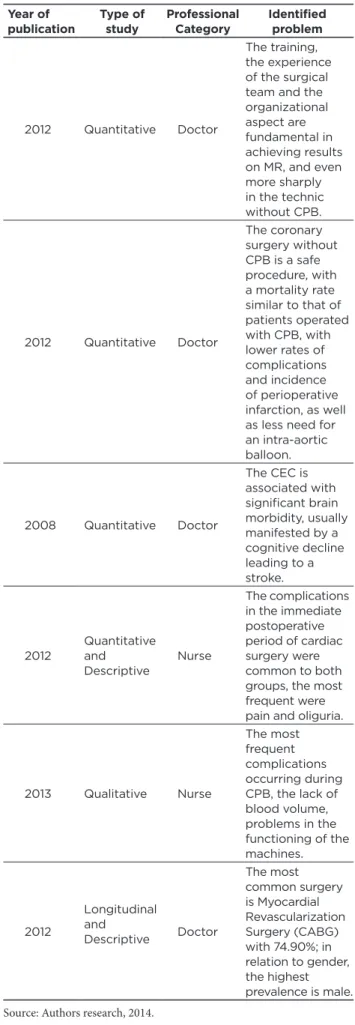
The type of study is observed in Tables 1 and 2, whether it is qualitative or quantitative, the year of publication, the problem identified and the professional category.
Regarding the type of study, most of them, 8 (70%), used the quantitative method, and 4 (30%) used the qualitative method.
Most scientific papers were developed by nursing professionals, 7 (60%), followed by 5 (40%) scientific articles developed by medical professionals. It is observed that most of the papers were published in 2012 by Nursing professionals, developed with quantitative and qualitative analysis.
The analysis was divided into two categories for better organization of data in order to address the objective of this study.
The first category contains scientific articles dealing specifically with care in the postoperative period, adding a total of 5 articles. The second category contains a total of 6 articles focused on cardiac surgery with cardiopulmonary bypass (CPB) and without cardiopulmonary bypass.
Comparison of nursing care in postoperative
cardiac surgery
The importance of the systematization of nursing care, in a way that helps the nurses to organize, systematize and conceptualize the nursing practice, making it possible to carry out an individual approach to the care of each client.1-2,6
Table 1 - Analysis of specific scientific articles related to
nursing care in the postoperative period
Year of
publicationType of study Professional category Problem identified
2012 Qualitative Nurse Nursing is concerned with the technical care to the inpatient, however, devoid of greater interaction with the patient and its family. 2012 Quantitative Nurse Fear and anxiety
2012 Quantitative/ descriptive Nurse
Patients demonstrated a lack of knowledge about the procedures. It is noteworthy that guidance on the surgical procedure is extremely necessary and relevant, especially considering the association of the heart with the symbolism of life. 2012 Qualitative Nurse The importance of a care plan is questionable because institutional constraints hamper its implementation, such as reduced staff, lack of training of nurses, the influence of material resources in providing assistance and the lack of communication. 2003 Quantitative Nurse The difficulty of implementing a qualified nursing care to the needs of the patients with heart problems. Source: Authors research, 2014.
Nursing care to patients undergoing cardiac surgery ranges from the participation in the choosing of the procedure to hospital discharge.1
The health team, especially the nurse, is responsible for the management of postoperative care of cardiac surgery, ensuring full-time direct assistance to the patient. 2.7
The main nursing diagnoses in the postoperative period of cardiac surgery are: risk of infection, risk of electrolyte imbalance, impaired gas exchange, risk for aspiration, altered protection, impaired skin integrity and risk of perioperative injury, risk of peripheral neurovascular dysfunction and risk of altered body temperature.8
The postoperative needs of rapid and synchronized actions, such as the installation of a mechanical ventilation system, cardiac monitoring, customer heating, connections of chest tubes to drain bottles, diuresis control and blood pressure, administration of infused liquids, ongoing assessment of the conscience and pain levels, maintenance of tissue integrity, prevention and infection control, hand washing, administration of prescription drugs and patient listening.1.6
The main problems presented by patients related to heart surgery are pain, anxiety and fear. The pain interferes with sleep patterns, rest and comfort maintenance. Fear and anxiety are present from the start of the surgical decision until the postoperative period. All these factors undermine the effectiveness of recovery, so it is for the professional nurse to observe the action of the patient, as well as, pay attention to the importance of providing psychological support for wrong and harm reduction.1-2.7
It is evident in the study records, the importance of the nursing professional guidance at the moment of patient discharge so that it and its family are aware of the new routine of life that will make the difference for its recovery. Thus the post-operative period involves biopsychosocial elements of great importance for successful treatment and optimization of the participation of the individual in the self-care process of recovery.2.7
Comparison of cardiac surgery with
cardiopulmonary bypass and without
cardiopulmonary bypass
Cardiac surgery came along with extracorporeal circulation, and it is an important milestone for health, as this procedure allows direct manipulation of the heart, correcting and healing numerous cardiac conditions previously considered incurable. The authors state that the bypass procedure consists of a system of machinery and circuits connected to the patient’s heart in order to replace the heart and lung functions, preserving its integrity, structure, function and metabolism of other organs and systems of the patient.9
The professional responsible for planning, performing and conducting the proceedings of extracorporeal circulation is the perfusionist, which is part of cardiac surgery team.9
Table 2 - Analysis of specific scientific articles related to
comparative cardiac surgery with cardiopulmonary bypass and without cardiopulmonary bypass
Year of
publication Type of study Professional Category Identified problem
2012 Quantitative Doctor
The training, the experience of the surgical team and the organizational aspect are fundamental in achieving results on MR, and even more sharply in the technic without CPB. 2012 Quantitative Doctor The coronary surgery without CPB is a safe procedure, with a mortality rate similar to that of patients operated with CPB, with lower rates of complications and incidence of perioperative infarction, as well as less need for an intra-aortic balloon. 2008 Quantitative Doctor The CEC is associated with significant brain morbidity, usually manifested by a cognitive decline leading to a stroke. 2012 Quantitative and Descriptive Nurse The complications in the immediate postoperative period of cardiac surgery were common to both groups, the most frequent were pain and oliguria.
2013 Qualitative Nurse The most frequent complications occurring during CPB, the lack of blood volume, problems in the functioning of the machines. 2012 Longitudinal and Descriptive Doctor The most common surgery is Myocardial Revascularization Surgery (CABG) with 74.90%; in relation to gender, the highest prevalence is male.
The procedure of cardiopulmonary bypass induces a systemic inflammatory syndrome mediated by autoimmune substances such as interleukins 1 and 6 and their complements.10.12
The bypass produces a systemic inflammatory response with release of substances which damage the clotting process and immune response, leading to fluid movement from the intravascular space into the interstitial because of changes in vascular permeability and decreased oncotic pressure, causing some complications in immediate postoperative period as acute pain, impaired gas exchange, hypothermia, decreased cardiac output and risk of imbalance of liquid volume.11-12
Myocardial revascularization without cardiopulmonary bypass has emerged as an alternative to avoid the deleterious effects of CPB that negatively affect the outcome of CABG, giving that the systemic inflammatory syndrome leads to complications inducing dysfunction of organs and increases the incidence of brain stroke.4,11
The higher the CPB time, the more serious will be the physiological imbalance of patient complications that may be caused by this procedure. Several researchers have been trying to demonstrate the benefits of cardiac surgery without CPB compared to conventional heart surgery. Patients with major CPB time had more neurological deficits, such as excessive sleepiness, impaired cognitive and intellectual function when compared to those patients who remained less time in CEC.11
The coronary artery bypass surgery with the use of CPB is an effective means for the treatment of symptoms of coronary artery disease, for the prevention of myocardial infarction and cardiac death in certain subgroups of patients. Moreover, this treatment provides a better quality of life for patients when compared with those undergoing other forms of treatment.10-11
CONCLUSION
This research allowed us to conclude some factors: most used articles were from 2012, written by Nurse and Doctor Professionals, study analysis used the quantitative method associated with the qualitative.
The procedure with cardiopulmonary bypass is, among the alternative means for cardiovascular damage recovery, the most effective, however, it brings some complications which the procedure without cardiopulmonary bypass reduces or extinguishes. However, the medical professional is the one responsible for the decision to choose between the two procedures, through its needs assessment, which includes the conditions inherent to each patient.
It is concluded that the systematization of nursing care is of utmost importance in the postoperative period of cardiac surgery because it is the nurse who plans and organizes the assistance and ensures that the nursing staff does an individualized and integrative approach to the customer. The main nursing diagnoses present in the articles were:
risk of infection, risk of electrolyte imbalance, impaired gas exchange, risk of aspiration, altered protection, impaired skin integrity and risk of perioperative injury, risk of peripheral neurovascular dysfunction and risk for body temperature change.
Interventions that the nurse professional performs involve from post-surgery specific care such as: cardiac monitoring, fluid administration, diuresis control and blood pressure; to psychosocial care: new postoperative routine, reduction of anxiety and fear, understanding of the patient before the limitations of the procedure; which include both patient and family members, where they become fundamental in the success and effectiveness of recovery.
REFERENCES
1. Lira ALBC, Araújo WM, Souza NTC, Frazão CMFQ, Medeiros ABA. Mapeamento dos cuidados de enfermagem para pacientes em pós-operatório de cirurgia cardíaca. Rev Rene. 2012; 13(5):1171-81. 2. Duarte SCM, Stipp MAC, Mesquita MGR, Silva MM. O cuidado de
enfermagem no pós-operatório de cirurgia cardíaca: um estudo de caso. Esc Anna Nery (impr.) 2012 out. dez 16 (4): 657-65.
3. Gama GGG, Mussi FC, Guimarães AC. Revisando os fatores de risco cardiovascular. Rev. enferm. UERJ 18(4):650-55, out.-dez. 2010. 4. Gomes, WJ. Cirurgia de revascularização miocárdica com e sem
circulação extracorpórea. O cirurgião cardíaco deve dominar ambas as técnicas. Rev Bras Cir Cardiovasc. [online], São José do Rio Preto, 2012, vol.27, n.2, pp. v-viii.
5. Gonçalves MZ. Análise da prevalência de cirurgia cardíaca no serviço de reabilitação cardíaca do hospital universitário de santa maria-revicardio e sua relação com a idade e gênero. [periódico na internet] 2014. [Cited in 2014 Apr 01]. Available at: <http://www.unifra.br/ eventos/sepe2012/Trabalhos/5351.pdf>.
6. Almeida CE, Enokibara MP, Ribeiro DA, Sampaio CEP. O cuidado de enfermagem associado à prescrição de enfermagem numa unidade de cirurgia cardíaca. Rev. pesqui. cuid. fundam. (Online);4(3):2510-20, jul.-set. 2012.
7. Faria GSF, Gutemberg S, Caixeta LR, Stival MM, Lima LR. Dor aguda: julgamento clínico de enfermagem no pós operatório de cirurgia cardíaca. REME rev. min. enferm; 16(3):400-9, jul.-set. 2012. 8. Galdeano LE, Rossi LA, Nobre LF, Ignacio DS. Diagnósticos de
enfermagem de pacientes no período transoperatório de cirurgia cardíaca. Rev. Latino-Am. Enfermagem [online]. 2003 março-abril; 11(2):199-206.
9. Dienstmann C, Caregnato RC. Circulação extracorpórea em cirurgia cardíaca: um campo de trabalho para o enfermeiro. Rev. SOBECC, São Paulo. jan./mar. 2013; 18(1): 35-43.
10. Cantero MA, Almeida RMS, Galhardo, R. Análise dos resultados imediatos da cirurgia de revascularização do miocárdio com e sem circulação extracorpórea. Rev Bras Cir Cardiovasc, São José do Rio Preto 2012; 27(1):38-44.
11. Torrati FG, Dantas RAS. Circulação extracorpórea e complicações no período pós-operatório imediato de cirurgias cardíacas. Paulo, Acta Paul Enferm. São Paulo, 2012; 25(3):340-5.
12. Nogueira CRSR, Hueb W, Takiuti ME, Girardi PBMA, Nakano T, Fernandes F et al. Qualidade de Vida após Revascularização Cirúrgica do Miocárdio com e sem Circulação Extracorpórea. Arq Bras Cardiol, São Paulo 2008, vol.91, n.4, p. 238-44.
Received on: 25/09/2014 Reviews required: No Approved on: 17/09/2015 Published on: 08/01/2017 _________
Author responsible for correspondence:
Jeana Cristina Barretta Instituto Federal do Paraná - Campus Palmas Av. Bento Munhoz da Rocha Neto, PRT 280, Palmas/PR