J. res.: fundam. care. online 2013.dec. 5(6):9-19
9
PROFESSIONAL KNOWLEDGE OF THE FAMILY HEALTH STRATEGY ON SICKLE-CELL DISEASE CONHECIMENTO DE PROFISSIONAIS DA ESTRATÉGIA SAÚDE DA FAMÍLIA SOBRE A ANEMIA FALCIFORME CONOCIMIENTO PROFESIONAL DE LA ESTRATEGIA DE SALUD DE LA FAMILIA SOBRE LA ENFERMEDAD DE CÉLULAS
FALCIFORMES
Laise Maria Formiga Moura Barroso 1, Telma Maria Evangelista Araújo 2, Brunna Eulálio Alves3, Maria do Carmo de
Carvalho e Martins 4
ABSTRACT
Objective: To evaluate the knowledge of medical professionals and nurses of the family health strategy on sickle-cell
disease. Method: This is a quantitative study of the universe of physicians and nurses that make up the family health strategy teams (n=104). The data were collected through a questionnaire in the period from March to May of 2012, descriptive and inferential analysis of the numeric variables. Results: The majority of the professionals were women (61.5%), specialized (85.6%) and having less than five years of experience in the family health strategy (34.6%). Part of the physicians (29.8%) have adequate knowledge on sickle cell anemia and 54.6% have regular knowledge on the disease, while more than half of nurses (54.4%) have inadequate knowledge. Conclusion: The findings point to the need for permanent education of the primary care professionals, since it is on the main port of access for users.
Descriptors: Sickle cell anemia, Family Health, Knowledge. RESUMO
Objetivo: Avaliar o conhecimento dos profissionais médicos e enfermeiros da Estratégia Saúde da Família sobre a
anemia falciforme. Método: Trata-se de um estudo quantitativo, com o universo de médicos e enfermeiros que compõem as equipes da Estratégia Saúde da Família (n=104). Os dados foram coletados por meio de um questionário, no período de março a maio de 2012 e realizada análise descritiva e inferencial das variáveis numéricas. Resultados: A maioria dos profissionais foi constituída pelo sexo feminino (61,5%), com especialização (85,6%) e apresentam experiência de menos de cinco anos na Estratégia Saúde da Família (34,6%). Parte dos médicos (29,8%) dispõe de conhecimento adequado sobre a anemia falciforme e 54,6% têm conhecimento regular sobre a doença, enquanto mais da metade dos enfermeiros (54,4%) possuem o conhecimento inadequado. Conclusão: Os resultados apresentados apontam para a necessidade de educação permanente dos profissionais da rede de atenção básica, visto que ela se constitui na principal porta de acesso dos usuários. Descritores: Anemia falciforme, Saúde da família, Conhecimento.
RESUMEN
Objetivo: Evaluar los conocimientos de los profesionales médicos y enfermeras de la estrategia de salud familiar sobre
la enfermedad de células falciformes. Método: Se trata un estudio cuantitativo con el universo de los médicos y enfermeras que conforman los equipos de la estrategia de salud de la familia (n=104). Los datos fueron recogidos a través de un cuestionario en el período de marzo a mayo de 2012 y realizado una análisis descriptiva e inferencial de las variables numéricas. Resultados: La mayoría de los profesionales se constituyó por mujeres (61,5%), especializada (85,6%) y tienen menos de cinco años de experiencia en la estrategia de salud de la familia (34.6%). Parte de los médicos (29,8%) tiene un conocimiento adecuado sobre la anemia de células falciformes y 54,6% tiene conocimiento regular sobre la enfermedad, encanuto que más de la mitad de las enfermeras (54,4%) tienen un conocimiento inadecuado. Conclusión: Los resultados presentados señalan la necesidad de educación permanente de los profesionales de la atención básica, puesto que está en la puerta principal de acceso para los usuarios. Descriptores: Anemia de células falciformes, Salud de la Familia, Conocimiento.
1Master's in Family Health from the University Center UNINOVAFAPI, Teresina-PI, Brazil, Email: [email protected]
2PhD in Nursing from UFRJ - Anna Nery School of Nursing. Professor of Professional Master’s Degree Program in Family Health,
University Center Uninovafapi, Professor of the Graduate and Masters Programs in Nursing at UFPI, Director of Surveillance and Health Care, State of Piaui. Teresina-PI, Brazil, Email: [email protected]
3PhD in Clinical Medicine fromCAMP. Hematologist Doctor, HEMOPI. Teresina-PI, Brazil, Email: brunnaeulá[email protected]
4PhD in Biological Sciences at UFPE. Professor of the Graduate and Professional Program Master's in Family Health Center
UNINOVAFAPI. Professor at UFPI. Teresina-PI, Brazil, Email: [email protected]
RESEARCH
J. res.: fundam. care. online 2013.dec. 5(6):9-19
10
Sickle Cell Anemia is defined as a chronichemolytic anemia associated with hemoglobin (Hb), which will result in a hereditarily homozygosity for HbS relative to HbA abnormal, ie parents asymptomatic carriers of a single affected gene (heterozygous) and produce HbA HbS (AS), will give her child the abnormal gene in double dose (homozygous SS).1
By constituting a chronic pathology, it is necessary that health professionals be prepared to administer adequate care, with early diagnosis and treatment, to ensure the wearer a better quality of life because the late recognition of the disease can lead to death in the first years of life.
It is one of the most ancient diseases of humanity, resulting from a genetic mutation occurred mainly in people from the African continent. Forced immigration because of slavery brought the gene to the entire Brazilian territory. The disease is hereditary, incurable and has high morbidity and mortality. ²
Regarding the ethnic prevalence in Brazil, is higher among blacks. However, it distributes itself heterogeneously, and may affect white individuals due to the miscegenation of the Brazilian population. The World Health Organization estimates that, annually, born in Brazil close to 3,500 children with sickle cell disease, of which approximately 1,900 have sickle cell anemia. Approximately one Afro-Brazilian child in every 37,400 is born with the disease and about one in every eight Afro-Brazilian bears sickle cell trait (HBAs).3
Early treatment provably increases the survival of affected children and improves the quality of life, because it reduces their sequels and attenuates the clinical complications, however,
does cure it. Patients should be monitored throughout their life in a comprehensive approach by means of a multidisciplinary team. 4
The inclusion of care for sickle cell anemia in the Family Health Strategy strengthens the primary care level, since the user with sickle cell anemia should be inserted in the public health system through this port of entry, according to regulation 7508/2011. However, it is necessary to draw attention to the importance of the organization of the work process, including the mechanisms of reference and counter reference. To do so, it is necessary not only for professional training, but also for the definition of protocols so that the practices are implemented.
For the establishment of appropriate practices, is essential to understand the instability of the clinical complications of the disease ranging from periods of well-being states of emergency care, which implies the need for care in other parts of the health network. Historically, the responsibility for the treatment of the disease is perceived as a competence of hematological centers. Thus, it is assumed that many the intermediate levels such as primary healthcare are unaware or even ignore the illness as an integral part of its scope of care. When these users or family members use the services of primary or urgency care require attention in the inpatient unit, shows the breakdown of assistance: insecure professionals and inadequately prepared to provide skilled care to the person with the disease and their family members.
It is noteworthy that continuing education for professionals already working in primary healthcare, in addition to those engaged in hospital care seems to be the right strategy at the time. As there is no specific treatment for sickle cell disease, general and preventive measures to
INTRODUCTION
J. res.: fundam. care. online 2013.dec. 5(6):9-19
11
alleviate the consequences of chronic anemia,sickle cell crises and susceptibility to infections, are fundamental in the treatment of these patients.
In this perspective, and considering the lack of studies that investigate the knowledge of professionals on this topic, this research aims to assess the knowledge on sickle cell anemia of medical professionals and nurses of the FHS (Family Health Strategy) of municipalities in the health of a micro-region in Piaui.
This is a descriptive cross-sectional study, conducted in 09 municipalities, among the 20 that make up a health micro-region of Piaui. The selection of the micro-region was based on the existence of a larger number of records of cases of sickle cell anemia in the state, according to information from the Secretariat of Health of the State of Piaui. 5
The study population was comprised by the universe of physicians (47) and nurses (57) teams of the Family Health Strategy (n=104) of the micro-region. The data were collected by means of a questionnaire, in the period from March to May 2012, after approval of the Ethics Committee in Research of NOVAFAPI, CAAE No 0379.0.043.000 -11. It is highlighted that all the ethical principles contained in the Resolution 196/96 of the National Council on Health were obeyed which regulates research involving human beings. Highlighting the content validation phase of the data collection instrument, which was performed through evaluation of the questions by a panel of professionals with expertise in the subject matter
(a hematologist, two pediatricians, a pharmacist and a nurse).
A descriptive analysis was conducted with data exploration by means of univariate and bivariate techniques and the Kolmogorov-Smirnov normality test was used. For observation of the relationship between the numerical variables, we used the Kruskal-Wallis test. Among the categorical variables, the Chi-square test was used with a significance level of (p<0.05), to verify the possible associations between the variables. 6 Considering the ignorance regarding the existence of studies that classify the knowledge of professionals on sickle cell anemia, the research performed in Teresina was taken as reference, on the topic "knowledge and practice on vaccination", which adopted a system of scores, already validated, with three class intervals, as the percentage of accuracy for the responses. In accordance with the aforementioned research, this study applied a scale categorizing the knowledge in percentage intervals of three classes: Inappropriate from 1 to 49%, regular from 50 to 79% and appropriate 80 to 100%.7 The discussion was based on literature produced on sickle cell anemia.
The population planned to participate in the study was of 100 professionals, of which were 50 nurses and 50 physicians. However, 57 nurses participated because they were included in the study coordinators of the Family Health Strategy municipalities and 47 doctors, since three refused to participate in the study, totaling 104 participants.
METHOD
J. res.: fundam. care. online 2013.dec. 5(6):9-19
12
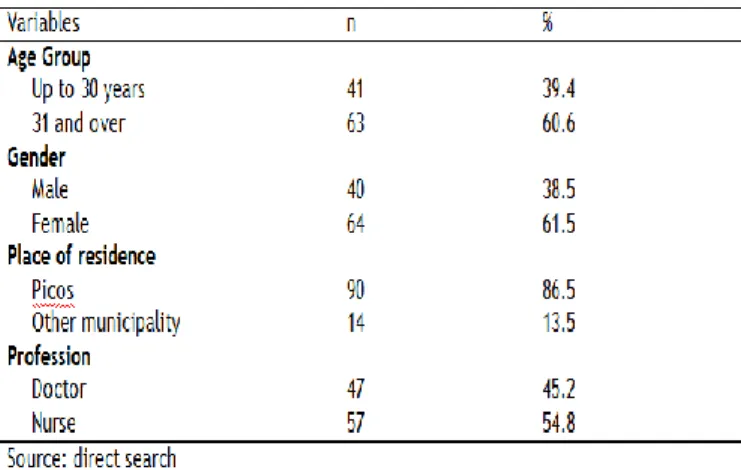
Table 1 presents the characteristics of the professional Family Health Strategy, according to sociodemographic variables, on which it was found that the majority of respondents were between 31 and years and older (60.6%), followed by the age group up to 30 years (39.4%), with an average of 42.8 years of age, with a predominance of women (61.5%). Regarding the place of residence, the majority is the city of Picos (86.5%).
Table 2 shows that more than half (55.8%) of the professionals have up to five years of work
in the cities, 85.6% already coursed a post-graduate degree and have more than six years since graduation (65.4%). The vast majority has no training on sickle cell anemia (94.2%). In addition, among those who were specifically trained, the training occurred less than five years ago.
It is observed that all investigated doctors and most nurses have knowledge of some of the clinical manifestations of the disease, however,
J. res.: fundam. care. online 2013.dec. 5(6):9-19
13
among them, which point out that, 100% of thenurses don't know them. In relation to the requested examinations for the diagnosis, doctors and nurses cited the Guthrie test (59%) and (41%) respectively, followed by electrophoresis 73.1% and 26.9%. Regarding the causes of the disease, both doctors (100%) and nurses (82.4%) referred to hereditary. Among those who reported not knowing, 100% were nurses.
With respect to cure the disease, 51.4% of physicians and 48.6% of nurses reported the non-existence. Regarding the evolution of the disease, the painful crises were cited most frequently by both doctors and nurses, with 76.2% and 23.8%, respectively.
They were questioned what treatment against cases, transfusion and drug treatment were the most suitable for both professional groups should be used. Among those who said they did not know which medicines used, 100% were nurses. In relation to the strategies to prevent sequelae and complications, self-care was the most cited by physicians (51.8%) and nurses (48.2%).
Also it was possible to verify that only the knowledge about the main manifestations of sickle cell anemia, about exams, diagnosis and strategies to prevent sequelae and complications, were statistically associated with the professional category (p>0.05).
It is observed in Figure 1, the majority of nurses (54.4%) had inadequate knowledge about sickle cell anemia, while most doctors had knowledge classified as fair (54.6%) or adequate (29.8%).
When performing the crossing of knowledge on sickle cell anemia with the professionals surveyed, we observed no statistically significant association (p> 0.05) in their average training time (Table 4).
J. res.: fundam. care. online 2013.dec. 5(6):9-19
14
In table 5, it can be observed that no variable related to knowledge about sickle cell anemia was statistically associated with the average working time of professionals in the study (p>0.05).
Professionals surveyed reside mostly in the region where they develop activities, in contrast to many regions of the state, where doctors and nurses have no fixed residence. This fact can be explained by the infrastructure available in some municipalities, especially in Picos, for it is the third most developed city of the state of Piaui. 8 It is worth noting that the Family Health Strategy recommends the insertion of professionals throughout the community, with the aim of fulfilling the principles of the National Policy of Basic Care, which emphasizes the bond and continuity of care as necessary requirements for promoting an integral assistance and quality.9
When they analyzed the study population data, such as the permanent education, it was found that the majority (85.6%) have
post-graduation. Similar Results were found in studies on the knowledge of professionals in sickle cell disease conducted in Montes Claros, MG, Brazil in 2010, where the majority of the professionals of the FHS have post-graduation (64.4%). 10
Education based on continuous learning is a necessary condition for the development of the subject in terms of their self-improvement, as a goal to be followed throughout their entire life. The diversity of information, as well as a wide range of needs of knowledge in more diverse areas, leads to the observation that it would be almost impossible task for formal education to the level of graduation, ensuring an adequate training for professionals. In this sense, the search for the continuity of the education of health professionals, through post-graduate courses and also from training free, must be not only an initiative of the institution to which they are bound, but mainly a commitment to each aimed at personal, professional and social transformation.11
It was noticed the large number of professionals who does not have any training in sickle cell anemia (94.2%). In order to produce satisfactory results, the team at Family Health Strategy requires a process of continuous and effective training and information so that they can meet the needs brought about by the dynamism of the problems. In addition to enabling the professional development, training is an important mechanism in the development of team self-conception and professional binding with the population, a fundamental characteristic of the entire work of the FHS. 12 It is known that the lack of training in whatever area of operation makes the service developed deficient causing professionals to end up learning what they should already know, the practical exercise of their activities on a daily basis.
J. res.: fundam. care. online 2013.dec. 5(6):9-19
15
Studies state that this disease has an impact onthe bearer's family and the health professionals, who for lack of knowledge end up being inadequately prepared to attend to cases of sickle cell disease. In the specific case of sickle cell anemia, so early attendance occurs, it is important that health professionals are informed about the existence of the disease and are able identify it.13
Regarding the knowledge of the professionals studied on sickle cell anemia, doctors stood out because they all recognize some of the main clinical manifestations, while some of the nurses did not know how to reply. Regarding the evolution of the disease also increased knowledge among physicians it was observed because only a small part of nurses cited the evolution of the disease.
The incipient knowledge of many nursing professionals in the clinical aspects of sickle cell anemia, with emphasis on signs and symptoms, possibly could be related with the fact that the diagnosis being a private physician. In any event, this panorama implies in screening of the patient by the nursing professional in the Family Health Strategy, once that this professional most of the times is the first to have contact with the patient, taking the referrals and subsidizing the medical diagnosis, i.e. always works from the perspective of maintaining an interdisciplinary team.
Even though there are evidences sustained 14 that sickle cell anemia is a chronic incurable illness, the same studies claim that it is treatable. In this perspective, it is of utmost importance to disseminate knowledge among health professionals and the population itself that early treatment provably increases the survival of affected children and improves the quality of life, but does not have a cure. 15 It was observed in relation to the causes of anemia, which all doctors answer correctly and a significant percentage of nurses has too. In
relation to the cure of the disease, both professional doctors and nurses, the vast majority answered correctly.
Recent studies have shown that patients with sickle cell anemia in red blood cell transfusion regular show improvement of the clinical evolution of the disease, especially significant reduction in the number of hospitalizations, occlusive vessel crises and treatment of acute thoracic syndrome. 16 In the evaluation of the treatment used, a large part of the doctors and nurses answered correctly quoting the transfusion. This is recommended in basic care, assistance to patients with sickle cell anemia, including the realization of complementary exams, when necessary, the immunizations basic and special, as well as the prescription and dispensing of medicines, when indicated, such as folic acid, penicillin or other antibiotic, analgesic and anti-inflammatory drugs. 17
In relation to the drugs used, only the doctors answered correctly. This fact can be justified due to the prescription being an act of physicians. It is worth noting that they do not mention all the medicines correctly as recommended by the Ministry of Health.
Regarding the strategies to prevent sequelae and complications, the majority of doctors, demonstrated knowledge, pointing to vaccination and self-care, while significant portion of nurses reported only the self-care. In sickle cell anemia there is no specific treatment; thus, the improvement of survival and quality of life of these patients is based on general and preventive measures. These measures include good nutrition, prophylaxis, diagnosis and early treatment of infections, by means of vaccination and the use of penicillin, maintenance of good hydration, self-care and avoiding adverse climatic conditions. 18
J. res.: fundam. care. online 2013.dec. 5(6):9-19
16
It adds to the lack of information regardingthe treatment and care across the sickle cell anemia by professionals from the primary care network, failures in the organization of service provision, precluding continued care to patients with this disease, which leads to seek secondary care and / or not adopt simple self-care measures. Data from the international literature shows that early diagnosis, especially at birth, and the appropriate treatment dramatically improve the rate of survival and the quality of life of patients with sickle cell anemia. 19
In the final classification of knowledge about sickle cell anemia, it was possible to verify that the two professional categories still feature a large gap, with emphasis on the nurse. Similar Results were found in studies on performance of professionals of family health teams in relation to the sickle cell disease conducted in Montes Claros, MG, Brazil, in the year of 2010, where the 50 questions related to knowledge of nurses and doctors about the sickle cell disease, there was an average of hit 32.7% with standard deviation of 5.1. 10
In relating the crossing of knowledge on sickle cell anemia with the professionals surveyed, training time and work the same, it was observed that there was no statistically significant association. There is an emerging need for updating and training of professionals in the FHS, with regard to screening and the approach to the patient with sickle cell anemia, emphasizing the assignments of each professional, with the aim of performing early diagnosis and guide the care for the improvement of the quality of life of these patients.
Knowledge on sickle cell anemia is without doubt one of the relevant aspects to be evaluated in practice professionals inserted into the network of basic care, since it is the main port of entry for users. Moreover, it is there that the majority of health problems of the population must be resolved, and that those who are fleeing to their level of complexity should be forwarded to another level of care.
This study reveals that the professionals investigated still need acquire better technical preparation to deal with the disease; there are views that the vast majority of physicians (54.6%) had their knowledge about sickle cell anemia classified as regular and only 29.8% appropriate. With respect to nurses, the situation was even more worrying, because 54.4% of them showed inadequate knowledge.
It was also found that the time since graduation and the time of work in the Family Health Strategy were not statistically associated with knowledge.
Primary care professionals should play a key role in quality of life and longevity of individuals with sickle cell anemia. In this perspective, it must consider the importance of acquiring new knowledge that will culminate in a care more qualified to relatives and persons suffering from sickle cell anemia. It is understood also that the knowledge acquired through training, by itself will not be enough to cope with the problem, since a compatible infrastructure is necessary for the deployment and organization of services focused on early diagnosis, treatment and monitoring of cases.
J. res.: fundam. care. online 2013.dec. 5(6):9-19
17
1. Silva IA. Atuação fisioterapêutica na anemiafalciforme. Lato & Sensu [Internet]. 2003 [cited 2012 Sep 05]; 4(1): 3-5. Available from:
http://www.nead.unama.br/site/bibdigital/pdf/ar
tigos_revistas/130.pdf
2. Kikuchi BA. Assistência de enfermagem na doença falciforme nos serviços de atenção básica. Rev. Bras. Hematol. Hemoter. [Internet]. 2007 [cited 2012 Sep 05] ; 29(3): 331-338.
Available from:
http://www.scielo.br/scielo.php?script=sci_arttext &pid=S151684842007000300027lng=en
3. Machado TR. Perfil hemoglobínico em comunidade quilombola do município de Viamão. Rev. Bras. Hematol. Hemoter. [Internet].2009 [cited 2012 Sep 05];31(4):47-68. Available from:http://www.cehmob.org.br/simposio/imagen
s/download/RBHH_pesquisa_epidemiologica.pdf
4. Ramalho AS, Magna LA, Silva RBP. A Portaria no 822/01 do Ministério da Saúde e as peculiaridades das hemoglobinopatias em saúde pública no Brasil. Cad. Saúde Pública. [Internet]. 2003 [cited 2012 Sep 05]; 19(4):1195-9. Available from: em:
http://www.scielo.br/scielo.php?script=sci_arttext
&pid=S0102311X2003000400040&lng=en&nrm=iso
5. Piaui. Secretaria de Estado da Saúde. Balanço de Saúde 2008-2010. Teresina: HEMOPI; 2011:97-119.
6. Field A. Descobrindo a estatística usando SPSS. 2ª ed. Porto Alegre: Artmed; 2009.
7. ARAUJO TME. Vacinação infantil: Conhecimentos, Atitudes e Práticas da População da Área Norte/Centro de Teresina/PI [tese]. Rio de Janeiro (RJ): Escola de Enfermagem Anna Nery; 2005.
8.Instituto Brasileiro de Geografia e Estatística (IBGE). Censo de 2010: resultados do universo. Picos-PI; 2011.
9. Ministério da Saúde (BR). Política Nacional da Atenção Básica. Portaria M.S n 2488, de 21/10/2011. Brasília: Ministério da saúde; 2011. [cited 2012 Sep 05]. Available from:
http://bvsms.saude.gov.br/bvs/saudelegis/gm/201
1/prt2488_21_10_2011.html
10. Vieira MM, Gomes LMX, Reis TC, Caldeira AP. Conhecimentos dos profissionais de saúde da atenção primária relacionados à doença falciforme. IV Fórum de Ensino, Pesquisa, Extensão e Gestão; 2010 Sep 22-25; Montes Claros, MG; Anais: On line;
2010. Available from:http://www.ppesquisa.unimontes.br/fepeg20 11/index.php/eventos/forum2010/search/authors/ view?Firstname=Tatiana&middleName=Carvalho&la stName=Reis&affilation=Universidade%20Estadual% 20de%20Montes%20Claros&country=BR
11. Paschoal AS, Mantovani MF, Méier MJ. Percepção da educação permanente, continuada e
REFERENCES
J. res.: fundam. care. online 2013.dec. 5(6):9-19
18
em serviço para enfermeiros de um hospital deensino. Rev. esc. enferm. USP [Internet]. 2007 [cited 2012 Sep 07] ; 41(3): 478-484. Available from:
http://www.scielo.br/scielo.php?script=sci_arttext
&pid=S008062342007000300019&lng=en
12. Ministério da Saúde (BR). Secretaria de Assistência à Saúde. Coordenação de Saúde da Comunidade. Saúde da Família: uma estratégia para a reorientação do modelo assistencial. Brasília: Ministério da saúde; 1997 [cited 2012 Sep
04]. Available from:
http://bvsms.saude.gov.br/bvs/publicacoes/cd09_
16.pdf
13. Diniz D, Guedes C. Anemia Falciforme: Um Problema Nosso. Uma abordagem bioética sobre a nova genética. Cad. Saúde Pública [Internet]. 2003 [cited 2012 Sep 04] ; 19(6): 1761-1770.
Available from:
http://www.scielo.br/scielo.php?script=sci_arttext
&pid=S0102311X2003000600020lng=en
14. Guimarães CTL, Coelho GO. A importância do aconselhamento genético na anemia falciforme. Ciênc. saúde coletiva [Internet]. 2010 [cited 2012
Sep 03]. Available from:
http://www.scielo.br/scielo.php?script=sci_arttext
&pid=S141381232010000700085&lng=en
15. Rodrigues CCM, Araújo IEM, Melo LL. A família da criança com doença falciforme e a equipe enfermagem: revisão crítica. Rev. Bras. Hematol. Hemoter. [Internet]. 2010 [cited 2012 Sep 03] ;
32(3): 257-264. Available from:
http://www.scielo.br/scielo.php?script=sci_arttext
&pid=S1516-84842010000300013&lng=en
16. Cançado RD, Jesus JA. A doença falciforme no Brasil. Rev. Bras. Hematol. Hemoter. [Internet]. 2007 [cited 2012 Sep 04] ; 29(3): 204-206.Available from:
http://www.scielo.br/scielo.php?script=sci_arttext
&pid=S151684842007000300002lng=en
17. Ministério da Saúde (BR). Secretaria de Atenção à Saúde. Departamento de Atenção Especializada. Manual de educação em saúde: Linhas de cuidado em doença falciforme. Brasília: Ministério da Saúde; 2009. [cited 2012 Sep 04]. Available from:
http://bvsms.saude.gov.br/bvs/publicacoes/manu
al_educacao_saude_v2.pdf
18. Brasil, Ministério da Saúde [Internet]. Manual de diagnostico e tratamento de doenças falciformes. Brasília: Agência Nacional de vigilância Sanitária; 2002. [cited 2012 Sep 04]. Available from:
http://bvsms.saude.gov.br/bvs/publicacoes/anvisa
/diagnostico.pdf
19. Silva RBP, Ramalho AS, Cassorla RMS. A anemia falciforme como problema de Saúde Pública no Brasil. Rev. Saúde Pública [Internet]. 1993 [cited 2012 Sep 04]; 27(1): 54-58. Available from:
http://www.scielo.br/scielo.php?script=sci_arttext
J. res.: fundam. care. online 2013.dec. 5(6):9-19