Polymorphisms
FTO
rs9939609,
PPARG
rs1801282 and
ADIPOQ
rs4632532
and rs182052 but not lifestyle are associated with obesity related-traits in
Mexican children
Muñoz-Yáñez C
1, Pérez-Morales R
2, Moreno-Macías H
3, Calleros-Rincón E
2, Ballesteros G
4, González R.A
4and Espinosa J
11
Departamento de Investigación, Facultad de Medicina, Universidad Juárez del Estado de Durango,
Durango, México.
2
Departamento de Biología Molecular, Facultad de Ciencias Químicas, Universidad Juárez del Estado de
Durango, Durango, México.
3
Departamento de Economía, División CSH de la Universidad Autónoma Metropolitana, Unidad Iztapalapa,
D.F. México, México.
4
Facultad de Ciencias, Universidad Autónoma del Estado de Morelos, Cuernavaca, Morelos, México.
Abstract
Concerning the genetic factors of obesity, no consistent association between populations has been reported, which may be due to the frequency of polymorphisms, the lifestyle of studied populations and its interaction with other
fac-tors. We studied a possible association of polymorphisms FTO rs9939609, PPARG rs1801282, and ADIPOQ
rs4632532 and rs182052 with obesity phenotypes in 215 Mexican children. Glucose, triglycerides, cholesterol, HDL and LDL were measured. In addition, weight, height, waist circumference and triceps skin thickness were recorded. High-energy diets and sedentary behavior were evaluated with a validated questionnaire. In contrast with other re-ports, onlyFTO rs9939609 was associated with obesity related-traits, including BMI (p = 0.03), waist circumference (p = 0.02), triceps skinfold (p = 0.03) and waist/height ratio (p = 0.01), and also with cholesterol levels (p = 0.02) and LDL (p = 0.009). Lower levels of triglycerides (p=0.04) were related with presence of PPARG rs1801282, while ADIPOQ rs4632532 showed an effect on HDL (p = 0.03) levels. On the other hand, diet, physical activity and screen time were not related with obesity. In summary, onlyFTO rs9939609 was associated with obesity related-traits, while PPARG2 rs1801282 and ADIPOQ rs4632532 were involved in lipid metabolism.
Keywords: Obesity, children; polymorphisms, energy intake, physical activity, lipid profile.
Received: November 4, 2015; Accepted: February 29, 2016.
Introduction
Obesity is a worldwide public health problem due to its association with chronic diseases, such as type 2 diabe-tes, hypertension, cardiovascular disorders and certain ty-pes of cancer. Obesity results from an interaction of social, psychological, genetic and environmental factors, like diet and physical exercise. The last National Health and Nutri-tion Survey found that the naNutri-tional prevalence of childhood overweight did not increase. However, in the Mexican state of Durango the childhood obesity raised from 22.9% in 2006 (Shamah-Levy and Villalpando-Hernández, 2007) to 37.5% in 2012 (Rivero-Vázquez, 2013), which might be the result of different genetic backgrounds of Mexico’s
Northern populations (Silva-Zolezzi et al., 2009). Many studies have demonstrated that genetic factors have an im-portant role in the development of obesity, although results are different depending on the population being evaluated. One of the most studied genes, thePPARGis a mem-ber of the nuclear hormone receptors super-family, which regulates transcription of genes involved in several biologi-cal functions, such as cell growth, adipocyte differentia-tion, metabolism of cholesterol and fatty acids, cell sur-vival, ubiquitination and adaptive thermogenesis.PPARG
is activated by lipophilic hormones, fatty acids from the diet, and their metabolites (He, 2009). The Ala allele of the polymorphism Pro12Ala ofPPARG was associated with obesity in a population from Spain (OR = 2.36, p = 0.03) and from India (OR = 3.2, p = 0.02) (González-Sánchezet al., 2002; Bhattet al., 2012), while the Pro allele was a risk factor for type 2 diabetes in a French population (OR = 1.37, p = 0.04) (Ghoussainiet al., 2005).
DOI: http://dx.doi.org/10.1590/1678-4685-GMB-2015-0267
Send correspondence to Jorge Espinosa. Facultad de Medicina, Universidad Juárez del Estado de Durango, Calz. Palmas 1 y Sixto Ugalde s/n. Col. Revolución. C.P. 35050 Gómez Palacio, Durango, Mexico. E-mail: [email protected]
FTOwas the first gene to be associated with obesity by genome-wide association studies (GWAs). Adults ho-mozygous the A allele, in rs9939609 polymorphism, weight on average 3 - 4 kg more and have a 1.67-fold in-creased risk of obesity (Fraylinget al., 2009). However,
FTOfunctions are not yet fully described; anin vitrostudy showed that it acts as a co-activator of the C/EBP family of transcriptional regulators, which in conjunction with
PPARGare necessary for adipocyte differentiation (Wuet al., 2010). In addition, it is expressed in proopiomelo-cortin-producing neurons participating in the satiety cycle (Tunget al., 2010). Accordingly, epidemiological studies support an association of the A allele with increased caloric intake (Speakmanet al., 2008), and loss of overeating con-trol (Tanofsky-Kraffet al., 2009).FTOrs9939609 was also associated with risk of obesity in a Mexican (OR = 1.38, p = 0.03) and Chinese populations (OR = 1.29, p = 0.001) (Villalobos-Comparánet al., 2008; Xiet al., 2010)
The less studiedADIPOQgene encodes adiponectin, a hormone secreted by adipose tissue into plasma, where it binds with receptors in muscle and liver, and participates in glucose uptake and beta-oxidation of lipids. Adiponectin levels were associated with obesity and insulin resistance in an Italian population (Filippiet al., 2004). In a Mexican American population,ADIPOQpolymorphisms rs4632532 and rs182052 increased BMI (p = 0.032 and p = 0.029, re-spectively) (Richardson et al., 2006);. Polymorphism rs182052 was related with low expression levels of adiponectin, in a Chinese population (Onget al., 2010).
In this study, we investigated the association between polymorphismsFTOrs9939609,PPARG2rs1801282, and
ADIPOQ rs4632532 and rs182052 with obesity-related traits in a Mexican population with high prevalence of childhood obesity.
Materials and Methods
Subjects
Two hundred and fifteen Mexican mestizo children (108 males and 107 females, ranging from 6.1 to 12.3 years old), whose parents and grandparents were born in Mexico, were selected to participate in the study. Sampling was per-formed on ten public elementary schools from the bordering cities of Gómez Palacio and Lerdo, in the state of Durango, Mexico, between January and June 2012. The protocol was approved by the Ethics Committee of the Facultad de Medi-cina of the Universidad Autónoma de Coahuila, Mexico, and all parents signed an informed consent.
The BMI is an attempt to quantify the amount of tis-sue mass (muscle, fat, and bone) in an individual. It is de-fined as the body mass divided by the square of the body height, and is universally expressed in units of kg/m2. The waist/height ratio is a better predictor of a person’s meta-bolic risk (Browninget al., 2010) and is defined as waist circumference (cm) divided by height (cm). Triceps
skin-fold thickness is measured in the right arm with Lange cali-pers. All children were assessed and measurements were recorded according to an established protocol (Shamah-Levy and Villalpando-Hernández, 2007). The “over-weight/obese” group was established using the age- and sex-specific BMI cutoff specified by the International Obe-sity Task Force (IOTF) (Coleet al., 2000) and by the World Health Organization (De Oniset al., 2007). Blood samples were drawn after overnight fasting. Total cholesterol, HDL (both by CHOD-PAP, Randox Laboratories Ltd. Ardmore, Crumlin, UK) and Triglyceride (Pointe Scientific Inc. De-troit, Michigan, US) levels were evaluated by enzymatic colorimetric methods. LDL levels were calculated using Friedewald’s formula. Glucose levels were measured by Glucose Oxidase method (Randox Laboratories Ltd. Ardmore, Crumlin, UK). Plasma glucose levels were mea-sured within 2 hours after the sample was obtained and plasma samples were stored at –20°C until analysis for the other biochemical parameters.
Dietary information was obtained by a semi-quanti-tative food frequency questionnaire (FFQ) applied to moth-ers or caregivmoth-ers by trained pmoth-ersonnel. The questionnaire included 101 food items classified in 14 groups and was used by the National Institute of Public Health in The Na-tional Survey of Health and Nutrition 2006 (ENSANUT2006) (Shamah-Levy and Villalpando-Her-nández, 2007). The interviewers asked about portions that were consumed by the children (times per week, times per day, and size) for each food item during the seven-day pe-riod prior to the interview. Dietary energy intake and source were calculated using the free specialized SNUT software (Rivera-Dommarcoet al., 2001). The number of hours per week that children engaged in intense physical activity were also asked, and recorded as Metabolic Equivalent (MET)/hour (a unit of MET represents a multiple of the ox-ygen consumption when at rest, which corresponds to 3.5 mL O2kg-1min-1. For example, if a person exercising
ex-pends 10 METs, he /she is using 10 times the amount of oxygen consumed when at rest) (Ridleyet al., 2008; Mora-les-Ruánet al., 2009). Energy intake was assessed consid-ering plausible intake levels according to the methodology used for ENSANUT2006 (Rodríguez-Ramírez et al., 2009). Children with reported energy intake above 5 stan-dard deviations (outliers) or below 25% of the recom-mended caloric intake (extreme malnutrition) were excluded from the obesogenic environment analysis be-cause these values are not biologically plausible (n=164). Atypical food consumptions were manually reviewed and when a clear mistake was detected or if the value was not plausible, the participant was excluded.
Genotyping assays
were performed with TaqMan probes in the ABI Prism 7900HT sequence Detection System (Applied Biosystems, Foster City, CA, USA) using the probes C_1129864_10 for
PPARGrs1801282, C_30090620_10 forFTOrs9939609, C_2412785_10 for ADIPOQ rs4632532 and C_27807233_10 forADIPOQrs182052 according to man-ufacturer’s instructions (Applied Biosystems).
Statistical analysis
The quantitative variables were reported as medians and interquartile ranges. Allele and genotype frequencies were estimated by direct gene counting. The Hardy-Wein-berg equilibrium was estimated using a Chi-square test. All the analyses were performed considering the cutoffs for obesity established by IOTF. Logistic regression models adjusted for age and gender were used to test associations of each genotype with overweight/obesity. We also ana-lyzed the effect of polymorphisms on several anthropo-metric (waist circumference, arm circumference, triceps skinfold thickness, waist circumference/height ratio) and metabolic parameters (glucose, triglycerides, cholesterol, HDL, LDL) using linear regressions under an additive model adjusted by gender and age. All quantitative traits were logarithmically transformed before statistical analysis
because some variables did not follow a normal distribu-tion. Association analyses were performed using the STATA 11.1 software. Statistical significance was consid-ered atp-values < 0.05 for all comparisons.
Results
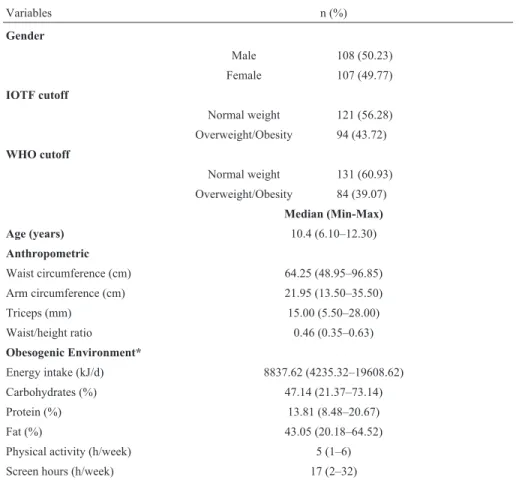
The prevalence of overweight/obesity in the 215 eval-uated children was 43.72% and 39.07% based in the IOTF and WHO cutoffs, respectively (Table 1); no significant difference was observed in the association analysis using the different cutoffs. The obesogenic environment analysis showed that children consumed more fat and less protein than recommended (Casanueva and Kaufer, 2008),. Also, screen time was above the limit established by the Ameri-can Association of Pediatrics (2h/day), and triceps skinfold thickness was higher than the normal for the median age (Casanuevaet al., 2008). No significant associations were observed between obesogenic environment and obesity or related traits (data not shown).
Regarding the genetic background, we found a very high percentage of children with familiar history of obe-sity-related diseases such as diabetes mellitus (63.96%) and hypertension (59.90%). Some children had levels of bio-chemical parameters above the reference values
(Interna-Table 1- General characteristics of the population studied.
Variables n (%)
Gender
Male 108 (50.23) Female 107 (49.77)
IOTF cutoff
Normal weight 121 (56.28) Overweight/Obesity 94 (43.72)
WHO cutoff
Normal weight 131 (60.93) Overweight/Obesity 84 (39.07)
Median (Min-Max)
Age (years) 10.4 (6.10–12.30)
Anthropometric
Waist circumference (cm) 64.25 (48.95–96.85) Arm circumference (cm) 21.95 (13.50–35.50) Triceps (mm) 15.00 (5.50–28.00) Waist/height ratio 0.46 (0.35–0.63)
Obesogenic Environment*
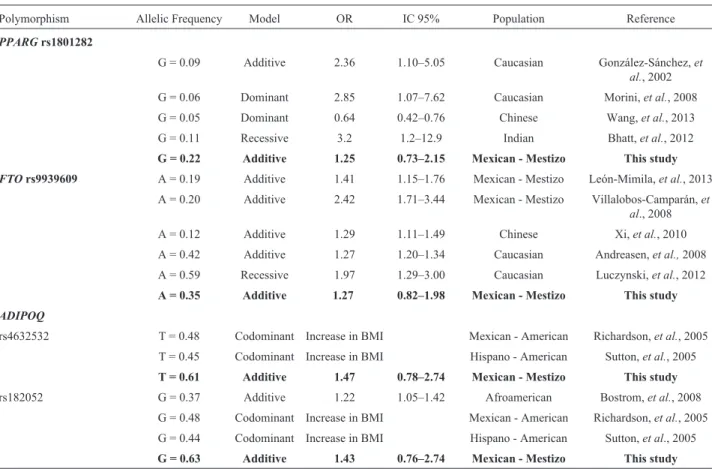
tional Diabetes Federation) (Zimmetet al., 2007) (Table 2). The minor allele frequencies were 0.22 for PPARG rs1801282, 0.35 for FTO rs9939609, 0.61 for ADIPOQ
rs4632532 and 0.63 for ADIPOQ rs182052, which are within range from those reported in other populations (Ta-ble 3). Genotype frequencies in all genes were in accor-dance with the Hardy-Weinberg equilibrium.
In respect to the association of genotypes with obe-sity, under an additive model, the OR was 1.25 (CI = 0.73 – 2.15) forPPARG rs1801282, 1.27 (CI = 0.82 – 1.98) for
FTO rs9939609, 1.47 (CI = 0.78 – 2.74) for ADIPOQ
rs4632532 and 1.43 (CI = 0.76 – 2.74) for ADIPOQ
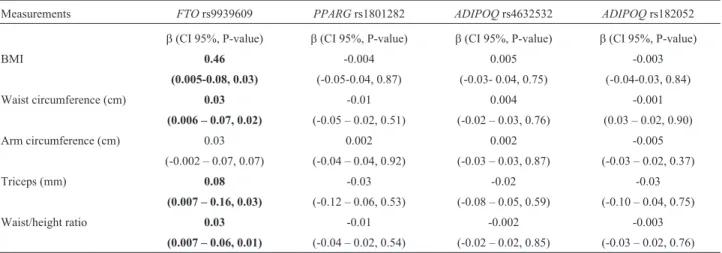
rs182052. A risk tendency was observed, although these values were not significant (Table 3). The association, however, was assessed under the codominant, dominant and recessive models and the risk trend was preserved (data not shown). The analysis of genotypes with obesity-related characteristics found thatFTOwas associated with BMI (b
= 0.46, p = 0.03), waist circumference (b= 0.03, p = 0.02), triceps skinfold (b= 0.08, p = 0.03) and waist/height ratio (b= 0.03, p = 0.01) (Table 4). Additionally,FTOhad an ef-fect on total cholesterol (b= 0.06, p = 0.02) and LDL (b= 0.12, p = 0.01) levels, although the increase was modest; in contrastADIPOQrs4632532 andPPARGrs1801282 were associated with a slight decrease in levels of HDL (b =
–0.06, p = 0.03) and triglycerides (b= –0.11, p = 0.04), re-spectively (Table 5).
Discussion
In this study, several risk factors of obesity were eval-uated in a Mexican children population. The results re-vealed that genetic factors were associated with obesity
Table 2- Biochemical parameters and hereditary backgrounds.
Biochemical parame-ters
Median (Min-Max) % Above reference value* Glucose (mg/dL) 79.87 (58.34–113.07) 5 (2.33) Cholesterol (mg/dL) 148.49 (84.80–353.70) 25 (11.63) Triglycerides (mg/dL) 78.29 (26.58–221.60) 16 (7.44) HDL (mg/dL) 53.66 (23.95–104.75) 46 (21.40) LDL (mg/dL) 74.21 (24.38–299.34) 14 (6.51)
Familial history n (%)
Diabetes mellitus 126 (63.96) Hypertension 118 (59.90) Dyslipidemia 73 (37.06) Cardiovascular 42 (21.32)
* According to International Diabetes Federation (IDF)(Zimmetet al., 2007)
Table 3- Comparison of association ofFTOrs9939609,PPARG2rs1801282, andADIPOQrs4632532 and rs182052 with obesity in different popula-tions.
Polymorphism Allelic Frequency Model OR IC 95% Population Reference
PPARGrs1801282
G = 0.09 Additive 2.36 1.10–5.05 Caucasian González-Sánchez,et al., 2002 G = 0.06 Dominant 2.85 1.07–7.62 Caucasian Morini,et al., 2008 G = 0.05 Dominant 0.64 0.42–0.76 Chinese Wang,et al., 2013 G = 0.11 Recessive 3.2 1.2–12.9 Indian Bhatt,et al., 2012
G = 0.22 Additive 1.25 0.73–2.15 Mexican - Mestizo This study
FTOrs9939609 A = 0.19 Additive 1.41 1.15–1.76 Mexican - Mestizo León-Mimila,et al., 2013 A = 0.20 Additive 2.42 1.71–3.44 Mexican - Mestizo Villalobos-Camparán,et
al., 2008 A = 0.12 Additive 1.29 1.11–1.49 Chinese Xi,et al., 2010 A = 0.42 Additive 1.27 1.20–1.34 Caucasian Andreasen,et al.,2008 A = 0.59 Recessive 1.97 1.29–3.00 Caucasian Luczynski,et al., 2012
A = 0.35 Additive 1.27 0.82–1.98 Mexican - Mestizo This study
ADIPOQ
rs4632532 T = 0.48 Codominant Increase in BMI Mexican - American Richardson,et al., 2005 T = 0.45 Codominant Increase in BMI Hispano - American Sutton,et al., 2005
T = 0.61 Additive 1.47 0.78–2.74 Mexican - Mestizo This study
rs182052 G = 0.37 Additive 1.22 1.05–1.42 Afroamerican Bostrom,et al., 2008 G = 0.48 Codominant Increase in BMI Mexican - American Richardson,et al., 2005 G = 0.44 Codominant Increase in BMI Hispano - American Sutton,et al., 2005
related traits, while the obesogenic environment had no ef-fect. The frequency of risk genotypes inFTOrs9939609, PPARGrs1801282, andADIPOQrs4632532 and rs182052 was different from what has been reported in other popula-tions. This was expected as a result, since studies show that there is variability in frequencies of polymorphisms in dif-ferent populations of the same ethnicity (Table 3). In regard to the association of these genes with obesity, most studies report OR’s in the range of 1.2 to 2, similar to our results, indicating that these genes are of low penetrance and their contribution to the development of obesity is small. How-ever, the presence of several genetic factors together with other factors could have a significant effect.
The presence of polymorphismFTOrs9939609 was associated with an increment in BMI, waist circumference and waist/height ratio. Waist/height ratio measures the ab-dominal fat in any gender or age and is a better metabolic
risk predictor than BMI (Browninget al., 2010; Kodamaet al., 2012). This result is in agreement with other studies in different populations (León-Mimilaet al., 2013; Luczynski
et al., 2012; Villalobos-Comparán et al., 2008; Xi et al., 2010). We also found that the A allele increases the risk of alterations in the lipid profile (cholesterol and HDL levels), as reported by other groups (Villalobos-Comparánet al., 2008; Mascarenhas-Meloet al., 2013). This supports the suggested activity of FTO protein, in conjunction with C/EBP, as a co-activator of PPAR gamma, which is in-volved in adipocyte functions, such as lipid metabolism and differentiation (Wuet al., 2010).
The polymorphism PPARG Pro12Ala (rs1801282) has been studied in different populations with contradictory results; in some studies Ala allele was associated with obe-sity (Bhattet al., 2012; Moriniet al., 2008), whereas in a Chinese population, it was reported as a protecting factor
Table 4- Association of polymorphisms with obesity-related traits
Measurements FTOrs9939609 PPARGrs1801282 ADIPOQrs4632532 ADIPOQrs182052
b(CI 95%, P-value) b(CI 95%, P-value) b(CI 95%, P-value) b(CI 95%, P-value)
BMI 0.46 -0.004 0.005 -0.003
(0.005-0.08, 0.03) (-0.05-0.04, 0.87) (-0.03- 0.04, 0.75) (-0.04-0.03, 0.84) Waist circumference (cm) 0.03 -0.01 0.004 -0.001
(0.006 – 0.07, 0.02) (-0.05 – 0.02, 0.51) (-0.02 – 0.03, 0.76) (0.03 – 0.02, 0.90) Arm circumference (cm) 0.03 0.002 0.002 -0.005
(-0.002 – 0.07, 0.07) (-0.04 – 0.04, 0.92) (-0.03 – 0.03, 0.87) (-0.03 – 0.02, 0.37) Triceps (mm) 0.08 -0.03 -0.02 -0.03
(0.007 – 0.16, 0.03) (-0.12 – 0.06, 0.53) (-0.08 – 0.05, 0.59) (-0.10 – 0.04, 0.75) Waist/height ratio 0.03 -0.01 -0.002 -0.003
(0.007 – 0.06, 0.01) (-0.04 – 0.02, 0.54) (-0.02 – 0.02, 0.85) (-0.03 – 0.02, 0.76) Linear regression was used to compare obesity measurements by genotype, using additive model adjusted for age and gender. Significant associations (p < 0.05) are indicated in bold. BMI: body mass index.
Table 5- Association of polymorphisms with biochemical parameters
Biochemical FTOrs9939609 PPARGrs1801282 ADIPOQrs4632532 ADIPOQrs182052 Parameter b(CI 95%, P-value) b(CI 95%, P-value) b(CI 95%, P-value) b(CI 95%, P-value) Glucose 0.01 -0.02 0.003 0.001
(-0.01 – 0.03, 0.36) (-0.05 – 0.006, 0.11) (-0.02 – 0.02, 0.75) (-0.02 – 0.02, 0.95) Cholesterol 0.06 0.01 -0.01 -0.006
(001 – 0.11, 0.02) (-0.05 – 0.07, 0.72) (-0.05 – 0.03, 0.64) (-0.05 – 0.04, 0.77) Triglycerides 0.07 -0.11 0.04 0.04
(-0.02 – 0.15, 0.14) (-0.22 - -0.003, 0.04) (-0.04 – 0.11, 0.30) (-0.04 – 0.12, 0.30)
HDL -0.02 0.01 -0.06 -0.05
(-0.09 – 0.05, 0.56) (-0.07 – 0.09, 0.78) (-0.12 - -0.007, 0.03) (-0.11 – 0.01, 0.12)
LDL 0.12 0.04 0.03 0.02
(Wanget al., 2013). In our study, we did not find an associ-ation under any model. However, this polymorphism showed a negative association with triglycerides level (b= –0.11, p = 0.04). This can be supported byin vitroevidence, which shows that allele Ala presents less affinity to DNA, and as a result, the ability to induce lipogenesis is decreased (Larsen et al., 2003). The different results reported for
PPARG rs1801282 may be due to PPARG being a tran-scription factor that responds to the environment (high fatty acids diet) and shows epistasis with other polymorphisms in the same gene (rs2938392, rs1175542, rs1175544) and other genes (ADB3R). Therefore, specific features of the obesogenic environment may influence associations ac-cording to the population analyzed.
ADIPOQrs4632532 showed an association with de-creased HDL levels. The polymorphisms evaluated in this study are associated with obesity in Afro-Americans (Bostromet al., 2008) and with increased BMI, waist cir-cumference, fasting insulin levels and skin fold thickness in Mexicans living in USA (Richardsonet al., 2006; Suttonet al., 2005). However, those studies did not find an associa-tion with HDL levels. Adiponectin participates in the beta-oxidation of fatty acids (Kadowaki and Yamauchi, 2005), so it is possible that the polymorphic gene impacts the transport of fatty acids (in HDL) into plasma. Accordingly, a positive correlation between HDL and adiponectin levels has been reported elsewhere (Mascarenhas-Melo et al., 2013). Although we did not measure plasma adiponectin, these studies support our results.
In addition to genetic factors, the obesogenic environ-ment including diet, physical activity and screen time was evaluated, but no association was found between environ-mental factors and obesity or gain in anthropometric mea-surements. Similar results were found in the National Survey 2006 (Floreset al., 2009). This study presents inac-curacies in diet records of both obese and non-obese groups. Therefore, energy intake could have been wrongly associated with obesity. This imprecision is frequently caused by the use of questionnaires as tools for diet intake assessment. The use of dietary diaries could overcome the problem; however, that method becomes impractical when large populations are surveyed.
The findings of our study are important because there are only two other studies that show association ofFTO
rs9930609 with obesity or obesity-related traits and modi-fied lipid profile in a Mexican population. In addition, the polymorphisms of PPARG rs1801282 and ADIPOQ
rs4632532 were not assessed in those previous studies. However, limitations in our study include a small sample size and difficulty determining the obesogenic environment factors.
In conclusion, this study analyzed environment and genetic aspects of obesity and found significant associa-tions betweenPPARGrs1801282 and triglycerides levels,
ADIPOQrs4632532 and HDL levels, andFTOrs9939609 with cholesterol, LDL and anthropometric measurements.
Acknowledgments
This study was supported by scholarship CVU249976 (CM). We thank L.N. Lucero Torres Nava and M.C. Alejandra Mendez Hernandez for technical assis-tance, and Dr. Ezequiel Fuentes Pananá, for critical reading of the manuscript
References
Bhatt S P, Misra A, Sharma M, Luthra K, Guleria R, Pandey RM and Vikram N K (2012) Ala/Ala genotype of Pro12Ala polymorphism in the peroxisome proliferator-activated re-ceptor-g2 gene is associated with obesity and insulin resis-tance in Asian Indians. Diabetes Technol Ther 14:828-834. Bostrom MA, Freedman BI, Langefeld CD, Liu L, Hicks PJ and Bowden DW (2008) Association of adiponectin gene poly-morphisms with type 2 diabetes in an African American population enriched for nephropathy. Diabetes 58:499-504. Browning LM, Hsieh SD and Ashwell M (2010) A systematic re-view of waist-to-height ratio as a screening tool for the pre-diction of cardiovascular disease and diabetes: 05 could be a suitable global boundary value. Nutri Res Rev 23:247-269. Casanueva E and Kaufer MPAB (2008) Nutriología Médica. 3rd
edition. Panamerica Press, México, DF, p 78-85.
Cole TJ, Bellizzi MC, Flegal KM and Dietz WH (2000) Estab-lishing a standard definition for child overweight and obe-sity worldwide: International survey. BMJ 320:1-6. De Onis M, Onyango AW, Borghi E, Siyam A, Nishida C and
Siekmann J (2007) Development of a WHO growth refer-ence for school children and adolescents. Bull WHO 85:660-667.
Filippi E, Sentinelli F, Trischitta V, Romeo S, Arca M, Leonetti F and Baroni M G (2004) Association of the human adi-ponectin gene and insulin resistance. Eur J Hum Genet 12:199-205.
Flores M, Macías N, Rivera M, Barquera S, Hernández L, Gar-cía-Guerra A and Rivera JA (2009) Energy and nutrient in-take among Mexican school-aged children, Mexican Na-tional Health and Nutrition Survey 2006. Salud Púb México 51(Suppl 4):S540-S550.
Frayling TM, Timpson NJ, Weedon MN, Freathy RM, Lindgren CM, Perry JRB and McCarthy MI (2009) A common variant in the FTO gene is associated with body mass index and pre-disposes to childhood and adult obesity. Science 316:889-894.
Ghoussaini M, Meyre D, Lobbens S, Charpentier G, Clément K, Charles M-A and Froguel P (2005) Implication of the Pro12Ala polymorphism of the PPAR-gamma 2 gene in type 2 diabetes and obesity in the French population. BMC Med Genet 6:e11.
He W (2009) PPARg2 polymorphism and human health. PPAR Res 2009:e849538.
Kadowaki T and Yamauchi T (2005) Adiponectin and adipo-nectin receptors. Endocr Rev 26:439-451.
Kodama S, Horikawa C, Fujihara K, Heianza Y, Hirasawa R, Yachi Y and Sone H (2012) Comparisons of the strength of associations with future type 2 diabetes risk among anthro-pometric obesity indicators, including waist-to-height ratio: A meta-analysis. Am J Epidemiol 176:959-969.
Lahiri DK and Nurnberger JI (1991) A rapid non-enzymatic method for the preparation of HMW DNA from blood for RFLP studies. Nucleic Acids Res 19:544-548.
Larsen TM, Toubro S and Astrup A (2003) PPARgamma agonists in the treatment of type II diabetes: Is increased fatness com-mensurate with long-term efficacy? Int J Obes Relat Metab Disord 27:147-161.
León-Mimila P, Villamil-Ramírez H, Villalobos-Comparán M, Villarreal-Molina T, Romero-Hidalgo S, López-Contreras B, Gutiérrez-Vidal R, Vega-Badillo J, Jacobo-Albavera L, Posadas-Romeros C,et al.(2013) Contribution of common genetic variants to obesity and obesity-related traits in Mexi-can children and adults. PLoS One 8:e70640.
Luczynski W, Zalewski G and Bossowski A (2012) The associa-tion of the FTO rs9939609 polymorphism with obesity and metabolic risk factors for cardiovascular diseases in Polish children. J Physiol Pharmacol 63:241-248.
Mascarenhas-Melo F, Sereno J, Teixeira-Lemos E, Marado D, Palavra F, Pinto R, Rocha-Pereira P, Teixeira F and Reis F (2013) Implication of low HDL-c levels in patients with av-erage LDL-c levels: A focus on oxidized LDL, large HDL subpopulation, and adiponectin. Mediators Inflamm 2013:e612038.
Morales-Ruán MDC, Hernández-Prado B, Gómez-Acosta LM, Shamah-Levy T and Cuevas-Nasu, L (2009) Obesity, over-weight, screen time and physical activity in Mexican adoles-cents. Salud Púb México 51(Suppl 4-1):S613-S620. Morini E, Tassi V, Capponi D, Ludovico O, Dallapiccola B,
Trischitta V and Prudente S (2008) Interaction between PPARgamma2 variants and gender on the modulation of body weight. Obesity 16:1467-1470.
Ong KL, Li M, Tso AWK, Xu A, Cherny SS, Sham PC and Lam KSL (2010) Association of genetic variants in the adipo-nectin gene with adipoadipo-nectin level and hypertension in Hong Kong Chinese. Eur J Endocrinol 163:251-257.
Richardson DK, Schneider J, Fourcaudot MJ, Rodriguez LM, Arya R, Dyer TD, Almasy L, Blangero J, Stern MP, Defronzo RA,et al.(2006) Association between variants in the genes for adiponectin and its receptors with insulin resis-tance syndrome (IRS)-related phenotypes in Mexican Americans. Diabetologia 49:2317-2328.
Ridley K, Ainsworth BE and Olds TS (2008) Development of a compendium of energy expenditures for youth. Int J Behav Nutr Phys Act 5:e45.
Rivera-Dommarco J, Shamah-Levy T, Villalpando-Hernández S, González de Cossío T and Hernández Prado B SJ (2001). Encuesta Nacional de Nutrición 1999. Estado Nutricio de niños y mujeres de México. Cuernavaca, Morelos, p 188-190.
Rivero-Vázquez S (2013) Encuesta Nacional de Salud y Nutri-ción2012. Durango (Vol. 2). Cuernavaca, Morelos, p 78-82. Rodríguez-Ramírez S, Mundo-Rosas V, Jiménez-Aguilar A and
Shamah-Levy T (2009) Methodology for the analysis of di-etary data from the Mexican National Health and Nutrition Survey 2006. Salud Públ México 51(Suppl 4):S523-S529. Shamah-Levy T and Villalpando-Hernández SRDJ (2007)
Resul-tados de Nutrición de la ENSANUT 2006. Cuernavaca, México, p 44-53.
Silva-Zolezzi I, Hidalgo-Miranda A, Estrada-Gil J, Fernandez-Lopez JC, Uribe-Figueroa L, Contreras A and Jimenez-San-chez G (2009) Analysis of genomic diversity in Mexican Mestizo populations to develop genomic medicine in Mex-ico. Proc Natl Acad Sci U S A 106:8611-8616.
Speakman JR, Rance KA and Johnstone AM (2008) Polymor-phisms of the FTO gene are associated with variation in en-ergy intake, but not enen-ergy expenditure. Obesity 16:1961-1965.
Sutton BS, Weinert S, Langefeld CD, Williams AH, Campbell JK, Saad MF and Bowden DW (2005) Genetic analysis of adiponectin and obesity in Hispanic families: The IRAS Family Study. Hum Genet 117:107-118.
Tanofsky-Kraff M, Han JC, Anandalingam K, Shomaker LB, Columbo KM, Wolkoff LE and Yanovski JA (2009) The FTO gene rs9939609 obesity-risk allele and loss of control over. Am J Clin Nutr 90:1483-1488.
Tung Y-CL, Ayuso E, Shan X, Bosch F, O’Rahilly S, Coll AP and Yeo GSH (2010) Hypothalamic-specific manipulation of FTO, the ortholog of the human obesity gene FTO, affects food intake in rats. PloS One 5:e8771.
Villalobos-Comparán M, Teresa Flores-Dorantes M, Teresa Vil-larreal-Molina M, Rodríguez-Cruz M, García-Ulloa AC, Robles L, Huertas-Vázquez A, Saucedo-Villarreal N, Ló-pez-Alarcón M, Sánchez-Muñoz F,et al.(2008) The FTO gene is associated with adulthood obesity in the Mexican population. Obesity 16:2296-2301.
Wang X, Liu J, Ouyang Y, Fang M, Gao H and Liu L (2013) The association between the Pro12Ala variant in the PPARg2 gene and type 2 diabetes mellitus and obesity in a Chinese population. PLoS One 8:e71985.
Wu Q, Saunders R, Szkudlarek-Mikho M, La Serna ID and Chin K-V (2010). The obesity-associated Fto gene is a trans-criptional coactivator. Biochem Biophys Res Commun 401:390-395.
Xi B, Shen Y, Zhang M, Liu X, Zhao X, Wu L and Wang X (2010) The common rs9939609 variant of the fat mass and obe-sity-associated gene is associated with obesity risk in chil-dren and adolescents of Beijing, China. BMC Med Genet 11:e107.
Zimmet P, Alberti G, Kaufman F, Tajima N, Silink M, Arslanian S and Caprio S (2007) The metabolic syndrome in children and adolescents-an IDF consensus report. Diabetes Voice 52:29-32.
Associate Editor: Mara H. Hutz