IOP Conference Series: Materials Science and Engineering
PAPER • OPEN ACCESS
Public Art Advancing Urban Context Transformations: Kreuzberg (Berlin)
To cite this article: Ines Xavier et al 2019 IOP Conf. Ser.: Mater. Sci. Eng. 471 092043
View the article online for updates and enhancements.
Content from this work may be used under the terms of theCreative Commons Attribution 3.0 licence. Any further distribution of this work must maintain attribution to the author(s) and the title of the work, journal citation and DOI.
Published under licence by IOP Publishing Ltd
WMCAUS 2018
IOP Conf. Series: Materials Science and Engineering 471 (2019) 092043
IOP Publishing doi:10.1088/1757-899X/471/9/092043
1
Public Art Advancing Urban Context Transformations:
Kreuzberg (Berlin)
Ines Xavier 1, Ana Virtudes 2, Rita Ochoa 3
1 University of Beira Interior, Covilhã, Portugal
2 C-Made – Centre of Materials and Building Technologies, University of Beira
Interior, Covilhã, Portugal
3 Center for Research and Studies in Sociology - University Institute of Lisbon/Beira
Interior University, Estrada do Sineiro, s/n, 6200-209 Covilhã, Portugal [email protected]
Abstract. The proposed article focuses on an analysis of Berlin as a model for urban
intervention, with proposals, both for the urban rehabilitation and for new works. The central district of Kreuzberg, will be studied taking into account that it is nowadays a place of artistic and bohemian focus, considered an integral part of the one of the main enclaves of power and culture in Europe. Local characterization will be carried out from the point of view of urban development and sociocultural transformation, as well as the artistic manifestations that are evident in public space, such as graffiti, which modify a surrounding urban space, either permanently or temporarily. Finally, in a logic of zooming on the city, a proposal will be presented for an urban void in a block at Kreuzberg east neighbourhood, which is associated with several manifestations against the gentrification processes therein. Throughout this study, it should be noted that it is still currently a challenge to define measures for the benefit of its inhabitants, leading the city in a direction that is advantageous and enriching for all, not yielding to economic interests of speculation. Therefore, an urban revitalization can and must motivate creative interventions in relation to public art, making way for the new urban planning models in city centres, pointing to more free and connected alternative lifestyles. 1. Introduction
This paper aims to present the results of an urbanistic analysis involving as case study the city of Berlin in Germany. It is focused on a proposal of a model for urban action, which includes several aspects, such as urban rehabilitation issues and new works. The chosen district was the central neighbourhood of Kreuzberg, which will be studied taking into account that this place is nowadays a landmark in terms of artistic and bohemian issues, being considered an integral part of the one of the main enclaves of power and culture in Europe. The public urban art is proposed as a pivotal key word, in order to advance this district context transformation.
2. Urban context transformations of contemporary cities
Contemporary cities are integrated into spatial systems, made of several parts, each one with distinct characteristics from the formal and historical point of view, corresponding to a complex urban structure. On the one hand, Ungers [1] suggests that, among the contrasts and contradictions inherent in the city itself, its current notion is identified as a structure carried out of complementary places. On
WMCAUS 2018
IOP Conf. Series: Materials Science and Engineering 471 (2019) 092043
IOP Publishing doi:10.1088/1757-899X/471/9/092043
2
the other hand, Rossi said [2], that a city conception consists of a system of layers, in which something is overlaid as the basis of reflection in successive historical moments.
The urban restructuring of the buildings contribute to the valorisation and innovation of the spaces are also, paradoxically, places of tension and cultural confrontation. Therefore, the way in which globalization influences the city is a result of a great cultural diversity and multiculturalism, through the uprooting of the place in a constant appropriation process. Thus, there is a successive transition, accelerated by the global and technological characters of contemporary societies. However, the demographic increase demanded the need to adapt the city to the reception of large immigrant flows, forcing for example the construction of new residential complexes. As a consequence, a central role was acquired in relation to the historical context, with a progressive transfer of functions to other peripheral areas [3]. In this sense, in order to meet the human and social needs of communities, cities have grown into complex structures that are difficult to manage. Thus, there is a confrontation of multiple messages and ideals dispersed in urban meaning results, and there is sometimes no way to define the cultural traits that best exemplify the city [4].
Thereby a social urban resilience is required where communitarianism is a model of a policy for group identities and cultures, based on the recognition of intrinsic values and irreducibly multiple characters of these identities of the society, all of which are equally worthy of respect. Therefore, judged free to assert themselves in the social space [5].
The increasing in phenomenon such as social segregation, accompanies a spatial fragmentation as a paradox of valuing a neighbourhood. This has the disadvantage of displacing the inhabitants elsewhere, resulting in an urban gentrification process. This process is inconsistent, given the needs of understanding the places of a city as a segregated cultural confrontation point that has gradually become the reason for lots of problems. Among them there are the functional and demographic emptying, in the current urban conjuncture of many cities.
Urban context transformations have been exploring the adaptability and the recovery of cities, such as after a situation of trauma, changing the interaction between physical spaces and time. In other words, this transformation proves the resilience of the city in a scenario of a chaotic situation, such as the destruction of the urban mesh as a result of wars or earthquakes.
In this context, this article approach is focused at the city of Berlin, as a model with urban interventions, which is seen case study for a several for renewing semi-consolidated residential blocks and for new constructions. In order to focus the analysis at a detailed scale, the choice was the central district of Kreuzberg, which will be studied, considering that it is, currently, an interesting local for artistic and bohemian expressions. It is considered an integral part of one of the main enclaves of power and culture in Europe. The methodological approach will characterize this neighbourhood from the point of view of an urban development and socio-cultural transformation, as well as the pivotal space for artistic manifestations, visible in the public art, which is modifying the surrounding landscape, either permanently or temporarily.
Finally, in a logic of zooming on the urban space, a proposal will be presented for a block of the district of Kreuzberg east, in order to advance its qualification.
3. The city of Berlin 3.1 As a stage / as a reflex
One of the things that Bowie more appreciates in Berlin is its similarity in cultural and interventional environment terms with New York [6].
The division of Berlin during the Cold War led it to a doubling of cultural offers (with two theatres, two stadiums among others) that enriched its cultural unification. At the same time, this reunification has resulted in a number of relationships in terms of design and spontaneous events, ranging from significant post-war destruction, division and reconstruction. The city in ruins offered a free ground for the utopian modernist thoughts with the purposes of conditioning a process of definitive demolition
WMCAUS 2018
IOP Conf. Series: Materials Science and Engineering 471 (2019) 092043
IOP Publishing doi:10.1088/1757-899X/471/9/092043
3
of the affected buildings. Since the war that architects considered this fact as an opportunity for urban regeneration [7].
The I.B.A. (International Architecture Exhibition, 1979 to 1989) was distinguished by a careful reading of the main international urban problems, where new concepts had to respond to the central problems of the city construction, clarifying concepts such as the relationship between centre and periphery or public and private spaces.
At the same time, the debate about the growing attention paid to preservation and the charm of the nudity of the ruins, appeared as a complex phenomenon of temporal ambiguity. In this sense, the ruins helped to establish the ties of architecture with nature and natural processes. Ruin is not the triumph of nature, but a moment of transition and a fragile balance between persistence and decadence [8], points out Simmel. This author recognizes a new meaning for this type of urban survival attained by monuments. An example of this relevance was the Berlin Wall (figure 1) whose destruction was hailed, symbolizing the end of the Cold War (1947-1991), being the city’s most iconic ruin.
Figure 1. Part of the Wall in East Side Gallery, captured photography in west Berlin, 2016
Berlin is considered an example of a cosmopolitan, creative and inclusive city, open to innovation and modernity, where history coexists with art, culture, bohemianism and technology. It is determined by the enhancement of cultural diversity and the promotion of social inclusion through economic, social and cultural developments. According to the United Nations Educational, Scientific and Cultural Organization (UNESCO) the diversity is a cultural dimension of the creative economy [9]. In this sense, the Universal Declaration on Cultural Diversity understands that diversity is an important factor in promoting economic, social development and intellectual growth [9].
The image of this city is distinguished from others, by an aesthetic of unfinished or expression of materials without finishing. There are sidewalls and rear elevations of buildings stripped by fragmented and completely open blocks, usually hidden by other buildings. In this context I.B.A. unlike the Neubau architects (root construction) who prioritized the continuity of the street. The
Altbau team (having rehabilitation actions in the area of the Kreuzberg district) did not care about the
gaps and disturbances in the peripheral blocks, once which provided even more ventilation and vegetation in an already congested area. Even the termination of the blocks that had historically remained open could be left unfinished [10]. Therefore, on the display were the blind gables, which ended up being used for the exaltation of artistic values of communication through free drawings, the graffiti. As an operative element of this neighbourhood, a new concept was also conceived for the
WMCAUS 2018
IOP Conf. Series: Materials Science and Engineering 471 (2019) 092043
IOP Publishing doi:10.1088/1757-899X/471/9/092043
4
.
Berlin block, in which the interior is like a public appropriated space and with a lower construction density, that is the interior patios denominated hofes. An example of an appropriation through a complex of consecutive courtyards is the Hackeschen Hofe (figure 2), consisting of the Hackescher market and a non-profit organization, Haus Schwarzenberg, allied to art galleries, entertainment and catering, whose main attraction are the Street Art Alley murals, that extend across all the facades and interiors of the buildings.
Figure 2. Hackeschen Hofe: Street Art Alley, Berlin 2016 3.2 The Kreuzberg district
The district of Kreuzberg is located in the central part of Berlin. It is parallel to the river in a congested urban network and an area that has been revitalized, due to its location bordering Berlin-east, having been spared the total demolition [7]. It has become, over the years in a neighbourhood too dense and overcrowded in terms of inhabitants, given its availability of cheap accommodation, attracting students, artists and activists, as well as political radicals and migrants. These features emphasize the existent immigrant culture of east Kreuzberg, a legendary bohemian vibration and an alternative feeling to growing consumerist materialism [7].
The current state of this neighbourhood maintained its distinctive identity, being officially a unique district with its neighbour Friedrichshain at northeast, separated by the river Spree (figure 3). Within its limits to the east, remains an environment of punk and artistic attitudes, mixed with a large population of immigrants and manifestations of public art in the streets dotted with graffiti. It is between two opposite political realities, communist to the east and capitalist to the west, underground culture found, being a productive field as an escape, in an environment of social abnormality.
Figure 3. Map of the boundaries of the Berlin city’s districts and specifically between Kreuzberg and Friedrischshain; (red) border of the Berlin-western Wall
WMCAUS 2018
IOP Conf. Series: Materials Science and Engineering 471 (2019) 092043
IOP Publishing doi:10.1088/1757-899X/471/9/092043
5
In other words, the imagination is born (also) from limit situations, such as escape or confrontation to a tense reality, as a need for expression [7]. Spontaneous artistic manifestations have been emerging and West Berlin has acquired an active and dynamic cultural community, which contributes to the characterization of an underground spirit.
As for the Wall, the large blank surface facing the west offers a unique opportunity for political demonstration, which constitutes in itself a violation of the established limit. Thus, a simple painting assumes a meaning of resistance, revolt and indignation [7], through the expression of graffiti. A section of the wall about 1.3 km long has not been demolished, but rather designed and painted by artists since 1990, now it is known as the 'East Side Gallery', the world's longest outdoor gallery [11], which runs along the north bank of the river Spree.
After this period, the restructuring of this entire area began slowly, along to the river banks, where there are numerous industrial and commercial buildings from the XIX and XX centuries. Also, the project called Mediaspree, part of Neabau, was a great opportunity to the former East Berlin and the 'New Berlin'. It represents one of the largest real estate investment projects in the city, aiming to establish telecommunications and media companies along a section of the banks of the River Spree, as well as implementing an urban renewal of the surrounding area [11].
Although these actions predominated from the 1990s, in order to create a centre of cultural production and spaces providing an opportunity for colonization by temporary uses. In the value of history and memory, in an architectural respect, it does not lie in the fact that something remarkable occurred once, but in the fact that remarkable events can continue to occur. The street Schlesisches Tor became known for its omnipresent graffiti to such an extent that several families moved into the area during the recent wave of gentrification, reported to be commissioning graffiti artists to mark their buildings, so that non- artists, do not do it [10].
However, much of the graffiti on buildings is anonymous and political in nature. The denomination of the housing block projected by the Portuguese very well-known architect Siza Vieira as Bonjour
Tristesse, situated in this street, lends itself to a graffiti that appeared in the upper part of the front
facade in the late 1980s (figure 4) and several stories about its unidentified author add to his enigmatic content [10]. The inhabitants of the city have interpreted the white facades of this building as a blank sheet. When there is no public sphere that represents indignation, the walls are lodged with their unauthorized voices. Graffiti is certainly the greatest representative of this phenomenon.
Figure 4. (right) Bonjour Tristesse (Portuguese architect Siza Vieira); (left) BLU artist’s mural located
at Cuvry-brache (Berlin).
WMCAUS 2018
IOP Conf. Series: Materials Science and Engineering 471 (2019) 092043
IOP Publishing doi:10.1088/1757-899X/471/9/092043
6
Initially subversive and alien to the instances and procedures of the exercises of power and authority, urban art has been incorporated and recognized as a way of renewal and attraction for the public spaces of globalized cities. Nowadays, it is valued as the creative record of a generation. Moreover, the way in which urban art has been embraced by the sectors of culture within cities, previously seen as peripheral and marginalized, is now completely absorbed by the art market where leading artists travel around the world, attracting curiosity under the individuals and also expose their work on the sacred walls of museums [13].
An interesting point of this fact, is that public urban art had a fluent role at gentrification process. According to Neil Smith in 1984, it was established with the help of progressive political agents and some avant-garde artists, who behaved as intermediaries between the culture industry and would-be artists [14]. Therefore, good art and good places spread, and good location means money [14]. The multiplicity of geographic areas in the globalized arts system is becoming increasingly pervasive, with the periphery gaining importance as an area conducive to experimentation, new creations.
3.3 The Cuvry-Brache and the BLU mural
In the district of Kreuzberg there is a singular place that stands out in its constructive density, where the negative effects of the gentrification process are felt. Located on the corner between the Cuvry and the Schlesische streets (the latter is the main street of the neighbourhood in the east), it is a vacant
space with about 10.000 m2 privileged by the border and sight on the river Spree. On the opposite side
of these streets, there are three blind gables from the former factory building Industriepalast (Industry Palace) and the current Hofe am Osthafen (comprising five commercial courtyards). Known in Berlin by Cuvry Brache, this is 'The set-aside of Cuvry', illustrating different kinds of manifestations of occupation (figure 5).
This area is part of a controversial speculation of investors included in Mediaspree. Along the river were being rehabilitated old factories for clubs and lofts with luxury terraces, that began to become incompatible with its previous inhabitants. From 1998, the particular interest in this urban field has generated a series of ideas in order to develop intentional commercial and business projects. However, following the bankruptcy of a shopping centre called the Cuvry Centre and the high objection of neighbourhood inhabitants, the responsibility was transferred to the 'Senate Urban Development Department'. In 2008, at this open space of free character was built a mural of graffiti at the blind gables of the factories, conceived by an artist named BLU, which through this work directed a critical message against urban development policies.
Gradually, there was the construction of small tents and wooden huts began, and in 2011 there were about 150 people living there. This area entitled Kreuzberger Freiflache (free space of the neighbourhood) was used as a space for gardening and crops, but also as a place for artistic and cultural expressions. Thereby, the Cuvry Brache was an open-air museum of street art, attracting thousands of visitors, that had first been a kind of nomadic camp [15], the first slum in Berlin [16]. Its presence was tolerated until the authorization to build a new proposal of buildings, and it is later under threat of eviction. Investors and landowners have repeatedly disrupted this culture of residents and newcomers to Kreuzberg, in an alternative space developed by the entire land area [16].
In 2012 neighbourhood residents held a series of cultural protest events to prevent the forced eviction. However, in 2013 the land was bought by a company to the Senate to install a new urban development. The Cuvry hofe project development plan was approved by the Senate, for a luxury commercial and residential complex with a promise of 20% of the housing to be low-cost, presented an eviction petition, examined by the police due to the fact that the inhabitants do not want to leave, because in Kreuzberg it is especially important to preserve the alternative inhabitants as well as to sustain a social infrastructure if there is misery in the families [17].
Within urban art the existing mural was world-known on Cuvry Street and, consequently, the graffiti on the outer walls of the factory were covered in black which, according to the artist wanted to prevent an investor from taking advantage of his graffiti to an apartment with a view on him that could be worth a lot [17]. This area on the south river bank has been undeveloped for many years,
WMCAUS 2018
IOP Conf. Series: Materials Science and Engineering 471 (2019) 092043
IOP Publishing doi:10.1088/1757-899X/471/9/092043
7
temporarily occupied and has become a kind of village and a free cultural space. However, the existence of a certain negligence and violence among its inhabitants were enough reasons for the eviction. For a temporary resident, the concept was to confront comfort, after all what does a city individual need to survive? There was a lack of interest in the unaccounted garbage on the spot. Obviously, it was a social experience but a sanitary disaster [18]. Definitely, it ended up being unoccupied and devastated by a burning that levelled the ground in September 2014 [19].
Figure 5. Cuvry-Brache occupied by wooden cabin, Berlin 2011
Recently, there is a feeling of indignation and the fate of this place is pending in an unknown underpinning a great attention caused by the visitors and residents who lurk the place, with the promise of a free Berlin [18].
4. Renewal urban proposals for Kreuzberg
Based on the urban transformation contexts previously described, a renewal project proposal was developed for the referred place. It refers to the restructuring of a block in which the Cuvry-brache is integrated, at east Kreuzberg. The program was defined on the basis of the 'BUR' (Berlin University Residences) competition, promoted by the online platform Archmedium in May 2016. Its main objective was to create a solution according to the meeting expectations of local community, regarding its inhabitants which are mainly composed by young people, artists and immigrants with Turkish origins. Inserted in a congested network it is included in a block, which is currently an urban emptiness, presenting a flat topography next to the river Spree.
As a consequence of all the tumultuous controversies previously explained, the solution decided to develop only half of the program submitted by the competition. Thus, the developed program consists in a project for a students’ dormitory, of collective housing units, endowed with common facilities. At the same time, a public space of articulation between two functions and the urban environment was proposed This program was based on the housing-related equipment gap and a new equitable approach to access to the public space. It can also be justified thanks to the dynamics that this area has reached in the face of the population’s strong interest in living at the city centre, reinforced by an urban rehabilitation process. In this sense, there was an essential point of exploring its partial occupation, in a solution with social coherence and appreciation considering the public space, highlighting the exposure of the gables and the elements of nature as the river.
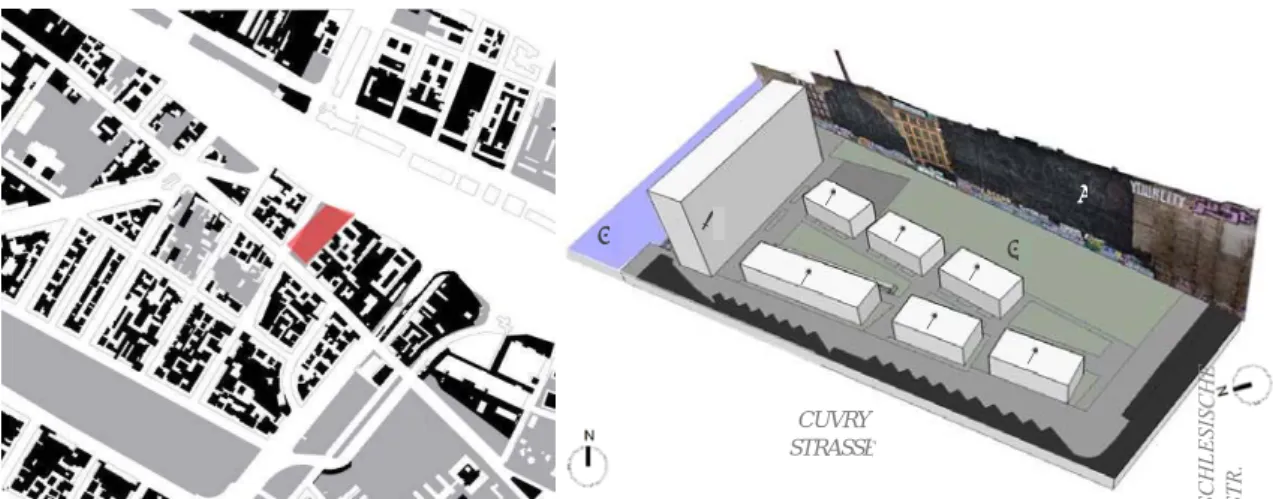
In general (figure 6) the case study area was organized into two main functional parts: 1. a private character space in order to give continuity to the residential area nearby to the secondary access road (Cuvry) and neighbouring blocks; 2. a space for public use at the service level and a confining green space within the boundaries of the blind gutters of the buildings, making up the former factory (Industriepalast). Two unified architectonic volumes were created by an accessible platform between the floors and the surroundings. Given the size of the student’ residence architectural program, it
WMCAUS 2018
IOP Conf. Series: Materials Science and Engineering 471 (2019) 092043
IOP Publishing doi:10.1088/1757-899X/471/9/092043 8 . 1 2 2 2 2 2 2 3 4 5 CUVRY STRASSE S P R E E
stands out in a single volume that is assumed in its verticality, composed by ten floors, of slender width with a height accented of contrast to the urban proportion, in order to associate to the element of the existing industrial chimney.
The second volume refers to a collective housing (or block of flats) with a lower height comparing with the first, but intermediate to neighbouring buildings. This volume was divided into five blocks, separated from each other, according to the pre-existing composition axes. This solution, follows an arrangement originated by the vertical break of the blind gables of the Industriapalst factory and the spans of the access to the courtyards, which are open to the interior of the Victoria Muhlenwrke block. The subtle manners, are here an allusion to the Berlin Hofes, usually hidden by other buildings. These are characterized by completely open fragmented blocks that by the war times have been half destroyed. In this way, a decreasing volumetric is established, starting parallel to the water front (river Spree) and accompanying the parallel alignment of the neighbouring housing construction. The housing facilities of the architectural program are thus, grouped by separated sets of parallelepipeds in order to avoid the creation of limited patios and access tunnels that imply passive safety.
Figure 6. (left) Localization plan of Cuvry-brache site (in red); (right) proposal: 1. Students’ residence
2. Housing units 3. Green area 4. Spree river 5. Old factory Industriepalast gables (Berlin) The blind gable has been transformed into a characteristic symbolism, exalting artistic values of communication through a free drawing, the graffiti. The solution proposes to leave a certain distance between the existing blind gables and the new, exposing a free green space and avoiding the accentuated instalment of the typical urban block of Berlin. Still to strengthening the proximity of the river the project creates a new flight of stairs towards the water front. This element makes possible an enjoyment by the users and the contemplation of the river Spree, contributing to a perception of calm and tranquillity. Finally, this area of the Cuvry-brache is assumed by this project as a physical, visual and symbolic space.
5. Conclusions
Such as this article aimed to show, Berlin represented an important mark in terms of urban planning solutions, resulting in several transformations, which were formalized through the practical and territorial experiences of I.B.A.. As a result of several relationships between the built design and spontaneous events, its urban fabric is characterized by a spatial and social fragmentation, to which the period of the Wall is not unrelated. In this context, this city is still an example that stands out for its eccentricity, where ruin is the subject of a reflective contemplation on practices of preservation and restoration of buildings. As a consequence, through their romanticizing, urban renewals arise implicit in the contemporary stylistic strategies, which appear through individual manifestations endowed with
WMCAUS 2018
IOP Conf. Series: Materials Science and Engineering 471 (2019) 092043
IOP Publishing doi:10.1088/1757-899X/471/9/092043
9
creative diversity, the graffiti. The implementation of public urban art is a way of spatial revitalization, understood as a process of action at the public realm that reflects different ways of qualifying cities.
Like Berlin itself, Kreuzberg is a neighbourhood of clashes/confrontations, and one of the main European artistic centres. It is a striking example of the multicultural resilience of the city, emphasizing the importance of artistic manifestations such as provocative and aesthetic graffiti, in a current of public space renewal in a creative atmosphere.
As this article previously assumed, currently, the process of gentrification occurs in several parts of Berlin, but particularly in west Kreuzberg. Here, there is an increasing in housing prices, which can be justified by the dynamics of this area in the face of its inhabitants’ interest in living at the city centre. This fact has been reinforced by public and private institutions investments, achieving financial profits throughout a process of rehabilitation and appreciation of urban art, attracting a creative upper class. In this sense, is possible to conclude that is still a challenge in this regard to define architectural and urban solutions capable of generating greater social cohesion among local people. These solutions should be discussed and outlined in benefit of its inhabitants, using this entrepreneurial change to lead the city in a direction that is advantageous and enriching for all, without yielding to speculative economic interests that neglect and affect the local community and the city’s resilience.
Finally, the proposed urban renewal solution aimed to show a proposal for an urban void, based on the integration of a block in Kreuzberg, known as Cuvry-brache, together with several appropriations and manifestations, against the process of gentrification, rethinking the urban continuity with the river Spree. In order to fill the housing needs, the proposed urban renewal project was drawn up creating a union with the symbolism and message of the BLU artist’s mural already extinct. This aims to give urban continuity to the artistic appropriations, at the same place that interpret with the public scene. Therefore, is possible to conclude that the urban revitalization solutions can happen in union with public art, paving the way for a new model of urbanism in the city centre, pointing to more connected alternative lifestyles.
References
[1] U. Oswald, “The dialect city”, Skira, Milano, 1997, p.17
[2] R. Aldo, “The architecture of the city”, Cosmo, Lisbon, pp.84-87, 2001.
[3] J. P. Lacaze, “The city and urbanism”, Institute Piaget, Lisbon, p.73 1999.
[4] S. S. Boaventura, “Globalization: fatality or utopia?”, Afrontamento, Oporto, pp.102-117, 2001.
[5] I. Guerra, “The multicultural and multiethnic city. Managing diversity and searching
democracy”, 2008,
www.om.acm.gov.pt/documents/58428/182327/2_PI_Cap.3.pdf/bb8afd9a-9177-4f2f-8dd7-eafcd34ca2ea (19-05-2016)
[6] K. P. Shoning, “Wall Citu”, in CLEALAND, D. (ed.) Architecural Design – Post Wal, Berlin,
1982.
[7] P. Baía, “Tragic new Berlim”, Final exam of degree in Architecture, Department of Architecture
of the Faculty of Sciences and Technology of the University of Coimbra, Coimbra, 2005.
[8] G. Simmel, “The ruins: an aesthetic test”, 2008
http://www.vitruvius.com.br/revistas/read/arquitextos/12.135.3997 (11-04-2016)
[9] UNESCO, “Universal Declaration on Cultural Diversity”, article 1, 2001
http://unesdoc.unesco.org/images/0018/001847/184755por.pdf (5-07-2016)
[10] E. Akcan, “A Building with Many Speakers: Turkish ‘Guest Workers and Alvaro Siza’s Bonjour Tristesse Housing for I.B.A. - Berlin. The Migrant’s Time”. Clark Institute Yale University Press, 2011.
[11] “Berlin.de”, Leitbild Spreeraum Friedrichshain-Kreuzberg
http://www.stadtentwicklung.berlin.de/staedtebau/foerderprogramme/stadtumbau/Kreuzberg -Spreeufer.1603.0.html (5-11-2016)
[12] S. Bacon, “Ruinous Heteropia – Berlin, techo and getrification”, 2015.
WMCAUS 2018
IOP Conf. Series: Materials Science and Engineering 471 (2019) 092043
IOP Publishing doi:10.1088/1757-899X/471/9/092043
10
[13] A. Giddens, “The world in the era of globalization”, 1st Edition, Presença, Lisbon, 2000.
[14] B. Shannon, “The new urban frontier: gentrification and the revanchist city, 2002,
https://brettany.wordpress.com/2012/08/07/smith-n-1996-_the-new-urban-frontier-gentrification-and-the-revanchist-city_-london-and-new-york-routledge/ (07-06-2016) [15] “Tai Schomaker© DoYouSpace”, “Tempelhof airfield, a user generate process”, 2016
http://www.doyouspace.net/tempelhof-power-a-user-generated-process/ (18-08-2016)
[16] “Reclaimyourcity.net © 2014-2015”, “Cuvry-Brache stays free”, 2013.
https://reclaimyourcity.net/content/cuvry-brache-stays-free (18/08/2016)
[17] K. Rydlink, “Cuvry-Brache threatens the eviction”, 2014, jornal Spiegel online, http://www.spiegel.de/politik/deutschland/favela-in-berlin-cuvry-brache-in-kreuzberg-soll-geraeumt-werden-a-987958.html (18/08/2016)
[18] Berliner Morgenpost, “Cuvry-brache – Die berliner und der kampf um feiraum”, 2014. http://m.morgenpost.de/bezirke/friedrichshain-kreuzberg/article130587358/Cuvry-Brache-Die-Berliner-und-der-Kampf-um-Freiraum.html (26-07-2016)
[19] I. Herwig, “Cuvrybrache: Investor lasst Wohnungsbau platzen”, 2016. http://www.bz-berlin.de/berlin/friedrichshain-kreuzberg/cuvrybrache-investor-laesst-wohnungsbau-platzen (20-04-2016)