97
Case Report
Short Communication
Revista da Sociedade Brasileira de Medicina Tropical 47(1):97-100, Jan-Feb, 2014http://dx.doi.org/10.1590/0037-8682-0053-2012
Address to: Dra Elaine Soares Coimbra. Deptº de Parasitologia, Microbiologia e Imunologia/ICB/UFJF. Rua José Lourenço Kelmer s/n, Campus Universitário, Bairro Martelos, 36036-900 Juiz de Fora, MG, Brasil.
Phone: 55 32 2102-3219; Fax: 55 32 2102-3214
e-mail: [email protected] Received 29 November 2012 Accepted 7 March 2013
First inventory of the sandfl y fauna (Diptera: Psychodidae,
Phlebotominae) in the municipality of Juiz de Fora,
State of Minas Gerais, Brazil
Izabella de Oliveira Pinheiro
[1],
Milton Ferreira de Castro
[1],
Murilo Gonçalves
[1],
Adilson da Costa Lima
[1],
Glênia Maria de Magalhães Campos
[1],
Adalberto Mitterofhe
[1],
Ricardo José de Paula Souza e Guimarães
[2],
José Dilermando Andrade Filho
[3]and
Elaine Soares Coimbra
[4][1]. Núcleo de Vigilância Epidemiológica, Ambiental e Saúde do Trabalhador, Superintendência Regional de Saúde, Secretaria de Estado da Saúde de Minas Gerais, Juiz de Fora, MG. [2]. Laboratório de Geoprocessamento, Instituto Evandro Chagas, Ananindeua, PA. [3]. Laboratório de Leishmanioses, Centro de Referência Nacional e Internacional para Flebotomíneos, Centro de Pesquisas René Rachou, Fundação Oswaldo Cruz. Belo Horizonte, MG. [4]. Departamento de Parasitologia, Microbiologia e Imunologia, Instituto de Ciências Biológicas, Universidade Federal de Juiz de Fora, Juiz de Fora, MG.
ABStRACt
introduction: This study aimed to inventory the phlebotomine sandl y fauna present in the urban area of Juiz de Fora, with an
emphasis on the genus Lutzomyia. Methods: Capture was performed from March to September 2012, using HP light traps placed
at peridomestic sites, in a municipal kennel and a forest biome. Results: A total of 133 specimens were captured, representing
eight species of the genus Lutzomyia. Lutzomyia pascalei was the most prevalent species. Conclusions: This research provides
an inventory and description of the spatial locations of the phlebotomine sandl y fauna of Juiz de Fora. Keywords: Lutzomyia. Juiz de Fora. Phlebotomine sandl y fauna.
Popularly known as mosquito-palha, birigui, cangalhinha,
tatuquira, asa dura, asa branca or anjinho in Brazil,
phlebotomine sandl ies (Diptera: Psychodid ae) are small insects
of great importance in the epidemiology of various diseases,
including the leishmaniases, in animals and humans¹. Between 1907 and 1940, a total of 33 phlebotomine species were identii ed in the Americas. Since then, interest in these insects has increased that number dramatically, and approximately 400 new species and subspecies have been described¹. Among these,
Lutzomyia longipalpis is considered particularly important as the main vector of visceral leishmaniasis. Perfectly adapted to
the urban environment, it can also be widely found in forest,
transitional and cerrado biomes, rel ecting its wide variety of
suitable habitats and eclectic alimentary preferences².
The municipality of Juiz de Fora (21°41’20”S/43°20’40”W) is situated in southeastern Minas Gerais, 283km from the State capital, Belo Horizonte, and canine visceral leishmaniasis is considered endemic in this city³. Juiz de Fora has a humid
subtropical climate, a mean annual temperature ranging from 15°C to 24°C and an average annual humidity of 80%. Annual
rainfall4 varies between 1,300 and 1,500mm. The urban area includes several remaining areas of Atlantic rainforest. In 2008,
the i rst cases of autochthonous canine visceral leishmaniasis
were diagnosed by the Secretaria Municipal de Saúde of
Juiz de Fora. However, no research on the local sandl y fauna has been conducted.
The entomological sampling was performed from March to September 2012, during 39 overnight monitoring events held in twelve neighborhoods of the eastern region of the
city (Alto Grajaú, Linhares, Nossa Senhora de Lourdes, Parque Burnier/JK, Progresso, Santa Rita, Santo Antônio, São Benedito, São Bernardo, São Dimas, Tiguera and Vila Ideal). With the exception of the São Benedito neighborhood, in which
both a peridomestic environment and forest biome site were
investigated, one HP light trap5 was set in a peridomestic site for
each household surveyed. One point of capture was also placed at the municipal kennel. In total, thirteen traps were installed, with attention given to the presence of bird and/or mammal shelters as well as of banana trees, organic matter accumulation in the soil, humidity, shade and vegetation. The traps were set from 5pm to 8am for three consecutive nights of two weeks per month (except for July, during which the collections were performed in just one week). After screening, the captured sandl ies were mounted on slides. The taxonomic identii cation was conducted
according to Young & Duncan6. Samples were sent to the
Centro de Pesquisas René Rachou, Fundação Oswaldo Cruz/ Belo Horizonte to coni rm the identities. The slides were stored
98
Pinheiro IO et al - Phlebotomine sandfl y fauna in Juiz de Fora, Minas Gerais, Brazil
TABLE 1 - Total numbers and percentages of sandl ies captured from thirteen sites in the eastern region of the municipality of Juiz de Fora, State of Minas Gerais, Brazil, from March to September 2012, distributed according to species, sex and habitat.
Peridomestic site Rainforest biome
males females males Females Total
Species n % n % n % n % n %
Lutzomyia amarali - - - - 1 1.6 1 0.7
Lutzomyia ayrozai 1 14.3 1 25.0 17 29.3 9 14.1 28 21.1
Lutzomyia edwardsi - - 1 25.0 - - 1 1.6 2 1.5
Lutzomyia hirsuta 1 14.3 - - 10 17.2 9 14.1 20 15.0
Lutzomyia lloydi 5 71.4 - - - - - - 5 3.8
Lutzomyia matosi - - - - 11 18.9 9 14.1 12 9.0
Lutzomyia pascalei - - - - 17 29.3 40 62.5 57 42.9
Lutzomyia sallesi - - 1 25.0 - - - - 1 0.8
Lutzomyia sp. - - 1 25.0 2 3.4 - - 3 2.2
Brumptomyia sp. - - - - 1 1.7 3 4.7 4 3.0
Subtotal 7 5.3 4 3.0 58 43.6 64 48.1 -
-Total 11 8.3 122 91.7 133 100.0 The locations were georeferenced using a Global Positioning
System (GPS), Garmin Model II-12, and imported into a Geographic Information System (GIS) to permit the
visualization of their spatial distribution.
As shown in table 1, a total of 133 phlebotomine sandl ies were captured, including 65 (48.9%) males and 68 (51.1%) females, from the forest biome (91.7%) and peridomestic sites (8.3%) surveyed. Eight species of the genus Lutzomyia
were captured: Lutzomyia (Psathyromyia) pascalei (Coutinho & Barretto, 1940), Lutzomyia (Psychodopygus) ayrozai
(Barretto & Coutinho, 1940), Lutzomyia (Psychodopygus)
hirsuta (Mangabeira, 1942), Lutzomyia (Psychodopygus)
matosi (Barretto & Zago, 1956) Lutzomyia (Psychodopygus)
lloydi (Antunes, 1937), Lutzomyia (Evandromyia) edwardsi
(Mangabeira, 1941), Lutzomyia (Evandromyia) sallesi (Galvão & Coutinho, 1939) and Lutzomyia (Lutzomyia) amarali
(Barretto & Coutinho, 1940). The most prevalent species was
Lu. pascalei (42.9%), followed by Lu. ayrozai (21.1%) and Lu. hirsuta (15%). With the exception of four specimens of the
genus Brumptomyia, which were not of interest in this research,
all of the captured specimens belonged to the genus Lutzomyia. Furthermore, three specimens of the genus Lutzomyia were
damaged and thus could not be identii ed. These specimens composed 5.3% of the specimens captured and were found in
the São Benedito neighborhood (table 1).
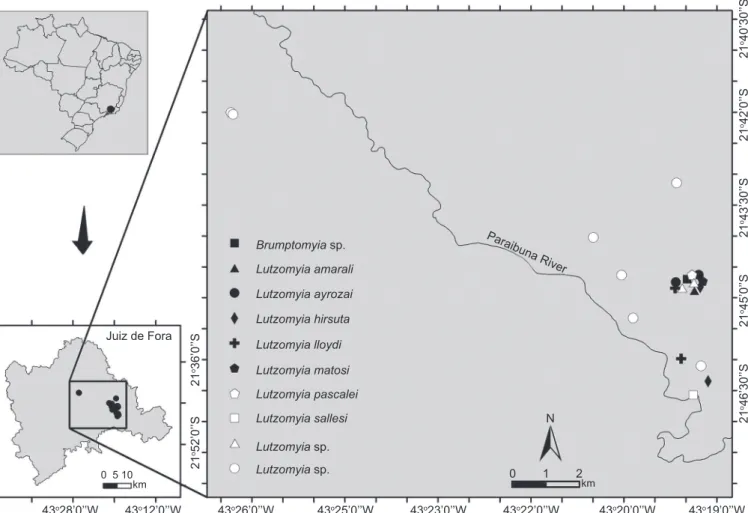
This study covered the eastern region of the City of Juiz de Fora. Figure 1 shows the spatial distribution of the phlebotomine sandl ies. All species found were concentrated in a single area of the region surveyed, within the São Benedito neighborhood.
Together, the two São Benedito sites accounted for 94.7% of the
total number of sandl ies captured (126 specimens).
No phlebotomine sandflies were captured in seven of the twelve neighborhoods surveyed (Alto Grajaú, Linhares, Parque Burnier/JK, Progresso, Santo Antônio, São Bernardo
and São Dimas). Both Lu. lloydi (Nossa Senhora de Lourdes
and São Benedito) and Lu. sallesi (Vila Ideal) were found
only in peridomestic sites. Lutzomyia amarali, Lu. matosi
and Lu. pascalei were found exclusively in the forest biome
(São Benedito). Lutzomyia ayrozai, Lu. edwardsi and Lu. hirsuta
were captured from both peridomestic sites and the forest site
(São Benedito, Santa Rita and Tiguera, respectively).
This study is the i rst inventory of phlebotomine sandl y
fauna held in Juiz de Fora. The species Lutzomyia intermedia,
Lutzomyia migonei and Lutzomyia quinqueferhave previously
been found in this municipality7,8. Therefore, the data obtained
in this work add to the available information on the local fauna,
identifying eight species of the genus Lutzomyia that have
not been previously reported in this city, namely Lu. amarali, Lu. ayrozai, Lu. edwardsi, Lu. hirsuta, Lu. lloydi, Lu. matosi, Lu. pascalei and Lu. sallesi. Notably, none of the formerly
reported species were found in the present study, possibly because they were captured at different sites within the city or because of possible changes related to biotic and/or abiotic factors. The most
prevalent species captured in the present study (Lu. pascalei)
has been shown to be in a process of geographical expansion.
Restricted to the northeastern and southeastern regions of Brazil
until recently, it has already been found in southern Brazil9,10.
The subgenus Psychodopygus was represented by four
species. Some species of this group, i.e., Lu. hirsuta and
Lu. lloydi, have been found to be naturally infected with Leishmania in Minas Gerais11,12. Lutzomyia lloydi was found
99
Rev Soc Bras Med Trop 47(1):97-100, Jan-Feb, 2014
AcKnOWLeDGMenTs
43o28’0’’W 43o12’0’’W 43o26’0’’W 43o25’0’’W 43o23’0’’W 43o22’0’’W 43o20’0’’W 43o19’0’’W
0 5 10 km
Brumptomyia sp.
21
o52’0’
’S 21
o36’0’
’S
N
0 1 2
km
21
o46’30’
’S 21
o45’0’
’S 21
o43’30’
’S 21
o42’0’
’S 21
o40’30’
’S
Paraibuna River
Lutzomyia amarali
Lutzomyia ayrozai
Lutzomyia hirsuta
Lutzomyia lloydi
Lutzomyia matosi
Lutzomyia pascalei
Lutzomyia sallesi
Lutzomyia sp.
Lutzomyia sp.
FIGURE 1 - Spatial distribution of sandl ies in the municipality of Juiz de Fora, State of Minas Gerais, Brazil. Coverage area of the city showing the sandl ies captured in the eastern region from March to September 2012.
In this work, the capture sites were chosen based on reports
of the occurrence of asymptomatic dogs seropositive for canine
visceral leishmaniasis. However, none of the eight Lutzomyia
species found is considered of epidemiological importance in the
transmission of this disease. In addition, this research showed that within the study area, a more diverse phlebotomine fauna existed in the natural environment than in those environments subject to anthropic impacts, consistent with the data from the literature1.
Further surveys will be performed in other areas of the city. In a recent review, Andrade & Dantas-Torresshowed that at least 93 species included in 16 genera of phlebotomine sandl ies identii ed in Brazil have already been found in the State of Minas
Gerais13. However, the authors added that many municipalities
have not yet been surveyed thoroughly. Thus, our research contributes to the knowledge of the species diversity and spatial locations of the phlebotomine sandl y fauna in Minas Gerais as well as to future studies of the behavior of these insects.
We are thankful to the superintendent of the Superintendência Regional de Saúde de Juiz de Fora (SRS/JF), Dr. Cláudio Moisés
Lacerda Reis; to the coordinator of the Núcleo de Vigilância Epidemiológica, Ambiental e Saúde do Trabalhador, Lourdes Maria Tasca Tavares; to the researchers of the Centro de Pesquisas René Rachou, Rogério Pereira, Juliana Xavier Faustino and Cristiani de Castilho Sanguinette; to Thamiris Mariane de
Almeida, Hélio Soares Gomes, Liliane de Souza Vieira, Nívea Maria Farinazzo; and to those responsible for the sites where the traps were placed, for their essential collaboration in this research.
100
references
fInAncIAL sUPPOrT
This work was supported by Fundação de Amparo à Pesquisa Cientíi ca do Estado de Minas Gerais (FAPEMIG).
1. Rangel EF, Lainson R. Apresentação. In: Rangel EF, Lainson R, editors. Flebotomíneos do Brasil. Rio de Janeiro: FIOCRUZ; 2003. p. 13-14. 2. Missawa NA, Lima GBM. Distribuição espacial de Lutzomyia longipalpis
(Lutz & Neiva, 1912) e Lutzomyia cruzi (Mangabeira, 1938) no Estado de Mato Grosso. Rev Soc Bras Med Trop 2006; 39:337-340.
3. Alves WA, Bevilacqua PD. Rel exões sobre a qualidade do diagnóstico da leishmaniose visceral canina em inquéritos epidemiológicos: o caso da epidemia de Belo Horizonte, Minas Gerais, Brasil, 1993-1997. Cad Saude Publica 2004; 20:259-265.
4. JF Minas Website. O portal de turismo de Juiz de Fora e região. Clima [Internet]. 2009; [Cited 2012 July 31]. Available at: http://www.jfminas. com.br/portal/informacao/clima/
5. Pugedo H, Barata RA, França-Silva JC, Silva JC, Dias ES. HP: um modelo apropriado de armadilha luminosa de sucção para captura de pequenos insetos. Rev Soc Bras Med Trop 2005; 38:70-72.
6. Young DG, Duncan MA. Guide to the identii cation and geographic distribution of Lutzomyia sandl ies in Mexico, the West Indies, Central
and South America (Diptera: Psychodidae). Mem Amer Entomol Inst 1994; 54:1-881.
7. Andrade Filho JD, Galati EAB, Falcão AL. Nyssomyiaintermedia (Lutz & Neiva, 1912) and Nyssomyianeivai (Pinto, 1926) (Diptera: Psychodidae: Phlebotominae) geographical distribution and epidemiological importance. Mem Inst Oswaldo Cruz 2007; 102:481-487.
8. Martins AV, Williams P, Falcão AL. American sandl ies. Academia Brasileira de Ciências. Rio de Janeiro; 1978.
9. Marcondes CB, Santos-Neto LG, Lozovel AL. Ecology of Phlebotomine sandl ies (Diptera, Psychodidae) in Brazilian Atlantic Forest. Rev Soc Bras Med Trop 2001; 34:255-260.
10. Eckert J, Souza GD. Flebotomíneos (Diptera: Psychodidae: Phlebotominae) no município de Estrela e primeiro registro de Lutzomyia pascalei (Coutinho & Barreto) no Rio Grande do Sul. Rev Bras Bioci 2010; 8:399-422.
11. Rangel EF, Ryan L, Lainson R, Shaw JJ. Observations on the sandl y (Diptera: Psychodidade) fauna of Além Paraíba, State of Minas Gerais, Brazil, and the isolation of a parasite of the Leishmania braziliensis complex from Psychodopygus hirsutus hirsutus 1985. Mem Inst Oswaldo Cruz 1985; 80:373-374.
12. Quaresma PF, Carvalho GML, Ramos MCNF, Andrade Filho JD. Natural Leishmania sp. reservoirs and phlebotomine sandl y food source identii cation in Ibitipoca State Park, Minas Gerais, Brazil. Mem Inst Oswaldo Cruz 2012; 107:480-485.
13. Andrey JA, Dantas-Torres F. Phlebotomine sandl ies (Diptera: Psychodidae) of the state of Minas Gerais, Brazil. Neotrop Entomol 2010; 39:115-123.