Coventry University Business School Coventry – U.K.
INTERNAL MARKETING AND THE QUALITY OF SERVICE PROVIDED
BY THE BACK-OFFICE TO THE FRONT-OFFICE AS KEY FACTOR
FOR CUSTOMER SATISFACTION
Tânia Simões Oliveira * Bráulio Alturas **
ISCTE – Lisbon University Institute - Portugal
* Master Student of ISCTE - Lisbon University Institute, Av. das Forças Armadas 1600-083 LISBOA, Portugal, Phone: (+351)217903066, Fax: (+351)217903099, E-mail:
** Assistant Professor of ISCTE - Lisbon University Institute, Av. das Forças Armadas 1600-083 LISBOA, Portugal, Phone: (+351)217903066, Fax: (+351)217903099, E-mail:
Introduction
Internal Marketing can be defined as a management philosophy that involves the internal and intentional use of marketing techniques (Ahmed & Rafiq, 1995) in order to motivate collaborators in the search for implementing entrepreneurial strategies focused on the external client (Ahmed & Rafiq, 2002). The lack of strategies at the level of internal communication, the non-existence, in certain situations, of channels that allow for an effective flow and follow-up of processes and actions, the non-awareness on the part of personnel of the premise “a collaborator is an internal client”, leads to i) delays in responses between departments, and consequently in the provision of services to the external client, ii) lack of information between departments and iii) total lack of knowledge of the different department’s policies and methods. All this, apart from making it impossible, or hampering the client-internal provider relationship, takes away the credibility from the services provided to the external client. Hence, we want to find out if Millennium bim, by implementing an internal marketing strategy that allows supervising the quality of the services provided by the Back-Office to the Front-Office, and by building an internal communication system, will impact the services provided to the external clients automatically contributing to their satisfaction.
A view of Internal Marketing
The term “Internal Marketing” emerged from Services Marketing literature (Gilmore & Carson, 1995) in 1980, as a concept that tried to develop employees with a conscience focused on the client and make the services quality an organizational imperative (Papasolomou-Doukakis, 2003).
Since the 80’s there have been collaborations in the theoretical and empirical context, however, as of 2003, the literature on the subject became scarce and purely commercial in nature, in a way losing its credibility. Currently, there is some work about how Internal Marketing operates in practice but doubts related to its implementation and definition weaken its legitimacy. There still isn’t a definition of Internal Marketing that is universally accepted and no single unified notion of Internal marketing (Foreman & Woodruffe, 1991; Rafiq & Ahmed, 1993). Internal Marketing is not recognized by its practitioners (Sargent & Saadia, 1998) and there is no agreement on its strategic objective or conceptual framework (Ballantyne, 2003). For Ballantyne and colleagues, (1995) ”Internal Marketing is any form of marketing within the organization that tries to focus the attention of collaborators on the internal activities that need to be changed in order to improve their performance in the external market” (Ballantyne et al., 1995: p. 15).
According to this approach, Internal Marketing tries to i) satisfy collaborators in order for them to improve their performance and ii) create value, both for internal clients, as well as for external clients.
The concept of satisfaction
Customer satisfaction has been a critical research area for over 40 years and in spite of the interest, marketing literature assigns to the concept of satisfaction, for several decades it was not fully exploited (Day, 1980), and specialized literature did not offer a satisfying definition of customer satisfaction that was universally accepted (Anderson, 1973). The first research on customer satisfaction was conducted in 1960 by Cardozo (1965) and indicated that customer satisfaction was influenced by the product or by the perceived quality of the services and by the purchase experience. The concept of customer satisfaction describes the emotional reaction, the degree to which a product meets the buyer’s expectations (confirmation level) (Oliver, 1980).
It was verified that some authors consider satisfaction an emotion (Westbrook, 1980; Woodruff et al., 1983; Mano & Oliver, 1993), others a mere cognitive comparison (Bloemer & Kasper, 1995; Churchill & Surprenant, 1982) and others a cumulative process, which is simultaneously emotional and cognitive (Oliver, 1980).
The vast majority of studies that refer to the background of satisfaction are related to the paradigm of disconfirmation that states that satisfaction or dissatisfaction, are the result of a comparison between existing expectations before the purchase and its results. According to Oliver (1980), clients have expectations regarding the performance of a certain product or service before purchase. Wotruba & Duncan (1975) distinguish “two types of expectations: normative expectations that precisely define how the product should behave and predictive expectations that indicate how one thinks the product will behave” (Wotruba & Duncan, 1975: p. 85). However, it is not just expectations that influence satisfaction over a product, the effort to acquire the product also influences satisfaction that “can be higher when clients make considerable effort to obtain the product, than when they only make a modest effort” (Cardozo, 1965: p. 244).
A growing body of literature proposes models for consumer satisfaction (Oliver 1980; Woodruff et al 1983; Oliver & DeSarbo 1988; Bolton & Drew 1991; Schlesinger & Heskett 1991; Anderson & Sullivan 1993; Woodruff & Gardial 1996). But once again in the literature that was been studied we find the factors that determine the relationship between satisfaction and internal marketing, however, after the descriptive research was conducted, the opposite was found.
Customer satisfaction may not be the ultimate goal for companies; customer satisfaction is primarily associated with financial performance. These results generally fall into two main categories: complaints and loyalty (Hsu & Hsu, 2008). Customer satisfaction is generally defined as a feeling or an assessment of customer value in relation to goods or services after they have been used (Jamal & Naser, 2003). Achieving customer satisfaction has also been considered a target for most service companies. It was shown that increasing the level of customer satisfaction increases profits, increases the recommendation mouth to mouth and reduces spending on marketing (Beerli et al., 2004).
The Millennium bim bank
Millennium bim was born from an agreement for a strategic partnership between the Portuguese Commercial Bank, currently Millennium bcp, and the Mozambican State, in 1995. Following changes that occurred in 2000, at the level of Banco Comercial de Moçambique shareholder structure (BCM), the main shareholder of Millennium bim, the Banco Comercial Português (BCP, Portuguese Commercial Bank), would similarly become, BCM’s reference shareholder. This evolution implied that BCP (currently Millennium bcp), became the main shareholder of both banks - Millennium bim and BCM. Hence, in November 2001 the merger took place, the Bank assumed the designation of one of the merged banks - Banco Internacional de Moçambique (International Bank of Mozambique) (Millennium bim) – and became the largest bank to operate in the national market. Millennium bim currently has the largest banking network in Mozambique, over 600 thousand clients and more than 117 branches throughout the country. For the prime segment Privates and Businesses, the Bank has eleven specialized branches – 7 in Maputo, 1 in Xai-Xai, 1 in Beira, 1 in Chimoio and 1 in Nampula – in order to improve supply and the quality of the service and strengthen its position in this important segment.
Research question and hypotheses
We derive our basic research question: What impact do the services provided by the Back-Office to the Front-Office have in the satisfaction of the external client?
The set of hypotheses related to this research question was built after the literature research: (H1) The quality of the services provided by the Back-Office to the Front-Office influences the satisfaction of the prime external client.
(H2) The factors that have more influence in global prime customers’ satisfaction are professionalism and the Front-Office’s level of service.
The empiric research that we proposed was built after the literature research, followed by the exploratory phase. Our construct assumes a direct relation (i.e. not mediated by any effects) between the internal consumer satisfaction and the external consumer satisfaction.
Methodological considerations
In order to test our hypotheses, we designed a two-phase research methodology:
i) Exploratory phase, including in-depth interviews with a sample of 7 prime branches managers (from the 11 prime branches that are open in Mozambique).
ii) Empiric phase, based on two structured and direct questionnaires developed through the contribution of the literature review and the interviews of the previous phase.
Based on i) the above hypothesis, ii) the answers to an interview carried out to those responsible for the prime branches in the city of Maputo, iii) the literature review, iv) the reports drafted in the context of a working group on the quality of the services to the prime segment, v) the researcher’s function within the bank under study and vi) the questions from a questionnaire carried out by Millennium bim to Corporate clients, the type of questions to include in the questionnaires were defined in order to ensure the measurement of variables and the verification of hypothesis.
A sample of i) 331 valid answers was obtained from a total of 400 questionnaires handed over to external clients, thus obtaining 82.75% rate of valid answers. Total responses were 370 (92.50%), of which 39 (9.75%) were annulled because the questionnaires were not properly filled in, and ii) 91 valid answers from a total of 91 questionnaires submitted to the whole universe of internal clients (Front-Office), thus obtaining a 100.00% response rate. The number of respondents in each branch is proportional to the branch’s number of external clients, i.e. it a sample per quota in which each sub-sample has the same weight the corresponding branch has on the bank in terms of prime clients.
The present study used all types of questions, i.e., general or specific and open or closed and for the most part closed questions were applied as they make statistical analysis easier, and the open questions were arranged in groups of identical responses and coded according to the answers obtained. In the present study, items in a 5-point Likert scale were used to assess satisfaction (from 1”terrible” to 5 “excellent”). In view of the variables under study, ordinal and nominal scales were used.
Findings
The first step in the analysis was to conduct Pearson linear correlations in order to identify which independent variables (specific aspects of performance such as level of reception, service, security, communication, etc.) have more influence on the global satisfaction with the branch (Appendix 1 - Appendix).The correlation allows to obtain a measure (correlation coefficient: r by Pearson) through which one can determine the strength or intensity and the meaning of an
association (Bryman & Cramer 2001). The correlations conducted with the results of the questionnaires to the external clients, reflect the relations between the dependent variable “Satisfaction” with the independent variables mentioned in the Appendix 1. The correlations conducted with the results of the questionnaires to the internal clients, reflect the relations between the dependent variable “Satisfaction” with the new independent variables found through the factorial analysis (Table 2).
None of these fifteen thematic titles have much correlation to global satisfaction. The correlations obtained are weak even though they are statistically significant. The highest correlation is with Staff Sympathy and Courtesy, i.e. when satisfaction with Staff Sympathy and Courtesy increases, global satisfaction tends to increase slightly. However, one should not consider that these 15 thematic titles are good satisfaction predictors.
95% Confidence Interval for Mean Mean Lower Bound Upper Bound 5% Trimmed Mean Median Variance Std.
Deviation Minimum Maximum Range
Interquartile
Range Skewness Kurtosis
Statistic 3.93 3.88 3.98 3.93 4.00 0.207 0.455 2 5 3 0 -0.876 3896
Std.
Error 0.025 0.134 0.267
Table 1: Descriptives of global satisfaction of the external client.
We tried to reduce the 15 thematic titles through an analysis of main components, however, the internal consistency of the six components found proved to be weak (Alpha´s Cronbach lower than 0.7). It was also verified that some of the 15 thematic titles that could potentially explain global satisfaction presented low communalities (between 0.4 and 0.6), thus, we decided not to define components and maintain the original thematic titles.
The external clients are quite satisfied (average of 3.93, in a scale of 1 (terrible) to 5 (excellent). Dispersion was also found to be low (standard deviation 0.455).
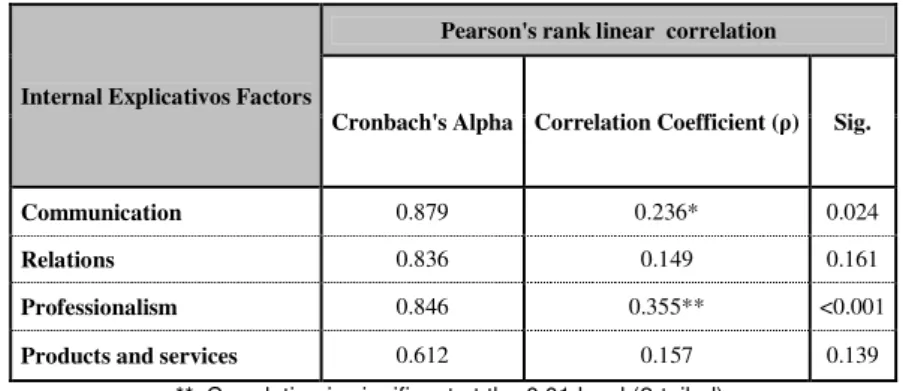
With regards to external clients, we computed a principal components analysis to reduce our data and we found 4 explanatory factors (Table 2).
Internal Explicativos Factors
Pearson's rank linear correlation
Cronbach's Alpha Correlation Coefficient (ρ) Sig.
Communication 0.879 0.236* 0.024
Relations 0.836 0.149 0.161
Professionalism 0.846 0.355** <0.001
Products and services 0.612 0.157 0.139 **. Correlation is significant at the 0.01 level (2-tailed).
*. Correlation is significant at the 0.05 level (2-tailed).
Table 2: Pearson linear correlations between the global satisfaction of the internal clients and its explanatory factors
Global satisfaction with the performance of the central services (Back-Office) is correlated to communication and professionalism, i.e. when satisfaction with communication and professionalism increases, global satisfaction tends to increase. Professionalism has a significant impact on satisfaction; however, communication does not have as much impact on satisfaction. The 2 correlations obtained are not very strong although they are statistically significant.
The results show that as the global satisfaction of external client’s increases, the satisfaction of the internal clients tends to decrease and vice-versa.
Marketing implications
Although there is some work on Internal Marketing since the 80’s, the doubts related to its practical implementation in organizations persist and this concept is not very known within organizations.
Although Hypothesis 1 was not confirmed, because it was not concluded that, in general, the satisfaction of internal clients influences that of external clients, we were able to measure the variables that have more influence on the satisfaction of both samples studied. Hypothesis 2 was partially confirmed considering that professionalism, because it gave rise to the factor relationship with the client, influences the satisfaction of external clients.
We tried to, in line with the objectives of Internal Marketing by Barnes, Bradley, Fox & Morris (2004), understand internal clients and their relationships with the organization and with external clients, in this manner, when assessing the satisfaction of the Front-Office with the services provided by the Back-Office we identified the points that should be worked on in order to increase the satisfaction levels of internal clients. With happier internal clients, the prime branches of Millennium bim will show better results and will be more productive, although, as was shown, this does not significantly affect the satisfaction of external clients, who seem more concerned with other factors.
The present study proved useful and necessary for Millennium bim as it provides information on the level of satisfaction of the collaborators of the prime branches of Maputo towards the services provided by the central services and it is clear that, in general, the former are not very happy with this relation. This relationship was assessed through a series of carefully selected items from the literature review and opinions gathered from interviews with the people in charge of the prime branches of Maputo; it was concluded that when satisfaction with the professionalism of the collaborators of the central services and with internal communication increases, so does the global satisfaction of the Front-Office. Thus Millennium bim should i) focus on training its collaborators and ii) look at Internal Communications as a tool for information, satisfaction and motivation of the internal client.
It is difficult to make previsions from the satisfaction obtained. It is a variable with poor prevision power and thus all conclusions are not robust and can not be generalized to other cases. The research is not totally focused on the objective, as in reality two independent studies were carried out which we tried to link together; the first study does not include questions on external clients (such as: “Do you feel the services provided to you by Back-Office influence the services you provide to internal clients?”). Both questionnaires are independent and it could have been possible, through the questionnaire applied to the internal clients, to conclude if the service provided by the Back-Office influences or not the service the Front-Office provides to the external client. Provided that, with the questionnaire for external clients we could have confirmed (or not) the impact verified with the first questionnaire.
There is a relation between the satisfaction of the internal clients and the satisfaction of the external clients, it is an inverse relation and this goes against hypothesis 1, i.e. the branches whose staff is more satisfied with central services, tend to have less satisfied internal clients so when internal satisfaction increases, external satisfaction tends to decrease.
We concluded that relative satisfaction with i) the sympathy and courtesy of the employees, ii) reliability, iii) the satisfaction of the client’s desires and needs, iv) the manager’s professionalism and v) the Front-Office’s response capacity are factors that contribute to a slight increase in the global satisfaction of the external clients. The clients of the segment under study are sensitive to the staff’s attitudes favouring Relational Marketing. This conclusion is largely explained by the fact that the satisfaction of the external clients is good and does not show much dispersion. The external clients seem to be consensual to evaluate the performance of the prime branches.
With this study, we were able to determine that the global satisfaction of the Front-Office with the performance of the services provided by the Back-Office is influenced by communication and the professionalism of the collaborators in the area, although we were hoping for a more significant contribution from these factors to global satisfaction.
According to the literature, internal communication is identified by most researchers as Internal Marketing’s main tool. A communication that flows within the organization to the different levels, using different flows and networks is a tool for the information, satisfaction and motivation of the internal client.
References
Ahmed, Pervaiz K. and Rafiq, Mohammed (1995), “The role of internal marketing in the implementation of marketing strategies”, Journal of Marketing Practice, Bradford, 1 (4), 32. Ahmed, Pervaiz K. and Rafiq, Mohammed (2002), “Internal marketing - Tools and concepts for customer focused management”, Oxford, Butterworth-Heinemann Publications.
Anderson, Eugene W. and Sullivan, Mary W. (1993), “The antecedents and consequences of customer satisfaction for firms”, Marketing Science, 12 (2 Spring), 125-143.
Anderson, Rolph E. (1973), “Consumer Dissatisfaction, the effect of disconfirmed expectancy on perceived product performance”, Journal of Marketing Research, Chicago, (February), 10 (1), 38-44.
Ballantyne, David. (2003), “A relationship-mediated theory of internal marketing”, European Journal of Marketing, 37 (9), 1242–1260.
Ballantyne, David; Christopher, M. and Payne, A. (1995), “Improving the quality of services marketing: service (re) design is the critical link”, Journal of Marketing Management, 2 (1), 7-24. Beerli, Assucion; Martin, Josefa D. and Quintana, Agustin (2004), “A model of customer loyalty in the retail banking market”, European Journal of Marketing, 38, 1/2, 253-275.
Blomer, Josée M. M. and Kasper, Hans D. P. (1995), “The complex relationship between consumer satisfaction and brand loyalty”, Journal of Economic Psychology, Amsterdam, (July), 16 (2), 311-329.
Bolton, Ruth N. and Drew, James H. (1991), “A Multistage Model of Customers Assessments of Service Quality and Value”, Journal of Consumer Research, 17 (4 March), 375-384.
Bryman, Alan and Cramer, Duncan (2001), “Quantitative Data Analysis with SPSS for Windows”, Routledge, London –UK.
Cardozo, Richard N. (1965), “An Experimental Study of Consumer Effort, Expectation and Satisfaction”, Journal of Marketing Research, 2 (August), 244-249.
Churchill, Gilbert A. Jr. and Surprenant, Carol (1982), “An Investigation into the Determinants of Customer Satisfaction”, Journal of Marketing Research, 19, (4 November), 491-504.
Day, Ralph L. (1980), “How satisfactory is research on consumer satisfaction”, Advances in Consumer Research, 7, 593-597.
Foreman, S. and Woodruffe, H. (1991), “Internal marketing: a case for building cathedrals”, Marketing Education Group Proceedings, Cardiff, (July), 404-22.
Gilmore, A. and Carson, D. (1995), “Managing and marketing to internal customers”, In Glynn, W. J.; Barnes, J. G., compil., “Understanding Services Management”. Chichester, John Wiley and Sons, 295-321.
Hsu, Jovan Chia-Jung and Hsu, Chao-Min (2008), “The Relationships Between Service Quality and Customer Satisfaction in a Leading Chinese Web 2.0 Company”, The Business Review, Cambridge, Kun Shan University, Tainan, Taiwan, (December), 11, 1.
Jamal, A. and Naser, K. (2003) “Factors influencing customer satisfaction in the retail banking sector in Pakistan”, International Journal of Commerce & Management, 13, 2, 29-53.
Mano, Haim and Oliver, Richard L. (1993), “Assessing the dimensionality and structure of consumption experience: evaluation, feeling and satisfaction”, Journal of Consumer Research, Gainesville, (December), 20 (3), 451-466.
Oliver, Richard L. (1980), “A Cognitive Model of the Antecedents and Consequences of Satisfaction Decisions”, Journal of Marketing Research, 17 (4 November), 460-469.
Oliver, Richard L. and Desarbo, Wayne S. (1988), “Response Determinants in Satisfaction Judgements”, Journal of Consumer Research, 14 (4 Mars), 495-507.
Papasolomou-Doukakis, Ioanna (2003), “Internal Marketing in the UK Retail Banking Sector: Rhetoric or Reality?”, Journal of Marketing Management, 19, 197-224.
Rafiq, Mohammed and Ahmed, Pervaiz K. (1993), “The scope of internal marketing strategy: defining the boundary between marketing and human resource management”, Journal of Marketing Management, 9 (3), 219-232.
Sargent, A. and Saadia, A. (1998), “The strategic application of internal marketing – an investigation of UK banking”, The International Journal of Bank Marketing, 16, 2, 66–79. Schlesinger, Leonard A. and Heskett, James L. (1991), “Breaking the Cycle of Failure in Services”, Sloan Management Review, 32 (3 Spring), 17-28.
Westbrook, Robert A. (1980), “Intrapersonal Affective Influences on Consumer Satisfaction with Products”, Journal of Consumer Research, Gainesville, (June), 7 (1), 49-54.
Woodruff, Robert B. and Gardial, Sarah F. (1996), “Know Your Customer – New approaches to understanding customer value and satisfaction”, Massachusetts: Blackwell Publishers.
Woodruff, Robert B.; Cadotte, Ernest R. and Jenkins, Roger L. (1983), “Modelling Consumer Satisfaction Processes Using Experience-Based Norms”, Journal of Marketing Research, 20 (3 August), 296-304.
Wotruba, Thomas R. and Duncan, P. L. (1975), “Are Consumers really satisfied?”, Business Horizons, 18, (1 February), 85-90.
Appendix
Satisfaction
Pearson Correlation Sig. (2-tailed)
Satisfaction 1
2.1. Friendliness and courtesy of staff 0,230** 0,000 2.2. Sensitivity to customer needs 0,106 0,054 2.3. Satisfaction of customers desires and needs 0,171** 0,002 2.4. Managers professionalism 0,167** 0,002
2.5. Confidentiality 0,065 0,238
2.6. Competitiveness of interest rates and commissions charged 0,077 0,161
2.7. Variety of services 0,081 0,140
2.8.Innovation in products and services -0,034 0,533 2.9.Performance of products and services -0,012 0,830
2.10.Security 0,118* 0,031
2.11.Reliability 0,199** 0,000
2.12.Appearance of facilities 0,124* 0,024 2.13.Responsiveness of the Front-Office 0,149** 0,007 2.14.Guarantee of services / products -0,045 0,416
2.15.Service levels 0,109* 0,048
**. Correlation is significant at the 0.01 level (2-tailed). *. Correlation is significant at the 0.05 level (2-tailed).
Appendix 1: Pearson Correlations between the global satisfaction of the external clients and its thematic titles.
Prime Branches Descriptive Statistics External Clients Internal Clients (Front-Office)
Rovuma Mean 3.34 4.00 Std. Deviation 0.65 0.58 Prestige Mean 4.23 4.00 Std. Deviation 0.43 0.82 Jat Mean 4.38 3.00 Std. Deviation 0.52 0.63 ONG´s Mean 3.74 4.17 Std. Deviation 0.45 0.75
Julius Nyerere Mean 3.88 3.85
Std. Deviation 0.41 0.38
Praça dos Trabalhadores Mean 4.04 3.45
Std. Deviation 0.38 1.00
Samora Machel Mean 3.98 3.42
Std. Deviation 0.21 0.90
Correlation - 0.634378842
Sig. 0.402437