INNOVATION IN FAMILY BUSINESSES – A CASE STUDY OF
GLSA
Maria Isabel Morais Cardoso Ribeiro Filipe
Dissertation submitted as partial requirement for the conferral of
MSc in Business Administration
Supervisor:
Prof.ª Alexandra Fernandes
ISCTE Business School, Departamento de Marketing, Operações e Gestão
Geral
2
IN
N
O
V
A
T
IO
N
I
N
F
A
MIL
Y
BU
S
IN
E
SS
-
–
A
C
A
SE
ST
U
D
Y
O
F GLS
A
M
a
ri
a
I
sa
be
l M
o
ri
a
s C
a
rd
o
so
R
ib
ei
ro
F
il
ipe
5
Resumo
Atualmente, num mundo onde a competição pela presença no mercado é destemida, a inovação torna-se essencial para as empresas sobreviverem e prosperarem. Dado que a maioria das empresas em todo o mundo são familiares, é importante entender como as mesmas agem no que diz respeito à inovação
Para muitas empresas familiares em todo o mundo, a inovação é um fator de distinção, que lhes permite perlongar por várias gerações.
Neste contexto, o principal objetivo da presente dissertação é entender até que ponto as empresas familiares são de fato mais inovadoras do que o outro tipo de empresa e a sua capacidade de inovar. Para esse fim, a revisão de literatura, num primeiro estágio, abordará a relação da empresa familiar com a inovação, analisando diferentes posições na literatura sobre a vontade e a capacidade deste tipo de empresa inovar.
Num segundo estágio, é apresentado o estudo sobre uma empresa familiar - a empresa GL - para fornecer um exemplo prático de uma empresa familiar inovadora. Com o objetivo de apresentar uma perspetiva interna da postura da empresa em relação à inovação, foram realizadas entrevistas a dois membros da família de gerações diferentes. A análise qualitativa das entrevistas forneceu informações práticas sobre como a GL se comporta relativamente à inovação, aplicando os conceitos-chave expostos na revisão de literatura à realidade da empresa.
Os aspetos teóricos da presente tese combinados com o estudo de caso da GL pretendem fornecer uma abordagem abrangente para as questões relacionadas aos processos de inovação nas empresas familiares.
Palavras-chave: Empresas familiares; Inovação; Tradição; Willingness-ability paradoxo Classificação JEL: M1; O3
6
Abstract
Nowadays, in a world where competion for market presence is fearless, innovating becomes essential for companies to survive and thrive. Given that the majority of companies worldwide a family business, it is relevant to understand how do these businesses act with regards to innovation.
For many family business worldwide innovation is a distinction factor, that allows them to continue to exist throught different generations.
In this context, the main purpose of the present dissertation is to understand to what extent are in fact family businesses more innovative than the other kind of enterprises and their capacity to innovate. For that purpose the literature review will, on a first stage address the family business’ relation with innovation, analysing different positions in literature on both the willingness and the abilty of these type of companies to innovate.
On a second stage, a study on a family business – the GL company – is presented, in order to provide a practical example of an innovative family business. For the purpose of presenting an internal perspective on the company’s posture towards innovation, interviews were conducted to two senior family members - the CEO and a manager. The qualitative analysis of the interviews has provided practical insights on how GL behaves towards innovation, by applying the key concepts exposed on the literature review to the company’s reality.
The theorectical aspects of the present thesis combined with GL’s case study intended to provide a comprehensive approach to the issues relating to the innovation processes within family businesses.
Key words: Family businesses; Tradition; Innovation; Willingness-ability paradox; JEL Classification: M1; O3
7
Ackowledgments
I would like to thank my boyfriend Tomás, my friends Luísa and Eva and my father, without whom this dissertation would have been possible.
I also like to thank my supervisor prof. Alexandra Fernandes for her guidance. Thank you all,
8
List of Abbreviations
FB – Family Business
FDI – Family-Driven Innovation ITT – Innovation Through Tradition SEW – Socioemotional Wealth GDP – Growth Domestic Product SC – Social Capital
RIFF -Readiness for Innovation in Family Firms EU – European Union
List of Figures
Figure 1: “3- Circle” model of family business (adapted from Tagiuri & Davis 1982) . 16 Figure 2: Family- Driven Innovation: Resolving the Paradox in Family Firms, adapted from (De Massis, Alberto, et al., 2015:9) ... 30 Figure 3: A Model of Innovation Through Tradition, adapted from (De Massis et al., 2016:98) ... 34 Figure 4: Family business innovation postures – GL case ... 53
List of Tables
Table 1: “Readiness for Innovation in Family Firms (RIFF) Framework” adapted from (Holt & Daspit,2015:85)………..24 Table 2: “Sequencing of a RIFF Assessment” adapted from (Holt & Daspit, 2015:90)………...25 Table 3:”The comparison of Qualitative and Quantitative Methods” adapted from (Park & Park,
9
Table 4: Interview general analysis……….47
Table 5: How to unlock the innovation potential of FBs – the GL case………..51
Table of Contents
List of Abbreviations ... 8 List of Figures ... 8 List of Tables ... 8 Introduction ... 11 1. Family Business ... 131.1. Definition of Family Business ... 13
1.2 Main Features ... 16
2. Innovation in Family Business ... 20
2.1 Innovation ... 20
2.2 Family business and innovation ... 20
2.3 Ability and Willingness to innovate in Family Businesses ... 22
2.4 Constraints to the ability and willingness to innovate ... 26
2.5 Willingness-Ability Paradox ... 29
3. How to unlock the innovation potential of FBs ? ... 29
3.1 Family-Driven Innovation ... 29
3.2 Innovation Through Tradition (“ITT”) ... 33
3.3 Collaboration to Innovation ... 34
3.4 Social Capital and Innovation in Family Businesses ... 35
3.5 Family Business Innovation Postures ... 36
3.6 Family system dimensions ... 38
4. Empirical Study ... 39
4.1 Methodology ... 39
4.2 Research methods ... 40
4.3 Selected method ... 41
4.4 Type of qualitative research: Semi-Structure Interview ... 42
4.5 Interview analysis ... 43
10
4.7 A small sample ... 44
4.8 Interview process and interview guide ... 45
5 Results and analysis ... 46
6 Discussion ... 50 7 Limitations ... 54 8 Conclusion ... 55 9 Bibliography ... 57 10 Webgraphy ... 59 11 Annexes ... 60
11
Introduction
Family businesses (hereinafter referred to as “FB’s”) are the most prevalent form of business organisation worldwide (De Massis, Alberto, et al., 2015). It is relevant to note that, despite the different social, economic, political and cultural landscapes in the several regions of the globe, family businesses are accountable for the biggest slice of the world’s wealth generation (Cano-Rubio, Fuentes-Lombardo, & Vallejo-Martos, 2017). FB’s are therefore crucial for driving growth and sustaining a strong economic base, both
regionally and on an international level.
In a time where innovation is crucial for the growth and continuity of businesses in general, it is rather relevant to understand where FB’s stand, when it comes to innovation. Given that as pointed out above, FB’s are key to the global economic stability, understanding to what extent are these forms of enterprises willing to invest in innovation, is essential for their survival when competing with other non-FB’s.
One of the FB’s priorities is stability instead of gathering short-term profit. Because of this, researchers argued that FB’s are more likely to have longer-term perspectives comparing with non-FB’s, as well as a common set of values that is not a characteristic of non-familiar entities (Lorandini, 2015). Nevertheless, FB’s are also likely to become resistant to change and adopt conservative strategies, which can cause constraints to future growth and profitability of the business. (Zahra, 2005).
These contradictory features of FB’s give rise to a paradox called the willingness-ability paradox. According to this paradox, some aspects of FB’s such as the ones described above, may in some cases enter in confrontation and restrain the innovation process within this type of business.
This thesis intends to expose this paradox and explain different solutions for unblocking this situation.
In order to do so more clearly, the thesis will be divided into a theoretical and a practical part. The first part, chapters 2, 3 and 4, will present the theoretical framework for family business and innovation. In chapter 2, the debate on the definition of FB’s will be presented, and some of the main definitions developed by literature will be exposed.
12
Chapter 3 will define innovation and explain the advantages and limitations of FB’s that can foster or restrain innovative processes. Finally, possible solutions for these issues will be described in chapter 4.
The second part (i.e. the empirical study) will be qualitative research composed by interviews made to a portuguese FB, which was considered by the Portuguese Association for Family Businesses as the most innovative in 2018, in Portugal. The interview will address some of the issues pointed out throughout the thesis; concerning innovation in FB’s and focus on the types of possible solutions used by the interviewed company to address these problems.
FB’s are very relevant to overall economic success and the study of how innovative these companies are, is both important, in the present, as well as relevant for future economic growth, which will likely continue to include FB’s as a bedrock of economic activity.
13
1. Family Business
On the present chapter, the Family Business concept will be analysed, and differentiation will be made between FB’s and non-FB’s by indicating some of the main features and criteria presented by literature.
1.1. Definition of Family Business
There is no specific definition for FB’s, because this type of business represents a complex reality, no consensus has been reached by literature on a single definition for FB’s. As referred by (Carney, 2015) cite by (Hernandez, 2018), FB’s have specific capabilities and resources when comparing to non-FB’s and behave differently than the latest.
Furthermore, it is also relevant to note that the concept of “family” is a shifting concept, varying throughout time and depending on the different regions. (Commission, 2009) The dynamic nature of the family “concept” is also a challenge to define FB’s, and as a response, new criteria and key elements have been proposed to define family in the context of FB’s. Nevertheless, “defining family remains a challenging task that can only
be met by devoting similar and simultaneous attention to both business and family (Basco and Pe´rez 2009; De Massis et al. 2012).”(Hernández-Linares, Sarkar, & Cobo,
2018:945)
Despite the non-existence of a single FB definition, they are recognised as the most predominant form of business in both regional and national contexts. FB’s are considered responsible for generating 70%-90% of the global GDP (Family Firm Institute, 2017) cite by (De Massis, Frattini, Majocchi, & Piscitello, 2018).
The existence of different positions concerning the FB concept is well reflected in (Austrian Institute for SME Research, 2008). The study states that: ‘there is not a single
definition of ‘family business’ which is exclusively applied to every conceivable area, such as to public and policy discussions, to legal regulations, as an eligibility criterion for support services, and to the provision of statistical data and academic research’
14
constraints in assessing the real impact of these business organisation forms in the world’s economy. (Hernández-Linares et al., 2018).
Robert G. Donnelley proposed the first concept of FB in 1964 (Hernández-Linares, Sarkar, & Cobo, 2018:931). According to Donnelley, FB is defined by the following criteria:
the business has been identified with at least two generations of the same family; and
the connection to the family has influenced both the company policy and the objectives of the family in itself.
During the two decades following Donnelley’s definition of FB, others have proposed different concepts based either in mono-criteria, such as management control or ownership, or multiple criteria relating the meaning of FB to a variety of indicators. The wide variety of FB concepts lead Handle cit in. (Hernández-Linares et al., 2018:931) to state that “defining the family firm is the first and most obvious challenge facing the
family business researcher.”
In more recent years, new criteria have been proposed, and other authors continued to present new FB’s concepts. Given that, it is not this thesis objective to discuss the different definitions and criteria, only a couple of these will be considered in order to present a framework on the subject.
From the research pursued, the purpose of this thesis, it was noticeable that the definition provided by Chua, J. H., Chrisman, J. J., & Sharma, P. (1999:25) cit in. (Thrassou,
Vrontis, & Bresciani, 2018:93) Has been widely quoted in literature1. According to these
authors the concept of FB’s is related to the transgenerational intentions of the family stating that “governed and/or managed with the intention to shape and pursue the vision
of the business held by a dominant coalition controlled by members of the same family or a small number of families in a manner that is potentially sustainable across generations.”
1 For example in the following: (De Massis et al., 2016; De Massis, Frattini, et al., 2015; Evert, Martin,
15
Since defining FB’s is a hard-working task, and it is recognised that there is no agreement to reach a consensual definition, an expert group of the European Commission, created especially for the purpose of studying FB’s in a European context. The expert group has suggested that it could be useful to use a clear concept of FB, that would apply to all European member states facilitate the study of the impact of FB’s on a much broader level, namely within the European Union (“EU”).
Thus, the expert group have proposed a definition given by the Finnish Working Group on Family Entrepreneurship, since it is a comprehensive and operational definition that has been widely accepted.
The definition is recommended by the expert group to be used in the member states and other countries to better produce comparable studies of the FB sector at European level (Commission, 2009:10).
According to the conclusions of the expert group: “A firm, of any size, is a family
business, if:
1) The majority of decision-making rights is in the possession of the natural person(s) who established the firm, or in the possession of the natural person(s) who has/have acquired the share capital of the firm, or in the possession of their spouses, parents, child or children’s direct heirs.
2) The majority of decision-making rights are indirect or direct.
3) At least one representative of the family or kin is formally involved in the governance of the firm.
4) Listed companies meet the definition of family enterprise if the person who established or acquired the firm (share capital) or their families or descendants possess 25 per cent of the decision-making rights mandated by their share capital” (European Commission,
2009:10).
The latest definition will be the one take into account on this research since it is recommended by the European Commission to be used in studies as a general definition (Commission, 2009:9).
16
1.2 Main Features
The “3 circle model.”
Family Businesses are composed by a range of firms in different sectors and sizes. These forms of business are estimated to represent more than 60% of all European companies, with great impact in the global economy (European Commission, 2009).
According to the European expert group, although there is no consensus on a single FB definition, there is general agreement that any definition of FB must contain three elements: Family, Business and Ownership.
The first illustration (see Figure 1) of these factors was made by the “3 -circle” model of the family business, created in 1982 by Tagiuri and Davis.
Figure 1: “3- Circle” model of family business (adapted from Tagiuri & Davis 1982)
As we can see, Figure 1 represents the different factors that interact with a family business. The “Family” circle represents the family members who do not have any managing or work role in the company (e.g. minor children, spouses); the “Ownership” circle refers to the non-family shareholders (e.g. investors) without any kind of
employment or management relationship with the company; and the “Business” circle
which refer to the company’s managers which are not family members. These are a vital part of the management of the company (Arenas Cardona & Rico Balvín, 2014).
According to (De Sá & Melo, 2016), what distinguishes FB from non-FB’s is precisely the different sections identified by the numerical points that are represented within the
17
figure. These points represent the crossing relations between the factors represented in the figure, that define the specific interactions within FB’s:
1. Section 1 refers to those family members who are employed in the company in management positions and are also shareholders of the company.
2. In section 2, these are the family members who do not have any management roles in the company, but who hold shares.
3. Section 3 represents the family members that do not have a percentage of the share capital of the company, but that, on the other hand, have a management position.
4. Finally, section 4 includes members of the company who do not make part of the family, but that hold shares and perform management positions in the company.
The “3 -circle” model is important to understand FB’s main features and how their characteristics differentiate them from non-FBs.
Resource-based view
The resource-based view is an approach defined by Werenfelt in 1984, that looks at the different resources of a company to understand its level of competitiveness. This approach can be used to distinguish FB’s from non-FB’s by analysing each specific resource of the family entities (Almarri & Gardiner, 2014:440).
According to (De Massis, Frattini, Pizzurno, & Cassia, 2015), this theoretical framework highlighted that inside a family firm, the interaction between the family entity, the
business itself and the family individuals could lead to unique conditions and
constituencies that generate unique capabilities and resources. As a result, the resource-based view states that there are competitive advantages/disadvantages in FB’s that occur from the interaction of the family and the business, depending on the level of stocks of different types of capital. These different types of capital are defined as it follows (De Massis, Frattini, et al., 2015:3):
Human Capital is defined as the people’s personified skills and knowledge. The commitment to the business, sincerity and close relationships are some of the advantages of the human capital inside a FB. On the other hand, FB’s are usually recognised by
18
having a lack of access to qualified human capital; this happens due to possible favouritism towards kin over more qualified individuals, and unfair human resources management which can be disadvantages to the business.
Financial Capital is defined as the current and potential monetary resources of the company. Families fight to preserve the longevity of the business over the generations. Thus, a long-term perspective is generated by the interaction between family and business to protect the founding generations and long-term financial security.
Social Capital is defined as the resources deriving from relationships among people. It involves both the relationships of individuals inside the company and between the firm and its external parties. FB’s have a unique family language, which contributes to better and fluid communication between the members of the family. Furthermore, as referred by Fukuyama and Lyman cit in. (De Massis, Frattini, et al., 2015:3) the conventional family values and goals which are shared by the members of the family, lead to higher levels of commitment to the workforce, that can create a competitive advantage over non-FB’s.
The unique social characteristics of FB’s also represent an advantage when communicating with external stakeholders. On the one hand, it is more likely that the stakeholders develop personal relationships with the family members of FB’s than in non-FB’s, which are generally more impersonal. On the other hand, family, members pay attention to the family reputation (which is not a factor in non-FB’s) and therefore are motivated to develop strong relationships with their external stakeholders.
Agency, Stewardship and Behaviour Theories
The Agency theory, the Stewardship theory and the Behavioural theory are three theories developed by literature, for the purpose of providing an academic framework for further insight into the behaviour of FB’s.
During the decade of 1960 and the early ’70s, economists have explored the risk-sharing among individuals and groups. It was found that, when cooperating parties have different attitudes towards risk, a problem of risk-sharing arises (agency problem). To respond to this problem, Agency Theory, created by Jensen and Meckling in 1976, is aimed to the ubiquitous agency relationships, in which one party (the principal) assign work for
19
another party (the agent) who performs the given work. To describe the relationship between these two parties, the agency theory uses a metaphor of a contract (Eisenhardt, 1989:58).
The Agency theory argues that due to family ownership, family individuals have some control rights over the firm’s assets, that are used to influence the decision-making processes inside the company. The conjugation of control and ownership, particularly in small FB’s, confers organisational powers to the founder and his/her family, generating three dominant propensities, known as parsimony, personalism and particularism that distinguish FB’s form non- FB’s:
Parsimony is established through the alignment of the interests between the owner and managers in FBs’, which reduce the tendency to opportunism and creates a propensity in the direction of resource conservation and allocation when comparing to non-FB’s.
Personalism emerged due to the fact that the family acts as a single agent in which management and ownership are concentrated, leading to authority personalisation giving family members a high degree of power and control over the FB’s.
Particularism stems from the personalisation of authority and emerges from the family control right that entailed a personalistic exercise of authority that permits family members to reach diversified goals rather than the maximization of firms value or pure profit.
The Stewardship theory is viewed as “ a complementary perspective to agency theory” (De Massis, Frattini, et al., 2015:5). According to this theory, managers look at the organisation as something they feel identified with, making them act in a non-opportunistic way.
The Stewardship theory view of FB’s behaviour, suggests that family managers look at their company as a vehicle to fulfil their needs for social contribution, security, belonging
and standing within family (De Massis, Frattini, et al., 2015:5).
Finally, the Behavioural theory basis the distinction of FB’s and non-FB’s on the willing to chase emotional value of ownership, enhance the creation and conservation of socioemotional wealth (“SEW”) for the family and on the degree of altruism towards the
20
members. SEW is defined as “the amount of affect and value family owners receive when
they invest in a firm.” (Lamb & Butler, 2018:1382) and can appear in many ways such as
belongings, family dynasty, and prestige (Lamb & Butler, 2018:1376).
Research shows that “when family owners gain SEW or affective value through their
ownership and involvement in a firm, and that the extent to which such noneconomic utilities influence their decisions is a primary cause of the differences between family and nonfamily firms”(Chrisman, Chua, De Massis, Frattini, & Wright, 2015:311). The
amount of psychological attachments to the company by the family members reinforce their commitment and chase of transgenerational control.
2. Innovation in Family Business
To better comprehend how FB’s behave concerning innovation, it is essential first to describe the concept. In the present chapter, a general definition of “innovation” will be presented, and an analysis of how to what extent FB’s are innovative companies will follow.
2.1 Innovation
As referred by (De Massis, Alberto, et al., 2015), Innovation is “the set of activities
through which a firm conceives, designs, manufactures, and introduces a new product, service, process, or business model.”
Innovation is a crucial process through which a firm can, not only survive and succeed but even renewal the organisation when needed. Superior returns and competitive advantage come with innovation; it is argued that innovation is “the most important
component in a business strategy through which a firm can gain an advantage over its competitors”(Sanchez-Famoso, Pittino, Chirico, Maseda, & Iturralde, 2019:2).
2.2 Family business and innovation
FB’s have a tendency towards conservative strategies and can sometimes show resistance to change and adaptability. Authors that agree with this vision say that “traditionally,
21 family firms have been viewed as conservative, resistant to change and averse to risk”(Nieto, Santamaria, & Fernandez, 2015:382). This tendency can, in some instances,
reduce their profitability and growth potential. Other authors argue that FB’s and innovation are opposites because of several factors, such as the need for control, the CEO's staying a long time in command, being risk-averse, and the Buddenbrooks
Syndrome (Bennedsen & Foss, 2015).
In this context, it is important to explain the Buddenbrooks Syndrome since it is a long-established term and "is evoked by business historians to explain the inability of family
firms to survive beyond the third generation" (Lorandini, 2015: 1005). According to
(Lorandini, 2015) the founder of a given firm, due to being a pioneer, is very dynamic. The second generation focuses on strengthening the family business, while the third and often the last generation, is more negligent, preferring pleasurable and unprofitable activities; Ultimately undermines the family business by showing that the successors to the founder do not have the same strength and dynamism to run the business, leading the same to its end (Lorandini, 2015:1005).
Furthermore, in the cases where founders stay too long in powers, it is common that they do not focus sufficiently in preparing enough capable leaders that might assume the command of the FB’s in the future. Moreover, a tendency exists for founders to “favour
their children and other family members, failing to fully integrate and retain competent employees who are not blood relatives”(Zahra, 2005:23). These factors often lead
individuals that disagree with owners to leave the firm. As a result of the non-existence of opposite/creative ideas, FB’s might fall into “strategic simplicity”, meaning that old routines and strategies that have worked well before, will be used again and again
“regardless of the strategic challenges facing the family firm” (Zahra, 2005:24).
Studies have shown that FB’s are less innovative than non-FB’s in relation to innovation inputs, such as investment in R&D. But, in innovation outputs, for example, new products investments, FB’s reach higher innovation performance than non-FB’s (Feranita, Kotlar, & De Massis, 2017). This controversial fact, lead family business researchers to be very interested in why and how FB’s can outperform non-FBs, “doing more with less”, despite having lower innovation inputs (Feranita et al., 2017).
22
2.3 Ability and Willingness to innovate in Family Businesses
Nowadays, the business environment is very complex, and because of that, FB’s must be engaged with innovation in order to improve their competitiveness.
According to (Holt, 2015), FB’s are more likely to innovate successfully only when their ready to do so. For that to happen, it is important not just that the company is well equipped but also that the individuals that work there, are enthusiastic about the innovation process. Studies suggest that the existence of certain resources (e.g. know-how, machinery or technology) combined with the management’s willingness to innovate in FB’s, have an impact on whether this type of business adopts or not innovation. Therefore, readiness to innovate will require both the ability and willingness to do so (Holt & Daspit, 2015:84).
Taking the above into account, (Holt & Daspit, 2015:84) define innovation readiness as “the degree to which the family, firm, and others involved are individually and collectively
able and willing to adopt an innovation”.
To understand to what extent are FB’s ready to innovate, it is essential to define the concepts of ability and willingness.
Ability is defined as “the discretion of the family to direct, allocate, add to or dispose of
a firm’s resources (De Massis et al., 2014: 6), and is related to the power and control that
the family has in the management of the company, namely through the capacity to make
“structural, statistic options” . (Rondi, Massis, & Kotlar, 2017:2)
On the other hand, willingness is the “favourable disposition of the involved family to
engage in distinctive behaviour” (De Massis et al., 2014: 347), leading the owner of the
company to act in a way that reflects the family’s goals.
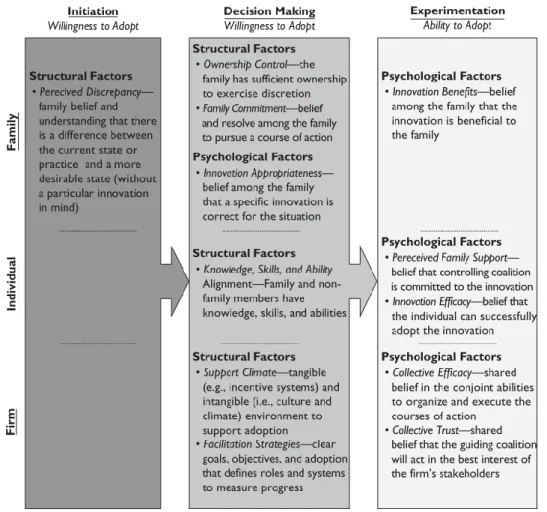
To assess, if a FB has the capacity to innovate, it is essential to understand the Readiness for Innovation in Family Firms (“RIFF”) Framework. This framework was developed by (Holt & Daspit, 2015) and allows family managers to perform a pre-test to the understand to what extent are FB’s ready or not to innovate.
Some FB’s maintain a high level of readiness to innovation, incrementing, in a proactive and continually way, a mindset onto innovation across generations. This ensures that
23
family individuals have the skills, knowledge and abilities to match the new requirements arising with innovation. On the other hand, there are other FB’s that are not prepared to innovate, at least for a long -period of time, which can lead to financial difficulties.(Holt & Daspit, 2015)
The innovation readiness is conditioned by specific structural and psychological factors. The structural factors are key elements to innovation readiness, that are necessary but insufficient preconditions for moving the family through the innovation process. On the other hand, to be prepared for innovation adoption, family leaders need to analyse psychological factors in order to understand the company’s willingness to innovate. These psychological factors are composed of individual and collective beliefs, intentions and attitudes.
Both structural and psychological factors can be analysed from the perspective of the family, of the firm’s strategies as well as from an individual point of view (Holt & Daspit, 2015). The success is dependent on the collective, interdependent people who individually contribute with something to the innovation. When high interdependence exists, the confidence of members individually is not as high when comparing to a shared psychological sense of confidence in collective abilities.
The table below represents the RIFF assessment framework, explaining in more detail each of the above-described factors
24
Table 1: “Readiness for Innovation in Family Firms (RIFF) Framework” adapted from (Holt & Daspit, 2015:85)
According to the authors mentioned above, for the purpose of determining the readiness of a FB for innovation, it is also important to take into account specific timings for each of the assessed criteria. In this context, (Holt & Despit, 2015) propose three stages throughout which the RIFF framework should unfold: initiation, decision making and experimentation.
The Initiation stage includes activities that refer to the recognition of a need and proposition of specific innovations to adopt.
The Decision-Making stage is related to the evaluation that is made of the proposed innovation from several strategic perspectives (e.g. technical or financial perspectives), which leads to a decision to accept an idea as the solution desired, apportioning resources toward its assimilation.
25
On the Experimentation stage, actions are required in order to implement an innovation “culture” within the company (Holt & Daspit, 2015). The required actions on this final stage of the process, are entirely related to psychological factors both at the level of the family, individuals working there and the firm itself. In general, the FB and all its elements should be motivated for the innovation process.
The figure below demonstrates the crucial factors that FB’s leaders must address to benefit insights into the firm’s innovation readiness (see Table 2).
Table 2: “Sequencing of a RIFF Assessment” adapted from (Holt & Daspit, 2015:90)
According to (Nieto et al., 2015), FB’s should be incentivised to innovate, since innovation creates new business opportunities and wealth.
26
Furthermore, the survival instinct and concern of FB’s for long-term continuity is coherent with its decision to innovate. Despite the need for incentives, FB’s only embraced innovation when the necessary abilities are engaged with a willingness to innovate. This only happens when the non-family members of the firm, believe in the family, the family belies in the benefits of the innovation and finally when existing trust and a sense of ability according to all those involved in the business (Holt & Daspit, 2015).
2.4 Constraints to the ability and willingness to innovate
According to (Chrisman, Chua, De Massis, Frattini, & Wright, 2015; Rondi, Massis, & Kotlar, 2017) the following situations might result on limitations to the willingness and ability of a FB to innovate:
Risk-aversion;
Reluctance to share control with non-FB’s members;
Lack of requisite skills (that exist among non-FB’s members), Socioemotional concerns;
Commitment to traditional product lines;
Crave to minimise the need for external financing.
Due to risk-aversion, conflicts between family members relating to the extent of the R&D investments performed might arise. For that reason, FB might tend to invest less in R&D, even if the long-term orientation of family owners (who understand the importance of innovation for maintaining the FB) possibly show that they have many incentives to invest more resources (Rondi, Massis, & Kotlar, 2017).
Furthermore, lower levels of willingness might derive from a generally cautious attitude towards resource allocation for innovation, and to the inflexibility related to entrenched mental models and long tenures (Dieleman, 2018). Since willingness for innovation emerges from the goals, intentions and motivations of the family who influence the firms’ behaviour, this results in a less innovative tendency.
27
On the other hand, FBs’ high ability results from its great control, strong networks, close relationship with the knowledge of the business and a high monitoring power guarantee that investments lead to tangible results (Dieleman, 2018).
The family firm’s ability to innovate is influenced by the combination of a specific set of family assets, which are the following, according to (Röd, 2016):
Long-term orientation; Long-term leader tenures; Tacit knowledge;
Strong family bonds;
And social networks built up over generations.
Other limitations might arise from the application of the agency and stewardship theory. Researchers have used these theories to test FB’s decisions to invest in the renewal of the firm. According to an agency perspective, FB’s are less likely to invest in the renewal of the firm when comparing with non-FB’s. Given that, in FB’s family members are usually in control of the management of the company, having the ability to consume gratifications and inflate compensations, these are less incentivised in the short term to invest in the company’s renewal and innovation.
The ability to run from the negative impact of the delayed renewal and the risk-aversion as well will make it more difficult for the FB’s to invest in innovation. In opposition to this, according to the stewardship theory perspective, family members act as stewards, having concerns regarding the future of the business. As mentioned above in chapter 2, according to this theory, members look at the company as something they identified with and therefore do not put their personal interest in front of the company’s. From a stewardship perspective, innovation in FB is likely to occur, given that family members will prefer to innovate in order to maintain the future of the company, then pursuing their own interests.
In general, those FBs who take into account long-term viability, as well as a wider variety of stakeholders, tend to behave in a way which benefits family business innovation. On
28
the other hand, FBs whose priorities are more short-sighted and family-focused can strangle innovation (Miller, Wright, Breton-Miller, & Scholes, 2015).
It is also important to note that FB’s that adopt socioemotional objectives, such as giving jobs to less competent family members, family-directed altruism, using the resources of the business for their own purpose might restrain the innovation processes (Miller et al., 2015). As explained in chapter 2 above, FB’s are more likely to value SEW over strictly financial gains (Berrone et al., 2010; Cennamo, Berrone, Cruz, & Gomez-Mejia, 2012; Miller & Le Breton-Miller, 2014). This is an emotional approach to the business regarding family members, which can cause different reactions. For example, some FB’s fight to create a strong business they can transmit to the following generations by building innovation-promoting resources such as human, relational and financial capital. Other family firms cater to family desires, of unqualified nepotism, favouring undeserved family individuals and the use of the family assets to fulfil family desires that can lead to a lack of resources (Miller, Wright, Breton-Miller, & Scholes, 2015).
It is interesting to note that, usually, the first generation of a FB is less averse to risk and less sensitive to uncertainty comparing with the following generations. This happens because, when a change of generations takes place and additionally, a rise in the number of owners, the complexity of interests grows. This dispersion of management powers among various members of the family might contain the consensus on innovation and risk-taking activities.
The Buddenbrooks syndrome (defined in chapter 2) is also related to the extent of innovation adoption in FB throughout different generations. The founder generation has nothing to lose when speaking of gains and losses since when a company is young and wants to expand, it will be required to take risks. But as the company grows, the generations and the number of owners changes, so the pressure comes too, and that means a bigger risk-aversion attitude when speaking about innovation.
While the family’s goals may lead to a reduced willingness to invest in high levels of R&D, the same goals may, as demonstrated, increase the family’s ability to innovate, leading to more efficient innovation activities and to an increased innovation output.
29
All of those situations described above lead us to the willingness-ability innovation
paradox since FB’s innovate less despite having the ability to innovate more.
2.5 Willingness-Ability Paradox
In the previous chapter about the constraints to ability and willingness to innovate, it is possible to realise that there is a paradox in innovation due to the evident contrast between FB’s ability to quickly innovate, and their common reluctance to do so.
FB’s, although having more potential to innovate than non-family ones, are the ones that innovate the least (Chrisman et al., 2015) (Rondi et al., 2017).
FB’s tend to take longer regarding making decisions surrounding technological change when compared to non-family businesses. The fascinating factor here is that, although FB’s are often reluctant to spend, risk-averse and focused on wealth concentration, even though they have strong decision-making abilities, they end up putting little or no focus on innovation. However, when they decide to implement something new, they tend to do so, both efficiently and quickly. Surprisingly when a company is family owned and managed, its efficiency in transforming inputs into innovative outputs is very positive (Rondi et al., 2017).
3. How to unlock the innovation potential of FBs ?
In this chapter, different solutions to the Willingness-Ability Innovation Paradox
available in literature will be presented.
3.1 Family-Driven Innovation
For FB’s to be able to unlock their potential by demystifying the innovation paradox, scholars have proposed a model that offers FBs the opportunity to use innovation as a competitive advantage. For this purpose, the concept of Family-Driven Innovation (FDI) has been defined as "the internally consistent set of strategic decisions that allow a family
30 and the idiosyncratic characteristics of the family firm" (De Massis, Alberto, & Frattini,
2015: 6).
Figure 2: “Family- Driven Innovation: Resolving the Paradox in Family Firms”, adapted from (De Massis, Alberto, et al., 2015:9)
The FDI is possible when the unique characteristics of the FBs match with the innovation decisions, which can lead to the firms’ competitive advantages through innovation (De Massis, Alberto, et al., 2015). As it is shown in the first square in figure 2, three factors exist that can be used to explain the FBs’ idiosyncratic characteristics and their heterogeneity:
1. The Family willingness which is defined, cite in (De Massis, Alberto, et al., 2015:9) as “favourable disposition of the involved family to engage in distinctive behaviour. It encompasses the goals, intentions, and motivations that drive the family involved to influence the firm’s behaviour in directions that are different from those pursued by firms without family involvement.” This leads to questioning by family owners, where do we want to go? The question is referring to the orientation of the firm, if it is oriented to
maximising profit, for example, or to reach family goals such as harmony, identity or others.
2. Then we have Family ability as discretion, defined as “the discretion of the [involved] family to direct, allocate, add to, or dispose of a firm’s resources. It also includes latitude in selecting the goals of the organization and in choosing among the range of feasible strategic, structural, and tactical decisions.” This questioning How can we go there?
31
The question is related to the set of decisions that a family firm will take to reach the goals that are stipulated in the first question (De Massis, Alberto, et al., 2015).
3. Finally, we have the Family Ability as resources which “refers to the family’s power to act and the resources and capabilities that family owners need to deploy in order to pursue their goals and lead the firm in the desired direction”(De Massis, Alberto, et al.,
2015:10) that lead to questioning what do we use/need to go there? The answer to this question will be related to the unique characteristics related to FB that can be used as a competitive advantage.
The second square represents the heterogeneity of innovation decisions, which is based on three main questions. These lead to the conclusion that if a firm has a good innovation strategy, then a competitive advantage exists (De Massis, Alberto, et al., 2015):
1. Firstly, is referring the “Where do we search for knowledge and resources we need to
innovate?” the possible answers to this question can be, the search for equilibrium
between the existing knowledge and the exploitation of the new. Other alternative can be the depth research of multiple technology opportunities which can have higher costs or the match between the knowledge of the past and newly created technologies. This last
option is based on the concept of Innovation Through Tradition2, which will be developed
in the next chapter (De Massis, Alberto, et al., 2015).
2. The second question is “How do we want to manage the innovation process?”
To answer this, it must be considerate the strategy that a firm will approach to develop and exploit innovation. For this to happen, it is needed to research on open innovation. The research on open innovation is suggested as the strategic priority for firms to compete with high performance and in high-velocity industries, to “leverage both inbound and
outbound flows of knowledge and technology to increase revenues and reduce the costs of their innovation process”(De Massis, Alberto, et al., 2015:11). It is essential for a
company to decide what is the degree of openness that will use in the innovation process, this means, what is the degree in which a firm will look for external sources of technology and knowledge to rapidly increase its development. Still, in the exploitation phase, open innovation means the systematical search for opportunities to sell proprietary
32
technologies outside the main business of the firm. This happens through approaches such
as joint ventures or out-licensing agreements.3
3. Finally, the question “What do we want to innovate?” In other words, what kind of
innovation the firm wants to invest, is it on a new product/service or in a new business
model?Usually, when there is a change in the business model, the product/services also
are changed. Nowadays, innovating a business model is also a source of competitive
advantage. There is a difference between product/service innovation and process
innovation since the product/service is concerned with what the company offers, which is immediately visible to the clients, but when the subject is the process, it is something that is not recognised by the clients in a short time. A higher risk exists when changes are made firstly in products/services compared with when these are made first in the business processes. The cause for this, lies on the fact that investing in process as a quicker and more direct impact is the FB market positioning, as well as in its clients' point of view. FDI is very important when a FB wants to innovate or change their posture in the market. It provides an understanding of the alignment between the single characteristics of a firm and its strategy to innovate. If a FB wants to invest in innovation, it is essential to prioritise the pursuit of maximising results of profitability over the non-economic goals.
Moreover, it is important to note that if family owners are overconcerned with the control preservation of the family identity, the way the company is managed can suffer a lack of professionalisation. It is essential to invest in non-family technology, knowledge and members. When a new generation replaces the former in the management of the company, a change of perspective regarding the renewal of the business and its performance might occur. New generations are sometimes more prone to innovate and support the investment in skilled human resources and the implementation of new R&D strategies that might contribute to the company’s innovation strategies.
If a FB can get a close fit between the unique characteristics of the company and the dimensions of its strategy of innovation, the innovation paradox can possibly be resolved, and the potential of innovation can also be unlocked, creating a competitive advantage to the company (De Massis, Alberto, et al., 2015).
33
3.2 Innovation Through Tradition (“ITT”)
Another approach that can be followed to unlock the FB innovation potential is the
Innovation Through Tradition (De Massis et al., 2016; Gorgoglione, Messeni Petruzzelli,
& Panniello, 2018).
The competences, knowledge, materials, signs, manufacturing processes, beliefs and values that belonged to the past create the concept of Tradition (Rondi et al., 2017). Research by (De Massis et al., 2016) has provided this new concept named Innovation
Through Tradition, which can be another alternative resolution to the paradox of family
firms. The ITT concept combines family business, dynamic capabilities and research in innovation in a way that shows fundamental capabilities demystifying past knowledge, being a new strategy of product innovation.
Some may think that the knowledge from the past is not a good way to innovate because it can cause dependence. Other scholars agree that developing innovative products throwing back to the past is a clever benefit for companies. (De Massis et al., 2016).
“knowledge pertaining to the past is increasingly recognized as a powerful and unique source of innovation advantage” cite in (De Massis et.al 2016:94) by (Messini Petruzzelli
& Albino, 2012).
Consumers make choices according to their perception of products and sometimes traditional can be seen as old and useless or as a good thing to maintain and trustworthy. Innovation is seen as a huge source of competitive advantage, so both these concepts (tradition and innovation) can be an interesting match (Gorgoglione et al., 2018). The connection to the past is related to the “nostalgia boom”, a search for products that are echos of the past. This tendency to look for nostalgia provoking products, often arise after unstable periods in History. According to (Brown, 2001), this is due to the fact that these products evoke a supposedly simpler and carefree past.
34
Figure 3: “A Model of Innovation Through Tradition”, adapted from (De Massis et al., 2016:98)
This model represents a Model of Innovation Through Tradition (see Figure 3), in which it can be seen in the sources of past knowledge, we have the tradition after interiorize the past and their forms, it happens a reinterpretation that innovatively allow new functionalities and meanings. This is the ITT concept.
3.3 Collaboration to Innovation
Other possible solution to resolve the innovation paradox in FBs can be the Collaboration to Innovation, defined as “a form of inter-firm relationship that involves the exchange
and sharing of resources such as financial capital, information, knowledge, and technology with external parties in order to achieve innovation” (Feranita et al.,
2017:138). Examples included of collaborative innovation are licensing, contractual agreements, joint ventures, alliances, technology exchange and partnerships, which englobe an extensive number of external parties, like suppliers, customers, competitors, between others.
Researchers look at the collaboration on innovation strategy and operations of FB’s, specifically focusing on the extent that access to resources such as capital, information, knowledge and technology, come from collaboration with external parties. They believe that external sources of innovation can be crucial in resolving the innovation paradox. Researchers defend that to reach any kind of innovation, it is important to take into
35
account external parties’ help since no firm is entirely self-sufficient when speaking about resources needed to achieve the innovation.
This need leads to collaboration with external organisations as a strategic tool. To define such collaboration, researchers have proposed three main perspectives:
Strategic
The first perspective is the strategic view. It uses the collaboration of innovation as a solution for its resources’ restrictions. From the lens of the resource based-view, collaboration to innovate is a strategic move used in order to reach the necessary resources. This is reached through the transfer of knowledge.
Transactional
The second perspective is related to possible opportunistic behaviours that come from the collaborations between parties. To prevent that, and do not have a negative impact on both companies, governance mechanisms are chosen to block those possible opportunistic behaviours. This leads to honest performance between collaborative parties. This is the transactional view.
Relational
Lastly, we observed a stream of literature that studies collaborative innovation using social exchange and network theories, emphasising the social exchange relations between partnering firms in a collaborative relationship. This social relationships emerge as crucial to the firms’ willingness to collaborate and share knowledge and are thus central to building collaborative innovation networks. We code this stream as relational view.
3.4 Social Capital and Innovation in Family Businesses
Some researchers suggest that to unlock the innovation potential of FB’s is important to consider not only the relational characteristics which are characteristics in the family system, but also the interaction of the family members and non-family members.
36
In this context, researchers have noticed that the relationships within family firms could be improved by investing in the social capital (“SC”) of the company. SC is defined as
“the bundle of resources made available through reciprocal and trusting relationships within a group, is an important source of innovation as it encourages the creation and integration of knowledge”(Sanchez-Famoso, Pittino, Chirico, Maseda, & Iturralde,
2019:1).
The more the interpersonal ties within people in a company, the more the assimilation and integration of knowledge, as a result of the easier communication and collaboration. As stated by (Sanchez-Famoso et al., 2019:2)“The quality of the relationships supports
experimentation and the search for new knowledge. Good interpersonal relationships held individuals feel psychologically safe and willing to engage in trial and error processes. (…) SC also allows people to seek advice and expertise to solve problems and generate new insight.”
Is important to consider the non-family SC since it helps family members to reach innovation through the assimilation and integration of new knowledge in FBs.
According to (Sanchez-Famoso et al., 2019:3) “Family members cannot be expected to develop all relevant knowledge needed (…) Thus, acquiring external knowledge and effectively integrating it in the organization are crucial to sustaining innovation. From this perspective, non-family members and their social relationships are important in the acquisition and assimilation of knowledge”. Studies about the relationship between these two kinds of SC identified that both, despite being distinctive, are complementary in the integration and development of innovation.
Researchers found out that the interaction of family and non-family members within a FB creates the conditions to increase innovation, and that their good relationship produces a positive effect on the innovation process. When there is a high non-family SC inside a FB, a positive relationship between innovation and family SC exists.
3.5 Family Business Innovation Postures
To help FB’s resolving the willingness-ability paradox, researchers have proposed the family firm innovation posture, defined as “the strategic orientation the owning family
37 imprints on the family business, shaping the firm’s innovation climate, philosophy, and practices” (Rondi et al., 2017:2).
After examining different levels of risk-taking and attachment to a tradition related to the variety of family business innovation postures, typologies of four ideal types were created: Seasoner, Re-enactor, Digger and Adventure (see Figure 3).
Figure 4: “Typology of family business innovation postures”, adapted from (Rondi et al., 2017:5)
In Figure 4, it is possible to observe the four types of family business innovation postures. These postures are connected to the relation between Tradition Attachment and the Risk-Taking Propensity. The four types of innovation postures are:
Seasoner – characterised by low risk-propensity due to the lower willingness to bet, and little tradition attachment, giving the capacity to innovate and changing the current state of the business by taking more moderate risk. What makes this type distinctive is the capacity to transform the existent resources into something new without changing the personal nature of the business.
38
Re-enactor – is also characterised with low-risk taking but with higher tradition attachment, which leads the company to innovate inside the existing patterns. To do so, the firm search for FB’ memories of the past, the intrinsic values, always with lower risk. Digger – this posture combines the high tradition attachment with high risk-taking, which
connects the single traditional organisational resources and capabilities from historical roots and legacy, with modern ones to innovate.
Adventurer – The last type, as it can be seen by the name, is the one that takes higher risks and has lower tradition attachment, which leads to undertaking risk-activities by a propensity to innovate distancing from the past. This type is very distinctive due to the willingness to innovate daringly.
As referred by (Rondi et al., 2017), The FB’ innovation business postures identified above, lead to highly innovative behaviour and high innovation achievement. The researchers’ focus is the possibility of FB’s having different orientations onto innovation and theoretically draw on the singularity of each FB’ posture included in their typology. 3.6 Family system dimensions
FB’s innovation postures can be one of the possible solutions to resolve the willingness-ability paradox, in combination with the family system dimensions.
Researchers outline four dimensions: family interactions, family functions, family events and family structures. Family systems theory exploits the importance of family individuals interaction and for FB’ outcomes, understanding the family system as complex, open, interactive and hierarchical, in which family individuals make an effort to maintain equilibrium.
Family systems theory’ focus is the interaction among people rather on the characteristics and structure, in which family status is crucially determined by communication among family members.
The family can be an uncohesion group, and low cohesion can debilitate the prevailing coalition.
Scholars have created two important dimensions, family goal diversity and family cohesion, with the purpose to contribute to FB innovation research.
39
Family goal diversity is defined as “the breadth of goals pursued by family
members”.(Rondi et al., 2017:5) It is possible that higher levels of goal diversity lead to
conflicts between family individuals with different levels of involvement in the business or among generations, for example. On the other hand, it is beneficial for the business when the individual's interests are spurred. A low goal diversity exists when family members want to pursue the same direction, for example, using the non-economic goals as a priority centring within the family. On the other side, this can constrain the development of differing ideas.
Family cohesion defined as “the emotional bonding that family members have towards
one another”(Rondi et al., 2017:2) is fundamental in the creation or assessment of
resources and dropping assets in financial problems situations. When the cohesion is high in families, so the altruism and reciprocity. Contrarily, non-cohesive families adopt opportunistic and individualistic behaviours.
Innovation can prosper in FB ‘s if there is a fit between FB’s innovation postures and the family system dimensions.
4. Empirical Study
The empirical study will be divided into three parts. The first part will be dedicated not only to the existent types of methodology, but also to the one elected for the purpose of this thesis and the reasons for that choice, also referring to the research questions of the dissertation purpose. In second place, the practical part will be presented according to the chosen research method, in which the results will be demonstrated regarding the interviews made and the possible answers to the research questions; and to finish, an interpretation of the founding’s be included the conclusions chapter.
4.1 Methodology
Family businesses are known for being conservative regarding innovation, risk averse and outdated. FBs represent the most common form of business organization worldwide. In a time where innovation is key for the survival and future of many companies globally, it is rather relevant to analyse the ability of FBs to create new and competitive products, and to understand what may be possible constraints to their availability to innovate. The
40
interest for this topic arose; from the fact, the relationship between innovation and FBs is a relatively recent topic of discussion, which motivated the author to further explore on the possible issues related to it. The thesis covers a number of topics not only through a comprehensive literature review, which contains the analysis of some of the most important scientific articles existing on the subject, but also through interviews to members of a family firm which was awarded the most innovative firm prize in Portugal. Hence, the research question this thesis intends to answer is the following: To what extent
do family business tend to innovate taking into account the existent constraints within these type of firms?
4.2 Research methods
There are two main types of research methods: the qualitative and the quantitative research.
In one hand, the quantitative method is more commonly used for the purpose of defining objective questions, usually using specific numbers and percentages, focusing on facts. On the other hand the qualitative research is a primarily exploratory / investigative method. It serves to understand reasons, opinions and motivations in order to provide answers to specific problems.
According to (Barnham, 2016:837) the quantitative method intends to answer ‘what
questions’, and in contrast, the qualitative method is more associated with ‘why?’ questions which explain why this method is essentially based on trying to find answers to
research questions.
Table 3 bellow provides detailed explanation of the main distinctive feature between the quantitative and the qualitative methods.
41
Table 3: “The comparison of Qualitative and Quantitative Methods” adapted from (Park & Park, 2016:4)
4.3 Selected method
The present thesis has been drafted based on the qualitative method. This was the selected approach for the following reasons:
Despite being of little use, qualitative research is associated with the family businesses studies, since it provides us with “powerful tools” for developing theory”(Fletcher, Massis, & Nordqvist, 2016:2) offering a range of theoretical orientations, research tools, among others.
Furthermore, the existance of the innovation paradox in family firms, as defined in chapter three, has also contributed for the choice of the qualitative method. This is because, according to (Fletcher et al., 2016: 3) “qualitative inquiry is particularly
appropriate for understanding contradictions, tensions, paradoxes and dualities in family businesses”.
Moreover, according to (Fletcher et al., 2016: 3) the qualitative method offers better mechanisms to understand the phenomenon and its contextual, individual, relational and processual nature. According to these authors, it is known that major studies are being
42
reviewed under qualitative methods to reach the viewpoints / perspectives of family firms’ individuals. This is linked with the fact that “The goal of a qualitative method is
to understand and explore the descriptive accounts and similarities and differences of various social events. (…) the qualitative method is focused on applied and theoretical findings and discoveries, based on research questions through a field study in natural conditions”(Park & Park, 2016: 3-4). Specifically regarding FBs qualitative research is
very useful to assess intentions, viewpoints and perspectives of the family members. (Fletcher et al., 2016).
4.4 Type of qualitative research: Semi-Structure Interview
The most common approaches in qualitative methods are unstructured or semi-structures techniques (e.g. individual depth interviews or group discussions). The fact that group discussions can influence the several interviewees’ answers when listening to each other’s interventions, has excluded this method to be one of the possible options for conducting the empirical study.
There are three types of interviews: unstructured, semi-structured and structured.
Unstructured interviews do not follow any kind of script and are therefore spontaneous. The structured interviews follow a specific script and are guided exclusively by the script order. Finally, a script guides semi-structured interviews, although it does not exclude possible questions that might arise during the interviews.
Taking the above into account, the best option for this type of dissertation is the semi-structured interview, as it allows for additional questions or information that may arise at the time of the interview to be included.
In this context, the interviews consisted in a guide with specific questions, and follow up questions and discussions were included based on the answers that the interviewees provided during the course of the interview. The interview guide will be divided in two parts, the first one, consistes in questions about the company and how it works. The second part are questions about innovation, if the company has an innovation department, how it works, if the department is independent, how they make decisions, amoung others