i
Forfaiting: An Alternative Financing Model
to Project Finance for PPPs?
JULIA BUSSE 152412001
ABSTRACT
Supervisors: Professor Ricardo Reis
Professor Joaquim Miranda Sarmento
Keywords: Public Private Partnerships (PPPs), Financing, Project Finance, Forfaiting Model,
Financial Crisis, Financing costs, Risk allocation
Dissertation submitted in partial fulfilment of requirements for the degree of the International MSc in Finance, at the Universidade Católica Portuguesa, June 2014.
Project finance which is primarily used to finance public private partnerships (PPPs) has faced deteriorating credit conditions during the financial crisis. This has ultimately decreased the competitiveness of PPPs compared to traditional public procurement. This study aims to find out in how far and under which conditions the forfaiting model which is predominantly used in Germany can be an alternative financing model for PPPs. For this purpose both models were compared to identify each model’s advantages and disadvantages. Furthermore, analyzing the financing patterns of PPPs in German building construction from 2002 to 2013 allowed further conclusions about the feasibility of forfaiting. It was found out that most of the German PPPs are financed by forfaiting. However, large projects are preferred to be financed by project finance. With the outburst of the financial crisis there was an evident increase in financing under forfaiting. Credit and market conditions related to project finance worsened considerably. Hence, it is assumed that projects initially planned to be financed by project finance have been dropped and/or alternatively financed by forfaiting. Overall it was found out that forfaiting is an alternative financing model for PPPs, not only in times of crisis.
ii
T
ABLE OF
C
ONTENTS
ACKNOWLEDGEMENTS ... iii LIST OF ILLUSTRATIONS ... iv LIST OF ABBREVIATIONS ... v CHAPTER 1: INTRODUCTION ... 1CHAPTER 2: LITERATURE REVIEW ... 3
CHAPTER 3: THE GERMAN PPP EXPERIENCE ... 7
CHAPTER 4: METHODOLOGY AND DATA ... 10
CHAPTER 5: COMPARISON OF PROJECT FINANCE AND FORFAITING ... 11
5.1 The concept of Project Finance in PPPs ... 11
5.2 The concept of Forfaiting with a waiver of claims in PPPs ... 13
5.3 Risk allocations ... 16
5.4 Capital structure ... 17
5.5 Financing costs and conditions ... 18
5.6 Payments for obtained financing ... 19
5.7 Financial crisis ... 20
5.8 Main Findings... 21
5.9 Advantages and Disadvantages of both models ... 23
CHAPTER 6: STATISTICAL ANALYSIS OF FINANCING MODELS IN GERMANY ... 24
6.1 Main Results ... 24
6.2 Sample split analysis ... 27
CHAPTER 7: CONCLUSION AND FURTHER RESEARCH ... 29
7.1 Main Findings... 29
7.2 Limitation of the study and further research ... 32
BIBLIOGRAPHY ... 33
iii
ACKNOWLEDGEMENTS
This thesis has been developed under the supervision of Professor Ricardo Reis and Professor Joaquim Miranda Sarmento while taking part in the dissertation workshop ‘Public Private Partnerships’ from February to May 2014. I would like to thank both professors for their advice, suggestions, time and knowledge sharing which made this thesis possible. Their efforts, guidance and support helped me throughout the entire process of developing and improving my thesis.
Furthermore, I would like to thank the Federation of the Germany Construction Industry for providing me with the data necessary to set up my thesis.
I would like to thank my fellow seminar mates but also all people who became important to me during the time of my master studies. I was not only able to have interesting discussions and get best suggestions but also to became good friends with special people who made it possible for me to share my experiences, doubts and time.
I would like to further thank my family. Most precisely my wonderful parents and grandparents without whose continuous support and love this thesis would not have been possible.
Last but not least, I would like to thank my friends whose constant company, support and encouragement have cheered me up during my whole life.
iv
LIST
OF
ILLUSTRATIONS
Figure 1: Overview of Project Finance in PPPs during the construction and operational stage ... 12
Figure 2: PPP life-cycle financing under Forfaiting ... 13
Figure 3: Steps involved in a PPP Forfaiting transaction ... 14
Figure 4: Overview of the Forfaiting Model in PPPs during the construction and operational stage .... 15
Table 1: Differences of Project Finance and Forfaiting ... 22
Table 2: Distribution of Forfaiting and Project Finance for the three governing levels in Germany ... 27
Table 3: Distribution of PPP financing for different investment volume ranges for the first sample split ... 29
Graph 1: Yearly distribution of Forfaiting and Project Finance in Germany ... 25
Graph 2: Yearly share of Forfaiting based on the total number of projects and investment volume ... 26
v
LIST
OF
ABBREVIATIONS
B Billion
D/E Debt to equity
DBFO Design-build-finance-operate
EC European Commission
EIB European Investment Bank
EPEC European PPP Expertise Center
EU European Union
FGCI Federation of the Germany Construction Industry
GBP British Pound
IMF International Monetary Fund
M Million
O&M Operation and maintenance
OECD Organization for Economic Co-operation and Development
PF Project Finance
PPP Public Private Partnership
SG State guarantee
SPV Special purpose vehicle
1
CHAPTER
1:
INTRODUCTION
Over the last two decades public private partnerships (PPPs) have become increasingly important in providing public infrastructure and services to the community. This being traditionally the task of the government, the introduction of PPPs involved the private sector in infrastructure provision in cooperation with the government. According to the OECD (2008) a PPP is an agreement between the government and one or more private partners according to which the private partners deliver a service in alignment with the service delivery objectives of the public partner and the profit objectives of the private partners. In PPPs, the private sector takes responsibility for construction, operation, and maintenance of an asset but also for financing. Project finance (PF) has been the predominant financing model in procuring PPPs for years. PF projects are highly leveraged, as the private contractor mainly raises long-term debt. Thus, there is a large borrowing need to finance the PPPs under PF. The interest rate for the debt is usually comprised of the reference interest rate EURIBOR which is variable and a fixed spread (Gatti, 2008). As the EURIBOR fluctuates with market movements, market ups and downs can have considerable influence on financing costs of PF.
Even though there are various reasons as to why a government might undertake a PPP, the main argument for a PPP is derived from the objective to achieve improved value for money (VfM). Grimsey and Lewis (2004, p. xv) define VfM as “the optimum combination of whole-of-life cycle costs, risks, completion time and quality in order to meet public requirements”. According to Marllos and Amekudzi (2008) value for money aids the government to determine whether to pursue a project as a PPP or rather through traditional public procurement by taking into account the whole-of-life cycle costs and savings. On top, to guarantee VfM the public procurer should ensure the quality of work and the competency of the private contractor rather than the lowest bid. Given a long history of publicly procured contracts being delayed and turning out to be more expensive than budgeted, transferring these risks to the private sector is one way in which a PPP can potentially add value for money in a public project (Grimsey and Lewis, 2005). Nowadays PPPs are implemented all over the world as an important alternative procurement method to traditional public procurement. However, PPPs are often criticised to be an ‘off-budget temptation’ for governments, as they enable them to make public investments and postpone the expenditures without compromising current budget and debt (Sarmento and Renneboog, 2014a).
2
However, with the start of the sub-prime mortgage crisis in the United States leading to the global recession in 2008/2009, the global PPP market was hit hard (Kappeler and Nemoz, 2010). Bank margins started to increase, liquidity and senior bank debts reduced substantially, PF and PPP lending started to compete for scarce regulatory capital allocations, and banks partially or totally withdrew from the PF market (EPEC, 2009). Banks such as Fortis, Dexia, Depfa Bank, and Eurohypo AG which supported the PPP market in Europe no longer existed in their pre-crisis forms, as they were acquired by other banks or bailed out by governments (Raisbeck, 2009). Since PF projects are characterized by high leverage, deteriorating credit conditions make it not only very hard for companies to borrow money to finance PPPs during crisis but also put extreme pressure on the competitiveness of PPPs.
In contrast, Germany has mainly financed its PPPs using another financing model called forfaiting with a waiver of claims (further on referred to as ‘forfaiting’) for years. It involves financing based on the pass-through of financing conditions close to those of municipal loans and hence is characterized by lower financing cost through guarantees on receivables which have been sold by the private contractor to a bank (Blott, 2012). Even though credit conditions have been worsened under forfaiting during times of crisis, they did so to a rather low extent compared to PF.
Hence, this study aims to find out in how far the forfaiting model used in Germany can address the challenges PF is encountering during times of crisis, and accordingly, to what extent and under which conditions forfaiting is an alternative financing model for PPPs. During the process of the study the following two research questions will be answered in order to draw the conclusions for this study:
1) Which advantages and disadvantages can be derived from the differences of project finance and forfaiting in financing PPPs?
This work intends to provide an understanding of the concepts of both financing models and their associated main differences to identify the limitations of each model and to conclude on their suitability in financing PPPs.
3
2) Has there been an increased shift in financing PPPs in Germany towards forfaiting since the beginning of the financial crisis and if yes, to what extent?
This question will analyse, if the financial crisis is a driver for a potential increase in financing PPPs under forfaiting in Germany. Forfaiting has been a frequently used financing method in Germany, though the authors want to find out, if the financial crisis even increased the share of projects financed under forfaiting, and which influence the crisis had on the respective investment volumes.
It was found out that most of the German PPPs are financed by forfaiting. However, large projects are preferred to be financed by PF. With the outburst of the financial crisis there was an increase in forfaiting. It is assumed that projects initially planned to be financed by PF have been dropped and/or alternatively financed by forfaiting, as PF faced deteriorating credit and market conditions. Overall it was found out that forfaiting is an alternative financing model for PPPs, not only during crisis. Even though there is no recommendation on when to use which financing model due to the individuality of each PPP, forfaiting can be an attractive financing approach especially for projects of smaller scale, since PPPs financed by PF do not meet the expected return of sponsors for small projects due to high transaction cost.
The previous chapter introduced the background as well as the research problem and the research questions of the study. An overview of the prevailing literature of the subject is provided in chapter two, followed by an introduction to the German PPP experience in chapter three. The subsequent chapter four specifies the methodology and data used in conducting the study. Chapter five compares project finance and forfaiting in detail on basis of different points of comparison, and closes with an overview of advantages and disadvantages of both project finance and forfaiting. Statistics showing the development and characteristics of forfaiting and project finance in Germany are presented in chapter six. The study concludes with the study’s main findings, its limitations and further research.
CHAPTER
2:
LITERATURE
REVIEW
Even though private and public parties have worked together for years, the concept of PPPs is rather recent and can be traced back to the introduction of the private sector initiative in the UK in the 1990s (Grimsey and Lewis, 2004; Yescombe, 2007). Until today no unitary definition exists. However, many authors and institutions such as Grimsey and Lewis (2004),
4
EC (2003), EIB (2004), IMF (2006), and OECD (2008) provide different definitions of PPPs. Generally speaking, PPPs are collaborations of a private sector party and a public authority which share resources, risks, and responsibilities in order to realize projects that are profitable for the business partners and serve public goods (Akintoye et al., 2003; Yescombe, 2007). Thereby it is of utmost importance that PPPs provide value for money, since they should only be used as an alternative for public procurement, if the latter condition applies (EC, 2003). PPPs bring together a number of different parties such as the public sector procurer, the sponsors, financiers, subcontractors, and other parties involved e.g. advisers, insurers, rating agencies, underwriters etc. (Grimsey and Lewis, 2004). The sponsors create a new and independent project company, also called special-purpose-vehicle (SPV). Grimsey and Lewis (2004) specify that the SPV is established to undertake an activity defined in a contract between the SPV and the public procurer whereby the project requires entering into subcontracts with a number of different parties for the execution of these activities.
Hence, a PPP comprises many stages such as (1) conception, (2) design, (3) construction, (4) financing, (5) operations and maintenance (O&M), and (6) residual value or transfer of the infrastructure from the private to the public partner at the end of the contract (Sarmento and Renneboog, 2014b). Each partner takes responsibility of different stages depending on the chosen PPP model. Different forms of PPPs ranging from minimal to maximal private sector involvement are continuously being developed to suit the project’s characteristics (EC, 2003). Malone (2005) describes existing schemes whose names generally reflect the responsibilities of the private partner. Moreover, the IMF (2004) also draws attention to the different variants of PPP schemes and identifies design-build-finance-operate (DBFO) as a typical PPP model under which the private contractor designs and builds an asset, finances its construction, and subsequently operates the asset and provides the services deriving from it. The EC (2003) further states that the main defining feature is the degree of private control over and involvement in financing. Financing comprises a major part of the project’s life-cycle.
Within the scope of traditional PPPs, financing is split in two phases, namely interim financing and post-delivery financing (Hopfe et al., 2009). Interim financing is the short-term financing during the construction phase which requires high capital investment. Post-delivery financing starts with the construction approval of the public partner and with the transition to the operation phase. In Germany, the private contractor finances the investments during the construction stage with short-term loans whereas post-delivery financing is usually funded by
5
PF or forfaiting (Hopfe et al., 2009). The private contractor uses different sources of financing such as equity, debt, mezzanine capital, or subsidies, to cover the high capital expenditures involved in PPPs. The mix of the latter depends on many factors such as the requirements of the public partner, the risk and reward preference of the sponsors, the risk and security structure of the project, as well as the chosen financing model (Weber et al., 2004).
Even though there are different methods to finance PPPs, PF is the traditional and most common method used. Private companies have commonly used PF to fund projects such as pipelines, mines, and oil fields historically, whereas more recently, PF is used to finance infrastructure (Esty, 2004). On top, Estache et al. (2007) outline that PF is typically used in sectors that require large capital expenditures, have long-lived assets, require long periods to amortize investment costs, and generate required returns of debt and equity holders. As for PPPs various definitions exist for PF. According to Esty (2004, p. 25) “Project finance involves the creation of a legally independent project company financed with non-recourse debt (and equity from one or more sponsors) for the purpose of financing a single purpose, industrial asset.”. He clearly points out important features of PF such as the formation of the SPV which functions as the borrower of the project. He stresses moreover that PF comprises non-recourse debt leaving the lenders with a big part of the project’s risks. Connected to that Brealey, Cooper, and Habib already highlighted in 1996 that PF shifts a variety of project risks to those parties best able to appraise and control them. Weber et al. (2004) as well as Leidinger and Prien (2010) are important authors discussing the PF experience for PPPs in Germany.
Next to PF the corporate finance approach of funding PPPs is also mentioned by few (Grimsey and Lewis, 2004; Yescombe, 2007). Even though PF is the dominant financing model in international practice, literature identifies forfaiting to be widely used for PPPs in Germany. Forfaiting is derived from French “à forfait” meaning to surrender or give up rights to something (Lütschg, 2004). Hill and Tanju (1998) specify that forfaiting is mainly used in trade finance involving the sale of an exporter’s receivables at a discount on a non-recourse basis to an investor. This allows, on the one hand, that the exporter can immediately collect his future payments, and, on the other hand, that the investor, called forfeiter, can collect the receivables directly from the importer upon maturity. Literature about forfaiting connected to PPPs is mainly found in Germany. Weber et al. (2004) as well as Braune (2006) provide a comprehensive overview of financing PPPs in Germany, thereby describing forfaiting in
6
detail. On top, Daube et al. (2008) provide a comparative framework of PF and forfaiting. Leidinger and Prien (2010) intended to increase the notion of different financing aspects of PPPs in Germany, thereby examining and describing forfaiting. Literature specifies that under forfaiting in PPPs the private contractor of a PPP project sells his claims for payment resulting from the PPP contract with the public authority to a bank (Braune, 2006; Weber et al, 2004). Besides, the public partner and the bank enter into a side agreement under which the public authority waives its objection regarding the unitary payments to be made. Accordingly, the bank bases its credit conditions on the solvency of the public partner, as the latter has to make payments to the bank. The EPEC (2011) further highlights that the forfaiting model is a variant of the “guaranteed minimum service charge” which is a state guarantee (SG) type under which the Government guarantees that unitary payments during the operational phase do not fall below a certain threshold, regardless of the private contractor’s performance.
As the financial crisis had a big influence on the development of PPPs in Germany, Partnerships Germany (2010) published, on behalf of the German Ministry of Finance, an extensive paper analysing the consequences of the financial crisis on PPPs in Germany and more interestingly the effects on both financing methods. However, not only Germany has seen a significant drop in PPP activity with the start of the financial crisis. In 2010 Kappeler and Nemoz published an economic and financial report providing a descriptive assessment of the evolution of PPPs in the EU with focus on the financial crisis. The two authors point out that PPP activity dropped by almost 50% compared to 2007 within the EU, since PPP transaction stood only at 15.8 € B in 2009. Moreover, DLA Piper (2009) provides an overview of the state of the European market during crisis time and analyses every country’s market situation in detail. Burger et al. (2009) also investigated the impact of the financial crisis on PPPs. Identifying channels through which the crisis affect PPPs, Burger et al. (2009) found out that cost of and access to finance are the main channels influencing particularly projects in pipeline. They further show possible measures to help PPPs during crisis and claim that governments must be rewarded for taking additional risk. Other authors have also tried to come up with responsive solutions, as the traditional PPP model using PF didn’t provide satisfactory benefits anymore. The EPEC (2009) published a paper identifying 3 main types of response available to public authorities and describe in another paper (2011) the various forms of SGs available for PPPs. Raisbeck (2009) discusses new PPP models and concludes that governments are called to take on more financial risks through government backed or guaranteed funds. On top, Tam (2012) discusses different policy options and argues that
7
limited government guarantees of bank debt and revenue will be the most effective method to ensure that new PPPs attract sufficient investments.
CHAPTER
3:
THE
GERMAN
PPP
EXPERIENCE
As in other countries, in Germany PPPs were also evolving due to the budgetary constraints of public institutions and the need for infrastructure investments for restoration of public services (Frank and Alfen, 2006; Lange 2006). To close this infrastructure gap PPPs emerged as an alternative to traditional public procurement. In order to coordinate and facilitate the development of PPPs in Germany, the State set up different institutions in the early 2000s. First, in 2002 the social democratic former Chancellor Schröder announced the establishment of the Federal PPP-Competence Centre (Alfen and Leupold, 2007). Moreover, a Steering Committee was established in 2002 which defined among others the PPP procurement process and different PPP models applied in public real estate (Alfen and Leupold, 2007). In 2004, the Federal PPP Task Force was founded as a staff unit under the auspices of the Federal Ministry of Transport, Building and Urban Affairs (Fischer et al., 2006). To develop the PPP initiative of the government the PPP Task Force elaborated a working program centering on the improvement of framework conditions, the establishment of a competence network, knowledge transfer and public relation (Christen, 2006). In 2008 the German PPP Task Force was replaced by the current national PPP Unit Partnerships Germany which is an independent advisory entity providing best practice to public authorities (DLA Piper, 2009). In 2005 after the German elections, the new government referred to PPP in its coalition agreement as an alternative procurement method of increasing importance (Alfen and Leupold, 2007). The former minister of finance stated to increase PPPs’ share of public sector investment from 4% to 15% which was similar to the PPP level of other comparable developed countries (Steinbrück, 2007).
In Germany, PPPs are implemented on 1) the national 2) regional (Bundesländer) and 3) municipal level (Schaefer and Voland, 2009). Contrary to the UK and France, in Germany each federal state is responsible for different tasks and tendering out separate projects (Blott, 20012). Due to the federal structure of Germany, task forces were not only set up on a national level but also by regional Bundesländer. On top, each of the 16 Bundesländer has a PPP unit which is usually a subsidiary of its Ministry of Economics or Finance (Blott, 2012).
8
There is no PPP law but projects are subject to a number of legal regimes in federal and state laws including constitutional and administrative law, the law of public procurement, budget law, tax law, investment and finance law, the law on public subsidies, contract law, and corporate law (Schaefer and Voland, 2009). Though, with the enacting of the federal PPP Acceleration Act (ÖPP-Beschleunigungsgesetz) in 2005 a first step towards a more comprehensive regulation on PPPs was made by providing a framework law which has changed a number of previously existing provisions relevant to operating PPPs (Schaefer and Voland, 2009). This includes including the Act against Restraints of Competition, the Public Procurement Ordinance, the Federal Budget Law, the Federal Law on Investment, and tax laws.
In accordance with German law there are seven different contract models, namely the owner model, the acquisition model, the leasing model, the rent model, the license model, the contracting model, and the company model (Table A1 in Appendix). The chosen type of contract model depends among others on the desired degree of influence of the public procurer (Hoppenberg et al., 2009). Most of the models make use of payments based on availability. Here the public procurer makes payments for performance irrespective of demand (cf. Table A1 in Appendix).
PPPs can be found in many areas when it comes to infrastructure. There are 5 main sectors under which PPPs are set up in Germany, namely building construction (also referred to as public real estate), transport, health care, IT & service management as well as street lighting. However, the current discussion and literature in Germany concentrates mainly on PPPs in building construction, as most of the PPPs in Germany have been realized in this sector. Within building construction there are the following sectors: 1) education 2) health 3) prison 4) sports/ leisure 5) administration and 6) others. Projects relating to education are dominant (Graph A1 in Appendix).
Graph A2 (in Appendix) provides an overview of the development of the number of projects
and investments in building construction. After a sharp rise in PPP activity since 2002, the PPP market has seen a striking drop in PPP activity since 2008 marked by an all-time low of the last decade in 2013. In 2013, only 11 new projects have been awarded with an associated investment volume of 249 € M. During the peak year 2007, 32 projects with an investment volume of 865 € M have been established. As of March 6th , 2014, 204 PPPs carrying an
9
investment volume of 5,895 € M were awarded with most of them being implemented on the local level, followed by the regional Bundesländer and the Federal State (Graph A3 in Appendix). Relatively to the size of the German economy private funding remains small lagging behind larger EU countries, an example of which is the total PPP investment volume in 2011 being a tenth of France’s (Blott, 2012).
It is also important to mention that PPPs have encountered a lot of criticism in Germany. The Courts of Audits of the Federal State and regional Bundesländer (2011) state that PPPs are not advantageous compared to public procurement. They are not generally against PPPs but insist that objective and transparent evidence need to be provided to prove that a PPP is a better project alternative than public procurement. Their study about the economic feasibility of PPPs (2011) analyzing 30 projects revealed among others that disadvantageous assumptions about public procurements were often made degrading the public procurement alternative and ultimately favoring PPPs. In general the Courts of Audits demand that PPPs which cannot be financed under public procurement should not be financed alternatively with PPPs and also should not be used to bypass new indebtedness interdictions, as these seem prevailing motives for PPPs. Moreover, PPPs have to be disclosed thoroughly in public budgets at any time during the contract life time. On top of that contracts and feasibility studies are confidential and not available to the public making it hard to judge the profitability of PPPs (Fischer, 2012).
Summing up, the current striking drop of PPP projects in Germany cannot only be traced back to the financial and sovereign debt crisis but also to growing public hostility (Blott, 2012). The governments’ PPP target of 15% of public investment was therefore never reached (DLA Piper, 2009). Nevertheless, the increasing political support allowed the establishment of different institutions in order to identify and remove major barriers and obstacles for PPPs (Alfen and Leupold, 2007). However, the German market is still lagging behind other EU countries. There is a strong voice coming from the construction industry, banks, and some think tanks, but there is also another voice coming from state departments saying that Germany has a well-functioning public sector and an unbeatable funding situation (Blott, 2012).
10
CHAPTER
4:
METHODOLOGY
AND
DATA
The study is based on qualitative and quantitative analyses. It aims to derive the advantages and disadvantages from the differences of PF and forfaiting. Secondly, this work tries to find out, if there has been a shift in financing PPPs in Germany towards forfaiting since the beginning of the financial crisis and if yes, to what extent.
Therefore, an understanding of the concepts of both financing models and their associated main differences is necessary to identify the limitations for each model. Qualitative analysis is being applied to explain and compare the two financing models. This comparison is completed by deriving advantages and disadvantages of the two models.
The second part of the study is based on quantitative analysis. We intend to find, if the financial crisis was a driver for a potential shift from PF to forfaiting. Accordingly, the data sample will first be analysed as a whole. Afterwards, two sample splits are conducted.
The data used was provided by the Federation of the German Construction Industry (FGCI). The data contains the PPP projects awarded in building construction from 2002 until March 6th, 2014. The data comprises the name of the project/location, the sector of the PPP, the private contractor, the public procurer, the financing model, the month of financial close, the investment volume as well as the contracting model. However, due to an increased confidentiality of the private contractors, the data provided to and by the FGCI concerning the financing model is partly incomplete since 2011. With the help of the FGCI’s online database1 the financing model of further 4 projects was retrieved. In the end, 30 projects out of 204 projects had to be removed, as the financing model was unknown. A further 11 projects for which the post-delivery stage was not financed by the private partner were taken out as well. In the end a sample of 164 projects was left for the analysis.
After examining the whole sample, the data of the first sample split, which is centre of analysis, was analysed taking the bankruptcy of Lehman Brother in September 2008 as a reference point. Here, the first period comprises projects from January 2002 to August 2008, whereas the second period considers data from September 2008 to June 2013. A second sample split, taking the start of the U.S. sub-prime crisis, which is connected with an increase
11
in interbank lending in August 2007, as a reference point, is conducted to identify since when the financial crisis severely impacted financing PPPs in Germany. Here, the first period comprises projects from January 2002 to August 2007, whereas the second period considers data from September 2007 to June 2013.
CHAPTER
5:
COMPARISON
OF
PROJECT
FINANCE
AND
FORFAITING
The following chapter introduces the concepts of project finance and forfaiting in more detail. Moreover, with respect to different points of comparison, the differences of the two models are derived. The chapter closes with an overview of the main findings of the analysis and presents advantages and disadvantages of each model.
5.1 THE CONCEPT OF PROJECT FINANCE IN PPPS
There is not a rigid PF model which is applied to all PPP projects using PF, since every project is different in nature (Esty, 2004). According to Fight (2006, p. 1) “Project finance is generally used to refer to a non-recourse or limited recourse financing structure in which debt, equity and credit enhancement are combined for the construction and operation, or the refinancing, of a particular facility in a capital-intensive industry”. As a legally independent SPV is created to run the PPP project, PF is referred to as off-balance sheet financing (Davis, 2003; Yescombe, 2007), since the project’s assets and liabilities do not appear on the sponsor’s balance sheet.
PF is applied over the whole life-cycle of the PPP project. Depending on the riskiness of the project, the SPV raises an appropriate mix of equity and debt which consists of senior and mezzanine debt also referred to as junior or subordinated debt, to finance the capital intensive construction stage (Sarmento and Rennebog, 2014b). Since most of the financing comes from debt, PPPs are highly leveraged projects (Yescombe, 2007). When reimbursing debt and equity during the operational stage, the SPV has to first pay back the senior debt, as it has priority right on the cash flows, then mezzanine debt and finally reward shareholders for their equity commitment (Sarmento and Rennebog, 2014b).
12
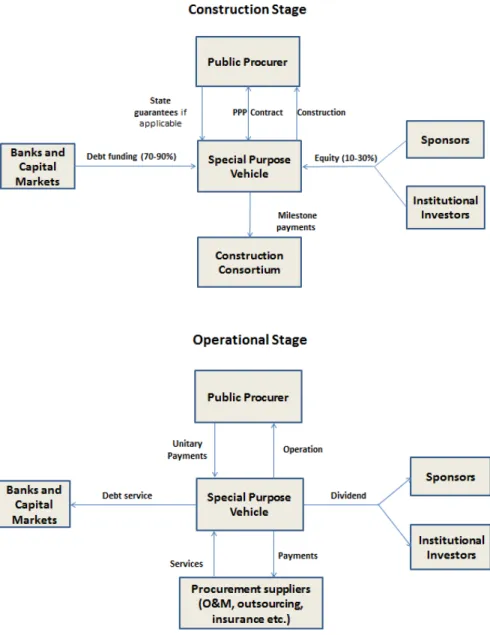
The public procurer has to make unitary payments which are initiated with the start of the operational stage, to the private contractor (Leidinger and Prien, 2010). On the other hand, the SPV needs to make milestone payments to the construction consortium during the construction stage, and payments to suppliers and investors to reward their capital commitment during the operational stage (cf. Figure 1).
On top, the government can provide different forms of guarantees to bear some downside risk of the PPP. With the onset of the financial crisis, the use of guarantees has become more prevalent and varied in nature (EPEC, 2010).
Figure 1: Overview of Project Finance in PPPs during the construction and operational stage
13
5.2 THE CONCEPT OF FORFAITING WITH A WAIVER OF CLAIMS IN PPPS
Forfaiting which is mainly used in trade finance is an agreement under which “an exporter surrenders ownership of export receivables by selling them at a discount to a forfaiter (financial institution/bank etc.) in exchange for cash” allowing exporters to maximize cash flow and eliminate inherent payment risk (Lütschg, 2004, p. 27).
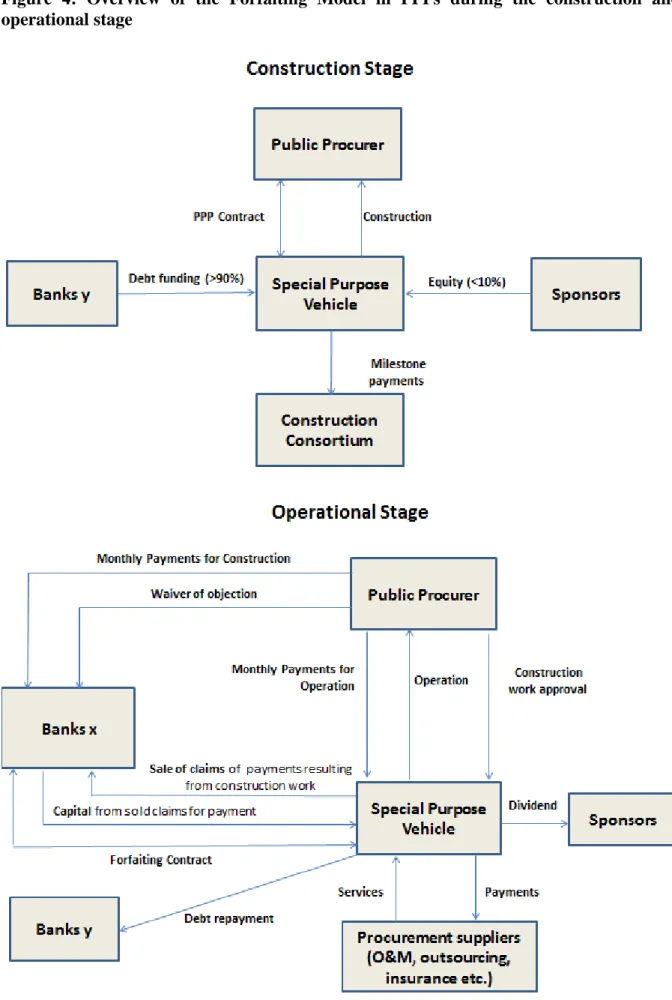
Transferred to PPPs, forfaiting involves the sale of claims2, namely the private contractor’s receivables resulting from the PPP contract with the public procurer, to a bank which consequently has to collect unitary payments from the public partner (Weber et al., 2004). Forfaiting in PPPs is combined with a waiver of claims (also called waiver of objection) which is an agreement specifying that the public procurer waives its right to reduce or suspend the unitary payments in case of deficient performance by the private contractor (Daube et al., 2008). Functioning like a guarantee, the waiver of claims allows credit conditions close to those of municipal loans. However, the actual forfaiting transaction is only set up during the post-delivery stage as shown in Figure 2.
Figure 2: PPP life-cycle financing under Forfaiting
Source: own exhibit
Looking at the whole-life-cycle of the PPP, the debt is provided by a bank (or bank syndicate) to the private contractor as an interim loan for construction at the beginning of the project (Leidinger and Prien, 2010). The interim loan is replaced by forfaiting financing with the beginning of the operation phase.
Figure 3 summarizes the steps involved in financing PPPs under forfaiting. First, after
construction completion the public procurer needs to approve the private contractor’s
14
construction work, as the payment obligations of the public procurer to compensate the private contractor for his construction work only arise after approval of the facility (Weber et al., 2004). The payment obligations are, however, sold to a bank as specified above. With the money received by the sale of claims the private contractor pays back the interim loan (Leidinger and Prien, 2010).
However, only part of the receivables belonging to the private contractor is sold on à-forfait bases (so called Teilforfaitierung), namely the receivables for construction (Weber et al., 2004). Receivables arising from the maintenance during the operation phase are excluded, as it would be impossible to reduce unitary payments in case the private contractor breaches contractual agreements during the operation phase (Weber et al., 2004).
Hence, the public procurer pays the unitary payments related to the construction work to the bank, whereas unitary payments resulting from the operation contract is directly paid to the private contractor. As under PF, the SPV needs to make milestone payments to the construction consortium and pay suppliers etc. for their services during the operational stage (cf. Figure 4).
Figure 3: Steps involved in a PPP Forfaiting transaction
Source: Adapted from Weber et al. (2004) and Leidinger and Prien (2010); debt can be sold to the bank financing the interim loan or to another bank
15
Figure 4: Overview of the Forfaiting Model in PPPs during the construction and operational stage
Source: Adapted from Weber et al. (2004) and Leidinger and Prien (2010); debt can be sold to the bank financing the interim loan or to another bank
16
5.3
R
ISK ALLOCATIONSThere are various types of risk involved in PPPs. Some risks are retained by the public procurer, whereas other types of risk are transferred to the private contractor, or are shared between both parties (Sarmento and Rennebog, 2014a).
In general, PPPs are characterized by a transfer of risk to the party which is best able to manage it (Grimsey and Lewis, 2005). In PF banks bear credit risk during the whole life cycle, as PF is characterized as off-balance sheet financing with limited recourse to shareholders and high leverage (Gatti, 2008). In exchange for bearing risks, banks impose tight discipline on management through contracts, oversight, and regular debt service payments (Esty, 2004). Accordingly, banks set up an extensive due diligence which includes technical, financial, legal and market due diligence, and implement a comprehensive project monitoring over the life cycle of the loan period informing about any impending or existing performance dysfunctions and allowing to react accordingly (Weber et al., 2004).The project company needs to provide, next to equity, certain guarantees such as pledges (bank deposits, sponsor’s equity stake), Step-in-Rights as well as reserve accounts, and has to comply with certain financial ratios (Leidinger and Prien, 2010). With these instruments banks make sure that sponsors share the risks. This ultimately incentivizes sponsors to maximize the project’s performance. Next to certain types of risk3, the risk of the public partner is based on the likelihood of the private contractor’s bankruptcy or contract termination, as the public partner faces additional cost in case of occurrence resulting from the new tendering process or eventual higher unitary payments (Leidinger and Prien, 2010).
In contrast, under the scope of forfaiting banks will only bear risk during the construction phase, as the private partner pre-finances the construction stage (Weber et al., 2004). Accordingly, the bank’s risks comprise the solvency risk of the project company and the risk of completion. Therefore, due diligence is only conducted by the banks for the planning and construction phase (Leidinger and Prien, 2010). During the operation phase there is only a small risk transfer from the public partner to the private contractor due to the waiver of claims (Leidinger and Prien, 2010). As the public partner needs to fulfill payment obligations for the bought receivables independently from the private contractor’s performance, it is the public partner that stays with a big part of risk (Weber et al, 2004). To limit this risk additional
3 There is extensive literature on which risk should be borne by which party. Risk differs depending on the
17
securities, next to equity, are implemented to guarantee an appropriate performance of the private contractor. The security approach and instruments used can be the same as mentioned under PF, however, the implementation of reserve accounts has not been common practice so far (Leidinger and Prien, 2010). Since banks do not require an equity stake of the sponsors (cf. 5.4), public authorities need to make sure that enough equity is provided to involve the private partner in risk sharing (Weber et al, 2004).
Even though a variety of methods is used to involve the private partner in risk sharing under forfaiting, no optimal risk allocation can be achieved, leaving the public partner with a major part of risk (Leidinger and Prien, 2010; Weber et al., 2004). However, compared to traditional procurement forfaiting offers improvements in risk transfer, as the waiver of objection is only issued after the construction approval transferring the risk of timely and proper construction of the asset to the private partner (Leidinger and Prien, 2010).
5.4
C
APITAL STRUCTUREUnder both models the high capital investment phase is mostly financed with debt making PPPs highly leveraged projects. However, the degree of leverage for PF is reported differently in literature. In PF debt usually amounts to 60-90% of provided financing but can be above 90% depending on the risk structure (Weber et al., 2004). Depending on the type of projects, Yescombe (2007) states that a debt/equity ratio (D/E) of 80% is appropriate for an infrastructure project with usage risk (e.g. toll road). As leverage varies by project sector, Esty (2004) specifies the average D/E for PF amounts to 70%. Nevertheless, banks require an equity stake to cushion possible cuts in unitary payments in case of the private contractor’s bad-performance. The provision of equity is, as mentioned above, a risk management instrument and furthermore a mean to link the sponsors to the success of the project to ultimately maximize their performance. For most, the equity stake depends on the riskiness of the project, the sustainability of the cash flows and the guarantees provided (Weber et al., 2004).
Under forfaiting debt of the project frequently exceeds 90% (Weber et al., 2004). The equity stake is low, as there are no equity requirements for municipal loans4 under German law5 (Partnerships Germany, 2010). The biggest part of equity is however quasi-equity in form of
4 Financing conditions of forfaiting close to the ones of municipal loans cf. 5.2
18
mezzanine capital (subordinated shareholder loans) (Weber et al., 2004). As explained before, equity can be provided by sponsors or financial investors. However, the involvement of financial investor is not constructive under forfaiting, as equity stakes are quite small and usually comprised by mezzanine capital (Weber et al., 2004).
5.5
F
INANCING COSTS AND CONDITIONSAs PPPs are mostly financed through debt under both methods, borrowing costs have a high impact on total financing costs. However, costs differ considerably, due to the fact that banks base credit conditions on the solvency of the project company under PF and on the public procurer under forfaiting (Weber et al., 2004).
Substantial costs for the debt raised under PF include the following: interest, cost of hedging, commitment and arrangement fee as well as documentation and processing fee (Weber et al., 2004). For both models the interest rate of the debt is composed of the reference interest rate (ISDAFIX6) and a project specific spread which is dependent on the risk structure of the project. Interest rates can be variable or fixed respectively fluctuating in a pre-determined interval (Weber et al., 2004). However, under PF in PPPs bank loans mostly have floating interest rates. Depending on the riskiness of the project the interest spread varies between 90 bps and 130 bps for the construction phase and between 80 bps and 140 bps for the operation phase for PF in Germany (Weber et al., 2004). However, rates increased with the start of the financial crisis (cf. 5.7). Besides, due to intense project monitoring and due diligence in PF, transactions costs are high and transaction times are long. As the due diligence has to be done independently of the project’s volume, transaction costs are rather fixed (Weber et al., 2004).
Under forfaiting the bank assesses the solvency of the private contractor for the interim loan but bases its financing conditions for the long-term financing of the project on the creditworthiness of the public procurer due to the waiver of objection (Leidinger and Prien, 2010). Therefore, advantageous financing conditions which are close to those of municipal loans can be obtained for the long-term financing of the project (Leidinger and Prien, 2010; Weber et al, 2004). The cost of debt is less comprehensive and includes interest, cost of hedging and a structuring fee (Weber et al., 2004). Depending on the riskiness of the project
6
To display long-term refinancing costs of banks the ISDAFIX became the leading reference interest rate in Germany. It is the leading benchmark for fixed rates on interest rate swaps set up by the International Swaps and Derivatives Association
19
the interest spread varies between 20 bps and 50 bps7 for both the construction and operation phase (Weber et al., 2004). Increasing rates are also observed under forfaiting with the start of the financial crisis (cf. 5.7). As due diligence and project monitoring are less extensive, transaction time and cost are low (Weber et al., 2004).
In PF credit periods are usually aligned to the duration of the project. Therefore, credit periods of 20 to 25 years, on special occasions also longer, are feasible. Nevertheless, lenders usually insist that loans are to be reimbursed 2 to 5 years before the termination of the contract leaving a so-called Tail. In PF credits until 25 € M are frequently provided by just one bank, whereas higher financing requirements are usually provided by a syndicated loan. In comparison, within the framework of forfaiting banks are more willingly to fix the interest reference rate over the whole credit period. Moreover, banks are more likely to match the lenders’ terms to the life-cycle period of the project accordingly abstaining from a Tail. (Weber et al., 2004, pp. 34-36, 58)
5.6
P
AYMENTS FOR OBTAINED FINANCINGAs banks oblige borrowers to repay their debt, payments have to be prompted to service the project company’s debt obligation. Under both models the public partner usually pays for the services provided by the private party. Though, until the approval of construction the public partner has no immediate payment obligations under either method (Weber et al., 2004). Accordingly, if the project fails in the construction phase, assets of the project company are used to repay the interest and principal for construction (Leidinger and Prien, 2010).
Under PF the public partner makes its unitary payments to the project company (cf. 5.1). The reimbursement of the obtained financing used for construction is ultimately done by the generated cash flows of the project company. Payments to the SPV are based on performance and can therefore be cut in case of bad performance according to the bonus-/ malus clauses specified in the PPP contract (Weber et al., 2004; Leidinger and Prien, 2010). In contrast, the private partner also has the opportunity to obtain a bonus for certain achievements.
In comparison, under forfaiting the private contractor collects the public procurer’s payment obligation resulting from construction by selling the latter to a bank. The collected money is
20
used to repay the debt (cf. 5.2). In turn the bank becomes the creditor of the public partner who has to make unitary payments for construction to the bank which bought the sold claims. Due to the waiver of claims payments need to be done independently of the service quality of the private contractor. Though, this applies only to the payments resulting from construction for which a waiver of claims has been issued. Accordingly, unitary payments for operation which go directly to the project company can be cut, since the same bonus-/ malus agreements apply, just as under PF (Weber et al., 2004).
5.7
F
INANCIAL CRISISThe increase in financing costs affected both models during the financial crisis. This sub-chapter analysis is based on Partnership Germany’s (2010, pp. 31-62) analysis about the consequences of the financial crisis on PPPs in Germany.
With the break-down of interbank lending credit margins started to increase significantly. An overview of the financing costs before and during the financial crisis for both models is shown in Table A2 (in Appendix). Especially the market for PF was hit hard. Margins of about 350 bps above the reference interest rate were observable for projects in PF in 2009. Moreover, liquidity costs as well as fees such as for arrangement and commitment rose. Financing cost reached a critical level, and PPPs were often not advantageous to public procurement any more. Financing volumes under PF have been reduced significantly due to the collapse of the syndication market and consequent establishment of “club deals” under which banks only make a promise for their part of the financing. As the risk aversion of banks increased, complex PPP projects with market risks were very hard to implement. On top of that, the number of banks offering PF decreased considerably. Banks switched from long term to mini-perm8 lending, especially for projects out of Germany. In general, short commitment periods for financing proposals became a big issue, since changing financing conditions before financial closure result in further assessments and therefore transaction cost and time. On top, a drop in investment volumes for PF arrangements has been observed during earlier crises as well. Several crises in the late 1990s and early 2000s such as the Asian and Russian crisis dramatically reduced total investment (Esty, 2004).
8 Mini-perm structures have been introduced for project finance because of the low long-term financing
liquidity during the financial crisis. Mini-perms are intended to be refinance after a short-term period of 5-7 years.
21
Under the scope of forfaiting an increase in liquidity costs as well as an increase of loan margins ranging between 40 bps and 100 bps was observable. However, German municipal loans were also facing increasing margins of 30 bps to 50 bps. No big issues have been faced to place big financing volumes or loan periods for over 20 years, and the bank’s risk aversion did not change under the scope of forfaiting.
In summary, both models were hit by the financial crisis. However, consequences are lower for forfaiting due to its municipal loan financing conditions. Even though forfaiting’s financing margins are not as low as during pre-crisis times, projects are economically feasible while not all projects financed by PF are advantageous to public procurement during crisis.
5.8
M
AINF
INDINGSTo increase the competitiveness of PPPs private bidders seek to reduce the financing costs with well-thought-out financing structures (Weber et al., 2004). PF and forfaiting are both characterized by differing risk allocations and financing costs. Financing PPPs with forfaiting offers favorable financing conditions close to those of municipal loans. These improved financing conditions come at the expense of the public procurer who has to take back risk which should be transferred to the private contractor according to the PPP concept (Weber et al., 2004). Forfaiting remained to be a feasible financing model during the financial crisis, since credit conditions worsened to a lower extent. Summarizing the most important points of the previous analysis, Table 1 provides an overview about the differences between PF and forfaiting.
22
Table 1: Differences of Project Finance and Forfaiting
Point of comparison Project Finance Forfaiting
Risk allocation high level of risk allocation low level of risk allocation
Risk for the banks, public and
private partner comparing the two models
banks: high
private partner: moderate public partner: low
banks: low private partner: low to moderate public partner: high
Leverage
high level: 60-90% or even higher than 90%
(Weber et al., 2004)
70-90% (Esty, 2004)
extremely high level: > 90% (Weber et al., 2004)
Debt guarantees
complex security system using different instruments such as pledges, Step-in-Rights, reserve accounts
less complex security system, no reserve accounts
Due diligence extensive due diligence by banks low degree of due diligence by
banks Transaction costs and
time
high due to extensive screening of project by banks
low due to low degree of due diligence by banks
Equity investors
low number of sponsors according to Esty (2004) limited to one to three, financial investors
low number of sponsors, no financial investors
Financing costs
high including: interest, cost of hedging, commitment and arrangement fee, documentation and processing fee
low including: interest, cost of hedging and a structuring fee
Interest rate spread9
spread varies between 90 bps and 130 bps for the construction phase and between 80 bps and 140 bps for operation phase in Germany (Weber et al., 2004)
spread varies between 20 bps and 50 bps for construction and operation phase in Germany (Weber et al., 2004)
Financing conditions
inferior financing conditions (floating interest rate, no match of debt maturity and project duration)
good financing conditions (rather fixed interest rate, match of debt maturity and project duration) Payments by the public
partner in case of bad or non-performance
can be cut according to bonus/malus agreements in the contract
cannot be cut for construction services but for other receivables which are not sold to the bank Impact of the financial
crisis
big impact on financing conditions, projects often not feasible
lower impact on financing conditions, projects still feasible Source: own exhibit
23
5.9
A
DVANTAGES ANDD
ISADVANTAGES OF BOTH MODELSFrom the current analysis in chapters 5.1 to 5.8 advantages and disadvantages can be derived. They are presented from the viewpoint of the public partner, as it is their responsibility to make the decision about entering a PPP and ultimately deciding about financing.
One of the main advantages and main characteristic of PF is the transfer of risks to the party which is best able to manage it which in consequence leads to an improved risk allocation. Hence, most of the risks are transferred to lenders and the private party, since debt has to be repaid with the generated cash flows of the project company. Further advantages are prevailing incentive mechanisms such as the private contractor’s obligation to provide equity and bonus/malus agreements increasing the effort of the private partner to maximize the project’s performance. As banks bear risks under PF, they conduct an extensive due diligence and project controlling examining and guaranteeing the feasibility of the project. Lastly, a more comprehensive security system such as the provision of reserve accounts demanded by the bank further improves the sustainability of the project.
However, a main disadvantage of PF over forfaiting is worse financing conditions including higher financing costs. Moreover, extensive due diligence involves high transaction cost and time. Even though a more comprehensive security system assures the sustainability of the project, it also increases the complexity of it. Lastly, a main disadvantage is PF’s variability during times of crisis. The analysis showed that worsened credit conditions during the financial crisis clearly degraded the PPP alternative under PF compared to public procurement.
In contrast, low financing costs can be derived to be forfaiting’s main advantage. Low borrowing as well as transaction costs can be obtained, as banks base credit conditions on the solvency of the public authority and only conduct limited due diligence. Moreover, better financing conditions are provided by lenders due to the fact that these are based on the solvency of the public partner. Hence, it is more likely that interest rates are fixed allowing for more adequate planning and calculus. On top, a match of project duration and credit term lead to reduced unitary payments, as they are stretched out over the remaining life-cycle of the projects (Weber et al., 2004). Another advantage is the inherent low transaction time leading to a shorter procurement process. In conjunction with a lower security system
24
forfaiting is clearly less complex and more flexible. A further main advantage is the method’s sustainability during crisis.
Nevertheless, the low financing cost under forfaiting comes at the expense of a low risk transfer. Only little of the risk is transferred to the private contractor leaving the public authority with a big part of risk. Unitary payments for construction have to be made independent of the private partner’s performance. Moreover, no extensive due diligence and project controlling is conducted by the banks leaving the public partner with the responsibility of committing own resources in order to prove and guarantee the feasibility of the project resulting in additional costs for the public procurer (Weber et al., 2004). Forfaiting misses central incentive mechanisms to increase the private contractor’s performance due to the waiver of claims (Braune, 2006). Lastly, forfaiting is not an appropriate model for financial investors due to the extremely low stake of equity (Weber et al., 2004). Table A3 (in Appendix) provides an overview of the described advantages and disadvantages.
CHAPTER
6:
STATISTICAL
ANALYSIS
OF
FINANCING
MODELS
IN
GERMANY
6.1
M
AINR
ESULTSSo far, the study has looked at the two different financing models in more detail. The following chapter aims to find out, if the financial crisis is a driver for a potential increase in financing PPPs under forfaiting in Germany. It is further intended to identify the magnitude of a potential shift from forfaiting to PF. Therefore, with the help of data provided by the Federation of the German Construction Industry quantitative analysis was conducted to observe characteristics and the development of PPP financing in building construction in Germany.
The sample period comprises 164 PPPs awarded between January 2002 and June 2013. Table
A4 (in Appendix) provides an overview of the distribution of forfaiting and PF in terms of
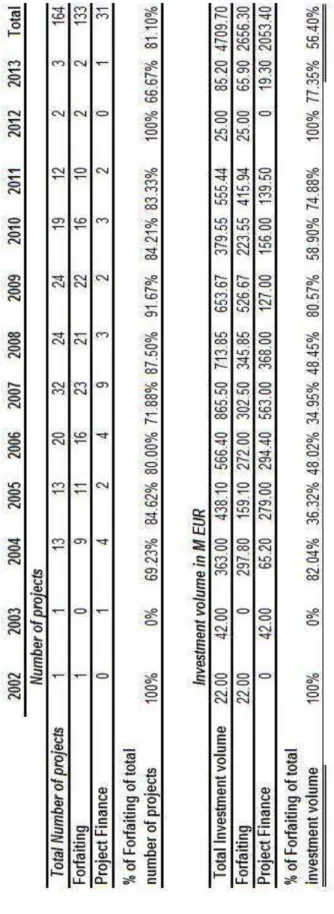
number of projects and investment volume. Out of the 164 projects, 133 were financed by forfaiting whereas only 31 were financed by PF. The investment volume, totaling 4,709.7 € M overall, adds up to 2,656.3 € M under forfaiting and to 2,053.4 € M under PF. There has been
25
an obvious decrease in the number of PPP projects since 2008. Doubtlessly, more projects have been financed by forfaiting than by PF, especially since 2007.
Table A5 (in Appendix) presents the descriptive statistics of the sample. The average
investment volume amounts to 28.72 € M for the whole sample and to 66.24 € M respectively to 19.97 € M for PF and forfaiting. The smallest investment volume adds up to 1 € M, whereas the maximum amounts to 258 € M. 81% of the projects have been financed by forfaiting. The standard deviation for the investment volume amounts to 40.51 € M.
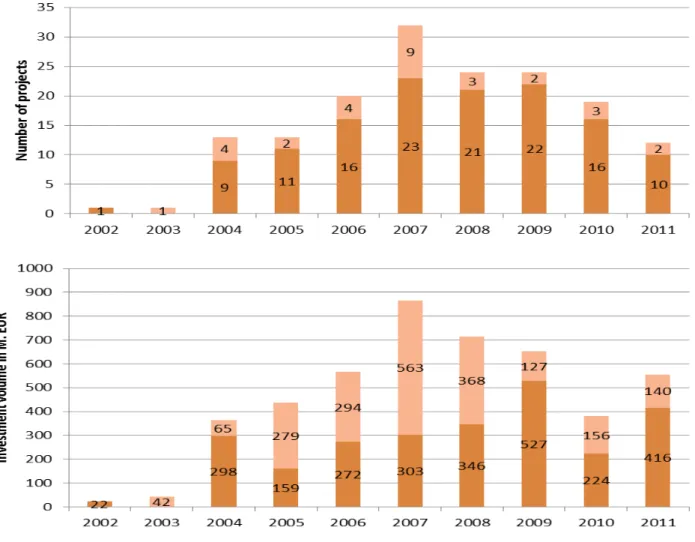
Graph 1: Yearly distribution of Forfaiting and Project Finance in Germany
26
Graph 2: Yearly share of Forfaiting based on the total number of projects and investment volume
Source: own exhibit
Graph 1 clearly shows that most of the PPPs in building construction are financed by
forfaiting. 2007 is the year with the highest number of projects financed by PF (9 projects). This is in line with the observations from Daube et al. (2008) who observed an increase in PF in the beginning of 2007. However, from 2008 on, the percentage of forfaiting of total projects increased remarkably, up to 91.67% in 2009 (Graph 2). Even though the share of forfaiting of total number of projects is high, there is a noticeable difference in distribution between the number of projects and investment volume. For the whole sample, 81.1% of the projects have been financed using forfaiting, whereas only 56.4% of the total investment volume is derived by forfaiting.
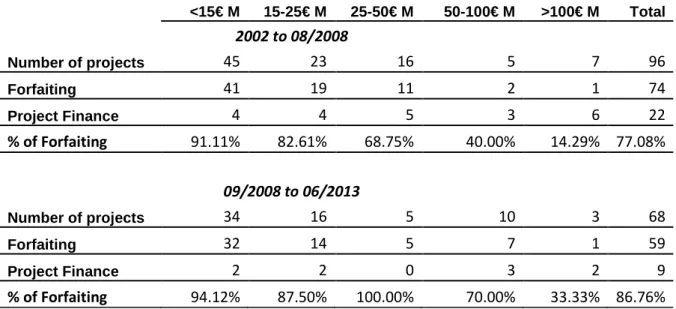
Connected to these findings, looking at different investment volume ranges in Table A6 (in Appendix) it can further be proved that forfaiting is mainly used for very small projects and primarily for projects below 100 € M. Projects below 15 € M have been financed by forfaiting in 92.41% of the cases. This share is continuously decreasing with a rising investment volume of the projects. Projects higher than 100 € M have only been financed by forfaiting in 20% of the cases.
27
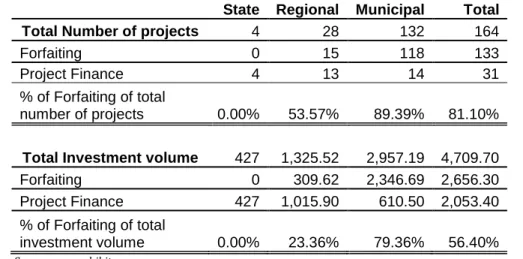
Looking at Table 2 it is further striking that all projects realized by the German State have been financed by PF, whereas 54% of regional and 89% of municipal projects have been financed by forfaiting. Again, the share of forfaiting of the total number of projects is noticeably higher than the share of forfaiting of total investment volume (23% respectively 79% for regional and municipal projects). However, only 4 projects have been implemented on the State level compared to 28 and 132 PPPs on the regional respectively municipal level.
Table 2: Distribution of Forfaiting and Project Finance for the three governing levels in Germany
State Regional Municipal Total
Total Number of projects 4 28 132 164
Forfaiting 0 15 118 133
Project Finance 4 13 14 31
% of Forfaiting of total
number of projects 0.00% 53.57% 89.39% 81.10%
Total Investment volume 427 1,325.52 2,957.19 4,709.70
Forfaiting 0 309.62 2,346.69 2,656.30
Project Finance 427 1,015.90 610.50 2,053.40
% of Forfaiting of total
investment volume 0.00% 23.36% 79.36% 56.40%
Source: own exhibit
6.2
S
AMPLE SPLIT ANALYSISIn order to observe a potential shift to forfaiting since the beginning of the financial crisis the sample was split in two periods taking the bankruptcy of Lehman Brothers in 2008 as a reference point. The first period comprises projects awarded between 2002 and August 2008 (before the financial crisis), whereas the second period comprises projects awarded between September 2008 and June 2013 (after the financial crisis).
Table A7 (in Appendix) shows the distribution of forfaiting and PF for the two sample
periods. During the period before the financial crisis a total of 96 projects were set up out of which 74 were financed by forfaiting and 22 by PF. On the contrary, the sample period after the financial crisis comprises 68 projects, 59 financed by forfaiting and 9 by PF. The total investment volume for the first period adds up to 2,900.75 € M. Out of the total 1,339.15 € M was raised under forfaiting and 1,561.60 € M under PF. The total investment volume for the
28
second period declined to 1,808.95 € M. Capital raised under forfaiting adds up to 1,317.15 € M but only to 491.80 € M for PF.
Table A8 (in Appendix) shows the descriptive statistics for the two periods. The average
investment volume amounts to 30.22 € M for the first period as well as to 70.98 € M and 18.10 € M for PF respectively forfaiting. Compared to the second sample period the average investment volume decreased to 26.60 € M and to 54.64 € M for PF projects. On the contrary, the average investment volume increased to 22.32 € M for forfaiting. Moreover, the maximum investment volume before the financial crisis amounts to 258 € M respectively to 196.1 € M after it. The standard deviation of investment volume decreased from 45.10 € M to 33.12 € M.
Looking at the share of forfaiting for the number of projects and investment volume in Graph
3 one can notice that 86.76% of the projects were financed by forfaiting after the outburst of
financial crisis. This is an increase of 12.56% (Table A7 in Appendix). On top, the percentage of forfaiting regarding investment volume increased remarkable 57.72% to 72.81% for the second period. At the same time the percentage of financing by PF decreased by 42.25% from 22.92% to 13.24% % (Table A7 in Appendix). Looking at the share of PF financing in terms of investment volume it decreased by 49.50% from 53.83% to 27.19%.
Graph 3: Share of Forfaiting based on total number of projects and investment volume
Source: own exhibit
Moreover, Table 3outlines the different investment volume ranges for the two periods under observation further highlighting that after the outburst of the financial crisis forfaiting was