HOW TO DESIGN A MEASURABLE
SHARED VALUE STRATEGY:
THE CASE OF COCA-COLA BRAZIL
Stefan Schneider
152114189Dissertation submitted in partial fulfillment of requirements for the degree of Int. MSc in Management at Universidade Católica Portuguesa
ADVISOR: Susana Frazão Pinheiros June 2016
2
Acknowledgements
Considering this thesis the final stage of my studies, I want to thank my parents before anyone else for having the opportunity to be at this stage. Thank you for always putting my wellbeing first and making my life easy, for all the sacrifices you have made, for giving me all the support you have, in my studies and beyond, both mentally and financially, for trusting me and believing in all of my plans, as absurd as they sometimes might be, and above all, for showing me how much I matter to you.
I want to thank my father who has taught me the values and principles that have guided me in all aspects of life. I want to thank my mother for her love and selflessness and for teaching me that not everything in life should be taken seriously. Thank you for all the things you do, day-in and day-out, which you do not even consider as thday-ings needday-ing thanks.
Danke Mama und Papa.
Abstract
This dissertation in form of a case study discusses the concept of Creating Shared Value (CSV), a management strategy focused on creating business value by identifying and addressing social issues, which is seen by many as an evolution of Corporate Social Responsibility (CSR). The main focus of this study is set on the development of a measurable shared value strategy. The case of Coca-Cola Brazil in the year 2008, when the company took the decision to develop a strategy to target the country´s low-income group, shall be used to illustrate the process of creating a successful measurable shared value strategy. This case study is aimed at both undergraduate and graduate students in the field of business taking a view at several areas such as strategy and social responsibility. In addition to the case study itself, this dissertation provides an extensive literature review and detailed teaching notes, which serve as a roadmap when using the case study for teaching purposes. The objective of the case study at hand is threefold: First, to teach how to develop a feasible, measurable shared value strategy. Second, to raise awareness about the opportunities of CSV and to show that addressing social needs is far from being a mere philanthropic activity, but rather a great source of competitive advantage. Third, the case study shall serve as a means for students to develop a stronger social mindset in their future careers.
4
Resumo
Esta dissertação na forma de um estudo de caso discute o conceito de Criação de Valor Compartilhado (CSV), uma estratégia de gestão focada na criação de valor económico através da identificação e tratamento das problemas sociais, o que é visto por muitos como uma evolução da Responsabilidade Social Empresarial (RSE). O foco principal deste estudo é definida no desenvolvimento de uma estratégia mensurável de valor compartilhado. O caso de Coca-Cola Brasil no ano de 2008, quando a empresa tomou a decisão de desenvolver uma estratégia para atingir o grupo de baixa renda do país, deve ser utilizado para ilustrar o processo de criação de uma estratégia de valor compartilhado mensurável bem-sucedida. Este estudo de caso é destinado a estudantes de graduação e pós-graduação na área de negócios, tendo uma vista em várias áreas como estratégia e responsabilidade social. Além do estudo de caso, esta dissertação fornece uma extensa revisão da literatura e notas de ensino. O objetivo deste estudo de caso é triplo: Primeiro, para ensinar como desenvolver uma estratégia viável e mensurável de valor compartilhado. Em segundo lugar, para aumentar a conscientização sobre as oportunidades de CSV e mostrar que lidar com as necessidades sociais está longe de ser uma mera atividade filantrópica, mas sim uma grande fonte de vantagem competitiva. Em terceiro lugar, o estudo de caso deve servir como ferramenta para os alunos a desenvolver uma mentalidade social mais forte em suas futuras carreiras.
Table of Contents
Introduction ... 7
Context ... 7
Aim and Purpose ... 7
Literature Review ... 8
The Concept of CSV ... 8
Reactions and Opinions about CSV ... 11
From CSR to CSV ... 12
Similarities between CSV and CSR ... 13
Differences between CSV and CSR ... 13
The Importance of Measuring Shared Value ... 14
Difficulties of Measuring Shared Value ... 17
Challenges of putting CSV into practice ... 17
Methodology ... 19
Case Study ... 19
Case Introduction ... 19
Brazil: Society, Culture and Economy ... 20
The rising middle-class ... 21
Coca-Cola Brazil ... 25
History ... 25
The “Live Positively” Platform ... 26
The Coca-Cola Brazil Foundation ... 29
After the meeting ... 30
Teaching Notes ... 31
Purpose ... 31
Target Audience ... 31
Case Summary ... 32
Relevant Theory ... 33
Suggested Discussion Questions ... 34
Conclusion ... 40
Limitations & Future Research ... 41
Bibliography ... 43
6
List of Figures and Tables
Figure 1 – Creating Shared Value ... 9
Figure 2 - Integrating Shared Value Strategy and Measurement ... 10
Figure 3 - Social Classes in Brazil ... 22
Figure 4 - The Burgeoning Middle of the C, D, and E-Class ... 24
Figure 5 - Youth Unemployment Rate (age 15-24) in 2003-2008 ... 24
Figure 6 - The "Live Positively" Platform ... 27
Figure 7 - Coletivo Retail ... 37
Figure 8 - The Coletivo Platform ... 40
Table 1 - Levels of Shared Value ... 10
Table 2 - Differences between CSV and CSR ... 34
Introduction
Context
In the last decades sustainability and social responsibility have been devoted an increasing degree of importance among society, along with a rising concern about environmental protection and the wellbeing of employees and community. Over the years, the role of the government of setting social and environmental objectives in the business sector has shrunk, assigning an increasing responsibility to corporations that no longer can act as isolated economic entities operating in separation from broader society. As a consequence, more and more companies are involved in activities to improve their social footprint, which has promoted the evolution and presence of concepts like Corporate Social Responsibility (CSR) and Creating Shared Value (CSV).
The concept of CSV officially dates back to the year 2011 when Michael Porter and Mark Kramer published the article “Creating Shared Value – How to Reinvent Capitalism and Unleash a Wave of Innovation and Growth”. This article builds on the previous findings of Porter and Kramer in the area of strategic CSR and has enjoyed great popularity ever since. What distinguishes CSV from CSR is that a company´s effort to address social needs is no longer seen as mere philanthropy. It is directly linked to economic improvements and integral to profit maximization. As one of the world´s leading nutrition companies, Nestlé shows a credible example of implementing CSV, demonstrating the creation of shared value in several of its activities. One area that the company focuses its CSV activities on is nutrition: by developing nutritious products that provide real health benefits to consumers and by making them more affordable through innovation and partnerships, Nestlé has been able to increase its presence and target new markets.
Aim and Purpose
This dissertation in form of a case study discusses the concept of Creating Shared Value, which in many parts of the business world has been greatly embraced and is seen by many as an evolution of Corporate Social Responsibility (CSR). Particular attention is devoted to the creation of a measurable shared value strategy. The case of Coca-Cola Brazil in the year 2008, when the company intended to develop a strategy to target the country´s low-income group, shall be used to illustrate the process of creating a measurable and feasible shared value strategy. This case study is aimed at both undergraduate and graduate students in the
8 field of business taking a view at several areas such as strategy and social responsibility. The objective of the case study at hand is threefold: First, this case study aims to teach how to develop a measurable shared value strategy. Oftentimes, companies plan CSV strategies, but fail to set up the appropriate metrics for measurement or address the wrong or too many social issues. Second, the purpose is to raise awareness about the opportunities of CSV and to show that addressing social needs is far from being a mere philanthropic activity, but rather a great source of competitive advantage. Third, this work should serve as a means for students to develop a stronger social mindset in their future careers.
Literature Review
In this chapter the concept of CSV and its main characteristics are explored. The literature review provides fundamental knowledge about how shared value can be created and how to design an effective and measurable strategy. First, the definition of CSV along with the three dimensions of how shared value can be created is presented. Then, reactions and opinions about CSV are discussed. After that the similarities and differences between CSV and CSR are analyzed. The next section focuses the measurement of shared value. Finally, this chapter ends with a discussion about the challenges of putting CSV into practice.
The Concept of CSV
The general assumption of the concept of CSV is to integrate a social mission in the corporate culture directing resources towards the development of innovations to tackle problems in society (Pfitzer, Bockstette, & Stamp, 2013). Porter and Kramer (2011) define the concept of CSV as “policies and operations that enhance the competitiveness of a company while simultaneously advancing the economic and social conditions in the communities in which it operates”. They argue that social engagement has a positive influence on its competitiveness if its well embedded in the corporate strategy and based on its profitability. Moreover, Porter and Kramer (2011) put an emphasis on the fact that CSV is to a great extent data driven, which allows adequate tracking of the social and economic outcomes with clear metrics, and ensures that all activities are in line with the set objectives. Figure 1 illustrates how the creation of social value and business are interrelated.
Figure 1 – Creating Shared Value
Adapted from Creating Shared Value. Bockstette and Stamp, 2012.
According to Porter and Kramer (2011) the concept of CSV is structured into three dimensions through which the creation of shared value can be accomplished. Together these dimensions form a virtuous cycle of creating shared value where all three are interlinked. Any progress in value in one dimension will lead to new opportunities for improvement in the others:
First dimension - Reconceiving products and markets:
By accessing new markets, better serving existing ones or driving down costs by developing innovative solutions companies can address social needs. In more advanced economies there is an increasing demand for products and services that meet societal needs, where the development of new products in various industries can solve social issues. In non-traditional markets there are various new business opportunities by serving disadvantaged communities and developing countries. General Electric with its Healthymagination program, for instance, aims to address social needs by improving affordability and access to health care by developing 100 new products to reach this objective (FSG, 2014).
Second dimension - Redefining productivity in the value chain:
There exist several opportunities for shared value in increasing the productivity and efficiency of the value chain. Possible measures include improvements in logistics, decreased use of resources, optimized utilization of electricity, more efficient distribution, higher productivity of employees or a smart choice of location. Nestlé, for example, started to support dairy farmers in rural areas by providing workshops and a better infrastructure through which the farmers have been able to grow and make their operations more efficient. The benefit for
Creating Shared Value Investments in long-term business
competitiveness that simultaneously address social and
environmental objectives term business
ss social and
Creating Business Value Investments in long-term competitiveness Investments in long
Creating Social Value Investments that address social and environmental objectives
10 Nestlé is having a more reliable supply of fresh milk, which represents one of the company´s crucial resources (FSG, 2014).
Third dimension - Enabling local cluster development
The development of local clusters is reflected in the effort of firms to secure its competitive position by creating an economically stable regional community with reliable social suppliers, a proper road- and telecommunications network, and better access to talent. The development of clusters consists among others of supporting local suppliers, but also social projects in education and infrastructure (Porter and Kramer, 2011). The case of Cisco provides a good example of strengthening local clusters: in conjunction with NGOs and educational institutions the company created a network of almost 10,000 academies in 165 countries that provide cloud-based trainings for network administrators and developers. In this way, Cisco has been able to create educational opportunities, but also grow its recruitment base of skilled employees in high-growth markets(FSG, 2014).
Table 1 presents the three dimensions of CSV and the examples of results that are intended to be achieved in both business and society in the respective dimensions.
Table 1 - Levels of Shared Value
Adapted from Measuring Shared Value by Porter et al., 2012.
LEVELS OF SHARED VALUE BUSINESS RESULTS SOCIAL RESULTS
Reconceiving product and markets: How targeting unmet needs drives incremental revenue and profits • Increased revenue • Increased market share • Increased market growth • Improved profitability • Improved patient care • Reduced carbon footprint • Improved nutrition • Improved education Redefining productivity in the value chain: How better management of internal operations increases productivity and reduces risks • Improved productivity • Reduced logistical and operating costs • Secured supply • Improved quality • Improved profitability • Reduced energy use • Reduced water use • Reduced raw materials • Improved job skills • Improved employee incomes Enabling cluster development: How changing societal conditions outside the company unleashes new growth and productivity gains. • Reduced costs • Secured supply • Improved distribution infrastructure • Improved workforce access • Improved profitability • Improved education • Increased job creation • Improved health • Improved incomes
Reactions and Opinions about CSV
Michael Porter´s popularity has helped CSV gain a vast amount of attention in the business world, which Crane, Palazzo, Spence and Matten (2011) describe as the “Porter-effect”. Ever since, Porter and Kramer’s Harvard Business Review article has been used as a basic reference in related academic literature and, in the majority of cases, forms the basis of discussion. Nonetheless, one can assume that the positive reception of the article is not only due to Porter´s popularity. This is shown by an increasing number of companies like Nestlé, Novo Nordisk, BASF or Nike turning their attention to social issues and finding business opportunities to address them, creating shared value in the process.
While this new approach has been embraced predominantly positively, skeptical opinions have emerged in the same way. Opposed to all positive reactions, the negative critics about CSV can be categorized in two ways: on the one hand there are several scientists who criticize only single elements of CSV, while on the other hand some doubt the originality of Porter and Kramer´s approach in general.
The positive reactions are predominantly due to the fact that CSV elevates the importance of social objectives and puts them on an equal footing with the corporate strategy, but also the importance of calling on governments to establish appropriate conditions for social value creation (Crane et al., 2011). In addition, Beschorner (2013) highlights the redefinition of capitalism basing the corporate strategy more on human needs. As Porter and Kramer (2011) point out, shared value is “a more sophisticated form of capitalism”, in which “the ability to address social issues is integral to profit maximization instead of treated as outside the profit model.”
Fundamental arguments against CSV are in many cases based on the critique of particular elements or on criticizing the concept in general. The general critique can be traced back to the belief that operating a profitable business can hardly be aligned with the generation of a social footprint (Karnani, 2010).
The main criticism, however, is explained by how conflicts of interests between economic and social objectives are dealt with. Authors like Crane et al. (2011) and Aakhus and Bzdak (2012) argue that CSV ignores the tensions between economic and social goals and only highlights win-win outcomes, while neglecting “continuous struggles between corporations and their stakeholders about limited resources and recognition” (Crane et al., 2011).
12 Crane et al. (2011) are convinced that the concept of CSV neither guarantees compliance with the law and ethical standards, nor does it provide a stable foundation for an ethically responsible business strategy. Criticism is passed on the general assumption of CSV that legal and moral standards are provided. On an equal basis, Sadowsky (2011) expresses doubts about a company´s fundamental business model, questioning whether it is in the best interest of the planet or society. To underline this claim, Sadowsky relates to the case of General Electric in 2011 when the firm tried aggressively to minimize its taxes, while at the same time running its growth strategy “Ecomagination” which aims at enhancing resource productivity and reducing environmental impact (Guardian, 2011).
Porter and Kramer (2011) presented the concept of CSV as a new way of capitalism where businesses take economic advantage of meeting society´s broader social challenges, instead of merely acting as charitable donors. Society´s needs are large and growing, which is why company´s should begin addressing them and embrace the opportunities of benefitting from wider, positive social impact. Based on this reasoning, Porter and Kramer suggest a redefinition of the purpose of a company, which instead of making profits only, should create shared value. Crane et al. (2011) criticizes harshly the view of “redefined capitalism“, stating that CSV “does little to tackle any of the deep-rooted problems that are in the heart of capitalism´s legitimacy crisis”. Crane et al. explain that Porter and Kramer see the need of transforming business thinking but fail to mention the strategy models that need to be transformed. Instead, they merely present capitalism and CSR as issues that need to be fixed. With respect to CSV being compared to CSV, Elkington (2012) strongly disagrees with Porter´s view on CSR. In an article in which he reacts to Porter and Kramer´s article he disagrees with Porter who states that CSR is fundamentally about philanthropy and complying with the rules set by society, concluding that “CSR just hasn´t worked”. In turn, Elkington (2011) argues that CSV, in contrast to CSR, is not able to address more profound social issues like human rights, corruption or bribery, which is part of the reason why he is convinced that CSR should not be abandoned for the concept of CSV.
From CSR to CSV
In the opinion of many authors CSV is a concept that evolves from Corporate Social Responsibility. This section will elaborate on this view, investigating the similarities between the two concepts and, more importantly, its differences.
The work of Porter and Kramer provides a clear definition of the concept of CSV that has gained wide acceptance for the most part. CSR, in contrast, has a high number of deviating definitions that are difficult to summarize in a concise manner. When elaborating on CSR, it is necessary to distinguish between two different types: traditional CSR and strategic CSR (Porter & Kramer, 2006). Traditional CSR is primarily based on philanthropy and “doing good” with respect to society, but also on operating in line with stakeholders´ expectations (Porter & Kramer, 2006). As Friedman (1970) puts it, the exercise of social responsibility is “one way for a corporation to generate goodwill as a by-product of expenditures that are entirely justified in its own self-interest”, which is to increase its profits. Strategic CSR, in turn, intends to integrate its key social activities into the company´s strategy. While traditionally, CSR is rather seen as a typical corporate philanthropy, strategic CSR is no longer as a mere obligation towards society, but more as an opportunity for differentiation and a means to gain a competitive advantage (Porter & Kramer, 2006).
Similarities between CSV and CSR
Comparing the two concepts of CSV and CSR reveals various aspects of similarity. Both are based on being well integrated into the practice of an organization and pursue a long-term objective, which is to contribute to the company´s overall competitiveness. This aspect goes hand in hand with the second commonality, which is defined by the objective of the two concepts to both lead to social and economic benefits. On the one hand both concepts´ purpose is to improve the social conditions in the community in which an organization operates. At the same time, the implementation of either of the concepts follows the objective of contributing to the profitability of a company, though, in a different way, which will be explained in the following section.
Differences between CSV and CSR
Despite all facets that both concepts have in common, a number of explicit differences can be identified. Porter and Kramer illustrate multiple characteristics that distinguish CSV from traditional CSR. According to their theory, CSR is mostly used to elevate a firm´s reputation and is usually separated from the core business activities. Other critics even argue that CSR is merely a cover for otherwise harmful business practices (Brown & Knudsen, 2013). This
14 reasoning, however, downgrades CSR to traditional CSR and neglects the core idea behind strategic CSR.
Unlike CSR, CSV is not meant to be an additional functional activity of an organization, but more an integral part of the core business with the goal of promoting social activities using economic arguments (Porter & Kramer 2011). What essentially sets CSV apart from strategic CSR is the strict evaluation and measurement of shared value. The constant analysis of results and the setup of key performance indicators form an inherent part of the concept. The “rigorous evaluation results in improvements and, hence, positive social and economic outcomes can be achieved” (Porter & Kramer, 2011). For CSR, in turn, the quantification of results and its evaluation is not a central part. The strict measurement of results is strongly connected to the nature of the concept of CSV, which sets as a pre-condition a direct link between economic and social improvements. Strategic CSR aims at attaining economic benefits as a long-term objective of social initiatives, but does emphasize a direct linkage between social and economic results. Nevertheless, the above-mentioned differences are predominantly of theoretical nature. In practice, there may be difficulties in measuring the success of social results as will be discussed in the next section.
The Importance of Measuring Shared Value
The concept of Creating Shared Value is still in its infancy, yet, an increasing number of companies is generating shared value by employing economically viable business strategies while increasing their positive influence on society. Even though CSV has sparked various companies to embrace business strategies that generate tangible social benefits, best practices to apply the concept have not been developed yet. In spite of companies´ growing interest in deploying a CSV strategy, the majority lacks the necessary data to measure and optimize results, in order to quantify their social impact in relation to economic benefits. In this context, measuring the progress with respect to social goals, as well as the degree to which social performance and economic improvement are connected is key (Porter, Pfitzer, Hills, Patscheke, & Hawkins, 2012). The purpose of shared value measurement is to “unlock new value creation” (Hills & Pfitzer, 2013). As stated by Porter et al. (2012) the measurement of results of a CSV initiative represents a fundamental element of CSV and is essential to determine its success and to be able to take advantage of the opportunities for innovation, growth, and social impact at scale.
Not only for the company itself, but also for investors and corporate decision makers measurement forms a crucial aspect: oftentimes shared value initiatives are still seen as risky experiments, therefore evidence of both social and economic value creation is “needed to convince stakeholders of their strategic and commercial relevance” (Peterson, Pfitzer, Mazzuri, Wendel, and Hoosen, 2012). As Hills and Pfitzer (2012) highlight in their article, the purpose of measuring shared value is the quantitative evaluation of joint business and social value creation, so that new value creation can be unlocked and can be used by management as a reference to inform strategic decisions and resource allocation.
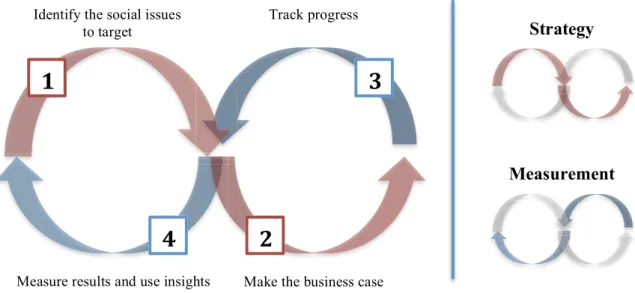
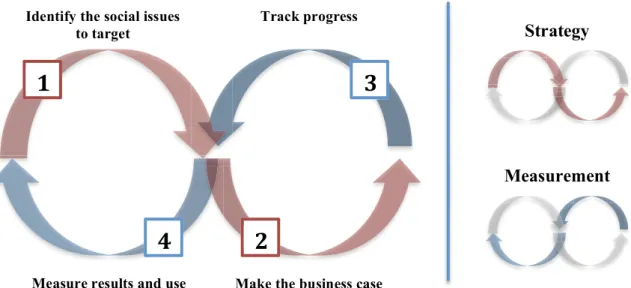
Following Porter and Kramer´s original article about Creating Shared Value Porter et al. (2012) developed a measurement framework, which provides fundamental steps to craft an integrated shared value strategy and allows to link social and economic results (see figure 2). In this way, results can be measured and new insights be used to unlock new value. According to them, a well developed shared value strategy and measurement process should consist of four basic steps, which form a continuous feedback loop that promotes further creation and scaling of shared value:
Step 1: Identify the social issues to target.
The initial phase of a CSV strategy requires scrutinizing a company´s environment to discover unmet social needs, which should then be analyzed for the purpose of identifying overlaps with the business itself across the three levels of shared value that were mentioned in section 1: Reconceiving product and markets; redefining productivity in the value chain; enabling cluster development. Following the identification of social needs specific social issues that offer the possibility to generate economic benefits need to be pinpointed and prioritized.
Step 2: Make the business case.
If the identified social needs are in line with at least one of the three levels of shared value, the next step is to conduct research and analyze how social improvement can increase business performance. This forms the basis for developing a concrete business case, in which the path to social and business value creation is explicitly articulated. In the business case specific targets and the respective activities and costs are to be defined for each shared value
! *&! opportunity. Based on this specification of the potential of every opportunity, the yes- or no-decision whether to run the CSV strategy is met.
Step 3: Track progress.
In this step the business case serves as a guideline for companies to monitor progress against the defined targets taking into account revenues and costs relative to financial projections, as well as inputs, business activities and outputs.
Step 4: Measure results and use insights to unlock new value.
The last step aims at validating the correlation between social and economic improvements and analyze if the CSV strategy results in a positive joint return. The insights of the analysis allow the company to further improve the creation of shared value. It is crucial to understand that a strict tracking of the results gives the opportunity to further unlock shared value.
Figure 2
-
Integrating Shared Value Strategy and MeasurementAdapted from Measuring Shared Value by Porter et al., 2012.
A study about shared value measurement for health solutions conducted by Peterson et al. (2012) discusses more extensively the measurement aspect of shared value. According to the study, companies should distinct between two different, but complementary components of measurement, both of which are decisive for the success of shared value:
!"
#"
$"
%"
Identify the social issuesto target
Make the business case Track progress
Measure results and use insights to unlock new value
Strategy
1. Measuring the innovation: By introducing new products and new operations companies can improve coverage and ensure appropriate use with new tiers of customers. Empowering people with new skills or increasing awareness of a social issue are examples of innovation. Companies need to understand if their efforts are really improving coverage and use, and if these efforts are increasing demand for the company´s products or services.
2. Measuring the impact: When creating shared value it is crucial to assess whether a shared value investment actually leads to social benefits, and whether these benefits increase the company´s economic prospects, for instance sales growth or product differentiation, in the long-run.
Difficulties of Measuring Shared Value
Measuring shared value can pose a highly demanding task, making it difficult to extract the benefits of quantifying social impact and linking it to economic improvement. A too high number of social issues and activities to be analyzed and tracked can be too overwhelming for companies. In order to avoid being lost in too many options, companies should narrow the number of issues and metrics to track down to a few high-priority social results and prioritize them accordingly (Porter et al., 2012). Another aspect that poses a major challenge is the measurement of social results in large populations. It is difficult, for instance, to measure the impact of a new medication on society as a whole. Here, it is important to select measurable outcomes that can be “extrapolated on a larger scale based on evidence of smaller scale impacts” (Porter et al., 2012). Moreover, the fact that business outcomes oftentimes have a different time horizon than social outcomes can complicate the alignment and evaluation of social and economic results. For this reason, a greater emphasis should be put on the measurement of intermediate social outcomes (Porter et al., 2012)
Challenges of putting CSV into practice
The concept of Creating Shared Value provides valuable benefits for a company by generating economic value in a way that it creates social value by focusing on its needs and seizing opportunities to improve it. Oftentimes, however, managers fail to employ new changes in their practices that are required to create social value (Brown & Knudsen, 2013).
18 Brown and Knudsen (2013) identified three common problems that may occur when a Shared Value strategy is pursued, but necessary management practices and organizational commitment are not in place:
The first problem can be found when companies managed to identify “win-win” opportunities in a new product or market, but fail to develop responsible practices when implementing the CSV strategy. As a consequence, companies predominantly focus on the business “win” and, thus, tend to neglect addressing the social issues, which is defined by Smith (2016) as “lose-win”, a situation in which society does not benefit while the business is still attains an economic return. In contrast, a “win-lose” situation in which a business creates a social benefit, but with no economic return, is evenly likely (Smith, 2016). The second problem is that many companies engage in initiatives that aim to solve social or environmental problems without adapting their overall business model. The authors’ reasoning is traced back to the case of Walmart in 2015 when the company implemented a sustainability program to reduce emissions and change consumer habits, but did not adapt its existing business model, that was based on maintaining its supply chain costs as low as possible, which turned out contrary to the new program.
The third problem Brown and Knudsen (2013) identified is the lack of discussion of how complexities and trade-offs are to be managed. This discussion is crucial to address social issues. In many cases, for instance, facilitative government institutions are necessary to identify and address needs and institutional voids (Brown & Knudsen, 2013). Brown and Knudsen even claim that attempts to make changes that improve labor conditions and environmental standards can even have a negative value effect if the implications are not properly evaluated and understood, which, as a consequence, can worsen the image and trust in firms.
In addition to the challenges mentioned by Brown and Knudsen (2013), Smith (2016) illustrates the challenge of adopting a local focus. He stresses the importance of cultivating collaborations with local affiliates that possess a deep familiarity with the language and culture of a local community, which is crucial in addressing the social needs of a community.
Methodology
The information provided in the case study is to a large extent based on secondary data retrieved from articles and reports found online, as well as an extensive interview with a representative of the Coca-Cola Brazil Foundation. The section about Brazil is mainly built on information provided in several online articles and various scientific studies and databases about the demographics of the country. Regarding the section about Coca-Cola the majority of the information was retrieved from other shared value case studies and Coca-Cola Brazil´s annual reports and sustainability reports. In the creation of the case study, an in-depth interview with the institutional development coordinator of the Coca-Cola Brazil Foundation provided invaluable information, necessary for a more profound analysis of the case. Due to the geographical distance, this interview was conducted via the online communications platform Skype.
Case Study
Case Introduction
It was a warm, sunny day in late 2008 and Coca-Cola Brazil´s board was meeting at the company´s headquarter in Rio de Janeiro with some of their first line directors. Regarding overall sales the year had been going well for the company so far, but instead of evaluating the current performance, this meeting was about the challenges Coca-Cola Brazil would be facing in the upcoming years. In 2008 and the years before, Brazil had gone through major economic and demographic changes. Since president Lula had taken over presidency in 2003, the middle-class had been growing at a tremendous pace. Along with a large number of Brazilians moving up in the pyramid of social classes, the buying power of this “new C-class” had increased substantially. Despite this movement, however, employability and level of education, predominantly among the youth in low-income communities, were lagging behind, reflecting the low rate of job opportunities. In the meeting the main concern was the question of how to target the large low-income communities, which Coca-Cola saw as a promising opportunity to build and grow its presence in the market. As the discussion went on it became clear that in order to increase its relevance in these communities, the classic approaches like expanding distributions channels or increasing marketing would not be enough. The company had to find another way to foster the relationship with these people. In the past, the company
20 had already carried out some CSR initiatives like the “Prato Popular”, an investment in reduced-cost meal-centers led by the government, which, however, was only designed to help the communities in need, but not to attain any economic benefit. The concept of Creating Shared Value had not yet been very present in the business world, but in the course of the meeting the discussion pointed more and more on the fact that a social issue had to be solved, so that the promising business opportunity could be seized. As the senior vice president pointed out during the meeting:
“Business-as-usual won´t be enough this time folks. We need to think bigger. If we want to win these people as our customers we need to do a lot more than just advertising. We have to establish a long-lasting relationship, solve the social issues that affect them and make a real social impact. But this all only makes sense if we have proper metrics to measure what we are doing and if we are able to track the impact we make in the communities.”
In the meeting the decision to plan a strategy to target the communities was made, which would be a challenging task, since in this case the usual approaches were not feasible.
Brazil: Society, Culture and Economy
With a population of close to 200 million inhabitants and a land area of more than 8,500,000 km2 Brazil is considered the fifth largest country in the world and the largest in Latin America both in terms of area and population. Prior to the becoming independent in 1822, the country´s history is intertwined mainly with that of Portugal, by which the country was colonized since its discovery in 1500.
From the 1930s to mid 1970s, Brazil found itself among the fastest growing economies in the world, giving the country for a long time the image of being „the country of the future“. However, despite successfully tackling inflation in 1994 and running a significantly more responsible macroeconomic policy as of 1999, productivity and economic growth have remained depressed, frequently being below the Latin American average.1
In 2008, president Luiz Ignacio „Lula“ da Silva remained extremely popular, despite a number of government corruption scandals that began in 2004, which was reflected in
approval ratings of 78 percent. Since he had taken over presidency in January 2003 together with the Worker´s Party (PT) by promising orthodox economic policies and the implementation of effective social programs, there had been an unprecedented increase in the middle class.2
The rising middle-class
In the beginning of 2008 Brazil received an investment grade by the well-known international rating agencies, after entering the list of countries with a high Human Development Index (HDI). Along with this change there was a substantial change in the distributions of levels of the society, which was reflected in a shrinking Gini coefficient, the indicator of income distribution3. The GINI coefficient had remained fairly stable since the early 1980s, always fluctuating around 0.60, indicating Brazil as one of the countries with the highest inequality in the world. However, in the years from April 2002 until April 2008 the Gini index fell from 0,627 to 0,584, a substantial decrease taking into account the scale of variation in the index.4
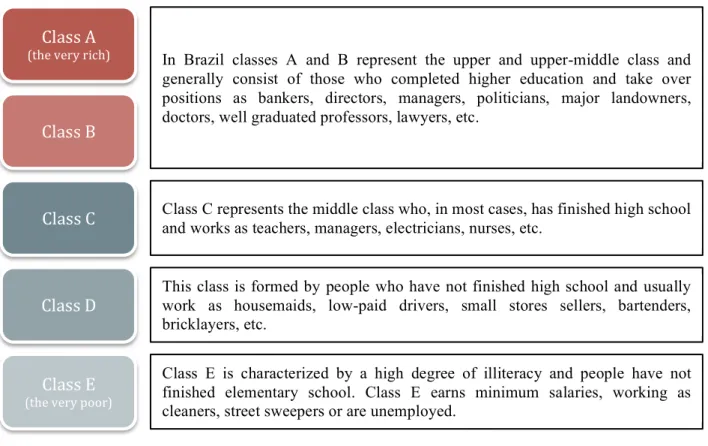
The most common concept of social classes in order to segment the almost 200 million people living in Brazil is the one that classifies the segments as letters A, B, C, D and E, as shown in Figure 3. The overall basis of this definition is the households’ gross monthly income.
2 Refworld (2009)
3 Definition of the Gini coefficient by Investopedia: The Gini index is a measurement of the income distribution of a country's residents. This number, which ranges between 0 and 1 and is based on residents' net income, helps define the gap between the rich and the poor, with 0 representing perfect equality and 1 representing perfect inequality.
! ""! Author´s own with information from Social Classes in Brazil. The Brazil Business, 2011.!
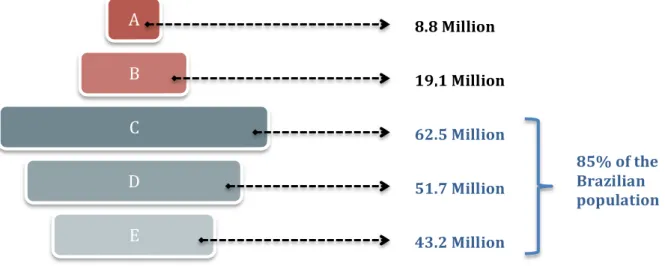
In the years before 2008, since Lula´s Working Party took power in 2003, millions of Brazilians were emerging from poverty to the middle class, the class C, as a result of new government programs like Bolsa Familia and a booming economy that led to an increased wages. In the time period from April 2004 to April 2008 class C grew by 22,8 percent when a major group of the D/E class moved to class C, while classes A and B together grew by 33,6%. Despite the growth of classes A and B, classes C, D and E still accounted for around 85% of the population, as Figure 4 shows5.
!!!!!!!!!!!!!!!!!!!!!!!!!!!!!!!!!!!!!!!!!!!!!!!!!!!!!!!!
%!New Middle Class CPS, FGV/IBRE CPS (2008)!
,-.//!0!! 1234!5467!6893: ,-.//!;! ,-.//!,! ,-.//!<! ,-.//!=! 1234!5467!>??6:!
In Brazil classes A and B represent the upper and upper-middle class and generally consist of those who completed higher education and take over positions as bankers, directors, managers, politicians, major landowners, doctors, well graduated professors, lawyers, etc.!
Class C represents the middle class who, in most cases, has finished high school and works as teachers, managers, electricians, nurses, etc.!
This class is formed by people who have not finished high school and usually work as housemaids, low-paid drivers, small stores sellers, bartenders, bricklayers, etc.!
Class E is characterized by a high degree of illiteracy and people have not finished elementary school. Class E earns minimum salaries, working as cleaners, street sweepers or are unemployed.!
Figure 4 - The Burgeoning Middle of the C, D and E Class
Adapted from Plano CDE Study based on the consolidation of IBGE data and the PNAD 2002 and
2009. Plano CSD, 2010.
Along with the vast growth of the middle-class and increased salaries, the consumption potential of the Brazilians increased remarkably. Hence, more and more people could afford durable goods like TV, radio, washing machine, fridge or DVD player. However, the new middle-class soon found itself unsatisfied with the limitations of the middle-class, and aside new TVs started demanding better education and other public services.
As the Brazilian economy expanded, more and more pressure was put on complementary factors that the government was in charge of. Two of them were infrastructure and education. In terms of infrastructure, public investment was facing a dramatic decline making the country especially lag behind in road and port infrastructure, creating a bottleneck for the economy. On the education side, a wide range of issues presented a major challenge for the government: the quality of instruction was fairly low in general; the general length of a school day was very short; absenteeism by students as well as teachers; poorly educated and non-involved parents; child labor, etc. Brazil was still below the Latin American literacy average and the deficit in the educational sector was leading to a shortage of human capital.6 Instead of scoring high in educational achievements in comparison with neighboring countries, Brazil found itself towards the top of inequality rankings. In fact, the supply of education was rising, !!!!!!!!!!!!!!!!!!!!!!!!!!!!!!!!!!!!!!!!!!!!!!!!!!!!!!!!
&!New Middle Class CPS, FGV/IBRE CPS (2008)!
0! ;! ,! <! =! 0 &'&"()**)+," !-.!"()**)+," /#'0"()**)+," 0!'1"()**)+," %$'#"()**)+," &02"+3"456" 789:)*)9," ;+;<*94)+," ;[email protected]!B?>C-.28?AD!*(%!E8--8?A!>4?>-4!
24 as a result of increased expenditures on education in general. In 2008 Brazil´s expenditure on education rose to 5.4% of GDP from 3.78% of GDP in 2002, which was among the highest among all OECD and partner countries with available data.7 Main drivers of the rain in educational expenditures were programs like the anti-poverty program Bolsa Familia, which paid families to keep their children in school. While this effort to eradicate poverty turned out successful in increasing the number of children enrolled in schools, the gap between the rich and the poor remained. In 2008, almost 20% of young people between 15 and 29 years were not in education, employment or training.8 As a consequence, levels of education and development of appropriate skills among the youth stayed low. In 2008, the youth unemployment rate (age 15-24) of 17.5%, which was in line with the figures of the previous years, was far above the average of the OECD countries (12.4%).9 The low youth employability still represented a major challenge of the country. As the Fernando de Holanda Barbosa Filho, researcher at the Brazilian Institute of Economics, pointed out:
“It is one thing to put children in school, and quite another to keep them studying and raising the quality of teaching. It is possible, but it is much more difficult.”
Figure 5 - Youth Unemployment Rate (age 15-24) in 2003-2008
Source: Youth Unemployment Rate (age 15-24) 2003-2008. www.quandl.com.
7
The Global Economy (www.theglobaleconomy.com) 8
The Guardian (2012)
9
Coca-Cola Brazil
The Coca-Cola Company is the largest beverage company in the world, maintaining a portfolio of more than 500 sparkling and non-carbonated brands. Regarding sales, Coca-Cola products sold in Brazil currently represent seven percent of global volume, which makes Brazil the company´s fourth largest market behind the U.S., Mexico, and China.10 In the Brazilian market, the Coca-Cola Company enjoys a dominant position in the soda market with a market share of 55% in terms of sales volume, followed by AmBev (19%) and Brasil Kirin (5%).11
History
Founded in 1942 during Coca-Cola´s global expansion that began in the 1940s, Coca-Cola Brazil represents the company´s fourth largest operation worldwide nowadays. The company´s head office is located in Rio de Janeiro, in the neighborhood of Praia de Botafogo. In order to provide support for the national operation, Coca-Cola Brazil operates regional offices in the cities of Rio de Janeiro, São Paulo, Fortaleza, Brasília, Curitiba and Porto Alegre.
In its first years of operations in Brazil, only Coca-Cola was produced at the Santa Clara Mineral Water Bottling Plant in Recife, in the northeast of the country, until 1945, when the Rio de Janeiro unit began its operations, with the capacity to produce 150 bottles per minute. An important aspect in the expansion of the franchises was the installation of Liquid Carbonic, which produced the essential ingredient for soft drinks CO2. In the beginning of the 1950s, about ten years into its expansion in Brazil, Coca-Cola already operated 11 bottling plants in the states of Rio de Janeiro, São Paulo, Minas Gerais, Bahia and Rio Grande do Sul. In that decade the slogan „Isto faz um bem“ („It´s a good thing“), which put an emphasis on the refreshing flavor of the beverage and reflected the country´s political and cultural transformations, was introduced and lasted for more than ten years. In the 1960s a number of technological innovations made it possible for Coca-Cola to develop new packaging, such as the medium-sized 290-ml bottle, which in conjunction with new emerging raw material
10 “Coca-Cola In Brazil: Global Events and Energy Drinks Could Drive Growth (Part 1),” Forbes, March 12, 2014. Accessed July 29, 2014. http://www.forbes.com/sites/great speculations/2014/03/12/coca-cola-in-brazil-global-events-and-energy-drinks-could-drive-growth-part-1/.
26 suppliers defined that start of manufacturing operations in Rio de Janeiro. The 1980s were marked by multiple important product launches like the introduction of soft drinks sold in cans in 1981 and the launch of the lime-flavored soft drink Sprite in 1984. The next decade was followed by several launches along with the increase of the company´s role in social, cultural, sports and environmental projects: next to the „Super Family“ bottle (a returnable 1.5 liter plastic bottle, Coca-Cola launched the Big Coke (2 liter size), the 1.25 liter size and 100% recyclable aluminum for the entire line of products.
In the first years of the 2000s, Coca-Cola initiated a nationwide diversification process, bringing to market non-carbonated beverages like water (Bonaqua), ice tea (Nestea), fruit-based nectars (Kapo) and an energy drink (Burn). In 2004, as a move towards higher sustainability, Coca-Cola developed a plan to reuse rainwater as an alternative source during industrial processes to minimize the use of water originating from watersheds. In the fallowing year, as a reward of multiple efforts made in terms of sustainability, Coca-Cola Brazil reached the first place among all of The Coca-Cola Company units based on the criteria of market performance aligned with sustainability practices.
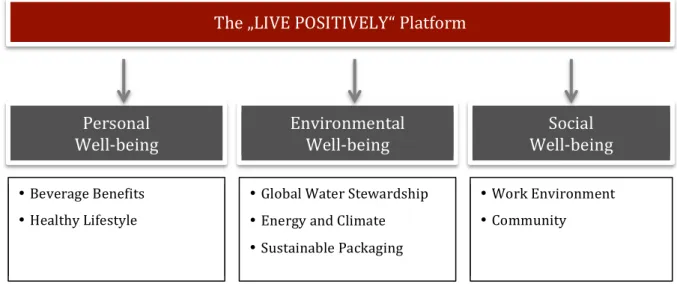
In 2007 the company took an important step to further focus on global water stewardship when the Coca-Cola Brazil Foundation launched the Brazilian Rainforest Water Program, which aims to recover watersheds through the reforestation of 3,000 hectares of riparian forests. In the same year, Coca-Cola Brazil launched its sustainability platform „Live Positively“ which unites and forms the foundation of the company´s sustainability activities, distinguishing between three main priorities: Personal Well-being (“Me”), Social Well-being (“We”) and Environmental Well-being (“The World”).
The “Live Positively” Platform
„LIVE POSITIVELY is a way for us to think holistically and globally about sustainability efforts throughout the Coca-Cola system. It includes goals, metrics and principles for our work across seven core areas key to our business sustainability: Beverage Benefits; Active Healthy Living; Community; Sustainable Packaging; Water Stewardship; Energy Management and Climate Protection; and Workplace.“12
!
!
Authors own with information from Coca-Cola Brazil, 2009, Sustainability Report 2008/2009
��������������������
Beverage Benefits
As a leader of the non-alcoholic beverage market, Coca-Cola Brazil aims to provide a high diversity of products in line with consumers´ expectations and desires. With a portfolio of approximately 150 products that cover a vast number of different tastes for the main daily occasions, Coca-Cola Brazil´s objective is to reach all consumer profiles in the country, especially in the main segments in which it operates: soft drinks, teas, waters and nectars. In order to comply with their commitment to responsible advertising, the company´s marketing policy follows two principles. Firstly, it is considered crucial to recognize that parents are responsible for what their children consume, and, secondly, no marketing should be directed at children under twelve.
Healthy Lifestyle
The platform´s healthy lifestyle pillar represents the company´s encouragement to engage in physical activities and develop balanced eating habits. In 2006, following a global guideline, Coca-Cola Brazil started to reinforce its packaging and campaigns to transmit messages reflecting its responsibility towards society, with the objective to motivate consumers to prioritize healthy living.
Figure 6 - The "Live Positively" Platform
N34!OPHQ=!BRSHNHQ=PTF!B-.2L?6E!
B46/?A.-!!
U4--GJ48AV! =A586?AE4A2.-!!U4--GJ48AV! U4--GJ48AV!S?98.-!!
•;4546.V4!;4A4L82/! •W4.-237!P8L4/27-4! •I-?J.-!U.246!S24X.6K/38>! •=A46V7!.AK!,-8E.24! •SC/2.8A.J-4!B.9Y.V8AV! ! •U?6Y!=A586?AE4A2! •,?EECA827! B46/?A.-! =A586?AE4A2.-! S?98.-!
28
Environmental Well-Being
Global Water Stewardship
Central to Coca-Cola Brazil´s water management is the objective to become water neutral by the year 2020. As a basic ingredient of all beverages produces, water represents a fundamental resource for the company. By constantly investing in new technologies the company aims to reduce water consumption and promotes the reuse of water. Considering the year 2002 where 2.47 liters of water per liter of beverage produced were used as the basis for measurement, Coca-Cola Brazil aims for a reduction to 1.5 liters of water per liter of beverage produced by 2020. Furthermore, the Forest Water program was implemented in 2007 to promote the recovery watersheds with the reforestation of the Atlantic Forest, which led to the establishment of various partnerships with local NGOs.
Energy and Climate
A fundamental aspect in the company´s operations is to produce more while using fewer resources, which forms the basis of Coca-Cola Brazil´s sustainability strategy, particularly with respect to its value chain. The objective is to boost production capacity and increasingly reduce the levels of greenhouse gas emissions. To reach this goal, the Coca-Cola Brazil Environmental Control System (ECS) was established in 2008 to record greenhouse gas emissions based on an inventory of the entire value chain in order to calculate its carbon footprint. As one of the measures to reduce the emissions is the use of new technology of refrigerators used at the points of sale.
Sustainable Packaging
To make the use of its packaging more sustainable up until the end of the product lifecycle, Coca-Cola Brazil puts a high effort in developing innovative and creative solutions with the objective of generating less waste in the production of the packaging as well as to drive the recycling chain from Brazil´s Northern to Southern regions. In this context, the integration between Coca-Cola Brazil and its bottlers is of high importance to ensure the success of its sustainability activities, which include the reduction of solid waste, increased use of recycled materials and more recycling. Establishing partnerships with different stakeholders are considered crucial for achieving its objectives as he company´s partnership with Walmart has shown, which resulted in the installation of more than 300 Recycling Stations inside the stores of the retail chain.
Social Well-Being
Work Environment
The pillar of work environment builds on investing in and developing the company´s associates. Important factors hereby are a company insurance plan for the associates, the empowerment of women along its value chain to strengthen women´s role in the Coca-Cola Brazil System, to promote personal and professional development of its associates, for instance, through mentoring programs. Core to its management of human resources is also the inclusion of people with special needs and strengthening the diversity within the company, which, as an example, is reflected in the extension of Coca-Cola Brazil´s health insurance benefits to the same-sex partners of its associates.
Community
Besides continuously increasing the presence of its products in the Brazilian market, Coca-Cola strives to be a socially recognized company. To reach this, the company adopts measures and programs in order to form a productive relationship in the communities in which it operates. Central to all activities regarding the development of communities is the Coca-Cola Brazil Foundation.
The Coca-Cola Brazil Foundation
The Coca-Cola Brazil Foundation (Instituto Coca-Cola Brazil) was established in 1999 and strives to unite the company´s social investments and transform the communities in which it operates by implementing programs to improve education and preserve the environment. All activities are based on the three pillars of the Coca-Cola Brazil Foundation, which are: Values, Learning Strategies and Competencies. In its operations the foundation strives to encourage the involvement of all parties of the value chain, from the bottlers to the corporate level. In the past, the foundation has successfully carried out the following programs:
Água das Florestas Tropicais Brasileiras is a program aimed at maintaining water resources of conserved forestal areas, the regeneration of its fauna, as well as the subsistence of the
30 communities within these areas.
The objective of the Reciclou, Ganhou program is to reward the recycling efforts and support cooperations of waste pickers, by improving the cooperatives´ infrastructure and the respective working conditions, offering waste pickers the opportunity of professional development.
The program Valorização do Jovem was initiated in collaboration with the government and numerous NGOs with the objective to improve public education in line with a long-term perspective.
Mission Statement: Mobilize society through the influence of the Coca-Cola Brazil System, with the objective to promote transformational programs of substantial impact on the socio-environmental development of the country.13
Vision: Contribute to effective socio-environmental transformations, being recognized as a dedicated organization through community work and partnerships.14
After the meeting
When the meeting was approaching the end, the board decided to form a cross-functional team that included 15 of Coca-Cola Brazil´s senior executives, which would be in charge of the design process of the shared value strategy. The team, including the senior executives, would attempt to get a better understanding of the low-income communities by immersing themselves in the favelas of major Brazilian cities like São Paulo and Rio de Janeiro. In the following months they lived with local families and held several conversations with community leaders, anthropologists and school directors. A crucial finding was that people from the communities wanted more than to simply be able to buy the company´s product as one quote by one of the community members illustrates well and which became central to the
13
Mission translated from Portuguese: „Moblizar a sociedade por meio da influência do Sistema Coca-Cola Brasil, com o fim de promover programas transformacionais de significativo impacto no desenvolvimento socioambiental do País.“
14Vision translated from Portuguese: „Contribuir para transformações socioambientais efetivas, sendo percebida como uma organização comprometida com trabalho em rede e mobilizadora de parcerias.“
project: “We love Coca-Cola, but we are thirsty for much more.” After the long period of research in the communities, the team managed to identify the core issues that had to be tackled: a very low employability among the youth, lack of proper education, little access to economic opportunities and a low level of productivity among the small retailers. A number of crucial factors, like its high reach and well-established relationships with retailers and bottling partners, put the company in a fairly strong position in addressing these issues. Furthermore, Cola Brazil could build on its in-house expertise and involve the Coca-Cola Brazil Foundation in the process. An aspect that was emphasized multiple times in the first meeting was the measurability of the program, which would be crucial for the evaluation and maximization of the impact. In only a few weeks after the clear identification of the issue the cross-functional team would have to present a feasible shared value strategy.
Teaching Notes
Purpose
This dissertation discusses the concept of Creating Shared Value (CSV), which in many parts of the business world has enjoyed great acceptance and is seen by many as an evolution of CSR. A particular emphasis is set on the design of a measurable shared value strategy. The case of Coca-Cola Brazil in the year 2008, when the company intended to develop a strategy to target the country´s low-income group, shall be used to illustrate the process of creating a feasible, and above all, measurable shared value strategy that allows for efficient evaluation of the outcomes and provides the possibility for scaling and improvement.
Target Audience
This case study is aimed at both undergraduate and graduate students in the field of business taking a view at several areas such as strategy, ethics, and social responsibility. Not only does it provide insights on how to attain economic improvements while addressing social issues, but also serves as a means to develop a social mindset in the students’ future careers.
32
Case Summary
It was in late 2008 when Coca-Cola Brazil´s board was holding meeting with some of their first line directors at the company´s headquarter in Rio de Janeiro. In terms of overall sales the company had been performing well so far in this year. The purpose of the meeting was to discuss the challenges and opportunities in dealing with the demographic change in the country.
In 2008 and the years before Brazil had been going through substantial economic and demographic changes with tens of millions of Brazilians moving up from the poor D/E class to the C class, forming a “new middle class” which had increased the buying power of the Brazilians. However, the level and quality of education and low level of job opportunities among the youth, especially in low-income areas but also in wide parts of the new C-class remained a serious issue in the country.
Coca-Cola saw a great opportunity in targeting people in these low-income areas, but knew that conventional practices like expanding distribution channels or increasing marketing efforts would not be sufficient. In order to increase its presence in these communities the company had to find another solution. With its “Live Positively” platform, consisting of three main pillars (Personal, Social, and Environmental Well-Being) and programs like “Prato Popular”, an investment in reduced-cost meal centers led by the government, Coca-Cola Brazil had already been engaged in several CSR activities, but was not deriving any direct economic benefits from them. During the meeting, the company concluded that in order to address the people from the low-income communities, a social issue had to be solved, which, at the same time, was seen as a promising business opportunity to reach economic objectives. In the end of the meeting the board decided to form a cross-functional team that included 15 of Coca-Cola Brazil´s senior executives, which was in charge of the design process of the shared value strategy. This cross-functional team would attempt to get a better understanding of the low-income communities by immersing itself in the favelas of major Brazilian cities. In the following months the team members lived with local families and held several conversations with community leaders, anthropologists and school directors.
A crucial finding was that people from the communities wanted more than to simply be able to buy the company´s product as one quote by one of the community members illustrates well and which became central to the project: “We love Coca-Cola, but we are thirsty for much more.” After the long period of research in the communities, the team managed to identify the core issues that had to be tackled: a very low employability among the youth, lack of proper
education, little access to economic opportunities and a low level of productivity among the small retailers who were oftentimes lacking competent assistance. A number of crucial factors, like its high reach and well-established relationships with retailers and bottling partners and its in-house expertise including the Coca-Cola Brazil Foundation, put the company in a fairly strong position in addressing these issues. Another aspect that was emphasized multiple times in the first meeting was the measurability of the program, which would be crucial for the evaluation and maximization of the impact. In only a few weeks after the clear identification of the issue the cross-functional team would have to present a feasible shared value strategy.
Relevant Theory
In order to analyze the Coca-Cola Brazil case, it is crucial to have a good understanding of the concept of Creating Shared Value. The relevant concepts for the discussion of this case are presented in the literature review in the previous chapter. Complementary to the literature review I recommend Porter and Kramer´s Harvard Business Review article, the article of Crane who takes a more critical stance to CSV, and Porter and Pfitzer´s article about measuring shared value:
Crane, A., Palazzo, G., Spence, L. J., & Matten, D. (2014). Contesting the Value of the Shared Value Concept. California Management Review, Vol. 56/No. 2.
Porter, M. E., Hills, G., Pfitzer, M., Patscheke, S., & Hawkins, E. (2012). Measuring Shared Value - How to Unlock Value by Linking Social and Business Results. Foundation Strategy Group.
Porter, M. E. & Kramer, M. R. (2011): Creating Shared Value - How to reinvent capitalism— and unleash a wave of innovation and growth. Harvard Business Review, Vol. 89/No. 1/2, 62–77.
34
Suggested Discussion Questions
1) What is CSV? How is it different from CSR?
The students should be able to give a clear definition of the concept of CSV, indicating the fundamental purpose of a shared value strategy of reaching both social and economic improvements.
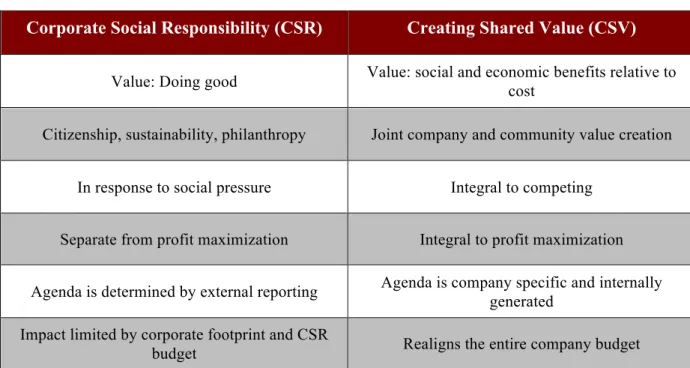
To further explore the concept and to avoid confusions between CSV and CSR, it is important to discuss the differences of the two concepts. The following table is based on the findings of Porter and Kramer and can be used as a reference15:
Table 2 - Differences between CSV and CSR
Corporate Social Responsibility (CSR) Creating Shared Value (CSV)
Value: Doing good Value: social and economic benefits relative to cost
Citizenship, sustainability, philanthropy Joint company and community value creation In response to social pressure Integral to competing
Separate from profit maximization Integral to profit maximization Agenda is determined by external reporting Agenda is company specific and internally generated Impact limited by corporate footprint and CSR
budget Realigns the entire company budget Adapted from Porter and Kramer, 2011, Creating Shared Value.
2) On which dimensions can a company create shared value?
This question builds on the three dimensions of shared value that are proposed by Porter and Kramer:
1. Reconceiving products and markets
o E.g. food companies who drive consumption by targeting low-income groups by providing products that meet the need for better nutrition instead of only focusing on taste and quantity.