A Work Project, presented as part of the requirements for the Award of a Masters Degree in Management
from the Faculdade de Economia da Universidade Nova de Lisboa.
Materials handling in hospitals:
An analysis of how the storage and materials handling
system can be improved, using the example of Hospital
Santa Maria.
Christiane Reichart
MST15000302
A Project carried out in the strategy area, with the supervision of: Prof. Amílcar Arantes
Acknowledgements
First of all, I would like to thank my supervisor Prof. Amílcar Arantes for the constant support while conducting the work project. Furthermore, many thanks go to Pedro Lima, logistics manager at Hospital Santa Maria, for providing me useful practical information and letting me gain an insight to the warehouse operations through spending a day at the hospital. Last but not least, I want to thank my colleague Stephan Messner for his continuous encouragement.
Abstract
Warehousing costs and especially order picking costs account for a considerable amount of total logistics costs, what leads to the purpose of this paper which is to elaborate means by which the materials handling process of hospitals can be improved. A detailed analysis of the material storage and picking process at Hospital Santa Maria is carried out in order to demonstrate best practices as well as main limitations for which solutions are developed. The findings are that the introduction of within-aisle storage, electric foldable picking vehicles and pick-by-voice system in combination with the Japanese concept Kaizen can improve warehouse operations drastically.
1. Introduction
The health care sector is different than other industries, however, the reason is not that it has lots of unique features, but the combination of specific factors makes it somewhat distinctive. These characteristics are amongst others the uncertainty of treatment and demand, goals diverging from mere profit gains, public intervention, restrictions on competition and ethical restrictions as everyone should be able to receive medical care (Folland et al., 2004). Pedro Lima (2009), logistics manager at Hospital Santa Maria in Portugal, stated that some years ago logistics were only rudimentary considered in hospital organization. Though, this has changed tremendously and now most hospitals are concentrating on logistics in order to gain various benefits and to reduce costs.
As a result of the fact that demand can hardly be predicted exactly, inventories are used in order to assure the supply of goods needed and to facilitate the coordination of supply and demand. Inventories require a warehouse for storage and a materials handling system to receive, store and internally distribute the items, leading to costs which have to be traded off with purchasing and transportation costs (Ballou, 2004). However, in contrast to other industries such as the automotive sector, the most important issue in the health care sector is not to keep inventory levels as low as possible. As a matter of fact, it is crucial to have an adequate service level in order to guarantee medical care. Nevertheless, material managers at hospitals should not overstock warehouses but aim at a trade-off between inventory carrying costs and a sufficient service level to prevent patients from suffering (Parker, 2002).
Besides the task of determining the quantity of stored goods, it has to be furthermore focused on efficient utilization of available space for storage and efficient materials
handling processes (Kowalski and Dickow, 1995). Ballou (2004) states that “storage and materials handling must be considered in concert”. According to De Koster et al. (2006), order picking is the most costly and most labour-intensive task in every warehouse. It is estimated that 55% of the total warehouse operating expenses are order picking costs. Gourdin (2001) states that inefficient picking leads to unsatisfactory warehouse operations, eventually leading to fatal consequences and costs for the entire supply chain. Processes slow down, the service level decreases, warehousing costs rise, and so forth. Therefore, it makes sense to concentrate on the improvement of order picking in order to enhance overall performance.
1.1 Main objective
The purpose of this paper is to provide an analysis of the current storage and materials handling processes at the warehouse of Hospital Santa Maria in order to discover potential of improvement for hospitals in general. Therefore, the resultant research question is: How can the storage and materials handling system of hospitals, such as Santa Maria, be improved?
The paper firstly examines past research of the field and then outlines the analysis of the materials handling system at Hospital Santa Maria, including the main methodology, status quo, role model areas, limitations and results. The idea is to give solutions how to reduce storage and material handling inefficiencies in order to facilitate picking and to cut costs, eventually leading to a better overall performance of the hospital. The obtained findings will then be combined in order to obtain recommendations for Hospital Santa Maria how to make the storage and materials handling more effective
2. Literature review
Regarding storage and picking systems in general, ample theory exists. However, concerning materials handling in hospitals research is deficient (Kowalski and Dickow, 1995 and Cook, 2007).
According to Kowalski and Dickow (1995), in order to design storage and materials handling systems, one has to take into account the nature of the organization, warehouse specifications, the storage equipment and the materials handling equipment. Then, Rouwenhorst et al. (2000) advise to make the decision about the layout design of the storage system, assign products to storage locations, assign orders to pick batches, group aisles into work zones, route order picking and sort and group picked items. Regarding the storage layout design, Meller and Gau (1996) discuss facility layout methods, hence where to locate receiving, picking, storage, sorting and shipping areas. Heragu et al. (2005) provide a model for the internal layout design or aisle configuration, which deals with the number of picking blocks and the number, width and length of aisles per block. According to De Koster (2005), the objective function of layout design should be to keep travel distance minimal.
The next step is to assign the products to storage locations. Hackman and Platzman (1990) as well as Frazelle et al. (1994) suggest to separate pick stock and bulk stock into forward and reserve area respectively in order to speed up order picking. Item sectioning can then be furthermore carried out as dedicated storage - each product has a fixed place -, random storage, closest open location storage, full turnover storage or class based storage - products are partitioned into classes depending on turnover, hence into fast-moving and slow-moving according to the Pareto method (De Koster, 2006).
Order picking can either be carried out manually or by means of mechanized systems, automated systems, semiautomated systems or information-directed systems (Bowersox and Closs, 1996).
Concerning manual picking, Vitasek (2007) differentiates between single-order picking, multi-order batch picking, order consolidation, wave picking and zone picking.
Kator (2007) discusses the use of barcode scanning and cart based picking (allows multiple order picking), which reduce labour costs and improve picking precision. Loudin (2004) perceives RFID (Radio Frequency Identification) “to become the next big thing”. Mark (2006) presents the pick-to-light and pick-by-voice system, which increase labour productivity by 50% and 10% respectively, as well as warehouse management system (WMS) to enhance productivity.
However, methods of storage location assignment and order picking can always be combined in order to achieve a better solution.
As materials handling in hospitals is not yet excessively covered by past research and as De Koster et al. (2006) estimate that order picking costs account for 55% of the total warehouse operating expenses which count for about 20% of total logistics costs, the analysis of the storage and handling decisions at Hospital Santa Maria will constitute a beneficial contribution to future research.
3. Discussion of the topic 3.1 Methodology
When examining the materials handling process, it can be distinguished between strategic and operational decisions. Strategic decisions focus on long-term objectives of organizations and are reassessed regularly (Markides, 1999). Operational decisions are concerned with meeting requirements effectively and ensuring the efficient use of resources (Pilkington and Meredith, 2009). Joshi et al. (2003) remark that the alignment of strategic and operational decisions results in superior performance.
As the purpose of this paper is to improve the materials handling process at Hospital Santa Maria, first of all the status quo is depicted and analysed through a comparison with relevant literature. Areas where Hospital Santa Maria serves as a role model are indicated as well as the main limitations of its current processes. Potential for improvement is identified and recommendations, taking into account strategic and operational aspects, are provided for Hospital Santa Maria as well as for other hospitals.
3.2 Status quo at Hospital Santa Maria
Since 2008, the “Centro Hospitalar Lisboa Norte, EPE” comprises two hospitals, Hospital Santa Maria and Hospital Pulido Valente, in order to consolidate various functions.
Hospital Santa Maria, which is with 1,000 beds the largest hospital in Portugal, has an annual budget of €300 million and a workforce of
4,892. The logistics division for both hospitals consists of 38 employees, two central warehouses, 311 points of supply, 5,640 different products,
62,408,921 annual movements of stock keeping units (SKU) and a budget of €30,000,000 (numbers from 2008).
3.2.1 The warehouse
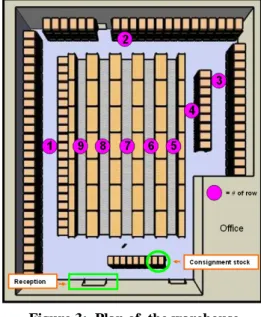
Hospital Santa Maria has one central warehouse which is operated 24 hours a day by 35 employees working in three shifts of eight hours each. Products in the warehouse are stored according to their turnover. Each stock keeping unit has its fixed place; fast moving goods are stored in rows one, two and three (85% of all SKUs) and products which are only picked two to three times a week are stored in rows four to nine or in the second floor of the warehouse (another five rows above rows four to nine). The lower
two trays of rows one to three are picking zones and the upper two trays are used to replenish the picking zones. The replenishment is undertaken at the end of each day. A small area of the warehouse is dedicated to consignment stock, which accounts for around 55% of the total value of stored products.
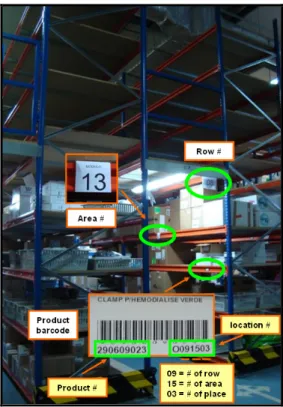
Each of the nine rows is split into several areas which are labelled with numbers. Attached to the tray is a magnetic piece with a barcode showing which product is stored there. Each SKU as well has a barcode attached identifying the product and indicating the location of the product, as illustrated in figure 4.
Figure 2: Warehouse
Figure 4: Shelf labelling and barcode
The operations in the warehouse consist of four processes – inflow, storage, picking and outflow – which are performed by different people. Three employees are responsible for receiving incoming shipments and for storing the products at the assigned location. Eight people carry out the picking process and the delivery of the filled picking vehicles to a central point. At this point one of the seven employees in charge of internal distribution takes over and delivers the supplies either to the service directly or to a central point in the corridor where the nurses have to retrieve the products they need. Products are internally supplied to 240 different places, called services. About 190 services receive clinical supplies, whereupon 107 are delivered directly and 83 have to catch the products from a central place in the respective corridor to which they are delivered.
3.2.2 Picking & internal distribution process
If a service is about to run out of supplies, an electronic order is generated and sent to the warehouse. In the warehouse a picking list specifying services which need to be delivered is compiled each day and the sequence of items to
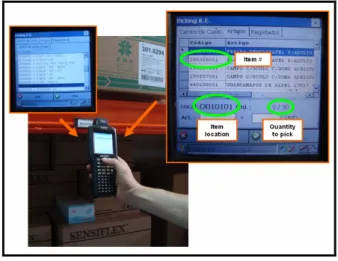
be picked for each service is sent to a PDA (Personal Digital Assistant) including scanner. This is a portable device which shows the route of picking; hence the article number, the location and the quantity of the items to be picked. The employee carrying out the picking takes the PDA as well as the picking vehicle and follows the
sequence the PDA shows (starting with row one and subsequently continuing with the other rows, optimizing travel distance within rows).
Figure 6: PDA with scanner
When arrived at the picking location the employee first scans the barcode attached to the tray as it can be seen in figure 6, then takes the required quantity out of the shelf, attaches a sticker with the respective barcode to each single product and puts it in the picking vehicle. Then he continues with the next product. If the quantity stored is not
system automatically. At the end of the picking route the employee puts a sticker on the vehicle indicating the service to which the picking vehicle has to be transported. He as well writes the number of the picking vehicle on the picking list and signs to prove that the picking order has been completed. Then he prints a list with the picked items, signs it and attaches it to the picking vehicle. Finally, he brings the picking vehicle to the central place where the employee responsible for internal distribution takes over. The picking vehicle is brought to the service destination and the distribution employee sorts the products in the shelves according to the newly attached barcodes. The nurse has to sign the list of items in order to verify the delivery. Then, the picking vehicle is brought back to the central place from where the picking employee brings it back to the central warehouse.
3.2.3 Evolution of the warehouse
In 2006, when a consultancy optimized the logistics processes of Hospital Santa Maria, the central warehouse was built. Before, items were stored at several places within the hospital. Paper orders were replaced by electronic orders and handheld scanners were introduced. However, the warehouse design remained suboptimal. Shelves were organized in a U-shape, leading to excessive travel time as employees had to turn at the end of the shelves. Furthermore, space utilization was not efficient as shelves did not have the maximum height possible. Therefore, in June 2009 change was initiated. The existent shelves were replaced by single shelves with increased height, leading to decreased travel time.
Taking the above mentioned improvements into account, logistics processes have been advanced considerably over the past three years. Following, areas where Hospital Santa Maria serves as a role model are depicted as well as potential for further enhancement.
3.3 Hospital Santa Maria as a role model ABC Analysis
The method used by Hospital Santa Maria for storage location assignment is class based storage, meaning that products are divided into classes according to the Pareto method. De Koster et al. (2006) explain that the fastest moving class contributes to around 85% of the turnover, but contains only 15% of products stored. These are typically called A-items. The next category according to movement is called B-items (20% of products stored make 10% of turnover). The third and usually last category is that of C-items (65% of products stored make 5% of turnover). After determining the classes they are assigned a storage place in the warehouse. When conducting class based storage, travel distance and time can be reduced, as items that are most frequently handled are stored close to the entrance of the warehouse.
Although Hospital Santa Maria carries out class based storage, storage place assignment is still suboptimal, as will be elaborated at point 3.4 (limitations).
Permanent places in the warehouse
All items are stored according to a fixed-slot placement system; hence each product is allocated to a permanent place in the warehouse. According to Bowersox and Closs (1996) the advantage hereby lies in instantly tracing the product, leading to decreased picking time as the employees do not have to spend excessive time finding the product.
Barcodes
As already mentioned before, Hospital Santa Maria uses barcodes to track material movements in the warehouse, what eases the automation of the whole logistics process.
handling and transportation. Every time an item arrives at the warehouse, is removed from the storage location or internally distributed, the product is scanned with handheld barcode scanners (Personal Digital Assistants/PDAs) and registered by the logistics software. Thereby, verification of incoming orders as well as picked items is possible and inventory levels can be updated and monitored (Gourdin, 2001). According to Michael Wolf of KNAPP (2009), barcode scanners cost about €2,000 per device plus €10,000 one-time costs for the software and are usually amortized within two to three years. Bowersox and Closs (1996) state that laser scanning technology leads to high materials handling accuracy and efficiency, accelerates materials handling, enables reliable data collection and immediate processing as well as protection against pilferage. Ludwig and Goomas (2007) report that the implementation of handheld barcode scanners results in a productivity increase of 24% and a selection accuracy of 99.8%, which is considerably higher compared to the paper-based method (96.5%). This in turn results in a reduction of labour hours, improves the quality of order picking and, as Kator (2007) mentions, leads to a decrease in warehousing costs.
Shelf space organization
In order to reduce travel distance and to speed up the picking process, De Koster et al. (2006) suggest to store pick stock in a small forward area and excess stock in a reserve area, which is then used to replenish the forward area if necessary. As already indicated before, Hospital Santa Maria uses the lower two trays of the shelves in the warehouse as forward area and the upper two trays as reserve area. The resulting advantages are that picking effort can be reduced as no fork-lift truck is needed to access the items and the forward area can fast be replenished by the reserve area as it is located directly above, reducing travel distance and material tracking time.
3.4 Main limitations at Hospital Santa Maria Travel distance not adequate
As mentioned at point 3.3 (role model areas), Hospital Santa Maria assigns products to storage locations according to turnover. However, travel distance is not yet kept to a minimum, as the fastest moving items are stored on the outer shelves (row one, two and three), leading to long travel distances when storing as well as picking the products.
Vehicles not adequate
The vehicles used by Hospital Santa Maria to carry out picking and to distribute internal supplies are very big, rigid and not versatile. This leads to a problem as the vertical height of the various hospital buildings poses a constraint on logistics through considerably extending the travel distance. There are nine floors, connected by twelve elevators which are to be used by patients, visitors and employees jointly. This leads to long waiting periods because of the time needed to go from one floor to another and the huge amount of people using the elevators (which only have twice the size of the actual picking vehicle). A considerable reduction in employees’ time spent on distributing internal supply would be possible when less time would be spent waiting for elevators to come or to have enough space to accommodate the picking vehicle, especially when taking back the empty picking cart to the warehouse. As the warehouse is situated on the ground floor, going up is not the main problem. To speak from experience, it can take more than 30 minutes until it is possible to enter the elevator in one of the middle floors in order to go back to the warehouse. Also, the present picking carts make it impossible to carry out delivery using the stairs of the buildings, independent of the carried amount.
Concerning employees’ health, the picking vehicles used are not ergonomic as they themselves are heavy and jointly with the load it needs a considerable amount of the workers’ strength to carry them all day long through the whole hospital (the longest corridor is 900 metres long).
Suboptimal use of storage space
When it comes to the type of material storage in the shelves, very different forms are present in the warehouse. Some products are stored in cartons on pallets or directly on the shelf, others are unpacked and put in plastic bins of various sizes or stored directly on the shelf. This leads to a suboptimal and inefficient use of storage space, most of all shelf height. Additionally, there is the danger of product damage when inaccurately stored.
Paper-based picking
Although in the warehouse of Hospital Santa Maria generally barcode scanning is used to pick items, urgent orders are carried out with paper-based picking. Hence, the items to be picked are printed as a paper list which the employee responsible for picking uses to carry out picking. According to Danelski (2007), paper picking is unproductive, leads to inaccuracy, does not enable traceability and does not allow for employee accountability.
3.5 Main recommendations
After analysing the current problems at the warehouse of Hospital Santa Maria, the following section gives ideas for improvement, taking into account the benefits and costs.
3.5.1 Operational Dimension
Effective Positioning
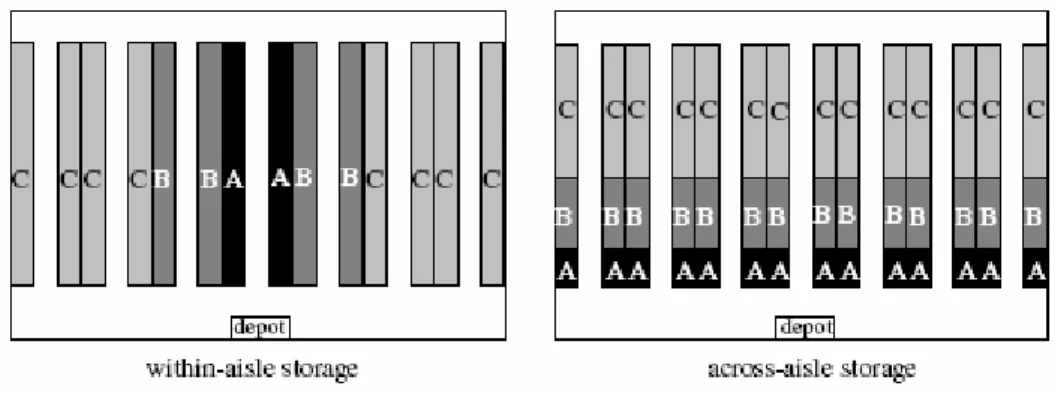
When conducting class-based storage, as Hospital Santa Maria is doing, there are several methods for effectively positioning the A, B and C-items. According to De Koster et al. (2006), within-aisle storage, where each aisle only contains one class, and across-aisle storage, where each aisle contains every type of item, are suitable schemes.
Figure 7: Storage methods
As can be seen in figure 7, independent of which method is used, fast moving items (A-items) are stored close to the starting point of picking, therefore leading to low travel distance and shorter picking time. De Koster et al. (2006) recommend exerting across-aisle storage as this system of item positioning is close to optimal. Petersen and Schmenner (1999) furthermore state that among various storage policies, within-aisle storage leads to the greatest reduction in travel time. According to Petersen (2002), within-aisle storage results in time savings of 45% to 50% compared to random storage. Proposal I: Therefore, the recommendation for Hospital Santa Maria is to store the products with the highest turnover in the middle aisles of the warehouse.
New picking vehicles and containers
One possibility is the fold-up cart offered by Cart-Mart for €154.13 (figure 8). It supports a capacity of 545 kg and can be folded in order to increase space utilization.
Figure 8: Fold-up cart from Cart-Mart1
Another possibility is the following convertible hand truck offered by Magliner for €226.56 (figure 9). It can be converted from four wheels to two wheels within seconds.
Figure 9: Convertible hand truck2 Figure 10: Powered hand truck from Magliner3
A more advanced vehicle, also offered by Magliner for €2,558, is the Powered Gemini (figure 10), which is a powered hand truck that can also be converted to a two-wheel truck. This vehicle is especially recommendable as it reduces delivery time up to 25%, leading to increased labour productivity. Furthermore, it reduces employee fatigue and stress as about 19 times less energy is needed to move the truck as compared to a non-powered vehicle. This leads to decreased worker absenteeism, minimized compensation claims and reduced turnover as well as increased job longevity, resulting in savings of about €2,000 a year per vehicle.
1 http://www.martforcarts.com/carts/7.html [accessed 22.10.2009] 2 http://www.magliner.com/index.php?page=shop.product_details&flypage=shop.flypage&product_id=88 &category_id=13&manufacturer_id=0&option=com_virtuemart&Itemid=30 [accessed 22.10.2009] 3 http://www.magliner.com/index.php?option=com_content&task=view&id=113&Itemid=255 [accessed 22.10.2009]
The proposed vehicles can be used together with one of the following containers in order to facilitate the transportation of small goods. The first one is a stackable container selling for €63.22 at Instawares (figure 11). It can be turned 180° to nest when empty, providing better space utilization. The second one is a stack and nest container found at theonlinecatalog (figure 12), available at different sizes with prices ranging from €11.33 to €27.08. The third one is a foldable storage and transport container from
SSI Schäfer (figure 13), offered for €11.70, leading to a volume reduction of 80% when
folded.
Figure 114 Figure 125 Figure 13: Foldable storage and transport container6
Proposal II: When comparing the different possibilities, the best solution seems to be the powered hand truck (powered Gemini) from Magliner in combination with several foldable storage and transport containers from SSI Schäfer. After delivery the boxes can be folded and attached to the vehicle after converting into a two-wheel truck. The costs of this solution are €26,048 for ten trucks including four containers each. However, the expected soft as well as hard benefits of around €40,000 over two years outweigh the costs by far and lead to an amortization of 16 months. Besides this, Pedro Lima stated that he would appreciate powered picking vehicles for the warehouse of Hospital Santa Maria.
4
http://www.instawares.com/quantum-solid-stack-and-nest-containers-23-3-4in-l-x-15-3-4in-w-x-7-3-4in-Efficient storage
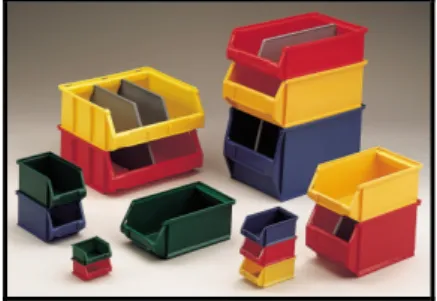
In order to enable more efficient storage, the open fronted stack bins from solentplastics (figure 14) are a good possibility as they allow uniform storage and easy access while maximizing space utilization. They are available in different sizes and have a capacity between 0.3 and 75 litres and a prize ranging from €2 to €28.
Proposal III: Through storing all small to middle sized items in bins, damage can be prevented and through stacking, the complete shelf space can be used.
Figure 14: Open fronted stack bins7
Paper-based picking
Concerning the paper-based picking of urgent orders, the solution could be quite simple. Proposal IV: As all products are tagged with barcodes and scanners as well as the underlying computer system are available, it should not be a huge problem to pick urgent orders through scanning as well, without adding additional costs. As already mentioned before, according to Ludwig and Goomas (2007), this leads to a further productivity improvement (24% over paper-based method) and an improved picking accuracy by 3.3%.
Introduction of Kaizen
A more general operational improvement is the introduction of Kaizen. According to Imai (1986), Kaizen is “the process of gradual and incremental improvement in a
7
pursuit of perfection of business activities” and is a Japanese management philosophy of continuous improvement. Smadi (2009) describes that the Kaizen strategy is particularly based on the following five principles:
Process improvement: Implementation is carried out according to the
“plan-do-check-act cycle” which means setting an improvement target, executing the plan, controlling for effective performance and standardizing the process as well as introducing new improvement targets.
Total quality management: Performance is improved in three dimensions, namely
quality perceived by the customer, overall cost of manufacturing and selling, and delivery of the right quantity at the right place and time.
Gathering of hard data: As Kaizen is a problem-solving process, relevant hard data are
essential to analyze and solve a problem effectively and efficiently.
Work as an interrelated process with a supplier and a customer: All employees within
an organization are suppliers of internal inputs or outputs to external customers, and have as well internal or external customers. Treating everyone as a customer leads to a transfer of high quality products and a substantially improved process performance.
Visual management: Problems have to be visible in order to enable everyone being part
of the process to take a corrective action in real time and to eliminate barriers to improvement.
Some benefits of Kaizen are amongst others time and money savings through improved work processes, lean manufacturing leading to enhanced productivity, improved competitiveness and reduced inventory. The fact that Kaizen consists of small continuously executed steps of change results in higher and more sustainable benefits
Proposal V: In order to successfully introduce Kaizen to Hospital Santa Maria, a person in charge has to be named in order to implement the concept and supervise the process. Furthermore, it has to be secured that all employees receive adequate information in order to understand the concept.
3.5.2 Strategic Dimension
Kator (2007) states that although barcode scanning is a good option of warehouse automation, voice-directed picking (pick-by-voice) might be even more efficient and further improve accuracy. Especially when employees need both hands to pick the products, they are often struggling with the handheld scanner and losing time. According to Friedman (2006), a voice-directed picking system consists of headphones, a microphone and a wireless computer attached to the employee’s belt. Picking data are transmitted to the wireless computer if an order is to be picked, telling the employee where to go, what and how much to pick. When picking the item the employee speaks out what he picked indicating the location, which is sent back to the computer system verifying the process. If a picking error occurred, the employee is informed immediately. Pendrous (2007) mentions an increase in labour productivity by 15% to 30% compared to paper-based as well as scanner-based picking, improved accuracy of 99.9% (as opposed to 96.5% when paper-based and 99.8% when scanner-based) and a return on investment of less than twelve months. In contrast to a pick-to-light system, pick-by-voice is suited to an environment where several employees carry out picking in the same zone at the same time, therefore perfectly suiting the situation at Hospital Santa Maria. According to Michael Wolf of KNAPP (2009), the costs for a pick-by-voice system are around €5,000-6,000 per component as well as one-time costs of €20,000-25,000 for the software. Taking into consideration the warehouse of Hospital
Santa Maria, in order to implement voice-directed picking they would need ten components leading to overall costs of about €72,500. The resulting monetary benefits over a two-year period are approximately €332,000 (savings due to improvement of productivity and accuracy), leading to an amortization of six months. However, as Hospital Santa Maria is a public institution they might not be able to realize the full savings potential in such a short time as they are not allowed to lay off employees. Nevertheless, overtime can be reduced, workers can be transferred to other departments and people who are about to retire do not have to be replaced. An example of a Portuguese company offering a voice-directed picking system is ISRETAIL8, who claims a return on investment of between six months to one year for their product.
Proposal VI: The recommendation for Hospital Santa Maria hereby is to change from barcode scanners to a pick-by-voice system in order to realize the above mentioned benefits.
4. Conclusion
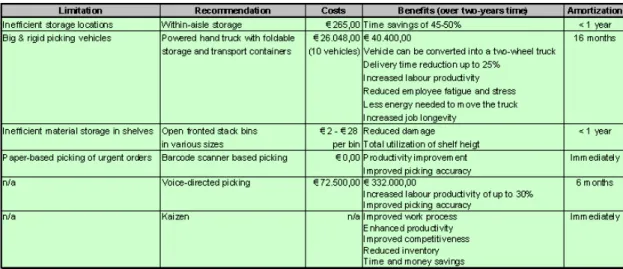
As hospitals are constantly challenged with budget reductions, high emphasis has to be put on managing the supply chain efficiently in order to cut spending. This paper has found that materials handling constitute a high percentage of logistics costs and after analysing the actual process of warehouse operations at Hospital Santa Maria as well as determining the limitations of the current picking process, the research question “How can the storage and materials handling system of hospitals, such as Santa Maria, be improved?” can be answered. The following table summarizes the main limitations as well as given recommendations to face these problems.
Table 1: Summary of limitations and recommendations
Among the significant findings of this paper are the replacement of the currently used picking vehicles as well as the change of the picking system from barcode scanners to voice-directed picking. However, practical implementation and continuous improvement are important in order to make change possible. The introduction of Kaizen can secure a permanent and sustainable advancement of processes which have to be revisited every year. After giving these recommendations it is now up to Hospital Santa Maria to take actions in order to make the enhancement of warehouse operations possible.
One limitation of this paper is the deep focus on Hospital Santa Maria when dealing with the different propositions as each hospital has its own specifications which have to be considered when designing a strategy. However, there is great value added, of course for Hospital Santa Maria, but also for other hospitals, as the examination done in this paper facilitates the conduction of analyses by other hospitals and gives them useful recommendations to consider when intending to enhance their materials handling process.
As already mentioned before, logistics in the health sector is still only rudimentary developed, but studies in this area have been growing recently. Future research will need to analyse combinations of different order-picking systems and storage location schemes, which have hardly been explored. Order picking costs are an important matter and therefore this paper concludes that hospitals should keep clearly in mind the impact of inefficient warehouse operations.
5. References
Ballou, Ronald H. 2004. Business Logistics/Supply Chain Management: Planning,
Organizing and Controlling the Supply Chain. Upper Saddle River New Jersey: Pearson
/ Patience Hall.
Bowersox, Donald and Closs, David. 1996. Logistical Management. The Integrated
Supply Chain Process. McGraw-Hill Higher Education.
Cook, Al. 2007. The dangers of stockpiling. Materials Management in Health Care.
16(9): 32-34.
Danelski, Darin. 2007. Making the Best Pick for Picking. Industrial Maintenance &
Plant Operation. 68(2): 16-17.
De Koster, René et.al. 2006. Design and control of warehouse order picking: A
literature review. European Journal of Operational Research. 182(2): 481-501.
Folland, Sherman et al. 2004. The Economics of Health and Health Care. Upper
Saddle River New Jersey: Pearson Education Inc.
Frazelle, S.T. et al. 1994. The forward–reserve problem. In: Ciriani, T.C. and
Leachman R.C., Editors. Optimization in Industry 2. New York: Wiley. 43–61.
Friedman, Dick. 2006. New Warehouse Management Technologies beat the old ones.
Supply House Times. 49(7): 64.
Gourdin, Kent N. 2001. Global Logistics Management: a competitive advantage for
the new millennium. Malden USA: Blackwell Publishing Ltd.
Hackman, S.T. and Platzman, L.K. 1990. Near optimal solution of generalized
resource allocation problems with large capacities. Operations Research. 38(5): 902– 910.
Heragu, L. et al. 2005. Mathematical model for warehouse design and product
allocation. International Journal of Production Research. 43(2): 327–338.
Imai, M. 1986. The Key to Japan's Competitive Success. McGraw-Hill: New York. Kator, Corinne. 2007. Which picking methods work? Modern Materials Handling.
62(3): 11-13.
Kowalski, Jamie C. and Dickow, James F. 1995. Lost in space? Health Facilities
Management. 8(1): 26-29.
Ludwig, Timothy and Goomas, David. 2007. Performance, Accuracy, Data Delivery,
and Feedback Methods in Order Selection: A Comparison of Voice, Handheld, and Paper Technologies. Journal of Organizational Behavior Management. 27(1): 69-107.
Joshi, Maheshkumar P. et al. 2003. Alignment of strategic priorities and performance:
an integration of operations and strategic management perspective. Journal of
Operations Management. 21(4): 353–369.
Lima, Pedro of Hospital Santa Maria. Focus interview 15.9.2009.
Mark, Ken. 2006. Exceeding expectations. Canadian Transportation & Logistics.
109(1): 14-18.
Markides, Constantinos C. 1999. A Dynamic View of Strategy. Sloan Management
Review. 40(3): 55-63.
Meller, R.D. and Gau, K.Y. 1996. The facility layout problem: Recent and emerging
trends and perspectives. Journal of Manufacturing Systems. 15(5): 351–366.
Parker, John. 2002. Just-In-Case Logistics. Traffic World. 226(2): 20.
Pendrous, Rick. 2007. Chilled trials planned this year for the 'talking tag'. Food
Manufacture. 82(9): 27.
Petersen, C.G. and Schmenner, R.W. 1999. An evaluation of routeing and
volume-based storage policies in an order picking operation. Decision Sciences. 30(2): 481-501.
Pilkington, Alan and Meredith, Jack. 2009. The Evolution of the Intellectual
Structure of Operations Management—1980-2006: A Citation/Co-Citation Analysis.
Journal of Operations Management. 27(3): 185-202.
Rouwenhorst, B. et.al. 2000. Warehouse design and control: Framework and literature
review. European Journal of Operational Research. 122(3): 515-533.
Smadi, Sami Al. 2009. Kaizen strategy and the drive for competitiveness challenges
and opportunities. Competitiveness Review. 19(3):203-211.
Vitasek, Kate. 2007. On picking and packing. Multichannel Merchant. 3(2): 41-42. Wolf, Michael of KNAPP. Focus interview 13.11.2009.