A Business Simulation course: a teaching strategy for students’
learning
Margarida M. PINHEIRO1 (Higher Institute of Accounting and Administration, University of Aveiro, Portugal) – [email protected]
Cláudia S. SARRICO (Department of Social, Juridical and Political Sciences, University of Aveiro, Portugal) – [email protected]
Rui A. SANTIAGO (Department of Social, Juridical and Political Sciences, University of Aveiro, Portugal) – [email protected]
Abstract
This article reports on the impact of the implementation of a Business Simulation course in a PBL (problem-based learning) undergraduate Portuguese Accounting programme, designed to enhance graduates’ performance in the labour market. In essence, PBL is an organizational model that promotes the acquisition of knowledge through a staged sequence of contextualized problems of real professional situations that students can integrate in the future. The PBL educational approach is based on pragmatism, practical learning goals and competence, as an individual or team work. Our paper focuses on the power of learning styles, namely the ones inspired by PBL, to influence students’ motivations; and asks to what extent motivation contributes to dissimilar performances. The research was carried out making use of data triangulation (it includes the perspectives of students, graduates and academics), theory triangulation (several streams were used in the literature review) and methodological triangulation (it articulates quantitative and qualitative methodologies). The methodology made use of semi-structured interviews to academics and closed questionnaires to the remaining participants. Based on our evaluation, we argue that it is possible to identify two different types of drivers that may justify the presence and the reinforcement of students’ motivation: extrinsic (related to the real-world features of the model and its pragmatic nature) and intrinsic (related to the innovative aspects of the teaching methods and learning styles). An interesting point, less evident in the literature, is that feedback (mainly from tutors but also from students’ peers) and the possibility of improving the work done, jointly, have a huge importance on the learners’ keenness and motivation. Finally, the idea that stimulating motivation will be reflected in the learning and results of students is of central importance for students’ performance and proactive learning.
Keywords: Higher education, teaching, learning styles, PBL
1. Introduction
In the face of intense competition in the modern corporate world and changing socio-economic demands, higher education institutions (HEIs) are exposed to strong outside pressures for change. Consequently, HEIs are compelled to shoulder expanding responsibilities for the production and dissemination of their knowledge (Bayne, 2007;
1 Address for correspondence: Margarida M. Pinheiro, Higher Institute of Accounting and Administration, University of Aveiro, Campus Universitário de Santiago, 3810-193 Aveiro, Portugal (Phone: 00351 234 380 110; Fax: 00351 234 380 111)
Rawson, 2000). As it is well known, students take in and process information in different ways: by hearing and seeing, acting and reflecting, visualizing and analyzing, or reasoning intuitively and logically (Felder, 2010). As well, teaching methods vary. Some teachers lecture and others lead students to self-discovery, some focus on applications and others on principles, some emphasize understanding and others memory. When mismatches exist between learning styles and the teaching style of the professor, problems arise. To overcome these problems, professors should strive for a balance of instructional methods. If the equilibrium is achieved, all students will be taught partially in a manner they prefer, which leads to an increased comfort level and keenness to learn, and partially in a less preferred manner, which provides practice and feedback in ways of thinking and solving problems which they may not initially be comfortable with but which they will have to use to be fully effective professionals. Problem-based learning (PBL) is well known as an alternative strategy to conventional teaching models (Nijhuis, Segers, & Gijselaers, 2007). In essence, PBL is an organizational model that promotes the acquisition of knowledge through a staged sequence of contextualized problems of real professional situations that students can integrate in the future (Dahlgren & Oberg, 2001). The PBL educational approach is based on pragmatism, practical learning goals and competence, as an individual or team work.
This article reports on the impact of the implementation of a Business Simulation course in a PBL undergraduate Portuguese Accounting programme, designed to enhance graduates’ performance in the labour market. Our work focuses on the power of learning styles, namely the ones inspired by PBL, to influence students’ motivations; and asks to what extent motivation contributes to dissimilar performances.
2. Paradigms of learning styles
Learning styles are the different ways that students respond to different kinds of teaching techniques and the different ways they take in and process information. Students are not similar; they come in a diversity of flavours and the notion of learning styles helps to systematize the differences between them, so that teachers can plan their methods to make sure that they are not addressing the means of just a select few of students but all of them. We can say that there are about thirty of forty different models of learning styles and they have a number of things in common and some differences (Felder & Brent, 2005). Learning styles
group common ways that people learn. Everyone has a mix of learning styles. Some people may find that they have a dominant style of learning, with far less use of the other styles. Others may find that they use different styles in different circumstances. There is no right mix.
Traditional schooling used and continues to use mainly logical and linguistic teaching methods. It also uses a limited range of learning and teaching techniques. Many schools still rely on much repetition, classroom and book-based teaching, and pressured exams for review and reinforcement. A result is that those students who mostly use these learning styles and techniques feel very comfortable with the method but those who use less favoured learning styles often find themselves in learning difficulties. To decrease friction and improve skill development, teaching methods should be designed to meet the needs of all learners (North Carolina State University).
Students have different attitudes about teaching and learning, different levels of motivation, and different responses to classroom environments and practices. The more carefully teachers understand these differences, the better opportunity they have of meeting the assorted learning needs of all of their students. How much students learn in a class depends among other things, on the match between their learning style preferences and the teaching styles used, with respectively consequences of mismatching between learning and teaching. Thus, knowledge of students' learning styles can be used to increase self-consciousness about their weaknesses and strengths as learners (Litzinger, Lee, Wise, & Felder, 2007).
Without going to a lot of details in learning styles, let us just briefly run the four major dimensions proposed by Felder (2010): sensing and intuitive, visual and verbal, active and reflective, and sequential and global. The sensitive learner will be concrete, practical and very real world oriented. The intuitive learner tends to focus on ideas, memories, as opposed to his immediacy surroundings. Visual learners get more out of pictures and diagrams; verbal learners get more out of words or written and spoken explanations. The active learner needs to be doing something with the material that they are working with, and needs to discuss it with other people. On the other hand, reflective learners need to go off in a corner and turn it over in their mind. A sequential learner is a step-by-step learning, one step logically
following another. A global learner is more holistic; he gets the big picture first and then starts ironing out the details.
So, if the course is divorced from the real world that does not have the kind of concrete information that the sensitives look for, sensitive learners will do poorly. On the other hand, if we have a course where students need to memorize and repeat back, intuitive will blank out and stop paying attention. Or if a course is purely verbal it will leave behind the visual learners. A straight lecture course where teacher talks and students listen is deadly for active learners who really cannot learn seating passive listening to someone else telling what they need to know. And the ideal course you also need some of the big picture but you also need some of the step-by-step logical that sequential learners can get their anchor in terms of understanding what is going on.
The important point is that what the teacher does may address the needs of one type or the other, and if the only thing the instructor does in a course is load heavily in one side ignoring the other, they are doing a disservice to a large percentage of the class that they are teaching. So, the key is balance. The ideal course touches all of those bases. The more you can balance between the students’ needs and the different learning styles, the better the course in going to be.
The dilemma of the different models of learning styles or the position of one’s learning style in a specific scale, for example, are not being debated here. Rather, the intention is to examine learning styles as predictors of success in PBL models.
3. Learning styles as predictors of success in PBL models
The classic PBL model was developed in the 1960s within medical education, and has since been taken up in fields of professional training. As discussing PBL in profundity is away from the range of this paper, we will only give a short outline here.
PBL is a term used within education for a range of pedagogic approaches that encourage students to learn through the structured exploration of a research problem. Theoretically, PBL is an organizational model that promotes the acquisition of knowledge through real world
problems or scenarios, in ways that will certify its recall and application to future professional problems. What is assumed is that knowledge and process skills can be applied to students’ future professional situations (Boud & Feletti, 1998).
In the PBL learning process students not only are attempted to identify what they need to learn to better understand the problem, but also they are supposed to use the information previously obtained. Once students have worked with the problem and identified their learning needs, they become engage in self-directed study to explore the information needed by finding and using a variety of information resources (books, reports, online information or experts’ opinion). In this way, learning is tailored to the needs and learning styles of the each student. Reworking the familiar lecture model, students work in small self-directed teams to characterize, accomplish and reflect upon a research situation. Working in self-directed groups, students thus take an active and organized approach to explain and explore the research problem. The methodology is characterised by the combination of collaborative team-based exploration and individual research and analysis. In PBL, learners are progressively given more and more responsibility for their own education and become increasingly independent of the teacher for their education. The problems in PBL are not only designed to challenge learners to develop effective problem-solving and critical thinking skills, but also to produce independent learners who can continue to learn on their own in their chosen careers. Employing effective self-directed learning skills seems to make continuous learning a lifetime habit (Albanese & Mitchell, 1993).
The main role of a PBL teacher is that of a facilitator, a tutor or an educational coach. First and foremost, the tutor needs to guide the learners in the PBL process. The tutor acts as a resource person, recommending readings or other sources of information, but not intervening directly in the group debate. Students come to him for advice and guidance. As learners become more proficient in the PBL learning process the tutor becomes less active. The responsibility of the PBL teacher is to prompt guidance and to present educational materials that facilitate learning. The PBL process is learner-centered at every step. Theoretically, at no time are students told what they should learn or what resources they have to use. This is a new skill either for students or for teachers and detailed training is required.
After students have finished their problem work they are supposed to assess themselves and each other in order to develop skills in self-assessment and the constructive assessment of peers. Self-assessment is a skill essential to effective learning. Independent thinking, problem solving and team-work are priceless skills for everyday life. As an example, we can say that the development of problem-solving skills is directly linked with both the design of the problems used and the facilitative skills employed by the tutors.
As a consequence of working with real problems and engaging the problems they will face in life and career, PBL students seems to be facing their future career with initiative and enthusiasm as their study is seen as important and relevant to their own lives. In PBL courses students often report greater satisfaction with their learning experiences than non-PBL students (de Vries, Schmidt and de Graaf, 1989). Even so, a systematic review of the literature found evidence that a tiny percentage of students do not appear to succeed in a PBL context (Maclellan, 2008). So, our investigation seeks to understand how satisfaction with PBL can be explained by students’ learning styles.
This research stresses on continuous learning, feedback devices, peer and tutors’ assessment, individual initiative and autonomy. Two assumptions are made in this research. First, we analyse students, graduates and tutors’ perceptions of the learning process in order to better understand what drives students to achieve the skill set necessary for their future professions. Second, we explore how we can alter our understanding of actual motivational drivers by means of different learning styles (Araz & Sungur, 2007; Silén & Juhlin, 2008).
4. Business Simulation course: a case study
The research setting for our investigation was the course of Business Simulation at the Higher Institute of Accounting and Administration of the University of Aveiro (ISCA-UA), as a PBL-type methodology. The generic objective of the course is the applied and contextual integration of previous information, in a global perspective, in order to prepare qualified professionals to be able to work in organisational environments. Strategically, Business Simulation is placed at the end of the undergraduate accountancy programme. As a final synthesis, it is acquainted with a practical and interactive view of entrepreneurial contexts,
increasing abilities, attitudes and competences previously identified with the graduate in accounting profile.
The course was firstly introduced in May 1996 and has the duration of a semester that corresponds to a virtual year of work in a simulated environment. The idea of creating this new type of learning environment was initially related to the difficulty of having tutorials with a great number of students, on the one side, and the need for practical preparation for the graduates, which would satisfy as much as possible potential employers, on the other side. The basis of the Business Simulation lays in a simulated market of virtual enterprises, which small groups of students must manage an undertaking. Each group consists of a firm or a public entity that is connected to an economic activity. Supported by a small memorandum that gives the broad frame of the firm within the global virtual market, each group has to develop its own business: setting up, perform all the operations related with its economic activity and proceed to the closing of the economic period. Also, the execution of all legal obligations is required. The existence of suppliers and customers assures the existence of competition, such as in real life situations. In order to guarantee a common working basis, three specific business-oriented partners are, each year, created. So, all the virtual enterprises must deal with a financial institution (that provides the indispensable financial operations), a commercial central (that shoulders the mission of leading the dynamics among the diverse activity sectors) and a public administration services entity (that takes the responsibility of the legal functioning of an assortment of public organisms).
Several tutors are involved in the simulation, each being responsible for a small number of groups. Periodical meetings among facilitators allow the regulation of an overall methodological standpoint. The general idea is that students assume a sizable responsibility for regulating and setting their own learning purposes.
It is fair to say that embracing a simulated-based learning approach represented a substantial change either for both students and teachers. Indeed, all the academics and all the students that take part in Business Simulation were faced, all of a sudden, with a traditionally opposed methodology. And this has challenged students and teachers quite a lot. For example, we can mention the tutoring of small groups instead lecturing large groups, or the continuous
assessment process based on professional achievements and oral and written reports as an alternative of traditional assessment.
Finally, we can say that learning styles are always present in Business Simulation, at least at the four levels previously described. Indeed, when it begins with the presentation of practical and contextualized problems that require students to integrate previous knowledge, the course is trying to meet the needs of both sensing and intuitive learners. On the other hand, either the fact of working in groups or the need of each student to reflect upon the situations enables not only active learners but also reflective ones to develop their capacities. At the same time, the big pictures suggested by the practical problems students have to answer and the step-by-step methodology needed to work them out, meet the learning processes of sequential and global learners. At last, the reports and oral presentations students need to accomplish the entire course long, as well as diverse visual elements they need to better explain potential solutions, are designed to catch visual and verbal learners.
5. Procedures for data and meyhods of analysis
The outcomes presented in this investigation analyzing the students’, graduates’ and academics’ perceptions about undergraduates’ motivations and performance have been read within the context of PBL methodologies in simulated environments in vocational higher education. Following Yin (1994), the research was carried out making use of three cross-referencing sources in order to allow findings to be interpreted from different perspectives. The first is theory triangulation, including several streams used in the literature review. The second is data triangulation since the perspectives of not only students but also graduates and academics were analysed. The third is methodological triangulation that articulates quantitative and qualitative methodologies. While students’ data was informed by a close-ended questionnaire, semi-structured interviews were made to employers and academics. In order to increase reliability, not only none of the participants were named but also all were freely involved in the study and fully informed about it.
The research includes all the undergraduates involved in the course at the moment of the empirical investigation and all the graduates since the beginning of the course. A total of 132 students and 423 graduates took part. Based on information gathered from teachers and
ISCA-UA’s human resources office, it was possible to generate a data base for all the academics involved in the course since its beginning. After examination of data we decided to select only academics with four or more years’ experience in Business Simulation. A total of 14 academics were interviewed. In order to distinguish between a control group and the Business Simulation PBL approach, it is important to mention that PBL methodologies are not the leading approach at ISCA-UA. In fact, its curricular structure is a traditional one, been the Business Simulation course the unique exception. That means that each student, academic or graduate has its own control group in the figure of non-PBL side experiences. Thus, all the conclusions derived from the study must be interpreted as value-judgments of PBL against traditional style methodologies.
The questionnaires were designed to reveal the opinions of students and graduates as to how the strategies implemented in the course shaped students’ motivations and performance. In essence, the dimensions linked to motivations and performance were the same for both groups with the exception of the question concerning the connection between theory and practice, which was only accessible to the graduates. In the students’ questionnaire, a second part linked with the course assessment dimension was added. A special attention was paid to questions’ formulation, anonymity was assured, and the construction was planned to reduce any potential halo effect. Besides, the questionnaire was content validated by representative samples of graduates and students. Questionnaires were prepared for optical reading. Analysis of quantitative data was done using SPSS (Statistical Package for Social Sciences). As with the students and the graduates, the semi-structured interviews were designed to understand the academics’ point of view of students’ motivations and performance. Supported by the literature review, a set of key conceptual ideas was firstly defined. The content analysis of the interviews was driven by a mixed strategy based upon an a priori categorical system with some a posteriori empirical adjustments, where necessary (Miles and Huberman, 1994). Interviews were audio-taped and transcribed. Qualitative data was coded using QSR N6/NUD*IST (Non-numerical Unstructured Data Indexing Searching and Theorizing).
The present section explores the different topics referring to students’, teachers’ and graduates’ experiences about the power of the learning styles in a PBL environment. Inspired on the information and opinions that we formed after doing this study, it seems possible to recognize some significant issues.
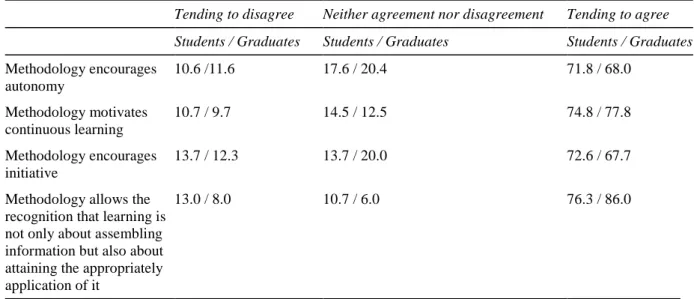
First, students’ results found that for at least 71%, the learning styles inspired by PBL within the Business Simulation experience encourages initiative, continuous learning, autonomy, and, prominently, intensifies the recognition that learning is not only about assembling information but also about attaining the appropriately application of it. That means that also a significant group of students (29% or less) show evidence of some doubts about the ability of the learning styles to foster such skills. Even though graduates’ results show a similar judgment, there are two main differences: on the one hand, graduates declare that initiative is not as developed as students suggest (5% less) and, on the other hand, graduates seem to give added value (10 % more) to the possibility of the learning styles inspired by PBL intensify the understanding that learning is more about the correct use of information than about gathering it (see Table 1).
Table 1 – Descriptors of students’ and graduates’ motivations and performances (rates)
Tending to disagree Neither agreement nor disagreement Tending to agree Students / Graduates Students / Graduates Students / Graduates Methodology encourages autonomy 10.6 /11.6 17.6 / 20.4 71.8 / 68.0 Methodology motivates continuous learning 10.7 / 9.7 14.5 / 12.5 74.8 / 77.8 Methodology encourages initiative 13.7 / 12.3 13.7 / 20.0 72.6 / 67.7
Methodology allows the recognition that learning is not only about assembling information but also about attaining the appropriately application of it
13.0 / 8.0 10.7 / 6.0 76.3 / 86.0
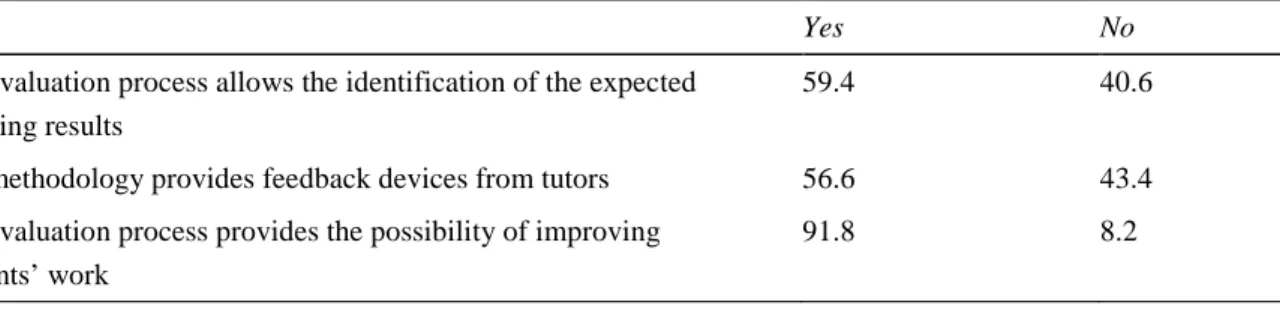
Second, it seems important to notice that more than 40% of students perceived that the evaluation process do not really allows the identification of the expected learning results. The same idea returns for the possibility of the methodology to provide feedback devices
from tutors. An interesting point, however, is that, for those students who receive feedback, the analysis shows that significant importance is given to the possibility of improving students’ work to better adjust to the expected objectives. Consequently, it can be infered that the feedback produced during tutorials is a driving force in increasing the students’ ability to follow their goals (see Table 2).
Table 2 – Descriptors of students’ assessment (rates)
Yes No
The evaluation process allows the identification of the expected learning results
59.4 40.6
The methodology provides feedback devices from tutors 56.6 43.4 The evaluation process provides the possibility of improving
students’ work
91.8 8.2
In a general way, students and graduates seized the importance of a PBL environment to attain a life-long learning perspective. They both perceived that methodologies motivated by PBL encourage an active participation of learners in the production of their own learning. But not all students or graduates feel that their autonomy or initiative skills were enhanced through PBL methodologies. Maybe, this can be explained by the fact that both of them had had their first PBL experience with the Business Simulation course.
In what concerns academics´ perceptions and opinions of students’ motivation and their outcomes, the study added four main issues.
Third, tutors described the learning production derived from the methodology as one of the most important aspects of the course. One tutor said:
Indeed, the most important aspect was not only to learn this but also to learn how to learn. That is, each time students were brought face to face with a new situation, they approached it from what they already knew, from what they had learnt, to learn. (Tutor K)
Some teachers underlined the pre-professional experiences and the learning how-to-learn as predisposed elements to a more self-directed and hands-on learning. One teacher commented:
They (students) are more secure about the problems they face. When a problem arises, as they already have confidence and have solved similar problems, they are more autonomous. (Tutor P)
Fourth, tutors seemed to believe that the contextualized problems that were steadily presented enabled the integration of earlier knowledge and the connection between theory and practice:
When there is a subject that connects together all the previous knowledge, students can picture the importance of what they have learnt before. And a lot of times I hear them say: “Look, that subject that was so hard for me to understand and that seemed to have no importance, is now the key for that application here (in the Business Simulation)”. (Tutor S)
Another tutor described the capacity of the methodology in Business Simulation to bridge the business and the educational worlds:
So, we left traditional methodologies behind that were, many times, very poor in the practical application of knowledge. We moved from a situation where information had little to do with reality to another situation where we looked for a handy application with high potential, the Business Simulation course. (Tutor K)
So, at the same time that academics were able to share their know-how as professionals, students were able to picture the significance of the material formerly obtained, specifically in the way it contributed to and brought together theory and professional practice.
Fifth, academics regard the adoption of the PBL environment as responsible for students’ motivation:
And if the teachers motivate them!... If teachers bring to the classroom practical situations of their own experience... I work in building construction and I have years of experience. And I put the problem that way “Faced with this problem, what would you do?” (Tutor S)
Nevertheless, academics recognize that the same PBL environment can be pretty stressful for many students and that the innovative nature of the course seems to evolve a gradual motivation amid students, as those make themselves more used to the methodology:
They (students) are very excited by it (the course). At the beginning, it is the opposite. - because they are unfamiliar with the process and they are afraid of the novelty. But from now on we don’t have to worry anymore because it has gained its own momentum. (Tutor B)
So, it is feasible that students can develop positive motivational feelings even if they did not originally have them.
Another interesting point is that the same innovative aspects and gradual familiarity seem able to enhance students’ self-esteem in a PBL environment:
Usually, they (students) arrive and they do not know what to do. There is uncertainty as to how this course works. But then, as they accomplish certain goals they become more secure and motivated till they even feel proud about their work. (Tutor E)
But tutors go further when they reflect upon students’ motivation. Really, academics refer intrinsic motivational drivers (as self motivation resulting from novel features and stipulated learning objectives) and extrinsic motivational drivers (the diversity of problems or the pragmatic nature of the course). In relation to these, tutors say:
We used to say that in the other subjects students learn a set block of information and simply disengage after the exams. But in the Business Simulation course, in methodological terms, in terms of motivation, it is a turning point. Because when facing a problem, students say “Given the knowledge that I have, I can achieve the objectives set for me”. (Tutor S)
It is the way the course is presented. It is the way that we have sought to embody the objectives of the Business Simulation course for the students. Since the moment they internalize that it is a real problem simulation, the receptiveness is totally different (Tutor S)
Sixth, it is well know that getting feedback is very important in the learning process (Ljungman & Silén, 2008). Academics described PBL students’ performance in an undoubtedly positive perspective. In their opinion, the feedback devices and the possibility of improving the work done, seems to have a clear benefit:
In this course no one ever fails. What we do is the following: we always give a second chance to revise a piece of work. Here, they make a mistake and learn what they have done wrong and then learn how to do it properly. The course has a succession of evaluation points that work as filters to students’ mistakes. (Tutor B)
So, joining the perspectives of students and academics, this study understands feedback as a positive procedure that results from a PBL organization founded on principles of continuous reflection and comment about the work done. As a result, it has a pivotal role in students’ performance. The centrality of this aspect derives from the possibility of a more proactive and motivational contribution and from the opportunity that students have to adjust their own mistakes. It can also be deduced that students seem inclined to take the opportunity to get their work better, and that the succeeding return has an enormous impact on their keenness and fortitude. Thus, feedback approaches jointly with the opportunity to accurate precedent mistakes materialize as filters that allow students to learn from their own errors.
In this context, findings show a promising picture of motivation either in an intrinsic or in an extrinsic way. Respondents emphasize the self-motivation inherent to the innovative nature of
a non-traditional teaching methodology, as a strong factor of intrinsic motivation. Extrinsic factors occur from the practical nature of the course and its real-world character. So, the virtual simulation environments that connect different working areas in the promotion of a multidisciplinary perspective, seems to act as a catalytic agent of motivation. However, we believe that the simple fact of facing an unfamiliar situation, in general, does not seem to be a good reason to be motivated. From this point of view, we wonder if the same pragmatism that justifies external motivations can impose itself more as an imperative to work out tangible problems than a stimulus for continuing.
At last, it is important to observe that even if PBL suggests motivation to be an integral component of the method, data collected from our case study revealed that this does not run in a straight-line.
7. Conclusions
More than a few studies (e.g. Dahlgren & Oberg, 2001) give emphasis to the students’ great motivation and enhanced performance provided by PBL methodologies. All along this research, we were able to analyze some students’, graduates’ and academics’ perceptions of motivational processes and performances within a PBL context. We argue that PBL methodologies can, eventually, reach diverse learning styles: from sensing to intuitive, from visual to verbal, from active to reflective, and from sequential to global. More, PBL tries to touch all those different aspects. Based on our evaluation, we uphold that it is possible to recognize two different types of branches that may rationalize the occurrence and the reinforcement of students’ motivation: intrinsic drivers (related to the innovative aspects of the methods) and extrinsic drivers (related to the practical environment of the model).
It is clear in the literature that providing students with different learning styles can be beneficial to work the ones less used. However, we believe that the simple fact of facing not so familiar situations, in general, does not seem to be a fine reason to be motivated. From this point of view, we speculate if the same diversity of learning styles that justifies motivation can enforce itself more as an imperative to work out tangible situations than an incentive for developing diverse skills.
Not so marked in the literature is the central role of feedback devices to correct students’ weakness as a catalytic agent of motivation and better performance. Even though the results presented must be interpreted with prudence, they allow us to hypothesise that correcting students failings using feedback devices in PBL methodologies seems to enhance learning in motivational terms and, consequently, in performance terms. Notwithstanding the fact that the questionnaires and interviews were (mostly) related with tutors’ feedback, we believe that peer feedback is another important element. Without a doubt, the easy fact that the study course runs within groups of two students is, definitely, of major importance in achieving a deeper understanding of how learning flows.
Finally, the idea that stimulating motivation will be reflected in the learning and results of students and graduates is of central importance. Throughout the study, performance issues were understood both in terms of results accomplished and in terms of what was learned during the PBL process. But the conversely problem was not addressed: the real dynamics of the entrepreneurial arena. In other words, even if PBL is shown to be a worthy value in the switch from school theory to professional practice, we speculate how the lack of contacts between recent graduates and the entrepreneurial world impact on graduates’ following performance. So, maybe, an additional appealing point can be added to the discussion: the perspective of employers.
At a time when HEIs are likely to aid students to enlarge a wide range of competencies (personal, social and professional) and alternative learning styles and strategies are been applied in vocational higher education, PBL methodologies are, more than ever, at the middle of interest. Our study findings sustain PBL learning styles as being reliable with the realization of these objectives. Still, as our research explores a single case study, we recommend that the findings presented in this paper serve as opening tips for future studies.
8. References
Albanese, M. A., & Mitchell, S. (1993). Problem-based learning: A review of literature on its outcomes and implementation issues. Journal of the Association of American Medical
Colleges, 68(1), 52-81.
Araz, G., & Sungur, S. (2007). The interplay between cognitive and motivational variables in a problem-based learning environment. Learning and individual differences, 17(4), 291-297.
Bayne, S. (2007). Higher Education as a visual practice: seeing through the virtual learning environment Teaching in Higher Education, 13(4), 395-410.
Boud, D., & Feletti, G. (1998). The challenge of problem based learning Bolton: Kogan Page.
Dahlgren, M. A., & Oberg, G. (2001). Questioning to learn and learning to question: structure and function of problem-based learning scenarios in environmental science education.
Higher Education, 41(3), 263-282.
Felder, R. (2010). Resources in Science and Engineering Education. Retrieved 2010/04/28, from http://www4.ncsu.edu/unity/lockers/users/f/felder/public/RMF.html
Felder, R., & Brent, R. (2005). Understanding Student Differences. Journal of Engeniring
Education, 94(1), 57-72.
Litzinger, T., Lee, S., Wise, J., & Felder, R. (2007). A Psychometric Study of the Index of Learning Styles. Journal of Engineering Education, 96(4), 309-319.
Ljungman, A. G., & Silén, C. (2008). Examination involving students as peer examiners.
Assessment & Evaluation in Higher Education, 33(3), 289-300.
Nijhuis, J., Segers, M., & Gijselaers, W. (2007). The interplay of perceptions of the learning environment, personality and learning strategies: a study amongst International Business Studies students. Studies in Higher Education, 32(1), 59-77.
North Carolina State University. Learning styles. Retrieved 2010/04/28, from
http://www4.ncsu.edu/unity/lockers/users/f/felder/public/Learning_Styles.html
Rawson, M. (2000). Learning to learn: more than a skill set. Studies in Higher Education,
25(2), 225-238.
Silén, C., & Juhlin, L. (2008). Self-directed learning - a learning issue for students and faculty. Teaching in Higher Education, 13(4), 461-475.