J. res.: fundam. care. online 2014. jul./set. 6(3):1302-1312
1302
INTEGRATIVE REVIEW OF THE LITERATURE
Terapia de reposição hormonal no climatério como fator de risco para o desenvolvimento do câncer de mama
Hormone replacement therapy in menopause as a risk factor for developing breast cancer Terapia de reemplazo hormonal en la menopausia como factor de riesgo para desarrollar cáncer de
mama
Natasha Firmino Souto 1 , Camila Brasil Moreira 2 , Paulo Augusto Soares Barros 3 , Ana Fátima
Carvalho Fernandes 4 , Míria Conceição Lavinas Santos 5
Objective: to analyze the scientific production involving the use of hormone replacement therapy during menopause as a risk factor for developing breast cancer. Method: an integrative literature review. The databases BDENF, LILACS and SciELO were used. There were 71 articles identified of which 24 comprised the sample. Results: it was observed that Brazil was the country with the most publications and Portuguese was the most queried language. Regarding the choice of study design, 50% of the studies had a methodological qualitative approach and the data collection method by means of documents was the most used. Conclusion: nurses as health professionals should advise women in per menopausal age about the risks and benefits of the use of hormone replacement therapy in order to assist them in adhering or not to treatment. Descriptors: hormone replacement therapy, breast neoplasms, menopause, nursing.
Objetivo: analisar a produção científica envolvendo o uso da terapia de reposição hormonal no climatério como um fator de risco para desenvolvimento de câncer de mama. Método: realizou-se uma revisão integrativa da literatura. Utilizamos as bases de dados BDENF, LILACS e SciELO. Identificamos 71 artigos, dos quais 24 compuseram nossa amostra. Resultados: observamos que o Brasil foi o país com mais publicações e o idioma mais requisitado foi o português. Em relação à escolha do delineamento do estudo, 50% dos estudos possuíam abordagem metodológica do tipo qualitativa e o método de coleta de dados por meio de documentos foi o mais utilizado. Conclusão: a enfermagem como profissional da saúde deve orientar as mulheres em idade perimenopausa sobre os riscos e benefícios do uso da terapia de reposição hormonal a fim de auxiliá-las na adesão ou não a esse tratamento. Descritores: terapia de reposição hormonal, neoplasias da mama, menopausa, enfermagem.
Objetivo: analizar la producción científica involucrando el uso de la terapia de reemplazo hormonal durante la menopausia como factor de riesgo para desarrollar cáncer de mama. Método: se realizó una revisión integradora de la literatura. Utilizamos las bases de datos BDENF, LILACS y SciELO. Se identificaron 71 artículos, de los cuales 24 formaban la muestra. Resultados: observamos que Brasil fue el país con el mayor número de publicaciones y la lengua portuguesa fue la más solicitada. En cuanto a la elección del diseño del estudio, el 50% de los estudios tenía aproximación metodológica de tipo cualitativo y el método de recogida de datos por medio de los documentos fue el más utilizado. Conclusión: enfermería como profesional de la salud debe aconsejar a las mujeres en edad peri menopáusica acerca de los riesgos y beneficios del uso de la terapia de reemplazo hormonal con el fin de ayudarles en el cumplimiento o no de este tratamiento. Descriptores: terapia de reemplazo de hormonas, neoplasias de la mama, menopausia, enfermería.
1 Nurse, Master's Student in Nursing at the Federal University of Ceara Nursing Department, Federal University of Ceara,
Fortaleza, Brazil. Email: [email protected]. 2Nurse, Graduate student in Public Health. Nursing Department, Federal
University of Ceara, Fortaleza, Brazil. 3Nurse, Specialist in Family Health Program. University Hospital Walter Cantídio.
Fortaleza, Ceará, Brazil. 4 PhD in Nursing, Full Professor, Federal University of Ceará, Nursing Department, Federal University
of Ceara, Fortaleza, Brazil.5Phd in Nursing from the Federal University of Ceará, Nursing Department, Federal University of
Ceara, Fortaleza, Brazil.
ABSTRACT
RESUMEN RESUMO
J. res.: fundam. care. online 2014. jul./set. 6(3):1302-1312
1303
M
enopause is a female sexual phase characterized by by definitive interruption her menstruations, from exhaustion in ovarian function. This usually occurs between 40 and 50 years of age, and is almost always followed by manifestations such as: thinning of the vaginal epithelium with loss of its secretions, reduction of breast masses, sensations of heat, redness, emotional instability, increased bone resorption with bone loss known as post-menopausal osteoporosis, as well as increasing the risk of coronary artery disease.1As a way to relieve the symptoms described above, is prescribed hormone replacement therapy (HRT). The short-term benefits are improvement or disappearance of vasomotor symptoms, improvement or disappearance of symptoms related to the central nervous system, improvement of vaginal and genital trophism, decrease of urinary symptoms and improvement in vaginal infections. In the long term, have decreased morbidity and mortality from atherosclerotic disease, decreased incidence of endometrial cancer (with an association of estrogen and progestin) and prevention of osteoporosis.2
However, despite these benefits studies show that the risks outweigh the benefits of such treatment, where replacement therapy for more than five years the addition of progesterone to estrogen replacement reduces the incidence of endometrial cancer, but does not reduce the risk of breast cancer.3-5
Based on the consulted articles and literature aiming to obtain a characterization of the work produced in the area of health involving this theme. It was decided to do an analysis of the evidence in order to understand if it is relevant to the association between the use of HRT in menopause be considered as a risk factor for the development of breast cancer. Moreover, from the data obtained in this study it becomes easier for health professionals to better clarify the patients at possible risk, developing ways and alternatives to minimize the effects of menopause. Thus contributing to a more conscious use of HRT on the part of both professionals and patients.
As it is a subject that is little explored by nursing, they need to deepen their knowledge about the use of HRT in postmenopausal women as a risk factor for the development of breast cancer, as a way to socialize such knowledge, between health professionals, especially nurses and in particular those who work directly with women's health. It is expected that this integrative review of the literature will serve as a motivation for further research, thereby promoting further development of the theme.
In this sense, this study aimed to identify the scientific production involving the use of HRT in menopause as a risk factor for breast cancer.
J. res.: fundam. care. online 2014. jul./set. 6(3):1302-1312
1304
METHOD
The study is characterized as an integrative literature review. The integrative literature review is characterized as one in which conclusions of previous studies are summarized in order to formulate inferences on a specific topic. Its implementation consists in the possibility of offering subsidies for the implementation of changes to promote the quality of conduct nursing through research models.6
For the elaboration of this Integrative Review, the methodological procedures were followed, described below: Formulation of the question / Problem and Objectives of the Review; the establishment of criteria for the selection of the articles (inclusion and exclusion criteria); Categorization of Studies; Evaluation of the studies included in the integrative review; Interpretation of the Data; Presentation of the results / Summary of the knowledge.6
The guiding question of this study was, "What are the risk factors associated with the use of HRT during menopause for breast cancer?”
The localization strategy of articles was querying them in the electronic databases, BDENF, LILACS and SciELO. There was no restriction as to the language and year of publication.
The search strategy in the database were used the terms Mesh (Medical Subject Headings) and the symbols of maxima will result (* ; " ") with the combination of terms and keywords: menopause; breast neoplasms; hormone replacement therapy and menopause; breast neoplasms; hormone replacement therapy.
The inclusion criteria were defined: type of sample - in post-menopausal women with use of hormone replacement; variable type - studies in which the variable hormone replacement was measured in menopause; hormone replacement was administered to women free of neoplastic disease; the extent of hormone replacement as a risk factor for breast cancer; type of outcome - breast cancer associated with exposure to hormone replacement in postmenopausal women; articles of journals published in Portuguese, English and Spanish, abstracts available in the selected databases, in the period between 1985 and 2010.
As exclusion criteria, articles without abstracts, articles with incomplete data; letters and abstracts; repetition of the same article in different databases.
The strategy for selection of studies was carried out by two researchers, regardless, which evaluated the titles and abstracts of articles identified by the strategy of broad search, checking each study that met the inclusion criteria of the integrative review.
The abstracts were reviewed by the researchers, in relation to articles indexed in more than one source of data, and in another language. Summaries of selected articles were read in their entirety, to verify if they met the objective of the integrative review. The summaries considered relevant were selected, retrieved and read in their entirety.
The data of each article were extracted and allocated on a form prepared by the authors. In the instrument were recorded; identification of the periodical (journal name,
J. res.: fundam. care. online 2014. jul./set. 6(3):1302-1312
1305
RESULTS AND DISCUSSION
year of publication, place of publication, language), goals and methodological aspects (type of study, method of data collection, outcome and thematic area),
At the stage of data analysis, the selected studies were analyzed individually to ensure the validity of the review. A critical analysis of the studies took place trying to explain the different or conflicting results in different studies, ie, the studies showed consistency with the purpose, methodology, discussion and outcome. Then the integrative studies selected for review were interpreted and performed the synthesis of the results, the main findings were discussed and presented in charts and tables.
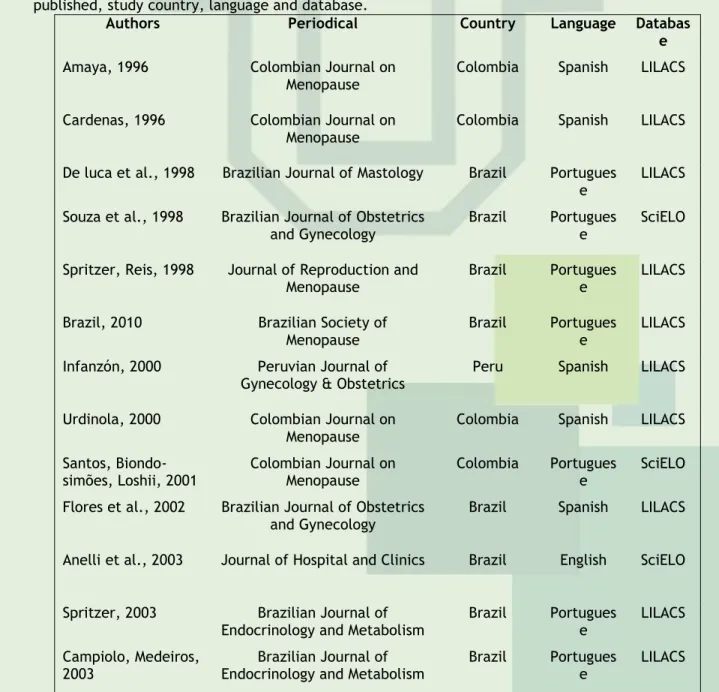
There were 71 articles identified, published in Lilacs (65%), Scielo (35%) and BDENF (0%). Of which 24 were selected, being 14, 10 and 0 articles, respectively of Lilacs, SciELO and BDENF. Of the 24 studies, 13 are national and 11 international, as presented in Figure 1.
Figure 1
.
Distribution of articles according to the author, year of publication, journal in which it was published, study country, language and database.Authors Periodical Country Language Databas
e Amaya, 1996 Colombian Journal on
Menopause Colombia Spanish LILACS
Cardenas, 1996 Colombian Journal on
Menopause Colombia Spanish LILACS
De luca et al., 1998 Brazilian Journal of Mastology Brazil Portugues e
LILACS Souza et al., 1998 Brazilian Journal of Obstetrics
and Gynecology
Brazil Portugues e
SciELO Spritzer, Reis, 1998 Journal of Reproduction and
Menopause
Brazil Portugues e
LILACS Brazil, 2010 Brazilian Society of
Menopause Brazil Portuguese LILACS Infanzón, 2000 Peruvian Journal of
Gynecology & Obstetrics Peru Spanish LILACS Urdinola, 2000 Colombian Journal on
Menopause Colombia Spanish LILACS
Santos,
Biondo-simões, Loshii, 2001 Colombian Journal on Menopause Colombia Portuguese SciELO Flores et al., 2002 Brazilian Journal of Obstetrics
and Gynecology
Brazil Spanish LILACS Anelli et al., 2003 Journal of Hospital and Clinics Brazil English SciELO Spritzer, 2003 Brazilian Journal of
Endocrinology and Metabolism Brazil Portuguese LILACS Campiolo, Medeiros,
J. res.: fundam. care. online 2014. jul./set. 6(3):1302-1312
1306
Gambacciani et al.,2003
Colombian Journal on Menopause
Colombia Spanish SciELO Mariño, 2004 Colombian Journal of Surgery Colombia Spanish SciELO Medina et al.,2004 Venezuelan Journal of
Oncology
Venezuela Spanish LILACS Bagarelli, Munhoz,
Oliani, 2004 Feminine Journal Brazil Portuguese LILACS Leão, Duarte,
Farias, 2005 Endocrinology and Metabolism Brazilian Journal of Brazil Portuguese SciELO Nahas et al., 2005 Brazilian Journal of Obstetrics
and Gynecology Brazil Portuguese LILACS Vílchez, Pedraja,
2005 Journal of Obstetrics and Gynecology of Venezuela Venezuela Spanish SciELO Peralta, 2006 Medical journal Clinic las
Condes
Chile Spanish LILACS Spritzer, Wender,
2007
Brazilian Journal of Endocrinology and Metabolism
Brazil Portugues e
SciELO Pardini, 2007 Brazilian Journal of
Endocrinology and Metabolism Brazil Portuguese SciELO Majilis, 2008 Chilean Journal of Radiology Chile Spanish SciELO
It was observed that the journal, in which the most studies were published addressing the issue of hormone replacement as a risk factor for the development of breast cancer has been the Brazilian Journal of Endocrinology and Metabolism with five publications (20.83%). It is believed that this occurred because of a journal that deals with themes related to endocrine function and metabolic which matches exactly with the use of HRT in menopause. In second place, was the Colombian Journal on Menopause with four publications (16.6%). Which is very relevant since it is a journal that deals with themes related to menopause, being completely related with the use of hormone therapy in postmenopausal women. In third place is the Brazilian Journal of Gynecology and Obstetrics with three publications (12.5%), which also addresses issues that have full connection with the use of HRT after menopause.
Upon analyzing the whole sample, it was observed that there were no publications in a particular nursing journal. All publications or occurred in general periodicals or journals in the medical area. This hinders the knowledge produced by nursing in being disseminated, thus necessitating the creation of more nursing journals in that address this issue.
We need more nurses are facing this issue because it is an area where they could make numerous interventions enough for a significant improvement in quality of life in postmenopausal women using HRT and even as a way to improve knowledge of these women on the use of hormonal therapies.
With respect to the years with the largest number of publications on this theme, they are in the year of 2003 with four articles (16.6%), followed by the year of 1998, 2004 and 2005 with three articles (12.5%) each.
With this, it was observed that from 1998 to 2005 there was a balance in the publications, or even the present growth. However, after 2005 there was a decline in
J. res.: fundam. care. online 2014. jul./set. 6(3):1302-1312
1307
production. Moreover, because it is such a relevant and current issues would be importantto continue the publication of such articles. Even as a way to assess whether the use of HRT in postmenopausal women is not even a risk factor or for the development of breast cancer.
For Polit and Hungler, nursing research presents a pace of rapid growth, and probably will increase in the 21st century.7
With this, can highlight 11 international publications (45.83%) in journals from Colombia, Chile, Venezuela and Peru, which shows us that the Spanish is a language quite chosen by researchers for international publications.
In Brazil the states that have been highlighted are São Paulo and Rio Grande do Sul This fact can be explained by a large concentration of universities in these locations, which increases the interest in disseminating scientific knowledge produced in universities through publications in journals.
Analyzing the degree of the researchers can identify those professionals who are included in the development and publication of research.
Most of the researchers identified were graduates (37.5%), however we know that the majority of graduates tend to publish with the accompaniment by a professor connected directly or indirectly educational institutions.
They are considered professors, such as associate professors, full professors, associate professors, lecturer and those who called themselves professors without mentioning their titration.
It is emphasize that in some studies (16.6%) the titration of authors was not found, which in some way involves a more accurate data processing with regarding the titration of authors. Often the titration is found, but no mention of whether they are teaching or not.
According to Lobiondo-Wood and Haber, the nurses of any educational level need to believe that evolution of nursing knowledge requires the development of research and that all professionals can participate in any phase of this process.8
As for the study design, half of the 12 studies (50%) adopted a qualitative approach, as shown in Table 1.
Table 1. Frequency and percentage of the studies according to the design of the studies.
Study Design f %
Qualitative 12 50.0
Quantitative 6 25.0
Quali-quantitative 6 25.0
Total 24 100.0
It is understood that by qualitative research which analyzes and interprets data related to the nature of phenomena, without the quantitative aspects are a concern. With a qualitative synthesized form is the name given to research that is worth the discursive reason.9
The qualitative research allows us to understand the problem in the environment in which it occurs without creating artificial situations that mask the reality which lead to equivocal interpretations and generalizations.10
According to Carvalho, such studies generate rich and descriptive data that allow the professional have an understanding of the complexity to which their patients under their care are involved.11
J. res.: fundam. care. online 2014. jul./set. 6(3):1302-1312
1308
The studies using the qualitative method working with values, beliefs,representations, habits, attitudes and opinions. They do not have any usefulness in measuring phenomena in large groups, being useful for anyone who seeks to understand the context in which some phenomenon occurs. Instead of measuring, their goal is to achieve a deeper understanding and, if necessary, the subjective object of study, without worrying about measures numerical and statistical analyzes.12
The result has been an upward trend in nursing publications within this perspective, considering it is a fundamental concern of nursing science the study of human experience on health.8
If it is assumed that to pursue nursing care and conducting field research, there needs to social interactions, and carefully listening to what people have and want to show as a good strategy to get information and interpretations regarding the practice through research.13 There six quantitative works (25%) found on this. For Lobiondo and Haber this
approach is based on the belief that human beings are a complex of many systems that can be measured objectively.8
According to Rodrigues, the following definitions apply quantitative investigations that rely predominantly on statistical data. This does not mean it cannot include qualitative data.9 Which will distinguish qualitative from quantitative is not just the use of numbers,
but the way of logical development.
In nursing research, it has been noted that quantitative methods are being used with little justification not are not appropriate for objects of study in this area of knowledge.14
There is an emerging trend for the integration of qualitative and quantitative data in studies, which were defined by quali-quantitative studies.8 There were six studies used in
this line during the period studied (25%).
This type of research with a methodological, quali-quantitative approach is complete. The proper approach will be chosen according to the profile of the author of the study and the techniques that allows them to accomplish it. The three types require knowledge, discipline and ability for their development.
In table 2, are presented the main methods used in the studies to obtain data. It is worth pointing out that although there have been 24 articles selected there are 26 methods presented, because some studies used more than one method for obtaining their data and all methods used were recorded.
According to Table 2, a considerable number of studies were conducted by using documents totaling 16 (61.53%).
Table 2. Frequency and percentage of the studies according to the data collection method.
Methods f % Unstructured Self-report Interview 2 7.69 Structured Self-report Questionnaires 2 7.69 Observation 1 3.85 Documents 16 61.53 Not described 1 3.85 Other 4 15.38 Total 26 100.00
The methods of data collection can be classified into methods of self-report, observation or bio-physiological measures. The self-reports can still be divided into
J. res.: fundam. care. online 2014. jul./set. 6(3):1302-1312
1309
structured, using questionnaires and scales, and can be semi-structured or unstructured, being usually obtained through interviews that can be completely free, focused, in groups, life or daily history that the subjects make.15The documental research closely resembles the bibliographic research. The difference is in the nature of the sources. The documentary research draws on materials not yet receiving analytical treatment, or cannot be reworked in accordance with the objects of the research.12
The interviews were 7.69 % of the sample. The goal of this interview is to elucidate the perceptions that individuals have about the world, that they be imposed without the worldview of the researcher. The main source of data in qualitative studies is the in depth conversation.15
As for the method of structured self-reporting, it was also found in 7.69% of questionnaires, i.e. two studies. In category observation, it is not described if only one work in each is found.
Also classified as others, found four studies (15, 38) where are studies that used dynamic drawings, modeling, testing, and other methods to collect their data.
Because it is a very specific theme did not, there was great variety in the thematic areas, Table 3. The thematic area that got more work was precisely hormone replacement therapy and the risk for development of breast cancer with 11 studies (45.83%). The use of HRT in women is still somewhat controversial due to its possible effects on the development of breast cancer in these women.
Table 3. Frequency and percentage of studies on hormone replacement therapy after menopause as a risk factor for the development of breast cancer in the journals indexed in the SciELO and LILACS databases according to the thematic area.
Thematic Area f %
Hormone replacement therapy in menopause 4 16.66
Hormone replacement therapy and the risk for development of breast cancer
11 45.83
Breast Cancer 3 12.50
Other 6 25.00
Total 24 100.00
The evidence points in the direction of increased risk of developing breast cancer in users of HT in post-menopause, dose- and time-dependent.16 However, there is still no
evidence sufficient to affirm that this treatment stimulates the emergence of new tumors or if it merely provides the faster growth of preexisting tumors.
However, research says that the treatment for more than five years does not add significant risk for breast cancer, but significantly decreases the risk of osteoporotic fractures.17, which shows us the HRT, a quite favorable in specific cases. However, it is
cautious to say that still needs further studies to reduce or abolish the risks of use of HRT. Breast cancer is a disease relatively rare and with few studies published so far. It is difficult to say precisely the relative risk between breast cancer and the use of HRT.18
In second place with four studies (16.66%) have hormonal therapy in postmenopausal women. Hormone replacement therapy in menopause has precise indications depending on the phase in which the woman is, pre, peri and post-menopausal women.
The main indication for hormone replacement therapy in menopause is the relief of menopausal symptoms, such as vasomotor symptoms, changes genito-urinary and prevention of osteoporosis in patients at risk. 17 However it is necessary to begin its use in certain
J. res.: fundam. care. online 2014. jul./set. 6(3):1302-1312
1310
CONCLUSION
known as "window of opportunity", period corresponding to the first three years of menopause where best cardiovascular and cognitive performances can be observed.
Also, observed three studies with the breast cancer theme (12.5%). And with broader and diverse issues in 6 studies (25%).
However according to experts, there is a need for a greater number of trials to assess the impact of combined replacement of androgens and estrogens on breast tissue.19
One of the topics discussed was classified with the theme of other in selected works, addressed precisely these hormones combined and as alternative solution to the possible risks of HRT.
The most important thing about this is that doctors should make their treatment decisions based on individual risks and benefits for each patient, taking responsibility and duty to promote the conditions for women going through the menopausal transition with quality of life.17
All research is to solve a significant problem for the profession or contribute to its solution, which usually constitutes a disturbing situation that needs to be investigated.20
According to the majority of these authors, the most important is to promote the use of HRT in a conscious manner. Such as, according to the need of each patient, weighing the risk-benefit and so that the woman can be informed of all of this, along with their physician whether or not to use it, by the type of hormone and the most favorable route. However, a correct position on the controversial issue of breast cancer development in the users of these therapies can only be acquainted with the development of more studies, which requires time and investment on the part of the professionals in the area. In particular, the information and dialog between professional and patient is paramount for accession or not to this kind of treatment.
Because it is a very specific, it is observed that the thematic area most addressed was HRT and the risk for development of breast cancer in 45.83% of the articles. This shows the great importance of the topic and the concern of professionals in conducting research and socialize knowledge obtained through further research.
Through the results of this study, health professionals and mainly nurses can strategize for further research and assistance of a more humane and holistic nursing. Hence the great importance of the development and publication of research.
Given the results obtained, it was observed that:
- There is a need to increase the number of studies, in order to obtain more data and knowledge in the research area.
- Encourage from graduating on, the importance of researching and especially to disseminate such data as a way to socialize knowledge.
- Improve the access of the synthesis of research results and insert them in nursing practice, by healthcare institutions.
J. res.: fundam. care. online 2014. jul./set. 6(3):1302-1312
1311
REFERENCES
- Insert more nursing in the thematic use of HRT as a way to broaden the field.
1. Berne RM, Levy MN, Koeppen BM, Stanton BA. Fisiologia. 5ª ed. Rio de Janeiro: Elsevier, 2004.
2. Brasil. Secretaria de Atenção à Saúde. Departamento de ações programáticas e estratégias. Manual de atenção à mulher no climatério/ Menopausa. Brasília: Editora do Ministério da Saúde, 2008.
3. Pinho VFS, Coutinho ESF. Variáveis associadas ao câncer de mama em usuárias de unidades básicas de saúde. Cad Saúde Pública 2007; 23(5): 1061-9.
4. Ruiz Flores M, Garibaldi I C, Contereas CP, Herrera R, Arteaga HE, Soto RE. WHI: riesgo de cáncer mamario y problemas cardiovasculares con terapia de reenplazo hormonal TRH combinada continua. Rev Obstet Ginecol Chile 2002;67(4): 263-74.
5. Brunner, Suddarth. Tratado de Enfermagem Médico-Cirúrgica, 2012.
6- Whitmore R, Knafl K. The integrative review: update methodology. J Adv Nurs 2005; 52 (5): 546-53.
7. Beck CT, Hungler BP, Polit DF. Fundamentos de pesquisa em enfermagem, 2004.
8. Lobiondo-wood G, Haber J. O papel da pesquisa em enfermagem. In:____. Pesquisa em Enfermagem: métodos, avaliação crítica e utilização. 4 ed. Rio de Janeiro:Guanabara-Koogan,2001.
9. Rodrigues RM. Pesquisa acadêmica: Como facilitar o processo de preparação de suas etapas. São Paulo. Atlas, 2007.
10. Cabral IE, Tyrrel MAR. O objeto de estudo e a abordagem de pesquisa qualitativa na Enfermagem. IN: Gauthier JHM. et al. Pesquisa em enfermagem: novas metodologias aplicadas. Rio de Janeiro: Guanabara Koogan, 1998.
11. Carvalho DR. Câncer de Mama: levantamento das produções científicas de Enfermagem no período 1994-2007. 2008. Monografia (Bacharelado em Enfermagem)- Departamento de Enfermagem, Universidade Federal do Ceará, Fortaleza, 2008.
12. Gil AC. Como elaborar projetos de pesquisa. São Paulo: Atlas, 2002.
13. Silva DGV, Trentini M. Narrativas de pesquisas em enfermagem. Rev. Latino-Am. Enfermagem 2002;10(3): 423-322.
14. Santos I, Clos AC. Pesquisa quantitativa e metodologia. Pesquisa em enfermagem: novas metodologias aplicadas. Rio de Janeiro: Guanabara Koogan, 1998.
15. Polit DF, Hungler BP. Fundamentos de pesquisa em enfermagem. 3. ed. Porto Alegre:Artmed,1995.
16. Nahas EAP, Lindsey SC, Vemura G, Nahas Neto J, Dalben I, Véspoli HL, Luca LA. Influência da terapêutica hormonal prévia sobre os indicadores de prognóstico do câncer de mama em mulheres na pós-menopausa. RBGO; 27(3): 112-117, 2005.
J. res.: fundam. care. online 2014. jul./set. 6(3):1302-1312
1312
17. Pardini D.Terapia hormonal da menopausa. Arq Bras Endocrinol Metab. 2007; 51(6): 938– 942.
18. Urdinola J. Terapia de reemplazo hormonal (THS) y cáncer de seno. Rev colomb menopaus. 2000;6(1): 89-92.
19. Leão LMCSM, Duarte MPC, Farias MLF. Insuficiência androgênica na mulher e potenciais riscos da reposição hormonal. Arq Bras Endocrinol Metab. 2005; 49(2): 205-16.
20. Polit DF, Beck CT, Hungler BP. Exploração da pesquisa em enfermagem. Fundamentos de pesquisa em enfermagem: métodos, avaliação e utilização. Porto Alegre: Artmed,2004.
Received on: 29/08/2013 Required for review: No Approved on: 25/04/2014 Published on: 01/07/2014
Contact of the corresponding author: Natasha Firmino Souto Rua Barros Leal, 2140. São João do Tauape. Fortaleza Ceará. E-mail: [email protected] Telefone: 85 9989 3674