Achievements of the Bologna process reforms – an
integrated management and IT approach
Raquel Velada1, Elsa Cardoso1, Ana Antunes1, António Caetano1, Rui Bento1, Francisco Aguiar1, Sílvia Silva1 and Manuel Menezes de Sequeira1
1
Lisbon University Institute (ISCTE-IUL)
Avenida das Forças Armadas, Edifício ISCTE, 1649-026 Lisboa, Portugal [email protected]
Keywords
Bologna Process, Decision Support Systems, Programme Performance Evaluation
1.
EXECUTIVE SUMMARY
In this paper we will describe a national perspective on the achievements of the Bologna Process in Portugal regarding the academic years of 2006/2007 and 2007/2008, and detail the approach followed at the Lisbon University Institute (ISCTE-IUL). The main objective of the paper is to describe the joint initiative that has been developed at ISCTE-IUL to implement a Decision Support System (DSS) that will enable the collection, analysis and dissemination (through reporting) of the required performance indicators to render possible an automatic elaboration of these reports. The paper will focus on the requirements gathering phase of the decision support system designed to enable the automatic generation of Bologna reports. This DSS constitutes a research project and is being developed with the sponsorship of the Computer Center (DSI) and Quality Assurance and Evaluation Office (GAQE), integrated with the University’s information system Fénix (based on FénixEDU®).
1.1. Background
Almost two years after the implementation of Bologna process, the Ministry of Science, Technology and Higher Education of Portugal (MCTES) passed a law (Act nº 107/2008) regarding the achievement of the Bologna process in terms of the real implementation of the new paradigm of teaching and learning set down by Bologna. In particular, Article 66º-A of the Act stipulates the elaboration of an annual public report comprising the level of achievement of the Bologna process in each Higher Education Institution (HEI) until the academic year of 2011. To comply with these legal requirements, ISCTE-IUL launched in October 2008 a task force comprising a team and the coordinator of GAQE. In addition to GAQE members, this team was composed by the President of the Pedagogical Council, and a group of two lecturers and two Master students specialized in Decision Support Systems working in close collaboration with the Information Systems Center of the University.
1.2. Conclusions
The consolidation of the Bologna process in HEI requires a swift production and communication of a set of integrated performance indicators. These indicators will enable the generation of the necessary information to monitor the quality of the teaching and learning in all programmes offered at ISCTE-IUL. This implies the gathering of a large amount of data, as well as the integration of diverse source systems. Unless a reliable IT approach is used, this may well result in a highly complex, time-consuming, or even maybe an unfeasible task given the quality standards that the University aims to deliver to its students. The proposed IT approach, based on the development of a Data Warehouse and Business Intelligence application, will be used to produce a subset of the Bologna reports for the 2008/2009 academic year. Expected outcomes of this approach are diverse, including the reliability reinforcement of the provided analysis and information.
2.
INTRODUCTION
The Bologna process introduced changes in the European Higher Education sector that can be considered an unique opportunity for Higher Education Institutions (HEI) to improve educational quality, attract new target groups of students, promote students mobility and to extend external relationships (OECD 2006). In this context, universities are expected to adjust their strategies and their positioning in the ever more globalizing and competitive world of Higher Education (HE).
In 2006, the Portuguese Government required an assessment of the status of the national HE sector by two international entities: the European Association for Quality Assurance in Higher Education (ENQA) and the Organisation for Economic Co-operation and Development (OECD). In particular, the OECD report recommended that Portuguese Universities and Polytechnics take responsibility for the educational success of their students. For instance, mechanisms should be introduced for obtaining systematic student feedback on the quality of teaching; feedback that should be communicated and used for performance improvement (OECD 2006, p. 105). In line with these recommendations, HEI regularly produce a report with the pedagogical assessment based on student questionnaires. Lisbon University Institute (ISCTE-IUL) also created a work group in 2006, which had the responsibility of implementing a teaching/learning evaluation system.
In August 2007, the Portuguese Government created an independent Agency for Evaluation and Accreditation of Higher Education and parliament passed a new legal framework for the evaluation of HE (Act nº 38/2007). The purpose of this new Act is to assess the quality of performance of HEI by measuring the degree of achievement of its mission using a set of performance parameters (Article 4 of the Act). In response to the new legal framework, ISCTE-IUL decided to create a Quality Assurance and Evaluation Office (GAQE) in order to comply with the new demands for internal quality assurance and self-assessment procedures. As a result of these new demands, GAQE extended the internal evaluation system to non-academic staff (in 2008) and to the academic staff (in 2009). Moreover, a Quality Management System according to ISO 9001 has been implemented for the University’s support services, which has been certified in December 2008.
Almost two years after the implementation of Bologna process, the Ministry of Science, Technology and Higher Education of Portugal (MCTES) passed a law (Act nº 107/2008) regarding the achievement of the Bologna process in terms of the real implementation of the new paradigm of teaching and learning set down by Bologna. In particular, Article 66º-A of the Act stipulates the elaboration of an annual public report comprising the level of achievement of the Bologna process in each HEI until the academic year of 2011. The Act prescribed main guidelines for the report. Therefore, each HEI had the freedom to compose a structure and the contents of the report that matched the required guidelines. To comply with these legal requirements, ISCTE-IUL launched in October 2008 a task force comprising a team and the coordinator of GAQE. In addition to GAQE members, this team was composed by the President of the Pedagogical Council, and a group of two lecturers and two Master students specialized in Decision Support Systems working in close collaboration with the Information Systems Center of the University. The first reports on the achievements of the Bologna process reforms referring to the academic years of 2006/2007 and 2007/2008 were published online on December 31, 2008. A survey on the implementation of the Bologna process in Portugal has also been recently published (Veiga & Amaral, 2009).
In this paper we will describe a national perspective on the achievements of the Bologna Process in Portugal regarding the academic years of 2006/2007 and 2007/2008, and detail the approach followed at ISCTE-IUL. The main objective of the paper is to describe the joint initiative that has been developed at ISCTE-IUL to implement a Decision Support System (DSS) that will enable the collection, analysis and dissemination (through reporting) of the required performance indicators to render possible an automatic elaboration of these reports. The paper will focus on the requirements gathering phase of the decision support system designed to enable the automatic generation of Bologna reports. This DSS constitutes a research project and is being developed with the sponsorship
of the Computer Center (DSI) and GAQE, integrated with the University’s information system Fénix (based on FénixEDU®).
The paper describes a critical evaluation of the current method used for collecting the required data to calculate the performance indicators, as well as the new technical infrastructure that is being developed using Business Intelligence and Data Warehousing methodologies and technologies. The outcome of this initiative will be expressed in terms of the agility in the reports’ elaboration, but more importantly in terms of reliability of the provided information. By strengthening the communication of the objectives and indicators used in the self-assessment reports to the community and especially to the University’s internal stakeholders, and by establishing clear responsibilities, we expect to engage them in a more active participation in term of information gathering.
3.
A NATIONAL PERSPECTIVE ON THE ACHIEVEMENTS OF THE BOLOGNA
PROCESS IN PORTUGAL
3.1. Achievements of the Bologna Process Report at ISCTE-IUL
As stated before, in order to answer to the legal requirement stipulated by Article 66º-A of the Act nº 107/2008, ISCTE-IUL launched in October 2008 a task force with the mission of elaborating a report on the achievements of the Bologna Process referring to the academic years of 2006/2007 and 2007/2008.
The report elaboration process started with the GAQE definition and construction of the main structure of the document. Based on a first data collection from different sources, the GAQE team elaborated a draft report for each programme of the Institution. The data sources included both digital data available from the University Information system (Fénix), and non-digital data gathered from the programme creation legal Acts, the Academic, Internationalization and Human Resources Offices. These first draft reports were then sent to the Head of each Department and corresponding Pedagogical coordinators for validation and completion of required information. GAQE later assembled those reports, and elaborate a single report for the Institution with aggregated data. This report was published in the University website on December 31, 2008, as required by the MCTES. The ISCTE-IUL report is structured according to seven main points:
1. Introduction;
2. Overall Description of the Institution; 3. Bologna Process Preparation;
4. Bologna Process Implementation; 5. ISCTE-IUL Quality Assurance System; 6. Student Support Actions and Policies; and
7. Conclusions and Action Points to reinforce the Quality of Teaching Assurance.
The introduction section of the report describes the methodology used to produce the report and its structure. In the second section, it is presented an overall description of the institution including:
• an indication of the existent programmes already adequate to Bologna in the academic years of 2006/2007 and 2007/2008;
• the teaching staff description for each programme (according to their education level); • the students description for each programme, including:
o demographic characteristics (age and gender)
o a summary of student admission process data (ratio of first option applicants / number of vacancies, minimum application classification of the enrolled students in the programme);
• a brief description of ISCTE-IUL’s students support services (such as grants and awards); • a short description of ISCTE-IUL’s Library services and documentation centers; and • the presentation of some indicators of competiveness (in terms of strength and weakness
ratios).
The third section of the report describes the Bologna Process Preparation with reference to global or institutional-wide initiatives and specific departmental or programme-level initiatives carried out at ISCTE-IUL. An example of the latter ones was the adjustment of the assessment methodologies to the new teaching paradigm introduced by the Bologna Process.
Section four focused on the implementation of the Bologna Process and the subsequent changes that occurred in the Institution and its programmes, in particular. These changes included:
• programme ECTS restructuring,
• acquisition and development of new competences, • adjustment of student workload hours,
• new programme curricula by ECTS and type of classes, and
• mobility indicators, such as the level of internationalization of students and teachers. The fifth section presents a description of the quality assurance system in place at ISCTE-IUL, highlighting the quantitative data collected from student satisfaction questionnaires, and qualitative opinions of teachers and students regarding the implementation of the Bologna process.
Section six details the actions and policies implemented for student support, regarding student academic success, the development of extracurricular and generic or cross-functional competences, and student employability and labour market integration. With respect to student academic success it was decided to present one high-level quantitative indicator – the percentages of students that have concluded their programme, i.e., number of graduates.
Finally, the last section presents the generic conclusions and future action points to reinforce the quality of teaching assurance.
3.2. Achievements of the Bologna Process Report at Other Universities
In fulfilment of the legal requirements of the Act nº 107/2008 (Article 66º-A), each Portuguese University had to elaborate a report describing their approach for the implementation of the Bologna process on the past two academic years. This section provides a discussion on the most interesting aspects, from our point of view, of some reports from other public Universities in Portugal1. The goal is to identify the common approaches followed in Portugal (benchmarking) in order to improve the
1
University of Porto (Engineering Faculty: FEUP, Faculty of Medicine: FMUP, Faculty of Psychology and Sciences of Education), Technical University of Lisbon (Engineering Faculty: Instituto Superior Técnico), University of Lisbon, University of Coimbra (Faculty of Sciences and Technology), University of Madeira, University of Minho, University of Trás-os-Montes and Alto Douro: UTAD, University of Aveiro, and New University of Lisbon (Faculty of Economics and Management).
structure and contents of next year’s Bologna report at ISCTE-IUL, as they will have to be issued annually until the academic year of 2011.
It should be pointed out that in 2008 HEI only had a short period of time (three months) to comply with this request of the MCTES. Therefore, it is not surprising that the majority of the reports have a more qualitative nature. The ones that present quantitative data are from Universities that already have a stable integrated Information System. However, there is no consensus on the quantitative indicators used, apart from the student admission process. But, an overall analysis on the reports is fairly positive, as they provide many different and useful ideas for Universities that are committed to improve their quality systems.
Veiga and Amaral (2009, p. 59) presented the results of a survey on the implementation of the Bologna process in Portugal, where they stress that, although the Portuguese Ministry of Science, Technology and Higher Education and the Bologna Follow-up Group “scored Portugal as having very good performance on the implementation of the European Qualifications Framework (…) there was no evidence that such a framework existed in Portugal, and the law establishing the Bologna-type structure only mentioned the Dublin descriptors”. This view is corroborated by our analysis of the reports. We found only very few reports mentioning the European Qualifications Framework (e.g., Faculty of Psychology and Sciences of Education, from the University of Porto).
Although recently created, the Portuguese Agency for Evaluation and Accreditation of Higher Education has not yet started to issue recommendations and guidelines for University quality assurance systems. Consequently, HEI have started to develop their own systems, and described their approaches in the Bologna reports, such as in the Engineering Faculty of the Technical University of Lisbon, University of Lisbon, University of Coimbra, University of Aveiro, and University of Minho reports.
Instituto Superior Técnico (IST), the Engineering Faculty of the Technical University of Lisbon presents a very interesting approach to quality assurance of course units. They attempt to provide a quantitative indicator to measure the Bologna implementation in terms of the change towards the new paradigm of teaching based on competences development rather than on a knowledge-based teaching and learning. This paradigm change imposed a necessary adjustment of evaluation methods in course units. They used the evaluation method classification proposed by Biggs (2003), which distinguishes traditional evaluation methods (e.g., written exams and tests) from performance evaluation that applies to new methods more aligned with competences development (e.g., reports, presentation and discussion sessions, dissertations, field projects, and paper assignments).
The proposed metric to measure the Bologna paradigm change in the Institution and its programmes is:
• the proportion of course units that use performance evaluation methods (considering also the different weight proportions assigned to each type of evaluation in each course) • the weight of the traditional model based on two main types of classes (theoretic, and
practical) on the student workload hours of contact.
The University of Minho has also conducted a “full reformulation” of teaching/learning evaluation methodologies, given a greater emphasis on student’s work and the use of new methodologies such as, distance learning, active learning, tutorial supervision, cooperative learning, problem-solving learning, and project-led learning. Another point of notice is the initiative of this University in consulting international experts to gather information that supports students and teachers in the implementation of the Bologna process (in terms of autonomous learning). To this end, they assembled a group of 15 teachers with different backgrounds to support training sessions for teaching staff and the development of learning competences in 1st year students.
A similar approach was carried out at the University of Aveiro, where a new institutional programme for advanced training of Higher Education teacher (FADES - Formação Avançada de Docentes do Ensino Superior, in Portuguese) was created with the purpose of introducing innovation in the teaching and learning methodologies. Eleven training sessions and workshops were reported on the 2007 academic year.
The Engineering Faculty (FEUP) of University of Porto also reports a list of 26 pedagogical training sessions for teachers that occurred from 2006 to 2008. Another relevant point in this report is the development of initiatives for measuring the pedagogical changes towards the new teaching paradigm. In particular, three questionnaire-based initiatives are described for measuring: (1) the student learning styles; (2) the pedagogical process (in terms of teachers and course units’ pedagogical performance, and student workload effort); and (3) the training adequacy on the perspective of employers and alumni.
In our opinion, the report from the Faculty of Sciences and Technology of the University of Coimbra presents a very complete quantification of the student admission process. It also provides quantitative data regarding the academic success of students based on two indicators: the average real approval rate of the programme and the number of graduates (for 1st, 2nd, and 3rd study cycles).
The report from the Faculty of Medicine (FMUP) of University of Porto presents a worth-reading approach with performance measures categorized in dimensions of analysis. For instance, they propose ‘reference indicators’ for life-long learning (i.e., their description of the student admission process), quality evaluation (of programmes, course assessment methodologies, teaching staff, student success, etc), synergies between research and teaching, flexibility of programmes, and student and teacher mobility (‘in’ and ‘out’).
3.3. Critical review on ISCTE-IUL report
The Bologna process has been amply discussed in academia. However, by producing the Bologna reports, Universities naturally embraced more mature reflections on their achievements. At ISCTE-IUL, the Pedagogical Council promoted a session with programme coordinators to present and debate a critical review of the Bologna reforms. Table 1 presents a synthesis of the strengths and weaknesses/issues to improve of the Bologna implementation process at ISCTE-IUL.
4.
AN INTEGRATED MANAGEMENT AND IT APPROACH
From an IT perspective, the required data for the Bologna reports was spread throughout several Departments, Offices, and IT systems. The effort to mobilize everyone in the Institution was huge, and the natural resistance to deliver data in time was significant. Given the time frame available (3 months) and the already described constraints, the final quantitative outcomes achieved in the report are significant.
This experience of compiling data from all programmes from multiple sources (people and systems) has made even more evident the advantages of developing a Decision Support System (DSS) that will enable the collection, analysis and dissemination (through reporting) of the required performance indicators to render possible an automatic elaboration of the annual Bologna reports, and in the future the more generic programme self-assessment reports.
Table 1. Main Strengths and issues to improve of the Bologna implementation at ISCTE-IUL
STRENGTHS
Adaptation of study programme curricula according to the Bologna model requirements, achieved in time and based on national and international reference models
Implementation of a set of diverse initiatives to trigger and monitor the Bologna process Improvement of the pedagogic monitoring activities, including the introduction of a new middle-semester evaluation, and the adjustment and application of an existent final evaluation to both 1st and 2nd cycle programmes
Involvement of teachers in the Bologna process changes
Reinforcement of responsibility for both students and teachers in the new learning process focused on the competencies development
Effort to improve the student-teacher proximity, by promoting the practice of lab and tutorial classes, weekly-assigned accompaniment sessions, and pedagogical meetings
ISSUES TO IMPROVE
Improvement of study programme curricula, taking into account the:
- Development of different types of competencies (generic and specific) - Better articulation between course units
- Increase of interdisciplinarity
- Student workload adjustment (contact and autonomous work hours)
Promote change in students’ habits and work strategies, towards more proactive, autonomous and competency-oriented methods
Improve the systematic and global pedagogic monitoring process
Ensure a high quality pedagogical training of teachers in terms of the Bologna teaching paradigm, and pedagogic methods and techniques
Improve and increase Institutional services and resources that support teaching and learning process
Improve the definition of course unit descriptions, in terms of evaluation methodologies, proportion of different types of classes, and learning outcomes including the specification of generic, specific and cross-functional competencies
The Bologna challenge also assumes that Universities strengthen their quality assurance systems, and particular their performance reporting systems. Undoubtedly, decision support systems can play a central role in guaranteeing the necessary data quality and integration, which are crucial for a transparent, and trusted reporting of performance. For several years, decision support systems have been applied to Higher Education in different contexts (Cardoso et al., 2003; Oliveira and Domingues, 2004; Mahnic and Pozenel, 2004). Given the new legal impositions of annual self-assessment procedures, it is our belief that the best path to follow is an integrated management and IT approach enabling the automatic generation of reports.
To this end, we started a joint initiative at ISCTE-IUL on September 2008 with a task force of two teachers from the Department of Information Sciences and Technologies, and two Computer Science Engineering master students, with the sponsorship of the Computer Center (DSI) and GAQE, integrated with both the GAQE team and the University’s information system Fénix (based on FénixEDU®) developers. The outcome of the two master theses will be a first version of a DSS designed to enable the automatic generation of a subset of the Bologna reports for the 2008/2009 academic year. From an IT perspective, one teacher specialised in Business Intelligence/DSS and
Data Warehousing and the current director of the Computer Center are supervising this research project. From a management perspective, the Director of GAQE and the Pedagogical Council supervise this research project, and are also the main clients and final users of the system. ISCTE-IUL members will be beneficiaries of the system outcomes.
4.1. Implementation of a Decision Support System
The Data Warehouse implementation methodology used in the project is the Dimensional Lifecycle methodology proposed by Ralph Kimball (2008). Figure 1 illustrates the different phases of the methodology that will be addressed
Figure 1. DW Lifecycle Methodology (Kimball et al., 2008)
One master thesis focuses on the following phases of the DW/BI project: business requirements definition, dimensional model
the end-user).
The business requirements definition phase comprises the analysis of the Bologna reports delivered by the end of 2008, by ISCTE
performance indicators that
comprehensive self-assessment programme reports. The project will focus on two crucial processes: programme performance evaluation and the student admission processes.
Dimensional modelling, a logical design technique used in Data Warehouses, project. A dimensional model stores data in a ‘start
query performance and resilience to change. The BI application s include the design and implementation of the final end
that will be necessary for the Bologna reports. The overall illustrated in Figure 2.
The second master thesis will be mainly responsible for the data integration work and the implementation of the physical model of the DW. Data integration in the staging area is also a very critical and time-consuming task; it involves three main pro
and Loading (ETL). The technical architecture used in the typical DW/BI infrastructure (see Figure Data Warehousing and the current director of the Computer Center are supervising this research om a management perspective, the Director of GAQE and the Pedagogical Council supervise this research project, and are also the main clients and final users of the system.
IUL members will be beneficiaries of the system outcomes.
of a Decision Support System
The Data Warehouse implementation methodology used in the project is the Dimensional Lifecycle methodology proposed by Ralph Kimball (2008). Figure 1 illustrates the different phases of the methodology that will be addressed by the two master theses.
Figure 1. DW Lifecycle Methodology (Kimball et al., 2008)
One master thesis focuses on the following phases of the DW/BI project: business requirements definition, dimensional modelling, and the specification and development of the BI Application (for The business requirements definition phase comprises the analysis of the Bologna reports delivered by the end of 2008, by ISCTE-IUL and other Public HEI. The goal is to gather a validated set of rs that enable the automatic generation of the Bologna and future more assessment programme reports. The project will focus on two crucial processes: programme performance evaluation and the student admission processes.
, a logical design technique used in Data Warehouses, is a critical phase in the . A dimensional model stores data in a ‘start-like’ structure optimized for user understanding, query performance and resilience to change. The BI application specification
include the design and implementation of the final end-users applications, like the reporting system that will be necessary for the Bologna reports. The overall technical infrastructure
will be mainly responsible for the data integration work and the implementation of the physical model of the DW. Data integration in the staging area is also a very consuming task; it involves three main processes called Extraction, Transformation and Loading (ETL). The technical architecture used in the typical DW/BI infrastructure (see Figure Data Warehousing and the current director of the Computer Center are supervising this research om a management perspective, the Director of GAQE and the Pedagogical Council supervise this research project, and are also the main clients and final users of the system. All
The Data Warehouse implementation methodology used in the project is the Dimensional Lifecycle methodology proposed by Ralph Kimball (2008). Figure 1 illustrates the different phases of the
Figure 1. DW Lifecycle Methodology (Kimball et al., 2008)
One master thesis focuses on the following phases of the DW/BI project: business requirements f the BI Application (for The business requirements definition phase comprises the analysis of the Bologna reports delivered IUL and other Public HEI. The goal is to gather a validated set of enable the automatic generation of the Bologna and future more assessment programme reports. The project will focus on two crucial processes:
is a critical phase in the like’ structure optimized for user understanding, cification & development phases users applications, like the reporting system technical infrastructure of the project is
will be mainly responsible for the data integration work and the implementation of the physical model of the DW. Data integration in the staging area is also a very cesses called Extraction, Transformation and Loading (ETL). The technical architecture used in the typical DW/BI infrastructure (see Figure
2), where data is extracted from source systems (two in the project: the University’s IS Fénix, and the database provided by the Higher Education Division
and then transformed, ‘cleaned’ to overcome inconsistencies and poor data quality, and finally loaded onto the central repository
later explored in the fourth level of the architecture applications have been developed. In the project, be used as the reporting tool.
In the product selection and installation phase 2008 Enterprise Edition and the open
of both products, the Microsoft platform was selected
project. The main reason was the stability of the current enterprise version, and the set of integrated tools provided in the platform, namely Integration services.
The project is ongoing, and it is scheduled to deliver a first prototype, usable by the GAQE team, by September 2009. The next section will present a partial output of the business requirements definition phase. Most Universities have opted to present a high level view of
of students based on two indicators: the average real approval rate of the progra
number of graduates. Using a decision support system it is possible to derive more aggregated data concerning the academic success of student
reasons behind the good or poor performance.
2
Direcção Geral do Ensino Superior (DGES), in Portuguese.
2), where data is extracted from source systems (two in the project: the University’s IS Fénix, and vided by the Higher Education Division2 with the national student admission data), and then transformed, ‘cleaned’ to overcome inconsistencies and poor data quality, and finally loaded onto the central repository (a database with a dimensional model struct
later explored in the fourth level of the architecture – the end-user access layer, where the BI applications have been developed. In the project, Microsoft SQL SERVER 2008 Reporting Services be used as the reporting tool.
Figure 2. Technical DW/BI architecture
selection and installation phase two BI platforms have been considered:
and the open-source Pentaho BI suite. After the evaluation and installation crosoft platform was selected to develop an
end-The main reason was the stability of the current enterprise version, and the set of integrated tools provided in the platform, namely Integration services.
ngoing, and it is scheduled to deliver a first prototype, usable by the GAQE team, by September 2009. The next section will present a partial output of the business requirements definition phase. Most Universities have opted to present a high level view of
of students based on two indicators: the average real approval rate of the progra
number of graduates. Using a decision support system it is possible to derive more aggregated data academic success of students and even study and explore the data to discover the reasons behind the good or poor performance.
Direcção Geral do Ensino Superior (DGES), in Portuguese.
2), where data is extracted from source systems (two in the project: the University’s IS Fénix, and with the national student admission data), and then transformed, ‘cleaned’ to overcome inconsistencies and poor data quality, and finally (a database with a dimensional model structure). The data is user access layer, where the BI Microsoft SQL SERVER 2008 Reporting Services will
two BI platforms have been considered: SQL Server source Pentaho BI suite. After the evaluation and installation -to-end solution for the The main reason was the stability of the current enterprise version, and the set of
ngoing, and it is scheduled to deliver a first prototype, usable by the GAQE team, by September 2009. The next section will present a partial output of the business requirements definition phase. Most Universities have opted to present a high level view of the academic success of students based on two indicators: the average real approval rate of the programme and the number of graduates. Using a decision support system it is possible to derive more aggregated data and even study and explore the data to discover the
4.2. Programme Performance Evaluation Study
This section presents an example of the first output of the research project, whose implementation is currently on going at
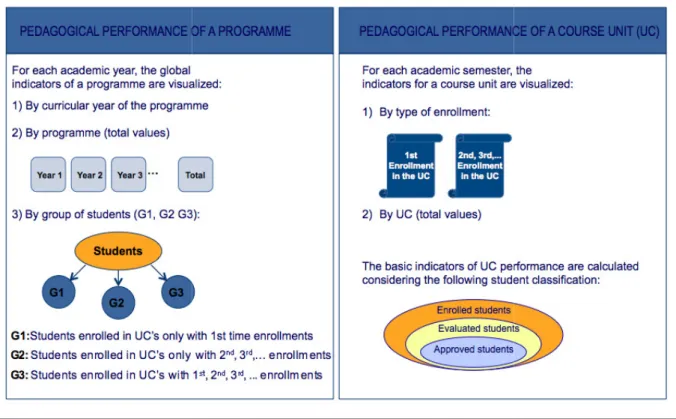
ISCTE-We will focus only on programme performance evaluation indicators. For each academic year, this assessment includes a hierarchy of analysis: student, course unit and prog
most global analysis is the performance evaluation of the programme, which is built based on the aggregation of the indicators from the other two analyses. Figure 3 illustrates the key aspects taking into account in the performance e
Figure 3. Programme and course unit performance evaluation
Programme pedagogic performance
As displayed in Figure 3, to deeply analyze the performance of a programme it is useful to divide the total student population into the following three segment or groups of students:
• G1: students enrolled only in course units (UC) for the first time (i.e., left behind);
• G2: students only enrolled in courses which have been left behind (i.e., only with 2 more-enrolments in all of their UCs);
• G3: students enrolled in courses for the first time and in courses left behind (i.e., students enrolled in UCs with 1
Table 2 describes the global performance indicators of a programme for calculated considering the individual performance of the programme’s students.
In Portugal, the indicators for student academic success are reported annually in official statistics inserted in an application called RAIDES (model
Programme Performance Evaluation Study
This section presents an example of the first output of the research project, whose implementation -IUL, in order to support the elaboration of next year’s Bologna reports. We will focus only on programme performance evaluation indicators. For each academic year, this assessment includes a hierarchy of analysis: student, course unit and programme performance. The most global analysis is the performance evaluation of the programme, which is built based on the aggregation of the indicators from the other two analyses. Figure 3 illustrates the key aspects taking into account in the performance evaluation programmes and course units.
Figure 3. Programme and course unit performance evaluation
Programme pedagogic performance
As displayed in Figure 3, to deeply analyze the performance of a programme it is useful to divide the tion into the following three segment or groups of students:
G1: students enrolled only in course units (UC) for the first time (i.e.,
students only enrolled in courses which have been left behind (i.e., only with 2 enrolments in all of their UCs);
students enrolled in courses for the first time and in courses left behind (i.e., students enrolled in UCs with 1st, 2nd or more enrolments).
Table 2 describes the global performance indicators of a programme for these groups of students, calculated considering the individual performance of the programme’s students.
In Portugal, the indicators for student academic success are reported annually in official statistics inserted in an application called RAIDES (models ESUP 10.2 e 11.2) and sent to the
This section presents an example of the first output of the research project, whose implementation IUL, in order to support the elaboration of next year’s Bologna reports. We will focus only on programme performance evaluation indicators. For each academic year, this ramme performance. The most global analysis is the performance evaluation of the programme, which is built based on the aggregation of the indicators from the other two analyses. Figure 3 illustrates the key aspects taking
Figure 3. Programme and course unit performance evaluation
As displayed in Figure 3, to deeply analyze the performance of a programme it is useful to divide the tion into the following three segment or groups of students:
G1: students enrolled only in course units (UC) for the first time (i.e., with no courses students only enrolled in courses which have been left behind (i.e., only with 2nd or students enrolled in courses for the first time and in courses left behind (i.e.,
these groups of students, calculated considering the individual performance of the programme’s students.
In Portugal, the indicators for student academic success are reported annually in official statistics s ESUP 10.2 e 11.2) and sent to the Ministry of
Science, Technology and Higher Education of Portugal. Table 3 presents a summary of the necessary indicators concerning the high-level view of the academic success of a programme.
Table 2. Global indicators of programme performance
CODE INDICATOR FORMULA
N-INS Total number of enrolled students
By programme, by curricular year, by group of students (G1 G2, G3)
N-UC Number of course units (UC’s) in the curricular year
By programme, by curricular year
N-avg UC-INS Average number of UC’s of enrolment
By programme, by curricular year, by group of students (G1 G2, G3
N-avg UC-APR Average number of UC’s with approval
By programme, by curricular year, by group of students (G1 G2, G3
Overload Index Overload Index By programme, by curricular year, by group of students (G1 G2, G3:
= N-avg UC-INS / N-UC
Table 3. Global indicators of academic success of a programme
CODE INDICATOR FORMULA
N-DIPL-prog Number of graduate students (i.e., that conclude the programme)
By programme, by sex, by age, by country of nationality, by total classification or final grade, by number of academic years from admission until programme conclusion
N-TRAN-year Number of students that transit to next academic year.
By curricular year, by sex
N-UC-diploma Number of UCs with approval considered for the diploma conclusion
By programme:
Average of UCs concluded (i.e. with approval) by students that have graduated the programme
Course unit pedagogic performance
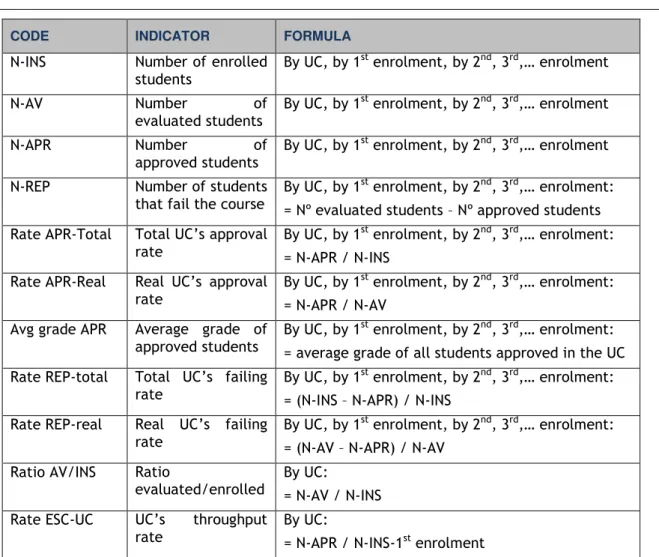
The pedagogical performance of a course unit can be assessed, for each academic semester, using the set of indicators reported in Table 4. As represented in Figure 3, the basic indicators of UC performance consider the following division of students in a UC: enrolled, evaluated, and approved. Evaluated students are students enrolled in a UC that are present and conclude (with or without success) at least one evaluation or examination test, and therefore have an assigned grade between 0 and 20. Approved students are those that passed the course.
By explicitly identifying students enrolled with a 1st enrolment in the UC from the repeaters we are able to analyze if the pedagogical performance of students with 1st enrolments in a UC is different from the performance of students having a 2nd, 3rd, or more enrolment in the UC.
One way to evaluate the success of an UC is to analyze the throughput rate of the UC, defined by the ratio between the students that ‘leave’ (the approved) and the students that ‘enter’ the UC (the ones with a 1st enrolment).
Table 4. Indicators of UC performance
CODE INDICATOR FORMULA
N-INS Number of enrolled students
By UC, by 1st enrolment, by 2nd, 3rd,… enrolment
N-AV Number of
evaluated students
By UC, by 1st enrolment, by 2nd, 3rd,… enrolment
N-APR Number of
approved students
By UC, by 1st enrolment, by 2nd, 3rd,… enrolment N-REP Number of students
that fail the course
By UC, by 1st enrolment, by 2nd, 3rd,… enrolment: = Nº evaluated students – Nº approved students Rate APR-Total Total UC’s approval
rate
By UC, by 1st enrolment, by 2nd, 3rd,… enrolment: = N-APR / N-INS
Rate APR-Real Real UC’s approval rate
By UC, by 1st enrolment, by 2nd, 3rd,… enrolment: = N-APR / N-AV
Avg grade APR Average grade of approved students
By UC, by 1st enrolment, by 2nd, 3rd,… enrolment: = average grade of all students approved in the UC Rate REP-total Total UC’s failing
rate
By UC, by 1st enrolment, by 2nd, 3rd,… enrolment: = (N-INS – N-APR) / N-INS
Rate REP-real Real UC’s failing rate
By UC, by 1st enrolment, by 2nd, 3rd,… enrolment: = (N-AV – N-APR) / N-AV
Ratio AV/INS Ratio
evaluated/enrolled
By UC:
= N-AV / N-INS Rate ESC-UC UC’s throughput
rate
By UC:
= N-APR / N-INS-1st enrolment
Another way to visualize the performance of a programme is by aggregating the performance of all course units (in average). Consequently, to fully characterize a programme’s pedagogical performance we need to a few more indicators, shown in Table 5.
Student pedagogic performance
The individual pedagogic performance of a student can be analyzed considering his/her performance in a particular UC or globally in a semester or academic year. Each year, every student is classified according to the types of enrolments he/she has in the academic year. Consequently, the performance of an individual student will be analyzed according to the target student groups G1, G2, and G3 earlier defined for the programme pedagogical performance. The set of elementary indicators of student performance in a UC are: number of repeated enrolments in the UC, and the classifications obtained for each possible type of evaluations. The global performance of a student in an academic year can be quantified by the following set of indicators: number of UC’s of enrolment, number of UC’s with approval, number of UC’s with evaluations, average classification (or grade) of
all UC’s with approval, maximum and minimum UC classifications, and number of yearly enrolments at ISCTE-IUL.
Additionally, it will be useful to correlate the student’s pedagogical performance with a generic characterization in terms of sex, age, residential and birth place geographical information, as well as his/hers admission profile (e.g., application classification, order of choice of the programme).
Table 5. Global indicators of programme performance: global vision of the programme’s UC’s
CODE INDICATOR FORMULA
Rate APR-Total Total approval rate of the programme (AVG %)
By programme (total of UC’s), by curricular year, by 1st enrolment, by 2nd, 3rd,… enrolment:
= AVG of Rate APR-Total of all UC’s of the programme
Rate APR-Real Total approval rate of the programme (AVG %)
By programme (total of UC’s), by curricular year, by 1st enrolment, by 2nd, 3rd,… enrolment:
= AVG of Rate APR-Total of all UC’s of the programme
Avg grade APR Average grade of approved students of the programme
By programme (total of UC’s), by curricular year, by 1st enrolment, by 2nd, 3rd,… enrolment:
= AVG of the Avg grade APR of all UC’s of the programme
Rate REP-total Total failing rate of the programme (AVG %)
By programme (total of UC’s), by curricular year, by 1st enrolment, by 2nd, 3rd,… enrolment:
= AVG of Rate REP-Total of all UC’s of the programme
Rate REP-Real Total failing rate of the programme (AVG %)
By programme (total of UC’s), by curricular year, by 1st enrolment, by 2nd, 3rd,… enrolment:
= AVG of Rate REP-Real of all UC’s of the programme
Ratio AV/INS Ratio
evaluated/enrolled (AVG %)
By programme (total of UC’s), by curricular year: = AVG of Ratio evaluated/enrolled of all UC’s of the programme
Rate ESC-UC Average UC’s throughput rate of the programme
By programme (total of UC’s), by curricular year: = AVG of throughput rate of all UC’s of the programme
5.
CONCLUSIONS
The consolidation of the Bologna process in HEI requires a swift production and communication of a set of integrated performance indicators. These indicators will enable the generation of the necessary information to monitor the quality of the teaching and learning in all programmes offered at ISCTE-IUL. This implies the gathering of a large amount of data, as well as the integration of diverse source systems. Unless a reliable IT approach is used, this may well result in a highly complex, time-consuming, or even maybe an unfeasible task given the quality standards that the University aims to deliver to its students.
The project described in this paper has precisely the main goal of gathering, integrating, and managing the required information for the assessment of programme pedagogical performance. Moreover, standardized outputs will be produced (in the form of reporting) that will be made available to the decision-makers and generally to the entire ISCTE-IUL community. The proposed IT approach, based on the development of a Data Warehouse and Business Intelligence application, will be used to produce a subset of the Bologna reports for the 2008/2009 academic year. Expected outcomes of this approach are diverse, including the reliability reinforcement of the provided analysis and information.
ISCTE-IUL is also committed and in process of improving the weaknesses experienced in the implementation of the Bologna process during the past academic years. An example is the introduction of more course unit enabling the students’ development of cross-functional competences.
The set of planned continuous improvement initiatives aim to consolidate the quality assurance system at ISCTE-IUL. Special attention will continue to be given to the European Quality Assurance Standards issued by ENQA to both Europe and Portugal (ENQA, 2006), and to the guidelines for preparing programme specifications defined by the Quality Assurance Agency for Higher Education (e.g., QAA, 2006).
6.
REFERENCES
Biggs, J. (2003). Teaching for Quality Learning at University, 2nd Edition. The Society for Research into Higher Education. Open University Press
Cardoso, E., Galhardas, H., Trigueiros, M. J., and Silva, A. R. (2003). A Decision Support System for IST Academic Information. Informatica - An International Journal of Computing and Informatics, Special Issue: Information and Communication Technology at European Universities, 27 (3), pp. 313-323
ENQA (2006). Quality Assurance of Higher Education in Portugal: an assessment of the existing system and recommendations for a future system. Report by European Association for Quality Assurance in Higher Education (ENQA), Helsinki, November 2006
Kimball, R., Ross, M., Thornthwaite, W., Mundy, J., and Becker, B. (2008). The Data Warehouse Lifecycle Toolkit, 2nd Edition. John Wiley & Sons, USA
Mahnic, V., and Pozenel, M. (2004). Analyzing enrolment and graduation records using a data warehouse. In Proceedings of the 10th International Conference of European University Information Systems (EUNIS 2004), Bled, Slovenia, June - July, 2004.
Oliveira, C., and Domingues, M. (2004). Multidimensional Analysis of Administrative Data in eLearning Systems. In Proceedings of the 10th International Conference of European University Information Systems (EUNIS 2004), Bled, Slovenia, June - July, 2004.
Organisation for Economic Co-operation and Development (OECD), Education Committee (2006, December). Reviews of National Policies for Education – Tertiary Education in Portugal. EDU/EC(2006)25. Retrieved January 15, 2008, from http://www.mctes.pt/docs/ficheiros/OECD___Relatorio__124_paginas_.pdf
QAA - Quality Assurance Agency for Higher Education (2006). Guidelines for preparing programme specifications. Report by Quality Assurance Agency for Higher Education, 2006
Veiga, A., and Amaral, A. (2009). Survey on the implementation of the Bologna process in Portugal. Higher Education, 57 (1), pp. 57-69