Sofia Ester Pereira Reis
M.Sc.Expanding the Magic Circle in
Pervasive Casual Play
Dissertação para obtenção do Grau de Doutor em Informática
Orientador: Professor Doutor Nuno Manuel Robalo Correia, Professor Catedrático,
Faculdade de Ciências e Tecnologia Universidade Nova de Lisboa
Júri:
Presidente: Professor Doutor Luís Manuel Marques da Costa Caires
Arguentes: Professora Doutora Mari Carmen Juan Lizandra
Professor Doutor Rui Filipe Fernandes Prada
Vogais: Professor Doutor Nuno Manuel Robalo Correia
Professor Doutor António Fernando Vasconcelos Cunha Castro Coelho
Professora Doutora Teresa Isabel Lopes Romão
Expanding the Magic Circle in Pervasive Casual Play
Copyright © Sofia Ester Pereira Reis, Faculdade de Ciências e Tecnologia, Uni-versidade Nova de Lisboa.
iii
Acknowledgements
I would like to thank my supervisor, Professor Nuno Correia, for his sup-port, scientific competence, and human qualities. Your guidance was of the ut-most importance for me to reach the last level in this long scientific adventure quest on casual games interlaced with reality. My sincere gratitude and respect goes to you, Professor, for being a true Jedi Master, in the mysterious ways of entertainment and human computer interaction, to all of the padawans here at the lab. Thank you for pointing me the spike traps along the way so that I could safely jump from platform to platform without falling in some deep treacherous pit.
Our Interactive Multimedia Group headquarters was an inspiring and amazing place to work and it was a privelige to meet all the researchers who work here. I know there is a bright future ahead of you, scientific mage col-leagues and friends, a future that you deserve, with lots of exciting adventures, victories and hidden levels. I cherished all our scientific debates, during which we outlined the next steps of our way. I hope our paths may cross again in the future.
In one of the seminars, in our department, we got to know the work of Xavier Anguera and I got the great opportunity to be an intern at Telefónica Re-search, in Barcelona. Thank you Xavier for inviting me, and thank you Xavier, Karen Church, Nuria Oliver and everybody at Telefónica for receiving me so well in the crystal tower. It was great to contact with other ways of working and to be involved in the cutting edge research you are developing. I hope we can meet again, Barcelona friends.
iv
Hugo Gamboa and Gonçalo Martins, for lending us the devices necessary to monitor the electrodermal activity and for their support in what regards work-ing with the devices. Delvwork-ing into the secret world of human emotions would have been much more difficult without your help. I would like to express my thanks to all the volunteers, who have answered our surveys and who tested our games, for kindly helping with our research. A special thanks to the teach-ers, and the students, who answered the survey and who shared their classes with me, for the Castle of Count Pat. I am also grateful to Professor Teresa Romão for helping me to find volunteers for the Imaginary Friend evaluation and again grateful to those volunteers for adopting the virtual companion. And a special thanks to all the unknown people from cyberspace who played Weather Wizards and the Enchanted Moor and who provided very valuable feedback.
v
Abstract
In this document we present proposals for merging the fictional game world with the real world taking into account the profile of casual players. To merge games with reality we resorted to the creation of games that explore di-verse real world elements. We focused on sound, video, physiological data, ac-celerometer data, weather and location. We made the choice for these real world elements because data, about those elements, can be acquired making use of functionality already available, or foreseen in the near future, in devices like computers or mobile phones, thus fitting the profile of casual players who are usually not willing to invest in expensive or specialized hardware just for the sake of playing a game.
By resorting to real world elements, the screen is no longer the only focus of the player’s attention because reality also influences the outcome of the game. Here, we describe how the insertion of real world elements affected the role of the screen as the primary focus of the player’s attention.
Games happen inside a magic circle that spatially and temporally delimits the game from the ordinary world. J. Huizinga, the inventor of the magic circle concept, also leaves implicit a social demarcation, separating who is playing the game from who is not playing the game [1]. In this document, we show how the insertion of real world elements blurred the spatial, temporal and social limits, in our games. Through this fusion with the ordinary world, the fictional game world integrates with reality, instead of being isolated from it. We also present an analysis about integration with the real world and context data in casual en-tertainment.
vii
Resumo
Neste documento são apresentadas propostas para fundir o mundo ficcio-nal dos jogos com o mundo real tendo em conta o perfil dos jogadores casuais. Para unir jogos com realidade, procedemos à criação de jogos que exploram o uso de diversos elementos do mundo real. O nosso foco foi no som, vídeo, dados fisiológicos, acelerómetro, meteorologia e localização. Escolhemos estes elementos do mundo real porque é possível adquirir dados, relativamente aos elementos referidos, fazendo uso de funcionalidade já disponível, ou previsível num futuro próximo, em computadores e telemóveis, o que se adequa ao perfil dos jogadores casuais, jogadores esses que normalmente não estão disponíveis para investir em hardware dispendioso ou especializado, simplesmente para jogar.
Devido ao uso de elementos do mundo real, o ecrã deixa de ser o único foco de atenção do jogador, uma vez que a realidade também influencia o jogo. Neste documento, é descrita a forma como a inserção de elementos do mundo real afetou a posição do ecrã como o principal foco da atenção do jogador.
Os jogos acontecem dentro de um círculo mágico, que delimita espacial-mente e temporalespacial-mente o jogo do mundo comum. J. Huizinga, o inventor do conceito do círculo mágico, também deixa implícita uma demarcação social entre quem está a jogar o jogo e quem é exterior ao jogo [1]. Nesta dissertação, mostramos como a inserção de elementos do mundo real tornou os limites espaciais, temporais e sociais mais difusos, nos nossos jogos. Graças a esta fusão com o mundo comum, o mundo fictício do jogo deixa de existir numa dimensão à parte da realidade para se integrar com a realidade. Também é apresentada uma análise sobre a integração de elementos do mundo real e dados de contex-to no entretenimencontex-to casual.
ix
Contents
1. INTRODUCTION ... 1
1.1. MOTIVATION ... 2
1.2. RESEARCH GOAL... 3
1.3. RESEARCH QUESTIONS ... 4
1.4. OVERVIEW OF THE RESEARCH... 5
1.5. CONTRIBUTIONS AND PUBLICATIONS ... 5
2. RELATED WORK ... 9
2.1. MAGIC CIRCLE ... 9
2.2. PERVASIVE GAMES ... 15
2.3. CASUAL GAMES ... 23
2.4. CASUAL PERVASIVE GAMES ... 29
3. MERGING GAMES WITH REALITY ... 33
3.1. THE CASTLE OF COUNT PAT ... 35
3.1.1. Effects of Classroom Noise on Students and Teachers ... 36
3.1.2. Changing Behavior with Games ... 37
3.1.3. The Game ... 38
3.1.4. Implementation and Architecture ... 42
3.1.5. Assessment of the School where the Game Was Tested ... 44
3.1.6. Evaluation ... 52
3.1.7. Discussion ... 64
3.2. IMAGINARY FRIEND ... 66
3.2.1. Detecting and Using Emotions ... 67
3.2.2. The Toy ... 68
3.2.3. Walking Along with the User ... 70
3.2.4. Connecting with the User’s Emotions ... 73
3.2.5. Implementation and Architecture ... 82
3.2.6. Evaluation ... 83
3.2.7. Emotion Castles ... 94
3.2.8. Sociability Framework for Imaginary Friends ... 95
3.2.9. Discussion ... 98
3.3. WEATHER WIZARDS ... 100
3.3.1. Weather in Entertainment ... 101
3.3.2. The Game ... 103
x
3.3.4. Evaluation ... 122
3.3.5. Discussion ... 129
3.4. ENCHANTED MOOR ... 131
3.4.1. Disseminating Cultural Heritage through Games ... 131
3.4.2. The Game ... 132
3.4.3. Implementation and Architecture ... 141
3.4.4. Evaluation ... 142
3.4.5. Discussion ... 152
4. ROLE OF THE SCREEN ... 155
5. MAGIC CIRCLE EXPANSION ... 161
5.1. SPACE ... 161
5.2. TIME ... 166
5.3. SOCIAL ... 170
6. INTEGRATION OF REAL WORLD ELEMENTS AND CONTEXT DATA ... 175
6.1. SOUND ... 177
6.2. PHYSIOLOGICAL SIGNALS ... 178
6.3. ACCELEROMETER DATA ... 180
6.4. WEATHER ... 180
6.5. VIDEO... 181
6.6. LOCATION ... 182
7. CONCLUSIONS AND FUTURE WORK ... 185
7.1. HOW IS IT POSSIBLE TO BREAK THE BARRIER BETWEEN GAMES AND REALITY?... 185
7.1.1. How can real world elements be inserted in casual games? ... 186
7.1.2. How can the player's attention be diverted from the screen? ... 187
7.1.3. How can the magic circle be expanded? ... 188
7.1.4. What are the technological requirements on the player side? ... 190
7.2. FUTURE WORK ... 191
xi
List of Figures
Figure 2.1: Pervasive game genres. ... 17
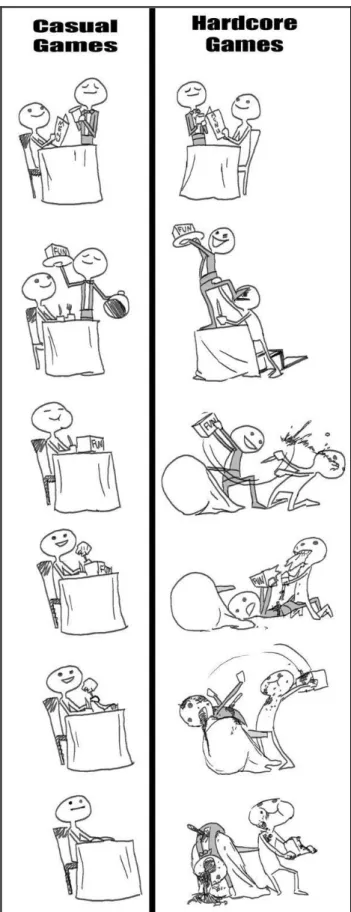
Figure 2.2: Casual games versus hardcore games representation by an unknown author. ... 25
Figure 2.3: Types of casual games. ... 26
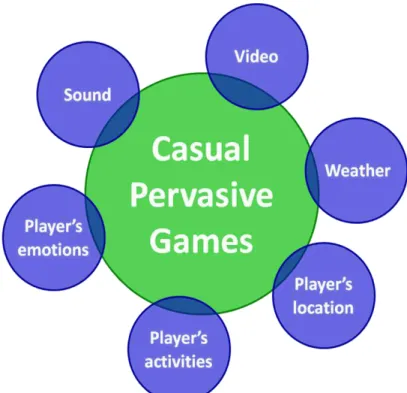
Figure 3.1: Real world elements that were integrated in casual games. ... 33
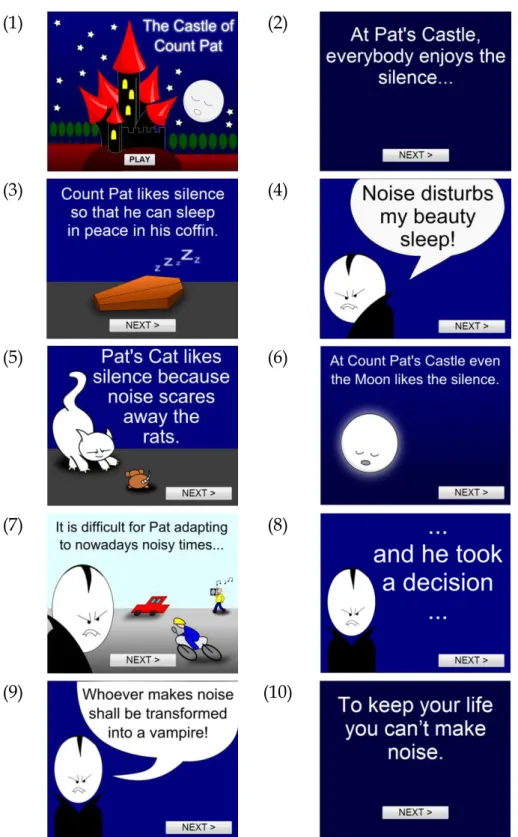
Figure 3.2: The game begins with a story that explains why silence is necessary at Count Pat’s castle. ... 39
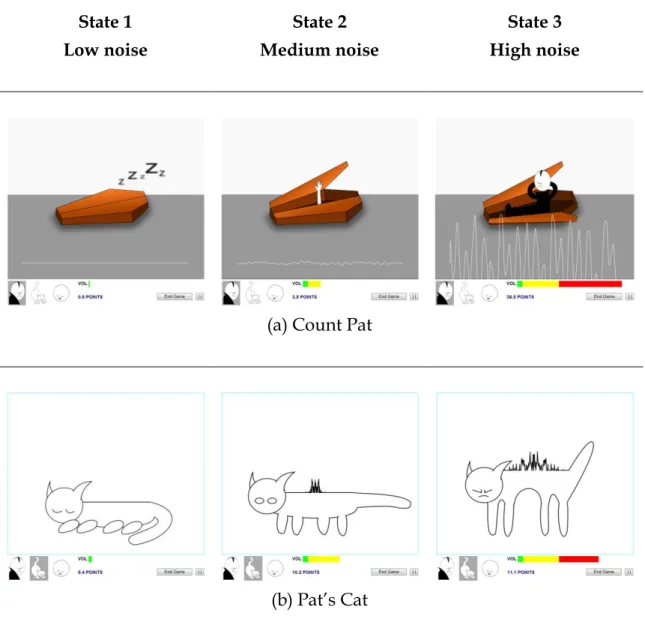
Figure 3.3: The different states of the three characters in the game. ... 40
Figure 3.4: The Castle of Count Pat game architecture. ... 43
Figure 3.5: Do teachers think that students make too much noise? ... 44
Figure 3.6: Do teachers find it more difficult to teach the class when the students are making too much noise? ... 45
Figure 3.7: Teachers who reported voice problems in consequence of their professional activity as teachers. ... 46
Figure 3.8: Teachers who feel that by the time their classes end their voices are hoarse. ... 46
Figure 3.9: Do teachers think that students are aware that talking while the teacher is explaining something negatively affects their learning? ... 47
Figure 3.10: Do teachers think that showing the students how much noise they are making will cause them to be quieter? ... 48
Figure 3.11: Do students think their colleagues make too much noise in the classroom? ... 49
Figure 3.12: Do students think that if they are quiet the grades will improve? . 49 Figure 3.13: Do students speak with their colleagues while the teacher is explaining something? ... 50
xii
Figure 3.15: Average amount of sound detected by the microphone with and
without the game. ... 53
Figure 3.16: Class while the game is being tested... 54
Figure 3.17: Was the class quieter during the use of the game? ... 56
Figure 3.18: Did the game help the students pay more attention to the lesson? 57 Figure 3.19: Did the game distract the students from what the teacher was explaining? ... 58
Figure 3.20: Was it important for the students to obtain a good score in the game? ... 60
Figure 3.21: Did students like the game’s characters? ... 61
Figure 3.22: Students’ favorite characters. ... 63
Figure 3.23: The Imaginary Friend’s concept. ... 69
Figure 3.24: Illustration of the user with the Imaginary Friend. ... 70
Figure 3.25: Close up of the Imaginary Friend. ... 71
Figure 3.26: Two users with the Imaginary Friend. The Imaginary Friend can be seen, projected on the floor, by the side of each user. ... 71
Figure 3.27: Projected image of the Imaginary Friend while the user is walking. Hands and feet move back and forth. ... 72
Figure 3.28: Projected image of the Imaginary Friend while the user is standing still. ... 72
Figure 3.29: All the devices used in the Imaginary Friend. ... 74
Figure 3.30: The bracelet, with the sensors underneath, on the left, connected to the PLUX device, on the right. ... 75
Figure 3.31: Emotion tags. ... 75
Figure 3.32: User selecting an emotion tag. ... 76
Figure 3.33: Collecting and storing the emotion cookies. ... 77
Figure 3.34: An initial version of the Imaginary Friend holding a cartoon jar. ... 79
Figure 3.35: List of past emotions experienced by the user. ... 79
Figure 3.36: Places where the emotion cookies were collected by the Imaginary Friend. The current position of the user is represented by a red figure. ... 80
xiii
Figure 3.38: Did the users hear the mobile phone beeping clearly when the Imaginary Friend asked them what they were feeling? ... 83
Figure 3.39: Did the users feel the mobile phone vibrating when the Imaginary Friend asked them what they were feeling? ... 84
Figure 3.40: Were the users feeling a strong emotion or was the emotion they were feeling changing when the Imaginary Friend asked them how they were
feeling? ... 85
Figure 3.41: Were the users questioned about how they were feeling the
appropriate number of times? ... 85
Figure 3.42: Did users feel the need for any more emotion tags besides the ones that the Imaginary Friend presented? ... 86
Figure 3.43: Did users feel an intense emotional connection with the Imaginary Friend? ... 87
Figure 3.44: Comparison on how the users liked different forms of visualizing past emotions. ... 88
Figure 3.45: Did the users find it useful / fun to register their emotions? ... 89 Figure 3.46: Did the users find it useful / fun to use an application that
automatically detects when they are feeling a strong emotions or when their
emotions are changing?... 89
Figure 3.47: Did the Imaginary Friend help users to think about their emotions and take important conclusions about their lives? ... 90
Figure 3.48: With whom would the users share their answers to the Imaginary Friend. ... 91
Figure 3.49: How easy the users considered it was to interact with the
Imaginary Friend. ... 91
Figure 3.50: How easy the users considered it was to conciliate the answers to the Imaginary Friend with their everyday lives. ... 92
Figure 3.51: Evaluation of the Imaginary Friend according to Microsoft’s
Product Reaction Cards. ... 93
xiv
Figure 3.54: Outline of a sociability framework for co-located interaction in
games... 97
Figure 3.55: Multicolor weather rooster. ... 102
Figure 3.56: Weather Wizards game running in two different mobile devices.103 Figure 3.57: Creating a user account in Weather Wizards. ... 104
Figure 3.58: Login in Weather Wizards. ... 104
Figure 3.59: How to retrieve the password in Weather Wizards. ... 105
Figure 3.60: Player’s profile in Weather Wizards. ... 105
Figure 3.61: Duel list with possible rivals. ... 106
Figure 3.62: Rival’s profile ... 107
Figure 3.63: Wizards dueling in different types of weather. ... 108
Figure 3.64: Player’s grimoire with options to buy lives and buy, upgrade and activate and deactivate spells. ... 110
Figure 3.65: Spell detail. ... 111
Figure 3.66: A locked spell. ... 112
Figure 3.67: A player’s master. ... 112
Figure 3.68: The Master grants a scholarship to the lackey. ... 113
Figure 3.69: The Master is too busy and cannot grant the scholarship at the present moment. ... 113
Figure 3.70: A player’s lackeys. ... 114
Figure 3.71: Power Rank. ... 115
Figure 3.72: Lackeys Rank. ... 115
Figure 3.73: Menu in the Weather Wizards game. ... 116
Figure 3.74: Weather Wizards client architecture. ... 117
Figure 3.75: Weather Wizards’ server functions interacting with the client and with the external providers. ... 118
Figure 3.76: Evolution of active device installs in Weather Wizards. ... 121
Figure 3.77: Did the use of real weather data made the players feel that the game was dependent from the real world? ... 123
xv
Figure 3.79: Do the players prefer randomly generated weather data or real
weather data?... 124
Figure 3.80: Do players think it is fun to know the real location of other players? ... 125
Figure 3.81: Does the game respond quickly to the player’s actions? ... 126
Figure 3.82: Did the game kept the players concentrated while they were playing? ... 127
Figure 3.83: Did the players feel involved by the game, less aware of what was surrounding them and less worried about everyday life?... 127
Figure 3.84: Lisbon under siege by Alfredo Roque Gameiro. ... 132
Figure 3.85: Screenshots of several parts of the labyrinthic forest. ... 135
Figure 3.86: Princess Laila waiting for the player by a waterfall. ... 135
Figure 3.87: The Moor Princesses, from left to right and from top to bottom: Fátima, Jasmina, Tadmor, Sara, Karima and Doniazade. ... 136
Figure 3.88: Saving the Enchanted Moor Princess. ... 137
Figure 3.89: Magic Mirror with zero people looking at it. ... 139
Figure 3.90: Magic Mirror with face detection via the computer’s webcam video capture. The player’s faces are highlighted by the green outline of rectangles. ... 140
Figure 3.91: The player’s reward for saving the Enchanted Moor. ... 140
Figure 3.92: Enchanted Moor game architecture. ... 141
Figure 3.93: Tag cloud with the names of all the mythological beings mentioned by the players. Font size is proportional to the number of times the creature was mentioned. The words corresponding to the top ten mentioned beings are marked with a green font color and yellow background. ... 143
Figure 3.94: Did the game arise the players’ curiosity to know more about Enchanted Moors? ... 144
Figure 3.95: Who helped the player break the Moor’s spell? ... 145
Figure 3.96: Location of the player when breaking the Moor’s spell. ... 145
xvi
Figure 3.98: Enchanted Moor evaluation according to the Challenge criteria. . 147
Figure 3.99: Enchanted Moor evaluation according to the Game Understanding criteria. ... 147
Figure 3.100: Enchanted Moor evaluation according to the Control criteria. ... 148
Figure 3.101: Enchanted Moor evaluation according to the Clear Goals criteria. ... 148
Figure 3.102: Enchanted Moor evaluation according to the Feedback criteria. 149 Figure 3.103: Enchanted Moor evaluation according to the Immersion criteria. ... 149
Figure 3.104: Enchanted Moor evaluation according to the Social Interaction criteria. ... 150
Figure 3.105: Evaluation of the Enchanted Moor game according to Microsoft’s Product Reaction Cards. ... 151
Figure 5.1: Course for a game of hopscotch [208]. ... 162
Figure 5.2: Spatial expansion in the proposed games. ... 165
Figure 5.3: Temporal expansion in the proposed games. ... 168
xvii
List of Tables
Table 3.1: Composition of the classes where the game was tested. ... 52
Table 3.2: Average amount of sound detected by the microphone during a first lesson without the game and during a second lesson with the game. ... 54
Table 4.1: Role of the screen, in consequence of the use of the real world elements. ... 155
Table 5.1: Spatial limits... 163
Table 5.2: Temporal limits. ... 166
Table 5.3: Social limits. ... 171
1
1.
Introduction
It's a dangerous business, Frodo, going out of
your door […] You step onto the road, and if
you don't keep your feet, there's no knowing where you might be swept off to.
J. R. R. Tolkien , The Lord of the Rings
Playing is an activity that has been around for a long time. According to J. Huizinga [1] play is free as people play because they enjoy it, not because they are forced to do it or because they are driven by some material interest. Play is also not real life but an escape from real life. Games happen inside a magic cir-cle, a sacred isolated space that immerses the players [1].
For K. Salen and E. Zimmerman [2] a game is “a system in which players
en-gage in an artificial conflict, defined by rules, that results in a quantifiable outcome”.
Similarly to J. Huizinga, these authors think that games are artificial because they are separated from real life. There is conflict in games because games are a contest of powers that abide to certain rules. Games have a quantifiable out-come and at the end a player has either won or lost.
2
necessary. In digital games it is possible to automate complex procedures thus facilitating the gameplay. For example, in a digital chess game the computer can automatically move the pieces and ensure that the rules are not broken. If played on a device connected to the Internet, digital games allow networked communication with other people far away. In this way, people in different continents can play together. Non digital games may also share some or all of these qualities but in digital games these advantages are usually more robust [2].
However, even though all the advantages of digital games, they suffer, in our view, of the following limitation: the screen is the player’s primary or even only focus of attention. Furthermore, interaction is narrow. Many games are still played only with keyboard input and screen and speakers output. With devices like Microsoft’s Kinect, the Nintendo Wii Remote or the PlayStation Move Motion Controller the range of interaction widens. However, even with these devices, the screen is rarely deprived of its prime position. It would be in-teresting if, at least during a few moments, digital games could be played with-out looking at a screen. Pervasive games have already accomplished that objec-tive with the inclusion of real world elements in games. That way, the player also has to pay attention to what is happening around her, because that will in-fluence the outcome of the game. From here arises the motivation of our work.
1.1.
Motivation
3
player life comes first and the game world follows, eventually, far beyond [3]. More information about the difference between casual and hardcore players can be found in Section 2.3.
Casual games assume the challenge of pleasing all audiences and bypass the luxury of focusing only in a restricted group of elite players. By fulfilling the requirements of a casual audience, hardcore players can still be attracted to-wards a game. However, when designing a game for hardcore players, casual players will be alienated [3,4]. By focusing on casual players’ characteristics our motivation here is to provide pervasive gameplay for everyone. We intend to reach the casual players, who play games to pass the time of for stress relieve, but also the dedicated hardcore players who consider games to be a fundamen-tal part of their lives.
Casual games are designed to attract the general public, but pleasing eve-rybody is no easy task. Pleasing eveeve-rybody, with a pervasive component in be-tween, is even more difficult. Adding a pervasive component to casual games in such a way that these games do not cease being casual, is an ambitious and difficult objective [5]. However, we consider this is a worthwhile objective be-cause, again, as casual games are games for everyone, consequently, research done in this area will benefit a large number of persons.
From an economic point of view, casual games are an interesting area with revenues that, in 2010, amounted to $6.00 billion [6]. Furthermore, according to the Newzoo report [7], online casual, social and mobile games take 49% of the time spent on games and account for 27% of the money spent on games. Finally, casual games accounted for 75% of the time spent in PC video games in the game titles tracked in the Nielsen report [8].
1.2.
Research Goal
4
around the player. We, therefore, intend to introduce a pervasive twist in casual games in a way that complies with the following conditions [9]:
As casual games are easy and simple to play, the real world elements must thus be integrated in a way that the game remains easy and sim-ple for the player.
Casual players are usually not willing to invest in expensive or spe-cialized hardware [10]. So the inclusion of real world elements will make use of functionality already available (or foreseen in the near fu-ture) in devices like computers, portable computers or mobile phones.
1.3.
Research Questions
From our research goal emerges one main research question and several subordinated sub questions:
How is it possible to break the barrier between games and reality? How can real world elements be inserted in casual games? How can the player’s attention be diverted from the screen? How can the magic circle be expanded?
What are the technological challenges on the player side?
5
1.4.
Overview of the Research
The context that frames our research is presented in Chapter 2. Chapter 3 includes our proposals for merging casual and pervasive, via the insertion of real world elements in games. Chapter 4 considers how the insertion of real world elements influenced the role of the screen. Chapter 5 discusses how the magic circle was expanded. Chapter 6 presents an analysis about integration with the real world and context data and the technological challenges associat-ed with pervasive entertainment. Finally, the conclusions are in Chapter 7.
1.5.
Contributions and Publications
This research work provides the following contributions:
Merge of casual games with reality through the integration of real world elements in games (Chapter 3). The real world elements we worked with are sound, video, the player’s physiological data, accel-erometer data, the player’s location and the weather.
Development of four games that demonstrate the integration of real world elements in casual games: the Castle of Count Pat (Section 3.1), the Imaginary Friend (Section 3.2), Weather Wizards (Section 3.3) and the Enchanted Moor (Section 3.4).
An evaluation on how the introduction of real world elements affected the role of the screen (Chapter 4) and the magic circle (Chapter 5).
A global reflection about the challenges faced when integrating real world elements and context data for providing pervasive games to a casual audience (Chapter 6).
6
Aspects of the described work are included in the following publications:
Journal
S. Reis, N. Correia, Casual Games with a Pervasive Twist, Submit-ted to Entertainment Computing, Springer-Verlag (Chapter 4 and Chapter 7).
Full papers
S. Reis, N. Correia, Co-located Interaction in Casual Games for the Dissemination of Traditional Stories, in: Proceedings of the 5º Sci-ence and Videogames ConferSci-ence - 2012, Lisbon, Portugal, Portu-guese Society for Videogames Science, 2012 (Section 3.4, Chapter 4, Chapter 5, Chapter 6 and Chapter 7).
S. Reis, N. Correia, Playing with the Weather, in: Proceedings of the 11th International Conference on Entertainment Computing (ICEC’12), Bremen, Germany, Springer-Verlag, 2012, pp. 172-184 (Section 3.3, Chapter 4, Chapter 5, Chapter 6 and Chapter 7). S. Reis, N. Correia, An Imaginary Friend that Connects with the
User’s Emotions, in: Proceedings of the 8th International Confer-ence on Advances in Computer Entertainment Technology (ACE’11), Lisbon, Portugal, ACM, 2011 (Section 3.2, Chapter 4, Chapter 5, Chapter 6 and Chapter 7).
S. Reis, N. Correia, The Perception of Sound and Its Influence in the Classroom, in: Proceedings of the 13th IFIP TC 13 International Conference on Human-Computer Interaction - Volume 6946 - Part I (INTERACT’11), Lisbon, Portugal, Springer-Verlag, 2011, pp. 609-626 (Section 3.1, Chapter 4, Chapter 5, Chapter 6 and Chapter 7).
Short papers
7
S. Reis, S. Cavaco, N. Correia, Educative Sound Game, in: Pro-ceedings of the 3º Science and Videogames Conference - 2010, Lis-bon, Portugal, Portuguese Society for Videogames Science, 2010, pp. 159-164 (Section 3.1, Chapter 4, Chapter 5, Chapter 6 and Chapter 7).
Doctoral consortium
S. Reis, Expanding the Magic Circle in Pervasive Casual Play, in: Proceedings of the 11th International Conference on Entertain-ment Computing (ICEC’12), Bremen, Germany, Springer-Verlag, 2012, pp. 486-489 (Chapter 1 and Chapter 7).
Work in Progress
S. Reis, K. Church, Insights into Co-located Shared Mobile Search, in: CHI ’13 Extended Abstracts on Human Factors in Computing Systems (CHI EA'13), Paris, France, ACM, 2013, pp. 1401-1406 (Chapter 6 and Chapter 7).
Poster
S. Reis, T. Romão, N. Correia, Pervasive Play for Everyone Using the Weather, in: Proceedings of the 7th International Conference on Advances in Computer Entertainment Technology (ACE’10), Taipei, Taiwan, ACM, 2010, pp. 104-105 (Chapter 1 and Section 3.3).
Workshops
S. Reis, N. Correia, Encouraging Co-located Players Social Interac-tion, in: Designing and Evaluating Sociability in Online Video Games - A CHI 2013 Workshop, Paris, France, 2013 (Section 3.2). S. Reis, K. Church, N. Oliver, Rethinking Mobile Search: Towards
9
2.
Related Work
Guybrush: At least I’ve learnt something from all of this.
Elaine: What’s that?
Guybrush: Never pay more than 20 bucks for a computer game. Elaine: A what?
Guybrush: I don't know. I’m not sure why I said that.
The Secret of Monkey Island, LucasArts
To merge casual games with pervasive games it is firstly necessary to know the previous work done in these two genres of games. This chapter be-gins by further describing the magic circle, the frontier that demarks the territo-ry where games happen (Section 2.1). Section 2.2 describes pervasive games and Section 2.3 describes casual games. Previous attempts of merging casual and pervasive games are mentioned in Section 2.4.
2.1.
Magic Circle
Back in 1938, the celebrated theorist and historian, Johan Huizinga, in his book Homo Ludens: A Study of the Play-Element in Culture [1], defined play as “a
free activity standing quite consciously outside ‘ordinary’ life as being ‘not serious’, but
10
proper boundaries of time and space according to fixed rules and in an orderly manner. It promotes the formation of social groupings which tend to surround themselves with secrecy and to stress their difference from the common world by disguise or other
means”. From this work, the following characteristics of play can be highlighted:
Play is free – People play because they enjoy it, not because of a phys-ical necessity, material interest of moral duty.
Play is not real life – Play is, on the contrary, an escape from real life.
Play is limited in both time and space – playing is an activity that be-gins and ends and that happens inside a demarked playground.
Play creates order and is order – play brings a temporary and limited perfection to an imperfect word [1].
Play is spatially and temporally separated from real life. Besides the spa-tial and temporal demarcation, during a play activity, a social demarcation is also implicit, in the form of the promotion of social groupings and in the secre-cy that separates the ones who are playing from the ones who are not playing.
In the book Homo Ludens: A Study of the Play-Element in Culture the magic circle concept is introduced: “The arena, the card-table, the magic circle, the temple, the stage, the screen, the tennis court, the court of justice, etc., are all in form and func-tion play-grounds, i.e. forbidden spots, isolated, hedged round, hallowed, within which special rules obtain. All are temporary worlds within the ordinary world, dedicated to the performance of an act apart. Inside the play-ground an absolute and peculiar order
reigns” [1].
Departing from J. Huizinga’s work, other authors have delved into the concept of the magic circle. For K. Salen and E. Zimmerman [2] “the magic circle of a game is where the game takes place. To play a game means entering into a magic circle, or perhaps creating one as a game begins. The magic circle of a game might have a physical component, like the board of a board game or the playing field of an athletic contest. But many games have no physical boundaries - arm wrestling, for example, doesn't require much in the way of special spaces or material. The game simply begins
when one or more players decide to play”. So, these authors also locate the game
11
For J. Juul [11], the magic circle is “a description of the salient differences be-tween a game and its surrounding context. It does not imply that a game is completely
distinguished from the context in which it is played”. To illustrate this definition J.
Juul mentions one example where, at dinner table, person A wants to reach for the salt but sees person B already extending her hand for it. It will be consid-ered inappropriate for A to snatch the salt from B. However if, latter in the evening, A and B are playing a game, and A sees the chance to capture a game piece from B, then A will not hesitate to do it. Polite conduct is therefore differ-ent in the context of the dinner and in the context of the game. J. Juul adds that the magic circle is “clearly not a perfect separation of a game from the rest of the
world, but an imperfect separation that players negotiate and uphold”, classifying the
magic circle, as “the boundary that players negotiate”.
T. L. Taylor [12] starts by claiming that “Games are typically thought of as
closed systems of play in which formal rules allow players to operate within a ‘magic
circle’ outside the cares of everyday life and the world. This rhetoric often evokes a sense
that the player steps through a kind of looking glass and enters a pure game space. From Monopoly to Final Fantasy, commercial games in particular are often seen as structures conceived by a designer and then used by players in accordance with given rules and
guidelines”. However, even though games are typically seen as closed spaces, T.
L. Taylor argues that this may end up not happening because “Players, however,
have a history of pushing against these boundaries”.
M. Nitsche [13] further adds to an idea of an expanding game playground by foreseeing that “Game worlds will spread into private spaces such as living rooms
as well as public spaces like restaurants, prisons or museums – not to offer a virtual
window in some kind of ‘otherworld’ but to provide a new perspective on the existing
one. Ultimately, this is what these games will aspire to: to create new realities”.
Never-theless these new realities, though they may be superimposed on the real world, still somehow stand apart, or they would not be a new reality, but part of the existing reality.
12
to the ordinary rules. The membrane is the ‘magic circle’ within which the rules are
dif-ferent. The membrane can be considered a shield of sorts, protecting the fantasy world from the outside world. The inner world needs defining and protecting because it is nec-essary that everyone who goes there adhere to the different set of rules. In the case of synthetic worlds, however, this membrane is actually quite porous. Indeed it cannot be sealed completely; people are crossing it all the time in both directions, carrying their
behavioral assumptions and attitudes with them”. E. Castronova proceeds to explain
that the membrane can be permeated via markets, politics and law.
The membrane is permeated via markets because when a player invests countless hours to fabricate a magic sword in the synthetic world of cyberspace that sword acquires real value. If players sell the objects they manufactured to other players charging real money, then this transaction somehow leaked into reality. Eventually, manufacturing magic swords in the game could become such a profitable activity that people would quit their daytime jobs to become a permanent worker in the virtual world. One could argue that the sword does not exist, that its value is illusory. However, E. Castronova counters that dia-monds’ value is also illusory. What good is a shinny stone that people wear around their necks, on their fingers or on their ears? If they are stranded alone on a desert island that stone is good for nothing. Though its frivolous nature the diamond has real value because of the time people invest to mine and polish it. Similarly, the magic sword becomes a commodity with real value because of the hours invested in it.
The membrane is permeated via politics because players conspire, in the privacy of forums outside the game, to change the rules of the game. For exam-ple, a group of archers may protest that the wizards are too powerful. Wary of the influence of the archers, the owners of the game, the programmer dictators, may wield to the pressure, officially announcing in the game that “We felt that wizards were becoming too overpowered with their use of the Staff of Stupidity, so we
reduced its damage” [14]. And, thus, the rules of the game were corrupted by
what happened outside the magic circle.
13
just like Microsoft Word. Bill Gates does not own the documents that users cre-ated with Microsoft Word, so why should the programmer dictators own the magic sword or the Staff of Stupidity that players created in the game [14]?
K. Huynh et al. [15] further elaborate on the concept of the magic circle claiming that what happens inside the magic circle does not always stay inside the magic circle. As proof they present the case of a massively multiplayer online role-playing game that allows players to practice engagement and mar-riage rituals. These amorous relationships do not always remain as simple make believe with several players meeting their virtual romantic partners of-fline in the real world. These virtual couples cross the border of the magic circle into reality thus showing that the magic circle is not an unassailable barrier.
Another author that worked on the concept of the magic circle is M. Copi-er [16]. She considCopi-ers that the current use of the magic circle is problematic and proceeds to argue that “The visualization and metaphorical way of speaking of the magic circle as a chalk, or even, rusty circle is misleading. It suggests we can easily sep-arate play and non-play, in which the play space becomes a magical wonderland. How-ever, I argue that the space of play is not a given space but is being constructed in nego-tiation between player(s) and the producer(s) of the game but also among players
them-selves”. According to this author, there is no magic wonderland created from a
complete isolation of the act of play. Still, M. Copier [16] relents that there is still a separation, though this separation is negotiable.
M. Consalvo [17] goes further in what refers to the permeability of the magic circle to the point of defending that there is no magic circle. She defies J. Huizinga’s proposal and does not consider games as places isolated from ordi-nary life: “we cannot say that games are magic circles, where the ordinary rules of life do not apply. Of course they apply, but in addition to, in competition with, other rules and in relation to multiple contexts, across varying cultures, and into different groups,
legal situations, and homes”.
14
broadly defined as “the idea that a boundary exists between a game and the world
outside the game” [18].
Authors differ on how the magic circle is porous: J. Juul and M. Copier say the border between game and reality is subject to negotiation [11,16]; T. L. Tay-lor reports that players push against the boundaries [12]; M. Nitsche sees the playground invading the real world [13]; E. Castronova permeates the border with markets, politics and law [14]; evidence is furthermore provided that the border can be crossed romantically [15]. Even J. Huizinga, though defending the playground is a territory of seclusion, mentions the case of play communi-ties that function as a way for players to retain the magic after the individual game is over, and admitting “how difficult it is to draw the line between, on the one
hand, permanent social groupings […] and the sphere of play on the other” [1].
Though these differences among the authors, for the sake of consistency, in this document, we will retreat to the source in the form of the coiner of the term, J. Huizinga, and consider that the magic circle is limited spatially, tempo-rally and socially and that it can be breached along these three axes. This was the perspective already previously assumed by M. Montola et al. [5], who also considered that the magic circle can blur spatially, temporally and socially. A game expands spatially if the game appropriates the ordinary world, with the whole world eventually becoming a playground. A game expands temporally if it is no longer clear when one is playing or not playing the game. And, finally, a game expands socially if it is no longer clear who is and who is not involved in the game [5].
There is no material proof that considering the border between the game world and the real world in terms of space, time and social is the correct and ultimate way. Why not in terms of negotiation? Why not in terms of markets, politics and law? However, as E. Zimmerman [18] sagaciously mentioned, no-body has ever seen the magic circle, nono-body has managed to proof its existence by technological means, invoke it paranormally and there is no magic circle prophet, or as E. Zimmerman more accurately put it, no “magic circle jerk”. In
his words, “The magic circle jerk doesn't exist. […] I'm sick of the magic circle jerk.
Let's bury the bastard” [18]. So, if no one has seen this border, it is debatable what
15
To sum up, in face of the controversy, whenever we refer to the magic cir-cle, latter on in this document, the following is meant:
The magic circle is a border between the game and reality.
The magic circle limits the game in terms of where the game is played, when the game is played and with whom the game is played.
The border can be expanded spatially, temporally or socially.
However, it is out of our scope to decide on a final definition of the magic circle. The assumptions made here about the magic circle and the spatial, time and social limits are made mostly for the sake of clarity. What we, indeed, aim is to use the real world elements to promote further contact between the fiction-al game world and refiction-ality (Section 1.2), regardless of an exact definition of the magic circle.
2.2.
Pervasive Games
Pervasive games are games that merge with real life. A pervasive game is
a “genre in which traditional, real-world games are augmented with computing
func-tionality, or, depending on the perspective, purely virtual computer entertainment is
brought back to the real world” [19].
PacManhattan [20], InStory [21], the Beast [22] and KnightMage [23] are four good examples of pervasive games.
16
In InStory [21] users discover Quinta da Regaleira. Quinta da Regaleira is a beautiful architectural complex, classified as World Heritage, that includes a twentieth century palace and a garden for initiation rites with labyrinthine gal-leries and subterranean grottoes. Quinta da Regaleira is connected with strong alchemical and sacred connotations. Users visit this mystical place with the help of a mobile device that provides them geo-referenced activities. The mobile de-vice offers specific information about the place the user is visiting as well as sto-ries and games [24]. Players interact with several virtual characters, who func-tion as narrators, such as a Hunter, an Amazon, a White Lady, an EcoVegan an-imal protecting figure and a Greyhound. To gain points and advance levels players solve puzzles and enigmas where they have to retrieve in-situ infor-mation at the geographical location they are currently at [25]. Players can also upload photographs, videos, sound clips and texts to create their own personal-ized activities [24]. As InStory is a flexible platform, that supports mobile story-telling, gaming activities and information access [21], it can be adapted to the exploration of other cultural or historical spaces. The system provides two ap-plications, InAuthor and InContent. InAuthor is a game editor for the creation of geo-referenced storytelling and gaming activities, which are represented as nodes. InContent allows the design of screen areas that function as content for the nodes [24].
The Beast [22] was designed to promote the Steven Spielberg film Artifi-cial Intelligence. In the film’s posters Jeanine Salla was credited as being the sentient machine therapist. Those who considered this strange and searched the Internet found out that Jeanine Salla had a web presence. The game never ad-mitted that it was not a game. To support this illusion the organizers of the game uploaded, to the Internet, a collection of photos, movies, audio record-ings, scripts, corporate material, logos, web sites and flash movies. Players even received faxes and packages full of game world props and artifacts via the postal system.
17
board games with computing functionality. The platform provides virtual game components and the players can interact with physical playing pieces.
Figure 2.1: Pervasive game genres.
Pervasive games can fall into the following categories (Figure 2.1): treas-ure hunts, assassination games, pervasive live action role playing games (LARP), alternate reality games, smart street sports, playful public performanc-es, urban adventure games and reality games [5].
Treasure hunts are about finding something. It may be, for example, a hidden object, a person or a location [5]. Geo cashing is a popular form of treas-ure hunt where players are given the GPS coordinates of a hidden object or place they have to find. In Story Mashup [26] players take pictures, with a cam-era phone, to illustrate stories. Nouns are extracted from the stories and players have to take a picture that matches that noun in a certain amount of time. The
Pervasive Game Genres
According to C. Magerkurth et al. [19] According to M. Montola et al. [5]
Treasure hunts
Assassination games
Pervasive LARPs
Alternate reality games
Smart street sports
Playful public performances
Urban adventure games
Reality games
Smart toys
Affective games
Tabletop games
Location aware games
18
Great Scavenger Hunt [27] is another game where players have to take pictures that match a list of items.
Assassination games were inspired by the film The 10th Victim. In this film people participate in a hunting game to satisfy their violent instincts. The hunt-ing game has 10 rounds. In five of the rounds the player is the assassin and in the other five rounds is the victim. The player who survives receives a big re-ward [5]. BotFighters [28] is one example of an assassination game. The player's mission is to locate and destroy other players armed with a mobile phone that is turned into a weapon. Cruel 2 B Kind [29] is another game where players slain each other with serenades, compliments or an innocent group cheer.
Pervasive LARPs are dramatic and narrative game forms that occur in a physical environment. Players pretend they are someone else and pursue objec-tives while interacting with each other in character. Costumes and props are used to add more believability to the characters. Pervasive LARPs have diverse themes like vampires, crime, historical settings or futuristic eras. This type of game is usually created by a community and for that community only and has no external audience. The urban space may serve as a scenario for the pervasive LARP but outsiders are seldom included in the game. For example, in Mas-querade, the vampires who reveal the supernatural world to outsiders are pun-ished with death. Profit is rarely an objective and participation fees cover the expenses of setting up the game and little else [5,30]. Momentum [31] is another pervasive LARP where players pretend they are the ghosts of dead revolution-aries who were attacked by the forces of conformism and who have returned to the land of the living.
19
site who was an amateur beekeeper. Margaret was a fictional character but nothing in the site indicated this. Several clues were hidden in Margaret's site that had been hacked. After a few months players finally discovered that the hacker was a damaged program that was leaking memories and code.
In smart street sports, another type of pervasive games, there are two kinds of players. One kind of players moves around in a city or in a more re-stricted space, like a university campus. These players are equipped with mo-bile phones or handheld computers. The other kind of players are sitting at their computers and play the game through the Internet. This second kind of players can communicate with the players that are moving around to give them instructions or information [5].
The previously mentioned PacManhattan [20] falls into the smart street sports genre. Human Pacman [34] is another smart street sport inspired in the Pacman videogame. In this game there is also a Pacman player that runs around in the real world and Ghost players that hunt down the Pacman player. Each of these physical players is helped by another player who is an Internet online player. However, in Human Pacman, contrary to what happens in PacManhattan, the helping players do not have to manually update the physi-cal players' position on a map. Pacman and the Ghosts are equipped with wearable computers that do that task automatically. Furthermore, here, contra-rily to what happens in PacManhattan, Pacman sees the dots in AR mode via the HMD display that is part of the wearable computer. Nevertheless, helpers are still necessary. Helpers inform their physical players' of the location of ene-my players as they are not visible in a map that appears in AR mode.
Can You See Me Now [35] also belongs to the smart street sports category. In this game, runners chase online players in a city. Runners really have to run. Online players use the arrow keys on the computer keyboard to escape the runners in a virtual model of the real city accessible through the Internet. Run-ners, who are located via GPS, can see the positions of online players on a handheld map and can communicate with each other using walkie-talkies.
20
beginning of the game knights choose the location of their castle by placing a physical flag on the ground. The flag is a Bluetooth embedded device. After that a virtual castle and a flag appear in the guides' 3D map and in the knights' mobile phone screen. The knights' objective it to reach the opponent's castle and capture their flag. Guides place virtual magic potions and traps in the ground. As these items are invisible to knights it is up to the guides to orient knights towards rewards and away from danger.
Like smart street sports, playful public performances are also played in public spaces. However, smart street sports focus on competition and playful public performances are aimed at creating a spectacle [5]. The Big Urban Game [37] is an example of a playful public performance. It was a game designed for Minneapolis and Saint Paul with the objective of changing people's perspective about the cities they live in. In the game, three teams competed to move a 25 foot high inflatable chess piece through a series of checkpoints. The pieces' posi-tion was shown on the game's website and on local newspapers. Players voted on the route they thought the chess piece should follow. The chess piece was transported by volunteers along the selected route and the time spent in that operation was added to the team’s total time. At the final checkpoint the team with the lower total time was declared the winner. The previously mentioned Momentum [31], that was included in the pervasive LARP category, also in-cludes some playful public performances. One of the public events was a demonstration to honor the dead. The second event was a party where the spir-its bade farewell.
21
Reality Games encourage people to view the place they live in a different way and are usually organized for unaware participants. In Vem Grater [5], a game that was played in a university campus, the organizers pilled chairs in a tower, scribbled strange words on a wall and spilled something red on the floor. The game also included an actor who roamed the corridors of the univer-sity asking people if they had encountered ghosts. This was supposed to be a poltergeist mystery, but the game ended up attracting the wrong kind of atten-tion because the university staff thought they were dealing with acts of vandal-ism. The staff called the police and at this point the game organizers finally had to step out, apologize and explain it was just a game.
Other authors propose the following genres for grouping pervasive games (Figure 2.1): smart toys, affective games, tabletop games, location aware games and augmented reality games [19].
Smart toys are toys augmented with pervasive technology. In Headbang Hero [39] the player wears a wireless motion sensing wig that evaluates the player's choreography when dancing to the sound of heavy metal music. Gauntlet [40,41], an arm piece enhanced with computer functionality, allows the player to manipulate real objects that act as game play elements. StoryToy [42] is a smart toy where the user interface is a farm, made of cloth, that is in-habited by stuffed animals that are equipped with motion sensors. The farm an-imals talk and react to each others’ actions. In another work [43], a robot inter-acts with two users playing a chess game. The robot shows an empathic behav-ior towards one of the players and behaves in a neutral way towards the other. The robot shows empathy via facial expressions, by looking at the player and via verbal responses.
22
another affective game. Here, the player wears a headset that reads brainwave activity to influence the trajectory of a ball in an obstacle course.
In tabletop games players sit together around a game. Chess is an example of a tabletop game. Tabletop games can be enhanced with technology. Such is the case of the already previously mentioned KnightMage [23] game. False Prophets [46] is another tabletop game where players use physical pieces to move around on a game board that is a projected map. The Build-a-Tree [47] tabletop game was designed to help visitors of a natural history museum learn about evolution. Other authors [48] coupled interactive tabletops with mobile phones to create the game Copoly which is an adaptation of Monopoly. Players interact with the world map on the interactive tabletop. The mobile phones show each player the amount of money and the list of owned properties.
Location aware games are games that use the player's physical position in the gameplay. That is the case of Pirates [49] where each player is the captain of a ship. The game's interface is visible through a handheld computer. To move the ship the player moves in the physical space. The location of the player is de-termined via proximity sensors. Viking Ghost Hunt [50], another location aware game, uses sound to more effectively immerse the player and stimulate emo-tional engagement. In iFitQuest [51] players run away from a ghost or collect coins. In either case their game’s characters movement is controlled by their movement in the real world.
23
2.3.
Casual Games
Casual games are currently an interesting area that can offer a happy es-cape and distraction to the necessary, but sometimes dull and tedious chores of everyday life. Windows Solitaire, Tetris and Pacman are three good examples of well known classic casual games. Casual games amounted to a $6.00 billion revenue in 2010 [6]. Card and puzzle are among the most popular casual games genres [8].
Like all other games, casual games are fun. However, to fall into the casual segment, a game must be easy. Casual games are easy in the sense that they have simple rules and natural interfaces that make use of images and symbols, in detriment of long and fastidious text descriptions [3,57]. In casual games the gameplay should be as obvious as possible so that even novice users without game literacy can quickly learn how to play.
It is not advisable, in a casual game, to require the player to have a perfect performance. In case the player commits an error the punishment is desirably light and even fun [57].
As casual games usually run in parallel with the player’s other everyday activities the game should be easily interrupted if the door bell rings or if the player has to talk to a friend or if some other important event to the player oc-curs [57].
Casual games may offer long term rewards, but short term gratification is essential [10].
Being fast is another characteristic that goes hand in hand with casual games. Nowadays, work demands increasingly more and more hours of peo-ple's time. This means that player sessions should not be long. Usually, casual players enjoy playing the game in small time increments instead of playing dur-ing a long session of several hours [3,10].
24
a cartoon character hitting another character is tolerable. Showing a 3D realistic character hitting another character with a club along with a realistic simulation of blood spattering is probably too much [10]. However, there are game devel-opers who, nevertheless opted for bloody gameplay. Such is, for example, the case of Fangz, a mobile game where the player violently slays vampires [58–60].
It is better, for a casual game, to offer a gameplay that triggers positive emotions and leave out a survival of the fittest scenario where the player is forced to kill and destroy in order to succeed. As much as possible, the game should not defy the norms of the player's social context [57]. As social norms vary from place to place, to be on the safe side, it is better to show players ab-stract content like, for example, puzzles. Tetris and Pong both rely on abab-stract concepts and were successful. If one steps outside abstract content, then it is better opting for completely innocuous subjects like, for example, running a farm. FarmVille [61] is one example of this option.
In casual games it is better to favor style over realism. Including 3D graphics in the game is OK, but it is more important to resort to stylish graphics with bright saturated colors. Sound can be used to create the mood, but the players should be able to turn it off, in case they are playing at the office or in the classroom [10].
25
26
According to Jesper Jull [3], casual games may be played for long hours and therefore in a way that is not casual at all. If the casual game is flexible it will allow the player to have a meaningful experience within a short time frame but does not prevent players from investing more time in the game. Usually, hardcore games are inflexible for they do not allow players who are only inter-ested in a short term commitment. A flexible casual game can be played in both a light and a hardcore way, therefore eventually attracting hardcore players.
In Figure 2.2 another distinction between casual and hardcore games is presented. We found this image in several sites and could not determine who the original author was. We leave the interpretation open to the reader. How-ever, it seems to us, the image alludes to the more challenging aspect of hard-core games.
Figure 2.3: Types of casual games.
The IGDA report [10], groups casual games in the following types (Figure 2.3): downloadable games, console downloads, ad supported web games, advergames, skill games and microtransaction supported games.
Types of Casual Games According to the IGDA Report [10]
Downloadable games
Console downloads
Ad supported web games
Advergames
Skill games
27
Downloadable games are typically available through portals or in the de-velopers' pages. In this genre of games the player downloads a file, then usually a short installation follows and after that the casual game is ready to be played. Normally, the player can use the game during a trial period for a certain amount of time. After that, to continue playing it is necessary to pay a fee. To-day, with faster Internet connections, the file size tends to increase in order to accommodate more features for players' enjoyment.
Console downloads are games that are downloaded to a game console, in-stead of a PC. Nowadays, players can download games, for their consoles, through the Internet.
Ad supported web games are other sort of casual games. These games are usually played in a browser. Sometimes the ad appears before the game starts, other times the player is confronted with ads when changing levels or at the end of the game. The ads can be integrated inside the game, as in game ad-related content, or be placed around the game, as a banner. In the browser, the-se banners may be placed above, bellow, to the left or to the right of the game. Sometimes, the game is completely surrounded by banners and becomes an is-land in the middle of the publicity.
Other type of casual games are the advergames. Advergames are devel-oped with the primary intent of promoting a brand or a product. Advergames go beyond just showing some in-game ads. The whole concept of the game re-volves around the sponsor of the game. Typically, advergames are distributed for free and their success is measured by the number of players the game reach-es and by the time they spend playing the game [4]. An advergame has to be fun and it also has to be a good advertisement for the brand or product being promoted. If the product or brand is not promoted or if the client perceives the product erroneously, then the game is a failure. However, a sole focus on pub-licity is not convenient because if an advergame does not entertain the players that advergame is also a failure. For an advergame to be successful both the en-tertainment and the publicity objectives have to be fulfilled.
28
prize or some other sort of material reward. Skill games bear therefore some re-semblance to a casino or to a lottery, as in both casinos and lotteries people risk a certain amount of money in hopes that they might gain the big prize. Howev-er, skill games are not only related to luck. They are called skill games because it is assumed that the player needs to develop her game skills in order to max-imize the chance of winning. Innovation is seldom welcome in skill games as players are generally more inclined to pay the entry fee if they feel the game-play is familiar.
In microtransaction supported games players have free access to the game's basic features. This type of games usually has a virtual economy with a virtual currency. The player can then pay to have certain advantages in the game [4,10]. Payments in microtransaction supported games are usually small.
Mobile phones, though not directly included in the categories suggested by the IGDA report (Figure 2.3), are becoming an increasingly more popular platform for casual games [4,62] with revenues that in 2011 amounted to $2.72 billion worldwide [62]. Strategy Analytics [63] estimates that 1 in 7 of the world’s population owns a smartphone in the third quarter of 2012 with 1.038 billion units in use worldwide [63]. According to mobiThinking the global smartphone penetration is 16.7% [64]. Significant time on smartphones is spent on games. Flurry [65] monitored time spent across app categories and conclud-ed that 39% of the time is spent on games. In tablets this percentage raises to 67%.
sup-29
ported by 371 million mobile devices. However the levels of compatibility vary. The Visionmobile Report [68,69] also predicts that there will be no single win-ner in the smartphone race with Android and iOS sharing the leadership, and Windows Phone eventually challenging BlackBerry for the third place. S. Bicheno from Strategy Analytics predicts Android and iOS will maintain lead-ership as far as 2017 [70]. So, variability in mobile devices will likely remain a constant, at least in the near future.
2.4.
Casual Pervasive Games
Some games have already managed to fit both the requirements of casual and pervasive games. In Insectopia [71], a pervasive casual game, players use their mobile phones to hunt for rare bugs. Bluetooth devices around the player, detected by the phone, are the sources of the bugs. Blowtooth [72] also explores the detection of other Bluetooth devices to smuggle drugs. Flying Cake [73] re-sorts to a mobile device’s camera to throw a virtual cake at an opponent. The game uses a face detection technique to superimpose a virtual character on the face of the opponent. Another game also resorts to a mobile device’s camera and to marker tracking to superimpose a virtual chess board on reality [74]. In the mobile game Cubodo [75] players cooperate with each other to transport a virtual package around the world. The package is displaced by the players’ real physical movement. In another game players slay imaginary opponents, at cer-tain locations, with stab and slash movements of their mobile phones [76]. It is also possible to create casual games that interface with the real world using on-ly a mere PC or portable computer. Social Heroes [77] is a game where players trade points by tagging each other using Twitter. The technological require-ments are very low. Players just have to be able to connect to Twitter through their PCs.
30
components which were released by companies. Undercover [79,80] is a game for mobile phones where players can locate other players as well as opponents via GPS. The game is set in an apocalyptic scenario where one’s mission is to fight against the increasingly powerful terrorist cells. In Foursquare [81] and SCVNGR [82] players progress in the game by visiting certain places. In GEwar [83], a web browser game that resorts to Google Earth, players recruit and train armies to capture cities. Turf Wars [84] is a mobile game that also revolves around conquering real world places. In the GeoGuessr [85] browser game the player is taken on a journey around the world and has to guess the location of the place shown via Google’s Street View. In Shadow Cities [86] the player be-comes a mage and takes over the streets by making runes on the mobile phone screen. Ingress [87] is about discovering sources of mysterious energy, with the help of the mobile phone, while fighting for the Enlightened or the Resistance side. In Zombies, Run! [88] players run around trying to escape and horde of zombies while receiving instructions via their headphones. Sharkrunners [89] resorts to the movement of real sharks.
31