This is an Open Access article distributed under the terms of the Creative Commons Attribution License, which permits unrestricted use, distribution, and reproduction in any medium, provided the original work is properly cited. Fonte:
http://www.scielo.br/scielo.php?script=sci_arttext&pid=S2236-89062017000100029&lng=en&nrm=iso. Acesso em: 9 jan. 2018.
REFERÊNCIA
ROCHA, Maria José Reis da et al. Floristic and ecological attributes of a seasonal semideciduous atlantic forest in a key area for conservation of the zona da mata region of Minas Gerais state, Brazil. Hoehnea, São Paulo, v. 44, n. 1, p. 29-43, jan./mar. 2017. Disponível em:
Floristic and ecological attributes of a Seasonal Semideciduous Atlantic
Forest in a key area for conservation of the Zona da Mata region of
Minas Gerais State, Brazil
1Maria José Reis da Rocha2, Mônica A. Cupertino-Eisenlohr3,7, Lúcio S. Leoni4, Aderbal Gomes da Silva5 and Mauro Eloi Nappo6
Received: 7.5.2016; accepted: 8.12.2016
ABSTRACT - (Floristic and ecological attributes of a Seasonal Semideciduous Atlantic Forest in a key area for conservation of the Zona da Mata region of Minas Gerais State, Brazil). We evaluated the floristic and ecological attributes of a seasonal semideciduous forest remnant (SSF) (500-1,050 m) located in a key area for biodiversity conservation. The importance of the fragment to the ecosystem conservation was revealed by its species richness (253), diversity (Shannon index = 4.6; Simpson’s complementary index = 0.98) and evenness (Pielou index = 0.83), which are considered high values for a SSF. Zoochory occurred in 77% of the species, indicating the existence of important biotic interactions that ensure the occurrence of gene flow. We recorded 14 endangered species, among which two are rare (Trigynaea oblongifolia and Trattinnickia ferruginea) and two are indicators of mature forests (Trattinnickia ferruginea and Virola bicuhyba). We confirmed the importance of key areas for biodiversity conservation and of the Atlantic SSF located at the 0-1,000 m altitudinal range. These areas deserve attention from conservationists due to the high species richness and high number of endemic and endangered species.
Keywords: Floristic Survey, Endangered Species, Hotspot, Species Distribution
RESUMO - (Atributos florísticos e ecológicos de uma Floresta Estacional Semidecidual Atlântica em área-chave para a conservação na Zona da Mata do Estado de Minas Gerais, Brasil). Avaliamos atributos florísticos e ecológicos de um remanescente de Floresta Estacional Semidecidual (FESD) (500-1.050 m) localizado em uma área-chave para conservação da biodiversidade. Evidenciamos a importância da conservação do fragmento devido à riqueza de espécies arbóreas (253), diversidade (Índice de Shannon = 4,6; Índice complementar de Simpson = 0,98) e equabilidade (Índice de Pielou = 0,83), que são considerados valores altos para uma FESD. A síndrome zoocórica representou 77% das espécies, sugerindo a existência de interações bióticas importantes para a manutenção do fluxo gênico. Registramos 14 espécies ameaçadas de extinção, dentre as quais duas raras (Trigynaea oblongifolia e Trattinnickia ferruginea) e duas indicadoras de florestas maduras (Trattinnickia ferruginea e Virola bicuhyba). Confirmamos a importância de áreas-chave para a conservação da biodiversidade e da FESD Atlântica localizada em cotas altitudinais de 0-1.000 m, a qual merece atenção dos conservacionistas por apresentarem alta riqueza de espécies e elevado número de espécies endêmicas e ameaçadas.
Palavras-chave: Distribuição de Espécies, Espécies Ameaçadas, Hotspot, Levantamento Florístico
1. Parte da Dissertação de Mestrado do primeiro Autor
2. Universidade Federal de Minas Gerais, Instituto de Ciências Biológicas, Departamento de Botânica, Laboratório de Sistemática
Vegetal. Av. Antônio Carlos, Pampulha, 30123-970 Belo Horizonte, Minas Gerais, Brasil
3. Universidade de Brasília, Instituto de Ciências Biológicas, Campus Darcy Ribeiro, Departamento de Botânica, 70919-970, Brasília,
Distrito Federal, Brasil
4. Instituto de Ciências Naturais, Herbário Guido Pabst - GFJF, Santa Emília, 36800-000 Carangola, Minas Gerais, Brasil
5. Universidade Federal de São João Del-Rei, Campus Sete Lagoas, Departamento de Ciências Agrárias, Centro, 35701-970 Sete Lagoas,
Minas Gerais, Brasil
6. Universidade de Brasília, Campus Darcy Ribeiro, Faculdade de Tecnologia, Departamento de Engenharia Florestal, 90910-900
Brasília, Distrito Federal, Brasil
7. Corresponding author: [email protected]
Introduction
Key areas for biodiversity conservation are sites of high value on a global scale (Giulietti et al. 2009).
Brazil, the analysis of the occupation of key areas for biodiversity conservation reveals a predominance of these areas in the Atlantic Forest (Giulietti et al. 2009).
The Atlantic Forest is one of the 35 biodiversity hotspots in the world (Zachos & Habel 2011). More than 80% of its remnants have less than 50 ha; such remnants are damaged by border effect and by the distance between fragments (Ribeiro et al. 2009). These small fragments are also among the priorities for conservation of the Atlantic Forest and as such must be properly managed to keep the functional link among the vegetation mosaics, minimize border effect and improve connectivity between fragments (Ribeiro et al. 2009).
Connectivity between fragments aims to aid individual and gene flow among populations and subpopulations and to increase their chances of survival, thus enabling the maintenance of ecological and evolutionary processes on a large scale (Ayres et al. 2005). Management of connectivity between fragments has been made by means of ecological corridors. The Central Corridor of the Atlantic Forest, for instance, currently encompasses 11 areas of high priority for conservation of the region and possesses the highest vascular plant diversity in the world (Ayres et al. 2005).
The Parque Nacional do Caparaó, located between Minas Gerais and Espírito Santo States, Brazil, integrates the Central Corridor of the Atlantic Forest. Furthermore, that park, along with the Parque Estadual da Serra do Brigadeiro and their respective surrounding forest fragments, form a key area for biodiversity conservation (Giulietti et al. 2009). We aimed to study issues of floristic, ecological, and conservationist interest in a forest remnant between those two Protected Areas, by addressing the following questions: 1) What are the tree species composition and diversity in the area? 2) Which is the predominant seed dispersal syndrome in the area? 3) Are there endemic tree species in the studied fragment? 4) Which and how many tree species are threatened with extinction on a statewide (Red List of Plant Species Threatened with Extinction in Minas Gerais State; Biodiversitas 2008), nationwide (Martinelli & Moraes 2013), and worldwide scale (Red List of Threatened Species of the International Union for Conservation of Nature – IUCN)? 5) Which and how many species are classified as rare, following Giulietti et al. (2009) and Martinelli & Moraes (2013)? While answering these questions, we also aimed to address their implications
Material and methods
The study area consists in a Montane Seasonal Semideciduous Forest remnant in the Zona da Mata region of Minas Gerais State, Brazil, located in the surroundings of the Central Corridor of the Atlantic Forest, between Parque Nacional do Caparaó and Parque Estadual da Serra do Brigadeiro (figure 1). The region is considered key for the conservation of rare species (Giulietti et al. 2009).
The studied forest remnant is located within the private property Santa Rita Farm (20°46'S, 42°02'W), at Faria Lemos municipality, on the watershed of Paraíba do Sul river. The fragment extends throughout an area of ca. 219 ha, with altitudes ranging between 500 and 1,050 m. The history of occupation of the site reveals areas with different land uses: recovering areas, which were deforested in the 1960s and 1970s for coffee cultivation and wood exploitation; and predominantly well-preserved forest patches that did not undergo significant anthropic action.
Koppen’s climate in the region is Tropical Aw, characterized by high temperatures, with an annual mean of 24.5 ºC (Peel et al. 2007). Mean annual precipitation is 1,200 mm, with high values being registered in the rainy season, which takes place from October through April.
For vegetation sampling, we established three transects 20 m wide and 400 m long each, parallel and distant 200 m from one another. In each transect we established 11 400-m2 plots (20 × 20 m), totaling 33 plots and 1.32 ha of sampling area. Plots were placed in order to be equidistant 20 m from one another along transects. Then, we sampled all tree individuals having circumference at 1.30 m above ground level equal to or higher than 15 cm. Individuals with tillers below the 1.30-m mark above ground level had all their bifurcations included in the sampling whenever at least one of the tillers met the sampling criterion. Then, we measured the perimeter of each of the other bifurcations separately and calculated their respective basal areas; only then we calculated the sum of the basal area of tillers (Moro & Martins 2011). Botanical material was identified by consultation to herbaria Guido Frederico João Pabst (GFJP) and Herbário do Jardim Botânico do Rio de Janeiro (RB), review of specialized literature, and by sending duplicates to specialists. Species were grouped in families following the classification system APG III (2009) and species’ authors were checked in the online platforms Missouri Botanical Garden (http://www.mobot.org/) and Flora do Brasil (http://floradobrasil.jbrj.gov.br/). All collected botanical material was deposited in the GFJP herbarium, in Carangola city, Minas Gerais State.
Floristic diversity in the study area was estimated by species richness, Simpson’s complementary index (1-D), and Shannon-Wiener (H’) and Pielou’s evenness (J’) indexes.
Species distribution was investigated based on two endemism criteria: (i) endemic to Brazil, and (ii) endemic to the Atlantic Forest. From this stage, we used only specimens identified at the species level in order to obtain higher data reliability in our analyses. To access such endemism criteria, we consulted databases Flora do Brasil (http://floradobrasil.jbrj. gov.br/) and SpeciesLink (http://splink.cria.org.br/), and the following literature: Catálogo das Árvores Nativas de Minas Gerais (Oliveira-Filho 2006), Plantas da Floresta Atlântica (Stehmann et al. 2009), and Árvores da Floresta Estacional Semidecidual - Guia de Identificação de Espécies (Ramos et al. 2008). Ecological representativeness of species was evaluated
by their dispersal syndrome, which is an important attribute to characterize environments and can be measured by the amount of plants that have zoochoric or the different abiotic syndromes (Campassi 2006). In that sense, we classified syndromes under categories zoochoric or abiotic based on diaspore morphology and on the review of literature on fruit and seed dispersal (e.g., van der Pijl 1982, Morellato et al. 2000, Catharino et al. 2006, Kinoshita et al. 2006, Campassi 2006, Yamamoto et al. 2007, Aquino & Barbosa 2009, Prado-Júnior et al. 2012).
The degree of threat to the sampled species was evaluated by consultation to the IUCN Red List of Threatened Species (http://www.iucnredlist.org/), Livro Vermelho da Flora do Brasil (Martinelli & Moraes 2013), and Lista Vermelha das Espécies da Flora Ameaçada de Extinção em Minas Gerais (Biodiversitas 2008). The rarity status of species was determined following Giulietti et al. (2009) and Martinelli & Moraes (2013).
Results and Discussion
We identified 253 tree species belonging to 130 genera and 49 botanical families. The families that showed highest species richness were Fabaceae (26 species), Lauraceae (21), Myrtaceae (19), Rubiaceae (16), and Annonaceae (10) (table 1).
Fabaceae, Rubiaceae, and Myrtaceae are among the 10 most representative botanical families in the Brazilian flora (BFG 2015). These families are also among the richest ones in terms of species and endemism in the Atlantic Forest (Stehmann et al. 2009).
Fabaceae genera that show high richness in the Atlantic Forest were found in the study area, such as Inga Mill. and Machaerium Pers. (Stehmann et al. 2009). According to Oliveira-Filho & Fontes (2000), the abovementioned genera are the most important ones in the Fabaceae that occur in seasonal forests, which is the case of the forest remnant we studied.
The most representative genera in the study area were Ocotea Aubl.,with seven species; Eugenia L., Myrcia DC. and Licania Aubl., with five species, each; and Aspidosperma Mart., Cupania L., and Trichilia P. Browne, with four species, each. Ocotea is the most species-rich genus of Lauraceae in Brazil, while Eugenia and Myrcia are the most diverse Myrtaceae genera (BFG 2015) and are among the 20 most diverse genera in the Atlantic Forest (Stehmann et al. 2009).
Table 1. List of angiosperm tree species found in a Seasonal Semideciduous Atlantic Forest remnant located at Santa Rita Farm, Faria Lemos municipality, Minas Gerais State, Brazil.
Family/Species Collector,
Collector Number
Endemic to Brazil
Endemic to the Atlantic Forest
Dispersal Syndrome Achariaceae
Carpotroche brasiliensis (Raddi) A.Gray Rocha, M.J.R., 1005 Yes No Zoochory Anacardiaceae
Astronium fraxinifolium Schott Rocha, M.J.R., 1006 No No Abiotic
Anacardiaceae 1 Rocha, M.J.R., 1007 No No
-Annonaceae
Anaxagorea dolichocarpa Sprague & Sandwith Rocha, M.J.R., 1008 No No Zoochory
Annona cacans Warm. Rocha, M.J.R., 1009 No Yes Zoochory
Guatteria campestris R.E. Fr. Rocha, M.J.R., 1010 Yes Yes Zoochory
Guatteria pogonopus Mart. Rocha, M.J.R., 1011 Yes Yes Zoochory
Guatteria sellowiana Schltdl. Rocha, M.J.R., 1012 Yes No Zoochory
Oxandra nitida R.E. Fr. Rocha, M.J.R., 1013 Yes Yes Zoochory
Trigynaea oblongifolia Schltdl. Rocha, M.J.R., 1014 Yes Yes Zoochory Xylopia brasiliensis Spreng. A.St.-Hil. Rocha, M.J.R., 1015 Yes Yes Zoochory
Xylopia sericea A.St.-Hil. Rocha, M.J.R., 1016 No No Zoochory
Xylopia sp. 1 Rocha, M.J.R., 1017 No No Zoochory
Apocynaceae
Aspidosperma parvifolium A.DC. Rocha, M.J.R., 1018 No No Abiotic
Aspidosperma polyneuron Müll.Arg. Rocha, M.J.R., 1019 No No Abiotic
Aspidosperma sp. 1 Rocha, M.J.R., 1020 No No Abiotic
Aspidosperma sp. 2 Rocha, M.J.R., 1021 No No Abiotic
Himatanthus bracteatus (A.DC.) Woodson Rocha, M.J.R., 1022 Yes Yes Abiotic Tabernaemontana hystrix Steud. Rocha, M.J.R., 1023 Yes Yes Zoochory
Apocynaceae 1 Rocha, M.J.R., 1024 No No
-Apocynaceae 2 Rocha, M.J.R., 1025 No No
-Aquifoliaceae
Ilex cerasifolia Reissek Rocha, M.J.R., 1026 Yes Yes Zoochory
Araliaceae
Schefflera morototoni (Aubl.) Maguire,
Steyerm. & Frodin Rocha, M.J.R., 1027 No No Zoochory
Arecaceae
Astrocaryum aculeatissimum (Schott) Burret Rocha, M.J.R., 1028 Yes Yes Zoochory
Euterpe edulis Mart. Rocha, M.J.R., 1029 No No Zoochory
Syagrus romanzoffiana (Cham.) Glassman Rocha, M.J.R., 1030 No No Zoochory Asteraceae
Piptocarpha macropoda (DC.) Baker Rocha, M.J.R., 1031 Yes No Abiotic Vernonanthura discolor (Spreng.) H. Rob. Rocha, M.J.R., 1032 No No Abiotic
Asteraceae 1 Rocha, M.J.R., 1033 No No
-Bignoniaceae
Jacaranda sp. 1 Rocha, M.J.R., 1034 No No Abiotic
Table 1 (continuation)
continue
Family/Species Collector,
Collector Number
Endemic to Brazil
Endemic to the Atlantic Forest
Dispersal Syndrome
Tabebuia sp1 Rocha, M.J.R., 1036 No No Abiotic
Zeyheria tuberculosa (Vell.) Bureau ex Verl. Rocha, M.J.R., 1037 No No Abiotic Burseraceae
Protium heptaphyllum (Aubl.) Marchand Rocha, M.J.R., 1038 No No Zoochory Protium tenuifolium (Engl.) Engl. Rocha, M.J.R., 1039 No No Zoochory Trattinnickia ferruginea Kuhlm. Rocha, M.J.R., 1040 Yes Yes Zoochory Caricaceae
Jacaratia spinosa (Aubl.) A.DC. Rocha, M.J.R., 1041 No No Zoochory
Celastraceae
Cheiloclinium anomalum Miers Rocha, M.J.R., 1042 No No Zoochory
Maytenus sp1 Rocha, M.J.R., 1043 No No Zoochory
Tontelea corcovadensis A.C. Sm Rocha, M.J.R., 1044 Yes Yes Zoochory
Celastraceae 1 Rocha, M.J.R., 1045 No No
-Chrysobalanaceae
Hirtella hebeclada Moric. ex DC. Rocha, M.J.R., 1046 Yes No Zoochory
Hirtella sp. 1 Rocha, M.J.R., 1047 No No Zoochory
Licania cf. blackii Prance Rocha, M.J.R., 1048 No No
-Licania kunthiana Hook.f. Rocha, M.J.R., 1049 Yes No Zoochory
Licania sp. 1 Rocha, M.J.R., 1050 No No Zoochory
Licania sp. 2 Rocha, M.J.R., 1051 No No Zoochory
Licania sp. 3 Rocha, M.J.R., 1052 No No Zoochory
Chrysobalanaceae 1 Rocha, M.J.R., 1053 No No
-Clusiaceae
Clusia sp. 1 Rocha, M.J.R., 1054 No No
-Garcinia gardneriana (Planch. & Triana)
Zappi Rocha, M.J.R., 1055 No No Zoochory
Tovomita cf. riedeliana Engl. Rocha, M.J.R., 1056 No No Zoochory
Tovomita sp. 1 Rocha, M.J.R., 1057 No No Zoochory
Tovomitopsis sp. 1 Rocha, M.J.R., 1058 Yes Yes Zoochory
Clusiaceae 1 Rocha, M.J.R., 1059 No No Zoochory
Combretaceae
Buchenavia sp. 1 Rocha, M.J.R., 1060 No No Zoochory
Elaeocarpaceae
Sloanea guianensis (Aubl.) Benth. Rocha, M.J.R., 1061 No No Zoochory Sloanea hirsuta (Schott) Planch. ex Benth. Rocha, M.J.R., 1062 Yes Yes Zoochory Erythroxylaceae
Erythroxylum citrifolium A.St.-Hil. Rocha, M.J.R., 1063 No No Zoochory Erythroxylum pulchrum A.St.-Hil. Rocha, M.J.R., 1064 Yes Yes Zoochory Euphorbiaceae
Joannesia princeps Vell. Rocha, M.J.R., 1065 Yes No Zoochory
Table 1 (continuation)
Family/Species Collector,
Collector Number
Endemic to Brazil
Endemic to the Atlantic Forest
Dispersal Syndrome
Sapium sp. 1 Rocha, M.J.R., 1067 No No Zoochory
Sebastiania sp. Rocha, M.J.R., 1068 No No Abiotic
Senefeldera verticillata (Vell.) Croizat Rocha, M.J.R., 1069 Yes Yes Abiotic
Euphorbiaceae 1 Rocha, M.J.R., 1070 No No
-Fabaceae
Anadenanthera colubrina (Vell.) Brenan Rocha, M.J.R., 1071 No No Abiotic Anadenanthera peregrina (L.) Speg Rocha, M.J.R., 1072 No No Abiotic Apuleia leiocarpa (Vogel) J.F. Macbr. Rocha, M.J.R., 1073 No No Abiotic
Bauhinia sp. 1 Rocha, M.J.R., 1074 No No Abiotic
Cassia ferruginea (Schrad.) DC. Rocha, M.J.R., 1075 No No Abiotic
Copaifera trapezifolia Hayne Rocha, M.J.R., 1076 No Yes Zoochory
Dalbergia nigra (Vell.) Benth. Rocha, M.J.R., 1077 Yes Yes Abiotic
Inga capitata Desv. Rocha, M.J.R., 1078 No No Zoochory
Inga striata Benth. Rocha, M.J.R., 1079 No No Zoochory
Inga vera Willd. Rocha, M.J.R., 1080 No No Zoochory
Machaerium nyctitans (Vell.) Benth. Rocha, M.J.R., 1081 No No Abiotic
Machaerium sp. 1 Rocha, M.J.R., 1082 No No Abiotic
Melanoxylon brauna Schott Rocha, M.J.R., 1083 Yes No Abiotic
Myrocarpus frondosus Allemao Rocha, M.J.R., 1084 No Yes Abiotic
Myroxylon peruiferum L.f. Rocha, M.J.R., 1085 No No Abiotic
Piptadenia gonoacantha Mart. J.F. Macbr. Rocha, M.J.R., 1086 No Yes Abiotic
Platypodium elegans Vogel Rocha, M.J.R., 1087 No No Abiotic
Pseudopiptadenia contorta DC.) G.P. Lewis
& M.P. Lima Rocha, M.J.R., 1088 Yes No Abiotic
Swartzia sp.1 Rocha, M.J.R., 1089 No No
-Vataireopsis araroba (Aguiar) Ducke Rocha, M.J.R., 1090 Yes Yes Abiotic
Fabaceae 1 Rocha, M.J.R., 1091 No No
-Fabaceae 2 Rocha, M.J.R., 1092 No No
-Fabaceae 3 Rocha, M.J.R., 1093 No No
-Fabaceae 4 Rocha, M.J.R., 1094 No No
-Fabaceae 5 Rocha, M.J.R., 1095 No No
-Fabaceae 6 Rocha, M.J.R., 1096 No No
-Lacistemataceae
Lacistema pubescens Mart. Rocha, M.J.R., 1097 Yes No Zoochory
Lamiaceae
Aegiphila integrifolia (Jacq.) B.D.Jacks. Rocha, M.J.R., 1098 No No Zoochory Vitex megapotamica (Spreng.) Moldenke Rocha, M.J.R., 1099 No No Zoochory Lauraceae
Aiouea saligna Meisn. Rocha, M.J.R., 1100 Yes No Zoochory
Table 1 (continuation)
continue
Family/Species Collector,
Collector Number
Endemic to Brazil
Endemic to the Atlantic Forest
Dispersal Syndrome Aniba firmula (Nees & Mart.) Mez Rocha, M.J.R., 1102 Yes No Zoochory
Aniba sp. 1 Rocha, M.J.R., 1103 No No Zoochory
Beilschmiedia emarginata (Meisn.)
Kosterm. Rocha, M.J.R., 1104 Yes Yes Zoochory
Licaria armeniaca (Nees) Kosterm. Rocha, M.J.R., 1105 No No Zoochory Nectandra cuspidata Nees & Mart. Rocha, M.J.R., 1106 No No Zoochory Nectandra lanceolata Nees & Mart. Rocha, M.J.R., 1107 Yes No Zoochory Ocotea citrosmoides (Nees) Mez Rocha, M.J.R., 1108 Yes Yes Zoochory
Ocotea divaricata (Nees) Mez Rocha, M.J.R., 1109 Yes Yes Zoochory
Ocotea indecora (Schott) Mez Rocha, M.J.R., 1110 Yes Yes Zoochory
Ocotea sp. 1 Rocha, M.J.R., 1111 No No Zoochory
Ocotea sp. 2 Rocha, M.J.R., 1112 No No Zoochory
Ocotea sp. 3 Rocha, M.J.R., 1113 No No Zoochory
Ocotea spixiana (Nees) Mez Rocha, M.J.R., 1114 Yes No Zoochory
Lauraceae 1 Rocha, M.J.R., 1115 No No
-Lauraceae 2 Rocha, M.J.R., 1116 No No
-Lauraceae 3 Rocha, M.J.R., 1117 No No
-Lauraceae 4 Rocha, M.J.R., 1118 No No
-Lauraceae 5 Rocha, M.J.R., 1119 No No
-Lauraceae 6 Rocha, M.J.R., 1120 No No
-Lecythidaceae
Cariniana legalis (Mart.) Kuntze Rocha, M.J.R., 1121 Yes Yes Abiotic
Lecythis sp. 1 Rocha, M.J.R., 1122 No No
-Malpighiaceae
Byrsonima sp. 1 Rocha, M.J.R., 1123 No No Zoochory
Malvaceae
Ceiba speciosa (A.St.-Hil.) Ravenna Rocha, M.J.R., 1124 No No Abiotic
Eriotheca sp. 1 Rocha, M.J.R., 1125 No No
-Eriotheca sp. 2 Rocha, M.J.R., 1126 No No
-Luehea divaricata Mart. Rocha, M.J.R., 1127 No No Abiotic
Pseudobombax grandiflorum (Cav.) A.
Robyns Rocha, M.J.R., 1128 Yes Yes Abiotic
Spirotheca sp. 1 Rocha, M.J.R., 1129 Yes Yes
-Sterculia apetala (Jacq.) H. Karst. Rocha, M.J.R., 1130 No No Abiotic Melastomataceae
Miconia altissima Cogn. Rocha, M.J.R., 1131 Yes Yes Zoochory
Miconia lepidota Schrank & Mart. ex DC Rocha, M.J.R., 1132 No No Zoochory Tibouchina estrellensis (Raddi) Cogn. Rocha, M.J.R., 1133 Yes Yes Abiotic Meliaceae
Cedrela fissilis Vell. Rocha, M.J.R., 1134 No No Abiotic
Table 1 (continuation)
Family/Species Collector,
Collector Number
Endemic to Brazil
Endemic to the Atlantic Forest
Dispersal Syndrome
Trichilia elegans A. Juss. Rocha, M.J.R., 1136 Yes No Zoochory
Trichilia pallida Sw. Rocha, M.J.R., 1137 No No Zoochory
Trichilia sp. 1 Rocha, M.J.R., 1138 No No Zoochory
Trichilia sp. 2 Rocha, M.J.R., 1139 No No Zoochory
Meliaceae 1 Rocha, M.J.R., 1140 No No
-Meliaceae 2 Rocha, M.J.R., 1141 No No
-Monimiaceae
Mollinedia acutissima Perkins Rocha, M.J.R., 1142 Yes Yes Zoochory
Mollinedia widgrenii A. DC. Rocha, M.J.R., 1143 Yes No Zoochory
Moraceae
Brosimum glaziovii Taub. Rocha, M.J.R., 1144 Yes Yes Zoochory
Brosimum guianense (Aubl.) Huber ex
Ducke Rocha, M.J.R., 1145 No No Zoochory
Clarisia ilicifolia (Spreng.) Lanj. &
Rossbach Rocha, M.J.R., 1146 No No Zoochory
Ficus adhatodifolia Schott Rocha, M.J.R., 1147 No No Zoochory
Ficus mariae C.C.Berg, Emygdio & Carauta Rocha, M.J.R., 1148 No Yes Zoochory
Ficus trigona L.f. Rocha, M.J.R., 1149 No No Zoochory
Sorocea bonplandii (Baill.) W.C.Burger,
Lanj. & de Boer Rocha, M.J.R., 1150 No No Zoochory
Myristicaceae
Virola bicuhyba (Schott) Warb. Rocha, M.J.R., 1151 Yes Yes Zoochory
Virola gardneri (A.DC.) Warb. Rocha, M.J.R., 1152 Yes Yes Zoochory
Myrtaceae
Campomanesia sp. 1 Rocha, M.J.R., 1153 No No Zoochory
Eugenia cf. florida DC. Rocha, M.J.R., 1154 No No Zoochory
Eugenia cf. magnifica Spring ex Mart. Rocha, M.J.R., 1155 No No Zoochory
Eugenia sp. 1 Rocha, M.J.R., 1156 No No Zoochory
Eugenia sp. 2 Rocha, M.J.R., 1157 No No Zoochory
Eugenia sp. 3 Rocha, M.J.R., 1158 No No Zoochory
Marlierea excoriata Mart. Rocha, M.J.R., 1159 Yes Yes Zoochory
Myrcia guianensis (Aubl.) DC. Rocha, M.J.R., 1160 No No Zoochory
Myrcia insigniflora M.F. Santos Rocha, M.J.R., 1161 Yes Yes Zoochory
Myrcia sp. 1 Rocha, M.J.R., 1162 No No Zoochory
Myrcia splendens (Sw.) DC. Rocha, M.J.R., 1163 Yes No Zoochory
Myrcia tenuivenosa Kiaersk. Rocha, M.J.R., 1164 Yes Yes Zoochory
Myrciaria floribunda (H.West ex Willd.)
O. Berg Rocha, M.J.R., 1165 No No Zoochory
Psidium guajava L. Rocha, M.J.R., 1166 No No Zoochory
Myrtaceae 1 Rocha, M.J.R., 1167 No No
-Table 1 (continuation)
continue
Family/Species Collector,
Collector Number
Endemic to Brazil
Endemic to the Atlantic Forest
Dispersal Syndrome
Myrtaceae 3 Rocha, M.J.R., 1169 No No
-Myrtaceae 4 Rocha, M.J.R., 1170 No No
-Myrtaceae 5 Rocha, M.J.R., 1171 No No
-Nyctaginaceae
Guapira opposita (Vell.) Reitz Rocha, M.J.R., 1172 No No Zoochory
Olacaceae
Heisteria silvianii Schwacke Rocha, M.J.R., 1173 Yes No Zoochory
Tetrastylidium grandifolium (Baill.) Sleumer Rocha, M.J.R., 1174 Yes Yes Zoochory Primulaceae
Myrsine umbellata Mart. Rocha, M.J.R., 1175 No No Zoochory
Phyllanthaceae
Hieronyma alchorneoides Allemão Rocha, M.J.R., 1176 No No Zoochory
Picramniaceae
Picramnia glazioviana Engl. Rocha, M.J.R., 1177 No No Zoochory
Proteaceae
Roupala sp. 1 Rocha, M.J.R., 1178 No No Abiotic
Rhamnaceae
Rhamnidium sp. 1 Rocha, M.J.R., 1179 No No Zoochory
Rosaceae
Prunus myrtifolia (L.) Urb. Rocha, M.J.R., 1180 No No Zoochory
Rubiaceae
Amaioua guianensis Aubl. Rocha, M.J.R., 1181 No No Zoochory
Bathysa australis (A.St.-Hil.) K. Schum. Rocha, M.J.R., 1182 No No Abiotic Coussarea congestiflora Müll. Arg. Rocha, M.J.R., 1183 No No Zoochory
Ixora brevifolia Benth. Rocha, M.J.R., 1184 - No Zoochory
Posoqueria acutifolia Mart. Rocha, M.J.R., 1185 Yes No Zoochory
Psychotria hastisepala Müll. Arg. Rocha, M.J.R., 1186 Yes No Zoochory
Psychotria sp. 1 Rocha, M.J.R., 1187 No No Zoochory
Psychotria vellosiana Benth. Rocha, M.J.R., 1188 No No Zoochory
Randia armata (Sw.) DC. Rocha, M.J.R., 1189 No No Zoochory
Randia sp. 1 Rocha, M.J.R., 1190 No No Zoochory
Rudgea jasminoides subsp. corniculata
(Benth.) Zappi Rocha, M.J.R., 1191 No No Zoochory
Simira sampaioana (Standl.) Steyerm. Rocha, M.J.R., 1192 Yes No Abiotic Tocoyena sellowiana (Cham. &
Schltdl.) K.Schum. Rocha, M.J.R., 1193 Yes No Zoochory
Rubiaceae 1 Rocha, M.J.R., 1194 No No
-Rubiaceae 2 Rocha, M.J.R., 1195 No No
-Rubiaceae 3 Rocha, M.J.R., 1196 No No
-Rutaceae
-Table 1 (continuation)
Family/Species Collector,
Collector Number
Endemic to Brazil
Endemic to the Atlantic Forest
Dispersal Syndrome
Zanthoxylum rhoifolium Lam. Rocha, M.J.R., 1198 No No Zoochory
Zanthoxylum sp. 1 Rocha, M.J.R., 1199 No No Zoochory
Rutaceae 1 Rocha, M.J.R., 1200 No No
Salicaceae
Casearia decandra Jacq. Rocha, M.J.R., 1201 Yes No Zoochory
Casearia sp. 1 Rocha, M.J.R., 1202 No No Zoochory
Casearia sylvestris Sw. Rocha, M.J.R., 1203 No No Zoochory
Macrothumia kuhlmannii (Sleumer) Alford Rocha, M.J.R., 1204 Yes Yes Zoochory
Xylosma prockia (Turcz.) Turcz. Rocha, M.J.R., 1205 No No Zoochory
Sapindaceae
Allophylus sp. 1 Rocha, M.J.R., 1206 No No Zoochory
Cupania ludowigii Somner & Ferrucci Rocha, M.J.R., 1207 Yes Yes Zoochory
Cupania sp. 1 Rocha, M.J.R., 1208 No No Zoochory
Cupania sp. 2 Rocha, M.J.R., 1209 No No Zoochory
Cupania vernalis Cambess. Rocha, M.J.R., 1210 No No Zoochory
Matayba elaeagnoides Radlk. Rocha, M.J.R., 1211 No No Zoochory
Sapindaceae 1 Rocha, M.J.R., 1212 No No
-Sapindaceae 2 Rocha, M.J.R., 1213 No No
-Sapindaceae 3 Rocha, M.J.R., 1214 No No
-Sapotaceae
Chrysophyllum sp. 1 Rocha, M.J.R., 1215 No No Zoochory
Micropholis gardneriana (A.DC.) Pierre Rocha, M.J.R., 1216 No No Zoochory
Pouteria torta (Mart.) Radlk. Rocha, M.J.R., 1217 No No Zoochory
Siparunaceae
Siparuna guianensis Aubl. Rocha, M.J.R., 1218 No No Zoochory
Siparuna sp. 1 Rocha, M.J.R., 1219 No No Zoochory
Solanaceae
Solanum intermedium Sendtn. Rocha, M.J.R., 1220 Yes Yes Zoochory
Solanum sp. 1 Rocha, M.J.R., 1221 No No Zoochory
Symplocaceae
Symplocos estrellensis Casar. Rocha, M.J.R., 1222 Yes Yes Zoochory
Symplocos sp. 1 Rocha, M.J.R., 1223 No No
-Urticaceae
Cecropia glaziovii Snethl. Rocha, M.J.R., 1224 Yes Yes Zoochory
Cecropia hololeuca Miq. Rocha, M.J.R., 1225 Yes Yes Zoochory
Coussapoa curranii S.F. Blake Rocha, M.J.R., 1226 Yes No Zoochory
Pourouma guianensis Aubl Rocha, M.J.R., 1227 No No Zoochory
Vochysiaceae
Qualea gestasiana A.St.-Hil. Rocha, M.J.R., 1228 Yes Yes Abiotic
Vochysia sp. 1 Rocha, M.J.R., 1229 No No Abiotic
Table 1 (continuation)
flora, were: Miconia Ruiz & Pav., Solanum L., Psychotria L., and Tibouchina Aubl. Solanum, Miconia, and Tibouchina are also among the 20 most diverse genera in the Atlantic Forest (Stehmann et al. 2009).
Species diversity in the study area was 4.6 according to Shannon-Wiener’s index (H’) and 0.98 according to Simpson’s complementary index (1-D). Pielou’s evenness (J’) was 0.83. Meira-Neto & Martins (2000) established maximum and minimum values for Shannon (H’ between 3.2 and 4.2) and evenness (J’ between 0.73 and 0.88) indexes to the Zona da Mata region of Minas Gerais State. Our data thus yielded results above those marks. In comparison with studies performed in other seasonal semideciduous
forest remnants that used similar sampling methods (e.g., Silva et al. 2004, Marangon et al. 2007, Leite & Rodrigues 2008, Dias-Neto et al. 2009, Braga et al. 2011, Santos et al. 2013, Coelho et al. 2016), the values of richness, diversity, and evenness found at Santa Rita Farm were also higher. The high values of those indexes found in our study provide evidence of the ecological importance of the studied fragment, which is located between two important Protected Areas (PAs) of the Atlantic Forest, namely the Parque Estadual da Serra do Brigadeiro and the Parque Nacional do Caparaó. In that sense, should an ecological corridor be implemented between those PAs, the remnant might well represent a strategic area for the maintenance of gene flow in the region.
Family/Species Collector,
Collector Number
Endemic to Brazil
Endemic to the Atlantic Forest
Dispersal Syndrome
Morphospecies 2 Rocha, M.J.R., 1231
Morphospecies 3 Rocha, M.J.R., 1232
Morphospecies 4 Rocha, M.J.R., 1233
Morphospecies 5 Rocha, M.J.R., 1234
Morphospecies 6 Rocha, M.J.R., 1235
Morphospecies 7 Rocha, M.J.R., 1236
Morphospecies 8 Rocha, M.J.R., 1237
Morphospecies 10 Rocha, M.J.R., 1238
Morphospecies 11 Rocha, M.J.R., 1239
Morphospecies 12 Rocha, M.J.R., 1240
Morphospecies 13 Rocha, M.J.R., 1241
Morphospecies 14 Rocha, M.J.R., 1242
Morphospecies 15 Rocha, M.J.R., 1243
Morphospecies 17 Rocha, M.J.R., 1244
Morphospecies 18 Rocha, M.J.R., 1245
Morphospecies 19 Rocha, M.J.R., 1246
Morphospecies 20 Rocha, M.J.R., 1247
Morphospecies 21 Rocha, M.J.R., 1248
Morphospecies 22 Rocha, M.J.R., 1249
Morphospecies 23 Rocha, M.J.R., 1250
Morphospecies 24 Rocha, M.J.R., 1251
Morphospecies 25 Rocha, M.J.R., 1252
Morphospecies 26 Rocha, M.J.R., 1253
Morphospecies 28 Rocha, M.J.R., 1254
Morphospecies 29 Rocha, M.J.R., 1255
Morphospecies 30 Rocha, M.J.R., 1256
A total 140 specimens were identified at the species level. Regarding their distribution in Brazil, 77 species (55%) are not endemic and 62 (44%) are endemic to the country. This latter value reflects the pattern overall found in the Brazilian flora, which has a high degree of endemism of seed plants - 57.4% of all phanerogams occurring in Brazil (BFG 2015). Psidium guajava L. was the only non-native species registered in our study (Sobral et al. 2016) while Ixora brevifolia Benth was the only species whose distribution is currently unknown (Di Maio 2016).
We registered 44 species endemic to the Atlantic Forest (31%) (table 1). The Atlantic Forest is known by its high endemism (Myers et al. 2000; Ribeiro et al. 2011). However, the percentage of endemic species in this hotspot has slightly decreased from 50.2% in 2010 to 49.5% in 2015 (BFG 2015). Such reduction in the percentage of endemism can be justified by the increase in knowledge on the distribution of species and by the area of Atlantic Forest inserted in other vegetation domains, like the gallery forests in the Cerrado and the enclaves in the Caatinga (BFG 2015).
The most representative dispersal syndrome was zoochory, which was found in 108 species (77%). The abiotic dispersal syndrome, on the other hand, was found in 32 species, which represent 23% of all sampled species (table 1). Our results are in line with the pattern found in the Atlantic Rainforest, in which, analogously to other tropical forests (Fleming 1979, Jordano 2000), zoochory is the predominant syndrome (Campassi 2006). Such pattern found in tropical forests is related to the absence of long seasonal periods (e.g., Morellato et al. 2000). In other words, rates of zoochorous dispersal decrease with increasing rainfall seasonality.
Forest fragmentation, fruit collection by humans, and long-term defaunation are the major factors responsible for the loss of interaction between dispersers and dispersed species (Fuentes 2000). Evidence that defaunation, especially of large frugivorous species, can lead to the disappearance of plant species with large seeds that significantly contribute to the maintenance of carbon stock in the Atlantic Forest has been reported (Bello et al. 2015). In that sense, it is worth noting that the studied remnant plays an important ecological role in the region, as it provides food to local fauna. However, performing a floristic survey and implementing management practices for conservation of animal species in the region are essential to maintain the more than 70%
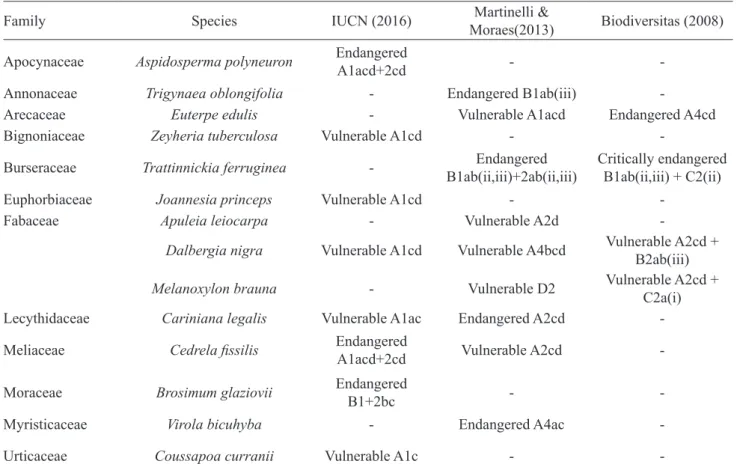
A total 14 threatened species were recorded in our survey (table 2). The main threat to populations of Aspidosperma polyneuron Müll.Arg., Apuleia leiocarpa (Vogel) J.F. Macbr., Cedrela fissilis Vell., Dalbergia nigra (Vell.) Allemão ex Benth., Joannesia princeps Vell., Melanoxylon brauna Schott, and Zeyheria tuberculosa (Vell.) Bureau ex Verl. is related to predatory exploitation by the timber industry and rural producers for manufacture of laminate and solid wood furniture as well as of ornamental structures, all of which have been historically leading to population decline in those species (Biodiversitas 2008, Martinelli & Moraes 2013, IUCN 2016). Trigynaea oblongifolia Schltdl. is considered rare (Martinelli & Moraes 2013), and similarly to Brosimum glaziovii Taub. (IUCN 2016), the species has a restricted distribution, which is the major threatening factor to both species. Populations of T. oblongifolia are threatened by loss of habitat quality (Martinelli & Moraes 2013). Euterpe edulis Mart. is threatened by its intense exploitation for palm heart harvest across the entire area where it occurs and by the consequent decline of its populations. Trattinnickia ferruginea Kuhlm. is a rare species (Giulietti et al. 2009), with populations restricted to well preserved Atlantic Forest remnants in Minas Gerais State; additionally, it is threatened by loss of its occurrence area and of habitat quality due to deforestation for charcoal production, pastures, and silviculture. Cariniana legalis (Mart.) Kuntze populations are declining not only due to intense exploitation for wood extraction, but also due to their occurrence in fertile lands widely used in agriculture. Virola bicuhyba (Schott) Warb. is endemic to ombrophilous and semideciduous Atlantic Forests and occurs preferentially in areas at advanced stages of regeneration or at climax (Martinelli & Moraes 2013). V. bicuhyba has medicinal value and its wood has high economic importance. Its major threat is the reduction of its populations, which is mainly caused by selective extraction and habitat conversion (Martinelli & Moraes 2013).
Table 2. Rare and threatened species found in the present study at Santa Rita Farm, Faria Lemos municipality, Minas Gerais State, Brazil, according to the Red List of the IUCN (2016), Martinelli & Moraes (2013), and Biodiversitas (2008).
Family Species IUCN (2016) Martinelli &
Moraes(2013) Biodiversitas (2008) Apocynaceae Aspidosperma polyneuron Endangered
A1acd+2cd -
-Annonaceae Trigynaea oblongifolia - Endangered B1ab(iii)
-Arecaceae Euterpe edulis - Vulnerable A1acd Endangered A4cd
Bignoniaceae Zeyheria tuberculosa Vulnerable A1cd -
-Burseraceae Trattinnickia ferruginea - Endangered
B1ab(ii,iii)+2ab(ii,iii)
Critically endangered B1ab(ii,iii) + C2(ii)
Euphorbiaceae Joannesia princeps Vulnerable A1cd -
-Fabaceae Apuleia leiocarpa - Vulnerable A2d
-Dalbergia nigra Vulnerable A1cd Vulnerable A4bcd Vulnerable A2cd + B2ab(iii)
Melanoxylon brauna - Vulnerable D2 Vulnerable A2cd +
C2a(i) Lecythidaceae Cariniana legalis Vulnerable A1ac Endangered A2cd
-Meliaceae Cedrela fissilis Endangered
A1acd+2cd Vulnerable A2cd
-Moraceae Brosimum glaziovii Endangered
B1+2bc -
-Myristicaceae Virola bicuhyba - Endangered A4ac
-Urticaceae Coussapoa curranii Vulnerable A1c -
-(Martinelli & Moraes 2013, Biodiversitas 2008). Anthurium santaritensis Nadruz & Croat is not under any threatened status in any of the analyzed lists, although according to the SpeciesLink platform (http:// splink.cria.org.br/) it occurs only at the Santa Rita Farm fragment (locality of the typus) and at Alegre and Vila Velha municipalities, Espírito Santo State. The species Dichorisandra leonii Aona & M.C.E. Amaral, Dichorisandra rupicola Aona & M.C.E. Amaral, Myrcia concisa Sobral & Leoni, and Calyptranthes carangola Sobral & Leoni were recently described (Sobral & Leoni 2010; Aona-Pinheiro & Amaral 2012; Sobral et al. 2016) based on material collected at Santa Rita Farm and its surroundings.
The studied remnant has important attributes that indicate its preservation degree as well as the importance of its conservation. Its high degree of preservation is demonstrated by the high values of richness, diversity, and evenness; by the high proportion of zoochorous species, which provide food to local fauna and thus contribute to the maintenance of ecological interactions; and by the presence of populations of several threatened species, two of
which (Virola bicuhyba and Trattinnickia ferruginea) occur in mature forests (Martinelli & Moraes 2013). The presence of the rare species Trigynaea oblongifolia and Trattinnickia ferruginea reiterates and subsidizes the importance of conserving the studied fragment, which is located in a key area for biodiversity conservation. Furthermore, our results reinforce the evidence found by Rezende et al. (2015), according to which areas located at the 0-1,000 m altitudinal range in the Seasonal Semideciduous Atlantic Forest deserve attention in terms of the need for conservation measures, due to their high species richness and high number of endemic and threatened species.
Acknowledgements
Literature cited
Aona-Pinheiro, L.Y.S. & Amaral, M.C.E. 2012. Four new species of Dichorisandra J.C. Mikan (Commelinaceae) from Southeast Brazil. Phytotaxa 48: 7-22.
APG III. 2009. An update of the Angiosperm Phylogeny Group classification for the orders and families of flowering plants: APG III. Botanical Journal of the Linnean Society 161: 105-121.
Aquino, A. & Barbosa, L.M. 2009. Classes sucessionais e síndromes de dispersão de espécies arbóreas e arbustivas existentes em vegetação ciliar remanescente (Conchal, SP), como subsídio para avaliar o potencial do fragmento como fonte de propágulos para enriquecimento de áreas revegetadas no rio Mogi-Guaçu, SP. Revista Árvore 33: 349-358.
Ayres, J.M., Fonseca, G.A.B., Rylands, A.B., Queiroz, H.L., Pinto, L.P., Masterson, D. & Cavalcanti, R.B. 2005. Os corredores ecológicos das florestas tropicais do Brasil. Sociedade Civil Mamirauá, Belém.
Bello, C., Galetti, M., Pizo, M.A., Magnago L. F.S., Rocha, M. F., Lima, R.A.F., Peres, C.A., Ovaskainen, O. & Jordano, P. 2015. Defaunation affects carbon storage in tropical forests. Science Advances 1: 1-11.
BFG. 2015. Growing knowledge: an overview of Seed Plant diversity in Brazil. Rodriguésia 66: 1085-1113.
Biodiversitas. 2008. Revisão das Listas das Espécies da Flora e da Fauna Ameaçadas de Extinção do Estado de Minas Gerais. Available in http:// www. biodiversitas. org. br/ listas-mg/ consulta. asp (access in 24-IV-2016).
Braga, A.J.T., Lima e Borges, E.E. & Martins, S.V. 2011. Florística e estrutura da comunidade arbórea de uma Floresta Estacional Semidecidual secundária em Viçosa, MG. Revista Árvore, Viçosa-MG. 35: 493-503. Campassi, F. 2006. Padrões geográficos das síndromes
de dispersão e características dos frutos de espécies arbustivo-arbóreas em comunidades vegetais na mata atlântica. Dissertação de Mestrado, Universidade de São Paulo, Piracicaba.
Catharino, E.L.M., Bernacci, L.C., Franco, G.A.D.C., Durigan, G. & Metzger, J.P. 2006. Aspectos da composição e diversidade do componente arbóreo das florestas da Reserva Florestal do Morro Grande, Cotia, SP. Biota Neotropica 6.
Coelho, S., Cardoso-Leite, E. & Castello, A.C.D. 2016. Composição florística e caracterização sucessional como subsídio para conservação e manejo do PNMCBio, Sorocaba - SP. Ciência Florestal 26: 331-344.
Di Maio, F.R. 2016. IxoraIn: Lista de Espécies da Flora do Brasil. Jardim Botânico do Rio de Janeiro. Available in http://floradobrasil.jbrj.gov.br/jabot/floradobrasil/ FB14078 (access in 28-IV-2016).
Dias-Neto, O.C., Schiavini, I., Lopes, S.F., Vale, V.S., Gusson, A.E. & Oliveira, A.P. 2009. Estrutura fitossociológica e grupos ecológicos em fragmento de Floresta Estacional Semidecidual, Uberaba, Minas
Fleming, T.H. 1979. Do tropical frugivores completed for food? Annales Zoologici Fennici 19: 1157-1172.
Flora do Brasil 2020 (em construção). 2016. Jardim Botânico do Rio de Janeiro. Available in http:// floradobrasil.jbrj.gov.br/ (access in 28-IV-2016).
Fuentes, M. 2000. Frugivory, seed dispersal and plant community ecology. Trends in Ecology and Evolution 15: 487-488.
Giulietti, A.M., Rapini, A., Andrade, M.J.G., Queiroz, L.P. & Silva, J.M.C. 2009. Plantas raras do Brasil. Conservação Internacional, Belo Horizonte.
IUCN. 2016. Lista Vermelha de Espécies Ameaçadas de Extinção da União Internacional para a Conservação da Natureza. 2013. Available in http://www.iucnredlist.org (access in 20-IV-2016).
Jordano, P. 2000. Fruits and frugivory. In: M. Fenner (ed.). Seeds: The Ecology of Regeneration in Plant Communities. 2 ed. CAB International, Wallingford, pp. 125-165.
Kinoshita, L.S., Torres, R.B., Forni-Martins, E.R. & Spinelli, T. 2006. Composição florística e síndromes de polinização e de dispersão da mata do Sítio São Francisco, Campinas, SP. Brasil. Acta Botanica Brasilica 20: 313-327.
Langhammer, P.F., Bakarr, M.I., Bennun, L.A., Brooks, T.M., Clay, R.P., Darwall, W., Silva, N., Edgar, G.J., Eken, G., Fishpool, L.D.C., Fonseca, G.A.B., Foster, M.N., Knox, D.H., Matiku, P., Radford, E.A., Rodrigues, A.S.L., Salaman, P., Sechrest, W. & Tordoff, A.W. 2007. Identification and gap analysis
of key biodiversity areas: Targets for comprehensive protected area systems. IUCN Best Practice Protected Areas Guidelines Series No 15, IUCN: Gland,
Switzerland.
Leite, E.C. & Rodrigues, R.R. 2008. Fitossociologia e caracterização sucessional de um fragmento de Floresta Estacional no sudeste do Brasil. Revista Árvore 32: 583-595.
Marangon, L.C., Soares, J.J., Feliciano, A.L.P. & Silva Brandão, C.F. L. Estrutura fitossociológica e classificação sucessional do componente arbóreo de um fragmento de Floresta Estacional Semidecidual, no município de Viçosa, Minas Gerais. Cerne 13: 208-221. Martinelli, G. & Moraes, M.D. 2013. Livro Vermelho
da Flora do Brasil. Andrea Jakobsson: Instituto de Pesquisas Jardim Botânico do Rio de Janeiro, Rio de Janeiro.
Meira-Neto, J.A.A. & Martins, F.R. 2000. Estrutura da Mata da Silvicultura, uma Floresta Estacional Montana no município de Viçosa, MG. Revista Árvore 24: 151-160.
Morellato, L.P.C., Talora, D.C., Takahasi, A., Bencke, C.C., Romera, E.C. & Zipparro, V.B. 2000. Phenology of Atlantic Rain Forest Trees: A Comparative Study. Biotropica 32: 811-823.
Moro, M.F., Martins, F.R. 2011. Métodos de Levantamento do Componente Arbóreo-Arbustivo. In: J.M. Felfili., P.V. Eisenlohr., M.M.R.F. Melo., L.A. Andrade., J.A.A. Meira-Neto. (eds.). Fitossociologia no Brasil: métodos e estudos de casos. Editora UFV, Viçosa, pp.174-212.
Myers, N., Mittermeier, R.A., Mittermeier, C.G., Fonseca, G.A.B. & Kent, J. 2000. Biodiversity hotspots for conservation priorities. Nature, 403: 853-858.
Oliveira-Filho, A.T. 2006. Catálogo das Árvores Nativas de Minas Gerais - Mapeamento e Inventário da Flora Nativa e dos Reflorestamentos de Minas Gerais. Editora UFLA, Lavras.
Oliveira-Filho, A.T. & Fontes, M.A.L. 2000. Patterns of floristic differentiation among Atlantic Forests in southeastern Brazil and the influence of climate. Biotropica 32: 793-810.
Peel, M.C., Finlayson, B.L. & Mcmahon, T.A. 2007. Updated world map of the Köppen Geiger climate classification. Hydrology and Earth System Sciences Discussions 11: 1633-1644.
Prado-Júnior, J.A., Lopes, S.F., Schiavini, I., Vale, V.S., Oliveira, A.P., Gusson, A.E., Dias-Neto, O.C. & Stein, M. 2012. Fitossociologia, caracterização sucessional e síndromes de dispersão da comunidade arbórea de remanescente urbano de Floresta Estacional Semidecidual em Monte Carmelo, Minas Gerais. Rodriguésia 63: 489-499.
Ramos, V.S., Durigan, G., Franco, G.A.D.C., Siqueira, M.F. & Rodrigues, R.R. 2008. Árvores da Floresta Estacional Semidecidual - Guia de Identificação de espécies. São Paulo: Editora da Universidade de São Paulo: Biota/Fapesp, São Paulo.
Rezende, V.L., Miranda, P.L.S., Meyer, L., Moreira, C.V., Linhares, M.F., Oliveira-Filho, A.T. & Eisenlohr, P.V. 2015 Tree species composition and richness along altitudinal gradients as a tool for conservation decisions: the case of Atlantic Semideciduous Forest. Biodiversity and Conservation 24: 2255-2272.
Ribeiro, M.C., Metzger, J.P., Martensen, A.C., Ponzoni, F.J. & Hirota, M.M. 2009. The Brazilian Atlantic Forest: How much is left, and how is the remaining forest distributed? Implications for conservation. Biological Conservation 142: 1141-1153.
Ribeiro, M.C., Martensen, A.C., Metzer, J.P., Tabarelli, M., Scarano, F. & Fortin, M.-J. 2011. The Brazilian Atlantic Forest: a shrinking biodiversity hotspot. In: F.E. Zachos. & J.C. Habel (eds.). Biodiversity hotspots: distribution and protection of conservation priority areas. Springer, Heidelberg/Dordrecht/London/New York, pp. 405-434.
Santos, M.L., Meira-Neto, J.A.A., Silva, A.F., Martins, S.V. & Campos, E.P. 2013. Estrutura fitossociológica
e raridade em um trecho de Floresta Estacional Semidecidual primária na zona da mata de Minas Gerais. Global Science and Technology 6: 101-117.
Silva, N.R.S., Martins, S.V., Meira-Neto, J.A.A. & Souza, A.L. 2004. Composição florística e estrutura de uma
Floresta Estacional Semidecidual Montana em Viçosa, MG. Revista Árvore 28: 397-405.
Sobral, M. & Leoni, L.S. 2010. Myrcia concisa (Myrtaceae), a New Species from Minas Gerais, Brazil. Novon 20: 345-347.
Sobral, M., Mazine, F.F., Leoni, L., Souza, M.C. & Melo, E.A.D. 2016. Five new southeastern Brazilian Myrtaceae. Phytotaxa 253: 57-70.
Sobral, M., Proença, C., Souza, M., Mazine, F. & Lucas, E. 2016. Myrtaceae. In: Lista de Espécies da Flora do Brasil. Jardim Botânico do Rio de Janeiro. Available in http://floradobrasil.jbrj.gov.br/jabot/floradobrasil/ FB24034 (access in 18-IV-2016).
Stehmann, J.R., Forzza, R.C., Sobral, M. & Kamino, L.H.Y. 2009. Gimnospermas e angiospermas. In: J.R. Stehmann, R.C. Forzza, M. Sobral & L.H.Y. Kamino (eds.). Plantas da Floresta Atlântica. Jardim Botânico do Rio de Janeiro, Rio de Janeiro, pp. 27-37.
van der Pijl, L. l982. Principles of dispersal in higher plants. 2 ed. Springer-Verlag, Berlin.
Yamamoto, L.F., Kinoshita, L.S. & Martins, F. R. 2007. Síndromes de polinização e de dispersão em fragmentos da Floresta Estacional Semidecídua Montana, SP, Brasil. Acta Botanica Brasilica 21: 553-573.