Alterations in the expression and activity of
extra-cellular matrix components in HPV-associated infections
and diseases
Suellen Herbster, Andressa Paladino, Sumara de Freitas, Enrique Boccardo*
Laboratory of Oncovirology, Department of Microbiology, Institute of Biomedical Sciences, University of Sa˜o Paulo, Sa˜o Paulo, Brazil.
Herbster S, Paladino A, Freitas S, Boccardo E. Alterations in the expression and activity of extracellular matrix components in HPV-associated infections and diseases. Clinics. 2018;73(suppl 1):e551s
*Corresponding author. E-mail: [email protected]
Infection with human papillomaviruses is associated with a series of benign and malignant hyperproliferative diseases that impose a heavy burden on human populations. A subgroup of mucosal human papillomavirus types are associated with the majority of cervical cancers and a relevant fraction of vulvar, vaginal, anal, penile and head and neck carcinomas. Human papillomaviruses mediate cell transformation by the expression of two pleiotropic oncoproteins that alter major cellular regulatory pathways. However, these viruses are not complete carcinogens, and further alterations within the infected cells and in their microenvironment are necessary for tumor establishment and progression. Alterations in components of the extracellular matrix for instance, matrix metalloproteinases and some of their regulators such as tissue inhibitors of metalloproteinases, have been consistently reported in human papillomaviruses-associated diseases. Matrix metalloproteinases function by remodeling the extracellular matrix and alterations in their expression levels and/or activity are associated with pathological processes and clinical variables including local tumor invasion, metastasis, tumor relapse and overall patient prognosis and survival. In this review we present a summarized discussion on the current data concerning the impact of human papillomavirus infection on the activity and expression of extracellular matrix components. We further comment on the possibility of targeting extracellular matrix molecules in experimental treatment protocols.
KEYWORDS: Human papillomavirus; Extracellular matrix; Matrix Metalloproteinases; TIMPs; RECK.
’ INTRODUCTION
Human papillomaviruses (HPVs) are small (B50 nm),
non-enveloped viruses with marked tropism for the stratified epithelia of mucosa and the skin. The viral cycle is strictly dependent on the epithelial differentiation program since the availability of cellular factors expressed in different strata of the epithelium play a role on viral gene expression and genome amplification (see below). The genome of these viruses is composed of a circular molecule of double-stranded DNA of approximately 8 kbp packaged with cellular histones. The viral DNA can be divided into three functional regions. The long control region (LCR) or upstream-regulatory region (URR) is a noncoding stretch of DNA that contains the viral origin of replication and sites for binding viral and cellular factors. The combination of viral and cellular proteins that bind to this region regulates both viral genome replication
and gene transcription. In addition, HPVs exhibit two coding regions. The early region (E) codifies the early genes that regu-late viral DNA replication and gene expression (E1, E2, E7), viral persistence (E5, E6 and E7), immune evasion (E5, E6 and E7), inhibition of apoptosis (E6 and E7) and virion maturation and release (E4). The late region (L) contains the genes that codify the major (L1) and minor (L2) capsid proteins (1).
HPV infections are ubiquitous and are associated with a series of hyperproliferative pathologies of epithelia and mucosa as well as most cases of cervical cancer and genital warts (2,3). To date, more than 200 HPV types have been described (4). Almost 40 types exhibit particular tropism for the mucosa of the anogenital region. HPV types from this subgroup are classified as being of high or low oncogenic risk, according to their association with cervical cancer. While high-risk HPV types are associated with almost the totality of cervical cancer cases, low-risk HPV types are the cause of almost all anogenital warts and low-grade lesions with little tendency to malignant progression. The most prevalent high-risk HPVs are HPV16 and HPV18, while the most common low-risk types are HPV6 and HPV11. In addi-tion, studies conducted during the last two decades have clearly shown that infections with specific high-risk HPV types are etiologically related with a significant proportion of vulvar, vaginal, anal, penile and head and neck carcinomas (5,6). High-risk HPV types express two oncogenes, E6 and E7, that collaborate to immortalize normal human keratino-cytes in cell culture systems and are essential to maintain the DOI:10.6061/clinics/2018/e551s
Copyright&2018CLINICS–This is an Open Access article distributed under the terms of the Creative Commons License (http://creativecommons.org/licenses/by/ 4.0/) which permits unrestricted use, distribution, and reproduction in any medium or format, provided the original work is properly cited.
No potential conflict of interest was reported.
Received for publication onJanuary 4, 2018.Accepted for publication onMarch 7, 2018
transformed phenotype in vivo (7). The main role of these proteins during the HPV cycle is to generate a cellular micro-environment permissive for viral replication (8). This includes the induction of DNA replication machinery, immune eva-sion and downregulation of apoptosis (9-17). To achieve this goal, E6 and E7 target critical cellular regulatory pathways including those mastered by p53 and pRb, respectively (18-20).
Despite the high impact of the expression of HPV proteins on cellular homeostasis, these viruses are incomplete carcino-gens. Therefore, further alterations in the cell as well as in its microenvironment are necessary for tumor establishment and progression. This process includes dysregulation of the extracellular matrix (ECM). In some cases, alterations in the levels and activity of defined ECM components have been experimentally associated with the expression of specific HPV proteins, suggesting the direct involvement of the virus in the deregulation of these factors. Other studies, mainly those conducted using clinical samples, have identi-fied alterations in the levels of ECM molecules during the progression of HPV-related diseases. However, in most situations the direct involvement of viral proteins on these alterations has not been addressed. In this review we discuss the current state of knowledge concerning the impact of HPV infection on the expression and function of components of the ECM.
ECM alterations in HPV-associated anogenital intraepithelial neoplasias
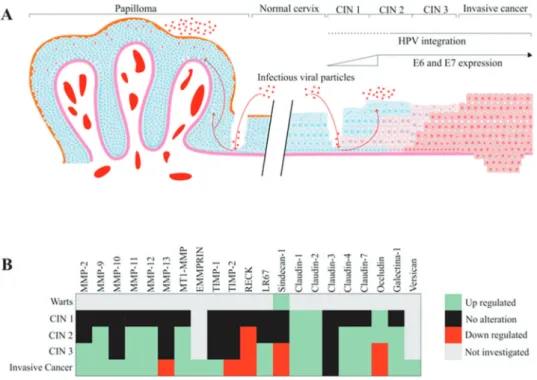
The natural history of cervical cancer development arises from precursor lesions, called cervical intraepithelial neo-plasias (CINs). CIN 1 and a subgroup of CIN 2 lesions are classified as productive lesions, in which the viral cycle is complete. On the other hand, a subgroup of CIN 2 and all CIN 3 lesions are cervical cancer precursors. The develop-ment of these lesions is mainly caused by persistent infection with oncogenic HPV types. Productive lesions present low to moderate histological alterations and spontaneously regress in the period of 1 to 2 years. In the event of high-risk HPV persistent infections, high-grade precancerous lesions (a sub-group of CIN 2 and all CIN 3) may develop within 3 to 5 years. Morphologically, CIN 3 (carcinomain situ[CIS]) represents a heterogeneous disease, and it can be considered a precur-sor lesion to a more advanced, invasive cervical cancer (21). HPV infection has been associated with several altera-tions in tissue organization and architecture, including dysregulation of matrix metalloproteinase (MMP) expres-sion and activity. Additionally, alterations in different molecules of the ECM can be observed in HPV-associated CINs. The main alterations in ECM components in CIN are summarized in Figure 1. For example, when MMP-2 expression was analyzed in cervical samples, the levels of this protein were undetectable in normal cervix and
low-grade lesions. In contrast, high-grade lesions and inva-sive carcinomas showed high MMP-2 expression, suggesting that MMP-2 may constitute an early marker for cervical cancer progression. Additionally, these results suggest that upregu-lated MMP-2 expression may be associated with the potential risk of invasion and metastasis (22,23). MMP-2 is also called gelatinase A and has fibronectin type II repeats in its catalytic domain, which mediates collagen binding to this protease. MMP-2 major function involves collagen type IV breakdown in the basement membrane (24,25).
MMP-2 and its regulator tissue inhibitor of metallo-proteinases type 2 (TIMP-2) are important determinants in the behavior of invasive tumors and in their metastatic potential. A previous study conducted with clinical samples from patients with CIN or invasive squamous cell cervical carcinoma (CC) showed that MMP-2 expression levels pre-sented a positive correlation with CIN grade, and was further increased after progression to invasive cancer. How-ever, TIMP-2 expression presented no alterations when normal tissues were compared to CIN 3 tissues (26). On the other hand, our group has shown that HPV16 E7 expres-sion is associated with a decrease in TIMP-2 expresexpres-sion and function in primary keratinocytes (27). Zhou et al. (28) ana-lyzed the expression of MMP-2, MMP-9, 1 and TIMP-2 in normal cervix, CIN cervix samples and cervical cancer samples using an immunohistochemistry (IHC) assay. Their results suggest that overexpression of these ECM components may play a key role in cervical cancer-associated lymph node invasion and metastasis.
In an early study, Davidson et al. (29) analyzed the expres-sion of MMP-9 in cervical squamous cell carcinoma and CIN 2-3 samples and observed that MMP-9 mRNA and protein expression were elevated in both high-grade CIN and inva-sive squamous cell carcinoma when compared with normal samples. Therefore, MMP-9 was also suggested as a possible early marker of cervical lesion progression. No et al. (30) also detected a higher expression of MMP-9 in CIN 3 lesions than that in CIN 1 and 2 lesions. In addition, our group has shown that the expression of the MMP inhibitor (MMPI) reversion-inducing protein cysteine-rich protein with kazal motifs (RECK) is downregulated in high-grade CIN and cervical cancer samples when compared with low-grade CIN and control samples. In addition, previous data from our group demonstrated that transduction with HPV16 E6 and E7 oncogenes correlates with reduced expression of the RECK protein in organotypic cultures of primary keratinocytes. We also observed increased MMP-2 and MMP-9 expression and activity in this system (27). Altogether, these results suggest that upregulation of MMP-2 and MMP-9 expression and activity are associated with high-grade CIN. On the other hand, the MMPI RECK exhibits reduced levels of expression in these lesions (26-28,31). These results are summarized in Figure 1B.
Recently, Valdivia et al. (32) analyzed the expression of MMP-11 and MMP-12 in low- and high-grade squamous lesions (LSIL and HSIL, respectively) and cervical carci-nomas. These authors observed that samples with posi-tive expression for MMP-11 were also posiposi-tive for MMP-12, and their expression increased according to lesion grade. In addition, they showed that MMP-11 and MMP-12 proteins accumulated mainly in the cytoplasm of transformed cells. On the other hand, these proteins were not detected in normal epithelia. These results indicate that MMP-11 and MMP-12 may be associated with the onset of cancer precursor lesions
and suggest that increased expression of these proteins can be considered an early event during the development of preneoplastic cervical lesions. The MMP-11 gene, which is also called stromelysin-3 (ST-3), is located on chromosome 22q11.23 and has been identified in a breast cancer cDNA library. MMP-12, also known as metalloelastase or macrophage elastase, is found on chromosome 11q22.3 (25,32-34).
Alterations in other ECM components have also been explored in the cervical tissue transformation context. Branca et al. (35) have found that 67-kDa laminin receptor (LR67) expression progressively increases with CIN grade. LR67 is associated with CIN 2 to CIN 3 progression, and it can be thought of as a marker of cellular proliferation in cervical tissue (26). These authors have also shown that the combined analysis of LR67 and vascular endothelial growth factor-C (VEGF-C) may improve high-grade CIN clinical detection (35). Moreover, analysis of the expression of sindecan-1 and claudins (CLDNs) in CIN 1, 2, and 3 and CIS lesions dem-onstrated that sindecan-1 and CLDNs 1, 4 and 7 expression levels are similar among CIN 2 and 3, CIS and normal epithe-lium. However, CLDN3 was not detectable in the squamous epithelium (36).
HPV infection has also been linked to a relevant percen-tage of lesions in other epithelia of the anogenital tract including the vulva, vagina and anus. Vulvar, vaginal and anal cancer precursor lesions are also denominated as vulvar intraepithelial neoplasia (VIN), vaginal intraepithelial neo-plasia (VAIN) and anal intraepithelial neoneo-plasia (AIN), respectively (37). Similar to what is observed in cervical precursor lesions, VIN, VAIN and AIN also progress through grades of epithelial transformation. Previous studies have determined the HPV DNA prevalence in VAIN, VIN and AIN on four continents using PCR assays. HPV6 and HPV11 were the most prevalent HPV types found in VIN 1 and AIN. Moreover, HPV16 was detected in 75% of vulvar, vaginal and anal HPV-positive carcinomas. The same study also determined that HPV18 was detected in only 10% of the evaluated samples (38). In another study, HPV16 or HPV18 were found in 76% of VIN 2-3, 64% of VAIN 2-3, 81% of AIN 2-3 and 42% of vulvar carcinoma samples. Additionally, the same HPV types were observed in 58% of women under 56 years of age who were diagnosed with carcinoma of the vulva (39).
Finally, a retrospective study analyzed the expression of MMP-2, MMP-9, TIMP-1 and TIMP-2 by IHC in VIN 1, 2 and 3 samples and invasive vulvar carcinoma. The results from this study suggested that overexpression of MMP-2, MMP-9 and TIMP-2 proteins may be related with the progression of VIN to invasive carcinoma (40).
ECM composition in HPV-associated cancers
The carcinogenic process naturally culminates in the over-coming of multiple ECM regulatory mechanisms in order to promote tissue invasion of established tumors (41). The dysregulation of ECM remodeling proteins is a common fea-ture in the natural history of human cancers, resulting in an overall collapse in normal ECM composition and main-tenance (42,43). This event is a devastating consequence of the imbalance between expression and activity of specific proteases and their natural negative regulators, which leads to an altered deposition-to-degradation ratio of several base-ment membrane structural molecules.
and pathological processes such as cancer. In cancer, this event can impact (I) tissue tension and (II) the release of chemotactic fragments of ECM components that influence the local micro-environment, as it favors (III) cell migration and recruitment of stromal, endothelial and immune cells to the tumor vicinity. The heterotypical association of cancer cells and other elements observed in the tumor microenvironment, such as inflamma-tory infiltrates, endothelial cells and tumor-associated fibro-blasts, must also be explored in order to fully understand the alterations in ECM remodeling resulting from this intricate crosstalk (44).
Historically, the most investigated proteases present in this crossroad are the MMPs. The activity of specific MMP types such as MMP-2, MMP-9 and membrane type 1 (MT1)-MMP is upregulated in most human cancers. These MMPs play a central role in basement membrane breakdown and cell inva-sion, as well as in neoangiogenesis and metastasis (25,45). The excess of MMP activity generates topographical changes in the tumor microenvironment by proteolysis-associated modi-fications of the structural ECM scaffold. In fact, linearization, thickening and/or degradation of specific collagen are com-mon events observed in epithelial tissue areas adjacent to tumor-associated blood vessels, where cancer cells invade. MMP activity also regulates cellular migration and release of ECM fragments with biological functions, such as growth factors (42).
The crucial role of specific MMPs in the process of carcino-genesis has set an objective task for researchers in the field to explore the potential of MMPs as therapeutic targets (46). However, the use of broad-spectrum, small-molecule MMPIs offers no clinical advantages due to the dose-limiting side effects (46,47). For example, some of the nonspecific MMP inhibitors also downregulate the TNF-aconverting enzyme (TACE) and prevent the release of TNF-a receptor II (TNF-RII), which contributes to the side effect of musculo-skeletal pain (47-49). Nevertheless, novel and more specific MMPIs and MMP cleavage-associated cytotoxic treatments are being tested in clinical trials as potential cancer treatment options (50-52).
Several authors have studied ECM alterations in both struc-tural and remodeling molecules in invasive cervical cancer. More specifically, alterations in the expression/activity of galectins, collagens, proteoglycans, laminins, fibronectins, integrins and proteases and their regulators were observed in both cervical cancer samples and derived cell lines. Considering the current review, we aim to assemble a more complete view of the spectrum of ECM alterations in HPV-associated tumors, mainly regarding cervical cancer.
MMPs in HPV-associated cancers
HPV16 seems to be associated with higher expression/ activity of specific MMPs during cervical cancer progression (27,31,53,54). Indeed, the imbalance between the expression/ activity of proteases such as MMPs and their negative regu-lators is a common feature in both cervical cancer samples and derived cell lines (22,27,31,54-56).
Several authors have reported the upregulation of speci-fic MMPs in samples of cervical carcinoma when com-pared to control healthy tissue, including MMP-1, MMP-2, MMP-3, MMP-7, MMP-9, MMP-10, MMP-11, MMP-12, MMP-13, MMP-14 (MT1-MMP) and MMP-15 (22,27,31,54–56).
The main alterations in ECM components in cervical tumors are summarized in Figure 1. Kaewprag et al. (54) analyzed the
ability of HPV16 and HPV18 oncoproteins to regulate the expression of MMP-1, MMP-2, MMP-7, MMP-9, MMP-10, MMP-11 and MMP-14 (MT1-MMP). These authors found a positive correlation between the expression level of MMPs and the cell invasion potential of C33A cells stably expressing different HPV16 oncoproteins. Furthermore, this study detected an upregulation of MMP-2 and MT1-MMP gene expression when C33A cells expressed both HPV16 E6 and E7 oncopro-teins, which correlated with increased cell invasion. Conversely, silencing of HPV16 E6 and E7 expression by shRNA led to the downregulation of MMP-2 and MT1-MMP expression. This was paralleled by a reduction in the invasive potential of these cells. Altogether, these observations suggest the direct effects of HPV oncoproteins in the modulation of these MMP types. Moreover, elevated MMP-2 and MT1-MMP protein levels were observed in clinical samples of HPV16-positive invasive cervical tumors when compared to CIN and normal cervical tissues. The authors also observed that PEA3 and Sp1 binding sites present on MMP-2 and MT1-MMP promoters were essen-tial for the transactivation activity mediated by HPV16 E6 and E7. MT1-MMP (or MMP-14) functions include ECM remodel-ing through proteolysis of collagen I, II, and III, fibrin, fibro-nectin, laminin-1, laminin-5, and vitronectin (25).
Even though MMP proteolytic network alterations are com-mon during the progression of cervical cancer, only upregula-tion of the expression/activity of MMP-2 (gelatinase A) and/ or MMP-9 (gelatinase B) seems to be indicative of a poor pro-gnosis in cervical cancer patients (22,57,58). In fact, others have observed a correlation between MMP-2 and MMP-9 transcript levels and cervical tumor invasion potential (22,55,56,59). Our group has shown that SiHa and CaSki HPV-positive cervical cancer-derived cell lines present higher levels of MMP-2, MT1-MMP, and TIMP-2 than the C33A HPV-negative cell line (53). Moreover, we demonstrated an association between HPV16 E6 and E7 expression, upregulation of MMP-2 and MMP-9 mRNA and decreased levels of their natural negative regulators RECK and TIMP-2 mRNA in primary keratinocytes grown in organotypic cultures (27). Finally, we analyzed RECK and MMP-9 expression levels in clinical samples from patients diagnosed with cervical cancer and observed (I) downregu-lated RECK protein expression and (II) upregudownregu-lated MMP-9 protein expression in cervical cancer when compared to CIN 1 or normal cervical tissue (27,31). Interestingly, MMP-2 is constitutively expressed in several cell types, and the accumulation of its active form depends on activation by MT1-MMP, while specific cytokines can operate under MMP-9 transcription regulation (60,61).
Branca et al. (26) observed a strong expression of MT1-MMP in paraffin-embedded invasive cervical cancer samples when compared to normal cervical tissues. This study also showed that all cervical cancer-derived cell lines analyzed (CaSki, C-4II, HT-3, ME-180, MS751, and HeLa) expressed high levels of MT1-MMP and MMP-2. On the other hand, Vazquez-Ortiz et al. (56) observed an upregulation of MMP-10, MMP-11 and MMP-12 and a downregulation of MMP-13 in cervical cancer samples when compared to HSIL samples using cDNA expression arrays. Additionally, it has been observed that keratinocytes expressing E7 from high-risk mucosal and cutaneous HPV types exhibit upregulated expression of MT1-MMP (62).
and LSIL, HSIL and cervical cancer clinical samples using IHC assays and gelatin zymography. The authors observed an increase in the protein levels of MMP-2 and MMP-9 in 13%, 80% and 90% of LSIL, HSIL and cervical cancer samples, respectively (22). MMP-9 specific activity and/or MMP-2 active protein levels were (I) increased in HSIL and cervical cancers when compared to normal control tissues (II) and correlated with increased lymph node metastasis and cancer relapse (22,63). Finally, patients with early stages of cervical cancer showed higher MMP-9 expression and experienced a decreased recurrence-free survival after standard treatment (64).
Other ECM molecules altered in HPV-associated cancer
The differential expression of specific modulators of ECM protease activity plays a central role in tumor microenviron-ment remodeling. These positive and negative modulators present an intricate interplay that impacts both their expres-sion and function in HPV-associated tumors (27,31,53,54).
Indeed, the protein levels of a disintegrin and proteinase 17 (ADAM17), amphiregulin (AREG), ECM metallo-proteinase inducer (EMMPRIN), and MMP were increased in cervical carcinoma clinical samples when compared with normal adjacent cervical tissues. Moreover, strong ADAM17, AREG, and EMMPRIN protein expression was associated with several poor prognosis parameters, including the presence of lymph node metastasis and advanced tumor stage (65). One of the mechanisms underlying the downregulation of TIMPs in cervical cancer might be through the function of EMMPRIN. Xu et al. (66) showed that exogenous expression of EMMPRIN downregulated TIMP-1 protein in HPV-positive cervical cancer-derived cell lines. These authors have also analyzed EMMPRIN downregulation using iRNA and observed an increase in TIMP-1 protein levels in the same cell lines.
Different types of collagens, including collagen types I, II, III, V, and IX may show increased deposition in the tumor microenvironment (42). Decreased expression or lack of collagen IV is an independent predictive factor for cervical lymph node invasion in patients with early stage cervical carcinoma (67,68). Moreover, increased protein levels of collagen XVII have been reported in cervical cancer clinical samples and were associated with increased local tumor spread. Additionally, this study showed that the COL17A1 gene was hypomethylated in cervical cancer clinical samples (69). Syndecan 1, a transmembrane heparan sulfate cell surface proteoglycan that is highly expressed in the normal cervical epithelium (except for the basal cell layer), presents a marked downregulation in invasive cervical carcinomas when compared with CIN samples (36,70,71). Similar to what has been shown for collagen IV, Numa et al. (70) showed that decreased or absent syndecan 1 expression presents an inverse correlation with cervical lymph node invasion but not with overall prognosis in cervical cancer patients. In oppo-sition to these results, it was reported that strong syndecan 1 cytoplasmic expression (without alterations in gene copy number) correlates with improved survival and represents an independent prognostic factor for patients diagnosed with cervical carcinoma (72).
CLDNs and occludins are families of proteins associated with the establishment of tight junctions and epithelial cell polarity and intercellular permeability. Expression levels of CLDN type 1, 2, 4 and 7 proteins were upregulated in HSIL lesions and in invasive cervical tumors when compared with normal cervical tissues (36,73). On the other hand, occludin is
expressed in the basal cell layer of normal cervical tissues, and its protein level is decreased in invasive cervical carcino-mas when compared with CIN samples. This study indicated that alterations in cell adhesion and ECM structure are a common early feature in cervical cancer progression (73).
The expression of the 67-kd high-affinity laminin–binding
protein (67LR) was increased in both CIN and cervical cancer samples when compared with normal cervical tissues (26,74). However, the latter study did not observe a significant capa-bility 67LR to predict either (I) high-risk HPV infection clear-ance in CIN after treatment or (II) survival in cervical cclear-ancer patients (26).
Versican, an ECM proteoglycan, was evaluated in cervi-cal cancer samples by IHC and in situ hybridization. The expression of high levels of versican in tumor stromal myofibroblasts was associated with (I) a lower frequency of tumor-infiltrating CD8-positive T cells, (II) increased tumor parametrial invasion and infiltration depth (III) and no change in cervical cancer survival (75). Interestingly, the beta-galactoside-binding protein galectin-1 was more expres-sed in tumor-adjacent stromal cells when compared with normal cervical tissue-associated stroma (76). Moreover, a higher expression level of galectin-1 was associated with increased local tumor relapse and poor cancer-specific sur-vival in patients with stage I-II cervical tumors after radiation treatment, although it could not predict distant metastasis (77). In 2015, a new study presented more results on ECM changes in cervical cancer clinical samples when compared with normal cervical tissues obtained from hysterectomy (78). All samples were previously verified for the presence of HPV DNA by nested PCR (79). Formalin-fixed cervical tissues were prepared for tissue microarray (TMA) and analyzed through IHC for 25 different ECM molecules, including laminin-1 and laminin-5, a-smooth muscle actin (aSMA) and fibronectin. Laminin-1 (3.8-fold) and aSMA (5.2-fold) proteins presented increased expression, mainly in cervical tumor-surrounding stroma when compared with normal cervical stroma. Moreover, tumor cells and both tumor and normal tissue-associated fibroblasts were collected from fresh cervical tissue and cultured in order to analyze the secre-tion of ECM elements. In summary, (I) tumor cells mainly expressed integrin a6b4 laminin receptors and (II) tumor-associated fibroblasts showed higher levels of laminin-a1 and laminin-b1 and lower levels of laminin-5, fibronectin, collagen III, TIMP-1 and the hyaluronan (HA) receptor CD44 when compared with normal fibroblasts (78). Finally, it has been shown that MMP-7 and MMP-9 expression correlate with CD44 expression in skin cancer cells (80,81).
Therefore, further studies are necessary to understand how HPV proteins affect the dynamic ECM balance in associated pathologies. This will help us to better understand the genesis of the disease and define more suitable clinical interventions. Importantly, a great majority of the ECM alterations described in this review have also been observed in HPV-independent tumors. Therefore, understanding the virus-mediated molecu-lar events leading to ECM disturbance may prove of value for understanding the basic mechanisms of carcinogenesis and the development of more general antitumor approaches.
’ ACKNOWLEDGMENTS
This research was supported by grants from FAPESP (2008/57889-1; 2013/27006-9) (CNPq 573799/2008-3) and CAPES (1680367).
’ AUTHOR CONTRIBUTIONS
Herbster S prepared the text describing ECM alterations in HPV-associated tumors. Paladino A prepared the text describing the general characteristics of HPV and the effect of the virus on ECM alterations present in precursor lesions and prepared the illustration in Figure 1. Freitas S assisted in the preparation of text describing the general characteristics of HPV and the effect of the virus on ECM alterations present in precursor lesions. Boccardo E prepared, revised and corrected all the text.
’ REFERENCES
1. Doorbar J, Quint W, Banks L, Bravo IG, Stoler M, Broker TR, et al. The biology and life-cycle of human papillomaviruses. Vaccine. 2012; 30(Suppl 5):F55-70, http://dx.doi.org/10.1016/j.vaccine.2012.06.083. 2. International Agency for Research on Cancer. Human Papillomaviruses,
vol. 90; 2007 [Internet]. IARC Monographs on the evaluation of carcino-genic risks to humans. Available from: http://monographs.iarc.fr/ENG/ Monographs/vol90/mono90-6.pdf%5Cnhttp://monographs.iarc.fr/ENG/ Monographs/vol100B/mono100B-11.pdf.
3. International Agency for Research on Cancer. Human Papillomaviruses, vol. 100B, 2012 [Internet]. IARC Monographs on the evaluation of carcino-genic risks to humans. Available from: http://monographs.iarc.fr/ENG/ Monographs/vol100B/index.php.
4. PaVE: Papillomavirus Episteme [access in 15 december 2017]. Available from: http://pave.niaid.nih.gov/.
5. Tota JE, Chevarie-Davis M, Richardson LA, Devries M, Franco EL. Epide-miology and burden of HPV infection and related diseases: implications for prevention strategies. Prev Med. 2011;53(Suppl 1):S12-21, http://dx. doi.org/10.1016/j.ypmed.2011.08.017.
6. Serrano B, Brotons M, Bosch FX, Bruni L. Epidemiology and burden of HPV-related disease. Best Pract Res Clin Obstet Gynaecol. 2018;47(1): 14-26, http://dx.doi.org/10.1016/j.bpobgyn.2017.08.006.
7. Goodwin EC, DiMaio D. Repression of human papillomavirus oncogenes in HeLa cervical carcinoma cells causes the orderly reactivation of dormant tumor suppressor pathways. Proc Natl Acad Sci U S A. 2000;97(23):12513-8, http://dx.doi.org/10.1073/pnas.97.23.12513.
8. Banerjee NS, Wang HK, Broker TR, Chow LT. Human papillomavirus (HPV) E7 induces prolonged G2 following S phase reentry in differentiated human keratinocytes. J Biol Chem. 2011;286(17):15473-82, http://dx.doi. org/10.1074/jbc.M110.197574.
9. Dyson N, Howley PM, Münger K, Harlow E. The human papilloma virus-16 E7 oncoprotein is able to bind to the retinoblastoma gene product. Science. 1989;243(4893):934-7, http://dx.doi.org/10.1126/science.2537532. 10. Barbosa MS, Edmonds C, Fisher C, Schiller JT, Lowy DR, Vousden KH.
The region of the HPV E7 oncoprotein homologous to adenovirus E1a and Sv40 large T antigen contains separate domains for Rb binding and casein kinase II phosphorylation. EMBO J. 1990;9(1):153-60, http://dx.doi.org/ 10.1002/j.1460-2075.1990.tb08091.x.
11. Klingelhutz AJ, Foster SA, McDougall JK. Telomerase activation by the E6 gene product of human papillomavirus type 16. Nature. 1996;380(6569): 79-82, http://dx.doi.org/10.1038/380079a0.
12. Brehm A, Nielsen SJ, Miska EA, McCance DJ, Reid JL, Bannister AJ, et al. The E7 oncoprotein associates with Mi2 and histone deacetylase activity to promote cell growth. EMBO J. 1999;18(9):2449-58, http://dx.doi.org/ 10.1093/emboj/18.9.2449.
13. Patel D, Huang SM, Baglia LA, McCance DJ. The E6 protein of human papillomavirus type 16 binds to and inhibits co-activation by CBP and p300. EMBO J. 1999;18(18):5061-72, http://dx.doi.org/10.1093/emboj/18.18.5061. 14. Helt AM, Galloway DA. Destabilization of the retinoblastoma tumor suppressor by human papillomavirus type 16 E7 is not sufficient to
overcome cell cycle arrest in human keratinocytes. J Virol. 2001;75(15): 6737-47, http://dx.doi.org/10.1128/JVI.75.15.6737-6747.2001.
15. Cho NH, Kim YT, Kim JW. Alteration of cell cycle in cervical tumor associated with human papillomavirus: cyclin-dependent kinase inhibitors. Yonsei Med J. 2002;43(6):722-8, http://dx.doi.org/10.3349/ymj.2002.43.6.722. 16. Longworth MS, Laimins LA. The binding of histone deacetylases and the
integrity of zinc finger-like motifs of the E7 protein are essential for the life cycle of human papillomavirus type 31. J Virol. 2004;78(7):3533-41, http://dx.doi.org/10.1128/JVI.78.7.3533-3541.2004.
17. Pim D, Banks L. Interaction of viral oncoproteins with cellular target molecules: infection with high-risk vs low-risk human papillomaviruses. APMIS.2010;118(6-7):471-93, http://dx.doi.org/10.1111/j.1600-0463.2010. 02618.x.
18. Crook T, Tidy JA, Vousden KH. Degradation of p53 can be targeted by HPV E6 sequences distinct from those required for p53 binding and trans-activation. Cell. 1991;67(3):547-56, http://dx.doi.org/10.1016/0092-8674(91) 90529-8.
19. Lechner MS, Mack DH, Finicle AB, Crook T, Vousden KH, Laimins LA. Human papillomavirus E6 proteins bind p53in vivoand abrogate p53-mediated repression of transcription. EMBO J. 1992;11(8):3045-52, http://dx.doi.org/10.1002/j.1460-2075.1992.tb05375.x.
20. Scheffner M, Huibregtse JM, Vierstra RD, Howley PM. The HPV-16 E6 and E6-AP complex functions as a ubiquitin-protein ligase in the ubiquitination of p53. Cell. 1993;75(3):495-505, http://dx.doi.org/10.1016/ 0092-8674(93)90384-3.
21. Steenbergen RD, Snijders PJ, Heideman DA, Meijer CJ. Clinical implica-tions of (epi)genetic changes in HPV-induced cervical precancerous lesions. Nat Rev Cancer. 2014;14(6):395-405, http://dx.doi.org/10.1038/nrc3728. 22. Sheu BC, Lien HC, Ho HN, Lin HH, Chow SN, Huang SC, et al. Increased
expression and activation of gelatinolytic matrix metalloproteinases is associated with the progression and recurrence of human cervical cancer. Cancer Res. 2003;63(19):6537-42.
23. Nasr M, Ayyad SB, El-Lamie IK, Mikhail MY. Expression of matrix metalloproteinase-2 in preinvasive and invasive carcinoma of the uterine cervix. Eur J Gynaecol Oncol. 2005;26(2):199-202.
24. Brummer O, Böhmer G, Hollwitz B, Flemming P, Petry KU, Kühnle H. MMP-1 and MMP-2 in the cervix uteri in different steps of malignant transformation—an immunohistochemical study. Gynecol Oncol. 2002; 84(2):222-7, http://dx.doi.org/10.1006/gyno.2001.6413.
25. Lu P, Takai K, Weaver VM, Werb Z. Extracellular matrix degradation and remodeling in development and disease. Cold Spring Harb Perspect Biol. 2011;3(12), doi: http://dx.doi.org/10.1101/cshperspect.a005058. 26. Branca M, Ciotti M, Giorgi C, Santini D, Di Bonito L, Costa S, et al. Matrix
metalloproteinase-2 (MMP-2) and its tissue inhibitor (TIMP-2) are prog-nostic factors in cervical cancer, related to invasive disease but not to high-risk human papillomavirus (HPV) or virus persistence after treatment of CIN. Anticancer Res. 2006;26(2B):1543-56.
27. Cardeal LB, Boccardo E, Termini L, Rabachini T, Andreoli MA, di Loreto C, et al. HPV16 oncoproteins induce MMPs/RECK-TIMP-2 imbalance in primary keratinocytes: possible implications in cervical carcinogenesis. PLoS One. 2012;7(3):e33585, http://dx.doi.org/10.1371/journal.pone.0033585. 28. Zhou CY, Yao JF, Chen XD. Expression of matrix metalloproteinase-2, 9 and their inhibitor-TIMP 1,2 in human squamous cell carcinoma of uterine cervix. Ai Zheng. 2002;21(7):735-9.
29. Davidson B, Goldberg I, Kopolovic J, Lerner-Geva L, Gotlieb WH, Weis B, et al. Expression of matrix metalloproteinase-9 in squamous cell carcinoma of the uterine cervix-clinicopathologic study using immunohistochemistry and mRNAin situhybridization. Gynecol Oncol. 1999;72(3):380-6, http:// dx.doi.org/10.1006/gyno.1998.5285.
30. No JH, Jo H, Kim SH, Park IA, Kang D, Lee CH, et al. Expression of MMP-2, MMP-9, and urokinase-type plasminogen activator in cervical intraepithelial neoplasia. Ann N Y Acad Sci. 2009;1171:100-4, http://dx. doi.org/10.1111/j.1749-6632.2009.04898.x.
31. Discacciati MG, Gimenes F, Pennacchi PC, Faião-Flores F, Zeferino LC, Derchain SM, et al. MMP-9/RECK Imbalance: A Mechanism Associated with High-Grade Cervical Lesions and Genital Infection by Human Papillomavirus and Chlamydia trachomatis. Cancer Epidemiol Biomarkers Prev. 2015;24(10):1539-47, http://dx.doi.org/10.1158/1055-9965.EPI-15-0420. 32. Valdivia A, Peralta R, Matute-González M, García Cebada JM, Casasola I, Jiménez-Medrano C, et al. Co-expression of metalloproteinases 11 and 12 in cervical scrapes cells from cervical precursor lesions. Int J Clin Exp Pathol. 2011;4(7):674-82.
33. Anglard P, Melot T, Guérin E, Thomas G, Basset P. Structure and promoter characterization of the human stromelysin-3 gene. J Biol Chem. 1995; 270(35):20337-44, http://dx.doi.org/10.1074/jbc.270.35.20337.
36. Sobel G, Szabó I, Páska C, Kiss A, Kovalszky I, Kádár A, et al. Changes of cell adhesion and extracellular matrix (ECM) components in cervical intraepithelial neoplasia. Pathol Oncol Res. 2005;11(1):26-31, http://dx. doi.org/10.1007/BF03032402.
37. Zbar AP, Fenger C, Efron J, Beer-Gabel M, Wexner SD. The pathology and molecular biology of anal intraepithelial neoplasia: comparisons with cervical and vulvar intraepithelial carcinoma. Int J Colorectal Dis. 2002; 17(4):203-15, http://dx.doi.org/10.1007/s00384-001-0369-0.
38. De Vuyst H, Clifford GM, Nascimento MC, Madeleine MM, Franceschi S. Prevalence and type distribution of human papillomavirus in carcinoma and intraepithelial neoplasia of the vulva, vagina and anus: a meta-analysis. Int J Cancer. 2009;124(7):1626-36, http://dx.doi.org/10.1002/ijc.24116. 39. Hampl M, Sarajuuri H, Wentzensen N, Bender HG, Kueppers V. Effect
of human papillomavirus vaccines on vulvar, vaginal, and anal intra-epithelial lesions and vulvar cancer. Obstet Gynecol. 2006;108(6):1361-8, http://dx.doi.org/10.1097/01.AOG.0000245786.86267.80.
40. Määttä M, Santala M, Soini Y, Turpeenniemi-Hujanen T, Talvensaari-Mattila A. Increased matrix metalloproteinases 2 and 9 and tissue inhibitor of matrix metalloproteinase 2 expression is associated with progression from vulvar intraepithelial neoplasia to invasive carcinoma. Acta Obstet Gynecol Scand. 2010;89(3):380-4, http://dx.doi.org/10.3109/00016340903555990.
41. Hanahan D, Weinberg RA. Hallmarks of cancer: the next generation. Cell. 2011;144(5):646-74, http://dx.doi.org/10.1016/j.cell.2011.02.013. 42. Egeblad M, Nakasone ES, Werb Z. Tumors as organs: complex tissues that
interface with the entire organism. Dev Cell. 2010;18(6):884-901, http:// dx.doi.org/10.1016/j.devcel.2010.05.012.
43. Muschler J, Streuli CH. Cell-matrix interactions in mammary gland development and breast cancer. Cold Spring Harb Perspect Biol. 2010; 2(10):a003202, http://dx.doi.org/10.1101/cshperspect.a003202. 44. Mott JD, Werb Z. Regulation of matrix biology by matrix
metalloprotei-nases. Curr Opin Cell Biol. 2004;16(5):558-64, http://dx.doi.org/10.1016/ j.ceb.2004.07.010.
45. Kessenbrock K, Plaks V, Werb Z. Matrix metalloproteinases: regulators of the tumor microenvironment. Cell. 2010;141(1):52-67, http://dx.doi.org/ 10.1016/j.cell.2010.03.015.
46. Coussens LM, Fingleton B, Matrisian LM. Matrix metalloproteinase inhi-bitors and cancer: trials and tribulations. Science. 2002;295(5564):2387-92, http://dx.doi.org/10.1126/science.1067100.
47. Pavlaki M, Zucker S. Matrix metalloproteinase inhibitors (MMPIs): the beginning of phase I or the termination of phase III clinical trials. Cancer Metastasis Rev. 2003;22(2-3):177-203, http://dx.doi.org/10.1023/A:1023 047431869.
48. Nelson AR, Fingleton B, Rothenberg ML, Matrisian LM. Matrix metallo-proteinases: biologic activity and clinical implications. J Clin Oncol. 2000; 18(5):1135-49, http://dx.doi.org/10.1200/JCO.2000.18.5.1135.
49. Steward WP, Thomas AL. Marimastat: the clinical development of a matrix metalloproteinase inhibitor. Expert Opin Investig Drugs. 2000;9(12): 2913-22, http://dx.doi.org/10.1517/13543784.9.12.2913.
50. Fingleton B. MMPs as therapeutic targets--still a viable option? Semin Cell Dev Biol. 2008;19(1):61-8, http://dx.doi.org/10.1016/j.semcdb.2007.06.006. 51. Sela-Passwell N, Trahtenherts A, Krüger A, Sagi I. New opportunities in drug
design of metalloproteinase inhibitors: combination between structure-function experimental approaches and systems biology. Expert Opin Drug Discov. 2011;6(5):527-42, http://dx.doi.org/10.1517/17460441.2011.560936. 52. Dufour A, Overall CM. Missing the target: matrix metalloproteinase
antitargets in inflammation and cancer. Trends Pharmacol Sci. 2013;34(4): 233-42, http://dx.doi.org/10.1016/j.tips.2013.02.004.
53. da Silva Cardeal LB, Brohem CA, Corrêa TC, Winnischofer SM, Nakano F, Boccardo E, et al. Higher expression and activity of metalloproteinases in human cervical carcinoma cell lines is associated with HPV presence. Biochem Cell Biol. 2006;84(5):713-9, http://dx.doi.org/10.1139/o06-084. 54. Kaewprag J, Umnajvijit W, Ngamkham J, Ponglikitmongkol M. HPV16
oncoproteins promote cervical cancer invasiveness by upregulating specific matrix metalloproteinases. PLoS One. 2013;8(8):e71611, http://dx.doi.org/ 10.1371/journal.pone.0071611.
55. Gilles C, Polette M, Piette J, Munaut C, Thompson EW, Birembaut P, et al. High level of MT-MMP expression is associated with invasiveness of cervical cancer cells. Int J Cancer. 1996;65(2):209-13, http://dx.doi.org/ 10.1002/(SICI)1097-0215(19960117)65:2o209::AID-IJC1443.0.CO;2-8.
56. Vazquez-Ortiz G, Pina-Sanchez P, Vazquez K, Duenas A, Taja L, Mendoza P, et al. Overexpression of cathepsin F, matrix metalloproteinases 11 and 12 in cervical cancer. BMC Cancer. 2005;5:68, http://dx.doi.org/10.1186/ 1471-2407-5-68.
57. Rauvala M, Aglund K, Puistola U, Turpeenniemi-Hujanen T, Horvath G, Willén R, et al. Matrix metalloproteinases-2 and -9 in cervical cancer: different roles in tumor progression. Int J Gynecol Cancer. 2006;16(3):1297-302, http://dx.doi.org/10.1111/j.1525-1438.2006.00448.x.
58. Libra M, Scalisi A, Vella N, Clementi S, Sorio R, Stivala F, et al. Uterine cervical carcinoma: role of matrix metalloproteinases (review). Int J Oncol. 2009;34(4):897-903, http://dx.doi.org/10.3892/ijo_00000215.
59. Kato Y, Yamashita T, Ishikawa M. Relationship between expression of matrix metalloproteinase-2 and matrix metalloproteinase-9 and invasion ability of cervical cancer cells. Oncol Rep. 2002;9(3):565-9.
60. Mitra A, Chakrabarti J, Chattopadhyay N, Chatterjee A. Membrane-associated MMP-2 in human cervical cancer. J Environ Pathol Toxicol Oncol. 2003;22(2):93-100.
61. Clark IM, Swingler TE, Sampieri CL, Edwards DR. The regulation of matrix metalloproteinases and their inhibitors. Int J Biochem Cell Biol. 2008;40(6-7):1362-78, http://dx.doi.org/10.1016/j.biocel.2007.12.006. 62. Smola-Hess S, Pahne J, Mauch C, Zigrino P, Smola H, Pfister HJ. Expression of
membrane type 1 matrix metalloproteinase in papillomavirus-positive cells: role of the human papillomavirus (HPV) 16 and HPV8 E7 gene products. J Gen Virol. 2005;86(Pt 5):1291-6, http://dx.doi.org/10.1099/vir.0.80551-0. 63. Wang PH, Ko JL, Tsai HT, Yang SF, Han CP, Lin LY, et al. Clinical signi-ficance of matrix metalloproteinase-2 in cancer of uterine cervix: a semi-quantitative study of immunoreactivities using tissue array. Gynecol Oncol.2008;108(3):533-42, http://dx.doi.org/10.1016/j.ygyno.2007.11.018. 64. Talvensaari-Mattila A, Turpeenniemi-Hujanen T. Matrix metalloprotei-nase 9 in the uterine cervix during tumor progression. Int J Gynaecol Obstet. 2006;92(1):83-4, http://dx.doi.org/10.1016/j.ijgo.2005.08.021. 65. Xu Q, Ying M, Chen G, Lin A, Xie Y, Ohara N, et al. ADAM17 is
asso-ciated with EMMPRIN and predicts poor prognosis in patients with uterine cervical carcinoma. Tumour Biol. 2014;35(8):7575-86, http://dx. doi.org/10.1007/s13277-014-1990-1.
66. Xu Q, Cao X, Pan J, Ye Y, Xie Y, Ohara N, et al. Extracellular matrix metalloproteinase inducer (EMMPRIN) remodels the extracellular matrix through enhancing matrix metalloproteinases (MMPs) and inhibiting tissue inhibitors of MMPs expression in HPV-positive cervical cancer cells. Eur J Gynaecol Oncol. 2015;36(5):539-45.
67. Bremer GL, Tiebosch AT, van der Putten HW, de Haan J, Arends JW. Basement membranes in cervical cancer: relationship to pelvic lymph node metastasis and prognosis. Gynecol Oncol. 1995;57(3):351-5, http:// dx.doi.org/10.1006/gyno.1995.1154.
68. Smrkolj S, Erzen M, Rakar S. Prognostic significance of topoisomerase II alpha and collagen IV immunoexpression in cervical cancer. Eur J Gynaecol Oncol. 2010;31(4):380-5.
69. Thangavelu PU, Krenács T, Dray E, Duijf PH. In epithelial cancers, aberrant COL17A1 promoter methylation predicts its misexpression and increased invasion. Clin Epigenetics. 2016;8:120, http://dx.doi.org/10.1186/ s13148-016-0290-6.
70. Numa F, Hirabayashi K, Kawasaki K, Sakaguchi Y, Sugino N, Suehiro Y, et al. Syndecan-1 expression in cancer of the uterine cervix: association with lymph node metastasis. Int J Oncol. 2002;20(1):39-43.
71. Shinyo Y, Kodama J, Hasengaowa, Kusumoto T, Hiramatsu Y. Loss of cell-surface heparan sulfate expression in both cervical intraepithelial neoplasm and invasive cervical cancer. Gynecol Oncol. 2005;96(3):776-83, http://dx.doi.org/10.1016/j.ygyno.2004.11.004.
72. Kim YI, Lee A, Lee BH, Kim SY. Prognostic significance of syndecan-1 expression in cervical cancers. J Gynecol Oncol. 2011;22(3):161-7, http:// dx.doi.org/10.3802/jgo.2011.22.3.161.
73. Sobel G, Páska C, Szabó I, Kiss A, Kádár A, Schaff Z. Increased expression of claudins in cervical squamous intraepithelial neoplasia and invasive carcinoma. Hum Pathol. 2005;36(2):162-9, http://dx.doi.org/10.1016/j.humpath.2004.12.001. 74. al-Saleh W, Delvenne P, van den Brule FA, Menard S, Boniver J, Castronovo V. Expression of the 67 KD laminin receptor in human cervical preneoplastic and neoplastic squamous epithelial lesions: an immunohisto-chemical study. J Pathol.1997;181(3):287-93, http://dx.doi.org/10.1002/ (SICI)1096-9896(199703)181:3o287::AID-PATH76243.0.CO;2-W.
75. Gorter A, Zijlmans HJ, van Gent H, Trimbos JB, Fleuren GJ, Jordanova ES. Versican expression is associated with tumor-infiltrating CD8-positive T cells and infiltration depth in cervical cancer. Mod Pathol. 2010;23(12): 1605-15, http://dx.doi.org/10.1038/modpathol.2010.154.
76. Kohrenhagen N, Volker HU, Kapp M, Dietl J, Kammerer U. Increased expression of galectin-1 during the progression of cervical neoplasia. Int J Gynecol Cancer. 2006;16(6):2018-22, http://dx.doi.org/10.1111/j.1525-1438.2006.00741.x.
77. Huang EY, Chanchien CC, Lin H, Wang CC, Wang CJ, Huang CC. Galectin-1 is an independent prognostic factor for local recurrence and survival after definitive radiation therapy for patients with squamous cell carcinoma of the uterine cervix. Int J Radiat Oncol Biol Phys. 2013; 87(5):975-82, http://dx.doi.org/10.1016/j.ijrobp.2013.08.037.
78. Fullár A, Dudás J, Oláh L, Hollósi P, Papp Z, Sobel G, et al. Remodeling of extracellular matrix by normal and tumor-associated fibroblasts promotes cervical cancer progression. BMC Cancer. 2015;15:256, http://dx.doi.org/ 10.1186/s12885-015-1272-3.
79. Füle T, Csapó Z, Máthé M, Tátrai P, László V, Papp Z, et al. Prognostic significance of high-risk HPV status in advanced cervical cancers and pelvic lymph nodes. Gynecol Oncol. 2006;100(3):570-8, http://dx.doi. org/10.1016/j.ygyno.2005.09.019.
80. Karvinen S, Kosma VM, Tammi MI, Tammi R. Hyaluronan, CD44 and versican in epidermal keratinocyte tumours. Br J Dermatol. 2003;148(1): 86-94, http://dx.doi.org/10.1046/j.1365-2133.2003.05028.x.