Department of Information Science and Technology School of Technology and Architecture
Prenegotiation and Actual Negotiation in Electricity Markets
By
Hugo Gonçalo Leonardo Lopes
A Dissertation presented in partial fulfillment of the Requirements for the Degree of Master in Computer Science Engineering - specialization in Information Systems and Knowledge
Management
Supervisors:
Doutor Fernando Jorge Ferreira Lopes, LNEG
Prof. Nuno Manuel Mendes da Cruz David, ISCTE
Acknowledgments
I would like to express my gratitude to my supervisor, Fernando Lopes, Ph.D., and to my professor and co-supervisor, Nuno David, Ph.D., for the opportunity to work on this dissertation, and for the continuous support throughout the last year.
My parents, Jo˜ao Duarte and Manuela Lopes, for prioritizing and supporting mine and my sister’s education. To my sister, Cl´audia Lopes, for helping me any time I needed it.
For my friends and colleagues, in particular, Gonc¸alo Carvalho, Marcos Pinto, Tiago Martinho, Renato Martins, and Henrique Grac¸a, for the many hours put on academic projects and helpful discussions.
To ISCTE (Instituto Universit´ario de Lisboa), including the professors, whose motivation and effort allowed me to reach this stage.
Finally, Laborat´orio Nacional de Energia e Geologia (LNEG), for providing me an envi-ronment to work on my dissertation, and to Cristina Ilco and Jo˜ao Filipe, who there helped me better understand the Energy Market.
Abstract
Software agents have been successfully used in a vast range of applications. Agents have been gradually designed to act in open environments and to manage their cooperative and competitive interactions with other agents present in their environment. In a Multi-agent System (MAS), involving different agents operating individually to meet their design goals, conflict will be inevitable — it is not necessarily bad or good, but it is inevitable. Conflict is the focal point of interaction, i.e. the driving force of negotiation. Furthermore, conflict is the element that connects the individual and social behavior of agents.
Software tools based on intelligent agents with negotiating capabilities have became im-portant and pervasive. Particularly, there is a growing demand to develop MAS featuring bi-lateral contracts in liberalized Electricity Markets (EMs). This dissertation addresses, at least in part, this challenge by presenting the computational tool NSEM – Negotiation Simulator for Electricity Markets. NSEM features Belief-Desire-Intention agents able to effectively plan actions, manage conflicts, and trade proposals to reach mutually beneficial agreements.
NSEM focuses on the preliminary activities that should come before negotiation, usually referred to as prenegotiation. These activities include the definition of the issues at stake, their prioritization, and the selection of an appropriate protocol and effective strategies. This dissertation presents details of NSEM’s implementation and test. NSEM was developed with the JAVA programming language and the JADE platform. Its test was performed by using a case study, featuring prenegotiation and actual negotiation of bilateral contracts in liberalized EMs.
Keywords
Autonomous Agents; Conflict of Interests; Automated Negotiation; Prenegotiation; Elec-tricity Markets
Resumo
A tecnologia baseada em agentes computacionais aut´onomos tem vindo a ser utilizada com sucesso numa vasta gama de aplicac¸˜oes. Num Sistema Multi-agente (SMA), composto por diversos agentes atuando individualmente para alcanc¸ar os seus objectivos de projecto, os conflitos s˜ao inevit´aveis. Os conflitos constituem o elemento que liga o comportamento individual e social dos agentes, sendo normalmente a forc¸a motriz da negociac¸˜ao.
O desenvolvimento de agentes com capacidade negocial sofreu avanc¸os significativos ao longo dos ´ultimos anos. Estes agentes apresentam diversas vantagens relativamente aos negociadores humanos, sendo de realc¸ar a capacidade de obterem acordos ben´eficos para todas as partes envolvidas na negociac¸˜ao. Nesta perspectiva, salienta-se a procura crescente de SMAs para simular a contratac¸˜ao bilateral de energia em mercados liberalizados.
Esta dissertac¸˜ao tenta responder a este desafio atrav´es do desenvolvimento da ferramenta computacional NSEM: “Negotiation Simulator for Electricity Markets”. NSEM permite criar agentes constitu´ıdos pelas atitudes mentais de crenc¸a, desejo e intenc¸˜ao, capazes de planear ac¸˜oes de forma efectiva, gerir conflitos, e negociar acordos mutualmente benefici´aveis.
NSEM coloca a ˆenfase no conjunto de atividades preliminares a realizar antes da negociac¸˜ao, referido usualmente como pr´e-negociac¸˜ao. Estas atividades incluem a definic¸˜ao dos itens a negociar, as suas prioridades, a escolha de um protocolo apropriado, e a selec¸˜ao de es-trat´egias efetivas. Esta dissertac¸˜ao apresenta detalhes da implementac¸˜ao e teste do NSEM. A implementac¸˜ao foi efetuada atrav´es do Java e do JADE. O teste foi realizado atrav´es do de-senvolvimento de um caso de estudo referente `a contratac¸˜ao bilateral de energia em mercados de eletricidade liberalizados.
Palavras Chave
Agentes Aut´onomos; Conflito de interesses; Negociac˜ao autom´atica; Pr´e-negociac˜ao; Mercado de Eletricidade
Contents
1 Introduction 1
1.1 Background . . . 2
1.2 Motivation and Research Questions . . . 4
1.3 Objectives . . . 5
1.4 Structure . . . 6
2 Autonomous Agents, Automated Negotiation, and Energy Markets: A State of Art 9 2.1 Autonomous Agents . . . 10
2.2 Conflict of interests . . . 14
2.3 Negotiation in Multiagent Systems . . . 15
2.4 Electricity Markets . . . 16
2.4.1 Pool Markets . . . 17
2.4.2 Bilateral Contracts . . . 17
2.5 Computational Platforms . . . 18
2.5.1 Open Agent Architecture (OAA) . . . 18
2.5.2 Repast . . . 19
2.5.3 JADE . . . 19
2.6 Energy Market Simulators . . . 20
3 Autonomous Agents, Conflict, and Bilateral Negotiation 25 3.1 Introduction . . . 26 3.2 Autonomous Agents . . . 26 3.3 Conflict of interests . . . 29 3.3.1 Potential Conflict . . . 29 3.4 Bilateral Negotiation . . . 30 3.4.1 Prenegotiation . . . 30
3.4.2 Preferences of Negotiators: The Additive Model . . . 32
3.5 Case Study . . . 34
3.5.2 Conflict and Alternative Plan Expansion . . . 36
4 Negotiation Simulator for the Liberalized Electricity Market 38 4.1 Introduction . . . 39
4.2 System Agents . . . 39
4.3 Communication Protocols . . . 42
4.3.1 Agent Pairing Protocol . . . 43
4.3.2 Belief Request Protocol . . . 43
4.3.3 Agenda Definition Protocol . . . 44
4.3.4 Conflict Validation Protocol . . . 44
4.3.5 Negotiation Protocol: Alternating Offers Protocol . . . 45
4.4 User-Agent Interface . . . 47 4.4.1 Market . . . 47 4.4.2 Buyer . . . 48 4.4.3 Seller . . . 51 5 Case Study 52 5.1 Introduction . . . 53 5.2 Buyer . . . 54 5.3 Seller . . . 56
5.4 Results and Discussion . . . 57
6 Conclusions and Future Work 59 6.1 Discussion . . . 60
6.2 Future Work . . . 61
Bibliography 63
Appendix A Java Code & XML: The Buyer A-1
A.1 Buyer’s State Management Method . . . A-2 A.2 Belief Management methods . . . A-5 A.3 Conflict Validation Protocol . . . A-9 A.4 Stored Plan Templates . . . A-14
List of Figures
1.1 Conflict as the foundation for the Individual-Social behavior connection. . . . 6
2.1 An agent interacting with an environment. . . 10
2.2 A An deliberative agent. . . 11
2.3 OAA System Structure. . . 19
3.1 The Belief-Desire-Intention architecture. . . 27
3.2 Block diagram of the negotiation process. . . 33
3.3 A fully composed plan for the buyer agent. . . 35
3.4 Expansion of alternative plan templates. . . 36
3.5 A partially composed plan with alternative plans expanded. . . 37
4.1 Internal flow of the buyer agent. . . 40
4.2 Internal flow of the seller agent. . . 42
4.3 Belief request protocol. . . 43
4.4 Conflict validation protocol. . . 45
4.5 Negotiation protocol. . . 46
4.6 Creating an agent in Negotiation Simulator for the Energy Market (NSEM). . 47
4.7 The context button in NSEM. . . 48
4.8 Agenda definition in NSEM. . . 49
4.9 Defining a deadline in NSEM. . . 49
4.10 Negotiation result in NSEM. . . 50
4.11 Buyer sending a profile in NSEM. . . 50
List of Tables
2.1 Comparison between existing Electricity Market (EM) simulators . . . 23
5.1 Electricity price set in a pool market divided into a six-period day . . . 53
5.2 Buyer’s belief regarding the seller’s selling prices . . . 54
5.3 Target and limit prices for the buyer agent . . . 55
5.4 Target electricity used by the buyer and seller . . . 55
5.5 Weights used by the buyer and seller . . . 56
5.6 Seller’s target and limit prices . . . 56
5.8 Market price and case study results . . . 57
Abbreviations
MAS Multi-agent System EM Electricity Market BDI Belief-Desire-Intention SMP System Marginal Price
EMCAS Electricity Market Complex Adaptive System REN Redes Energ´eticas Nacionais
MIBEL Iberian Electricity Market
SEPIA Simulator for the Electric Power Industry Agents AMES Agent Based Modelling of Electricity Systems
MASCEM Multi-Agent System that Simulates Competitive Electricity Markets OAA Open Agent Architecture
ICL Interagent Communication Language Repast S Repast Simphony
JADE Java Agent Development Framework API Application programming interface IS Intention Structure
FIPA Foundation for Intelligent Physical Agents ACL Agent Communication Language
XML Extensible Markup Language GUI Graphical User Interface
OMEL Operador del Mercado Ib´erico de Energ´ıa NYSEG New York State Electric & Gas
NSEM Negotiation Simulator for the Energy Market LNEG Laborat´orio Nacional de Energia e Geologia
List of Symbols
S Set of environment states . . . 11
A Set of actions . . . 11
agi An intelligent agent . . . 14
agj An intelligent agent different from agi . . . 15
Ag A set of autonomous agents . . . 27
agi An agent∈ Ag . . . 27
Bi A set of beliefs possessed by agi . . . 27
bim A belief possessed by agi . . . 27
bhim The header of bim . . . 27
bbim The body of bim . . . 27
bdim Description of the belief bim . . . 27
Gi A set of goals agiwants to achieve . . . 27
gik A goal possessed by agiand∈ Gi. . . 27
gbik A statement that identifies gik . . . 27
PLi A library of plan templates from agi . . . 27
ptiz A plan template∈ PLi . . . 27
pthiz Header of plan template ptiz . . . 27
pttiz The type of ptiz . . . 27
pt pciz The preconditions that must be true before pti j can executed . . 27
ptbiz The body of the plan template ptiz . . . 27
pteiz describes a set of statements that should be hold after ptiz . . . . 27
ptniz Name of ptiz . . . 28
ptaiz A set of arguments for ptniz . . . 28
APTiy Applicable plan templates for giy . . . 28
AltPiy A set of alternative plans for goal giy . . . 28
ISi Intention structure of agi . . . 29
intjk An intention∈ ISjfrom agj . . . 29
ISj Intention structure of agj . . . 29
intjk An intention∈ ISjfrom agj . . . 29
Incomp Incompatibility between intentions . . . 29
PPi A set of possible plans agi believes agents in its environment have generated . . . 29
PIi A set of possible intentions agi believes agents in its environ-ment have generated . . . 29
PotCon fi, j Potential Conflict between agi and agj . . . 30
intim(agj) Intention intim(agj)∈ PIian represents an intention agibelieves agjhas . . . 30
proptsender,receiver proposal sent on step t from sender to receiver . . . . 32
t Temporal step of the negotiation . . . 32
I Set of issues included in each proposal . . . 34
R(M) Random value within [0,M] . . . 34
1
Introduction
Contents
1.1 Background . . . 2
1.2 Motivation and Research Questions . . . 4
1.3 Objectives . . . 5
1.1
Background
Software agents, also known as intelligent agents, have been successfully used in a vast range of applications. From industrial to medical, they have changed the way developers ap-proach software design. In the last few years, agents have begun to gradually be designed to act in open environments, with incomplete and uncertain information, limited resources, and able to manage their cooperative and competitive interactions with the other agents. The key-word became “interaction”– between an agent and its environment, between agents operating in the same environment, or even between agents and humans [1].
Industrial applications were the first type of applications to exploit the features of soft-ware agents, using them in process management, telecommunications, air traffic control and transportation. There are also numerous commercial applications, ranging from informa-tion management and electronic commerce, to business process management. Regarding the medical field, software agents are found in patient monitoring applications, generic medical treatments, and in many others life-depending applications.
Multi-agent Systems (MAS) are systems composed of multiple agents that interact to solve problems that are beyond the individual capabilities of each agent. They offer modular-ity. Accordingly, if a problem domain is particularly complex, large, or unpredictable, a good way to solve it is to develop a number of agents functionally specific to solve particular prob-lems present in that problem domain [2]. An area that reflects these probprob-lems, and can benefit from a Multi-agent System (MAS) approach is the liberalized Electricity Market (EM).
Generally speaking, the electricity sector has four large areas of activity: production, transportation, distribution and commercialization. The electricity is generated in power plants and transported in high voltage through a transmission grid to electric substations near residential areas, or other demand areas, where it is commercialized. The liberalized EM, in-troduced in the 1980s in some countries, transformed what was a monopoly into a sector with the functions of electricity production and commercialization separated from the functions of transportation and distribution. This detachment created two markets, a wholesale market, where diverse producers competitively sell electricity to retailers, and a retail market, where retailers competitively resell the electricity to end consumers. Accordingly, this considers a MAS involving the following types of agents:
1. Producers or generators, which represent generation companies that sell electricity to a wholesale market;
2. Retailers or suppliers, representing retail companies that buy electricity from a whole-sale market and sell it in a retail market;
3. Consumers or clients, which represent end consumers that buy electricity in a retail market.
Commercialization of electricity in the EM may be performed in pools, by bilateral con-tracts, or through hybrid models (involving aspects of pools and bilateral contracts). Pool markets are a form of auction, where participants can send bids to sell and buy electricity, for a certain period of time, to an entity referred to as market operator, who in turn analyzes all the bids submitted and calculates a market price that must be followed by all participants. On the other hand, bilateral contracts involve basically the negotiation of prices, volumes, periods, among other possible issues, between two traders.
Multi-agent systems allow for simulation and analysis of real-life complex systems. The agent-based view provides tools and techniques that can assist the construction, implementa-tion and study of both small and large computer systems [3]. Conceptually, a MAS presents itself as a good way to represent distributed domains such as the EM, and to simulate the interactions and dynamics between the different entities participating in it. However, when the information and/or control is distributed as it is in a MAS, a set of problems are raised related to the design and effective operation of the system, such as [3, 4]:
1. The design problem – how to formulate, describe, decompose, and allocate problems and synthesize results among a group of intelligent agents?
2. The coordination problem – how to ensure that agents act coherently in making de-cisions or taking action, accommodating the non-local effects of local dede-cisions and avoiding harmful interactions?
3. The discord problem – How to recognize and reconcile disparate viewpoints and con-flicting intentions among a collection of agents trying to coordinate their actions? The design problem is related to the domain in which the agents operate, how that domain is represented, and how the domain problems are addressed. In this dissertation, the domain is the liberalized EM, in particular, the commercialization of electricity through bilateral contracts.
The coordination and discord problems are related to the way agents react to social con-flicts, because in a world with multiple agents, each trying to meet its objectives in an au-tonomous manner, conflicts will inevitably surface. These conflicts can be resolved through negotiation.
Negotiation is an important form of social interaction, composed of different phases (and processes), notably prenegotiation, actual negotiation, and deal execution. Prenegotiation is the main focus of the work in this dissertation. It involves mainly the construction of a plan accounting for the activities that negotiators should attend to before the negotiation process begins. Typically, these activities include:
1. Defining the negotiation issues, i.e. the negotiation agenda; 2. Defining targets and limits for each issue;
3. Selecting an appropriate protocol; 4. Selecting a negotiation strategy.
1.2
Motivation and Research Questions
The research of autonomous agents with negotiating capabilities has increased over the last years. Generally speaking, researchers have adopted two distinct approaches to the design of the agents [5]:
Theoretical or Formal – based on agent specification; involves the development of formal models of autonomous agents with negotiating capabilities, which typically are not associated to any computational system;
Practical or Computational – based on agent implementation; involves the development of computational models and their experimental validation; these models define data structures, the processes that manage those structures, and the flow of information be-tween various processes;
This dissertation adopts a practical approach. In the last years, a number of software tools based on intelligent agents with negotiating capabilities have been introduced to model liber-alized markets. However, in spite of the capabilities and versatility of existing systems, most of them are limited to particular domains and specific types of agents. Presently, there is a growing demand to develop MAS featuring bilateral contracts in EMs.
When considering the aforementioned negotiation systems, it’s clear where the research focus has been put on, namely on the negotiation process itself, i.e. the attempt to acquire a favorable agreement. The preliminary activities that precede the negotiation, i.e. the prene-gotiation process, have not received much attention [6].
As mentioned above in section 1.1, negotiation has its foundation on social conflict. How-ever, most existing computational models and frameworks do not consider the origins, causes and motivations of conflict. Furthermore, it is legitimate to create a generic negotiation model that ignores a specific agent architecture, i.e. an agent that emphasizes the social behavior while ignoring the individual behavior. This allows for the latter integration of many types of agent’s architectures, but raises the question on how to integrate them:
1. How to integrate an autonomous agent’s individual behavior (in particular, the capa-bility to plan actions) with its social behavior (the capacapa-bility to negotiate contracts) ?
The key for a successful negotiation is in the planning and preparation that precedes the negotiation. This is in accordance with successful human negotiators. While persuasive ar-guments, astute communications skills, and clever maneuvers may be important, they do not
overcome the disadvantages brought on by bad planning and preparation. The foundation for success is in the preparation and planning realized before the negotiation itself [6]. Accord-ingly, we highlight the following question:
2. Successful human negotiators often consider prenegotiation, i.e. planning and prepa-ration for negotiation, a crucial factor for a successful negotiation outcome. How to develop software agents able to effectively plan and prepare for a negotiation?
Existing EM simulators include agents with limited capabilities in planning for negotia-tion. The focus is on to the negotiation process. Little attention is given to the identification of the negotiation issues and the resulting negotiation agenda [6]. In this dissertation, the aim is to create agents capable of preparing (efficiently) for negotiation, and to equip them with social aspects, applying the Java programming language and the Java Agent Development Framework (JADE) platform1. We highlight the following issue:
3. How to develop software agents capable of negotiating bilateral contracts in the EM, with prenegotiation on its foundation?
1.3
Objectives
The main objectives of this dissertation are detailed as follows:
1. To develop a simplified EM, composed of autonomous agents representing electricity producers, retailers and end consumers; the focus will be on the retail market;
2. To implement simplified Belief-Desire-Intention (BDI) agents capable of creating plans to meet their design objectives; furthermore, the agents should be able to detect con-flicts involving other agents present in the environment;
3. Implement autonomous agents with the capabilitiy to negotiate bilateral contracts; in particular, the dissertation focuses on the development of agents capable to effectively plan for negotiation (prenegotiation) and able to exchange negotiation proposals and counterproposals in an iterative way;
4. To develop and implement a case study relative to a retail market, involving negotiation through bilateral contracts, between a retail representative and a electricity consumer, and focusing on the negotiation preparation.
1This work was performed under the project MAN-REM: Multi-agent Negotiation and Risk Management
in Electricity Markets (FCOMP-01-0124-FEDER-020397), and supported by both FEDER and National funds through the program “COMPETE—Programa Operacional Tem´atico Factores de Competividade.
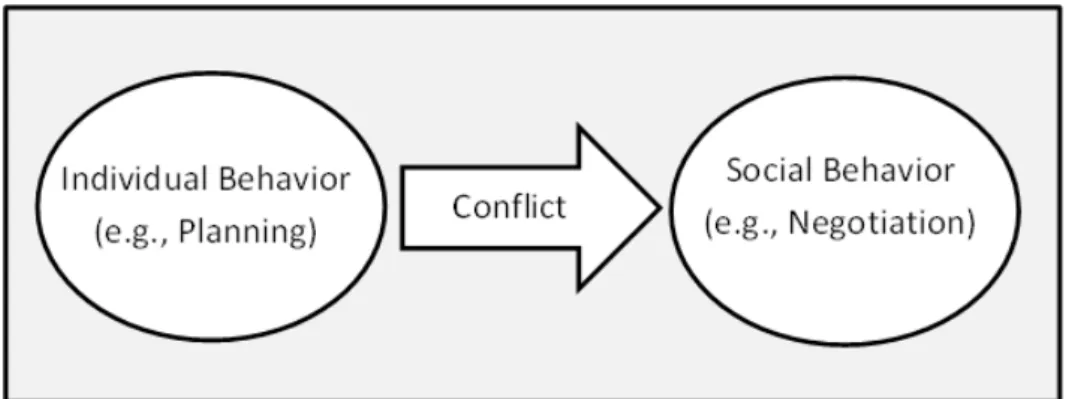
Figure 1.1:Conflict as the foundation for the Individual-Social behavior connection
All the objectives above are accomplished by utilizing the tools and techniques of MASs. Furthermore, the approach adopted in this dissertation is shown in figure 1.1: the conflict, as the key concept, will tie-in individual and social aspects of an agent behaviors.
1.4
Structure
This dissertation is composed by six chapters and two appendices:
1. A succinct introduction to the background of this dissertation, the motivation, and the main objectives.
2. The State of the Art. In this chapter, crucial topics are discussed as they were presented previously in existing publications. It starts with an attempt to find different definitions of autonomous agents, a discussion of their properties and environments. The various types of agents are shortly described, including the BDI architecture, that will be fea-tured in the developed system. Conflict of interests is then presented from the point of view of five authors with different approaches, including the one adopted in the disser-tation. Next, the different facets of negotiation are described, its different properties and processes, and the possible agent development approaches. The EM’s composition is elaborated on and its liberalization contextualized. Various existing simulators for the EM are detailed and analyzed side by side. To end the chapter, some platforms capable of assisting MAS development are described.
3. The third chapter will share some topics with the previous chapter, but now the concepts are described as they were implemented in the developed system. It starts with an in depth description of the agent’s architecture, notably, the plan generation process. It is followed by a definition of conflict, how it is implemented and how it relates to the overall system. The chapter concludes by detailing the various steps that need to be taken in order to model the prenegotiation and execute the negotiation.
4. The fourth chapter, we present a more technical look at the simulator developed, Negotiation Simulator for the Energy Market (NSEM), and its implementation. The flow of exe-cution for each main agent type is presented, their protocols for communication are detailed, and a small simulator walkthrough is done for an easier user experience, us-ing the Graphical User Interface (GUI).
5. A case study using NSEM that considers the prenegotiation and actual negotiation pro-cesses, in a retail market of the EM.
6. The conclusions. It includes a summation of the work performed in this dissertation, a discussion of the objectives reached, the dissertation’s contributions, and suggestions for future work.
7. The first appendix presents a few methods from NSEM in the Java language.
8. The second appendix presents partial data files from NSEM, in Extensible Markup Language (XML).
2
Autonomous Agents, Automated
Negotiation, and Energy Markets:
A State of Art
Contents
2.1 Autonomous Agents . . . 10 2.2 Conflict of interests . . . 14 2.3 Negotiation in Multiagent Systems . . . 15 2.4 Electricity Markets . . . 16 2.5 Computational Platforms . . . 18 2.6 Energy Market Simulators . . . 20
2.1
Autonomous Agents
There is no universal consensus for the definition of the term “agent”, but it is widely accepted that autonomy is at its core. Wooldridge [7] presents an adapted version of a pre-existing definition for an agent: “An Agent is a computer system that is situated in some environment, and that is capable of autonomous action in this environment in order to meet its design objectives”.
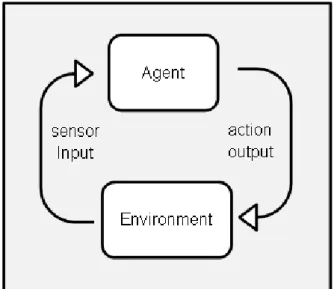
Figure 2.1:An agent interacting with and environment
Another definition, presented by Russel and Norvig [8], and illustrated in figure 2.1, is as follows: ”An agent is anything that can be viewed as perceiving its environment through sensors and acting upon that environment through actuators.”.
Jennings and Wooldridge [9] distinguishes two usages for the term agent. The first being weak and relatively uncontentious, and the second strong and potentially more contentious. The week notion is used to describe hardware or software that denotes the following proper-ties:
• Autonomy: agents operate without direct intervention, human or other, and have some kind of control over their actions and internal state;
• Social ability: agents exhibit some kind of language, which can be used to interact with other agents and possibly humans;
• Reactivity: agents perceive their environment and use the perceived information to respond in a timely manner to changes that occur in that environment;
• Pro-activeness: agents do not simply act in response to their environment, they are able to exhibit goal-directed behavior by taking the initiative.
The strong notion of agency is utilized by some researchers to denote an agent that shows the proprieties described above, and is also implemented using mental attitudes that are gen-erally associated with humans, like knowledge, belief, intention and obligation.
The literature commonly distinguishes different types of agents, notably [9]: (i) purely reactive agents, (ii) deliberative agents, (iii) hybrid agents, and (iv) bdi agents. A brief description of each type follows.
Purely Reactive Agents
Purely reactive agents decide what actions to take without taking into account their his-tory. They base the decision making process only on the present. Putting it simply, they just react to changes that occur in the environment. This process is represented as follows [7]:
action : S→ A where:
(i) S ={s1, s2, ...} is a set of environment states;
(ii) A={a1, a2, ...} a set of actions.
Deliberative Agents
These agents feature an explicit symbolic model of the environment where they operate in. As illustrated in figure 2.2, for each new data perception, an agent updates its information about the environment, and plans the actions necessary to meet its design objectives based on that information.
BDI Agents
Belief-Desire-Intention (BDI) architectures have their roots on the practical reasoning [10], which is a process founded in the philosophical realms denoting the importance of continuously deciding which actions to perform towards achieving predefined goals. The process itself requires two sub-processes[7]:
• deliberation: deciding what goals we, as humans, want to achieve; • means-ends: determining how to achieve these goals.
This process is adopted by BDI agents, which have been successfully applied to various applications [11]. The decision process begins by identifying what options are available. After having this set of options, also known as alternatives, agents must commit to some of them, which are referred to as intentions. For each intention, agents should make a reasonable attempt to achieve it. This means [7]:
• Agents must carry out a course of action that they believe will lead to a path that will satisfy an intention;
• Agents will not entertain options that are inconsistent with previously adopted inten-tions;
• Agents have to persist with an adopted intention and attempt to achieve it; however, if it becomes clear that they will never achieve it, they should drop it;
• If the reason for having an intention disappears, the intention should be dropped; • If agents adopt an intention, they must believe there is a good chance to achieve it. It is clear that sometimes agents should drop an intention, making it worthwhile to stop and reconsider the adopted plans. The key issue is when should an agent stop to reconsider adopted plans (or intentions). Reconsideration comes at a cost, both in time and computer resources, so there is a need to decide how often it occurs. The decision should be based on the environment where the agents are located in. If the environment does not change quickly, then it is prone to a more pro-active (goal directed) behavior. However, if the environment changes frequently, reactive (event driven) agents show frequently a better performance than pro-active agents [7].
Hybrid Agents
This architecture results from the combination of features from both deliberative and reac-tive agents. It tries to overcome disadvantages from both architectures. More specifically, on the deliberative side, its important to stress the incapability to react immediately to changes
that occur in the environment, and on the reactive side, the incapability to rationalize deci-sion making when trying to efficiently achieve design goals. The resulting architecture is composed of different hierarchical layers, with reactive layers having priority over delibera-tive layers, much to assure immediate responses to changes that occur in the environment.
Agent Environments
Russel and Norvig [8] identified a number of dimensions to categorize environments. Some of these dimensions follows:
• Fully observable vs. partially observable: When at each point in time, an agent has ac-cess through its sensors to the state of the environment it is located in, that environment is considered fully observable. An environment may be considered partially observable as a result of noisy and inaccurate sensors or missing elements from the sensor data, such as information not privy to one agent;
• Deterministic vs. stochastic: If the next state of the environment is ascertained exclu-sively by the current state and the actions performed by the agent, the environment is considered deterministic; otherwise, it is regarded as stochastic;
• Episodic vs. sequential: In episodic environments, the agent’s experience is divided in episodes, each consisting of a perception followed by a single action. The choice of action does not depend on actions taken in previous episodes, only on the current episode itself. In sequential environments, a current decision could affect all future decisions;
• Static vs. dynamic: Dynamic environments may change while an agent is deciding what action to perform. The environment changes with the passage of time, and if the agent does not perform an action within the allotted time, it considers the agent as taking no action. In static environments, neither the environment nor the agent accounts for the passage of time and the next state comes only after the agent has decided what to do. There also a semi-dynamic environment. In this case, the environment does not consider the time, but the agent does, affecting its own performance score;
• Discrete vs. continuous: A discrete-state environment has a limited number of distinct states, and the same notion is applied to both the way the time is handled and the perceptions and actions of the agent;
• Single agent vs. multiagent: Single agent environments are environments where only one agent is present. Depending on the dynamic between the agents, a multiagent environment may be viewed as either a competitive environment, a cooperative envi-ronment, or a combination of both.
2.2
Conflict of interests
Consider the following two main components of an autonomous agent operating in a multiagent system [5]:
• Individual component, which refers to the internal rationalization drawn by an agent; • Social component, defined by the interaction and communication between distinct
agents.
These components are brought together by the presence of conflict. Before we continue delineating agent conflict, let us first look at human conflict. Julia Galliers [12] has identified several main attributes in human conflict, notably:
1. Each social conflict requires, at least, two parties; 2. Each conflict has important purposes and consequences;
3. Opposing values, exclusive values, and/or incompatible values are fundamental facets of each conflict, and these values should be a result of limited resources (symbolic or material).
Julia Galliers has then developed a definition of agent conflict based on their features. She states that conflict consists in a relationship between two agents, in respect to one proposition: “Conflict of goals or conflict of beliefs exist between one agent and another, when the agents’ beliefs or goals with respect to the same proposition [p] are believed by the one agent to be in opposition, and this agent also has a persistent goal to change the other’s belief or goal...´´
Conte and Castelfranchi [1] defined conflict based on the concepts of interest and counter-interest:
“A conflict of interest between two agents [x and y] with regard to a given [world] state q occurs when q is an interest of x’s goal that [a world state] p be true at time t, while it is a counter-interest of y’s goal that [a world state] z be true at the same time.”
Parsons et al. [13] studied conflict between BDI agents and ascertained that conflict happens when:
1. Agents adopt opposing intentions;
2. An agent wants another agent to change a particular mental attitude;
Lastly, we have a definition that divides conflict detection in two stages[14]: potential conflict and true conflict. Consider an agent agi operating in an environment populated with
present in the environment and these plans are composed by intentions. Let agj be one
of the agents present in the environment. The agent agi declares a potential conflict if an
intention adopted by itself is incompatible with an intention agibelieves agjhas. Only after
agi validates the belief about agj’s (incompatible) intention, does it declare a true conflict.
This approach was adopted in this dissertation.
2.3
Negotiation in Multiagent Systems
Negotiation is a form of social interaction that allows for the resolution of problems oc-curring in a number of situations. Typically, these situations involve:
• Two or more parties;
• A conflict between the parties;
• An individual preference to find an agreement.
When developing negotiating agents, there are various approaches or models that can be adopted, each having specific strengths and weaknesses. Three well-known models are as follows[15]:
• Game-theoretic models: involves the analysis of specific negotiation situations and indicates precise results concerning the optimal strategies negotiators should choose; • Heuristic models: indicates negotiation guidelines and beneficial strategies that lead to
good outcomes (and not optimal outcomes);
• Argumentation-based models: negotiators can argue about their mental attitudes during negotiation.
Negotiation itself is composed by different processes, notably[6]:
1. A prenegotiation process: deals with the preparation and planning for negotiation; 2. An actual negotiation process: where the search for an agreement is held;
3. An execution process, where a final agreement is analyzed and implemented;
The prenegotiation process is the most important for the present dissertation and a brief de-scription of it follows
Prenegotiaton involves mainly the conception of a plan which delineates the activities that negotiators should attend to before starting the actual negotiation process. The collection of activities to be fulfilled includes [15]:
• Establishing the negotiation agenda;
• Defining the limits, i.e. the points where any settlement beyond them is not acceptable, thus terminating the interaction;
• Defining the targets, i.e. the values negotiators realistically feel they should get in a settlement;
• Selecting an appropriate interaction protocol. The protocol may simply allow for the exchange of offers, or alternatively, support argumentation.
There are three groups of strategies commonly used by (human) negotiators [16]:
• Contending – negotiators maintain their aspirations and try to persuade the opponent to yield;
• Concession making – negotiators cut back their aspirations to accommodate the oppo-nent; these strategies try to find acceptable compromises [17];
• Problem solving – negotiators maintain their aspirations and try to reconcile them with the opponent’s aspirations; they work towards integrative agreements, which provides higher joint benefit than compromise agreements [18].
Strategies are typically implemented through a variety of tactics. The main difference between strategies and tactics is the scope. Tactics present short-term actions to enact high-level strategies [19].
The actual negotiation process involves mainly an exchange of offers and counter-offers [20]. However, negotiation involves more than a series of proposed agreements. The ex-change of information is related to two dilemmas that all negotiators face [21]. The first is honesty: how much truth to tell the other negotiating parties. In case of too much truth, the opposing agents may take advantage of that information. In case of too little, negotiation may end in a stalemate. The second dilemma is trust: the credence put on the information received by the other partie. This decision takes into account a number of factors, such as how negotiators have negotiated in the past, their negotiation reputation, and the present cir-cumstances.
2.4
Electricity Markets
Electricity is most often produced at power stations, transmitted at high-voltages to multi-ple substations, and distributed at medium and low-voltages to end consumers. Almost since inception, electric utilities have been vertically integrated, meaning specific firms were ac-countable for generation, transmission and distribution [22]. This monopoly model has been discarded worldwide over the years, through the deregulation of electricity markets.
Liberalization aims to increase competition, resulting in better pricing and service qual-ity, which in turn leads to more satisfied end-users. To achieve this, deregulation has sepa-rated the functions of electricity generation and retail from the natural monopoly functions of transmission and distribution. This has led to the establishment of a wholesale market for electricity generation and a retail market for electricity retailing, where end-users can choose their supplier from competing electricity retailers [15].
2.4.1
Pool Markets
Rather than relying on iterative interactions between suppliers and consumers to reach a market equilibrium, pools provide this equilibrium in a systematic way. A pool generally op-erates as follows: generating companies submit bids to sell a specific amount of electricity at a certain price and for a certain period, while consumers submit offers specifying the quantity and price at which they intend to buy the energy. Supply and demand curves are generated and intersected. The intersection represents the market equilibrium. All the bids submit-ted at a price lower than or equal to the market clearing price (the price of the electricity at which the quantity supplied is equal to the quantity demanded) are accepted, and generators are instructed to produce the amount of energy corresponding to their accepted bids. Sim-ilarly, all the offers submitted at a price greater than or equal to the market clearing price are accepted, and the consumers are informed of the amount of energy that they are allowed to draw from the system. The market clearing price represents the price of one additional megawatt-hour of energy and is therefore called System Marginal Price (SMP). Generators pay this SMP for every megawatt-hour that they produce, whereas consumers pay the SMP for every megawatt-hour that they consume, irrespective of the bids and offers that they have submitted [23].
2.4.2
Bilateral Contracts
In bilateral contracts, negotiation is performed directly between a party representing the demand and a party representing the offer. The negotiation features a discussion to define prices, volumes, terms and conditions, which after agreed on, will be denoted on a contract [24]. This model allows for a better price stability, increasing the chance to avoid price volatility. There are several types of bilateral contracts, notably [23]:
• Customized long-term contracts – the terms of these contracts are flexible since they are negotiated privately to meet the needs and objectives of both parties. They usually involve the sale of large amounts of power (hundreds or thousands of megawatts) over long periods of time (months or even years). The large transaction costs associated with the negotiation of such contracts make them worthwhile only when the parties want to buy or sell large amounts of energy;
• Trading over the counter – these transactions involve smaller amounts of energy to be delivered according to a standard profile, that is, a standardized definition of how much energy should be delivered during different periods of the day. This form of trading has much lower transaction costs and is used by producers and consumers to refine their position as delivery time approaches;
• Electronic trading – participants can submit the offers to buy energy, or bids to sell energy, directly in a computerized marketplace. All market participants can observe the bids and offers submitted, but do not know the identity of the party that has submitted them. When a party submits a new bid, the software checks to see if there is a matching offer for the bid’s period of delivery. If it finds an offer whose price is greater or equal to the price of the bid, a deal is automatically struck and the price and quantity are displayed to all participants. If no match is found, the new bid is added to the list of outstanding bids and remains there until either a matching offer is made, the bid is withdrawn, or it lapses because the market closes for that period. Each time a new offer is entered in the system, a similar procedure is used. This form of trading is extremely fast and cheap.
2.5
Computational Platforms
There are numerous platforms to assist the development of a MAS. This section describes three well-known platforms.
2.5.1
Open Agent Architecture (OAA)
The Open Agent Architecture was developed at the Stanford Research Institute and allows software services to be provided through the cooperative efforts of autonomous agents. Com-munication and cooperation between agents is brokered by facilitators, which are responsible for matching requests from users (or agents). This process does not require that an agent or a user know the identities, locations, or number of the other agents involved. OAA is structured to minimize efforts in creating new agents and dealing with legacy applications. Figure 2.3 presents the small OAA system, showing a user-interface agent, some application agents and several meta-agents. The agents play different and important roles. All of them are organized in some sort of “community”, by being linked to the same facilitator. More than one facilita-tor is possible, especially in larger systems, creating multiple “communities”, each similar to the one shown in figure 2.3.
In some systems, the user interface agent is implemented as a collection of “micro-agents” each monitoring a different input modality (shown in figure 2.3 as “Modality Agents”). Also, every agent includes a set of declarations of the services it provides, in an Interagent
Com-munication Language (ICL). These public declarations are referred to as solvables and are composed of three parts [25]: a goal, a list of permissions, and a list of parameters.
Figure 2.3:OAA System Structure [25]
2.5.2
Repast
Repast was created at the University of Chicago in close collaboration with the Argonne National Laboratory. It is a free and open-source agent-based modeling and simulation toolkit with three released platforms: Repast for Java, Repast for the Microsoft .NET framework, and Repast for Python Scripting. Repast Simphony (Repast S) extends the Repast portfolio by offering a new approach to the simulation, development and execution, including a set of advanced computing technologies for applications (such as social simulation). Although not completely, Repast focuses on social behavior, having been applied to a wide variety of applications, ranging from social systems to evolutionary systems, market modeling, and industrial analysis [26].
2.5.3
JADE
The JADE platform is a middleware technology for the development and run-time ex-ecution of peer-to-peer agent based applications, which can interoperate both in wired and wireless environments. JADE is compliant with the Foundation for Intelligent Physical Agents (FIPA) specifications, and provides a homogeneous set of Application programming interfaces (APIs) that are independent from the underlying network and Java version[27]. JADE is probably the most widespread agent-oriented middleware today. It is completely distributed with a flexible infrastructure which allows for easy integration of extensions and ad-on modules. JADE is written in Java and provides a run-time environment implementing
the life-cycle support features required by agents [28]. Accordingly, JADE was the platform adopted in this dissertation.
2.6
Energy Market Simulators
Presently, there are several simulators applied to the liberalized market energy. This sec-tion describes the following six: EMCAS, MASCEM, SEPIA, AMES and PowerWeb.
EMCAS
The Electricity Market Complex Adaptive System (EMCAS), developed by the Center for Energy, Environmental and Economic Systems Analysis at the Argonne National Lab, is one of the most popular energy market simulators [29]. Agents in EMCAS include the Indepen-dent System Operator (ISO), the Generation Company, the Customer, the Demand Company, the Distribution Company, the Transmission Company, and the Regulator. They show decen-tralized decision-making capabilities, and are able to learn through genetic algorithms [24]. Each agent supports a diverse number of strategies, while simultaneously allowing specific market rule addition by users, granting a posterior analysis of the impact on both individual agents and the global system [29].
EMCAS supports negotiation through bilateral contracts and pool markets. Agents can represent producers, intermediaries, consumers and independent system operators. Bilateral contracts are initiated by the agent representing the demand, followed by a response from the agent representing a producer. The latter is based on foretold prices for pool and bilateral contracts, ascertained through history analysis and future predictions. The decision model of agents is based on an assemblage of public information, made available to all market participants, and private information, resulting from previous proposal acceptance/rejection accounts. Agents can use this information to rethink their strategies for the next round of negotiation [24]. EMCAS is currently utilised by REN for analysis on MIBEL [30].
SEPIA
The Simulator for the Electric Power Industry Agents (SEPIA) was developed by Hon-eywell Technology Center and the university of Minnesota [31]. It is a specific Agent-Based Simulation tool for developing Energy Market Agent-Based Simulation models with the pur-pose of gaining insights about the behavior of system participants and their impact on EMs. The main physical components are: Zones, Physical Generators, Generation Companies, Generator of Last Resort, Consumer Load, Consumer Companies, Transmission System, and Transmission Operator [29]. The simulator can be split up into three main components:
1. Graphic interface, which allow users to specify, monitor and drive the simulation; 2. Agents that represent specific domain entities;
3. Discret event simulation mechanisms that control the evolution of the simulation and agent communication.
Agents in SEPIA are composed by diverse layers. Also, agents that represent producers companies have an adaptive module, with a learning component based on the Q-learning algorithm, which allows them to explore alternative strategies for pricing. It should also be mentioned that this simulator is limited to bilateral contract simulations [24].
PowerWeb
Developed by the Cornell University, this simulator allows testing and analysis of dif-ferent kinds of energy markets, and implementation of diverse market models. However, it only supports fixed demand for pool markets. Sellers can bid for energy, from one single production unit allowed to them, in two different ways:
• Explicitly declaring the price and quantity of the bid until the unit production maximum is reached;
• Choosing one of the six available strategies.
This simulator can be accessed through a web application, which allows for usage in distributed computing environment [32]. Agent usage is simple and limited, being its purpose to simply model different types of proposals for market trading.
AMES
The Agent Based Modelling of Electricity Systems (AMES) is an open source multi-agent simulator developed within the JAVA language, for the Repast platform, by Tsun and Tesfatsion [33]. With no commercial end in mind, it was developed with the purpose of bet-terment EM’s research and education. This system includes four main components: traders, transmission grids, markets, and an ISO. The market involves a day-ahead market and a real-time market, while the ISO has four functions: system reliability assessment, day-ahead unit commitment, dispatch, and settlement. A learning module is integrated into the simulation framework for adaptive decision making of traders, and the physical transmission grid is modeled as a five-node transmission grid [29].
MASCEM
Developed by the Instituto Superior de Engenharia do Porto using the JAVA program-ming language, the Multi-Agent System that Simulates Competitive Electricity Markets (MASCEM) is a Energy Market Multi-agent System [34]. The agents can simulate market facilitators, generators, consumers, market operators, traders, and network operators. MASCEM features bilateral contracts and a pool market, although on the latter consumers can directly submit their bids to the market operator. Accepted agreements can result from both bilateral con-tracts and the pool market, and must be submitted for verification by the market operator [29]. During the negotiation process, this simulator allows agents to re-think their strategies, based on results from previous rounds of negotiation [35].
Discussion
The aforementioned complex systems focus mainly on the negotiation process. Impor-tant features that help depict real-life negotiations can be found in most of them, such as MASCEM’s mid-negotiation strategy reconsideration. A short comparison of these features is illustrated in 2.1. The main agent types portrayed are generators, consumers, and market operators. However, the prenegotiation process is basically not featured in these systems, although individual steps of this process, such as the definition of limits for the negotiation issues, are included (as part of the negotiation process). As stated above, this dissertation focuses on the main prenegotiation tasks, and the link between the individual and social be-havior of agents, i.e. the role conflict plays in driving negotiation.
T able 2.1: Comparison between existing Electricity Mark et (EM ) simulators EMCAS SEPIA P o werW eb AMES MASCEM Mark et models Bilateral Contracts; Pool Bilateral Contracts Pool Pool Bilateral Contracts; Pool Agents ISO; Generation Compan y; Cus-tomer; Demand Compan y; Distri-b ution Compan y; T ransmission Com-pan y; Re gulator Generation Com-panies, Generator of Last Resort, Consumer Compa-nies, T ransmission System, and T rans-mission Operator Sellers; ISO T rader , mark et, transmission grid, ISO Generator , con-sumer , trader , mark et facilitator , mark et operator , netw ork operator Multi-Agent Sys-tem Y es Y es No Y es Y es Adaptation Genetic algorithms Genetic algorithms; Q-learning for pro-ducer agent No V ariant Roth-Ere v (VRE) Strate gy based on history License Commercial Commercial Free Open source Research project
3
Autonomous Agents,
Conflict, and Bilateral Negotiation
Contents
3.1 Introduction . . . 26 3.2 Autonomous Agents . . . 26 3.3 Conflict of interests . . . 29 3.4 Bilateral Negotiation . . . 30 3.5 Case Study . . . 343.1
Introduction
A quick search for a definition of “software” leads to [36]: “... the instructions which control what a computer does...”
While this still applies to today’s agents architectures, the notion of autonomous agent tries to break free from the domain defined in the previous software definition. A look at a definition of the term “autonomous” leads to [36]:
“... independent and having the power to make your own decisions...”
From the previous statements, it is possible to infer a goal for autonomous agents: to enhance original instructions. Also, depending on the application, adaptability and learning may be important features of autonomous agents, allowing computer software to respond to situa-tions not defined in the original instrucsitua-tions, and build on previous situasitua-tions towards better decision-making algorithms.
This chapter starts by detailing the architecture of BDI agents (as it was adopted by the de-veloped simulator in the dissertation Negotiation Simulator for the Energy Market (NSEM)). Next, conflict and bilateral negotiation are discussed, placing emphasis on the prenegoti-ation phase of negotiprenegoti-ation, and detailing the negotiprenegoti-ation strategy developed for this work. Finally, the chapter introduces a case study involving a retailer and a customer negotiating bilateral contracts in an Electricity Market (EM). The case study illustrates some aspects of the individual and social behavior of agents, placing emphasis on plan generation and issue identification.
3.2
Autonomous Agents
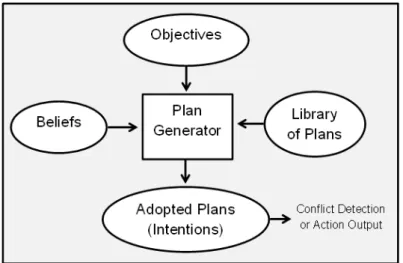
The Belief-Desire-Intention architecture tries to model the human decision-making be-havior and has its roots on the practical reasoning process [10]. Its main elements are:
• A set of beliefs, representing information about the agent itself, the other agents, and the environment;
• A set of goals, representing world states to be achieved;
• A library of plan templates, representing actions that should be performed to achieve goals;
• A plan generator, responsible for obtaining the required information from the previous three elements, conjugate them, and create full plans;
Figure 3.1:The Belief-Desire-Intention architecture
Figure 3.1 shows the main components of the architecture, and how they interact.
A description of each component follows (see Lopes et al. [14] for a more in depth descrip-tion).
Let Ag={ag1, ag2} be a set of autonomous agents. Let agi∈ Ag be an agent from Ag and
Bi={bi1, bi2, ...} a set of beliefs of agi. Each belief bim∈ Biis represented as follows:
bim = < bhim, bbim>
where:
(i) bhimis the header of bim;
(ii) bbim is the body of bim, and contains a statement that agibelieves to be true.
The header bhim of bim is a 2-tuple: bhim=< name, bdim>, where name is the name of
an agent in Ag of which the intention is about, and descrimis a short description of bim.
Let Gi={gi1, gi2, ...} be the set of goals that agiwants to achieve. A generic goal gik∈ Gi
is described as follows:
gik=<gbik>
where gbik is a statement that identifies the goal gik. This statement is used by the “Plan
Generator” to search for an adequate plan template from the plan library. The library consists of a collection of plan templates, PLi ={pti1, pti2, ...}, where plan template ptiz∈ PLi is a
5-tuple [14]:
ptiz=<pthiz,pttiz,pt pciz,ptbiz, pteiz>
(i) pthiz is the header of ptiz; it is the attribute used when searching for a plan
template, which is compared to a goal’s body;
(ii) pttiz is the type of ptiz, either composite or primitive;
(iii) pt pcizis a set of preconditions that must be true before ptiz can be applied;
(iv) ptbizis the body of ptiz; its content depends on the type;
(v) pteiz is a set of statements that should hold after ptiz has been successfully
executed.
The header pthizis itself a 2-tuple, i.e. pthiz=<ptniz,ptaiz>, where ptniz is the name of
ptizand ptaizis a set of arguments for ptiz.
There are two possible types of plan templates, namely primitive and composite. If ptiz
is a primitive plan template, then ptbiz is a set of one or more actions that satisfy a goal. On
the other hand, if ptizis a composite plan template, ptbizis a collection of references to other
plan templates present in the library. In other words, a composite plan template specifies the decomposition of a goal into sub-goals, by referencing other composite or primitive plan templates.
An agent agi∈ Ag is capable of generating complex plans, {pi1, pi2, ...}, based on the
simple plan templates stored in the library. The process of generating a plan piyfor achieving
a goal giyinvolves four main tasks [15]:
• Plan retrieval. Upon choosing giy, the agent agi uses it to search the library PLi for
all plan templates whose header unifies with the body of giy, and whose preconditions
pt pciz apply in the current state. The plan templates retrieved are labeled applicable
plan templates. The set of applicable plans is denoted as APTiy;
• Plan selection. Consists of selecting a preferable plan template, let’s say ptiz∈ APTiy.
The selection is based on a scoring system to find the most favorable plan template; • Plan addition. The plan generator adds the previously selected plan template ptizto the
plan piy. Let AltPiy = APTiy− ptiz. The plan templates in AltPiy are added to piy and
labeled as alternative plans. They have a key role in prenegotiation (see in sub-section 3.5.2);
• Plan interpretation. This task consists of selecting a composite plan template ptiz from
the plan piy and expanding its body’s elements, which in composite plans are
them-selves goals. Accordingly, the plan generator repeats these four tasks for each of those goals, resulting in a recursive process that ends when all primitive plan templates have been retrieved, selected and added to the plan.
Let ISi ={inti1, inti2, ...} be the Intention Structure (IS) of agi. The several elements of
ISi are plans adopted by agi, i.e. intentions, and are structured into and-trees. In particular,
after generating the plan piy, the agent agi adopts piy for execution in the future. This is
accomplished by recursively adding every plan template present in piy into the ISi, as an
intention to execute, i.e. a goal that is not yet achieved but is considered, at the present moment, achievable. Each intention created by agent agicorresponds to an header of a plan
template, thus corresponding to a goal that agiwishes to reach.
3.3
Conflict of interests
Much like human negotiators, an agent in a negotiation environment needs two facets: • A private side, which considers the agent’s own rationalization process, its beliefs,
individual goals, strategies, intentions, etc. This is also called the individual behavior component;
• A public side, accountable for any interaction with other agents (e.g., negotiation and communication), requiring knowledge and skills on how to deal with social situations. This is also known as the social behavior component.
Although both sides can exist individually, each side has less meaning and purpose without the other. Without interaction, goals might not get achieved and beliefs may stay outdated. Without the individual component, would there be a reason for such interaction? Probably not.
An agent with both components also needs a way to determine how they should interact. This is the key role of conflict. In a MAS, with multiple agents operating individually to meet their own design goals, conflict is inevitable. Let intiq∈ ISibe an intention that agi∈ Ag wants
to accomplish. Likewise, let intjk∈ISj be an intention that the other agent agj ∈ Ag wants
to accomplish. A conflict Con fi, j occurs when the intentions intiq and intjkare incompatible
[14]:
Con fi, j=∃intiq∧ ∃intjk∧ Incomp(intiq, intjk)
where Incomp(intiq, intjk) represents an incompatibility between intentions intiq and intjk, i.e
the two intentions cannot be executed simultaneously.
3.3.1
Potential Conflict
Let PPi={pi1(agj), pi2(agj), ...} and PIi={inti1(agj), inti2(agj), ...} be a set of possible
plans and a set of possible intentions agi believes agj has generated. Agent agi checks
has. Since agi is unsure about the true plans and intentions of agj, it will initiate a process
called Potential Conflict Detection, involving the detection of a potential conflict PotCon fi, j
[14]:
PotCon fi, j=∃intiq∧ ∃intim(agj)∈ PIi∧ Incomp(intiq,intim(agj))
where:
(i) intim(agj)∈ PIirepresents an intention agibelieves agj has;
(ii) Incomp(intiq, intim(agj)) represents an incompatibility between intiqand intim(agj).
If PotCon fi, j is true, agi needs to validate it by confirming the veracity of the intention
intim(agj). This process involves a conversation between agi and agj, where agi informs
agj about the potential conflict and requests this agent to validate the intention intim(agj).
The agent agj can choose either to refuse to participate in a conversation, or to reply to the
message received. If agj confirms intim(agj), agi will declare the conflict as validated, and
inform agj. If agj does not confirm intim(agj), agi will request information about the true
intention of agj, so to double-check for the existence of a conflict, and consequently be able
to either declare the conflict as validated, or to acknowledge the existence of no conflict. In either case, agj is informed before ending the conversation.
3.4
Bilateral Negotiation
As stated before, three main phases are often identified in negotiation: prenegotiation, actual negotiation, and execution (or ending). The prenegotiation phase deals with the activ-ities that come before formal negotiation. The actual negotiation process involves mainly the exchange of offers between the parties. It may also feature argumentation, learning, dynamic strategy selection, and impasse resolution. The last phase, execution, includes the analysis and improvement of a final agreement. Since prenegotiation is the main focus of this work, the remainder of this section presents some details of the most importante prenegotiation activities.
3.4.1
Prenegotiation
Is the starting point of negotiation equally fair to all participants? Any confrontation be-tween humans suggests that this is not the case. Personal traits will distinguish individuals in such situations, be their personality, tolerance, creativity, and many other attributes. The same holds for negotiation, where traits such as charisma, confidence, boldness, and so on, give an edge to negotiators. Clearly, such traits are not easily obtained. To some negotiators, they may be inherent. Others may find them with experience. However, there are other methods
to obtain the so sought after advantage, even before the starting of negotiation. Accordingly to successful negotiators, preparation and planning, also known as prenegotiation, is central to obtain a successful outcome, and the aforementioned advantageous traits cannot overcome a poor planning.
Prenegotiation is the first step in the overall negotiation process, composed by the follow-ing phases [15]:
(i) the definition of the issues to negotiate and the creation of a negotiation agenda; (ii) the definition of the limits and targets for each issue at stake;
(iii) the selection of an interaction protocol, and the definition of the preferences; (iv) the selection of a negotiation strategy.
A brief description of each of these tasks follows.
Agenda
The negotiation agenda, i.e. the collection of issues at the negotiation table need to be agreed by all parties. To this end, each agent submits its own proposal about the set of issues to discuss during negotiation. This proposal (or list) is formed from the headers of all the primitive plans associated with the negotiation plan. These primitive plans represent facts that the agent wishes to discuss during negotiation.
The agenda is thus the result of an interaction process. The initiator submits a proposal and the opposing agent sends a proposal. If the initiator agent accepts the counter-proposal, or both the proposal and the counterproposal contain the same issues, an agreement is reached and the agenda is defined.
Targets and Limits
The agents must assign target and limit values for each issue on the agenda. A target is a level of benefit to stride for at any time. A limit is a fallback position, i.e. a level of benefit beyond which an agent will not yield.
Deadline
A mutual deadline must be agreed by both negotiating sides before the starting of negoti-ation. The deadline is a date and time set for the near future.

![Figure 2.3: OAA System Structure [25]](https://thumb-eu.123doks.com/thumbv2/123dok_br/19205626.955834/37.892.159.752.184.502/figure-oaa-system-structure.webp)