A Work Project, presented as part of the requirements for the Award of a Masters Degree in Management from the NOVA – School of Business and Economics.
A behavioral perspective on the effects of using performance measurement systems in the companies: evidence from a case study
João Bernardo Lampreia, 1632
A Project carried out under the supervision of:
Associate Professor Maria João Major
2 Abstract
The effects of PMSs on the people’s behaviour represent a high degree of relevance in the context of an organization performance and success. Thus, motivational and behavioural consequences of performance measurements are far from being totally understood (Franco-Santos et al., 2012). This work project (WP) purposes going further regarding the consequences/effects on people’s behaviour of using PMSs in
organizations. The researcher conducted 11 interviews to managers during a nine-month internship as a controller in a Portuguese multi-national company.
The evidence from this WP suggests that the way how managers understand a PMS determines a lot the way how they behave. Data also supports that PMSs influences in several ways motivation, perceptions, participation and job-related stress of managers. Keywords: performance measurement systems, KPIs, consequences, people’s behaviour
Table of contents
I. Purpose of the Work Project
II. Literature review on the effects of PMSs III. Methodology
IV. The field study V. Conclusions VI. Bibliography
3 I. Purpose of the Work Project
This work project aims to contribute for a deeper insight regarding the consequences/effects on people’s behaviour of using PMSs in organizations. By conducting 11 interviews to managers and a 9 month internship as a controller in a Portuguese multi-national company, this study purposes to answer the following research question: How do managers understand KPIs and PMSs and behave towards them?
Over the past, performance measurements and management has attracted a lot of interest (Neely et al., 2005). Since the early 90’s, the desired need to succeed is growing exponentially and the most competitive businesses have looked more intensively for gains in productivity and efficiency (Harrington et al., 2011). Consequently, that kicked off the interest, not only by organizations, but also by the academic community in the development of processes and systems that could be capable of measuring internal processes and performance, but also support and measure the impact of managers’ decisions. More recently, some authors such as Davis and Albright (2004) and Kennerley and Neely (2003) claimed that the use of PMSs may provide integrative information for better decision-making, facilitating strategy implementation and for enhancement of organizational performance.
Currently, when discussing performance measurement, we mean not only the use of financial but also of non-financial performance measures to translate and operationalize the organization’s business strategy (Franco-Santos et al., 2012). For instance, balanced scorecards (BSC) and key performance indicators (KPIs) can be considered performance measurement systems (PMSs). However, Franco-Santos et al. (2012) mention the lack of studies and consensus about an important topic that is the consequences for companies of using PMSs.
4 The complexity of large organizations requires better knowledge of organizational behaviour and culture for managers to make best use of the personnel they have to manage. Even where performance measures are instituted as definition of the important aspects of that job, these may have important implications in the motivation and behaviour of personnel. Thus, motivational and behavioural consequences of performance measurements are inadequately understood (Franco-Santos et al., 2012), which motivates the author to study this topic. Furthermore, despite not being the aim of this research, organizational culture and management style will be referred in several occasions in this WP as factors influencing the effects that PMS may have on people’s behaviour.
During the internship, the author faced the situation of how managers understand and perceive PMSs might actually explain some of their behaviours. For instance, Ukko (2009) argues that if managers understand the connection between individual’s and the organization’s targets, personnel and organizational performance improve. This suggests that many other effects of PMSs can exist, depending on the way how people understand them. Hence, the lack of literature about this subject has also motivated the author to include it in his research question.
The structure of this WP proceeds as follows. Section II presents the literature review about PMSs and three categories of PMSs’ effects according to Franco-Santos et al. (2012). Section III explains the methodology followed in this WP. Section IV depicts the field study and discusses the main findings. Finally, in section V are the main conclusions, limitations and contributions of this study.
II. Literature Review
Franco-Santos et al. (2012, p.80) clarify the definition of a PMS by arguing that it “exists if financial and non-financial performance measures are used to operationalize
5 strategic objectives”. In fact, PMS are increasingly being used in companies to provide integrated information for better decision making and communication of strategic goals (Lee and Yang, 2010). Moreover, information that a PMS provides to managers may be used to remove uncertainties in the decision-making processes, evaluate processes and the consequences of past decisions as well as, it may suggest corrective measures and improvements in organizational learning (Grafton et al., 2010; Pavlov and Bourne, 2011). Several researches, such as, Chenhall (2005), Ittner et al. (2003), and Kaplan and Norton (1996, 2001) state that an integrative PMS is a primary information characteristic which helps organizations to achieve strategic competitiveness, not only by aligning internal processes with the long-term strategic goals, linking them to short-term actions, but also by developing organizational learning. For instance, the Balanced Scorecard (BSC) (Kaplan and Norton, 1992, 1996, 2001), which is a formal PMS, provides a framework for managing the implementation of strategies, containing a wide set of performance measures (KPIs), customer relations, internal business processes, organization’s learning and growth activities that allow, at the same time, dealing with changes in the company’s competitive market and technological environments.
When talking about performance measurements implementation and their effectiveness, it is important to take into consideration the organizational factors, such as, top management support, training, interaction of employees, and the connection between performance and rewards. In addition, moderating1 factors such as organizational culture can influence the effectiveness of the performance measurements implemented (e.g.
1 Some researchers have indicated a set of factors, external to PMSs, which moderate the effect of PMSs. Sharma et al. (1981, p.292) define a moderator as “one which specifies the form and/or magnitude of the relationship between a predictor and a criterion variable”. Franco-Santos et al. (2012) state strategic orientation, organizational structure and competition, perceived environmental change and environmental uncertainty, organizational culture and management style, and quality of information systems as being examples of moderating factors of PMSs’ effects. However, the strength these factors have on influencing the effects of PMSs clearly lacks of research.
6 Domanovic, 2013). The effectiveness of these systems exist if they provide clear information, clear decisions for understanding of managers and employees, reflecting a greater commitment and efficiency from their side.
It is clear that PMS are designed and implemented in companies with an ultimate goal and focus – increase performance. However, their effects are far from have been totally studied. Once they have affected a broad range of processes, they have also directly affected stakeholders. Having said that, Franco-Santos et al. (2012) are one of the most recent authors studying and presenting in detail the consequences of the PMSs.
The work of Franco-Santos et al. (2012) analyses the consequences of the use of PMSs and classifies them into three categories: performance, organizational capabilities and people’s behaviour.
CLASSIFICATION OF THE CONSEQUENCES OF PMS EXAMPLES
PERFORMANCE Effects of PMSs on financial and non-financial results - Managerial performance - Market performance - Financial performance
ORGANIZATIONAL CAPABILITIES
Processes, activities or competences affected by PMSs and that are linked to changes in competitive advantage.
- Organizational learning - Innovativeness
PEOPLES’ BEHAVIOUR Cognitive mechanisms, actions and reactions of people when facing a PMS.
- Motivation - Perceptions - Participation - Cooperation
Table 1 – Classification of the consequences of PMSs Adapted from Franco-Santos et al. (2012, p.83) The effects on performance is by far the group which is most studied in literature of the effects of a PMS. There is a significant number of studies supporting the beneficial effects of PMSs in the business performance, whether being financial or non-financial performance (e.g. Davis and Albright, 2004; Hoque and James, 2000; Ittner, Larcker and Randall, 2003), as well as the beneficial effects on the managers’ perceptions of performance (e.g. Chenhall, 2005; Hoque and James, 2000; Lee and Yang, 2010). Besides financial performance measures, researchers suggest that companies are increasingly adopting a growing set of non-financial performance measures. These help them to have
7 a higher measurement system satisfaction and thus, improve performance. However, Kraus and Lind’s (2010) research point to the fact that managers still focus too much on financial performance information due to the need for simplicity and internal comparability but also due to capital market pressures.
Regarding the effects on team performance, Scott and Tiessen (1999) mention that team members’ participation in the process of setting performance targets enhances performance results.
Studies from Cousin et al. (2008) and Mahama (2006) found evidence that PMSs improve cooperation and socialization among firms from different geographies, consequently enhancing perceived inter-firm financial and non-financial performance.
However, on the other hand, evidence state that control systems could make processes more formal and complex, thus bringing rigid action plans, targets and information gathering. Several of these practices are associated with bad performance (e.g. Griffith and Neely, 2009; Said et al., 2003). Therefore, it is fair to say that PMSs do not improve automatically organizational performance. In addition, there are factors that moderate the effect of PMSs on performance. This seems to be the case of organizational culture or management style.
The consequences of PMSs on organizational capabilities are explored in the second group of this literature. It focuses mostly in the more important views. In the research of Franco-Santos et al. (2012), it is argued that PMSs help managers engage in the strategic formulation and review processes. It will also help them align actions with the strategy adopted by organization.
Communication is another effect of a PMS. In fact, most authors that have studied this effect agree on the direct and beneficial effect that PMSs have on communication by favouring the alignment of strategy to manager’s actions (Franco-Santos et al., 2012). For
8 instance, organizations must communicate to employees the attributes of the PMS in order to increase their perception of technical validity and perception that systems reflect the organization’s value chain.
PMSs also affect management practices, even though depending on factors such as the maturity of the systems, the organization’s culture and the characteristics of the systems’ users (Ukko et al., 2007). In the research of Ukko (2009), he concludes that under appropriate circumstances, a performance measurement affects positively different aspects of management, leadership, and the quality of work-life balance. He also emphasizes that employees and organizational performance improve if performance measures are linked to rewards, and if managers understand the connection between individual’s and the organization’s targets. Communication face-to-face between managers and employees is a determinant factor to enhance the understanding of such link, providing as consequence a more solid base for the decision-making.
The effects of PMSs on the people’s behaviour represent a high degree of relevance in the context of an organization performance and success. The reason why this is so important is simply because people are obviously who design and implement PMSs in companies, and are also the final users of them. PMSs shape processes and the way how decisions are taken towards the achievement of organization’s strategy and goals (Flamholtz, 1996). PMSs also promote interactions among managers and employees, and perform an active role in influencing managers’ attitudes and psychological processes, as an example of this, psychological empowerment2 (Hall, 2008). Therefore, the interaction among employees are complex and can be influenced by factors external to the systems (Franco-Santos et al., 2012).
2 According to Conger and Kanungo (1988, p. 474), empowerment refers to a “process of enhancing feelings of self-efficacy among organizational members through the identification of conditions that foster powerlessness and through their removal by both formal organizational practices and informal techniques of providing efficacy information”.
9 Franco-Santos et al. (2012) summarize the consequences of PMSs on people’s behaviour in: strategic focus, cooperation, relationships among headquarters and subsidiaries, socialization, participation, relationships within and among departments, motivation, psychological empowerment, goal commitment, organizational citizenship behaviours, role conflict, goal conflict, role ambiguity, job relevant information, job satisfaction, managerial decision-making, managerial self-monitoring, managerial learning, leadership, organizational culture, perceived satisfaction with the PMS, perceptions of subjectivity, perceptions of trust, perceptions of justice, performance evaluation bias, strategic initiative bias, bonus allocation bias, and finally conflicts and tensions, time consuming, visibility and workload.
Regarding cooperation, coordination and participation, Mahama (2006) finds a direct relationship between PMSs and cooperation in aspects such as information sharing, problem solving and willingness to adapt to changes. Moreover, the research of Papalexandris et al. (2004) finds that PMSs are useful for coordinating activities within and among departments while Butler et al. (1997) conclude that the participation is enhanced through iterative and consultative processes for the development and implementation of such systems. Because employees feel part of the organization’s decisions and they are meaningful, participation enhances employees’ trust, sense of control, fairness, and commitment (Lau and Sholihin, 2005). In this case, the positive effect that PMSs may have on organizational commitment lead to less absenteeism and, then, costs associated with it are avoided (Rasit and Isa, 2014). Evidence also supports that PMS simplifies socialization processes because of the need of cooperation as well as promoting employee involvement in the organization’s performance measures and management processes (Mahama, 2006).
10 PMSs also influence the motivation of managers through the role of clarity and psychological empowerment (Hall 2008). According to Marginson and Ogden (2005), PMSs provide managers clearer, concise and objective information, avoiding ambiguity and reinforcing psychological empowerment. Moreover, well-defined performance measures, but in particular, non-financial performance measures are positively associated with perceptions of organizational justice, increasing the sense of fairness thus, decreasing subjectivity and consequently reinforcing commitment (Lau and Sholihin, 2005).
Other authors, such as Webb (2004), argue that a PMS must include both financial and non-financial performance measures in order to increase the manager’s perceptions of self-efficacy and goal achievement, which consequently increase motivation. On the other hand, ineffective communication and ineffective management control causes conflict and poor motivation, especially when PMSs are used for performance reward purposes (Malina and Selto, 2001). Therefore, these systems must be supported by effective mechanisms of communication that could encourage feedback, dialogue and participation among employees and managers.
Another consequence of PMSs on people’s behaviours that literature emphasizes is the goal conflict and consequently tensions that they may create (Cheng et al., 2007). For instance, level of goal conflict and tension increase in cases where performance is visible to everyone, workload is higher and multiple tasks are perceived as difficult. However, little consensus in literature is available about the impact of the systems on conflicts and tension.
The last consequence of a PMS to be mentioned in this WP is people’s stress. Franco-Santos et al. (2012) argue that there is no objective research about how PMSs increase people’s stress levels and negatively affect their performance. Nonetheless,
11 PMSs affect, at least, indirectly people’s stress. Some authors have concluded that besides the influence of the systems on role clarity, factors such as environmental turbulence, cross boundary activities, innovative processes, poor work relationships, poor communication between superior and subordinate lead to role ambiguity and managerial failure (Longenecker et al., 2007). The consequence for individuals is an increase on psychological stress and health injuries. In addition, the recent research of Rasit and Isa (2014) reinforces that, under those circumstances, employees suffer dysfunctional stress and non-optimal performance, which in return increases turnover of personal.
III. Methodology
Taking as references Ryan et al. (2002), Silverman (2003) and Yin (2009), it is performed a single case study in a Portuguese multinational company to address the research question of this WP: How do managers understand multi-criteria KPIs and PMSs and behave towards them?
This research method has been depicted as the method that should be adopted when: (i) the object of study is a contemporary phenomenon; (ii) the researcher has no control over the phenomenon object of the investigation; and (iii) the objective of the research is to get a deep understanding of the phenomenon within its context (Yin, 2009, 2014). This research meets these three conditions. Mix sources of evidence are used to enable data triangulation. These sources include semi-structured interviews to the main managers of the company, direct observation and participative observation through a nine-month internship as a controller in the Managerial Control department.
Interviews enabled the researcher to focus directly in the WP topic and understand in depth the internal processes and systems of the company (Yin, 2011, 2015). About, 11 semi-structured interviews to the main managers of the company were conducted during the nine-month internship of the researcher (that is, between May 2015 and January
12 2016). The time duration planned for each interview was 60 minutes. However, some interviews were longer and others were shorter (see details on interviews in Table 2):
Interviewee Category Channel Duration
(minutes)
Date 1 Top manager Orally (recorded) 60 07/04/2015
2 Top manager Orally (recorded) 60 22/04/2015
3 Middle manager Orally + email 75 28/04/2015
4 Middle manager Orally (not recorded) 40 10/07/2015
5 Top manager Orally (recorded) 70 02/10/2015
6 Top manager Orally (recorded) 90 09/10/2015
7 Top manager Orally (recorded) 90 12/10/2015
8 Top manager Orally (recorded) Orally (not recorded)
45 + 30
21/10/2015 26/11/2015
9 Middle manager Orally (recorded) 75 23/10/2015
10 Middle manager Orally (not recorded) 90 05/12/2015
11 Middle manager Orally (not recorded) 45 16/12/2015 Table 2 – Interviews’ details
In this study, it was considered to be top managers those who have either a high degree of responsibility in the company such as business directors and executive board members or are in a high hierarchy of the company’s structure. For those who have a middle-high degree of responsibility such as senior managers or those who report their work to top managers were considered to be middle managers.
The guidelines for the interviews followed a general to particular approach where it starts with general and open questions about PMSs in the company, their characteristics and the role of the manager when dealing with such systems. More personal and objective questions about the managers’ behaviours when dealing with a PMS are made in the second part of the interview. Finally, it is presented a situational case in order to address the different responses that a manager has when facing the same challenge/problem.
Direct and participative observations were also employed as they enable the researcher to cover events in real time, understand the context of the event and obtain an insightful into interpersonal behaviour and motives (Yin, 2009, 2014). The researcher performed a very active role in the company as a controller, having the possibility to deal directly with the different business areas, their top managers, the several KPIs of the
13 organization and with, in general, the people that work with the PMSs. Thus, its role in the investigation can be described as ‘actor researcher’ (Ryan et al., 2002). The approach adopted to collect data here was to listen colleagues carefully, register on paper quotations and to later on it would be possible to question them and gather information about their perceptions, behaviours and emotions in the work place when facing a PMS, keeping at the same time some distance on the phenomenon.
Main findings and conclusions on this WP are produced taking into account the patterns verified trough the several sources of evidence (Ryan et al., 2002; Silverman, 2001; Yin, 2009, 2014). For that, in order to easily get the patters, it was done a diagram based on the answers obtained in the interviews (Ryan et al., 2002) (see appendix 3). IV. The field study
The organization, where the study takes place, is a Portuguese multinational company employing over than 2000 people with offices in Angola, Brazil, Poland and Spain. The company results from a merge of two national companies that took place in 2008 and is quoted in Euronext Lisbon. It operates in several businesses areas, namely in the development of healthcare software, services to pharmacies, and IT consulting.
The development of PMSs in the company has not been significant across time, however, the most important progresses took place in the last two years. Before the merge happened, it is known that one of the two companies used jet report and “cubos” as the systems to monitor performance, compare it to the budget and produce some KPIs. The case of the other company, PMSs simply did not exist. Right after the merger, “cubos” disappeared. This is not understood by some of the current managers. A manager in the workplace admits the following:
“I’ve never understood why after the merge, a system that used to work well, such as “cubos”, disappeared. Nobody has explained to us why they have put aside “cubos””.
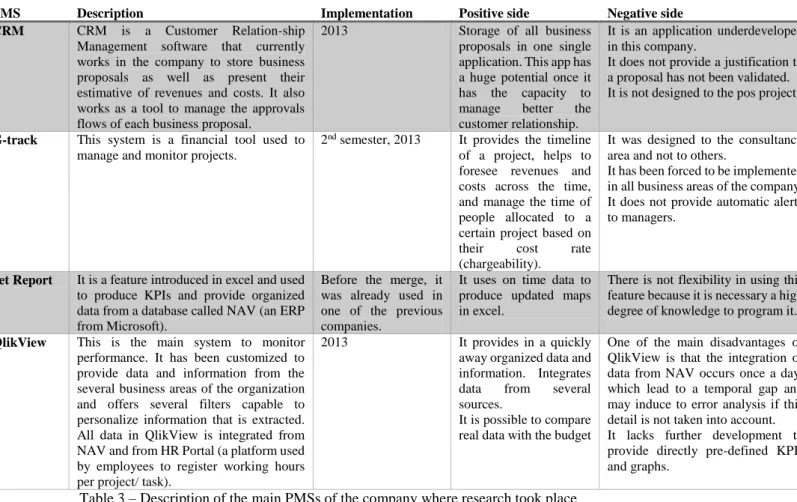
14 Currently, there are several tools in the company working as PMSs, but none of them are actually considered to be formal. This means that the existent systems do not integrate a strategic plan with the respective actions to achieve targets. The following table describes the current PMSs in the company:
PMS Description Implementation Positive side Negative side
CRM CRM is a Customer Relation-ship Management software that currently works in the company to store business proposals as well as present their estimative of revenues and costs. It also works as a tool to manage the approvals flows of each business proposal.
2013 Storage of all business proposals in one single application. This app has a huge potential once it has the capacity to manage better the customer relationship.
It is an application underdeveloped in this company.
It does not provide a justification to a proposal has not been validated. It is not designed to the pos project.
G-track This system is a financial tool used to manage and monitor projects.
2nd semester, 2013 It provides the timeline
of a project, helps to foresee revenues and costs across the time, and manage the time of people allocated to a certain project based on their cost rate (chargeability).
It was designed to the consultancy area and not to others.
It has been forced to be implemented in all business areas of the company. It does not provide automatic alerts to managers.
Jet Report It is a feature introduced in excel and used to produce KPIs and provide organized data from a database called NAV (an ERP from Microsoft).
Before the merge, it was already used in one of the previous companies.
It uses on time data to produce updated maps in excel.
There is not flexibility in using this feature because it is necessary a high degree of knowledge to program it.
QlikView This is the main system to monitor performance. It has been customized to provide data and information from the several business areas of the organization and offers several filters capable to personalize information that is extracted. All data in QlikView is integrated from NAV and from HR Portal (a platform used by employees to register working hours per project/ task).
2013 It provides in a quickly away organized data and information. Integrates data from several sources.
It is possible to compare real data with the budget
One of the main disadvantages of QlikView is that the integration of data from NAV occurs once a day, which lead to a temporal gap and may induce to error analysis if this detail is not taken into account. It lacks further development to provide directly pre-defined KPIs and graphs.
Table 3 – Description of the main PMSs of the company where research took place
Thereby, these PMSs are capable to produce some KPIs and monitor performance. The company also elaborates the annual budget3 (a way of establishing targets), which together with the information provided by the systems, enables to make comparisons and evaluate gaps. Interviewee 1 mentions:
“The implementation of PMSs has been a big step forward for the company. They allow us to monitor performance and compare it to the budget established. This makes managers easily aware of their performance as well as the companies’ performance”.
3 Even before the merger, the companies had elaborated an annual budget in order to establish annual targets. Actually, this is the only instrument that the current company uses to communicate strategic goals, making them to reflect on targets. The annual budget involves the participation more actively of top managers, which set the main targets, and less actively of business areas directors with the controllers’ support.
15 But most of the interviewees state that they are, for sure, underdeveloped and perhaps not well designed. For example, interviewee 6 states:
“We still have a long path ahead of us to achieve full potential of our systems. Before that is the challenge to gather accurate information and not wrong or biased information”.
Actually, one of the most important tool for the majority of the company’s workers – G-track, is constantly suffering corrective modifications in the attempt to minimize errors, and putting them according to the initial objectives established for their implementation. Also QlikView does not still provide pre-defined maps.
It is possible to observe, through the way how processes happen, that the PMSs in the company focuses mainly on three dimensions:
- Financial performance, where it is given special focus to sales revenue (customer perspective analysis) and purchases (supplier perspective analysis) leading to production of KPIs of the overall performance of the company. Examples are sales, costs, debt and stocks turnover. The system integrates the annual budget, leading to the production of information based on comparisons.
- Business areas, where the pace of the business is monitored per business area and per type of project. It is also used a measure to address the time that an employee is allocated to a project based on his/her cost rate – chargeability. Little non-financial measures are used, but two examples are the number of technical assistances per client or time spent for helpdesk services answer a call.
- Employees, where are produced indicators that measure the ability of sales force translate their work into sales with the objective of giving sale commissions. Non-financial measures are used in the Human Resource department such as employee turnover, headcount (number of active employees) and absenteeism.
16 The main objectives of the company when producing KPI's was to have a picture of the company's behaviour over the years, justify not only the performance of the year but also future decisions. Finally, KPIs work as an instrument to provide bonus to employees.
For the last couple of years, the decision about the development of new KPIs and PMSs, and which of them should be adopted, has been exclusively of the responsibility of the executive board, having the CEO the final approval decision. It was, in fact, the CEO who had the initiative, for example, to implement the new system of allocating costs in the company (G-track), but it is important to mention that the development of systems have been always supported by the DSI department (i.e. Information Technology Department of the company) and the Director of the Managerial Control Department. Moreover, the development of new PMSs and indicators over time, in this company, happens mainly due to the need of accessing the market trends, comparison to competitors, allocation and awareness of costs or due to external impositions. For instance, the company's internationalization forced the development of new systems and indicators that could follow subsidiaries performance in countries outside of Portugal. Also the fact that the company is listed on the Euronext Lisbon since 2008, it is required by the regulator – Comissão de Mercado de Valores Mobiliários (CMVM) that the company produces additional indicators for investors.
But on a daily basis, it is the Managerial Control Department that deals directly with the PMSs. The team of seven controllers (including the researcher) helps to implement PMSs, producing information and calculating the KPI’s to the company's top managers and business directors. Based on this, it would be expected that managers play a role in the development of PMSs, however, in practice this does not happen. Although
17 the company has a management control team, the way how the organization’s structure4 is designed does not motivate individuals from this department to take an active role in finding solutions and new managerial forms of running the business. Interviewee 10 observed:
“If I have an idea or if I am aware of a structural problem, I actually do not know to whom I should talk to in order to be sure the problem will be solve or even if someone understands my point of view”.
Therefore, observations and interviews suggest that middle managers or even some top managers do not feel comfortable to suggest and implement new KPIs as well as new ideas to their superiors. Besides the current systems not promoting directly human behaviour initiatives, organizational culture and the management style in the company may be factors moderating it. According to interviewee 6:
“For sure, the organizational culture has an important role in influencing people’s behaviour. A good PMS is that one capable of promoting and supporting managers’ actions but also shape their behaviours. In our case, as PMSs are not designed to directly influence employees’ behaviour, I act according with my perception of how culture in the company is.”
During the internship it was evident for the researcher that the way how managers understand the current PMS determines the way how they behave. A middle-manager from a non-consultancy area (interviewee 9) states the following:
“I don’t even know if we can consider that we have [formal] PMSs. I can’t see any strategy on them. However, about what exists, I don’t understand their goals, especially when forcing customized systems to be implemented in different business areas. For instance, G-track is one of them. What can you expect of my behaviour? Of course I feel a little bit frustrated because it does not provide us accurate information”.
It was visible the lack of consensus towards the existent PMSs in the company, where each person has his/her own view and opinion about them. In this context, it is
4 Organization’s structure is designed in such a way that it is privileged decisions at the top management level and where there is not frequent dialog between directors and subordinates about the current decisions of the company.
18 favourable an environment where subjectivity exists. In order to overcome subjectivity, managers are constantly spending time talking between each other in an attempt to find consensus or enhancing the degree of their confidence based on second opinions. As interviewee 7 explains:
“When I look to the systems we have, I see many problems. For instance, there are cases that they provide us wrong information, making employees spending more time performing their tasks. Also, I can’t see any system, or at least perceive that there is a system, indicating me which direction the overall company wants to go”.
The understanding of the role of a system is critical for the majority of employees. This is due to the fact that their personal strategy may not be aligned with the company’s strategy. As the quote mentions, some managers and most of the employees cannot identify clearly the current targets of the company, simply because they do not know how to do it or even have easy access to it.
Despite being possible for some people to have access to the budget through the systems, where, in fact, the annual targets of the company are established, the lack of training in the PMSs usage penalize their wide benefits. Poor communication can cause serious misunderstandings. Observations in the field demonstrate the need of a wide communication plan. In fact, employees claim for guidelines to understand the company’s choices and strategies, and convey the need to be more confident when performing their tasks. According to them, it is very important that the company communicates to employees its values and principles and what the company expects from its employees. Observation evidenced that business areas where communication works better were those that less criticize the current systems. These types of perceptions translate into more individualism and less cooperativism among business areas.
Managers state that understanding a PMS comes from training, others explain how it works, why they are necessary but also the way how they are communicated or even if
19 they are intuitive in their utilization. Most of the interviewees agree that the understanding is essential for people accept the adoption of new processes. To this respect interviewee 8 argues that:
“Looking at the systems with a positive attitude makes the acceptance of new processes easier. A positive attitude makes people more pro-active to understand a system (…). A Positive attitude is something that belongs to person’s personality. Not everyone is capable to have a very positive attitude towards the implementation of new methods. However, positive communication influences a lot managers’ commitment”.
Advantages in adopting PMSs should be demonstrated to employees. For example, PMSs help achieve positive results. That is why it becomes necessary a communication plan that keeps consistency, decreases biased understandings and finally increases engagement. Some managers mention that an interesting communication plan requires a pro-active and dynamic approach in order to capture employees’ attention. One of the middle-managers (interviewee 9) insists:
“Periodic and creative events with managers would be good to promote and show the advantages of using PMSs”.
On the other hand, there is a group of managers emphasizing the need of clear and consistent PMSs in order to avoid different interpretations of the information that they provide. Interviewee 5 contends:
“Communication by many sources lead to different interpretations (…). It seems to be what currently happens”.
The main consequence observed about this inconsistent way of communication is the low level of credibility in the institution, on the top management and on the PMSs.
Most of the interviewees describe bad systems as being too many, complex (integrating information from several sources), difficult to use and understand, not accurate and do not even satisfy the needs of the business. As interviewee 6 notes:
“I see our PMSs as complexes but simple [and vice versa] at the same time. On one hand, complex because they are so many but at the same time underdeveloped (…). However, simple because the systems only provide us simple and basic KPIs,
20
not combining the different KPIs into more complex ones. In this last perspective it could be very useful to get better and more interesting information”.
This quotation confirms the idea that managers want to see PMSs as simple instruments of getting complex information.
During the period of study in the company, behaviours of managers towards PMSs were addressed into five perspectives: motivation, participation, perception, job-related stress and tensions.
-Motivation: Motivation can be the positive stress that performance measures creates on people. It makes people move forward, not only in the good moments but also in the bad moments. Interviewee 8 emphasizes:
“I would say that the strongest effect of a PMS is on motivation. Whether as being positive or negative motivation”.
In a case where a KPI result is bad, if the manager feels that he/she has a resourceful and effective team, positive stress occurs. Clear systems can make people believe that targets are achievable. Interviewee 7 confirms:
“When targets are clear and achievable, I am always motivated”.
-Perception: In this perspective, perceptions about the effectiveness of a PMS are taken into account. Employees that see PMSs as being clear and well-designed tend to be motivated to achieve their goals. Interviewee 5 affirms:
“PMSs are enhancers of people performance, however right now they are not clear and not well-implemented. In some employees their perspective is that the PMSs implemented in the company are not well-designed and so nobody meets the goals.”
People’s perceptions of self-achievement and goal-achievement are strongly dependent on the effectiveness/quality of PMSs however, the way internal processes are established in the organization also influences managers’ perceptions. The internal processes refer to the set of actions that managers take to be aware of the position of the business and as a result they take decisions. These processes can include either a more pro-active or a less
21 pro-active approach by managers, but essentially, the organizational culture might have a significant role here. It was observed that PMSs increase perception of self-achievement and goal-achievement. Although here there is a time gap of on average one month. This is due to the way how systems and processes in the company are designed.
Finally, it was found an apparent relationship between perception of unfairness and disappointment with the use of PMSs. Some managers emphasize their disappointment when perceiving a system as not being fair. This happens in this company, in systems that are perceived as providing higher quality and more accurate information to some business areas and not to the other ones, are not clear and cause subjectivity.
-Participation: it was evident that PMSs in the company promote interaction among employees. Long discussions and debates among managers and their subordinates about the business performance are, for instance, one of the effects. Others are the discussions about how to interpret a system and the validity of information that they provide.
On the other hand, middle managers ask for more dialogue and opportunity to participate in the conception of the PMSs. Interviewee 9 suggests:
“A culture of participation would enable an easier process of how people could understand and accept the systems”.
Working as a moderating factor, organizational culture influences participation. Low effective PMSs make managers act according with, firstly, what they think the company wants them to act upon, and secondly, the judgment of others that will limit their actions.
-Job-related stress: most of the interviewees agree on the positive stress that a PMS incites. On the positive side, people can be more excited and feel more energized to perform their best. KPI’s offer comfort to managers in decision-making processes. Thus, they feel more confident because they can support their thoughts and decisions on metrics,
22 having the positive endorsement of their partners what it respects to the judgement of the decisions. Interviewee 6 states:
“I feel if I need to take difficult decisions, people will understand my point of view if I justify them with KPIs provided by PMSs”.
At this stage, people tend to be more pro-active on being updated about the current metrics of the department where they work, going directly to meet, if necessary, the person capable to provide the accurate information. On the negative side, people may feel frustrated or even anxious. These negative effects appear essentially due to the lack of clarity and errors of the systems that create uncertainty for employees and hence, this is reflected on how they perform their tasks. Moreover, “bad” systems lead to wrong decision-making, which decreases the level of managers’ confidence. Under these circumstances, people tend to be more reactive than pro-active because they wait for others to provide them accurate information. Furthermore, managers may understand that the system works in one way, creating expectations which do not correspond to the actual reality, leading to frustration, especially when time rushes.
A top manager (interviewee 2) suggests to overcome the negative pressure of a PMS the following methods:
“The negative pressure of a PMS can be avoided with mentoring and coaching initiatives”.
-Tensions: managers state that, on one hand, PMSs may clarify biased perceptions but, on the other, may create tensions between people because they feel more controlled. It was also found tensions in situations where targets were not well-defined, causing feelings of unfairness and incompetence. Finally, the author perceived tensions in the formulation of budgets (budget gaming) and conflicts of interest in the monthly results of some business areas.
23 V. Conclusion
The aim of this WP is to contribute for a deeper insight regarding the consequences/effects on people’s behaviour when using PMSs in the companies. Its purposes was to answer the following research question: How do managers understand KPIs and PMSs and behave towards them?
The evidence from this WP suggests that the way how managers understand a PMS determines a lot the way how they behave. Data supports that PMSs influences in several ways motivation, perceptions, participation and job-related stress of managers. There is consensus on the comfort that a PMS provides managers’ decision-making processes. Furthermore, PMSs promote pro-activity, however, lack of clarity and errors of the systems favours reactivity on managers.
The understanding of a PMS depends on the effectiveness/quality of it, which in other words means a well-designed, clear (Domanovic, 2003), intuitive and accurate system. Communication is also a crucial element in facilitating managers’ understandings of a system, diminishing subjectivity and engaging them to the companies’ values and targets.
Moreover, findings suggest that complex and not well-designed PMSs promote team discussions, and do not help enhance team performance because decisions take more time to be determined. Simple and integrative systems that can produce functional KPIs are better than complex systems that are badly-designed and implemented. “Bad” systems make managers’ decisions too dependent from others, being a factor that avoids the autonomy of the manger. This leads to demotivation and passiveness of employees.
One of the consequences of the PMSs found in this study is the tension that they may create on people. Even though PMSs help to clarify managers’ perceptions, they also
24 call for the attention of people’s performance to others. This creates a sense of “public control”.
Finally, despite not being the aim of this research, evidence suggests that organizational culture and management styles influences managers and employees’ behaviour. Therefore, the investigator suggests as a topic of further research the extension of the relationship between PMSs, organizational culture, and management styles.
The main limitations of this study are the time available for the empirical study to take place and the limited number of pages to develop the WP. Another limitation relates to the fact that the researcher participated actively in the company, ending up as being part of its internal processes and a user of the PMSs, which may eventually lead to biased interpretations and judgements of the systems. A final limitation is that, the case study here presented does not allow (statistical) generalizations. As Ryan et al. (2002) state case study research applies a logic replication and extension rather than a sampling logic; as so the explanations drawn from this study need to be used in other investigations in order to test their ability to explain the phenomenon that we are in investigating in the WP, and hence generate theoretical generalizations.
VII. Bibliography
Butler, A., Letza, S. R., & Neale, B. (1997). “Linking the balanced scorecard to strategy”. Long range planning, 30(2), 242-153.
Cheng, M. M., Luckett, P. F., & Mahama, H. (2007). “Effect of perceived conflict among multiple performance goals and goal difficulty on task performance”. Accounting & Finance, 47(2), 221-242.
Chenhall, R. H. (2005). “Integrative strategic performance measurement systems, strategic alignment of manufacturing, learning and strategic outcomes: an exploratory study”. Accounting, Organizations and Society, 30(5), 395-422.
Conger, J. A., & Kanungo, R. N. (1988). “The empowerment process: Integrating theory and practice”. Academy of management review, 13(3), 471-482.
Cousins, P. D., Lawson, B., & Squire, B. (2008). “Performance measurement in strategic buyer-supplier relationships: the mediating role of socialization mechanisms”. International Journal of Operations & Production Management,
25
Davis, S., & Albright, T. (2004). “An investigation of the effect of balanced scorecard implementation on financial performance”. Management accounting
research, 15(2), 135-153.
Domanovic, V. (2013). “The effectiveness of performance measurement in terms of the contemporary business environment”. Economic Horizons, 15(1), 33-46.
Flamholtz, E. (1996). “Effective organizational control: a framework, applications, and implications”. European Management Journal, 14(6), 596-611.
Franco-Santos, M., Lucianetti, L., & Bourne, M. (2012). “Contemporary performance measurement systems: A review of their consequences and a Framework for research”. Management Accounting Research, 23, 79 – 119.
Grafton, J., Lillis, A. M., & Widener, S. K. (2010). “The role of performance measurement and evaluation in building organizational capabilities and performance”. Accounting, Organizations and Society, 35(7), 689-706.
Griffith, R., & Neely, A. (2009). “Performance pay and managerial experience in multitask teams: evidence from within a firm”. Journal of Labor Economics,
27(1), 49-82.
Hall, M. (2008). “The effect of comprehensive performance measurement systems on role clarity, psychological empowerment and managerial performance”. Accounting, Organizations and Society, 33(2), 141-163.
Harrington, L. H., Boyson, S., Corsi, T. M., & Guadalupe, L. J. (2012). “X-SCM: The New Science of X-treme Supply Chain Management & We: How to Increase Performance and Profits through Full Engagement”.
Hoque, Z., & James, W. (2000). “Linking balanced scorecard measures to size and market factors: impact on organizational performance”. Journal of
Management Accounting Research 12, 1–17.
Ittner, C. D., Larcker, D. F., & Randall, T. (2003). “Performance implications of strategic performance measurement in financial services firms”. Accounting,
Organizations and Society, 28(7), 715-741.
Kaplan, R. S., & Norton, D. P. (1996). “Using the balanced scorecard as a strategic management system. Harvard Business Review, 74(1), 75-85.
Kaplan, R. S., & Norton, D. P. (2001). Transforming the balanced scorecard from performance measurement to strategic management: Part I”. Accounting
Horizons, 15(1), 87-104.
Kaplan, R. S., & Norton, D. P. (1992). “The Balanced Scorecard – Measures That Drive Performance”. Harvard Business Review 70 (1) (February 1): 71 – 79
Kennerley, M., & Neely, A. (2003). “Measuring performance in a changing business environment”. International Journal of Operations & Production
Management, 23(2), 213-229.
Kraus, K., & Lind, J. (2010). “The impact of the corporate balanced scorecard on corporate control—A research note”. Management Accounting Research, 21(4), 265-277.
26
Lau, C. M., & Sholihin, M. (2005). “Financial and nonfinancial performance measures: How do they affect job satisfaction?”. The British Accounting
Review, 37(4), 389-413.
Lee, C. L., & Yang, H. J. (2011). “Organization structure, competition and performance measurement systems and their joint effects on performance”.
Management Accounting Research, 22(2), 84-104.
Longenecker, C. O., Neubert, M. J., & Fink, L. S. (2007). “Causes and consequences of managerial failure in rapidly changing organizations”. Business
Horizons, 50(2), 145-155.
Mahama, H. (2006). “Management control systems, cooperation and performance in strategic supply relationships: A survey in the mines”. Management Accounting
Research, 17(3), 315-339.
Malina, M. A., & Selto, F. H. (2001). “Communicating and controlling strategy: an empirical study of the effectiveness of the balanced scorecard”. Journal of
management accounting research, 13(1), 47-90.
Marginson, D., & Ogden, S. (2005). “Coping with ambiguity through the budget: the positive effects of budgetary targets on managers' budgeting behaviours”. Accounting, Organizations and Society, 30(5), 435-456.
Neely, A., Gregory, M., & Platts, K. (2005). “Performance measurement system design: a literature review and research agenda”. International journal of
operations & production management, 25(12), 1228-1263.
Papalexandris, A., Ioannou, G., & Prastacos, G. P. (2004). “Implementing the balanced scorecard in Greece: a software firm’s experience”. Long Range
Planning, 37(4), 351-366.
Pavlov, A., & Bourne, M. (2011). “Explaining the effects of performance measurement on performance: An organizational routines perspective”.
International Journal of Operations & Production Management, 31(1), 101-122.
Rasit, Z. A., & Isa, C. R. (2014). “The Influence of Comprehensive Performance Measurement System (CPMS) towards Managers’ Role Ambiguity”.
Procedia-Social and Behavioral Sciences, 164, 548-561.
Ryan, B., Scapens, R. W., & Theobald, M. (2002). Research method and
methodology in finance and accounting.
Said, A. A., HassabElnaby, H. R., & Wier, B. (2003). “An empirical investigation of the performance consequences of nonfinancial measures”. Journal of
Management Accounting Research, 15(1), 193-223.
Scott, T. W., & Tiessen, P. (1999). “Performance measurement and managerial teams”. Accounting, Organizations and society, 24(3), 263-285.
Sharma, S., Durand, R. M., & Gur-Arie, O. (1981). “Identification and analysis of moderator variables”. Journal of marketing research, 291-300.
Silverman, D. (2013). Doing qualitative research: A practical handbook. SAGE Publications Limited.
27
Ukko, J. K. (2009). Managing through measurement: A framework for successful
operative level performance measurement. Lappeenranta University of
Technology.
Ukko, J., Tenhunen, J., & Rantanen, H. (2007). “Performance measurement impacts on management and leadership: Perspectives of management and employees”. International Journal of Production Economics, 110(1), 39-51.
Webb, R. A. (2004). “Managers' Commitment to the Goals Contained in a Strategic Performance Measurement System*”. Contemporary Accounting
Research, 21(4), 925.
Yin, R.K. (2009). Case Study Research: Design and Methods, 4th edition, Sage, Thousand Oaks, CA.
Yin, R.K. (2011). Qualitative Research from Start to Finish, Guilford Press: NY.
Yin, R.K. (2014). Case Study Research: Design and Methods, 5th edition. Sage, Thousand Oaks, CA.
Yin, R.K. (2015). Qualitative Research from Start to Finish, 2nd edition, Guilford Press: NY.