Li through Xe generated with the generator coordinate
Hartree-Fock method
EUSTÁQUIO V. R. DE CASTRO1 and FRANCISCO E. JORGE2
1Departamento de Química, Universidade Federal do Espírito Santo, 29060-900 Vitória, ES, Brazil 2Departamento de Física, Universidade Federal do Espírito Santo, 29060-900 Vitória, ES, Brazil
Manuscript received on March 8, 2001; accepted for publication on August 28, 2001; presented byFernando Galembeck
ABSTRACT
The generator coordinate Hartree-Fock method is used to generate adapted Gaussian basis sets for the atoms from Li (Z=3) through Xe (Z=54). In this method the Griffin-Hill-Wheeler-Hartree-Fock equations are integrated through the integral discretization technique. The wave functions generated in this work are compared with the widely used Roothaan-Hartree-Fock wave functions of Clementi and Roetti (1974), and with other basis sets reported in the literature. For all atoms studied, the errors in our total energy values relatively to the numerical Hartree-Fock limits are always less than 7.426 mhartree.
Key words:generator coordinate Hartree-Fock method, Gaussian basis sets, atomic total energy values.
1 INTRODUCTION
Hartree-Fock (HF) wave functions for atoms may be computed numerically by standard methods (Froese Fischer 1977). Algebraic approximations to HF wave functions in which the radial orbitals are expanded by the Roothaan procedure (Roothaan 1960) in a set of basis functions such as Slater-type functions (STFs) or Gaussian-Slater-type functions (GTFs), are known as Roothaan-HF wave func-tions. Roothaan-HF wave functions are convenient for many purposes, as indicated by the large impact of the work of Clementi and Roetti (CR) (1974).
An alternative to the Roothaan-HF method is the generator coordinate HF (GCHF) method devel-oped by Mohallem et al. (1986). In the last years, this method has been used with success to gener-Correspondence to: Eustáquio V.R. de Castro
E-mail: [email protected]
ate atomic and molecular wave functions (Jorge et al. 1998, Jorge and Martins 1998, Jorge and Fantin 1999, Jorge and Franco 2000, Jorge and Aboul Hosn 2001, Centoducatte et al. 2001, de Castro and Jorge 1998, Pinheiro et al. 1997a, b, da Costa et al. 1991, Custodio et al. 1992a, b).
In this paper we present accurate adapted Gaus-sian basis sets (AGBSs – a specific basis set for each atom studied here) for the atoms from Li through Xe, generated with the GCHF method (Mohallem et al. 1986). These basis sets are appropriate to be contracted and enriched with polarization functions and, then, can be used in nonrelativistic molecular calculations.
2 METHOD
i(1)=
φi(1, α)fi(α)dα , i=1, . . . , n,
(1)
where n is the number of one-electron functions of the system,φi are the generator functions (GTFs –
in our case),fi are the weight functions andαis
the generator coordinate. Using Eq. (1) to build a Slater determinant for the multi-electronic wave functions, and minimizing the total energy E with respect to thefi(α), one arrives at the
Griffin-Hill-Wheeler-HF (GHWHF) equations (Mohallem et al. 1986)
[F (α, β)−εiS(α, β)]fi(β)dβ=0, i=1, . . . , n,
(2)
whereF andS are Fock and overlap kernels, re-spectively (for more details about these kernels see Mohallem et al. (1986)).
The GHWHF equations are integrated using a procedure known as integral discretization (ID) (Mohallem 1986). The ID technique is implemented through a relabelling of the generator coordinate space, i.e.,
=lnα
A, A >1, (3)
whereAis a scaling factor determined numerically. In the new generator coordinate space, an equally spaced N-point mesh{i}is selected, and the
in-tegration range is characterized by a starting point min, an increment , and the number of dis-cretization points N. The highest value(max)for the generator coordinate is given by
max=min+(N−1) . (4) The choice of the discretization points determines the exponents of the GTFs.
3 RESULTS AND DISCUSSION
Self-consistent-field ground state total energy calcu-lations are performed for the atoms from Li (Z=3) through Xe (Z=54), using the GCHF method
(Mo-Throughout the calculations we used the scaling fac-torA [see Eq. (3)] equal to 6.0. For all atoms studied here, we searched the best discretization parameters (minand)values for each s, p and d symme-try. The AGBS exponents generated in this work for the above atoms can be easily reproduced by using Eqs. (3) and (4) and the discretization parameters showed in Table I. All calculations were carried out using a modified version of the ATOMSCF program (Chakravorty et al. 1989). For each atom, the op-timization process is repeated until the total energy stabilize within ten significant figures.
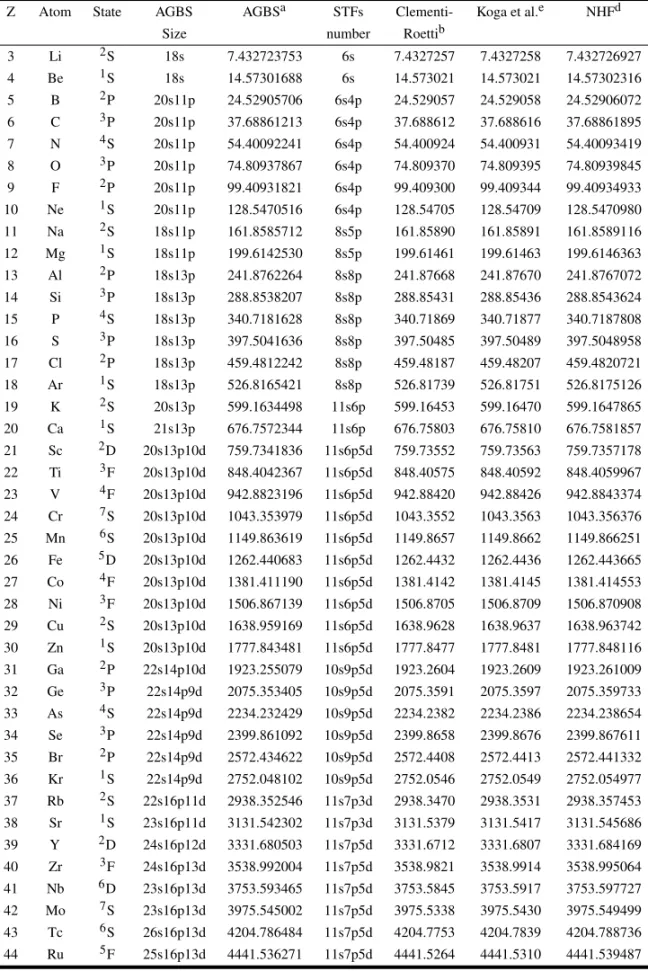
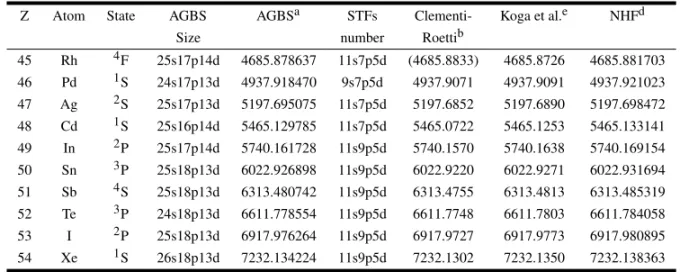
Table II shows the ground state total en-ergies (in hartree) for Li-Xe calculated by us with the GCHF method (Mohallem et al. 1986), by CR (1974) and Koga et al. (1993) using a fully-optimized basis sets of STFs, and by a numerical HF (NHF) (Bunge et al. 1992) method.
From Table II we can see that our total energies for Li, Be, and Na-Kr are worse than the CR (1974) results, while for the fourth-row atoms the opposite occurs. For B, C and Ne the two ap-proaches give the same energy values. These results are surprising since the CR wave functions have been regarded for a long time as having near NHF qual-ity. It is known that STFs have the correct functional forms to describe the nonrelativistic wave functions of atomic species at the origin, but they are not par-ticularly suitable for self-consistent field molecular calculations. On the other hand, GTFs are useful in the evaluation of multicenter integrals in molecules, but they do not possess the correct functional be-havior at the origin. Thus, for an atomic system, to obtain equivalent results for any physical or chem-ical property it is necessary to use GTFs basis set greater in size than STFs basis set. The CR (1974) result for Rh is wrong, because it is below the HF limit.
TABLE I
Discretization parameters of the adapted Gaussian basis sets (AGBSs).
Z Atom N min(s) (s) min(p) (p) min(d) (d) 3 Li 18s –0.6330 0.1380
4 Be 18s –0.5490 0.1380
5 B 20s11p –0.4790 0.1320 –0.5290 0.1380 6 C 20s11p –0.4150 0.1320 –0.4630 0.1380 7 N 20s11p –0.3640 0.1320 –0.4110 0.1390 8 O 20s11p –0.3190 0.1320 –0.384 0.1400 9 F 20s11p –0.2810 0.1320 –0.3530 0.1410 10 Ne 20s11p –0.2460 0.1320 –0.3200 0.1410 11 Na 18s11p –0.6000 0.1521 –0.2507 0.1390 12 Mg 18s11p –0.5475 0.1506 –0.2021 0.1370 13 Al 18s11p –0.4858 0.1485 –0.5459 0.1420 14 Si 18s11p –0.4338 0.1470 –0.4917 0.1400 15 P 18s11p –0.3915 0.1460 –0.4459 0.1390 16 S 18s11p –0.3545 0.1415 –0.4247 0.1380 17 Cl 18s11p –0.3228 0.1446 –0.4004 0.1380 18 Ar 18s11p –0.2929 0.1440 –0.3719 0.1370 19 K 20s13p –0.6523 0.1479 –0.3108 0.1350 20 Ca 21s13p –0.5902 0.1422 –0.2678 0.1340
TABLE I (continuation)
Z Atom N min(s) (s) min(p) (p) min(d) (d) 48 Cd 25s16p14d –0.5229 0.1301 –0.1458 0.1226 –0.3289 0.1200 49 In 25s17p14d –0.4687 0.1287 –0.4859 0.1307 –0.2702 0.1170 50 Sn 25s18p13d –0.4284 0.1281 –0.4785 0.1260 –0.2255 0.1210 51 Sb 25s18p13d –0.4040 0.1280 –0.4521 0.1251 –0.2074 0.1206 52 Te 24s18p13d –0.3825 0.1302 –0.4431 0.1248 –0.1873 0.1200 53 I 25s18p13d –0.3668 0.1270 –0.4238 0.1241 –0.1733 0.1192 54 Xe 26s18p13d –0.3479 0.1237 –0.4103 0.1236 –0.1554 0.1190
are better than those obtained by them (see Table II). Clearly, greater number of STFs are needed to im-prove the wave function (Koga et al. 1993) accuracy for Sr and Zr-Cd.
In summary, the AGBSs generated in this work are appropriate to be used in nonrelativistic atomic and molecular calculations of physical and chem-ical properties. An application of these basis sets in HF calculations of some properties of third- and fourth-row diatomic molecules is in progress. We recall that AGBSs generated with the GCHF method (Mohallem et al. 1986) were used with success to calculate various properties of first- and second-row diatomic molecules (Pinheiro et al. 1997a, b).
For the atoms from Li toAr, the error in our total energies is not more than 1 mhartree. For the third-and fourth-row atoms the error is always larger than 1 mhartree (see Table II). The largest error (7.426 mhartree) occurs for In.
4 CONCLUSIONS
The present work shows that a specific and careful numerical evaluation of the GHWHF equations for each of those atoms studied here, is capable of gen-erating accurate AGBSs to be used in HF atomic and molecular calculations.
When we compare our ground state total en-ergies with the benchmark results obtained by CR (1974), who used fully-optimized basis sets of STFs, we find that the results for first-, second- ant third-row atoms are in general worse, while those for fourth-row atoms are better than theirs. Besides
sults and the corresponding values computed with a NHF method (Bunge et al. 1992) is equal to 7.426 mhartree for In.
ACKNOWLEDGEMENTS
We acknowledge the financial support of CNPq (Brazilian Research Agency).
RESUMO
Utiliza-se o método coordenada geradora Hartree-Fock para gerar bases Gaussianas adaptadas para os átomos de Li (Z=3) até Xe (Z=54). Neste método, integram-se as equações de Griffin-Hill-Wheeler-Hartree-Fock através da técnica de discretização integral. Comparam-se as funções de ondas geradas neste trabalho com as funções de ondas Roothaan-Hartree-Fock de Clementi e Roetti (1974) e com outros conjuntos de bases relatados na lite-ratura. Para os átomos estudados aqui, os erros em nossas energias totais relativos aos limites numéricos Hartree-Fock são sempre menores que 7,426 milihartree.
Palavras-chave: método coordenada geradora Hartree-Fock, conjuntos de bases de Gaussianas, energias totais atômicas.
REFERENCES
Bunge CF, Barrientos JA, Bunge AV and Cogordan
JA.1992. Hartree-Fock and Roothaan- Hartree-Fock energies for the ground states of He through Xe. Phys Rev A 46: 3691-3696.
Centoducatte R, Jorge FE and Peixoto LT.2001.
Adapted Gaussian basis sets for ions with N<54. J
TABLE II
Ground state HF total energies in hartree (sign reversed) for the atoms from Li (Z=3) through Xe (Z=54).
Z Atom State AGBS AGBSa STFs Clementi- Koga et al.e NHFd
Size number Roettib
TABLE II (continuation)
Z Atom State AGBS AGBSa STFs Clementi- Koga et al.e NHFd
Size number Roettib
45 Rh 4F 25s17p14d 4685.878637 11s7p5d (4685.8833) 4685.8726 4685.881703 46 Pd 1S 24s17p13d 4937.918470 9s7p5d 4937.9071 4937.9091 4937.921023 47 Ag 2S 25s17p13d 5197.695075 11s7p5d 5197.6852 5197.6890 5197.698472 48 Cd 1S 25s16p14d 5465.129785 11s7p5d 5465.0722 5465.1253 5465.133141 49 In 2P 25s17p14d 5740.161728 11s9p5d 5740.1570 5740.1638 5740.169154 50 Sn 3P 25s18p13d 6022.926898 11s9p5d 6022.9220 6022.9271 6022.931694 51 Sb 4S 25s18p13d 6313.480742 11s9p5d 6313.4755 6313.4813 6313.485319 52 Te 3P 24s18p13d 6611.778554 11s9p5d 6611.7748 6611.7803 6611.784058 53 I 2P 25s18p13d 6917.976264 11s9p5d 6917.9727 6917.9773 6917.980895 54 Xe 1S 26s18p13d 7232.134224 11s9p5d 7232.1302 7232.1350 7232.138363
aHF total energies obtained by using our adapted Gaussian basis sets (AGBSs).bHF total energies
obtained by using fully-optimized STFs basis sets (Clementi and Roetti 1974).cHF total energies obtained by using fully-optimized STFs basis sets (Koga et al. 1993).dNumerical HF (NHF) total energies for Li to Xe obtained by Bunge et al. (1992).
Clementi E, Carravetta V and Cacelli I. 1989.
Modern techniques in computational chemistry: MOTECC-89; Clementi E., Ed., Leiden: ESCOM.
Clementi E and Roetti C.1974. Roothaan-
Hartree-Fock atomic wave functions. At Data Nucl Data Ta-bles 14: 177-478.
Custodio R, Goddard JD, Giordan M and Morgan
NH.1992a. The application of an optimization tech-nique to the development of universal basis sets. Can J Chem 70: 580-588.
Custodio R, Giordan M, Morgan NH and
God-dard JD. 1992b. Application of an
optimiza-tion technique to the discretized version of the Griffin-Hill-Wheeler-Hartree-Fock equations. Int J Quantum Chem 42: 411-423.
Da Costa HFM, da Silva ABF, Mohallem JR, Simas
AM and Trsic M.1991. The generator coordinate
Hartree-Fock method for molecular systems. For-malism and first applications to H2, LiH and Li2. Chem Phys 154: 379-384.
De Castro EVR and Jorge FE.1998. Accurate
univer-sal Gaussian basis set for all atoms of the periodic table. J Chem Phys 108: 5225-5229.
Froese Fischer C.1977. The Hartree-Fock Method for
Atoms. New-York: Wiley.
Jorge FE and Martins RF.1998. Accurate universal
Gaussian basis set for H through Xe for Hartree-Fock calculations. Chem Phys 233: 1-7.
Jorge FE and Fantin PA.1999. A universal basis set
for cations and anions generated with the generator coordinate Hartree-Fock method. Chem Phys 249: 105-111.
Jorge FE and Franco ML.2000. A universal
Gaus-sian basis set for positive and negative ions from H through Xe. Chem Phys 253: 21-26.
Jorge FE and Aboul Hosn HM.2001. Gaussian basis
sets for isoelectronic series of the He to Ne. Chem Phys 264: 255-265.
Jorge FE, Librelon PR and Canal Neto A.1998.
Adapted Gaussian basis sets for atoms Cs to Lr based on the generator coordinate Hartree-Fock method. J Comp Chem 19: 858-865.
Koga T, Tatewaki H and Thakkar AJ. 1993.
Roothaan- Hartree-Fock wave functions for atoms with Z<54. Phys Rev A 47: 4510-4512.
Mohallem JR.1986. A further study on the
discretisa-tion of the Griffin-Hill-Wheeler equadiscretisa-tion. Z Phys D 3: 339-344.
Mohallem JR, Dreizler RM and Trsic M. 1986.
equations. Int J Quantum Chem Symp 20: 45-55.
Pinheiro JC, da Silva ABF and Trsic M.1997a. The
generator coordinate Hartree-Fock method applied to the choice of a contracted Gaussian basis for first-row atoms. J Mol Structure (Theochem) 394: 107-115.
Pinheiro JC, da Silva ABF and Trsic M.1997b.
Gen-erator coordinate Hartree-Fock method applied to the choice of a contracted Gaussian basis for the second-row atoms. Int J Quantum Chem. 63: 927-934.
Roothaan CCJ.1960. Self-consistent field theory for