BRAZILIAN SAVANNAH
Fenologia e biometria de pinhão-manso no cerrado
Fábio de Lima Gurgel1, Bruno Galvêas Laviola2, Daniel Medeiros da Silva3, Adilson Kenji Kobayashi4, Tatiana Barbosa Rosado2
ABSTRACT
Phenological studies on three morphologically distinct accessions of physic nut (Jatropha curcas L.) were conducted in the
Brazilian Savannah biome. Plant growth rate, flowering, fruit formation and development were measured in order to establish appropriate management practices for increasing productivity. The accessions CNPAE-102 (toxic and susceptible to powdery mildew), CNPAE-169 (non-toxic and susceptible to powdery mildew) and CNPAE-259 (toxic and resistant to powdery mildew) were studied. Accessions with undetectable levels of phorbol ester in the grains were considered as non-toxic. The agronomic variables (plant height, number of inflorescences, number of green and ripe fruits per plant) from each accession were measured biweekly during one year (August 2009 to July 2010), correlating them with climatic variables using the Pearson’s correlation analysis. CNPAE-102 showed the highest growth rate (0.76 cm day-1), with 1.10 m increment in height and final height of 2.60 m.
CNPAE-169 showed the lowest growth rate (0.63 cm day-1) with final mean height of 1.85 m. CNPAE-102 and CNPAE-259 showed
early cycle and CNPAE-169, late cycle. The minimum temperature was the climatic variable that determined the most inflorescences.
Index terms: Growth rate, flowering, fruiting, temperature.
RESUMO
Estudos fenológicos de três acessos morfologicamente distintos de pinhão-manso (Jatropha curcas L.) foram conduzidos
no bioma Cerrado brasileiro. A taxa de crescimento da planta, florescimento, formação e desenvolvimento dos frutos foram medidos, a fim de se estabelecer práticas de manejo eficientes para o aumento de produtividade. Os acessos estudados foram: CNPAE-102 (tóxico, susceptível a oídio), CNPAE-169 (não-tóxico, susceptível a oídio) e CNPAE-259 (tóxico, resistente a oídio). Os materiais considerados não-tóxicos não possuem ésteres de forbol detectáveis nos grãos. No período de um ano (agosto de 2009 a julho de 2010) registraram-se, quinzenalmente, as variáveis agronômicas (altura de plantas, número de inflorescências, número de frutos verdes e maduros por planta) de cada acesso, correlacionando-as com as variáveis climáticas, por meio da análise de correlação de Pearson. O acesso CNPAE-102 apresentou a maior taxa de crescimento (0,76 cm dia-1), incremento 1,10 m na altura
e altura final de 2,60 m; o CNPAE-169 apresentou menor incremento (0,63 cm dia-1), atingindo altura final de 1,85 m. Os acessos
CNPAE-259 e CNPAE-102 foram os mais precoces, e o CNPAE-169 o mais tardio. A temperatura mínima foi a variável climática que determinou o maior número de inflorescências.
Termos para indexação: Taxa de crescimento, florescimento, frutificação, temperatura.
(Received in june 7, 2011 and approved in september 22, 2011)
1Empresa Brasileirade Pesquisa Agropecuária/Embrapa – Amazônia Oriental – Travessa Doutor Enéas Pinheiro – s/n – Cx. P. 48 – 66095-100 – Belém – PA – Brasil – [email protected]
2Empresa Brasileirade Pesquisa Agropecuária/Embrapa – Agroenergia – Brasília – DF – Brasil 3Faculdades Integradas/UPIS – Brasília – DF – Brasil
4Empresa Brasileirade Pesquisa Agropecuária/Embrapa – Meio-Norte – Teresina – PI – Brasil
INTRODUCTION
The Brazillian Savannah biome occupies an area of 204.7 million hectares and covers the states of Bahia, Goiás, Maranhão, Mato Grosso, Mato Grosso do Sul, Minas Gerais, Paraná, Piauí, São Paulo, Tocantins, as well Federal District, around 20% of the Brazilian territory. The vegetation is considered a wet seasonal savannah and It is characterized by a very variable structure, ranging from open grasslands (campo limpo), through open scrubland (campo sujo and cerrado sensu stricto) to dense woodlands (cerradão) (EITEN, 1994).
Several crops were introduced in this region, initially for food such as wheat, beans and rice, and in
recent years have seen the introduction of species in order to evaluate their potential for adaptation and
same inflorescence, hermaphrodite flowers may also occur but at lower proportion. The inflorescences have higher number of male flowers, from 10 to 20 flowers per female flower. The fruits are ovoid capsules, 1.5 to 3.0 cm in diameter, trilocular, usually containing three seeds with one seed per locule. The seeds measure 1.5 to 2.0 cm long and 1 to 1.3 cm wide, representing between 53 to 79% of the fruit weight and oil content ranges from 33 to 38% (DIAS et al., 2007).
The adoption of physic nutas a culture to meet the Brazilian National Program for Production and Use of Biodiesel is due mainly to the high potential of grain yield and as a non-food species which crop management is consistent with the family farming profile (LAVIOLA et al., 2010). Despite the absence of improved cultivars and the lack information on production in different regions, it has been disseminated and implemented in several regions of Brazil (LAVIOLA; DIAS, 2008). For such species which is still undergoing domestication, the understanding of its phenology would contribute in the establishment of management practices for increasing productivity (AMORIM et al., 2009). It is also known that genetic materials behave differently in the same environment. Thus, phenological and climatological monitoring are important tools for predicting annual production, in order to identify the regulatory mechanisms of periodic growth rhythm and reproduction (ABDULLA et al., 2011; LEELA et al., 2011).
Among the morpho-agronomic traits related to production, plant height is important in the description of genotypes of a species, contributing to its diversity, and in the identification of the most promising accessions in a germplasm bank (LAVIOLA et al., 2010; Rosado et al., 2010). Moreover, it contributes to the description of plant morpho-physiological conditions at time intervals and can be used to investigate the effect of ecological phenomena on the growth, such as the adaptability of a plant species in diverse ecosystems, competition effects, genotypic differences in productive capacity and the influence of agronomic practices on growth (BENINCASA, 1988). On the other hand, the number of inflorescences per plant and the number of ripe and dry fruits per plant are production components that interfere directly in the economic output (grain or oil). It is also important to relate these parameters with the climate variables to analyze the influence of physical environment variables on plant phenology.
Therefore, this study was undertaken to provide information on the phenology of three different genotypes of physic nut in the Brazilian Savannah biome during the 2009/2010 agricultural year, as well as relating the
variationsx in growth and reproductive parameters to climate variables.
MATERIAL AND METHODS
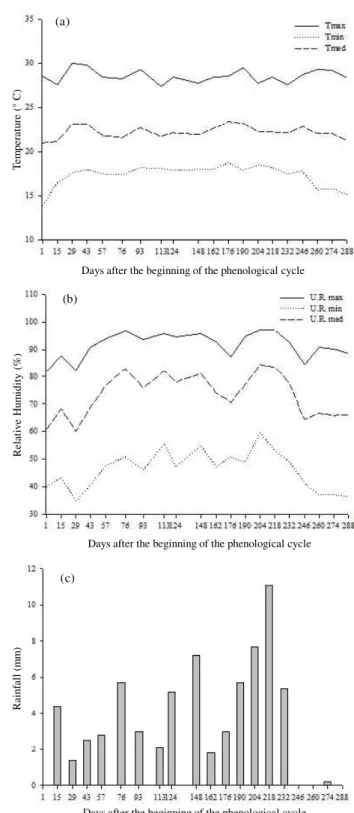
The experiment was conducted with accessions of the physic nut germplasm bank established in the experimental area of Embrapa Cerrados in Planaltina, Distrito Federal, Brazil, at 15°35’30'’S and 47°42’30'’W, at 1007 m. The climate is classified as Aw, tropical with dry winter and rainy summer, according to Köppen-Geiger. The annual climatic variables are: 28.5° C maximum temperature, 17° C minimum and 22° C average. Relative humidity ranged from 91.3 to 46% with 73% average. Total rainfall for the period was 1,089.4 mm. The soil is classified as Oxisol with high clay content.
The germplasm bank was established from seeds collected from isolated plants of physic nut between December 2007 and May 2008 at different locations, and from materials found in collections and plantations in Brazil. For this study, three accessions morphologically distinct CNPAE-102 (toxic, susceptible to powdery mildew), CNPAE-169 (non-toxic, susceptible to powdery mildew) and CNPAE-259 (toxic, resistant to powdery mildew) were used. Accessions with undetectable levels of phorbol ester in the grains were considered as non-toxic (DEVAPPA et al., 2010).
The quantification of phorbol esters (toxic compounds) was performed according to Makkar et al. (1997) with modifications to the extraction procedure. The ground seeds were placed on equipment by accelerated solvent extraction ASE 350 (Dionex, USA) using tetrahydrofuran as a solvent and then evaporated under nitrogen flow. The oily residue was transferred to a test tube of 10 mL and extracted four times with methanol (1 x 2 mL + 3 x 1 mL) and transferred to 5 mL volumetric flask, completed volume. The working solution was filtered to vial (PTFE Syringe VertiPure, 13 mm, 0.2 µm) and injected (100 µm) in High Performance Liquid Chromatography (HPLC) Varian, using column C18 250 x 4.6 mm (5 µm) Vertisep UPS, room temperature (around 25º C), ultraviolet detection (DAD) in the range from 200 to 340 nm. To construct the standard curve was used standard 12-myristate 13-acetate phorbol (Sigma, Cod.8139). The phorbol ester levels were 9.3 mg/g for access CNPAE-102 and 5.49 mg/g for access CNPAE-259.
March. Crop management practices, pest and disease control were carried out as routine maintenance of the germplasm bank (DIAS et al., 2007).
During a year period (August 2009 to July 2010), plant height was measured bi-weekly. Plant height (PH) was measured from the base of the stem to the top of the highest branch. To explain physiological growth during the phenological cycle, the nonlinear sigmoidal regression model with four parameters was used:
Where: a = ymax - ymin; b = adjustment parameter; xip= Inflection point; y0 = minimum point of the curve.
The inflection point (xip) corresponded to the time (days) when maximum growth rate of each access was observed. The points of minimum curvature (PCmin) and maximum (PCmax) were calculated as previously reported by Venegas et al. (1998), using the parameters of nonlinear equations:
b
x
x
a
y
y
ipexp
1
0 (1) max 0PC x 2b
min 0
PC x 2b (2)
The PCmin indicates the time in the curve when an expressive plant growth started and PCmax indicates when growth tended to stabilize.
Subsequently, the absolute growth rate was calculated:
, where
2 1
2 1
(H H )
AGR
(t t )
H
1 and H2 represent plant height of two successive samplings, and t1 and t2 represent the interval in days between the two samplings.
The number of inflorescences per plant (NIP), number of green fruit (NGF) and the number of yellow or dry fruits, considered as ripe (NRF). For these three reproductive variables, figures describing the oscillation of each variable during the phenological cycle were prepared (Figure 1).
The observations started on August 21st, 2009 (day 1) and ended on July 16th, 2010 (day 330), 22 observations in total. The experimental plot consisted of five plants. The mean for each variable was calculated in order to correlate them with the climatic variables.
Figure 1 – Mean of the climatic variables measured biweekly during the phenological cycle. (a) Temperature (°C). (b) Relative Humidity (%). (c) Rainfall (mm).
(a)
(b)
(c)
Days after the beginning of the phenological cycle
Days after the beginning of the phenological cycle
Days after the beginning of the phenological cycle
During the evaluation of the phenological cycle, the climatic variables temperature and relative humidity were monitored daily (Figure 1) and the mean values related to the biweekly assessment were calculated. Daily rainfall was also recorded, calculating the mean precipitation for each period. In order to correlate plant growth, flowering and fruiting with the climate, Pearson’s correlation analysis between agronomic and climatic variables was conducted using the computer application Genes (CRUZ, 2004). For each variable, the mean for each period in which observation was carried out, in a total of 20 observations, was considered (days 1 to 288). At the last observation of climatic variables (day 288) plants were already quiescent and monitoring these variables during the period of 330 days was not necessary.
RESULTS AND DISCUSSION
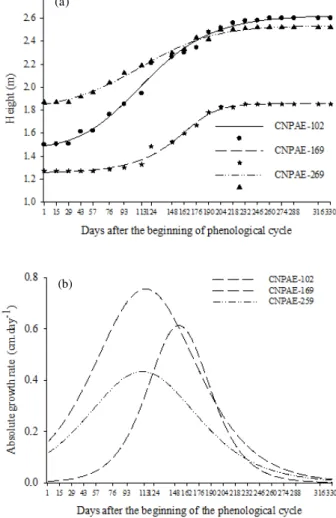
The variation in the growth of the accessions over a phenological cycle, between August 2009 and July 2010, can be observed in Figure 2a. Accessions of physic nut presented distinct growth. CNPAE-102 showed higher growth throughout the period, an increment of 1.10 m and reaching a final height of 2.60 m. The non-toxic accession CNPAE-169 showed lower growth in the period (0.63 m), reaching a final height of 1.85 m at the end of the phenological cycle. CNPAE-259 showed an intermediate growth behavior, reaching 2.52 m at the end of the period, growing 0.61 m.
Among the accessions, CNPAE-169 showed a later development (PCmin), initiating the vegetative growth 104 days (Dec 2nd, 2009) after the trial started, while CNPAE-259 and CNPAE-102 started earlier, after 25 days (Sep 14th, 2010) and 34 days (Sep 23rd, 2009), respectively (Table 1). At the beginning of winter, as a deciduous plant, leaf abscission occurs and the plant remains quiescent, surviving on reserves and water stored in the trunk and branches until environmental stimuli trigger a new growth cycle (SATURNINO et al., 2005; ABDELGADIR et al., 2009). According to Larcher (2004), external stimuli may affect endogenous factors not only at cellular and molecular level, affecting the metabolic processes via transcription and translation, but also has a coordinating role throughout the plant body, which is performed by hormones which trigger changes in seasonal behavior of the plant. However, as shown in Figure 2a, the response to environmental stimuli is complex, with significant differences among genotypes in response to external factors.
Despite the difference among the genotypes on growth initiation, the accessions reached the end of the growing season a few days apart (PCmax) with a maximum gradient of 7 days between CNPAE-102 and CNPAE-169.
Besides showing the lowest growth increment, CNPAE-169 (Figure 2a) also showed shortest growth time during the reproductive period (97 days of growth, while CNPAE-102 and CNPAE -259 grew for 160 and 171 days, respectively (Table 1). The values of the growth period were calculated by the difference between the PCmax and PCmin of each accession.
Figure 2 – Growth behavior of three accessions of physic nut as a function of time elapsed after planting. (a) Plant height. (b) Absolute growth rate.
The plants showed the highest growth rate (Xip) at 110 days (Dec 8th, 2009) for CNPAE-259, at 114 days (Dec 14th, 2009) for CNPAE-102 and 152 days (Jan 21st, 2010) for CNPAE-169, this last among all the later. In the studied period, CNPAE-102 showed the highest growth rate (0.76 cm day-1) during the phenological cycle, followed by CNPAE -169 (0.61 cm day-1) and CNPAE-259 (0.44 cm day-1) (Figure 2b).
(a)
The differences in growth among accessions are explained by factors intrinsic to genotypes and such information should be considered in the use of genetic resources in the breeding program of the species. The analysis of growth demonstrated that CNPAE-169 has a lower tolerance to the cerrado environment. Since physic nut produces inflorescences in terminal buds, lower vegetative growth may be directly reflected in the production of fruits (SATURNINO et al., 2005; ACHTEN et al., 2010). Considering characteristics related to breeding programs, high productivity is followed by the absence of phorbol esters in seeds (DEVAPPA, 2010). Such character would allow the use of the press cake resulting from the extraction of oil as animal feed. In this sense, the use at commercial level of the non-toxic accession CNPAE-169 will require its recombination with early cycle and productive materials.
In Figure 3, variations on flowering and number of green and ripe fruits representing the reproductive period in the agricultural year can be observed. In general, the reproductive period characterized from the first flowering to fruit ripening, started after 29 days (Sep 18th, 2009) with differences among genotypes in the intensity of flowering. The end of the reproductive period occurred around 316 days (Jun 7th, 2010), a total of 287 days. In the reproductive period plants are more susceptible to changes in the environment. Different aspects such as photoperiod, humidity, temperature, pollinators and dispersers, may be involved in variations in flowering and fructifications from one year to another. The understanding of the flowering and fruiting patterns of a species, provided by phenological surveys, is fundamental to unravel both the process itself and its reproductive success (FISCH et al., 2000).
Flowering is one of the most important phenological stages of the crop for oil production. The number of female flowers and their fertilization determine how many fruits and seeds will eventually develop. A continuous flowering results in a sequence of stages of reproductive development in the same branch, ripe fruit at the base, green fruit in the middle and flowers at the end of the branch (JUHÁSZ et al., 2009).
Table 1 – Nonlinear sigmoidal regression equations for plant height in three genotypes of physic nut as a function of time after planting and growth parameters.
Genotype Model R2 (%) X
ip (days) PCmin PCmax
CNPAE-102 Ŷ = 1.41 + 1.21/(1 + exp( -(x – 113.74)/39,96)) 99.29 114 34 194
CNPAE-169 Ŷ = 1.26 + 0.60/(1 + exp( -(x – 152.41)/24.36)) 99.23 152 104 201
CNPAE-259 Ŷ = 1.80 + 0.74/(1 + exp(- (x – 110.16)/42.69)) 99.44 110 25 196
Figure 3a shows two phases of flowering during the reproductive period. The first phase between 29 and 162 days, and the second phase between 162 and 330 days after planting. CNPAE-102 at 93 days of the first phase showed the highest number of inflorescences (16 inflorescences) and CNPAE-259 at 204 days showed the largest number of phase two, with 12 inflorescences. In the second phase of the flowering CNPAE-169 kept flowering for longer period when compared to the other accessions, a mean of ten open inflorescences could be observed after 204 days. The data presented in Figure 3a characterized the early cycle of CNPAE-102 and the late cycle of CNPAE-169.
Physic nut produces flowers in terminal buds of branches grown in the current year and the production of new inflorescences is dependent upon new branches formation and growth. The drop in the rate of new inflorescences formation at 162 days might be explained by developing fruits in the same period, which competed directly with the formation of new inflorescences. During the reproductive phase of plant changes occur in the direction of metabolic drain, where the fruits have pr ior ity for photoassimilates h ence restricting vegetative growth (ABDELGADIR et al., 2009). The fruits in development are so competitive, that monopolize most of the photoassimilates from surrounding leaves, as well as from more distant ones, causing a sharp decline in growth (ANWAR et al., 2010).
In the comparison of Figure 3a and Figure 3b, the results showed that although the late-cycle accessions CNPAE-259 and CNPAE-169 have a peak of about 8 inflorescences per plant on the first phase of flowering, a formation of a small number of green fruit was observed. A possible explanation for this is related to changes in the ratio of female/male flowers within the inflorescence, which is influenced throughout the year.
In general, for the accession CNPAE-102 the tendency of ripe fruit production also occurs in two peaks during the reproductive cycle (Figure 3c). The peak in the production of inflorescences was higher in the first phase of flowering (Figure 3a) but the production of mature fruits was higher in the second phase (Figure 3c). Moreover, when comparing the number of green fruit (Figure 3b) to number of ripe fruits (Figure 3c), the results show that only a part of developing fruits formed ripe fruits. One aggravating factor in the study environment that contributes to reducing fruit numbers was the severe occurrence of powdery mildew in the region (DIANESE; CARGNIN, 2008), especially for the susceptible CNPAE-102 and CNPAE-169 variants. As the disease attacks the reproductive organs, it may have contributed to a large reduction of flowers and young developing fruits (CARELS, 2009).
The results of the phenological study conducted with these three accessions have identified the period in which the highest concentration of inflorescence, and subsequent fruit formation and development occurred. Such information is very important for the characterization of the genotypes cycle and for proper management of the plant. Furthermore, the present results underlie the identification of critical periods during the crop cycle, in which an environmental stress may cause more severe and sometimes irreversible damage. These periods should also be very well characterized in order to avoid or at least minimize damage to the plants and consequently to the production.
Phenological cycles of tropical plants are complex, with irregular patterns that are difficult to recognize, especially in short-term studies (BENCKE; MORELLATO, 2002). The results contributed in the understanding of the phenology of physic nut in the cerrado environment in the second year of development. However, the observations will continue to further stages of growth and reproduction of physic nut until adult plants.
Pearson’s correlation analysis showed the relationship among the agronomic traits evaluated, as well as the direct influence of climatic variables on growth and development of physic nut genotypes (Table 2). For plant Figure 3 – Reproductive development of three accessions
of physic nut as a function of time elapsed after planting. (a) Number of inflorescences per plant (NIP). (b) Number of green fruits per plant (NGF). (c) Number of ripe fruits per plant (NRF).
(a)
(b)
(c)
Days after the beginning of the phenological cycle
N um be r o f i nf lo re sc en ce s pe r p la nt
Days after the beginning of the phenological cycle Days after the beginning of the phenological cycle
height (PH) a positive correlation with the number of green and ripe fruits (1% significance) in all three accessions was observed. But no correlation with climatic variables was found. The positive correlation of plant height with reproductive variables indicates that production is related to growth and, therefore, management practices for high rates of vegetative growth should be considered.
The number of inflorescences per plant (NIP) showed significant correlation with number of ripe fruits (NRF) only for accession CNPAE-102 and the correlation was negative. These results indicate that not only the number of inflorescences will determine the fruit production but other factors may play different roles in flower fertilization, development of the reproductive organs and contributing to the number of fruits.
The climatic variable that best correlated positively with the agronomic traits was the minimum temperature (Tmin, Table 2). This variable determined the emergence of a higher number of inflorescences, being associated, in general, to the relative humidity for the formation of new inflorescences (NIP). The induction of inflorescences is the first component of production observed during the phenological cycle and the other components depend upon it. NGF and NRF were not explained by climatic variables, since after the formation of the inflorescences, other factors such as the occurrence of diseases, insects, among others, might contribute more effectively in the expression of characters.
According to Larcher (2004), temperature has an indirect influence on growth and on the course of
development (due to its quantitative effect on the energy supply from the basal metabolism and the biosynthesis) and direct effects via regulatory processes, such as thermoinduction, thermoperiodism and thermomorphism. A study by Laviola et al. (2007) reported that the cycle of coffee trees, as well as the duration of reproductive phases was influenced by the altitude of cultivation, and the longest cycle was associated with occurrence of lower temperatures at higher altitudes.
Ciênc. agrotec., Lavras, v
. 35, n. 6, p. xx-xx, nov
./dez., 201
Phenology and biometry of physic nut...
1129
CNPAE-102
NIP NGF NRF Tmin Tmed Tmax R.H.min R.H.med R.H.max p.p.
AP -0.2428ns 0.6007** 0.7305** 0.1021ns 0.1618ns -0.1103ns 0.1556ns 0.2012ns 0.2808ns 0.1480ns
NIP -0.0721ns -0.4596* 0.5428* 0.1767ns -0.2850ns 0.5292* 0.6544** 0.6245** 0.3819ns
NGF 0.2911ns 0.4474* 0.2576ns -0.3378ns 0.4308ns 0.3469ns 0.2647ns 0.3085ns
NRF -0.3070ns -0.0598ns 0.0942ns -0.3031ns -0.2368ns -0.0435ns -0.3599ns
CNPAE-169
NIP NGF NRF Tmin Tmed Tmax R.H.min R.H.med R.H.max p.p.
AP -0.0015ns 0.6295** 0.6583** 0.0128 ns 0.1632ns -0.0462 ns 0.0407 ns 0.0658ns 0.1425 ns 0.1081ns
NIP -0.1045ns -0.3849 ns 0.5988** 0.2176ns -0.1702 ns 0.7569** 0.8176** 0.7532** 0.6655**
NGF 0.3678 ns 0.0976 ns 0.0885ns -0.1776 ns 0.0891 ns 0.1087ns 0.0633 ns 0.2202ns
NRF -0.4743* -0.1592ns 0.1842ns -0.4381ns -0.3079 ns -0.0977 ns -0.3507ns
CNPAE-259
NIP NGF NRF Tmin Tmed Tmax R.H.min R.H.med R.H.max p.p.
AP 0.4252ns 0.7172** 0.5944** 0.1001ns 0.1521ns -0.1404ns 0.1814ns 0.2007ns 0.2632ns 0.1275ns
NIP 0.0817ns -0.2726ns 0.6786** 0.3117ns -0.3012ns 0.8057** 0.8030** 0.6867** 0.7626**
NGF 0.5323* -0.0620ns 0.1453ns 0.0518ns -0.1718ns -0.1562ns -0.0912ns -0.1281ns
NRF -0.4596* -0.1865ns 0.1464ns -0.4323ns -0.2966ns -0.1126ns -0.3441ns
CONCLUSIONS
The accession CNPAE-102 shows the highest growth rate (0.76 cm.day-1), with 1.10 m increment in height and final height of 2.60 m. CNPAE-169 shows the lowest increment in height (0.63 m), reaching final height of 1.85 m. The accessions CNPAE-102 and CNPAE-259 show early cycles and CNPAE-169, late cycle.
Minimum temperature is the climatic variable that determines the most inflorescences.
ACKNOWLEDGEMENTS
To FINEP and CNPq for financial support.
REFERENCES
ABDELGADIR, H. A.; JOHNSON, S. D.; VAN STADEN, J. Effect of foliar application of plant growth regulators on flowering and fruit set in Jatropha curcas - A potential oil seed crop for biodiesel. South African Journal of Botany, v. 75, n. 2, p. 391-391, apr 2009.
ABDULLA, R.; CHAN, E. S.; RAVINDRA, P. Biodiesel production from Jatropha curcas: a critical review.
Critical Reviews in Biotechnology, v. 31, n. 1, p. 53-64,
Mar 2011.
ACHTEN, W. M. J. et al. Biomass production and allocation in Jatropha curcas L. seedlings under different levels of drought stress. Biomass & Bioenerg,
v. 34, n. 5, p. 667-676, may 2010.
AMORIM, I. L.; SAMPAIO, E. V. D. B.; ARAUJO, E. D. Phenology of woody species in the Caatinga of Serido, RN, Brazil. Revista Arvore, v. 33, n. 3, p. 491-499, may-jun
2009.
ANWAR, F. et al. Jatropha Curcas seed oil as a viable source for biodiesel. Pakistan Journal of Botany, v. 42,
n. 1, p. 575-582, jan. 2010.
BENCKE, C. S. C.; MORELLATO, L. P. C. Comparison of two methods of plant phenology estimation, their interpretation and representation. Revista Brasileira de Botânica, São Paulo, v. 25, n. 3, p. 269-275, set. 2002. BENINCASA, M. M. P. Análise de crescimento em plantas: noções básicas.Jaboticabal: FUNEP, 1988. 42 p.
CARELS, N. Jatropha curcas: A Review. Advances in Botanical Research, v. 50, p. 39-86, 2009.
CRUZ, C. D. Programa Genes – Programa para análise
estatística, biométrica e multivariada de dados
quantitativos e moleculares. Versão 2004. Disponível em: <http://www.ufv.br/dbg/genes/genes.htm>. Acesso em: set. 2010.
DEVAPPA, R. K.; MAKKAR, H. P. S.; BECKER, K. Jatropha Toxicity. A Review. Journal of Toxicology and Environmental Health-Part B-Critical Reviews, v. 13, n.
6, p. 476-507, 2010.
DIANESE, A. C.; CARGNIN, A. Ocorrência de Oidium
sp. em pinhão-manso. Brasília, DF: Embrapa Cerrados,
2008. 15 p. (Embrapa Cerrados. Documentos, 231). DIAS, L. A .S. et al. Cultivo de pinhão-manso (Jatropha curcas L) para produção de óleo combustível. Viçosa:
UFV, 2007. v. 1. 40 p.
EITEN, G. Vegetação do Cerrado. In: PINTO, M. N. (Org.).
Cerrado: caracterização, ocupação e perspectivas. Brasília: Ed. Universidade de Brasília, 1994. p. 17-73. FISCH, S. T. V. et al. Fenologia reprodutiva de Euterpe edulis Mart. na Mata Atlântica (Reserva ecológica do Trabiju, Pindamonhangaba-SP).Revista Biociências, Taubaté, v. 6, n. 2, p. 31-37, 2000.
JUHÁSZ, A. C. P. et al. Floral biology and artificial polinization in physic nut in the North of Minas Gerais state, Brazil. Pesquisa Agropecuária Brasileira, Brasília,
v. 44, n. 9, p. 1073-1077, set. 2009.
LARCHER, W. Ecofisiologia vegetal. São Carlos: RiMa,
531p., 2004.
LAVIOLA, B. G. et al. Genetic parameters and variability in physic nut accessions during early developmental stages. Pesquisa Agropecuária Brasileira, Brasília, v. 45, p. 1117-1123, 2010.
LAVIOLA, B. G. et al. Assimilates allocation in fruits and leaves of coffee plants cultivated in two altitudes.
Pesquisa Agropecuária Brasileira, Brasília, v. 42, p. 1521-1530, 2007.
LEELA, T. et al. Morphological, physico-chemical and micropropagation studies in Jatropha curcas L. and RAPD analysis of the regenerants. Applied Energy, v. 88,
n. 6, p. 2071-2079, jun. 2011.
MAKKAR, H. P. S. et al. Studies on nutritive potential and toxic constituents of different provenances of Jatropha curcas. Journal of Agriculture and Food Chemistry, Easton, v. 45, p. 3152-3157, 1997.
ROSADO, T. B. et al. Molecular markers reveal limited genetic diversity in a large germplasm
collection of the biofuel crop Jatropha curcas L. in Brazil. Crop Science, Madison, v. 50, p. 1-11, nov./
dec. 2010.
SATURNINO, H. M. et al. Produção de oleaginosas para o biodiesel. Informe Agropecuário, Belo Horizonte, v. 26,
n. 229, p. 44-74, 2005.
VENEGAS, J. G.; HARRIS, R. S.; SIMON, B. A. A comprehensive equation for the pulmonary pressure-volume curve. Journal of Applied Physiology, Bethesda,