Ciência Rural, v.39, n.2, mar-abr, 2009.
ISSN 0103-8478
Gerson Neudí ScheuermannI* Anildo Cunha JuniorI Lucas CyprianoII Alexandre Mossate GabbiII
ABSTRACT
This study evaluated a phytogenic feed additive for broiler chickens. A total of 1,632 broiler chicks were distributed into four treatments: negative control (without growth promoter); positive control (avilamycine, 10ppm + colistin, 15ppm); and two alternative treatments with 150ppm of phytogenic additive, one with a reduced Ca and P levels diet (PA-R1) and the other with lower energy, and amino acids, besides Ca and P (PA-R2). The trial was conducted with 12 replicates, each consisted of a pen with 34 birds. The alternative diets showed body weight intermediate to the two controls at 42 days, with no significant (P>0.05) treatment effect on feed conversion ratio. No treatment differences (P>0.05) on carcass yield and composition was observed. There was a tendency of abdominal fat lipids saturation, when the phytogenic additive was used, as possible consequence of a decreased level of soybean oil in the diets. A difference (P<0.001) on ingredient consumption profile was observed between the treatments. All together, this study showed a possibility to reduce the cost of total feed used to produce a broilers or a ton of body weight by the utilization of the tested phytogenic additive.
Key words: broiler chickens, phytogenic feed additive, antibiotic growth promoter.
RESUMO
O objetivo neste estudo foi avaliar a utilização de um aditivo fitogênico na dieta de frangos de corte. Um total de 1632 aves foram distribuídas em quatro tratamentos: controle negativo (sem antibiótico promotor de crescimento; controle positivo (com avilamicina, 100ppm + colistina, 15ppm), e dois tratamentos alternativos com 150ppm do aditivo fitogênico, um com níveis de Ca e P reduzidos (PA-R1) e outro também com menores níveis de energia e aminoácidos
(PA-R2). O experimento foi conduzido com 12 repetições, cada uma delas com 34 aves. As aves submetidas às dietas alternativas apresentaram peso corporal médio, intermediário aos tratamentos de controle, aos 42 dias de idade, não se observando efeito significativo (P>0,05) na conversão alimentar. Nenhuma diferença (P>0,05) foi observada no rendimento e na composição centesimal da carcaça. Com adição do aditivo fitogênico, verificou-se aumento da saturação dos lipídios da gordura abdominal, possivelmente, devido à menor inclusão de óleo de soja em tais dietas. Houve diferença significativa (P<0,001) no consumo de ingredientes entre os tratamentos. O conjunto dos dados mostrou que a utilização do aditivo fitogênico possibilita a redução do custo da ração necessária para produzir um frango ou uma tonelada de peso vivo.
Palavras-chave: frangos de corte, aditivos fitogênicos, antibiótico promotor de crescimento.
INTRODUCTION
There is currently considerable controversy regarding the use of antibiotics as growth promoters in poultry production, what has led to restriction or even a complete ban of these substances in some countries. Considering the simple removal of antibiotic growth promoters might have a negative economic impact, search for alternative additives has been incentivated. Among the possibilities are natural products from plant origin, which should be of special concern in Brazil because of its flora biodiversity.
Natural plant products, mainly essential oils,
IIEmbrapa Suínos e Aves, CP 21, 89700-000, Concórdia, SC, Brasil. E-mail: [email protected]. *Autor para
correspondência.
IIPronutra do Brasil, Tenente Francisco Lehmkuhl, Palhoça, SC, Brasil.
Phytogenic additive as an alternative to growth promoters in broiler chickens
Aditivo fitogênico como alternativa aos promotores de crescimento em frangos de corte
Ciência Rural, v.39, n.2, mar-abr, 2009.
have been evaluated as possible feed additives for animal production, especially considering their in vitro antimicrobial activity (COWAN, 1999). Moreover, an important propriety which has also been observed recently in rats (PLATEL & SRINIVASAN, 2004) and chickens (JANG et al., 2006) is the benefit of some natural substances on the gastrointestinal enzymatic activity, most likely improving nutrient digestibility. Some studies reported the use of plant extracts and essential oils on feed trials conducted with broiler chickens. No positive effect on body weight or feed efficiency was observed when dried garlic was used up to 4.5% in broiler diets (KONJUFCA et al., 1997). Concerned about the possible negative effect of garlic processing on its active substances, FREITAS et al. (2001) worked with fresh garlic, using it at 0.6% in broiler diets, but also no performance benefits were observed. BOTSOGLOU et al. (2002) indicated that dietary oregano oil exerted no growth promotion on broilers when supplemented the feed at 50 or 100mg.kg-1. On
the other hand, JAMROZ & KAMEL (2002) observed improvements in daily gain (8.1%) and in feed conversion ratio (7.7%) of chickens when fed with diets supplemented (300mg.kg-1) with a plant extract
containing capsaicin, cinnamaldehyde, and carvacrol. Similarly, Alternanthera brasilianaextracts (180mL per
200kg of feed) improved broiler performance from 14 to 21 days of age (BIAVATTI et al., 2003). HERNÁNDEZ et al. (2004) observed that two blends of plant extracts (oregano, cinnamom, and peeper at 200mg.kg-1 and
sage, thyme, and rosemary at 5,000mg.kg-1) affected
digestibility and improved the performance slightly, but not significantly. MUHL & LIEBERT (2007) evaluated the effects of two commercial phytogenic feed additives on male chickens and no significantly response on growth performance, nutrient utilization and threonine efficiency was observed. Anyway, it can be considered that the effect of plant products on broiler chicken performance under practical production conditions is still not sufficiently established and the results indicate the difficulty in translate in vitro observations to in vivo conditions. The objective of this study was to evaluate the effect of a plant additive compound on general broiler chicken performance and carcass composition.
MATERIAL AND METHODS
The experiment was carried out with 1,632 male broiler chickens, Cobb 500 strain, placing 34 chicks
per pen (12 birds/m2). Four experimental diet treatments
were applied since the first day of age, with 12 replicates. At arriving, all the chicks were weighted individually in order to form blocks based on the initial body weight (BW).
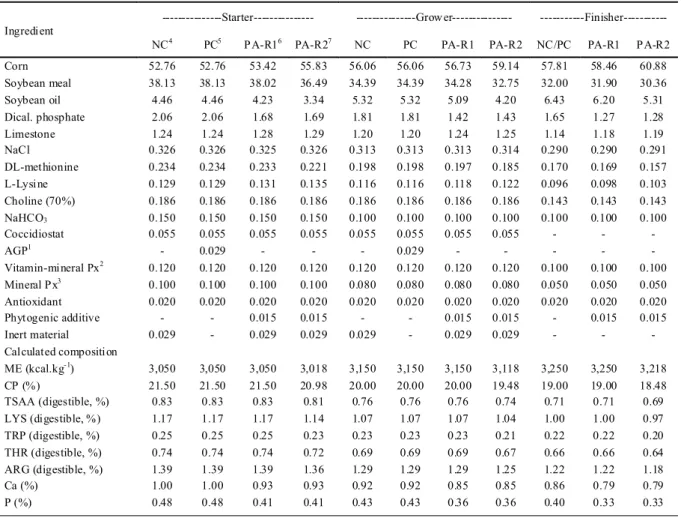
Four experimental diets were elaborated considering three age periods (initial, 1-21; growing, 21-35; and final, 35-42), based on feed composition according to ROSTAGNO et al. (2005), except the protein values which were analyzed. While there was no growth promoter in the negative control (NC), avilamycine (10ppm) and colistin (15ppm) were added on the positive control (PC). Alternative treatments (PA-R1 and PA-R2) used 150 ppm of a commercial phytogenic product - Biostrong 510 (Delacon, Vienna, Austria) - a mixture of microencapsulated essential oils, capsaicins, and saponins. Treatment PA-R1 considered an improvement on the efficiency of calcium and phosphorous utilization as a contribution of the phytogenic additive. This was considered on feed formulation reducing the requirements of these nutrients (Table 1). For treatment PA-R2, besides Ca and P, there was also considered an improvement on the efficiency of energy and amino acids (Table 1). For these reasons, there was a feed composition difference between the alternative treatments (Table 1). All feed was prepared in a pellet form and used ad libitum during the whole experimental period.
Live performance (average BW, feed consumption and feed conversion ratio-FCR, and mortality) was assessed weekly up to the final age (42 days). In order to obtain carcass data, at 42 days one bird per pen was sampled, weighed, and euthanized by CO2 asphyxiation. Different parts of the carcass were excised, weighed, and mixed together for proximate composition analysis (dry matter-DM, crude protein-CP, fat, and ash) by near infrared reflectance spectroscopy, using a Foss NIRSystem 6500 under 400 to 2,500 nm, according to KLEIN et al. (2003).
Ciência Rural, v.39, n.2, mar-abr, 2009.
detector temperatures were set at 250 and 280°C, respectively. Carrier gas used was N2 (0.7mL min-1).
FAME’s were identified by comparison of the peak retention times between each the sample and the authentic standards (Sigma Chemical Co., St. Louis, MO, USA). Quantification of FAME’s was done by area normalization. Additionally, Iodine Index was estimated based on fatty acid composition, according to PIKE (1998).
In order to evaluate economic impact of the treatments, total feed cost per bird and total feed cost per ton BW were calculated based on performance data and considering commercial price of the feed
ingredients. Statistical analysis of the data was performed using procedure GLM of SAS (2002) and considering blocks and treatments as the main factors. When treatment effect was significant (P<0.05), REGWQ multiple comparison of means test was used.
RESULTS AND DISCUSSION
The present study provides an evaluation of a phytogenic feed additive in order to improve the economic performance of broiler chickens. Because of the still recent restriction on the utilization of antibiotic growth promoters in animal production, development
Table 1 - Composit ion (%) and calculated levels of energy and nutrients of the experimental diets.
Ingredi ent
---Starter--- ---Grow er--- ---Finisher---
NC4 PC5 PA-R16 PA-R27 NC PC PA-R1 PA-R2 NC/PC PA-R1 PA-R2
Corn 52.76 52.76 53.42 55.83 56.06 56.06 56.73 59.14 57.81 58.46 60.88
Soybean meal 38.13 38.13 38.02 36.49 34.39 34.39 34.28 32.75 32.00 31.90 30.36
Soybean oil 4.46 4.46 4.23 3.34 5.32 5.32 5.09 4.20 6.43 6.20 5.31
Dical. phosphate 2.06 2.06 1.68 1.69 1.81 1.81 1.42 1.43 1.65 1.27 1.28
Limestone 1.24 1.24 1.28 1.29 1.20 1.20 1.24 1.25 1.14 1.18 1.19
NaCl 0.326 0.326 0.325 0.326 0.313 0.313 0.313 0.314 0.290 0.290 0.291
DL-met hionine 0.234 0.234 0.233 0.221 0.198 0.198 0.197 0.185 0.170 0.169 0.157
L-Lysi ne 0.129 0.129 0.131 0.135 0.116 0.116 0.118 0.122 0.096 0.098 0.103
Choline (70%) 0.186 0.186 0.186 0.186 0.186 0.186 0.186 0.186 0.143 0.143 0.143
NaHCO3 0.150 0.150 0.150 0.150 0.100 0.100 0.100 0.100 0.100 0.100 0.100
Coccidiostat 0.055 0.055 0.055 0.055 0.055 0.055 0.055 0.055 - - -
AGP1 - 0.029 - - - 0.029 - - - - -
Vitamin-mi neral Px2 0.120 0.120 0.120 0.120 0.120 0.120 0.120 0.120 0.100 0.100 0.100
Mineral Px3 0.100 0.100 0.100 0.100 0.080 0.080 0.080 0.080 0.050 0.050 0.050
Antioxidant 0.020 0.020 0.020 0.020 0.020 0.020 0.020 0.020 0.020 0.020 0.020
Phyt ogenic additive - - 0.015 0.015 - - 0.015 0.015 - 0.015 0.015
Inert material 0.029 - 0.029 0.029 0.029 - 0.029 0.029 - - -
Calculated compositi on
ME (kcal.kg-1) 3,050 3,050 3,050 3,018 3,150 3,150 3,150 3,118 3,250 3,250 3,218
CP (%) 21.50 21.50 21.50 20.98 20.00 20.00 20.00 19.48 19.00 19.00 18.48
TSAA (digestible, %) 0.83 0.83 0.83 0.81 0.76 0.76 0.76 0.74 0.71 0.71 0.69
LYS (digestible, %) 1.17 1.17 1.17 1.14 1.07 1.07 1.07 1.04 1.00 1.00 0.97
TRP (digestible, %) 0.25 0.25 0.25 0.23 0.23 0.23 0.23 0.21 0.22 0.22 0.20
THR (digestible, %) 0.74 0.74 0.74 0.72 0.69 0.69 0.69 0.67 0.66 0.66 0.64
ARG (digestible, %) 1.39 1.39 1.39 1.36 1.29 1.29 1.29 1.25 1.22 1.22 1.18
Ca (%) 1.00 1.00 0.93 0.93 0.92 0.92 0.85 0.85 0.86 0.79 0.79
P (%) 0.48 0.48 0.41 0.41 0.43 0.43 0.36 0.36 0.40 0.33 0.33
1
AGP (Ant ibi otic grow th promoter): avilamycine (10ppm) + colist in (15ppm) in feed.
2
Compositi on per kg premix: Vi t. A, 10,000,000UI; V it. D3, 3,000,000UI; Vit E, 40,000mg; Vi t. K, 3,000mg; Thiamine, 2,000mg; Riboflavin, 6,000mg; Piridoxin, 4,000mg; Vit. B12, 15,000mcg; Niacin, 50,000mg; Pantothenic acid, 12,000mg; Folic aci d, 1,000mg; Biotin, 150mg, Se, 250mg.
3Compositi on per kg premix: Fe, 100,000mg; Cu, 20,000mg; Mn, 160,000mg; Zn, 100,000mg; Co, 2,000mg; I, 2,000mg.
4Negat ive cont rol, without AGP. 5Positive control
6Diet with phytogenic additive, restricted in Ca and P.
Ciência Rural, v.39, n.2, mar-abr, 2009.
and evaluation of alternative additives has shown up as a promising research opportunity. Efforts have been documented about the utilization of phytogenic substances in broiler feed, but in general effects on performance and economic viability have been inconsist (WESTENDARP, 2005; WINDISCH et al., 2008), what justified this study.
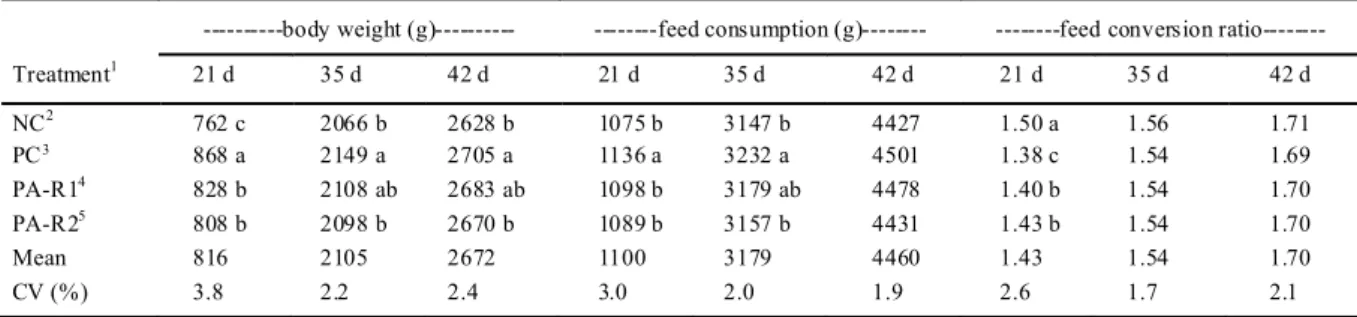
The experiment was conducted up to 42 days of the broiler chickens, generating cumulative performance data (BW, feed consumption and FCR), which are presented on table 2. Treatment effect on BW was significant on the three ages evaluated, with a general superior performance of PC, and a reduced BW observed for NC broiler. Alternative treatments showed intermediate BW, slightly higher for PA-R1 broilers. The fact that BW of alternative treatments did not differ statistically from PC at 42 days, and that there was no treatment effect for FCR at this age indicates the possibility of economic advantage for these alternatives. Considering that these diets were formulated with reduced nutrient requirements, the results corroborate studies carried out with rats (PLATEL & SRINIVASAN, 2004) and broilers (JANG et al., 2006) which showed stimulation on the gastrointestinal enzyme activity as a consequence of some plant extract ingestion.
There was no treatment effect on general carcass variables, both in absolute (average: carcass=1,896.2g; breast=599.1g; drumsticks=249.0g; thighs=366.3g; wings=195.8g; abdominal fat=33.5g) or in relative to BW values (average: carcass=71.7%; breast=22.6%, drumsticks=9.4%, thighs=13.8%, wings=7.4%; abdominal fat=1.3%). Similarly, no treatment effect was observed on carcass composition data estimated
by near infrared spectroscopy (average: DM=34.4%; CP=18.1%, fat=13.3%, ash=1.7%). The results indicate no possibility of broiler carcass yield improvement based on the phytogenic product ingestion.
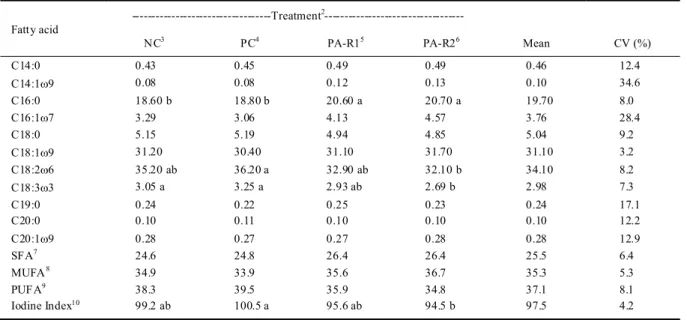
Fatty acid analysis was performed on abdominal fat in order to evaluate a possible treatment influence on the fatty acid profile. As shown on table 3, fatty acid profile compares to published data (MARION & WOODROOF, 1963). Treatment effect, however, was restricted to palmitic (C16:0), linoleic (C18:2ω6), and linolenic (C18:3ω3) acids. While alternative diets increased the proportion of palmitic acid, reduced values of linoleic and linolenic acids were observed, mainly for the PA-R2 treatment. As reviewed by JONES (1986), body fat composition of poultry chickens closely reflects diet lipid profile. In the present study, lower levels of dietary soybean oil (Table 1) which resulted in reduced ingestion of this feed ingredient, specially treatment PA-R2 (Table 4), showed higher abdominal fat saturation, as confirmed by estimated Iodine index (Table 3).
Because of the reduction on energy and nutrient requirements assumed for the PA-R2 treatment, there was an expected impact on feed ingredient consumption. This treatment resulted in more space in the feed formula, allowing utilization of higher levels of corn (P<0.05; Table 4), a relative cheap ingredient. Lower consumption of more expensive ingredients (dicalcium phosphate, soybean meal, soybean oil, and DL-methionine) was observed, while the use of L-Lysine increased in order to compensate soybean meal reduction. PA-R1 diet also reduced the consumption of dicalcium phosphate because the requirement of P was reduced at formulation. Interestingly, there was
Table 2 - Accumulated performance data.
---body weight (g)--- ---feed consumption (g)--- ---feed conversion ratio---
Treatment1 21 d 35 d 42 d 21 d 35 d 42 d 21 d 35 d 42 d
NC2 762 c 2066 b 2628 b 1075 b 3147 b 4427 1.50 a 1.56 1.71
PC3 868 a 2149 a 2705 a 1136 a 3232 a 4501 1.38 c 1.54 1.69
PA-R14 828 b 2108 ab 2683 ab 1098 b 3179 ab 4478 1.40 b 1.54 1.70
PA-R25 808 b 2098 b 2670 b 1089 b 3157 b 4431 1.43 b 1.54 1.70
Mean 816 2105 2672 1100 3179 4460 1.43 1.54 1.70
CV (%) 3.8 2.2 2.4 3.0 2.0 1.9 2.6 1.7 2.1
1For treatment detail s see table 1.
2Negative Control, wi thout AGP.
3
Positive Control
4
Diet with Phytogenic additive, restricted in Ca and P.
5Diet with Phytogenic additive, restricted in Ca, P, energy, and amino acids.
Ciência Rural, v.39, n.2, mar-abr, 2009.
also a reduction on consumption of soybean oil for PA-R1. Lower levels of Ca and P of the PA-R1 diet gave space in the feed formula allowing higher inclusion of corn, which is cheaper than soybean oil, the higher energy source available in the formulation. The different ingredient profile, together with the broiler performance lead to an economic evaluation of the treatments.
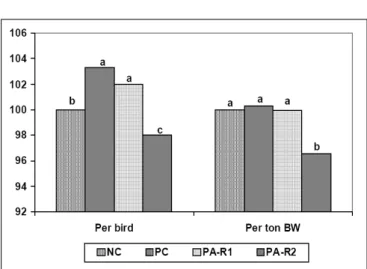
Relative comparison of the treatments, based on the cost of feed used to produce a 42-day bird or a ton of BW of these broilers is presented in figure 1. PA-R2 resulted in a significant (P<0.001) lower feed cost per bird produced or per ton of BW, indicating economic advantage when the phytogenic feed additive is used in diets with reduced energy and nutrient levels.
Table 3 - Fatty acid composit ion (%) of abdominal fat1.
Fatt y acid
---Treatment2
---N C3 PC4 PA-R15 PA-R26 Mean CV (%)
C14:0 0.43 0.45 0.49 0.49 0.46 12.4
C14:1ω9 0.08 0.08 0.12 0.13 0.10 34.6
C16:0 18.60 b 18.80 b 20.60 a 20.70 a 19.70 8.0
C16:1ω7 3.29 3.06 4.13 4.57 3.76 28.4
C18:0 5.15 5.19 4.94 4.85 5.04 9.2
C18:1ω9 31.20 30.40 31.10 31.70 31.10 3.2
C18:2ω6 35.20 ab 36.20 a 32.90 ab 32.10 b 34.10 8.2
C18:3ω3 3.05 a 3.25 a 2.93 ab 2.69 b 2.98 7.3
C19:0 0.24 0.22 0.25 0.23 0.24 17.1
C20:0 0.10 0.11 0.10 0.10 0.10 12.2
C20:1ω9 0.28 0.27 0.27 0.28 0.28 12.9
SFA7 24.6 24.8 26.4 26.4 25.5 6.4
MUFA8 34.9 33.9 35.6 36.7 35.3 5.3
PUFA9 38.3 39.5 35.9 34.8 37.1 8.1
Iodine Index10 99.2 ab 100.5 a 95.6 ab 94.5 b 97.5 4.2
1
Data are average (n = 6).
2For treatment detail s see table 1. 3Negat ive cont rol, without AGP. 4Positive control
5
Diet with phytogenic additive, restricted in Ca and P.
6
Diet with phytogenic additive, restricted in Ca, P, energy, and ami no acids.
7SFA: saturated fatty acids.
8MUFA: monounsaturated fat ty acids.
9UFA: pol yunsaturat ed fatty aci ds.
10Estimated based on fatty acid composition.
a-b
Difference lette rs in same row i ndicate significant effect (P<0.05) using REGWQ Procedure.
Table 4 - Consumption of major feed ingredients (g consumed.kg-1 BW at 42 days).
Treatments1 corn soybean meal soybean oil dicalcium phosfate DL-Methionine L-Lysi ne
NC2 939.8 b 583.1 a 91.5 a 30.7 a 3.35 a 1.91 b
PC3 925.4 b 575.6 a 89.9 a 30.3 a 3.31 a 1.89 b
PA-R14 941.6 b 575.9 a 86.8 b 24.0 b 3.30 a 1.93 b
PA-R25 976.5 a 547.5 b 71.5 c 24.0 b 3.08 b 1.99 a
Mean 945.8 570.5 84.9 27.2 3.26 1.93
CV (%) 2.1 2.0 2.2 2.1 2.0 2.0
1For treatment description see table 1. 2Negat ive cont rol, without AGP. 3Positive control
4Diet with phytogenic additive, restricted in Ca and P. 5
Diet with phytogenic additive, restricted in Ca, P, energy, and ami no acids.
a-c
Ciência Rural, v.39, n.2, mar-abr, 2009. CONCLUSION
The use of the phytogenic feed additive in broiler chicken diets formulated with reduced energy and nutrient requirements presents economic advantage when feed cost is considered.
REFERENCES
BIAVATTI, M.W. et al. Preliminary studies of alternative feed additives for broilers: Alternanthera brasiliana extract, propolis extract and linseed oil. Rev Bras Cienc Avic, v.5, p.147-151, 2003.
BOTSOGLOU, N.A. et al. Effect of dietary oregano essential oil on performance of chickens and on iron induced lipid oxidation of breast, thigh and abdominal fat tissues. Br Poult Sci, v.43, p.223-230, 2002.
COWAN, M.M. Plant products as antimicrobial agents. Clin Microbiol Rev, v.12, p.564-582, 1999.
de FREITAS, R. et al. Utilização do alho (Allium sativum L.) como promotor de crescimento de frangos de corte. Rev Bras Zootec, n.30, p.761-765, 2001.
FOLCH, J. et al. A simple method for the isolation and purification of total lipids from animal tissues. J Biol Chem, v.226, p.497-509, 1957.
HARTMAN, L.; LAGO, R.C.A. Rapid preparation of fatty acid methyl esters from lipids. Lab Pract, v.22, p.475-481, 1973.
HERNÁNDEZ, F. et al. Influence of two plant extracts on broilers performance, digestibility, and digestive organ size. Poult Sci, v.83, p.169-174, 2004. JAMROZ, D.; KAMEL,C. Plant extracts enhance broiler performance. J Anim Sci, v.80, p.41, 2002. JANG, I.S. et al. Effect of a commercial essential oil on growth performance, digestive enzyme activity and intestinal microflora population in broiler chickens. Animal Feed Sci and Techn, v.134, p.305-315, 2006.
JONES, R.L. Nutritional influence on carcass composition in the broiler chicken. Proc Nutr Soc, v.45, p.27-32, 1986.
KLEIN, C.H. et al. Espectroscopia infravermelho próximo para predição da composição de carcaça de frangos de corte. Concórdia: Embrapa Suínos e Aves, 2003. 2p. (Comunicado Técnico, 334). KONJUFCA, V.H. et al. Modulation of cholesterol levels in broiler meat by dietary garlic and cooper. Poult Sci, v.76, p.1264-1272, 1997.
MARION, J.E.; WOODROOF, J.G. The fatty acid composition of breast, thigh, and skin tissues of chicken broilers as influenced by dietary fats. Poult Sci, v.42, p.1202-1207, 1963. MUHL, A.; LIEBERT, F. Growth nutrient utilization and threonine requirement of growing chicken fed threonine limiting diets with commercial blends of phytogenic feed additives. J Poult Sci, v.44, p.297-304, 2007.
PIKE, O.A. Fat characterization. In: NIELSEN, S.S. Food analysis. Maryland: Aspen Publishers, 1998. Cap.14, p.217-235.
PLATEL, K.; SRINIVASAN, K. Digestive stimulant action of spices: A myth or reality? Indian J Med Res, v.119, p.167-179, 2004.
ROSTAGNO, H.S. et al. Tabelas brasileiras para aves e suínos: composição de alimentos e exigências nutricionais. Viçosa: UFV, 2005. 141p.
SAS INSTITUTE INC. System for Microsoft Windows, Release 9.1. Cary, NC, USA, 2002-2003. (cd-rom). WESTENDARP, H. Essential oils for the nutrition of poultry, swine and ruminant. Dtsch Tierarztl Wochenschr, v.112, p.375-380, 2005.
WINDISCH, W.M. et al. Use of phytogenic products as feed additives for swine and poultry. J Anim Sci, v.86, p.E140-E148, 2008.
Figure 1 - Relative cost of total feed consumed per bird or per ton BW. NC: negative control; PC: positive control; PA-R1: phytogenic additive with calcium and phosphorous restriction; PA-R2: phytogenic additive with calcium, phosphorous, energy and amino acid restriction. Values are expressed as percentage of NC. a-cDifferent letters in