
BJRS
Concentrations of Se, Ba, Zn and Mn in Brazil nuts
M. J. A. Armelin
a; V. A. Maihara
a; S. M. F. Cozzolino
b; P. S. C. Silva
aand
M. Saiki
aa
Instituto de Pesquisas Energéticas e Nucleares, Centro do Reator de Pesquisas /Laboratório de Análise por Ativação Neutrônica, 05508-000, São Paulo-SP, Brasil ; bFaculdade de Ciências Farmacêuticas, Universidade de
São Paulo, 05508-900, São Paulo-SP, Brasil [email protected]
ABSTRACT
The concentrations of Se, Ba, Zn and Mn were determined in samples of Brazil nuts collected in two ways: a) in a production farm predominantly for export and, b) in various points of sale from different regions of Brazil. Instrumental neutron activation analysis was the analytical technique used in this study. Results indicate that the concentrations of Se and Ba varied greatly among the Brazil nut samples analyzed. This large variability may be related to the soil characteristics from which the nuts were produced. An inverse correlation was observed between the concentrations of Se and Ba. On the other hand, the concentrations of Zn and Mn did not show significant differences among these samples.
Keywords: Brazil nuts; Instrumental neutron activation analysis; inorganic elements.
1. INTRODUCTION
Brazil nuts (Bertholletia excelsa, family Lecythidaceae) grow on wild trees predominantly from the Amazon region [1].The consumption of this food has been highly suggested by nutritionists
07-02A (2019) 01-10
ISSN: 2319-0612 Accepted: 2019-01-05
because of its high selenium concentration. Selenium is an important part of antioxidant enzymes that act in the prevention of age-related illnesses such as cancer and cardiovascular diseases [2]. Besides selenium, this nut has a high protein content (15–20%), sulfur amino acids, 60–70% lipids (Essential fatty acids) and vitamin E [3].
In addition to selenium, it is known that barium is also accumulated in Brazil nuts [4]. Barium is not considered essential and can be toxic depending on its chemical form. The Ba2+ ion and the soluble compounds of this element (notably chloride, sulfide, nitrate, hydroxide) are toxic to animals and humans. In the case of animals, barium tends to be concentrated in the bones which may compete with calcium, although only about 2% of barium ingested in dietary is absorbed by the body [5-6]. Smith [7] also reported that the Brazil nut tree has a unique capacity for accumulating barium and radium in its fruit. This accumulation for Ba and Ra has been explained as a possible formation of organic complexes which increase the mobility of alkaline earth ions, particularly for these elements, favoring their movement redistribution during fruit development. Also, some soil areas of the Amazon region are rich in Hollandite (Ba2Mn8O16)
mineral, according to literature [1].
Zinc is an essential component for the activity of hundreds of enzymes and manganese is necessary for the metabolism of macronutrients, tissue and bone formation, as well as in the reproductive processes [8]. However, it is important to note that the amount of minerals contained in food reflects their concentrations in the soil [9]. In this way, the same type of food can have heterogeneous concentration of a certain mineral if it comes from different areas. The goal of this study was to verify the variability of Se, Ba, Zn and Mn concentrations in Brazil nuts which are placed on the market and, based on the results, to evaluate the quality of these nuts for human health. For this, samples were collected in two ways: a) on a production farm predominantly for export and, b) in various points of sale from different regions of Brazil.
2. MATERIALS AND METHODS
2.1. Brazil nut sampling and treatment for the analysis
A total of 20 samples of Brazil nuts without shell, approximately 200 g each, were collected for this study. A part of these (n=10) were obtained from an Amazonian ecological farm, in which researches are carried out in partnership with Empresa Brasileira de Pesquisa Agropecuária (EMBRAPA). The other part (n=10) were obtained from several points of sale located in different regions of the country.
The weight of a whole nut ranged from 2.8 to 5.1 g. In order to obtain homogeneous material for the analyses, the nuts without previous treatment were ground in a mill with titanium knife. In addition to grinding no other treatment was performed on the samples because the nuts contain a high content of oil.
2.2. Instrumental Neutron Activation Analysis (INAA)
Approximately 300 mg of milled nuts were weighed in a polyethylene bag. This bag had been cleaned by leaching with a diluted HNO3 (1:5) solution and purified water.
Certified standard solutions (Spex Certiprep) of Se, Ba, Zn and Mn were used to prepare the standards. Aliquots (50-100 µL) of these solutions were transferred to small sheets of analytical filter paper (Whatman number 42). After drying, these sheets were placed into polyethylene bags for irradiation.
Two types of irradiations were carried out at the IEA-R1 nuclear research reactor of IPEN-CNEN/SP. First, the sample and standards of Ba and Mn elements were irradiated together in a polyethylene container for 30 s. After a decay time of 60 min, 139Ba (at 166 keV) and 56Mn (at 846 keV) activities were measured in the sample and in standards. In a second irradiation, sample and standards of Se and Zn were irradiated in an aluminum container for 8 h. The thermal neutron flux utilized ranged from 0.1 to 1.5 x 10¹² n cm-2 s-1. The 75Se (at 264 keV) and
65
Zn (at 1115 keV) activities were measured after, at least, 10 days of decay time. In addition, analyses of certified reference materials NIST SRM 1515 Apple Leaves was also carried out.
The concordance between the arithmetic mean of four determinations and the certified values were taken as the uncertainty of the method.
The equipment used to measure the gamma-radiation was a model GX2020 hyperpure Ge detector, coupled to a model 1510 Integrated Signal Processor and MCA System 100, both from Canberra. The detector used had a resolution (FWHM) of 0.9 keV for 122 keV gamma rays of
57
Co and 1.9 keV for 1332 keV gamma-rays of 60Co.
The element concentration was calculated by comparative method.
3. RESULTS AND DISCUSSION
The results obtained in the certified reference material NIST SRM 1515 Apple Leaves, used for quality control, showed good agreement with the certified values. The precision of results was also good except for Se (Table 1). In this case, the precision was of the order of 25%, due to the low concentration of element in this material.
Table 1: Concentrations of Ba, Mn, Se and Zn obtained in certified reference material
NIST SRM 1515 Apple Leaves by INAA
Element unit This study (mean±SD)a Certified values
Ba, µ g-1 50 ± 5 49 ± 2
Mn, µ g-1 53 ± 4 54 ± 3
Se, µ g-1 0.08 ± 0.02 0.050 ± 0.009
Zn, µ g-1 12.1 ± 0.6 12.5 ± 0.3
. aArithmetic mean and standard deviation from four individual determinations.
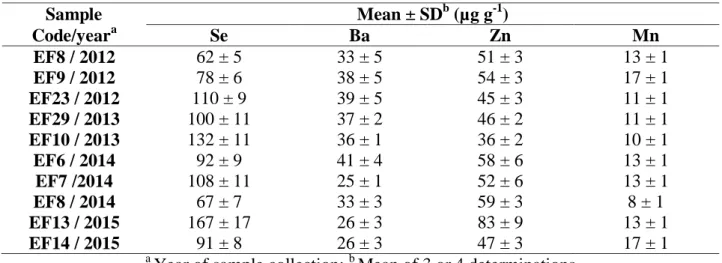
Elemental concentrations of Se, Ba, Zn and Mn determined in Brazil nuts are shown in Tables 2 and 3. Table 2 presents the concentrations obtained for samples collected at an Amazonian ecological farm, while Table 3 shows the concentrations obtained for the samples collected at various points of sale in the country. The variation of Se concentrations in the samples of Table 2 was lower than those of Table 3, since these samples were produced from nut trees grown on the same type of soil. For the samples collected at the various points of sale (Table 3), a large variation in Se concentrations was observed. It was noted that the mean concentration of Se
(101 µg g ) of the samples presented in Table 2 is approximately 7 times higher than the mean concentration of this element (14 µg g-1) of Table 3. On the other hand, experiment performed by Martins [10] showed that there is no significant variation in Se concentrations with the size of the nuts.
Table 2: Mean concentrations of Se, Ba, Zn and Mn in Brazil nut samples produced in an
Amazonian ecological farm.
Sample Mean ± SDb (µg g-1) Code/yeara Se Ba Zn Mn EF8 / 2012 62 ± 5 33 ± 5 51 ± 3 13 ± 1 EF9 / 2012 78 ± 6 38 ± 5 54 ± 3 17 ± 1 EF23 / 2012 110 ± 9 39 ± 5 45 ± 3 11 ± 1 EF29 / 2013 100 ± 11 37 ± 2 46 ± 2 11 ± 1 EF10 / 2013 132 ± 11 36 ± 1 36 ± 2 10 ± 1 EF6 / 2014 92 ± 9 41 ± 4 58 ± 6 13 ± 1 EF7 /2014 108 ± 11 25 ± 1 52 ± 6 13 ± 1 EF8 / 2014 67 ± 7 33 ± 3 59 ± 3 8 ± 1 EF13 / 2015 167 ± 17 26 ± 3 83 ± 9 13 ± 1 EF14 / 2015 91 ± 8 26 ± 3 47 ± 3 17 ± 1 a
Year of sample collection; b Mean of 3 or 4 determinations
Table 3: Mean concentrations of Se, Ba, Zn and Mn in Brazil nut samples obtained from
several points of sale located in different regions of the country.
Sample Mean ± SDb (µg g-1) Code/yeara Se Ba Zn Mn PS30 / 2012 5.0 ± 0.5 2174 ± 47 44 ± 5 9 ± 1 PS31 / 2013 31 ± 3 513 ± 27 37 ± 2 9 ± 1 PS32 / 2013 5.4 ± 0.5 3724 ± 570 39 ± 2 17 ± 2 PS33 / 2014 32 ± 3 359 ± 36 52 ± 3 13 ± 2 PS34 / 2014 4.4 ± 0.5 1977 ± 105 36 ± 2 11 ± 1 PS1 / 2015 3.5 ± 0.4 1805 ± 193 42 ± 5 16 ± 1 PS2 /2015 8.2 ± 0.9 2102 ± 247 56 ± 6 14 ± 1 PS3 / 2015 6.7 ± 0.7 2164 ± 89 39 ± 2 15 ± 1 PS4 / 2015 2.6 ± 0.3 3114 ± 507 40 ± 5 13 ± 1 PS5 / 2015 39 ± 4 1789 ± 104 41 ± 2 11 ± 1 a
The Recommended Dietary Allowance (RDA) for Se is 55 µg/day for adults [11]. The RDA value for this element is based on amount needed to maximize synthesis of the selenoprotein glutathione peroxidase.
According to the results of Table 2, the consumption of only one Brazil nuts, mean weigh 4 g, provides a Se concentration about 400 µg which satisfies the RDA. On the other hand, in accordance with the results of Table 3, to reach the RDA for selenium it would be necessary to consume from 4 to 10 Brazil nuts.
It is interesting to observe in Table 3 that Se concentration in Brazil nut varied inversely with the Ba concentration. Similar results were reported by Parekh [12] when samples from Brazil, Bolivia, Peru and northern South America were studied. The ratios between Ba and Se concentrations in samples from the farm had a small variation (0.16 to 0.53), whereas for the samples collected at several points of sale the variation was large (11 to 1198). These results are illustrated, respectively, in Figures 1 and 2.
Figure 1: [Ba]/[Se] ratio versus year of collection, for samples obtained from Amazonian
Figure 2: [Ba]/[Se] ratio versus year of collection, for samples obtained at different points of
sale.
The high concentration of Ba in some samples can be explained because part of the soil that composes the Amazon Basin presents high concentration of Hollandite (Ba2Mn8O16) [1].
According to Gonçalves [6], experiments carried out with Brazil Nuts have shown that the Ba is present in this food as insoluble compounds, basically in the form of barium sulfate that is not bioavailable and therefore they do not cause damage to human health.
The concentrations of Zn practically did not vary among the Brazil nuts samples analyzed. The mean concentration of Zn for the samples from the Amazonian ecological farm (Table 2) was (53 ± 12) µg/g, while for the samples obtained at different points of sale (Table 3) was (43 ± 7) µg/g. These results are similar to those presented in TACO [13], where the concentration of Zn is equal to 4.2 mg/100g (42 µg/g) for the edible part of Brazil nuts. The Food and Nutrition Board, Institute of Medicine, National Academies (FNB/IOM) of the United States has proposed that the tolerable upper level of Zn intake for adults is 40mg/day [14].
No significant variations were observed in Mn concentrations among the studied samples of Brazil nuts presented in Tables 2 and 3. The mean concentration of Mn, for the Brazil nut samples, considering all the results (Tables 2 and 3) was (13 ± 3) µg/g. This result is very close to that presented in TACO [13], where the concentration of Mn for the edible part of Brazil nuts
is equal to 1.10 mg/100g (11 µg/g). According to the FNB/IOM, the tolerable upper level of Mn intake for adults is 11 mg/day [14].
Thus, based on the results obtained, Brazil nuts helps to supply the recommended daily intake of Zn and Mn and, it is far from reaching the maximum tolerable level for these elements.
4. CONCLUSIONS
The concentrations of Se and Ba varied greatly among the Brazil nut samples analyzed. This large variability among the concentrations may be related of the soil characteristics from which the nuts were produced. An inverse correlation was observed between the concentrations of Se and Ba. On the other hand, the concentrations of Zn and Mn did not show significant differences among the Brazil nut samples analyzed.
5. ACKNOWLEDGMENTS
REFERÊNCIAS
1. CHANG, J.C.; GUTENMANN, W.H.; REID, C.M.; LISK, D.J. Selenium content of Brazil nuts from two geographic locations in Brazil. Chemosphere, v. 30(4), p. 801-802, 1995.
2. IP, C.; LISK, D.J. Bioactivity of selenium from Brazil nuts for cancer prevention and selenoenzyme maintenance. Nutrition and Cancer, v. 21(3), p.203-212, 1994.
3. CHUNHIENG, T.; HAFIDI, A.; PIOCH, D.; BROCHIER, J>; MONTET, D. Detailed study of Brazil nut (Bertholletia excels) oil microcompounds: phospholipids, tocopherols and sterols.
Journal of the Brazilian Chemical Society, v. 19(7), p.1374-1380, 2008.
4. PENNA-FRANCA, E.; FISZMAN, M.; LOBÃO, N.; COSTA-RIBEIRO, C.; TRINDA-DE, H.; DOS SANTOS, P.L.; BATISTA, D. Radioactivy of Brazil nuts. Health Physics, v.14, p. 95-99, 1968.
5. CCME – Canadian Council of Ministers of the Environment. Barium Canadian soil quality guidelines for the protection of environmental and human health. In: CANADIAN
EN-VIRONMENTAL QUALITY GUIDELINES, 1999, (Barium – CEQG-CCME). Available at:
<http://ceqg-rcqe.ccme.ca/download/en/258/>. Last accessed: 9 Nov. 2012.
6. GONÇALVES, A.M.; FERNANDES, K.G.;RAMOS, L.A.; CAVALHEIRO, E.T.G.; NOBREGA, J.A. Determination and fractionation of barium in Brazil Nuts. Journal of the
Bra-zilian Chemical Society, v. 20(4), p.760-769, 2009.
7. SMITH, K.A. The comparative uptake and translocation by plants of calcium, strontium, barium and radium I. Bertholletia Excelsa (Brazil Nut Tree). Plant and Soil, v.34, p. 369-379, 1971.
8. COZOLLINO, S.M.F. Biodisponibilidade de nutrientes, 4rd Ed. Barueri, SP, Brasil: Manole, 2012.
9. LEMIRE, M.; FILLION, M.; BARBOSA Jr, F.; GUIMARÂES, J.R.D. MARGLER, D. Elevated levels of selenium in the typical diet of Amazon riverside populations. Science of the
10. MARTINS, M.; PACHECO, A.M.; LUCAS, A.C.S.; ANDRELLO, A.C.; APPOLONI, C.R.; XAVIER, J.J.M. Brazil nuts: determination of natural elements and aflatoxin. Acta Amazonica, v. 42(1), p. 157-164, 2012.
11. NAS – National Academy of Sciences. Dietary reference intakes for vitamin C,
Vita-min E, selenium and carotenoids. Available at: https://www.nap.edu/read/9810. Last accessed: 20 Jun. 2017.
12. PAREKH, P.P.; KHAN, A.R.; TORRES, M.A.; KITTO, M.E. Concentrations of selenium, barium, and radium in Brazil nuts. Journal of Food Composition and Analysis, v.21, p. 332-335, 2008.
13. TACO – Tabela brasileira de composição de alimentos. NEPA – UNICAMP. 4ed, Campinas: NEPA – UNICAMP, 2011.
14. DRI – Dietary Reference Intakes for Vitamin A, Vitamin K, Arsenic, Boron, Chromium, Copper, Iodine, Iron, Manganese, Molybdenum, Nickel, Silicon, Vanadium and Zinc, 2001. Available at: https://www.ncbi.nlm.nih.gov/books/NBK222310/.Last accessed: 27 Jun. 2017.
![Figure 1: [Ba]/[Se] ratio versus year of collection, for samples obtained from Amazonian ecological farm](https://thumb-eu.123doks.com/thumbv2/123dok_br/18284398.882062/6.893.175.717.663.992/figure-ratio-versus-collection-samples-obtained-amazonian-ecological.webp)
![Figure 2: [Ba]/[Se] ratio versus year of collection, for samples obtained at different points of sale](https://thumb-eu.123doks.com/thumbv2/123dok_br/18284398.882062/7.893.176.720.227.557/figure-ratio-versus-collection-samples-obtained-different-points.webp)
