UNIVERSIDADE DA BEIRA INTERIOR
Engenharia
Detection of Encrypted Traf c Generated by
Peer-to-Peer Live Streaming Applications Using
Deep Packet Inspection
André Filipe Ferreira Esteves
Dissertation submitted in candidature for the degree of Master of Science in
Computer Science and Engineering
(2nd Cycle Degree)
Supervisor: Dr. Mário Marques Freire
Acknowledgements
First i would like to start thanking the person who give the chance to integrate his dynamic research team were work and fun walk side by side, to professor Mário Freire my gratitude, for all the scienti c knowledge acquired along this work, for the motivation, and also for the almost unlimited resources provided to make this research possible.
I would also like to thank David Milheiro for the help mounting the research test-bed, and João Gomes and professor Pedro Inácio for the great suggestions to improve my work. I am also grateful to the University of Beira Interior, in special to the Computer Science Department and to the Multimedia Signal Processing research group for all the support and equipment provided for this work, and also for having such delight place to work.
To my parents and my brother for all the motivation and support over the years, as without them i would not have made here. For all the work they have put on themselves so i could nish my academic studies. To my brother for making me realize that i could take a little break once a time. To my girlfriend who helped me in every way she could, either giving ideas or correcting my English. To her, my eternal love.
For last, but not the least to all my friends who supported me along this work: David Monteiro, Rui Raposo, Rui Brás, Hugo Santos, André Gomes, Bruno Campos, and to all the others, my sincere gratitude.
This work was partially supported by the Portuguese Fundação para a Ciência e a Tecnologia through the project TRAMANET: Traf c and Trust Management in Peer-to-Peer Networks, with contracts PTDC/EIA/73072/2006 and FCOMP-01-0124-FEDER-007253.
Resumo Alargado
A popularidade e o número de aplicações que usam o paradigma de redes par-a-par (P2P) têm crescido substancialmente na última década. Estas aplicações deixaram de serem usadas simplesmente para partilha de cheiros e são agora usadas também para distribuir conteúdo multimédia. Hoje em dia, estas aplicações têm meios de cifrar o conteúdo da comunicação ou empregar técnicas de ofuscação directamente no protocolo. Nesta dissertação, foi real-izada uma investigação para identi car uxos de tráfego encriptados, que foram gerados por três aplicações populares de distribuição de conteúdo multimédia em redes P2P: TVUPlayer, Livestation e GoalBit. Para este trabalho, foi criada uma plataforma de testes que pretendia simular um cenário quase real, e o tráfego que foi capturado, continha uma grande variedade de aplicações. O método proposto nesta dissertação recorre à técnica de Inspecção Profunda de Pacotes (DPI), e por isso, foi necessário analisar o conteúdo dos pacotes a m de encontrar padrões que se repetissem, e que iriam mais tarde ser usados para criar um conjunto de re-gras SNORT para detecção de pacotes chave na rede, gerados por estas aplicações, a m de se poder correctamente classi car os uxos de tráfego. Após descobrir que a aplicação Livestation deixou de funcionar com P2P, apenas as duas regras criadas até esse momento foram usadas. Quanto à aplicação TVUPlayer, foram criadas várias regras a partir do tráfego gerado por ela mesma e que tiveram uma boa taxa de precisão. Várias regras foram também criadas para a aplicação GoalBit em que foram usados quatro cenários: com e sem encriptação usando a opção de transmissão tracker, e com e sem encriptação usando a opção de transmissão sem necessidade de tracker (aqui foi usado o protocolo Kademlia). O método foi avaliado experi-mentalmente na plataforma de testes criada para o efeito, sendo demonstrado que a precisão do conjunto de regras para a aplicação GoalBit é de 97%.
Abstract
The number of applications using the peer-to-peer (P2P) networking paradigm and their popular-ity has substantially grown over the last decade. They evolved from the le-sharing applications to media streaming ones. Nowadays these applications commonly encrypt the communication contents or employ protocol obfuscation techniques. In this dissertation, it was conducted an investigation to identify encrypted traf c ows generated by three of the most popular P2P live streaming applications: TVUPlayer, Livestation and GoalBit. For this work, a test-bed that could simulate a near real scenario was created, and traf c was captured from a great variety of applications. The method proposed resort to Deep Packet Inspection (DPI), so we needed to analyse the payload of the packets in order to nd repeated patterns, that later were used to create a set of SNORT rules that can be used to detect key network packets generated by these applications. The method was evaluated experimentally on the test-bed created for that purpose, being shown that its accuracy is of 97% for GoalBit.
Contents
Acknowledgements i
Resumo Alargado iii
Abstract v
1 Introduction 1
1.1 Focus and Scope . . . 1
1.2 Problem Statement and Objectives . . . 5
1.3 Adopted Approach for Solving the Problem . . . 7
1.4 Main Contribution . . . 9
1.5 Dissertation Overview . . . 10
References . . . 11
2 On-Line Detection of Encrypted Traf c Generated by Mesh-Based Peer-to-Peer Live Streaming Applications: The Case of GoalBit 13 2.1 Introduction . . . 14
2.2 Related Work . . . 15
2.3 Method and Experimental Setup for Detection of Encrypted GoalBit Traf c . . . . 15
2.4 Results and Discussion . . . 17
2.5 Conclusion . . . 18
2.6 References . . . 19
3 Identi cation of Encrypted Traf c Generated by Peer-to-Peer Live Streaming Applica-tions Using Deep Packet Inspection 21 3.1 Introduction . . . 22
3.2 Related Work . . . 24
3.3 Overview About P2P Media Streaming . . . 25
3.4 Method and Experimental Test-bed for Detection of Encrypted Traf c . . . 25
3.5 Application Details and SNORT Rules . . . 27
3.6 Experiments and Result Discussion . . . 29
3.7 Conclusion and Future Work . . . 32
3.8 References . . . 32
4 Conclusions and Future Work 35 4.1 Main Conclusions . . . 35
List of Figures
1.1 Schematic representation of a P2P tree-based system. . . 2 1.2 Schematic representation of a P2P mesh-based system. . . 3 1.3 Percentage of traf c usage between 2009 and 2010 in North America. Adapted
from [17]. . . 4 1.4 Percentage of traf c usage between January and September 2010 in North
Amer-ica using a mobile access. Adapted from [17]. . . 5 1.5 Percentage of traf c usage between 2009 and 2010 in Europe. Adapted from [17]. 6 2.1 Experimental testbed at the research lab . . . 16 2.2 Number of TCP packets in the collected traces vs. the packet size. . . 18 2.3 Comparison of the detection rate of SNORT with the rules proposed herein,
OpenDPI, l7- lter and l7-netpdlclassi er for the captured traces. . . 18 2.4 Number of SNORT rules triggered during 10 different experiments. . . 18 2.5 Number of TCP SNORT rules triggered for two GoalBit TCP ows extracted from
the traf c experiments. . . 19 3.1 Experimental test-bed at the MSP-Cv research lab. . . 26 3.2 Number of TCP packets in the collected traces vs. the packet size. . . 31 3.3 Count of triggered TCP rules by two TCP streams ltered from GoalBit traf c
experiments. For the sake of clarity, the y-axis is in logarithmic scale. . . 31 3.4 Number of rules triggered in each one of the three days of experiments. For
the sake of clarity, the y-axix is in logarithmic scale. Experiment 1 refers to the traces collected in March 4, 2011; experiment 2 refers to the traces collected in January 17, 2011; experiment 3 refers to the traces captured in January 21, 2011 (as described in table 7). . . 32 3.5 Comparison of completeness percentage between the SNORT rules, OpenDPI,
Chapter 1
Introduction
1.1 Focus and Scope
Peer-to-peer (P2P) networks appeared as a new paradigm after the success of a popular music sharing application, called Napster [1], which allowed the download of music through the com-puter of each user. However, the way Napster was implemented had some major drawbacks: the rst was the single point of failure due to the centralized server that managed the connec-tions; the second was the copyright infringements due to the unauthorized distribution of illegal content. After Napster lawsuits to shutdown, new P2P systems like Gnutella and Fastrack [2, 3] emerged without the need of a central server, since any computer system with an Internet con-nection and using this kind of applications could provide additional resources or services with low cost support, since no extra hardware was needed. In addition of being easy to manage, this kind of systems is tolerant to faults due to its decentralized approach, since if a peer fails one still may get the information from other peer in the network. Another advantage is the easiness of installing the needed software. However, there are also drawbacks due to the use of P2P systems. One is associated with the way performance may be affected when resources are accessed too many times, since, in that cases, users may notice a performance degradation. Another concern is the security of a P2P system, because one cannot guarantee that all peers will administrate their machine appropriately in order to do not share illegal material. Besides the main concerns related to P2P systems, another issue is how to control so much information and with that, becomes dif cult to maintain a backup of that information.
Recently, it was observed that P2P le-sharing, as a percentage of the overall Internet traf c, has begun to decrease [3]. In this study, it was reported that P2P le-sharing had a huge de-cline between 2007 and 2009, mainly due to law infringements, traf c shaping in organizations, and specially due to more legal and convenient ways of le sharing like Megaupload [4], Rapid-Share [5], Net ix [6], etc. Another contribution for P2P le-sharing decline was due to security issues, like malware infections, les that carry viruses and trojan horses, and many other issues concerning the security of P2P systems. Although a decline of the percentage has been noticed, the volume of P2P le-sharing traf c has increased due to larger sizes of the les transferred. In [3, 7] it is shown that video traf c is increasing and is expected to be the dominant Internet activity in the next few years. As one can see from the success of Youtube [8], on-line video is growing and will keep on growing trough video-streaming, video-on-demand and videoconfer-ences, among other possibilities. Due to the advantage of the scalability of P2P systems against the restrictions of multicast networks, it has been investigated the possibility of dividing multi-media content and streaming it into the Internet using peer-to-peer technology [8, 9, 10, 11]. Multicast networks could also be used to stream a video over the Internet, but the limited scala-bility, the expensive costs, and the fact that multicast networks are restricted to infrastructures managed by single network operators, put restrictions on that media delivery.
By using P2P, users can watch their favourite movie and still upload parts of the movie to other users so they can also watch, and so forward. P2P media streaming uses the data sharing mode of "watching while it makes download", and that may have some disadvantages like, as peers are constantly entering and leaving the network they may affect the bandwidth, the use of an overlay topology that have a single point of failure causing the rest of the peers to stay without watching the stream, and of course the peer bandwidth can result in a good quality stream or a bad one. Live P2P media streaming systems can be classi ed into three categories based on the overlay network structure: tree-based, mesh-based and a hybrid combination of the previous two.
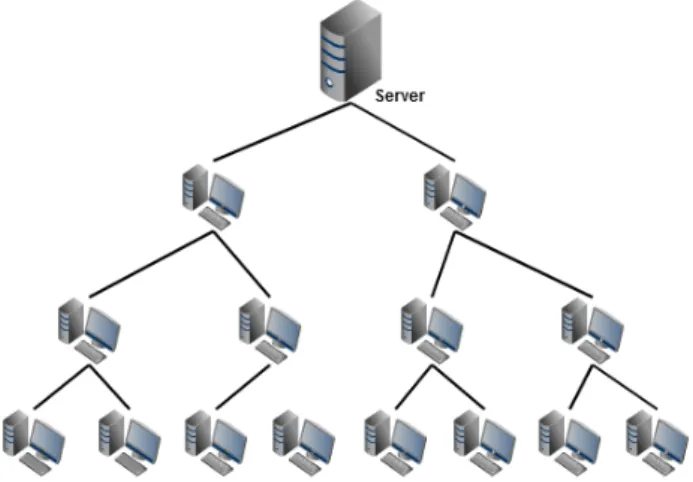
The tree-based systems have a well organized tree structure were peers join the network in a certain tree level and receive the video from their parent peer and forward the received video to its children peers [12]. The major disadvantage of this system is their vulnerability to peer churn. When a parent peer leaves the network all of its children (all subtree below the peer that leaves will be affected) will temporarily see their video delivery disrupted. Another prob-lem with this kind of systems is the peer bandwidth ef ciency degradation due to the fact leaf nodes that are a large portion of peers in the network do not contribute with their uploading bandwidth and to address this problem multi-tree based approaches have been proposed. In multi-tree systems, the streaming is divided into multiple sub-streams creating therefore mul-tiple sub-trees one for each sub-stream. Figure 1.1 is an example of a peer-to-peer tree-based streaming system.
Figure 1.1: Schematic representation of a P2P tree-based system.
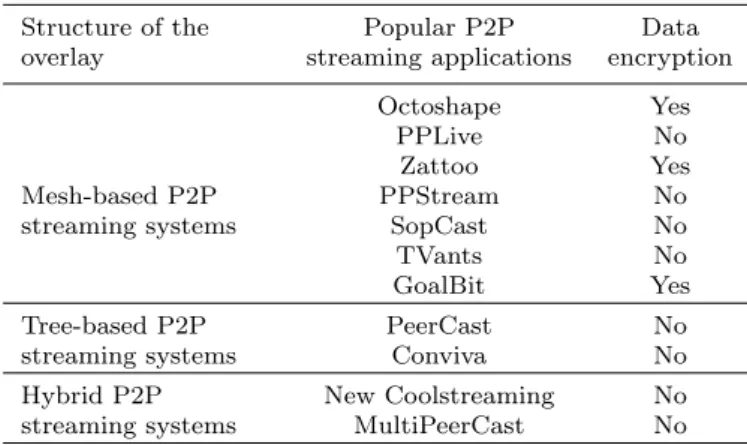
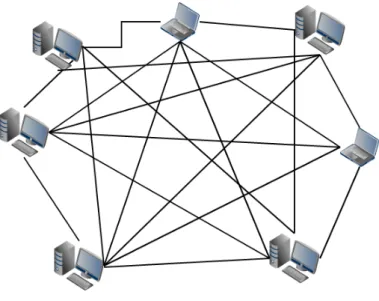
In a mesh-based system there is no strict topology. Here peers are distributed based on their content and bandwidth availability. A peer can download/upload from and to multiple neigh-bours simultaneously and if one peer leaves, the peer can still download from the remaining neighbours. The working principle is similar to the one of BitTorrent [13], i.e. , a node register to the system and receive a list of addresses from a tracker, the tracker is nothing more than a super-node which tracks peers that are downloading and peers that downloaded a le. After its registration, a node contacts the peers from the list the tracker gives to it and receive a list of chunks that they have and that are able to share. Nevertheless, besides the high reliability and availability of a mesh-based system, maintaining this kind of systems is more expensive than a tree-based one. TVUplayer [14], and GoalBit[15] are examples of mesh-based P2P streaming applications. Figure 1.2 presents a schematic representation of a mesh-based system. Hybrid
Figure 1.2: Schematic representation of a P2P mesh-based system.
systems combine the best features of tree-based and mesh-based structures [16]. They have high reliability as mesh-based structures due to the possibility of making multiple links between any two nodes, got lower delay as in tree-based structures, and got lower overhead when com-pared to mesh-based structures. The main disadvantage is the high topology maintenance cost, when compared with the low cost and easy implementation of a tree-based structure. All this evolution in media streaming led to a high network traf c volume, which in turn led to net-work performance issues. These issues include netnet-work congestion, bad or insuf cient QoS in media streaming services, and bandwidth demands. The use of P2P media streaming, if not suitably authorized, may lead to a degradation of the network, which may compromising the performance of critical networked applications or network-based tasks performed in a giving institution. A study presented in [17] contains both xed and mobile data providers and possible by the voluntary participation of Sandvine [18]. In this study, Sandvine concluded, that real-time entertainment (which includes P2P live streaming and Video on Demand (VoD) streaming) has grown over the last years, starting to be a dominant category in several regions presented in this study, even surpassing P2P le sharing traf c quota. It should be noted that this study encompasses xed and mobile networks. For example in North America, it was observed that real-time entertainment was the largest contributor to data consumption on both xed and mobile access (43% of peak period traf c and 41% respectively) networks. As for Asia-Paci c region, due to the success of the peercasting applications, such as PPStream and PPLive, P2P live streaming and VoD streaming had an increase of traf c volume. Nonetheless, P2P le-shar-ing continues to be a major component of traf c and exhibits remarkably consistent upstream levels throughout over a 24 hour period.
The study states that Latin America continues to have a high traf c volume of P2P le-sharing, but real-time entertainment is emerging as the dominant source of content, showing that the behaviour of the subscriber is shifting towards favouring on-demand applications. At last, in Europe, Web browsing is the category that accounts for more byte usage. Meanwhile, BitTorrent is the most used P2P lesharing protocol (this is the case everywhere except in Latin America, where Ares protocol prevails), representing almost 30% of upstream peak period traf c and
slightly more than 8% of downstream peak period traf c. Figure 1.3 shows the traf c growth of real-time entertainment between 2009 and 2010 during peak hours and with a xed access in North America. 0 10 20 30 40 50 60 70 80 90 100 2009 2010 C at egory perc ent age (%) Years Outside Top 5 Real-Time Communications Social Networks Gaming Secure Tunneling P2P Filesharing Web Browsing Real-Time Entertainment
Figure 1.3: Percentage of traf c usage between 2009 and 2010 in North America. Adapted from [17].
Also in this study, it is reported that for mobile access from January to September 2010, real-time entertainment traf c rose substantially: from about 26% to 41.3%, while P2P lesharing traf c suffered a major decline, representing now only 5,6% of peak period bytes. Web browsing remained almost the same with only a slightly drop of about 5%. Social Networking is growing progressively generating 8,3% of mobile traf c during the peak period. In gure 1.4 it is pre-sented a traf c comparison on mobile networks between 2009 and 2010. Figure 1.5 describes the changes in the traf c of applications and services that are driving data usage in the European region. The data gathered in the study presented in [17] is completely subscriber-anonymous. No information regarding speci c content or subscriber identity was collected. Without the possibility of detecting P2P traf c, the network administrator cannot take measures against the degradation of the network performance with possible implications for critical applications or services that depend on the network. Recently, P2P applications provide means to encrypt the traf c allowing it to stay undetected until it reaches the end user.
0 10 20 30 40 50 60 70 80 90 100 Jan-10 Sep-10 C at egory perc ent age (%) Month-Year Outside Top 5 Social Networks Secure Tunneling P2P Filesharing Web Browsing Real-Time Entertainment
Figure 1.4: Percentage of traf c usage between January and September 2010 in North America using a mobile access. Adapted from [17].
1.2 Problem Statement and Objectives
Nowadays, one concern for network administrators is the unauthorized use of P2P media stream-ing applications that may obfuscate their tracks, through the use of encryption methods or enable tunnelling and proxy support, and may ood the network with huge volumes of multi-media data. The use of obfuscation methods make dif cult an accurate identi cation of the encrypted P2P traf c in order to block it if needed. This dissertation investigates a possible solution to the problem described above, i.e, to accurately identify encrypted traf c generated by peer-to-peer media streaming applications.
The main objective of this dissertation is to propose and validate a solution to the problem of detecting encrypted traf c generated by peer live streaming applications, using techniques of deep packet inspection (DPI), with or without partition schemes of the contents of the pack-ages. The solution makes use of a popular open-source network intrusion detection system (NIDS), Snort [19], and will comprehend the de nition of a set of suitable rules for Snort in order to allow the identi cation of encrypted traf c generated P2P media streaming applica-tions. The research work reported in this dissertation considers the following applications: Livestation [20], TVUPlayer [14] and Goalbit [15], albeit Livestation has discontinued the use of P2P approaches. In order to achieve this main objective, several steps were pursued:
0 10 20 30 40 50 60 70 80 90 100 2009 2010 C at egory perc ent age (%) Year Outside Top 5 Real-Time Communications Storage and Back-up Services Gaming
News Groups P2P Filesharing Web Browsing Real-Time Entertainment
Figure 1.5: Percentage of traf c usage between 2009 and 2010 in Europe. Adapted from [17].
• Study of P2P live streaming concepts;
• Study of the state of art about the detection of encrypted traf c generated by P2P live streaming applications;
• Investigation of a method for detection of encrypted P2P traf c based on deep packet inspection and using an intrusion detection system;
• Implementation of a laboratory testbed for detection of encrypted traf c generated by P2P live streaming applications;
• De nition and implementation of the set of rules for Snort to detect P2P encrypted traf c; • Performance studies of the proposed solution for detecting P2P encrypted traf c.
1.3 Adopted Approach for Solving the Problem
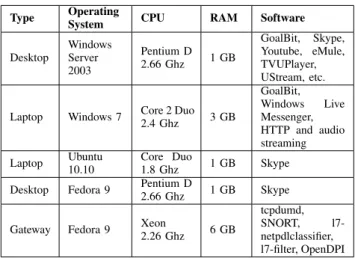
The approach began by reviewing the state of art on P2P traf c detection to check if current so-lutions also work for detecting media streaming with encrypted traf c. After analysing current solutions and their limitations, a laboratory belonging to the Department of Computer Science of the University of Beira Interior was chosen to conduct the research on the detection of en-crypted P2P traf c generated by the three above mentioned media streaming applications. The laboratory consists of six racks, each comprising four computers, making a total of 24 com-puters, each one connected to the switch in rack by Unshielded Twisted Pair (UTP) Cat.5e/6 cabling. The switches in the six racks are then connected to the auxiliary gateway also by UTP Cat.5e cabling. The auxiliary gateway connects to the main gateway using the same type of cabling, which then connects to a layer-two Enterasys C2H128-48 switch also by UTP Cat.5e/6 cabling, which in turn connects to the network backbone device (an Enterasys E7 switch) in the Department of Computer Science building using an optical bre uplink. All external communica-tions with the University are managed by the Enterasys SSR main router located in the University Computing Center. Details about the topology of the research laboratory, the characteristics of the hardware such as CPU and RAM and the software that was running on the above mentioned computers can be found in [21]. After the installation of all needed applications, one started the process of traf c capture. The captured traf c was after used to look for patterns on the packets belonging to the three applications so SNORT signatures for detection of the traf c could be created.
Snort is a open-source Network Intrusion Detection System (NIDS) created by Martin Roesch in 1998. It is capable of real-time traf c analysis and packet logging within a Internet Protocol (IP) network. After its initial release as a lightweight NIDS, Snort became a mature feature-rich Intrusion Prevention System (IPS), making it a de facto standard on intrusion detection and prevention. It performs protocol analysis, content searching, and content matching. Can also be used to detect probes or attacks, including, but not limited to, common gateway interface, buffer over ows, server message block probes, and stealth port scans. Snort can be con gured into three modes:
• Sniffer mode, in which basically it reads packets from the network and display them in the console (screen);
• Packet Logger mode, instead of displaying the packets in the screen, it saves them into a le in the disk;
• Network Intrusion Detection System mode, this is the most complex mode, in which af-ter an analysis of the network traf c against a user rule set, it decides what action is performed.
Only the Network Intrusion Detection System mode was used along this dissertation, because the other two modes were almost of no interest for this dissertation, since they do not process packets against a user rule set. NIDS mode has multiple output options, but once again only one was used, and that was fast alert mode output. Fast alert mode option writes the alert in a simple format with a timestamp, the speci c alert message, and the source and destination IPs/ports. The following command is an example, but similar to the one we used on every performed test:
./snort -c snort.conf -A fast -h 192.168.1.0/24
The command used on the test had another particularity, since we aimed high-speed network operation (100/1000 Mbps), we needed to have another program for writing the alerts into a database. Snort has the option to log an alert in a binary form, increasing this way his own speed, and leaving the writing to another useful program called Barnyard2 [22]. Barnyard2 is an open source interpreter for Snort uni ed2 binary output les. Its primary use is for allowing Snort to write to disk in an ef cient manner and leaving the task of parsing binary data into various formats to a separate process that will not cause Snort to miss network traf c.
Before proceeding to Snort installation and con guration, we need to install the new Data Acquisition (DAQ) library that was released with Snort version 2.9. The DAQ replaces direct calls to pcap functions with an abstraction layer that facilitates operation on a variety of hardware and software interfaces without requiring changes to Snort. It is possible to select the DAQ type and mode when invoking Snort to perform pcap readback or inline operation. The version used was the daq-0.5.tar.gz that can be downloaded in [19]. We extracted the source code and then compile it using the common methods:
• ./configure • make
• make install • ldconfig
Remember that for using the above commands, root privileges are necessary, so it was used sudo before the commands. The last command is used, when we need to create the necessary links and cache to the most recent shared libraries found in the directories speci ed on the command line, in the le /etc/ld.so.conf, and in the trusted directories (/lib and /usr/lib). After installing DAQ, we also need to install another library called libdnet. The same process of the DAQ is applied here too, without the ldconfig command. Extract the source code, compile it and after that create a symbolic link between les in different directories with ln -s /usr/local/lib/libdnet.1.0.1 /usr/lib/libdnet.1.
To install Snort, we could get it from the repositories, but that would not guarantee that Snort was on its latest version. Snort 2.9.05 was downloaded from [19]. Snort was extracted as normal for compilation, that in this case have some options that were needed:
• ./configure –enable-ipv6 –enable-gre –enable-mpls –enable-targetbased
–enable-decoder-preprocessor-rules –enable-ppm –enable-perfprofiling –enable-zlib
–enable-active-response –enable-normalizer –enablereload –enable-react –enable-flexresp3
• make
• make install
The options of ./configure are described further down on snort.conf le. For running Snort it is also needed to set up an environment, that consists on creating some directories, create a Snort user, and move some les. The le snort.conf contains the main con guration for running
Snort, and is sectioned in:
1. Set the network variables for your network 2. Con gure the decoder
3. Con gure the base detection engine 4. Con gure dynamic loaded libraries 5. Con gure preprocessors
6. Con gure output plugins 7. Customize the rule set
8. Customize preprocessor and decoder rule set 9. Customize shared object rule set
In section one of snort.conf le, the network variable HOME_NET was set to 10.0.2.0/24 and the variable EXTERNAL_NET was set to !$HOME_NET, i.e., all that was not in 10.0.2.0/24 was considered external. In section four, the paths for the libraries and the preprocessor engine were changed to their real locations. To use Barnyard, we needed to change the output plugin to output unified2: filename snort.log, limit 128 in section six.
We used MySQL as the relational database management system for Snort application. No ex-traordinary con guration is needed, just need to create a database based on the scheme le found on Snort directory. As part of Snort installation, the latest rules had to be downloaded. All rules created for this thesis were moved to the Snort rules directory and added to snort.conf in section seven. Rules in Snort have two parts: the rule header, and the rule options. The rule header contains the rules action, protocol, source and destination IP addresses and netmasks, and the source and destination ports information. The rule option section contains alert mes-sages and information about which parts of the packet should be inspected to determine if the rule action should be taken.
After running experiences using Livestation, TVUPlayer and Goalbit, one carried out an ex-haustive work looking for patterns in the payload of encrypted packets generated by these applications. A method was then derived, which is based on the identi cation of some packets that are not encrypted and the association of these packets with the corresponding ow. The patterns for a given P2P application were coded into Snort rules and using the proposed method all packets of the ow to which the identi ed packets belong to were identi ed as belonging to that P2P application. The remainder of the dissertation addresses this solution.
1.4 Main Contribution
The main contribution of this dissertation is a method for classifying encrypted traf c generated by Livestation, TVUPlayer, and GoalBit applications. This method includes a set of Snort rules
created after a careful analysis of the encrypted traf c in order to nd a pattern in the payload of the packets that is repeated through the ow of packets. Regarding GoalBit, four different stream transmission con gurations were used in order to cover all the possible outcomes in terms of repetitive patterns.
This contribution, considering both trackerless and tracker-based con gurations of GoalBit and also TVUPlayer and Livestation applications, is planned to be submitted for publication in an international journal. An earlier version of this article only considering GoalBit in a trackerless con guration has been published in the Proceedings of the 10th IEEE International Symposium on Network Computing and Applications (IEEE NCA11), held in Cambridge, Massachusetts USA, between 25 and 27 of August, 2011.
1.5 Dissertation Overview
This dissertation is presented as a compilation of articles, and for that is organized has follows: in Chapter 1, it is presented an overview of the P2P technology. It is described the problems associated with high traf c volumes and the need to classify network traf c. It is also stated the problem for which this dissertation provides a possible solution, as well as the main con-tributions of this work to the advance of the state of art in P2P traf c detection. In the last section of the rst chapter, it is described the structure of this dissertation.
In Chapter 2, it is presented the rst article that was presented at the 10th IEEE International Symposium on Network Computing and Applications (IEEE NCA11), which describes the research work related to the detection of GoalBit encrypted traf c when using the trackerless-based stream transmission feature.
Chapter 3 presents an article to be submitted for publication in an international journal, that is an extended version of the one presented on Chapter 2, in which we also take into account the cases of TVUPlayer and Livestation, but also experiment with four different transmission con gurations in GoalBit, with and without encryption using a tracker-based approach, and with and without encryption using a trackerless-based approach.
References
[1] Napster Homepage. http://www.napster.com/. (Accessed October 13, 2011).
[2] R. Rodrigues and P. Druschel, Peer-to-peer systems, Commun. ACM, vol. 53, pp. 72 82, October 2010.
[3] S. Ortiz Jr., Is peer-to-peer on the decline?, Computer, vol. 44, pp. 11 13, February 2011.
[4] Megaupload. http://www.megaupload.com/. (Accessed October 13, 2011). [5] Rapidshare. https://www.rapidshare.com/. (Accessed October 13, 2011). [6] Net ix. https://signup.netflix.com/global. (Accessed October 13, 2011).
[7] N. Leavitt, Network-usage changes push internet traf c to the edge, Computer, vol. 43, pp. 13 15, October 2010.
[8] Y.-C. Tu, J. Sun, M. Hefeeda, and S. Prabhakar, An analytical study of peer-to-peer media streaming systems, ACM Transactions on Multimedia Computing, Communications, and Applications, vol. 1, pp. 354 376, Nov. 2005.
[9] M. Hefeeda, S. Hambrusch, and B. Bhargava, On peer-to-peer media streaming, Pro-ceedings 22nd International Conference on Distributed Computing Systems, pp. 363 371, 2002.
[10] A. Sentinelli, G. Mar a, M. Gerla, L. Kleinrock, and S. Tewari, Will IPTV ride the peer-to-peer stream? [Peer-to-Peer Multimedia Streaming], IEEE Communications Magazine, vol. 45, pp. 86 92, June 2007.
[11] Y. Liu, Y. Guo, and C. Liang, A survey on peer-to-peer video streaming systems, Peer-to-Peer Networking and Applications, vol. 1, pp. 18 28, Jan. 2008.
[12] Q. Zhu, R. Wang, D. Qian, and F. Xiao, Re-exploring the potential of using tree structure in p2p live streaming networks, in Proceedings of the 2009 Sixth IFIP International Confer-ence on Network and Parallel Computing, NPC '09, (Washington, DC, USA), pp. 125 132, IEEE Computer Society, 2009.
[13] Bittorrent. http://www.bittorrent.com/. (Accessed October 13, 2011).
[14] TVUNetworks Homepage. http://www.tvunetworks.com/. (Accessed October 13, 2011). [15] GoalBit Homepage. http://goalbit.sourceforge.net/. (Accessed October 13, 2011). [16] N. Zong, Y. Zhang, V. Pascual, C. Williams, and L. Xiao, P2P Streaming Protocol (PPSP)
Requirements. (2010). http://tools.ietf.org/html/draft-zong-ppsp-reqs-04, 2010. (Internet Draft. Accessed April 10, 2011.).
[17] Sandvine 2010 Global Internet Phenomena Report. http://www.sandvine.com/ downloads/documents/2010GlobalInternetPhenomenaReport.pdf. (Accessed October 13, 2011).
[18] Sandvine homepage. http://www.sandvine.com/. (Accessed October 13, 2011). [19] SNORT Homepage. http://www.snort.org. (Accessed October 13, 2011). [20] Livestation Homepage. (accessed October 13, 2011).
[21] A. F. Esteves, P. R. M. Ináncio, M. Pereira, and M. M. Freire, On-line Detection of En-crypted Traf c Generated by Mesh-Based Peer-to-Peer Live Streaming Applications: The Case of GoalBit, in Proceedings of 10th IEEE International Symposium Network Comput-ing and Applications (NCA), pp. 223 228, Aug. 2011.
[22] Barnyard2 Project Page. http://www.securixlive.com/barnyard2/. (accessed October 13, 2011).
Chapter 2
On-Line Detection of Encrypted Traf c Generated
by Mesh-Based Peer-to-Peer Live Streaming
Applications: The Case of GoalBit
André F. Esteves, Pedro R. M. Inácio, Manuela Pereira, and Mário M. Freire
Proceedings of 2011 Tenth IEEE International Symposium on Network Computing and Applica-tions (NCA 2011), Cambridge, MA, USA, August 25-27 2011
On-Line Detection of Encrypted Traffic
Generated by Mesh-Based Peer-to-Peer Live
Streaming Applications: The Case of GoalBit
Andr´e F. Esteves∗, Pedro R. M. In´acio†, Manuela Pereira‡, and M´ario M. Freire§
Instituto de Telecomunicac¸˜oes, Department of Computer Science, University of Beira Interior Rua Marquˆes d’ ´Avila e Bolama, 6201-001 Covilh˜a, Portugal
Email:∗[email protected],{†inacio,‡mpereira,§mario}@di.ubi.pt
Abstract—The number and popularity of applications devel-oped over the Peer-to-Peer (P2P) network paradigm has been growing over the last decade, some of which are dedicated to streaming multimedia content. To deceive traffic shaping mechanisms or improve the security of the communications, these applications generate encrypted traffic or resort to several obfuscation techniques, making it difficult to manage this kind of traffic at the network level. In this work, we propose a method that explores transmission vulnerabilities of the encrypted traffic allowing its detection. Hence, an experimental testbed was created to capture a diversity of traffic, which includes flows of a widely used P2P media streaming application called GoalBit. The collected traces of traffic were then analysed, and a set of rules was created for the SNORT network intrusion detection system, which allows the successful detection of the encrypted traffic generated by GoalBit. The accuracy of this system was then validated experimentally.
I. INTRODUCTION
Empowered by web-based video streaming services, such as YouTube, and by the success of IP television (IPTV), video traffic has been grown significantly over the last few years, being foreseen a sevenfold increase between 2009 and 2014 [1]. Another contribution for the rise of the video traffic is the emergence of peer-to-peer (P2P) media streaming services, also known as P2P TV services. In fact, media streaming over the Internet may be implemented either through IP mul-ticast functionalities or through peer-to-peer systems. Since the former approach only works on network infrastructures managed by a single network operator due to limitations of IP multicast facilities, P2P-based approach has been successfully investigated to overcome these limitations, having the potential to provide a scalable worldwide infrastructure [2].
The popularity and diversity of applications using the peer-to-peer (P2P) networking paradigm has substantially grown over the last decade. By exploring the resiliency and world-wide adoption of this technology, these applications are not only used for content sharing and distribution, but also for media streaming. To protect the privacy of the users, bypass filtering/blocking mechanisms or overcome network limita-tions, it is common for these applications to employ evasion techniques, provide encryption for the contents and include the option to apply protocol obfuscation. To avoid being classified with basis on port numbers, these applications offer
the possibility to adjust the port number as a configuration parameter, or simply agree on the usage of a random one during the P2P link establishment phase. On the one hand, these functionalities favour the adoption of the applications, since they adapt to different network conditions and sometimes operate in very controlled scenarios but, on the other, they make the task of classifying and managing the network traffic a lot harder. This problem has been motivating several research works on this area, as further elaborated below.
Methods for classification of peer-to-peer traffic can nowa-days be classified into three categories [3] : i) traffic classi-fication based on port numbers, ii) traffic classiclassi-fication based on deep packet inspection (DPI), and iii) traffic classification in the dark.
Methods for P2P application detection based on port num-bers are ineffective because most of the currently available P2P applications use either arbitrary ports or well-known ports that are assigned to specific application-layer protocols such as Hypertext Protocol (HTTP) to deceive classification mechanisms. Due to this reason, this kind of methods is nowadays considered obsolete.
The category of deep packet inspection methods search on the entire data field of IP packets, often referred to as IP packet payload, for specific character patterns (also called signatures) associated with specific application-layer protocols. Usually those signatures are previously stored in a database. This kind of methods is used today not only for detection of application protocols, but also for detection of virus and malware through content filtering and also for intrusion detection and protection. Key issues in this kind of methods are the performance under high-speed network operation and the detection of encrypted traffic. A suitable overview of recently investigated methods of this category is provided in [3]. Some also claim that DPI may lead to legal and privacy issues [4]–[6], since DPI implies that the network manager is somehow accessing the contents of the communications. Nonetheless, the DPI techniques have a high accuracy rate for known protocols or when the traffic is not encrypted. Nonetheless, in [7], it is stated that it is possible to detect and classify P2P applications that use encrypted traffic without losing much accuracy.
classification of the IP packets using behavioural or statistical patterns at a flow-level or through specific properties of the packets (excluding the data field of the packets), such as source/destination addresses or packet sizes. Encryption of the data field of the packets is not a problem for this kind of methods because they do not analyse the data field contents, but usually they suffer from lack of accuracy. This category of methods comprehends a plethora of strategies, including statistical approaches, e. g. [8], behavioural approaches, which may be based on specific flavours such as social interaction, e.g. [9], entropy, e.g. [10], recurrence quantification analysis [11], and a variety machine learning (ML) approaches for traffic classification, which may be further categorized as unsu-pervised [12], [13], suunsu-pervised [14]–[16] and semi-suunsu-pervised ML approaches [17].
In this paper, we address the problem of detection of encrypted traffic generated by one of the most popular mesh-based P2P live streaming applications that generate encrypted traffic in a freely available version: the GoalBit [18] applica-tion. Along the paper we describe a solution for this problem based on deep packet inspection and present its assessment in terms of accuracy.
The remainder of this paper is organised as follows. Section II reviews several approaches to classify encrypted P2P traffic. Section III describes the method and the experimental test-bed for detection of encrypted traffic generated by BoalBit and Section IV presents and discusses the obtained results. Section V contains the main conclusions.
II. RELATEDWORK
Albeit a large amount of papers have been published re-garding Internet traffic classification, only a very few of them address the problem of identification of traffic generated by peer-to-peer media streaming applications. In the following, it is presented an overview about papers addressing the specific issue of the identification of traffic generated by P2P media streaming applications.
In [19], a comparison among three different traffic classifiers for peer-to-peer television (P2P TV) applications is presented: a DPI method, a method based on single-class Support Vector Machines (SVMs), known as IPSVM classifier [20], and a method based on multi-class SVMs, known as KISS clas-sifier [21], which needs to perform payload analysis, being therefore ineffective for encrypted traffic. The considered applications were used without encryption or obfuscation techniques. It is shown that the DPI approach is very effective mainly due to the fact that those applications do not use encryption or obfuscation techniques, being appointed the main disadvantage of this approach, which relies on the process of deriving the signatures that is still manual, time-consuming and error-prone. It is also shown that other two methods relying on single-class or multi-class SVMs replace the signature database with a suitable automatic training phase and they guarantee very good results provided that the training set is appropriate.
In [22], Xu et al. proposed a content-based partitioning scheme to discover shared data and identify the P2P data transfer behavior, being applied to some specific applications of P2P file sharing, P2P live streaming and P2P video on demand. It is shown through experiments that the proposed scheme has a high accuracy. However, the proposed method needs to perform payload analysis being therefore ineffective for classification of encrypted traffic.
In [23], Bermolen et al. proposed a behavioral approach based on support vector machines for fine-grained classifica-tion of P2P media streaming applicaclassifica-tions. It is shown that the proposed method, known as Abacus, correctly classifies about 95% of packets, bytes and peers in the worst case. It is also shown that the number of false alarms is very small, being below 0.1% in the worst case.
In [24], Finamore et al. presented a comparison between Abacus [23] and Kiss [21]. It is shown that both approaches are comparable in terms of accuracy in classifying P2P media streaming applications, at least regarding the percentage of correctly classified bytes and for non-encrypted traffic. How-ever, in terms of the computational cost of the classifiers, Abacus presents a better performance than KISS, but KISS is much more general, as it can classify other kinds of ap-plications as well. However, KISS is ineffective for encrypted traffic whereas Abacus does not suffer from this drawback.
As reported in some of the papers mentioned above, most of the research work about detection of encrypted traffic has abandoned approaches based on deep packet inspection for detection of encrypted traffic with the argument that these tech-niques are not applicable to that kind of traffic. In this paper, we explore the use of deep packet inspection for detection of encrypted traffic by exploring transmission vulnerabilities of encrypted traffic, since in some critical points of the link control or establishement phases, or even during some parts of data transmission, encryption is not used.
III. METHOD ANDEXPERIMENTALSETUP FOR
DETECTION OFENCRYPTEDGOALBITTRAFFIC
The experimental test-bed was implemented in the MSP-Cv research lab at the University of Beira Interior. The lab contains 24 desktop computers running Fedora 9 or Windows Server 2003 operating systems. There is also a computer functioning as an auxiliary gateway between these desktop computers and the main Internet gateway. This aux-iliary gateway manages all incoming and outgoing traffic in that lab, runs the Fedora 9 operating system and has, among other, the tcpdump [25], SNORT, OpenDPI [26], l7-netpdlclassifier [27] and l7-filter [28] ap-plications installed. Tcpdump was used for capturing traffic and for analysing it. After analysing the traffic to find patterns, several rules were created using the SNORT syntax.
The other classification applications mentioned above were used to provide a base of comparison in order to validate the set of rules created for SNORT, starting with OpenDPI which is an open-source version of Protocol and Application Classification Engine (PACE), a traffic classification engine
TABLE I
CHARACTERISTICS OFHARDWARE ANDSOFTWARE USED IN THE
TEST-BED ON THE RESEARCH LAB.
Type OperatingSystem CPU RAM Software Desktop WindowsServer
2003 Pentium D 2.66 Ghz 1 GB GoalBit, Skype, Youtube, eMule, TVUPlayer, UStream, etc. Laptop Windows 7 Core 2 Duo2.4 Ghz 3 GB
GoalBit, Windows Live Messenger, HTTP and audio streaming Laptop Ubuntu10.10 Core Duo1.8 Ghz 1 GB Skype Desktop Fedora 9 Pentium D2.66 Ghz 1 GB Skype Gateway Fedora 9 Xeon2.26 Ghz 6 GB
tcpdumd, SNORT, l7-netpdlclassifier, l7-filter, OpenDPI
from ipoque. OpenDPI uses mainly DPI to classify network traffic and has the particularity of not supporting the detec-tion of encrypted protocols. L7-netpdlclassifier was developed by the Computer Networks Group (NetGroup) of Politecnico di Torino and makes use of the NetBee [29] library. The signatures are written using the Netpdl language (a XML-based syntax), the output it produces is a packet-XML-based output file (i.e., the classification result for each packet). L7-filter is a well known open-source application that makes use of DPI for network traffic classification, this application uses regular expressions to define the payload signatures and produce a flow-based output (i.e., the classification result for each flow). The 24 desktop computers were running different appli-cations, namely P2P-TV (TVUPlayer, GoalBit, Sopcast, PP-Stream), P2P file-sharing applications (eMule, FrostWire), VoIP applications (different versions of Skype), online audio streaming and online flash video streaming (Youtube and UStream).
One of the most important requirements for running P2P software is the hard-drive space. On the other hand, real-time network monitoring requires more computational resources, since processing the captured traffic and running the intrusion detection system at the same time consumes a lot of Central Processor Unit (CPU) power and Random Access Memory (RAM). Table I summarizes the characteristics of the hardware such as CPU and RAM and also the software that was running on the above mentioned computers.
In the lab, each set of four desktops are connected to a single switch using Unshielded Twisted Pair (UTP) Cat.5e cabling, which is then connected to the auxiliary gateway using the same type of cabling, which in turn connects to the network backbone device (an Enterasys E7 switch) using optical fiber. All external communications with the University are managed by the Enterasys SSR main router located in the University Computing Center. Figure 1 shows the topology of the testbed. GoalBit is an open-source video streaming application that runs on Windows, GNU/Linux, Mac and even Solaris. It was
Fig. 1. Experimental testbed at the research lab.
initially developed by Uruguayan researchers for experiments concerning P2P networks. GoalBit enables the user, not only to watch streamed channels, but also broadcast their own multimedia contents. GoalBit supports several video sources such as files, Hypertext Protocol / Microsoft Media Services / Real-Time Protocol (HTTP/MMS/RTP) streams, webcams, DVD devices, etc. It also supports multiple video formats like Windows Media Video (WMV), Divx, H.264 and others.
Users can choose broadcasting between streaming using trackers (BitTorrent-based) or a trackerless mechanism as the one implemented by Kademlia. They can also choose to encrypt the traffic contents, change the bit-rate or even the chunk size. In this work, two video files were used for streaming experiments: one with the duration of 40m and the other with the duration of 1h35m. During the experiments, the options to encrypt the traffic using the private key function available at the broadcast feature was selected. The bit-rate and the chunk size were not altered, being left to default values of 285 and 65536 respectively.
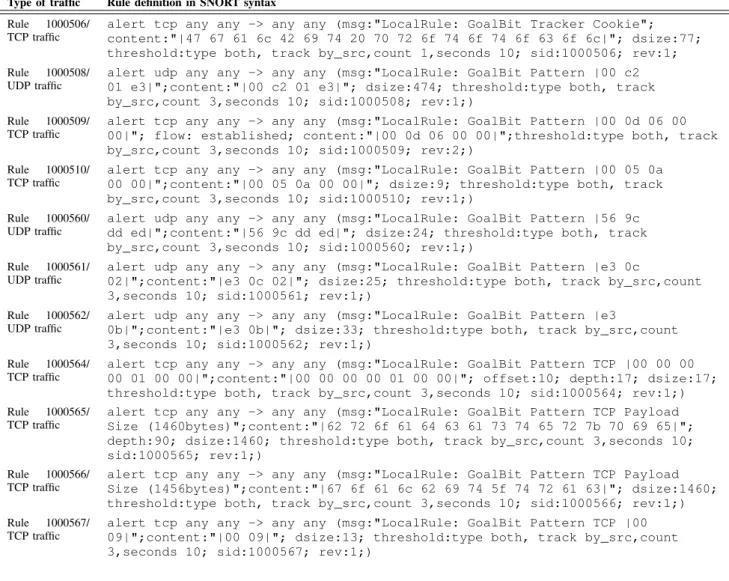
The computers running the application were all logically connected to the same network of the research lab, except for a laptop that was connect to a wireless network with an address space different from the wired one. The computer connected to the wireless network was broadcasting the stream. Because the main broadcasting computer was outside the research network, we were able to capture all communications between the internal and external computers. The set of SNORT rules for GoalBit was created after an exhaustive analysis of the captured traffic in a controlled network environment. We included the set of rules in Table II.
The main idea behind the proposed method relies on the finding of GoalBit signatures (repetitive string series) in the data field of IP packets, in some critical points of the link phase (e.g. establishing phase and further non-encrypted com-munication during data transfer phase), when encryption is not used, which allows the identification of the sessions associated with the GoalBit application. Then all traffic associated with that flows is identified as being generated by GoalBit, albeit we are only able to detect the parts of which that are not encrypted. Those signatures, to be identified in IP packets carrying data from GoalBit application, are expressed in terms
TABLE II
SET OFSNORTRULES FOR DETECTION OFGOALBITIPPACKETS. Rule number &
Type of traffic Rule definition in SNORT syntax Rule 1000506/
TCP traffic alert tcp any any -> any any (msg:"LocalRule: GoalBit Tracker Cookie";content:"|47 67 61 6c 42 69 74 20 70 72 6f 74 6f 74 6f 63 6f 6c|"; dsize:77; threshold:type both, track by_src,count 1,seconds 10; sid:1000506; rev:1;
Rule 1000508/
UDP traffic alert udp any any -> any any (msg:"LocalRule: GoalBit Pattern |00 c201 e3|";content:"|00 c2 01 e3|"; dsize:474; threshold:type both, track by_src,count 3,seconds 10; sid:1000508; rev:1;)
Rule 1000509/
TCP traffic alert tcp any any -> any any (msg:"LocalRule: GoalBit Pattern |00 0d 06 0000|"; flow: established; content:"|00 0d 06 00 00|";threshold:type both, track by_src,count 3,seconds 10; sid:1000509; rev:2;)
Rule 1000510/
TCP traffic alert tcp any any -> any any (msg:"LocalRule: GoalBit Pattern |00 05 0a00 00|";content:"|00 05 0a 00 00|"; dsize:9; threshold:type both, track by_src,count 3,seconds 10; sid:1000510; rev:1;)
Rule 1000560/
UDP traffic alert udp any any -> any any (msg:"LocalRule: GoalBit Pattern |56 9cdd ed|";content:"|56 9c dd ed|"; dsize:24; threshold:type both, track by_src,count 3,seconds 10; sid:1000560; rev:1;)
Rule 1000561/
UDP traffic alert udp any any -> any any (msg:"LocalRule: GoalBit Pattern |e3 0c02|";content:"|e3 0c 02|"; dsize:25; threshold:type both, track by_src,count 3,seconds 10; sid:1000561; rev:1;)
Rule 1000562/
UDP traffic alert udp any any -> any any (msg:"LocalRule: GoalBit Pattern |e30b|";content:"|e3 0b|"; dsize:33; threshold:type both, track by_src,count 3,seconds 10; sid:1000562; rev:1;)
Rule 1000564/
TCP traffic alert tcp any any -> any any (msg:"LocalRule: GoalBit Pattern TCP |00 00 0000 01 00 00|";content:"|00 00 00 00 01 00 00|"; offset:10; depth:17; dsize:17; threshold:type both, track by_src,count 3,seconds 10; sid:1000564; rev:1;)
Rule 1000565/
TCP traffic alert tcp any any -> any any (msg:"LocalRule: GoalBit Pattern TCP PayloadSize (1460bytes)";content:"|62 72 6f 61 64 63 61 73 74 65 72 7b 70 69 65|"; depth:90; dsize:1460; threshold:type both, track by_src,count 3,seconds 10; sid:1000565; rev:1;)
Rule 1000566/
TCP traffic alert tcp any any -> any any (msg:"LocalRule: GoalBit Pattern TCP PayloadSize (1456bytes)";content:"|67 6f 61 6c 62 69 74 5f 74 72 61 63|"; dsize:1460; threshold:type both, track by_src,count 3,seconds 10; sid:1000566; rev:1;)
Rule 1000567/
TCP traffic alert tcp any any -> any any (msg:"LocalRule: GoalBit Pattern TCP |0009|";content:"|00 09|"; dsize:13; threshold:type both, track by_src,count 3,seconds 10; sid:1000567; rev:1;)
of Snort rules, being then Snort used to detect such signatures. IV. RESULTS ANDDISCUSSION
The results discussed in this section represent the work performed for the traffic traces captured during three different days as shown in Table III. Based on the signatures discovered using human observation, it was possible to identify packets carrying GoalBit encrypted traffic and, from there, classify the flows generated by the application. As expected (we are dealing with encrypted traffic), the true positive rate for the classification of the traffic at the packet level was below 25%. Nonetheless, a small number of packets was sufficient to iden-tify most of the flows generated by the GoalBit application. In order to reduce the disk space usage (another computational burdens), the rule set was created using a threshold count of 3 at each 10 seconds, i.e., at each 10 seconds, SNORT only emits a maximum number of 3 alerts.
The TCP rules were created based on periods in which encryption was not being used, like the start of the
transmis-sion and also some parts in the middle of the transmistransmis-sion. Rule 1000509 was observed on GoalBit traffic but when tested against the traces we captured also matched non-GoalBit traffic, accounting this way for the false positive rate. Rule 1000506was being triggered both when encryption was used but also when it was not, the main issue in using this rule is that it only was triggered when we have the first bytes of the TCP session, but it is still quite useful to detect GoalBit traffic. Two rules were created after observing packets with large payload sizes, they are rule 1000565 with 1460 bytes and rule 1000566 with 1456 bytes respectively, the packets with this payload signatures can be found scattered all over the GoalBit traffic, however there are few packets triggered by these two rules, meaning that these packets were not using encryption.
The UDP rules were created also by observing GoalBit traffic, but in this case the signatures observed were from the Kademlia protocol used by GoalBit in two of the traces, for
TABLE III
CHARACTERISTICS OF CAPTURED TRAFFIC
Date Start time End Time Volume(GB) NumberPackets of 17-01-2011 17h46 19h31 3.4 6570257 21-01-2011 18h12 21h04 5.9 9634160 04-03-2011 12h17 19h31 29.7 58995815
Fig. 2. Number of TCP packets in the collected traces vs. the packet size.
this reason all applications that make use of this protocol are also triggered as GoalBit traffic. The UDP rules do not appear in the charts, because they were triggering all applications that use Kademlia protocol. Nonetheless the UDP packets were carrying information not relative to the content being distributed, but the information carried in the UDP packets is useful for peers communicating among themselves and also for making them known in the network.
Due to the low true positive rate a flow classification approach was used. In the flow classification we could identify multiple packets using the rule set and because the flow actually belonged to GoalBit we classified all the packets on that flow as GoalBit. Using the flow approach we managed to increased the true positive rate by 77%, making a total of 96% true positive rate.
As we were running the rule set, some false positives were raised, due to a signature that identifies GoalBit as well as other traffic, accounting for a total of 1.3%. We have a small percentage of false negatives 2.7% due to multiple flows only carrying ACK,SYN and PUSH flag packets. In figure 2, we can see that in GoalBit the packet sizes do not vary that much since we only count a significant number of packets with size 40 to 79 bytes and from 1280 to 1514 bytes.
To obtain a comparative perspective of the performance of the SNORT system with our rule set, we ran it against other DPI software like OpenDPI, l7-filter and l7-netpdlclassifier. We can see in figure 3 that the applications tested failed to classify GoalBit, the detection rate referred in figure 3 is the total accuracy percentage of the set of rules created without false positive or false negatives.
We conducted several experiments by dividing the trace files into ten pcap files. The results showed a great amount
Fig. 3. Comparison of the detection rate of SNORT with the rules proposed herein, OpenDPI, l7-filter and l7-netpdlclassifier for the captured traces.
Fig. 4. Number of SNORT rules triggered during 10 different experiments.
of triggered TCP rules from experiment four to the last one, as shown in figure 4.
As in our testbed the true positive rate was a little low as said before, we started by classifying the traffic using a flow approach which will be explained below. We grabbed the ten experiment files and we filtered out the IPs from the machines that were just running GoalBit, then protocols like ARP, NBNS, ICMP, HTTP, MSN and ICMPv6 were also removed because they were of no use to create the set of rules. From there, we then filtered a random TCP stream using the Wireshark ”Follow TCP stream” feature that only shows the chosen TCP stream. After the previous step we had a trace file containing only the chosen TCP stream, we ran SNORT to see if it triggered any rules, and as hoped it triggered several rules has shown in figure 5.
V. CONCLUSION
P2P applications became very popular, not only for content sharing and distribution but also for media streaming. In the last few years an attempt to obscure or even encrypt the traffic generated by those P2P applications has been made in order to increase privacy or to avoid the identification of traffic generated by such applications to escape traffic shaping or blocking. In this paper, we investigated the detection of encrypted traffic generated by GoalBit, one of the most popular
Fig. 5. Number of TCP SNORT rules triggered for two GoalBit TCP flows extracted from the traffic experiments.
P2P media streaming applications. We proposed a method based on deep packet inspection designed to operate on-line with the aim of detecting encrypted traffic generated by GoalBit. The proposed method looks for GoalBit signatures in packets, which are coded as SNORT rules, this system being used to detect encrypted GoalBit traffic. The proposed method is evaluated experimentally through a test-bed created for that purpose, being shown through experiments that the accuracy of the proposed method is about 96%. Results also show that the signatures devised along the research work are sufficient to distintingly identify a few packets generated by GoalBit, which are enought to point out most of the flows of traffic generated by this application. The design of several other signatures for similar P2P applications is part of our future research directions.
ACKNOWLEDGMENT
This work was partially supported by the Portuguese Fundac¸˜ao para a Ciˆencia e a Tecnologia through the project TRAMANET: Traffic and Trust Management in Peer-to-Peer Networks, with contracts PTDC/EIA/73072/2006 and FCOMP-01-0124-FEDER-007253.
REFERENCES
[1] N. Leavitt, “Network-Usage Changes Push Internet Traffic to the Edge,” Computer, vol. 43, no. 10, pp. 13 –15, 2010.
[2] E. Leonardi, M. Mellia, A. Horvath, L. Muscariello, S. Niccolini, and D. Rossi, “Building a cooperative P2P-TV application over a wise network: the approach of the European FP-7 strep NAPA-WINE,” IEEE Communications Magazine, vol. 46, no. 4, pp. 20 –22, 2008. [3] Joao V. Gomes, Pedro R. M. In´acio, Manuela Pereira, M´ario M. Freire,
and Paulo P. Monteiro, “Detection and Classification of Peer-to-Peer Traffic: A Survey,” (Accessed April 10, 2011). [Online]. Available: http://floyd.di.ubi.pt/nmcg/pdf/2011-P2PSurvey.pdf
[4] Z. Guo and Z. Qiu, “Identification peer-to-peer traffic for high speed networks using packet sampling and application signatures,” in Proceed-ings of 9th International Conference on Signal Processing, 2008 (ICSP 2008), 2008, pp. 2013 –2019.
[5] S. Jordan, “Some Traffic Management Practices Are Unreasonable,” in Proceedings of 18th Internatonal Conference on Computer Communi-cations and Networks, 2009 (ICCCN 2009), 2009, pp. 1–6.
[6] G. Aceto, A. Dainotti, W. de Donato, and A. Pescape, “PortLoad: Taking the Best of Two Worlds in Traffic Classification,” in Proceedings of INFOCOM IEEE Conference on Computer Communications Workshops, 2010, pp. 1–5.
[7] European Advanced Networking Test Center, “P2P Taste Test,” January 2009. [Online]. Available: http://www.internetevolution.com/document. asp?doc id=178633(accessedApril10,2011)
[8] M. Crotti, F. Gringoli, P. Pelosato, and L. Salgarelli, “A statistical approach to IP-level classification of network traffic,” in Proceedings of IEEE International Conference on Communications, 2006 (ICC’06), vol. 1, 2006, pp. 170–176.
[9] M. Iliofotou, H. chul Kim, M. Faloutsos, M. Mitzenmacher, P. Pappu, and G. Varghese, “Graph-Based P2P Traffic Classification at the Internet Backbone,” in Proceedings of IEEE INFOCOM Workshops, 2009, pp. 1 –6.
[10] J. Gomes, P. Inacio, M. Freire, M. Pereira, and P. Monteiro, “Analysis of Peer-to-Peer Traffic Using a Behavioural Method Based on Entropy,” in Proceedings of IEEE International Performance, Computing and Communications Conference, 2008 (IPCCC 2008), 2008, pp. 201–208. [11] F. Palmieri and U. Fiore, “A nonlinear, recurrence-based approach to traffic classification,” Comput. Netw., vol. 53, pp. 761–773, April 2009. [Online]. Available: http://portal.acm.org/citation.cfm?id= 1517860.1518207
[12] S. Zander, T. Nguyen, G.Armitage, “Automated traffic classification and application identification using machine learning,” in Proceedings of 30th IEEE Conference on Local Computer Networks, 2005, pp. 250– 257.
[13] Erman J, Arlitt M, Mahanti A., “Traffic classification using clustering algorithms,” in Proceedings of SIGCOMM06 Workshops, Pisa, Italy, 2006, pp. 281–286.
[14] A. Este, F. Gringoli, L. Salgarelli, “Support Vector Machines for TCP traffic classification,” Computer Networks, vol. 53, pp. 2476–2490, 2009. [15] Auld T, Moore AW, Gull SF., “Bayesian neural networks for Internet traffic classification,” IEEE Transactions on Neural Networks, vol. 18, no. 1, pp. 223–239, 2007.
[16] Moore AW, Zuev D., “Internet traffic classification using Bayesian analysis techniques,” in Proceedings of ACM Sigmetrics, 2005, pp. 50– 60.
[17] J. Erman, A. Mahanti, M. Arlitt, I. Cohen, C. Williamson, “Of-fline/realtime traffic classification using semisupervised learning,” Per-formance Evaluation, vol. 64, pp. 1194–1213, 2007.
[18] “GoalBit Homepage.” [Online]. Available: http://goalbit.sourceforge. net/(accessedApril10,2011)
[19] N. Cascarano, F. Risso, A. Este, F. Gringoli, A. Finamore, and M. Mellia, “Comparing P2PTV traffic classifiers,” in Proceedings of the IEEE International Conference on Communications (ICC 2010). Cape Town, South Africa: IEEE, May 2010, p. 6 pages.
[20] A. Este, F. Gringoli, and L. Salgarelli, “Support vector machines for TCP traffic classification,” Elsevier Computer Networks, vol. 53, no. 14, pp. 2476–2490, 2009.
[21] A. Finamore, M. Mellia, M. Meo, and D. Rossi, “KISS: Stochastic packet inspection,” in Proceedings of the First International Workshop on Traffic Monitoring and Analysis (TMA ’09), vol. 5537. Aachen, Germany: Springer-Verlag, Berlin, Heidelberg, May 2009, pp. 117–125. [22] K. Xu, M. Zhang, M. Ye, D. M. Chiu, and J. Wu, “Identify P2P traffic by inspecting data transfer behavior,” Computer Communications, vol. 33, no. 10, pp. 1141 – 1150, 2010. [Online]. Available: http://www.sciencedirect.com/science/article/ B6TYP-4Y65SDF-1/2/664c2d6ccc40a5869afe5238b0c4493e
[23] P. Bermolen, M. Mellia, M. Meo, D. Rossi, and S. Valenti, “Abacus: Ac-curate behavioral classification of P2P-TV traffic,” Computer Networks, vol. 55, no. 6, pp. 1394 – 1411, 2011.
[24] A. Finamore, M. Meo, D. Rossi, and S. Valenti, “Kiss to Abacus: A Comparison of P2P-TV Traffic Classifiers,” in Proceedings of the Second International Workshop on Traffic Monitoring and Analysis (TMA ’10). Berlin Heidelberg: Springer-Verlag, 2010, pp. 115–126.
[25] “Tcpdump Homepage.” [Online]. Available: http://www.tcpdump. org/(accessedApril10,2011)
[26] “OpenDPI Homepage.” [Online]. Available: http://www.opendpi. org/(accessedApril10,2011)
[27] “L7-Netpdl Classifier Homepage.” [Online]. Available: http://netgroup. polito.it/research-projects/l7-traffic-classification(accessedApril10, 2011)
[28] “L7-filter Homepage.” [Online]. Available: http://l7-filter.sourceforge. net(accessedApril10,2011)
[29] “NetBee Library Homepage.” [Online]. Available: http://www.nbee. org(accessedApril10,2011)
Chapter 3
Identi cation of Encrypted Traf c Generated by
Peer-to-Peer Live Streaming Applications Using
Deep Packet Inspection
André F. Esteves, Pedro R. M. Inácio, Manuela Pereira, and Mário M. Freire
Noname manuscript No. (will be inserted by the editor)
Identification of Encrypted Traffic Generated by Peer-to-Peer
Live Streaming Applications Using Deep Packet Inspection
Andre F. Esteves · Pedro R. M. Inacio · Manuela Pereira · Mario M. Freire
Received: October 24, 2011 / Accepted: date
Abstract The popularity and number of applications using the peer-to-peer (P2P) networking paradigm has substantially grown over the last decade. These appli-cations are not only used for content sharing, but also for media streaming, and they commonly encrypt the communication contents or employ protocol obfusca-tion techniques. In this article, we propose a method for identification of encrypted traffic flows generated by three of the most popular live streaming applica-tions: TVUPlayer, GoalBit and Livestation. Our ap-proach consists on devising a set of Snort rules that can be used to detect key network packets generated by these applications resorting to Deep Packet Inspec-tion (DPI), which can then be used to identify the re-spective encrypted traffic flow. The proposed method is evaluated experimentally on a test-bed created for that purpose, being shown that its accuracy is about 85% for TVUPlayer, 97% for GoalBit and 100% for Livestation. Keywords Peer-to-peer media streaming · Live streaming· Peer-to-peer networks · Traffic obfuscation · Traffic classification· Deep packet inspection
An earlier version of this paper has been presented at 10th IEEE International Symposium on Network Computing and Applications (IEEE NCA 2011), Cambridge, MA, USA Au-gust, 25 - 27, 2011 [21].
This work was partially supported by the Portuguese Funda¸c˜ao para a Ciˆencia e a Tecnologia through the project TRAMANET: Traffic and Trust Management in Peer-to-Peer Networks, with contracts PTDC/EIA/73072/2006 and FCOMP-01-0124-FEDER-007253.
Andre F. Esteves, Pedro R. M. Inacio, Manuela Pereira, Mario M. Freire
Instituto de Telecomunicaes, Department of Computer Sci-ence, University of Beira Interior, 6201-001 Covilh, Portugal Tel.: +351-2755-319891
Fax: +351-2755-319899
E-mail: [email protected], (inacio, mpereira, mario)@di.ubi.pt
1 Introduction
It has been recently predicted that Internet video traf-fic will increase signitraf-ficantly over the next years, being foreseen a sevenfold increase between 2009 and 2014 [37]. Besides the success of some web-based video streaming services, such as YouTube [65] and Tudou [58], and by the increasing interest in IP television (IPTV), peer-to-peer media streaming services are also emerging as a new paradigm for media streaming. In fact, media streaming over the Internet may be implemented either through IP multicast functionalities or through peer-to-peer (P2P) systems. Since the former approach is only feasible on network infrastructures managed by a sin-gle network operator due to limitations of IP multicast facilities, P2P-based approaches have been successfully investigated to overcome these limitations, having the potential to provide a scalable worldwide infrastruc-ture [39]. Even services such as YouTube and Tudou are reported to use or are preparing to use P2P ap-proaches, as mentioned in [68], in order to accelerate their downloading rates and to reduce the transmission cost.
The popularity and diversity of applications using the peer-to-peer (P2P) networking paradigm has sub-stantially grown over the last decade. By exploring the resiliency and worldwide adoption of this technology, these applications are not only used for content sharing and distribution, but also for media streaming. To pro-tect the privacy of the users (e.g., in Voice over Internet Protocol (VoIP) calls), bypass filtering/blocking mech-anisms or overcome network limitations (e.g., firewall policies demanding for a session to be initiated from the inside of the network), it is common for these applica-tions to employ evasion techniques, provide encryption for the contents and include the option to apply
![Figure 1.3: Percentage of traf c usage between 2009 and 2010 in North America. Adapted from [17].](https://thumb-eu.123doks.com/thumbv2/123dok_br/18174139.873871/16.892.160.754.257.705/figure-percentage-traf-c-usage-north-america-adapted.webp)

![Figure 1.5: Percentage of traf c usage between 2009 and 2010 in Europe. Adapted from [17].](https://thumb-eu.123doks.com/thumbv2/123dok_br/18174139.873871/18.892.164.751.161.600/figure-percentage-traf-c-usage-europe-adapted.webp)