Introduction
Citrus tristeza virus (family: Closteroviridae, genus: closterovirus, CTV) is one of the most im-portant citrus pathogens worldwide. The virus is phloem-limited and the virions are thread-like fil-amentous particles, about 2000⫻11 nm in size (Bar-Joseph et al., 1989). The CTV genome is a single stranded, positive-sense RNA molecule of 19226– 19296 nucleotides organized in 12 open reading frames encoding at least 19 proteins (Pappu et al., 1994; Karasev et al., 1995). The virus is encapsi-dated by at least two proteins, a major capsid
pro-Typing of Egyptian Citrus tristeza virus (CTV) isolates based
on the capsid protein gene
HALA A. AMIN,1 FILOMENA FONSECA2, CARLA SANTOS2 and GUSTAVO NOLASCO2
1Virus and Mycoplasma Research Department, Plant Pathology Research Institute, Agriculture Research
Center, Giza, Egypt
2Centro de Desenvolvimento de Ciências e Técnicas de Produção Vegetal, Universidade do Algarve-FERN,
Campus de Gambelas, 8005-139 Faro, Portugal
Summary. The capsid protein gene of three Egyptian CTV isolates from two locations was amplified by
immunocapture RT-PCR and analysed by single stranded conformation polymorphism and sequencing. The CTV isolates studied did not differ significantly in sequence composition and each isolate consisted of very similar haplotypes. Comparison with reference sequences from isolates elsewhere in the world showed that these haplotypes clustered very close to the severe strain T3 from Florida causing quick decline and stem pitting. Analysis of the deduced amino acid sequence showed the epitope characteristic of reactivity with the MCA13 antibody. Sequence comparison with the sequence of an Egyptian isolate (Qaha) available in the Genbank showed a distance of about 8%, suggesting that it had a different origin.
Key words: capsid protein gene, MCA13.
Corresponding author: G. Nolasco Fax: + 351 289 818419
E-mail: [email protected]
tein (CP) with a molecular weight close to 25 kDa which covers most of the particle length, and a di-verged copy of this protein, with a molecular weight around 27 kDa and covering only one extremity (Febres et al., 1996).
CTV isolates differ widely in their biological characteristics, particularly in the symptoms they produce in various citrus species or cultivars (Roist-acher and Moreno, 1991). Syndromes having dif-ferent economic consequences can be produced ranging from barely noticeable symptoms to those causing the quick decline of scions grafted on sour orange rootstock, or stem pitting of the branches with poor fruit quality, regardless of scion or root-stock. A number of efforts have been made to de-velop typing methods for the virus, most of which target the CP or the CP gene (Niblett et al., 2000). The capacity of ELISA to distinguish between CTV
strains is limited to discriminating between mild and quick decline-inducing isolates from Florida based on the use of the MCA13 monoclonal anti-body (Permar et al., 1990).
The virus is naturally transmitted by several aphid species of which Toxoptera citricida (Kirka-ldy) and Aphis gossypii (Glover) are the most im-portant (Rocha-Pena et al., 1995). T. citricida though the most efficient and important in virus transmission (Yokomi et al., 1994) is not present in the Mediterranean basin.
CTV is not yet a major cause of citrus disease in Egypt and the most efficient aphid vector, T. ci-tricida, has not been reported in this country. How-ever, the majority of Egyptian citrus plantations consist of sweet orange (Citrus sinensis Osbek) grafted on sour orange (C. auratium L.) rootstock, and because CTV and Aphis gossypii occur on both, CTV is a major threat to the Egyptian citrus in-dustry.
One accession of the complete sequence of a CTV Egyptian isolate (Qaha) is available at the Gen-bank (AY340974) but there are no further details regarding its origin. The aim of the present work was to undertake the molecular characterization of some additional Egyptian CTV isolates by CP analysis. One CP gene sequence was deposited at the Genbank with the accession number DQ211658.
Materials and methods Virus isolates
Three Egyptian CTV isolates were collected from citrus orchards at two locations 60 km apart, El-Kanater (K1 and K2) and Anshas (ANO). Iso-lates K1 and K2 were obtained from rough lemon trees (C. jambhiri Lush.) grafted on sour orange rootstock with typical CTV decline symptoms (de-cline, scion overgrowth, honey-combing) and main-tained on Mexican lime (C. aurantifolia [Christm.] Swing.) plants in a greenhouse kept at 28°C. The reactions caused by these two isolates on Mexican lime included chlorotic flecks, vein clearing, leaf cupping and mild stem pitting. Isolate ANO was collected from Washington Navel sweet orange grafted on a sour orange rootstock field tree show-ing typical CTV decline symptoms but this isolate produced no noticeable symptoms (very slight stunting) on Mexican lime. Isolate ANO was
main-tained in ‘Madam Vinous’ sweet orange. In previ-ous assays these isolates had reacted positively with polyclonal antibodies and with the monoclonal antibodies MCA13 and 3CA5 but negatively with the monoclonal antibody 3DF1.
Isolating, cloning and sequencing of the CP gene The CP gene was isolated from the bark of in-fected twigs by the immunocapture reverse tran-scriptional polymerase chain reaction (IC/RT-PCR) (Nolasco et al., 1993). Amplified DNA fragments of the expected size (672 bp) covering the CP gene, the stop codon and one additional base were di-rectly TA cloned into a linearized and thymidylat-ed pTZ57R/T plasmid vector (Fermentas GmbH, St. Leon Rot, Germany). Details concerning the amplification of the coat protein gene, single stranded conformation polymorphism (SSCP) anal-ysis, cloning and sequencing can be found in Lbida et al. (2004).
Results and discussion
IC/RT-PCR was used to amplify the CP gene from Egyptian CTV isolates. The amplified prod-ucts showed a single DNA band of the expected size (672 bp).
SSCP analysis of the IC/RT-PCR products did not reveal differences in haplotype conformations among the three isolates (Fig. 1). The patterns ob-tained had a single conspicuous band suggesting the absence of mixtures of haplotypes. To avoid cloning similar sequences, only the amplified CP gene product of K1 and ANO isolates was ligated into the pTZ57R/T and cloned.
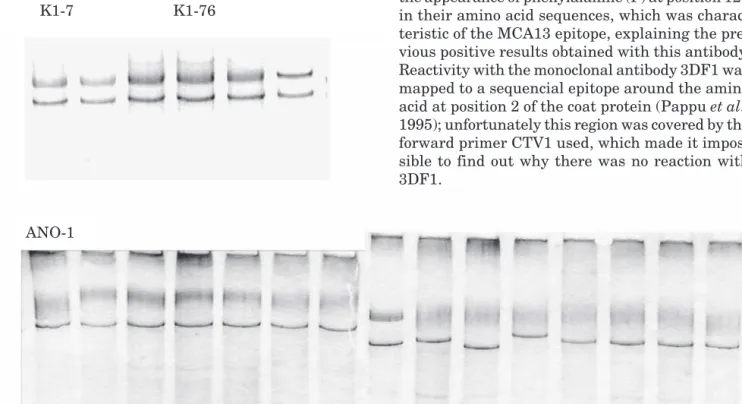
Analysis of colonies was done by PCR with the same pair of primers as that used in the initial amplification. Twenty-one colonies produced a DNA band corresponding to the correct size for an in-sert containing the whole CP gene. SSCP analysis was done on these amplified products prior to se-quencing (Fig. 2). Low heterozygocity (a measure of intra-isolate variability) was evident since al-most all the patterns obtained from the clones that came from the same isolate were similar.
Clones K1-7, K1-76 and ANO-1 were sequenced, revealing 672 base fragments as expected. The two terminal parts, 20 bases long and corresponding to the primers, were excised and a multiple align-ment was done along with sequences previously
Fig. 2. SSCP patterns obtained from PCR products of the cloned CP gene of isolates K1 (top) and ANO (bottom). Labelled lanes indicate the haplotypes that were sequenced.
Fig. 1. SSCP patterns of IC/RT-PCR products of the Egyptian isolates (K1, K2 and ANO) and a positive con-trol isolate (C+).
obtained, which have already been used as refer-ence sequrefer-ences in other studies (Zemzami et al., 2002; Lbida et al., 2004). The following sequences were used in the comparisons: AF184118 (haplo-type 28C), AF184114 (haplo(haplo-type 19-121), AF184113 (haplotype 13C), M76485 (haplotype T36). The CP gene sequences from the Florida isolates T30 and
K1 K2 ANO C+
K1-7 K1-76
T3 were kindly provided by C.L. Niblett. The se-quence of haplotype CB3-104 from the Capão Bon-ito isolate from Brasil was reported in Targon et al. (2000). The CP sequence part from accession No. AY340974 (Qaha, Egypt) was also included in the comparisons.
The three haplotypes sequenced were almost identical: K1-7 and K1-76 differed in only one nu-cleotide and ANO-1 differed from K1-7 and K1-76 in 2 and 3 nucleotides, respectively. This confirmed the low heterozygocity obtained by SSCP analysis and supported the conclusion that only 3 sequenc-es were already enough to display the genomic variability of these isolates.
The amplified open reading frame of the three Egyptian isolates were 669 nucleotides long, and the deduced amino acid sequences, which were identical, were 223 amino acid residues long, which is in agreement with previously published CTV CP (Pappu et al., 1993). The sequences were examined for the MCA13 epitope (Pappu et al., 1993). All three sequences had a thymine (T) at position 371 in their nucleotide sequences and this determined the appearance of phenylalanine (F) at position 124 in their amino acid sequences, which was charac-teristic of the MCA13 epitope, explaining the pre-vious positive results obtained with this antibody. Reactivity with the monoclonal antibody 3DF1 was mapped to a sequencial epitope around the amino acid at position 2 of the coat protein (Pappu et al., 1995); unfortunately this region was covered by the forward primer CTV1 used, which made it impos-sible to find out why there was no reaction with 3DF1.
The matrix of nucleotide distances (single p-dis-tance) between haplotypes was used to construct the dendrogram shown in Figure 3. The three hap-lotypes sequenced appear close to the sequence of the reference haplotype T3, which was obtained from an isolate from Florida causing severe quick decline and stem-pitting in sweet orange (Halbert et al., 2004). This is the reference haplotype for the cluster named Gr 4 after Zemzami et al. (2002). Haplotypes of this group react with the hybridisa-tion probe IV presented by Halbert et al. (2004), as deduced from sequence analysis. As shown in the dendrogram, the CP gene of the Qaha haplotype was far from the Egyptian isolates sequenced in this study (mean distance 0.08). The Qaha haplo-type sequence appeared close (identical) to isolate T36 from Florida causing severe quick decline. Judging from the sequence data, the occurrence of CTV in Egypt appeared to be the result of two in-dependent introductions.
The sequencing results and the presence of the MCA13 epitope in the CP suggest that isolates causing severe quick decline are present in Egypt. This appears to be in contradiction with the some-what attenuated symptoms obtained during the biological indexing of Mexican Lime plants. This
was attributed to the higher than optimal green-house temperature at which the biological index-ing was performed.
Tristeza syndrome epidemics have not yet been reported in this country. Experience in other coun-tries which do not have T. citricida as a vector in-dicates that several years usually pass before nat-ural transmission with other aphid vectors occurs. This delay could be long enough to set up an erad-ication programme. However, if T. citricida, which was recently found in Portugal, should start spreading throughout the Mediterranean region, the CTV eradication effort should be significantly stepped up.
Acknowledgements
This work was in part financially supported by grant POCI/AGR/59090/2004 from Fundação para a Ciência e Tecnologia, Portugal.
Literature cited
Febres V.J., L. Ashoulin, M. Mawassi, A. Frank, M. Bar-Hoseph, K.L. Manjunath, R.F. Lee and C.L. Niblett, 1996. The p27 protein is present at one end of Citrus Fig. 3. Dendrogram showing the clustering pattern of the CP gene sequences of Egyptian and worldwide reference isolates as obtained by UPGMA. Numbers close to the branches represent the bootstrap values. The horizontal bar represents the nucleotide distance scale.
tristeza virus particles. Phytopathology 86, 1331– 1335.
Halbert S.E., H. Genc, B. Cevik, L.G. Brown, I.M. Rosales, K.L. Manjunath, M. Pomerinke, D.A. Davison, R.F. Lee and C.L. Niblett, 2004. Distribution and characteriza-tion of Citrus tristeza virus in south Florida following the establishment of Toxoptera citricida. Plant Disease 88, 935–941.
Karasev A.V., V.P. Boyko, S. Gowda, O.V. Nikolaeva, M.E. Hilf, E.V. Koonin, C.L. Niblett, K. Cline, D.J. Gumpf, R.F. Lee, S.M. Garnsey, D.J. Lewandowski and W.O. Dawson, 1995. Complete sequence of the citrus tristeza virus RNA genome. Virology 208, 511–520.
Lbida B., F. Fonseca, C. Santos, M. Zemzami, A. Bennani and G. Nolasco, 2004. Genomic variability of Citrus tris-teza virus (CTV) isolates introduced into Morocco.
Phy-topathologia Mediterranea 43, 205–210.
Niblett C.L., H. Genc, B. Cevik, S. Halbert, L. Brown, G. Nolasco, B. Bonacalza, K.L. Manjunath, V.J. Febres, H.R. Pappu and R.F. Lee, 2000. Progress on strain dif-ferentiation of Citrus tristeza virus and its application to the epidemiology of citrus tristeza disease. Virus
Re-search 71, 97–106.
Nolasco G., C. de Blas, V. Torres and F. Ponz, 1993. A meth-od combining immunocapture and PCR amplification in a microtiter plate for the routine diagnosis of plant viruses and subviral pathogens. Journal of Virological
Methods 45, 201–218.
Pappu H.R., A.V. Karasev, E.J. Anderson, S.S. Pappu, M.E. Hilf, V.J. Febres, R.M.G. Eckolff, M. McCaffery, V. Boy-oko, S. Gowda, V.V. Dolja, E.V. Koonin, D.J. Gumpf, K.C. Cline, S.M. Garnsey, R.F. Dawson and C.L. Niblett, 1994. Nucleotide sequence organization of eight 3’ open reading frames of the Citrus tristeza closterovirus ge-nome. Virology 199, 35–46
Pappu H.R., S.S. Pappu, K.L. Manjunath, R.F. Lee and C.L. Niblett, 1993. Molecular characterization of a structur-al epitope that is largely conserved among severe
iso-Accepted for publication: December 23, 2005
lates of a plant virus. Proceedings of the National
Acad-emy of Sciences USA 15, 90(8), 3641–3644.
Pappu H.R., S.S. Pappu, T. Kano, M. Koizumi, M. Cambra, P. Moreno, H.-J. Su, , S.M. Garnsey, R.F. Lee and C.L. Niblett, 1995. Mutagenic analysis and location of a high-ly conserved epitope of the Citrus tristeza closterovirus capsid protein. Phytopathology 85, 1311–1315. Perma T.A., S.M. Garnsey, D.J. Gumpf. and R.F. Lee, 1990.
A monoclonal antibody which discriminates strains of citrus tristeza virus. Phytopathology 80, 224–228. Rocha-Pena M.A, R.F. Lee, R. Lastra, C.L. Niblett, F.M.
Ochoa-Corona, S.M. Garnsey and R.K. Yokomi, 1995. Citrus tristeza virus and its aphid vector Toxoptera
ci-tricida. Plant Disease 79, 437–445.
Roistacher C.N. and P. Moreno, 1991. The worldwide threat from destructive isolates of citrus tristeza virus. A re-view. Proceedings of the 11th Conference of the
Interna-tional Organization of Citrus Virologists. IOCV,
River-side, CA, USA, 7–19.
Targon M.L.P.N., M.A. Machado, G.W. Muller, H.D. Colet-ta Filho, K.L. Manjunath and R.F. Lee, 2000. Sequence of coat protein gene of the severe Citrus tristeza virus complex Capão Bonito. Proceedings of the 14th
Confer-ence of the International Organization of Citrus Virolo-gists. IOCV, Riverside, CA, USA, 121–126.
Yokomi R.K., R. Lastra, M.B. Stoetzel, V.D. Damgsteet, R.F. Lee, S.M. Garnsey, M.A. Rocha-Pena and C.L. Niblett, 1994. Establishment of brown citrus aphid Toxoptera
citricida (Kirkaldy) (Homoptera:Aphididae) in Central
America and the Caribbean basin and its transmission of Citrus tristeza virus. Journal of Economical
Ento-mology 87, 1078–1085.
Zemzami M., C.M. Soares, A.M. Bailey, C.L. Niblett. and G. Nolasco, 2002. Molecular characterization and clas-sification of Morrocan isolates of Citrus tristeza clos-terovirus. Proceedings of the 15th Conference of the
In-ternational Organization of Citrus Virologists. IOCV,