Alterations in isozyme patterns
induced by different leveis of iron,
manganese and boron on white lupin
by
AMARILIS DE VARENNES and
ISABEL CARVALHO Instituto Superior de Agronomia Secção Autónoma de Química Agrícola
RESUMO
Tremoceiros brancos, quando cultivados em soluções nutritivas com vários níveis de ferro, manganês ou boro, apresentaram perfis isoenzimáticos dife rentes, de aspartato-aminotransferases, fosfatases ácidas e carboxilesterases.
Concentrações elevadas de ferro ou manganês induziram a síntese de novas isoenzimas com actividade de aspartato-aminotransferase. Estas apresentaram mobilidades electroforéticas menores do que as das enzimas normalmente pre sentes. Altas concentrações de ferro também inibiram a actividade de uma carboxilesterase. Uma fosfatase ácida foi estimulada nas folhas, por altos níveis de manganês.
A falta de ferro na solução nutritiva conduziu à inibição de uma fosfatase ácida e a de manganês à de uma carboxilesterase.
Elevados níveis de boro inibiram a actividade de todas as aspartato- aminotransferases normalmente presentes nas raízes.
SYNOPSIS
White lupin plants grown in nutrient Solutions with different leveis of iron, manganese or boron presented distinct zymographic stains of aspartate aminotransferase, acid phosphatase and carboxylesterase isozymes.
High leveis of iron or manganese induced the synthesis of new aspartate aminotransferase isozymes which had lower electrophoretic mobility than the enzymes usually present. High iron leveis also inhibited the activity of one isocarboxylesterase. An acid phosphatase isozyme was stimulated in leaves grown in the presence of high leveis of manganese.
Lack of iron or manganese in the nutrient Solutions inhibited one acid phosphatase and one carboxylesterase isozymes, respectively.
High boron concentrations caused the inhibition of all root aspartate aminotransferase isozymes.
1. INTRODUCTION
The technique of isozyme electrophoresis has been frequently used to discriminate among species or cultivars of several plants as grape (Walters et al., 1989), maize (Smith, 1988), rice (Glaszmann,
1987), lettuce (Mejia and McDaniel, 1986), raspberry (Cousineau and
Donnely, 1989) and lupin (Cabral, 1990).
As far as white lupin is concerned, since it is mainly autoga- mous and multiplied by seed, several isozyme phenotypes would be expected. In fact, Cabral (1990) characterized nine distinct white lupin cultivars based on aspartate aminotransferase (2.6.1.1.) acid phosphatase (3.1.3.2.) and carboxylesterase (3.1.1.1.) isozyme pat- terns. She calculated a low polymorphism index (Marshall and
Allard, 1970), varying from 0.060 to 0.097, proving the existence of genetic stability in these cultivars.
Stability of isozyme patterns to environmental factors is also essential if these are to be used for taxonomic purposes. Cabral (1990) showed that the expression of the isozymes studied was main- tained, albeit with some quantitative differences, when white lupin plants were subjected to water déficit.
In the present study, we investigated if white lupin isozyme pat- terns of aspartate aminotransferase (AAT), acid phosphatase (AP) and carboxylesterase (CE) were stable when plants were grown in the presence of different leveis of iron, manganese or boron. The re- sults obtained showed that iron or manganese déficit inhibited some isozyme species. Furthermore, high leveis of all micro-nutrients studied (leveis not frequently encountered in normal growing con- ditions) also affected the zymographic stains of these enzymes.
2. MATERIAL AND METHODS
PLANT MATERIAL - White lupin seeds (Lupinus albus L. cv
Es-
toril) were germinated in moist cottonwool, at room temperature in the dark, for four to five days. Seedlings were transplanted to nutri- ent Solutions which contained: macro-nutrients - 6 mM Ca(N03)2, 6 mM KN03l 2.5 mM MgS04 and 1 mM KH2PO±\ micro-nutrients - 30 p,MZnS04 , 1 pMNa2Mo04,0.1 fiM CuS04 , 0.1 p.M CoCl2 and variable amounts of iron, manganese and boron supplied as Fe-EDTA, MnS04 and H3B03, respectively. Normal concen- trations of these micro-nutrients were 75 pM Fe , 100 pM Mn and 100 pM B. Besides these concentrations, 0, 750 and 7500 pM Fe; 0, 1000 and 10000 pM Mn and 1000, 2000 and 4000 pM B were also used. Since continuous growth in the presence of 7500 pM Fe in- hibits the establishement of a normal root system (VARENNES, 1990), in some experiments plants were grown for one week with 75 pM Fe , and then grown for a further week with 7500 pM Fe .
Plants were kept in a growth chamber at
18° Cand
55%hu-
midity, with
14/10h dark/light periods at a light intensity of
500 pmolfoton m~2 s-1
supplied by day light fluorescent tubes.
Samples were collected one, two and three weeks after trans- plant and analysed for enzyme activity.
PR0TEIN EXTRACTI0N - Protein extraction and all posterior handling of samples was carried out at 0oC. Leaves or roots were homogenised in 0.1 M Tris-HCl buffer, pH 7.5, containing 0.25% sodium thioglycollate and 0.25% potassium disulfite. The ho- mogenates were centrifuged for 20 min at 14 000 rpm. The su- pernatants were immediately used or stored frozen at -20°C until the following day.
ISOZYME ELECTROPHORESIS - Protein samples were resolved by polyacrilamide gel electrophoresis according to Davis and Ornstein (1961) using 8% acrylaniide in the resolving gel and 2.5% acrylamide in the stacking gel. Electrophoresis was performed at 200 V whilst. the samples went through the stacking gel and then at 500 V until the tracking dye reached the bottom of the gels.
ENZYMIC STAINING - Enzymatic activities were detected using the staining procedures described by Schwartz et al.( 1963), Scan-
dalios (1969) and Markert and Hunter (1959). Briefly, for A AT ac- tivity, gels were reacted with 2-oxoglutaric acid, aspartic acid and pyridoxil-5’-phosphate. After the reaction had proceeded for 15 min, the gels were developed with Fast Blue BB salt, at 37°C until the bands had the desired intensity.
To detect acid phosphatases, the substrate used was a-naphtyl phosphate and after 15 min its products were detected at 52° C with Fast Garnet GBC.
Carboxylesterases were detected using as substrates a- and /Tnaphtyl acetates. The products were developed with Fast Blue
RR salt, at room temperature.
All the developing reactions were stopped by transfer of the gels to 50% ethanol.
MICRO-NUTRIENT ANALYSIS - Leaves or roots were dried at 105°C and then burned at 500°C. To determine iron and manganese concentrations, the ash was digested in 3 M HCl and the amount of these elements determined with an atomic absorption spectropho- tometer.
To determine boron concentration, the ash was dissolved in 0.1 M HCl and reacted at 55°C with 5% oxalate and 0.04% curcumin in ethanol. It was then dissolved in ethanol and the solution was centrifuged. The absorvance of the supernatant was measured at 540 nm and the results obtained were compared with a Standard curve.
3. RESULTS
IRON, MANGANESE AND BORON LEVELS - The concentration of micro-nutrients in the Solutions used had a direct influence in the elements leveis, in the plants. As can be seen in Table I, iron leveis were higher in the roots than in the corresponding leaves, whilst the opposite was true for boron and manganese.
TABLE I - Micronutrient leveis present in white lupin plants grown for three weeks in nutrient Solutions with variable concentrations of these elements.
Levei of Fe in the nutrient solution (/iM Fe)
0 75 750 7500
Leaves
(mg Fe/g dry weight) Roots
0.12 0.29 0.73 1.6 (mg Fe/g dry weight) 0.21 1.5 4.1 5.1
Levei of Mn in the nutrient solution (pM Mn) 0 100 1000 10 000 Leaves (mg Mn/g dry weight) Roots 0.07 1.5 5.5 7.6 (mg Mn/g dry weight) 0.02 0.14 0.79 5.7
Levei of B in the nutrient solution
(pMB) 100 1000 2000 4000 Leaves (mg B/g dry weight) Roots (mg B/g dry weight) 0.05 0.3 0.6 1.1 0.05 0.1 0.2 0.4
NORMAL ZYMOGRAMS - Leaf and root zymograms from plants grown with normal leveis of all micro-nutrients presented some bands that were always observed and additional bands that some- times were not present, presumably due to different incubation times during the staining proc.edures. Therefore, any variations in these bands, when different leveis of micro-nutrients were tested, were discarded.
Lupin leaves and roots showed two main bands with A AT ac- tivity, with 7?/values of 0.18 and 0.25. An additional band (72/0.13) was observed, specially in the root material, but frequently also in the leaf extracts. Leaves usually presented a darker 72/0.25, whilst the roots showed a stronger 72/ 0.18.
Zymographic stains of AP isozymes from leaves or roots were almost undistinguishable and consisted of four main bands with Rf values of 0.2, 0.42, 0.45 and 0.55. The band with lowest elec- trophoretic mobility (Rf 0.2) was very wide and was probably com- posed of two or more proteins (in fact, sometimes two bands with Rf values of 0.16 and 0.2 were observed). The second and third proteins (Rf 0.42 and 0.45) were often observed as a merged large band. Additional minor bands, like those with Rf values of 0.05 and 0.08, were also frequently detected.
CE zymograms from leaves or roots were easily differentiated. Both consisted of six main bands with Rf values of 0.09, 0.22, 0.38, 0.42, 0.55 and 0.58. However, Rfs 0.55 and 0.58 from roots were always wider and darker than the corresponding leaf bands. On the other hand, leaf bands with Rf values of 0.09 and 0.22 were more intense.
Additional minor bands, like those with Rf values of 0.37 and 0.50 were sometimes observed.
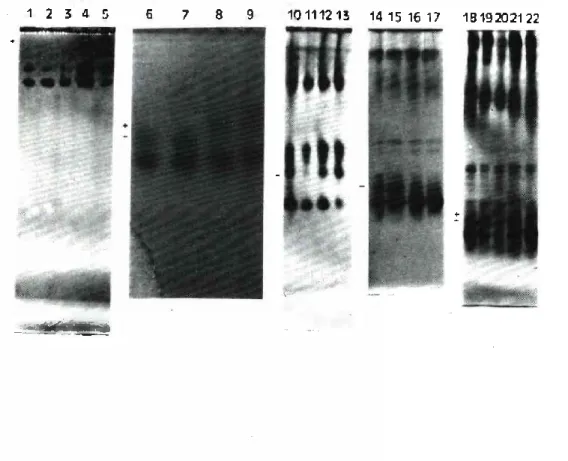
IR0N-RELATED IS0ZYME PATTERNS - High leveis of iron in the nutrient solution induced the appearance of a new leaf band with low electrophoretic mobility and presenting A AT activity. As can be seen in Fig. 1, plants grown with 0, 75 or 750 /xM Fe in the nu trient solution only revealed the three usual proteins (the upper band was very weak and can not be observed in the photographed gel). On the other hand, plants grown with 7500 pM Fe and spe cially those grown for a week with 75 fiM Fe and another week with 7500 //M Fe presented an additional band with a Rf value of 0.08. On one occasion, in one week old plants. instead of this pattern, the protein with a Rf value of 0.18 seemed to have migrated less, remaining in a position corresponding to a Rf value of 0.15 (Fig. 1, lanes 6-9).
FIGURE 1 - Isozyme patterns of white lupin plants grown in nutrient Solutions with diffevent leveis of iron. 1- 9 leaf aspartate aminotransferase isozymes;
10-13 leaf acid phosphatase isozymes; 14-17 root carboxylesterase isozymes; and 18-22 leaf carboxylesterase isozymes.
1, 6, 10, 14 and 18 - plants grown with IbpM Fe 2, 7, 11, 15 and 19 - plants grown with no iron 3, 8, 12, 16 and 20 - plants grown with 750 pM Fe 4, 9, 13, 17 and 21 - plants grown with 7500 pM Fe 5 and 22 - plants grown for a week with 75 pM Fe
The root
AATisozyme pattern was not affected by the different
leveis of iron tested (data not shown).
Leaf acid phosphatases were not affected by high leveis of iron in the nutrient solution. On the other hand, in plants one week or more old, lack of iron in the solution lead to a decrease in the activity of a protein with a P/value of 0.45 (Fig. 1, lanes 10-13).
Root acid phosphatases were not affected by the different leveis of iron tested (data not shown).
A root isocarboxylesterase (Rf 0.55) was affected by high leveis of iron. Its activity sharply decreased in roots grown for one or more weeks with 750 or 7500 /íM Fe (Fig. 1, lanes 14-17). In leaves, its activity was less affected, though sometimes a decrease was also observed (data not shown). Alternatively, in plants grown for a week with 75 gM Fe and another week with 7500 fiM Fe, this pro tein seemed to migrate less, remaining in a position corresponding to a Rf value of 0.53 (Fig. 1, lane 22).
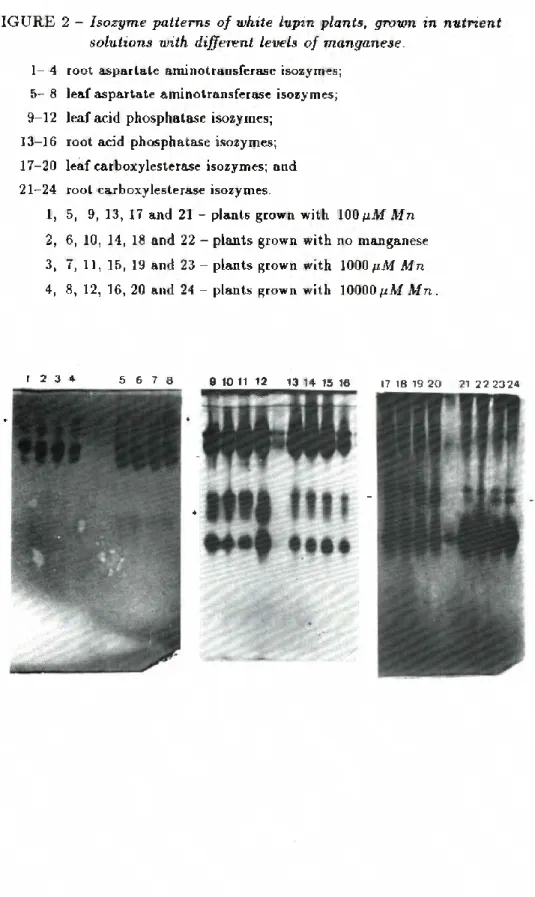
MANGANESE-RELATED ISOZYME PATTERNS - Zymographic assays from one week old plants, grown in the presence of different leveis of manganese lead to identical results. This was not the case with older plants. Leaves or roots from two or three week old plants, grown with 10000nM Mn, presented an additional AAT species with a Rf value of 0.1 (Fig. 2, lanes 1-8). Plants with the same age but grown with no manganese in the nutrient solution showed a marked decrease in the activity of one isocarboxylesterase (Rf 0.42), (Fig. 2, lanes 17-24).
Three week old plants, but not younger plants, grown with 10000nM Mn, showed an inc.reased activity in a leaf AP isozyme with a Rf value of 0.45 (Fig. 2, lanes 9-12).
Root acid phosphatases were not affected by the leveis of man
ganese used (Fig.
2,lanes
13-16).B0R0N-RELATED ISOZYME PATTERNS -
The activities of
CEand
AP
isozymes were not affected by the leveis of boron tested (data
not shown). The same was true for leaf
AATspecies (Fig.
3,lanes
1-4).
On the other hand, root
AATisozymes, in one or more week
old plants grown with
2000or
4000 f.iM B ,were strongly affected.
In the latter, this enzyme activity was not detected at all, whilst in
the former weak bands were still observable (Fig.
3,lanes
5-8).FIGURE 2 - Isozyme patterns of white lupvn plants, grown m nutrient Solutions with different leveis of manganese.
1— 4 root aspartate aminotransferase isozymes; 5— 8 leaf aspartate aminotransferase isozymes; 9-12 leaf acid phosphatase isozymes;
13-16 root acid phosphatase isozymes; 17-20 leaf carboxylesterase isozymes; and 21-24 root carboxylesterase isozymes.
1, 5, 9, 13, 17 and 21 - plants grown with 100 pM Mn 2, 6, 10, 14, 18 and 22 - plants grown with no manganese 3, 7, 11, 15, 19 and 23 - plants grown with 1000 pM Mn 4, 8, 12, 16, 20 and 24 - plants grown with 10000p.M Mn.
FIGURE 3 - Aspartate aminotransferase isozymes from white lupin plants grown with different leveis of boron.
1-4 5-8 1 2 3 4
leaf isozymes and root isozymes.
and 5 - plants grown with and 6 - plants grown with and 7 - plants grown with and 8 - plants grown with
100 pM B 1000 yM B 2000 pM B 4000 pM B.
4. DISCUSSION
The present results show that different leveis of some elements in the nutrient solution induce isozyme changes in white lupin. The only cultivar tested was cv Estoril; therefore, though it is likely that similar changes will occur in other cultivars, the discussion can only be focused on this particular one.
Several lupin cultivars have been recently characterized for “normal” zymograms of the isozymes tested in the present work
(Cabral, 1990). However, some of the results we obtained with non-stressed plants are different from the zymograms previously reported for cv Estoril. Since Cabral(1990) states that the cultivar she used was obtained in a cultivated field, it is possible that it was no longer the pure cultivar. We obtained our seed from Estação Agronómica Nacional, where this cultivar was developed, so we are confident that it truly corresponds to its designation.
No genetic analysis of white lupin has been carried out. The refore, zymographic bands can correspond to true isozymes or be the result of post-translational modifications of these proteins. Thus, the results we obtained with A AT can be interpreted in two ways. Either cv Estoril has a silent locus that becames activated only after stress, as growth in the presence of high leveis of iron or man- ganese, or the new bands represent iron- or manganese- induced alterations in post-translational modifications. The former hypoth- esis would lead to a new isozyme with a characteristic Rf value, which seems not to be the case. However, a rigorous determination of Rf values was not carried out, so it remains possible that the bands observed with high leveis of iron or manganese correspond to the same species. The latter hypothesis is strengthened by the fact that a shift towards a lower electrophoretic mobility of one A AT species (17/0.18) was observed in one week old iron-stressed leaves. Shifts in electrophoretic mobility were reported in flax isoperoxi- dases as a consequence of growth in the presence of high leveis of nitrogen and phosphorus or in high leveis of nitrogen, phospho- rus and potassium. These differences were due to heterogeneity in the carbohydrate moieties of the isozymes (Gaudreault and Tyson,
1986) and could be eliminated by digestion with a-mannosidase
elec-trophoretic shifts of AP species were explained by association of the two isozymes to form a high molecular weight aggregate (Goldstein
et al., 1988).
It should be pointed out that, contrary to those results, in the present case the three normal species are still detected; thus, the new band is not formed at the expense of an usual one.
It is curious to note that Cabral (1990) reported the presence of minor bands with low electrophoretic mobility in several lupin cultivars, including the one she referred as cv Estoril. In that case, a band with a P/value of 0.05 was reported, which is in the mobility range of the bands detected by us in iron- or manganese-stressed plants. The plants Cabral (1990) analysed were very probably sub- jected to, at least, an intense chloride stress, as she used tap water in her experiments.
High leveis of boron had a negative effect in all root A AT isozymes. It should be noted that roots presented a lower levei of boron compared with the corresponding leaves, where no inhibition was observed.
An enzyme degradation during the extraction procedure, due to high leveis of boron in the sample, is therefore ruled out.
An AP isozyme (P/0.45) was sensitive to the leveis of iron or manganese. It was inhibited in the absence of iron and stimulated by high leveis of manganese.
Two isocarboxylesterases proved to be sensitive to the leveis of micro-nutrients in the solution. One species (Rf 0.42) was absent in leaves from plants grown without. manganese and another (Rf 0.55) was absent in roots from plants grown with high leveis of iron.
Enzyme activation or inhibition in response to several types of stress has been described for some isozymes. For instance, an isoperoxidase from maize was inhibited under water stress (Thakur
et al., 1981) and another isozyme from bean was inhibited under iron-deficient conditions (Sijmons et al., 1985). On the other hand, several isoperoxidases from tobacco were stimulated by wounding and Tobacco Mosaic Virus infection (Lagriminiand Rothstein, 1987). Salt stress can lead to an increase in the activity of high molecular weight AP isozymes from spinach (Pan, 1987).
ACKNOWLEDGEMENTS
We would like to thank Eng-. Diamantino Rebelo, from Esta ção Agronómica Nacional, for his generous gift of the white lupin seeds. We also wish to thank Mr. António Mil-Homens for photo- graphy and Mrs. Graça Pereira Roque for her technical assistance.
REFERENCES
Cabral, F.M.M. (1990) — Polimorfismo isoenzimático em Lupinus. Identificação e caracterização de populações (albus e L± luteus L.), Instituto Superior de Agronomia, Lisboa, 141
PP-Cousineau, J.C. and Donnelly, D.J. (1989) — Identification of rasp- berry cultivars in vivo and in vitro using isozyme analysis, Hort. Sei., 24: 490-492.
Davis, B.J. and Ornstein, L. (1961) — Disc electrophoresis, Distilla- tion Products Industries, Rochester, USA.
Gaudreault, P.R. and Tyson, H. (1986) — Evidence for heteroge- neity in the carbohydrate moieties of peroxidase isozymes from two environmentally induced flax genotrophs, Can. J. Bot., 64: 2682-2687.
Gaudreault, P.R. and Tyson, H. (1988) — Elimination of differ- ences in the mobility of flax isoperoxidases on PAGE by digestion with a-mannosidase, Plant Physiol., 86: 288-292.
Glaszmann, J.C. (1987) — Isozymes and classification of Asian rice varieties, Theor. Appl. Genet., 74: 21-30.
Goldstein, A.H., Baertlein, D.A. and McDaniel, R.G. (1988) — Phosphate starvation inducible metabohsm in L. esculentum. II. Characterization of the phosphate starvation inducible-ex- creted acid phosphatase, Plant Physiol., 87: 716-720.
Lagrimini, L.M. and Rothstein, S (1987) — Tissue specificity of tobacco peroxidase isozymes and their induction by wounding and tobacco mosaic virus infection, Plant Physiol., 84: 438-442.
Markert, C. and Hunter, R. (1959) — The distribution of esterases in the mouse tissues, J. Histochem. Cytochem., 7: 42-49.
Marshall, D.R. and Allard, R.W. (1970) — Isozyme polymor- phisms in natural populations of Avena fatua and A. barbata, HerecLity, 25: 373-382.
Mejia, L. and McDANIELS, R.G. (1986) — Electrophoretic characte- rization of lettuce cultivars, Hort. Scz., 21: 278-280.
Pan, S. (1987) — Characterisation of multiple acid phosphatases in salt-stressed spinach leaves, Aust. J. Plant Physiol., 14: 117-124.
Scandalios, J.C. (1969) — Genetic control of multiple molecular fornis of enzymes in plants: a review, Biochem. Genetics, 3: 37-79.
SCHWARTZ, M.K., Nisselbaum, J.S. and Bodansky, O. (1963) — Procedure for staining zones of activity of glutamic oxoloacetic transaminase following electrophoresis with starch gel, Amer. J. Clin. Pathol., 40: 103-106.
Sijmons, P.C., Kolattukudy, P.E. and Bienfait, H.F. (1985) - Iron deíiciency decreases suberization in bean roots through a decrease in suberin-specific peroxidase activity. Plant Physiol., 78: 115-120.
Smith, J.S.C. (1988) — Identification of pedigrees of hybrid maize (Zea mays L.) cultivars bv isozyme electrophoresis and rever- sed-phase high-performance liquid chromatography. Euphytica, 39: 199-205.
Thakur, P.S., SlNGH, G. and Rai, V.K. (1981) — Peroxidase isozy- mes in relation to developing water déficits in t.wo Zea mays L. cultivars, New Phytol., 89: 25-32.
Varennes, A. de (1990) — Effects of iron stress on lupin polypeptide patterns, Garcia de Orta, Sér. Est. Agron. (em publicação).
Walters, T.W., PoslusznY, U. and Kevan, P.G. (1989) — Isozyme analysis of the grape (Vitis). I. A practical solution, Can. J. Bot., 67: 2894-2899.